
Compensation Its not just for pretty pictures Fluorescence
- Slides: 53
Compensation: It’s not just for pretty pictures
Fluorescence Spillover Compensation • Simple in concept… Correct spillover into different parameters • Straightforward in execution… Proper settings based on controls • …But a lifetime to understand? Profound impact on visualization Nonintuitive aspects Subtle interactions that can be hard to diagnose
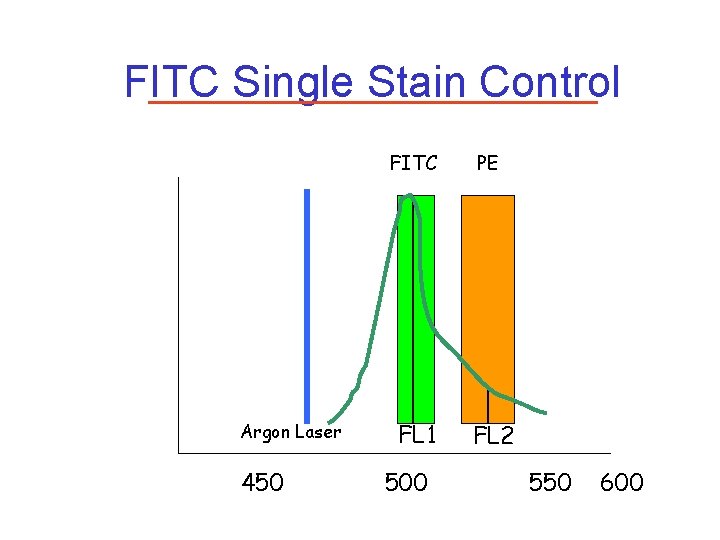
FITC Single Stain Control Argon Laser 450 FITC PE FL 1 FL 2 500 550 600
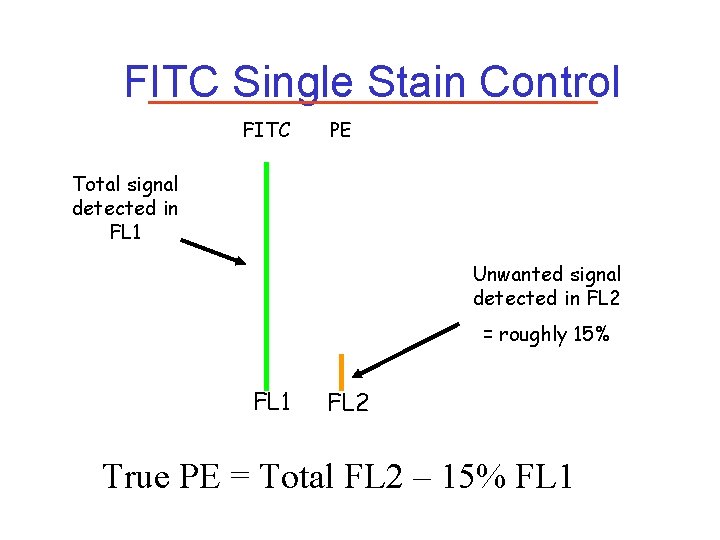
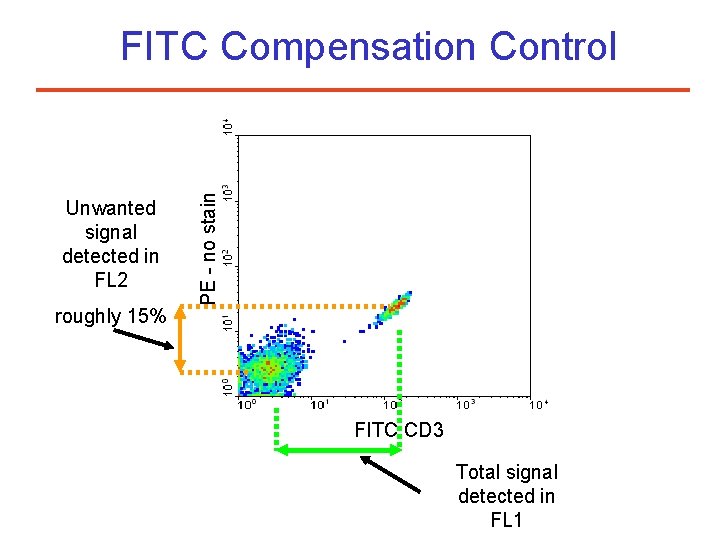
FITC Single Stain Control FITC PE Total signal detected in FL 1 Unwanted signal detected in FL 2 = roughly 15% FL 1 FL 2 True PE = Total FL 2 – 15% FL 1
Unwanted signal detected in FL 2 roughly 15% PE - no stain FITC Compensation Control FITC CD 3 Total signal detected in FL 1
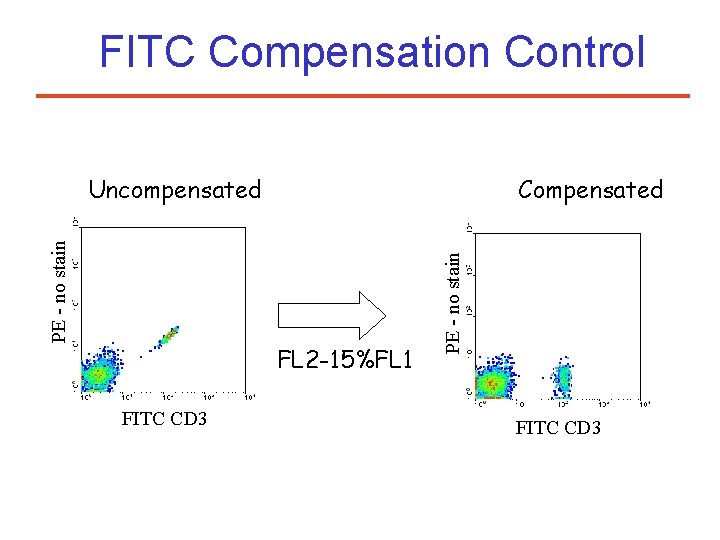
FITC Compensation Control Compensated FL 2 -15%FL 1 FITC CD 3 PE - no stain Uncompensated FITC CD 3
Compensation in 2 colors: Mostly aesthetic Accurate identification and enumeration of subsets is still easy in two color experiments
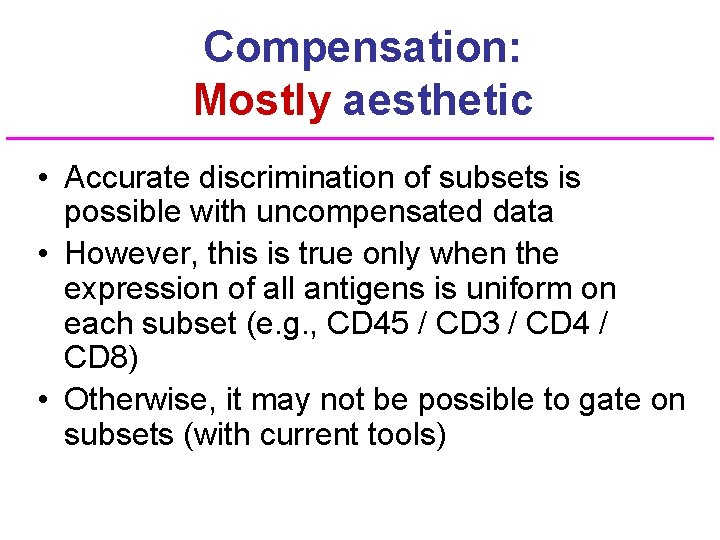
Compensation: Mostly aesthetic • Accurate discrimination of subsets is possible with uncompensated data • However, this is true only when the expression of all antigens is uniform on each subset (e. g. , CD 45 / CD 3 / CD 4 / CD 8) • Otherwise, it may not be possible to gate on subsets (with current tools)
Compensation for more colors: It’s not just pretty pictures • Spillover from unviewed measurement channel can alter event positions– without obvious visual evidence (no diagnostic diagonals!) • Thus, gate positions may depend on unviewed measurement channels and be different for various tubes in a panel • Separation of populations may require multi -dimensional surfaces (rather than lines of a polygon).
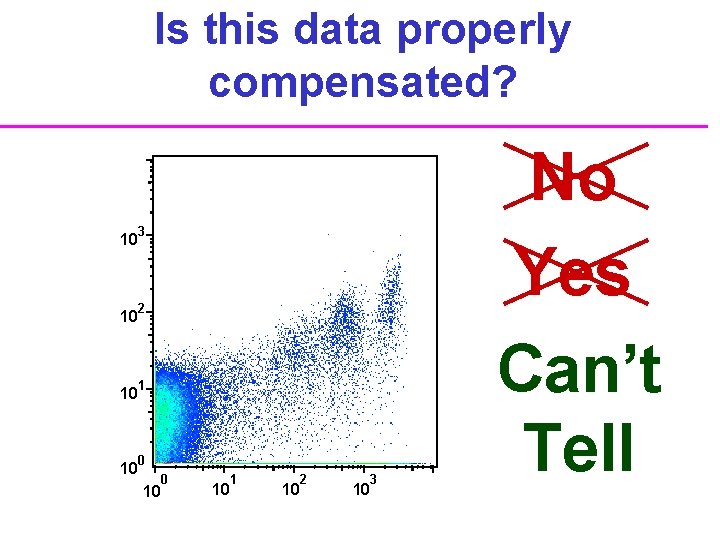
Is this data properly compensated? 10 3 10 2 10 1 10 0 0 10 1 10 2 10 3 10 No Yes Can’t Tell
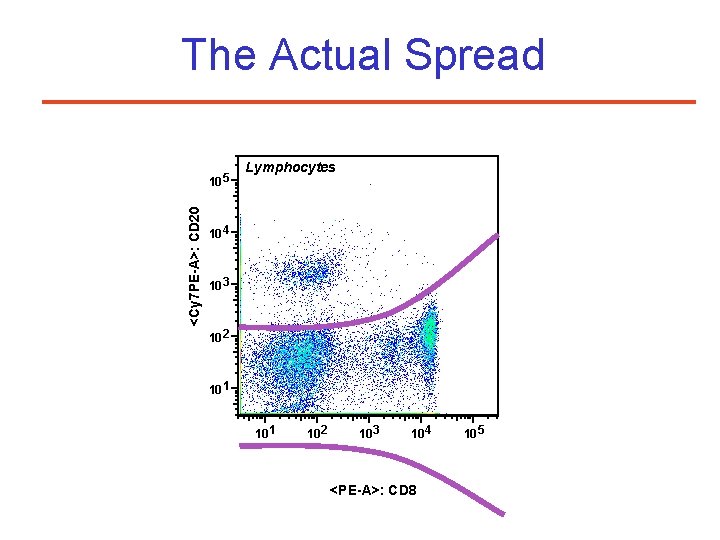
Impact of Compensation on Visualization and Analysis of Data • “Visualization artifacts” lead to: – Manual overcompensation – Incorrect gate settings • Specific staining controls become essential What causes this apparent visualization artifact (data spreading)?
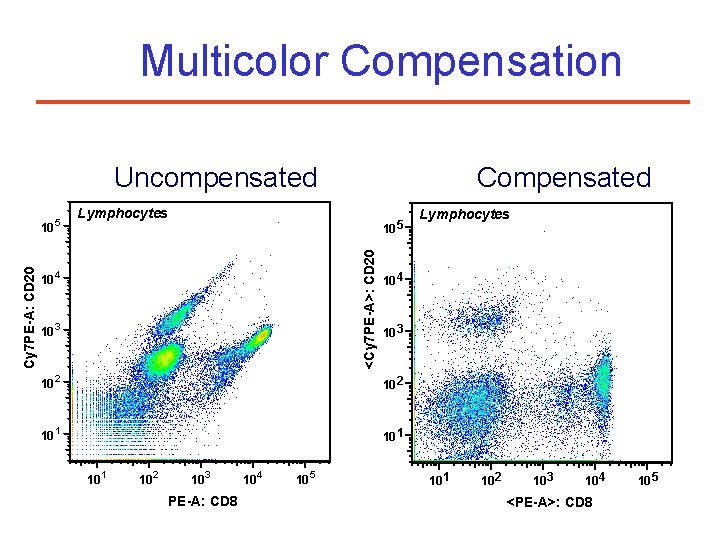
Spreading due to Measurement Error Why do these populations look funny?
Multicolor Compensation Uncompensated Lymphocytes 10 5 <Cy 7 PE-A>: CD 20 Cy 7 PE-A: CD 20 10 5 Compensated 10 4 10 3 10 2 10 1 10 2 10 3 PE-A: CD 8 10 4 10 5 Lymphocytes 10 1 10 2 10 3 10 4 <PE-A>: CD 8 10 5
The Actual Spread <Cy 7 PE-A>: CD 20 10 5 Lymphocytes 10 4 10 3 10 2 10 1 10 2 10 3 10 4 <PE-A>: CD 8 10 5
Imperfect Measurement Leads to Apparent Spread in Compensation Why is there a 400 -unit spread? Photon counting statistics.
Log Transformation of Data Display Leads to Manual Overcompensation
Overcompensation Cannot Correct Error-induced Spread
Compensation Does NOT Introduce or Increase Error: Compensation Only Reveals It! • All measurements have errors; often the error is proportional to the square-root of the measurement. • The measurement error is present before compensation. Compensation does not increase this error, it does not change it, it does not introduce any more error. • Compensation simply makes the error more apparent by shifting it to the low end of the log-scale.
Spread of Compensated Data • Properly compensated data may not appear rectilinear (“rectangular”), because of measurement errors. • This effect on compensated data is unavoidable, and it cannot be “corrected”. • It is important to distinguish between incorrect compensation and the effects of measurement errors.
How can we identify undercompensated data? Diagonals in the data indicate poorly compensated data: but ONLY AT 45˚! Other slopes indicate nonlinear correlations that have nothing to do with compensation. Visual estimation is very difficult. Proportional to intensity (spillover) Proportional to square root of intensity
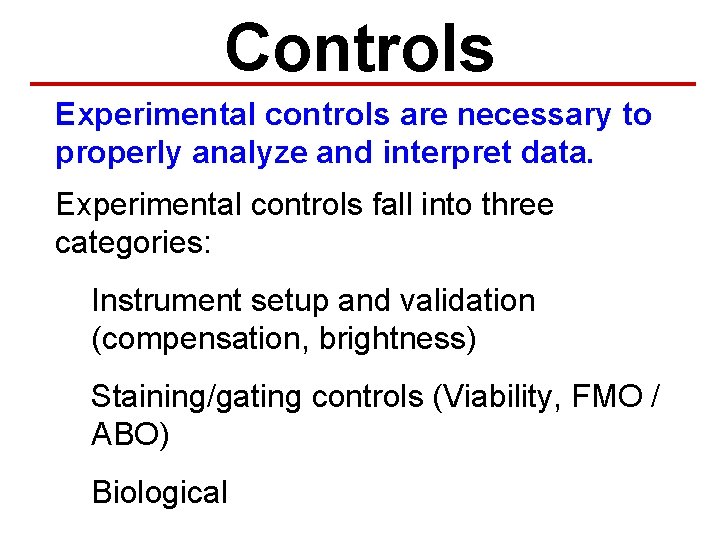
Controls Experimental controls are necessary to properly analyze and interpret data. Experimental controls fall into three categories: Instrument setup and validation (compensation, brightness) Staining/gating controls (Viability, FMO / ABO) Biological
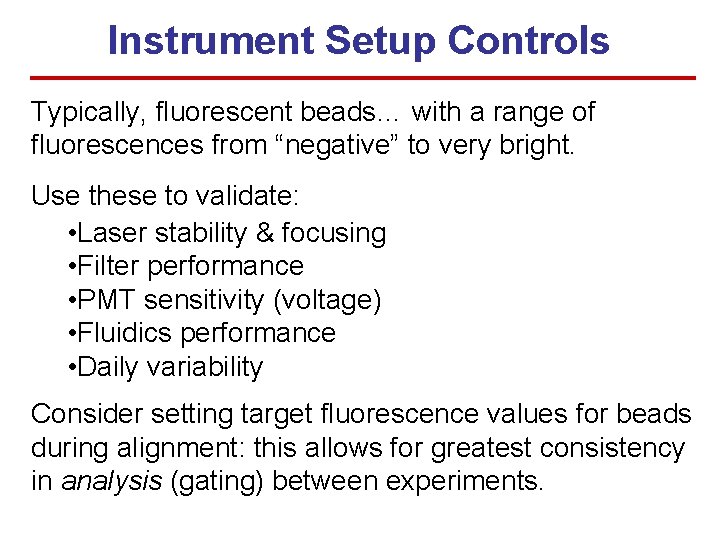
Instrument Setup Controls Typically, fluorescent beads… with a range of fluorescences from “negative” to very bright. Use these to validate: • Laser stability & focusing • Filter performance • PMT sensitivity (voltage) • Fluidics performance • Daily variability Consider setting target fluorescence values for beads during alignment: this allows for greatest consistency in analysis (gating) between experiments.
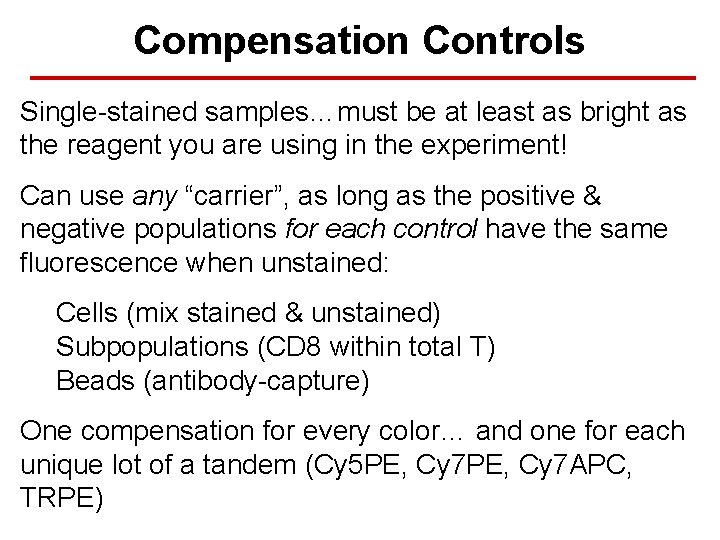
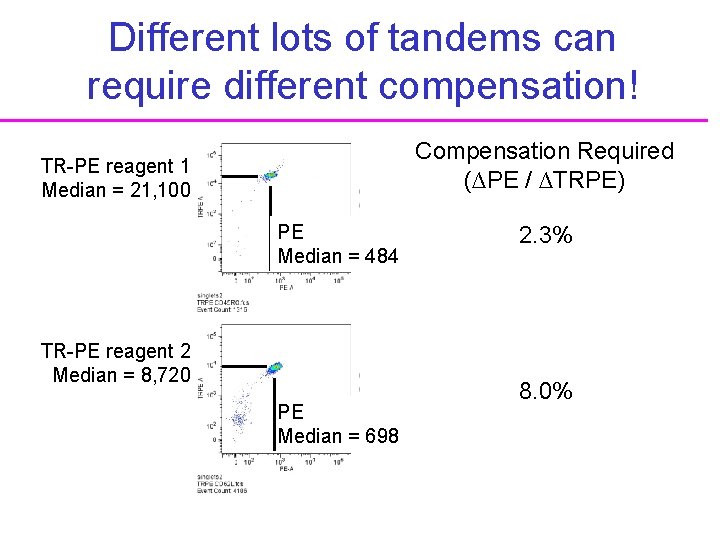
Compensation Controls Single-stained samples…must be at least as bright as the reagent you are using in the experiment! Can use any “carrier”, as long as the positive & negative populations for each control have the same fluorescence when unstained: Cells (mix stained & unstained) Subpopulations (CD 8 within total T) Beads (antibody-capture) One compensation for every color… and one for each unique lot of a tandem (Cy 5 PE, Cy 7 APC, TRPE)
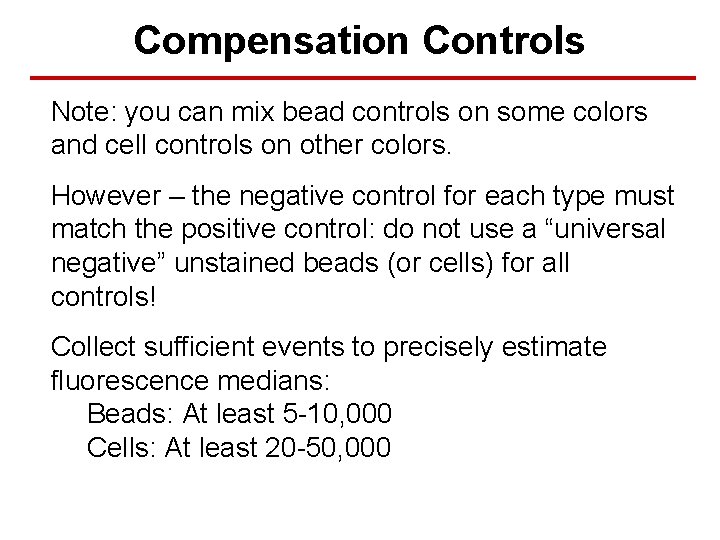
Compensation Controls Note: you can mix bead controls on some colors and cell controls on other colors. However – the negative control for each type must match the positive control: do not use a “universal negative” unstained beads (or cells) for all controls! Collect sufficient events to precisely estimate fluorescence medians: Beads: At least 5 -10, 000 Cells: At least 20 -50, 000
Using Beads to Compensate • Exact reagent used in experiment • 100% positive (not ever rare) • Small CV, very bright (precise fluorescence measurement) • Sonicate weekly to reduce aggregates • Some reagents may not work (Igl, non mouse, too dim, EMA/PI) – for these, use cell-based compensations
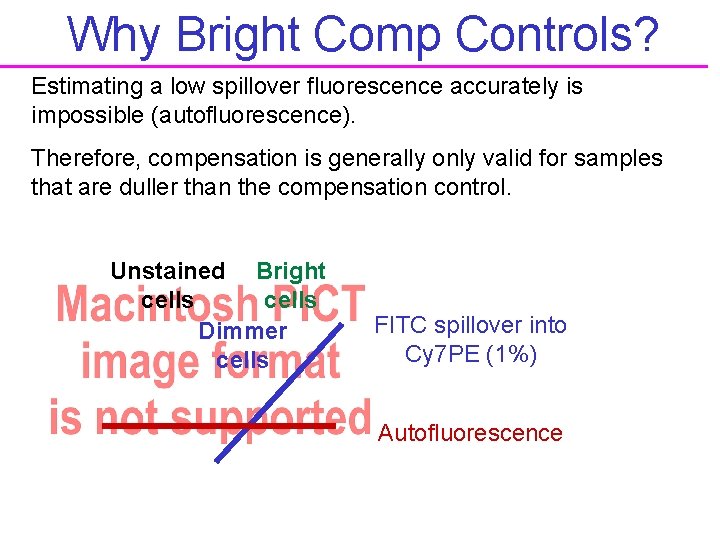
Why Bright Comp Controls? Estimating a low spillover fluorescence accurately is impossible (autofluorescence). Therefore, compensation is generally only valid for samples that are duller than the compensation control. Unstained Bright cells Dimmer cells FITC spillover into Cy 7 PE (1%) Autofluorescence
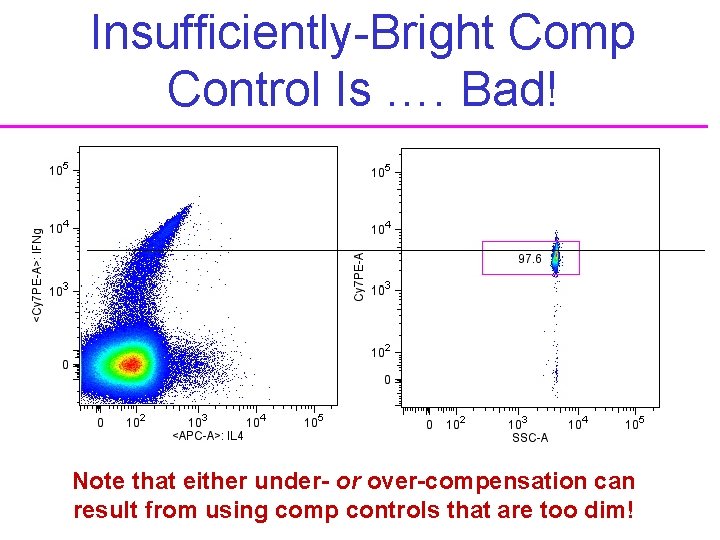
Insufficiently-Bright Comp Control Is …. Bad! Note that either under- or over-compensation can result from using comp controls that are too dim!
Compensation of Multicolor FACS Data • It is impossible to set proper compensation using visual guides (dot plots, histograms). – Use statistics (medians of gated cells) – Use automated compensation tools • Antibody-capture beads are an excellent way to set compensation! • Compensation controls must be matched to your experiment and at least as bright as any of your reagents.
Some Examples of Problems • The following four examples illustrate some types of problems that can be occur related to compensation. • In each case, compensation itself is not the problem: there is an underlying reagent, instrumentation, or analysis problem. • However, the manifestation of this problem is an apparent incorrect compensation!
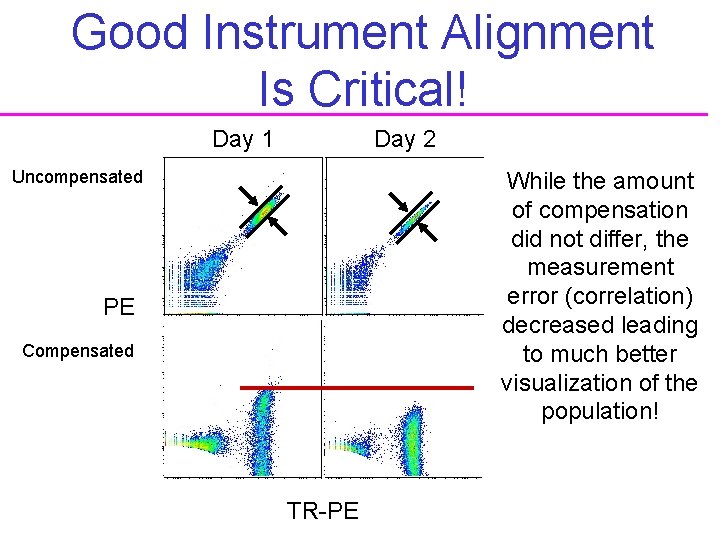
Good Instrument Alignment Is Critical! Day 1 Day 2 Uncompensated While the amount of compensation did not differ, the measurement error (correlation) decreased leading to much better visualization of the population! PE Compensated TR-PE
CFSE: A Special Case Cells stained with CFSE-DA, FITC-CD 8, or unstained were collected uncompensated. CFSE has a slightly redder spectrum than FITC… must use CFSE as a comp control!
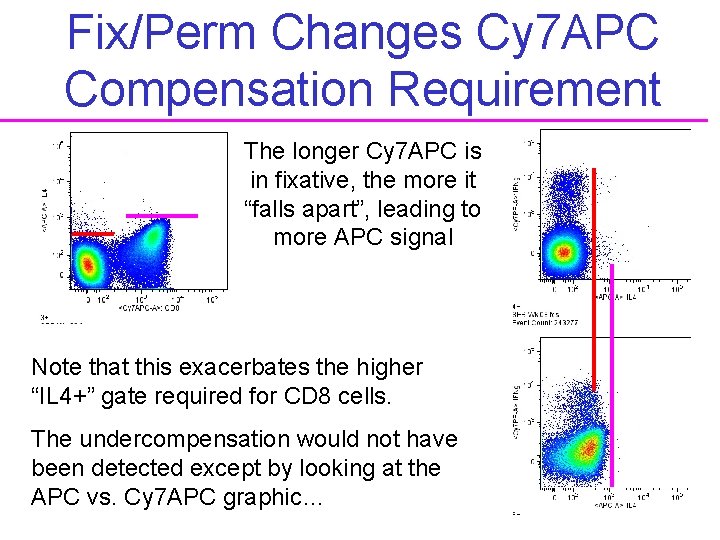
Fix/Perm Changes Cy 7 APC Compensation Requirement The longer Cy 7 APC is in fixative, the more it “falls apart”, leading to more APC signal Note that this exacerbates the higher “IL 4+” gate required for CD 8 cells. The undercompensation would not have been detected except by looking at the APC vs. Cy 7 APC graphic…
Different lots of tandems can require different compensation! Compensation Required (∆PE / ∆TRPE) TR-PE reagent 1 Median = 21, 100 PE Median = 484 TR-PE reagent 2 Median = 8, 720 PE Median = 698 2. 3% 8. 0%
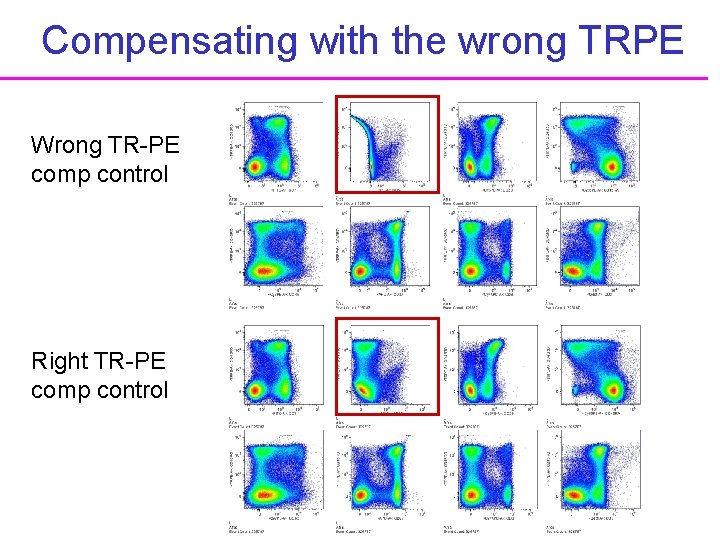
Compensating with the wrong TRPE Wrong TR-PE comp control Right TR-PE comp control
Staining Controls • Staining controls are necessary to identify cells which do or do not express a given antigen. • The threshold for positivity may depend on the amount of fluorescence in other channels!
Staining Controls • Unstained cells or complete isotype control stains are improper controls for determining positive vs. negative expression in multicolor experiments. • The best control is to stain cells with all reagents except the one of interest. FMO Control “Fluorescence Minus One” Also known as “ABO” (all-but-one)
Identifying CD 4 cells with 4 colors PBMC were stained as shown in a 4 -color experiment. Compensation was properly set for all spillovers
Complex Interactions in Compensation The same data is shown with correct or wrong Cy 5 PE->Cy 7 PE comp setting. Note that neither of these channels is shown here!
FMO controls aid even when compensation is improper Incorrect Cy 5 PE into Cy 7 PE compensation
FMO Controls • FMO controls are a much better way to identify positive vs. negative cells • FMO controls can also help identify problems in compensation that are not immediately visible • FMO controls should be used whenever accurate discrimination is essential or when antigen expression is relatively low
Present Quad-Gates of the Future
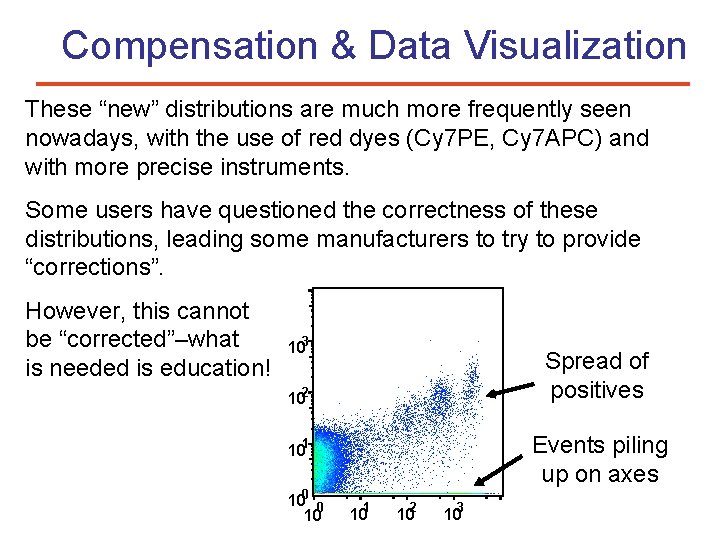
Compensation & Data Visualization These “new” distributions are much more frequently seen nowadays, with the use of red dyes (Cy 7 PE, Cy 7 APC) and with more precise instruments. Some users have questioned the correctness of these distributions, leading some manufacturers to try to provide “corrections”. However, this cannot be “corrected”–what is needed is education! 103 Spread of positives 102 Events piling up on axes 101 100 0 10 101 102 103
Compensation Offset? ? ? • At least two FACS data analysis software programs offer a “feature” to turn on a “compensation offset”–to try to make data look more like what we have expected. • The term “Compensation Offset” simply means that random noise is added to the data to hide the “spread” in compensated data. • This “feature” reduces sensitivity!
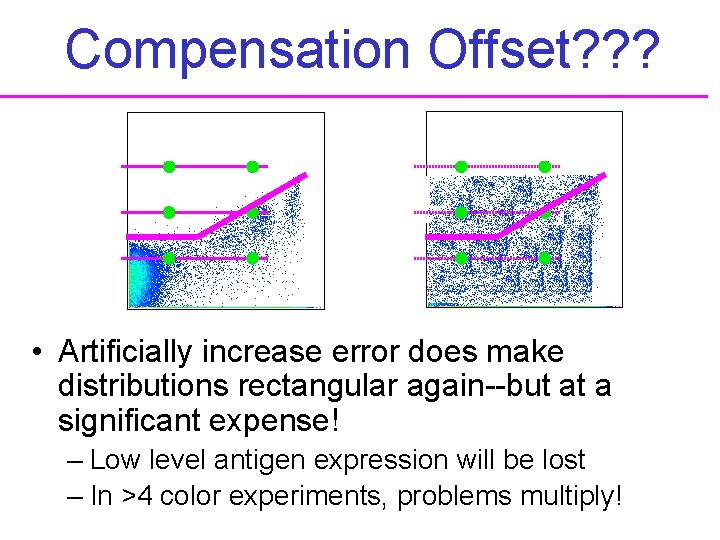
Compensation Offset? ? ? • Artificially increase error does make distributions rectangular again--but at a significant expense! – Low level antigen expression will be lost – In >4 color experiments, problems multiply!
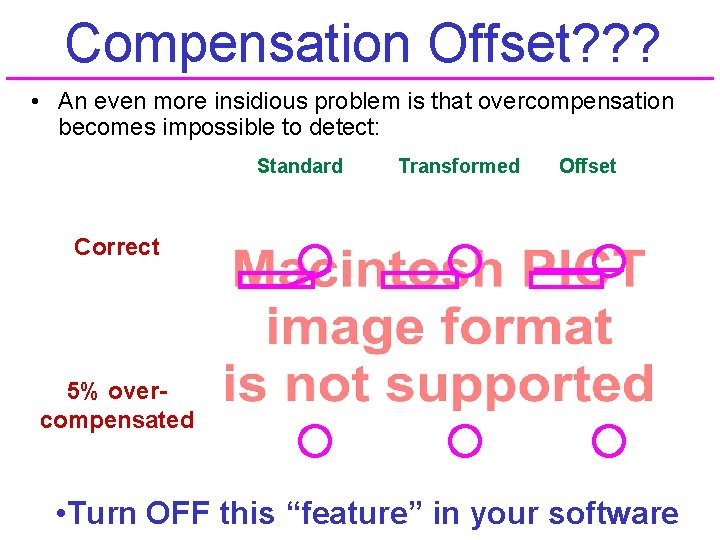
Compensation Offset? ? ? • An even more insidious problem is that overcompensation becomes impossible to detect: Standard Transformed Offset Correct 5% overcompensated • Turn OFF this “feature” in your software
Is There A Solution? • The spread in compensated data is unavoidable (basic physics) • Can we visualize data so that the distributions are more intuitive? • Nearly all immunophenotyping data is shown on a logarithmic scale… why? – Dynamic range of expression (4 logs) – Often, distributions are in fact log-normal
Alternatives to a Log Scale • Compensation reveals a linear-domain spreading in the distribution. • This is most obvious at the low end of fluorescence, because the measurement error is small compared to bright cells. • Can we re-scale the low end of the fluorescence scale to effect a different compression in this domain? • What about negative values? – Remember, this is just a fluorescence from which we subtract an estimated value with measurement error
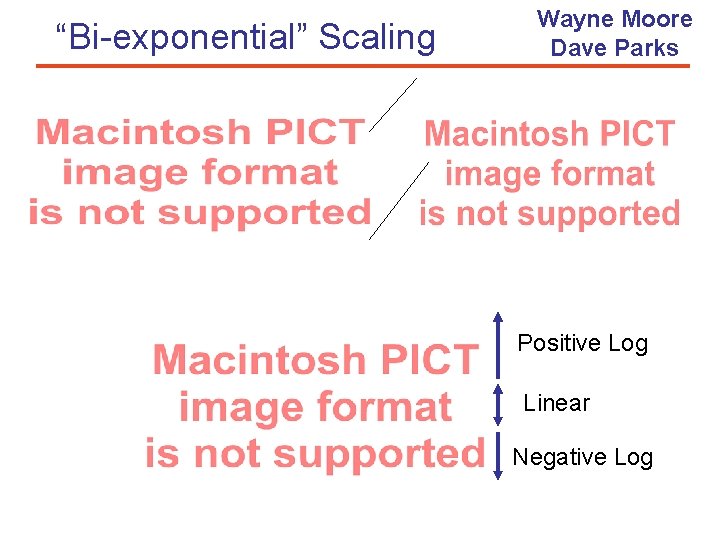
“Bi-exponential” Scaling Wayne Moore Dave Parks Positive Log Linear Negative Log
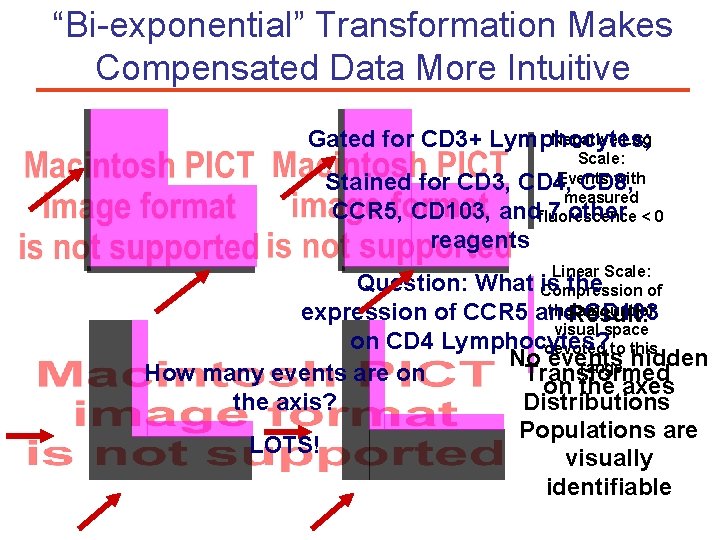
“Bi-exponential” Transformation Makes Compensated Data More Intuitive Negative Log Gated for CD 3+ Lymphocytes; Scale: Events with Stained for CD 3, CD 4, CD 8, measured CCR 5, CD 103, andfluorescence 7 other < 0 reagents Linear Scale: Question: What is the Compression of the. Result: amount of expression of CCR 5 and CD 103 visual space on CD 4 Lymphocytes? to this No devoted events hidden range How many events are on Transformed on the axes the axis? Distributions Populations are LOTS! visually identifiable
“Bi-exponential” Transformation Makes Compensated Data More Intuitive Only changes the visualization of data • Does not affect gating or statistics • Cannot change the overlap (or lack thereof) of two populations. Supports the basic goal of graphing data: showing it in an intuitive, aesthetic manner Note: the transformation is complex: it is different for each measurement channel and compensation matrix, and depends on the autofluorescence distribution. However, these parameters can be automatically selected by the software.
Transformation Confirms Compensation Median Transformed
Summary Compensation is straightforward…. But: • Interpretation of compensated data is complicated by “spillover spreading” arising from measurement errors • Proper compensation requires careful attention to compensation controls: bright, matched reagents & staining conditions • Proper analysis of compensated data requires careful attention to staining controls • Biexponential transformation of displays is critical for analysis and interpretation of compensated data
Compensation Resources • Bagwell & Adams: Ann NYAS 677: 167 (1993) Software compensation • Stewart & Stewart: Cytometry 38: 162 (1999) 4 -color compensation, pitfalls • Roederer: Current Protocols in Cytometry Protocol, explanation, discussion • Roederer: Cytometry 45: 194 (2001) Visualization artifacts, FMO controls • http: //www. drmr. com/compensation/