
Compensation for IRHP misselling During and after insolvency




![Directions on Restoration • Davy v Pickering [2015] EWHC 380 (Ch): - Application by](https://slidetodoc.com/presentation_image/030dd91d5cca9a5186ada40edaa466a5/image-37.jpg "Directions on Restoration • Davy v Pickering [2015] EWHC 380 (Ch): - Application by")
![Directions on Restoration • Regent Leisuretime Ltd v Nat. West Fiance Ltd [2003] BCC](https://slidetodoc.com/presentation_image/030dd91d5cca9a5186ada40edaa466a5/image-38.jpg "Directions on Restoration • Regent Leisuretime Ltd v Nat. West Fiance Ltd [2003] BCC")
![Directions on Restoration • Regent Leisuretime Ltd v Nat. West Fiance Ltd [2003] BCC](https://slidetodoc.com/presentation_image/030dd91d5cca9a5186ada40edaa466a5/image-39.jpg "Directions on Restoration • Regent Leisuretime Ltd v Nat. West Fiance Ltd [2003] BCC")
![Restoration post-administration • Rloans LLP v Registrar of Companies [2012] EWHC B 33 (Comm)](https://slidetodoc.com/presentation_image/030dd91d5cca9a5186ada40edaa466a5/image-40.jpg "Restoration post-administration • Rloans LLP v Registrar of Companies [2012] EWHC B 33 (Comm)")
![Restoration postadministration • Rloans LLP v Registrar of Companies [2012] EWHC B 33 (Comm)](https://slidetodoc.com/presentation_image/030dd91d5cca9a5186ada40edaa466a5/image-41.jpg "Restoration postadministration • Rloans LLP v Registrar of Companies [2012] EWHC B 33 (Comm)")
![Restoration postadministration • Rloans LLP v Registrar of Companies [2012] EWHC B 33 (Comm)](https://slidetodoc.com/presentation_image/030dd91d5cca9a5186ada40edaa466a5/image-42.jpg "Restoration postadministration • Rloans LLP v Registrar of Companies [2012] EWHC B 33 (Comm)")
![Mutuality • Stein v Blake [1996] AC 243 - Claim and cross-claim - Two](https://slidetodoc.com/presentation_image/030dd91d5cca9a5186ada40edaa466a5/image-46.jpg "Mutuality • Stein v Blake [1996] AC 243 - Claim and cross-claim - Two")


- Slides: 54
Compensation for IRHP mis-selling: During and after insolvency Darragh Connell Philip Currie Forum. Chambers. com
Compensation for mis-sold IRHPs Darragh Connell
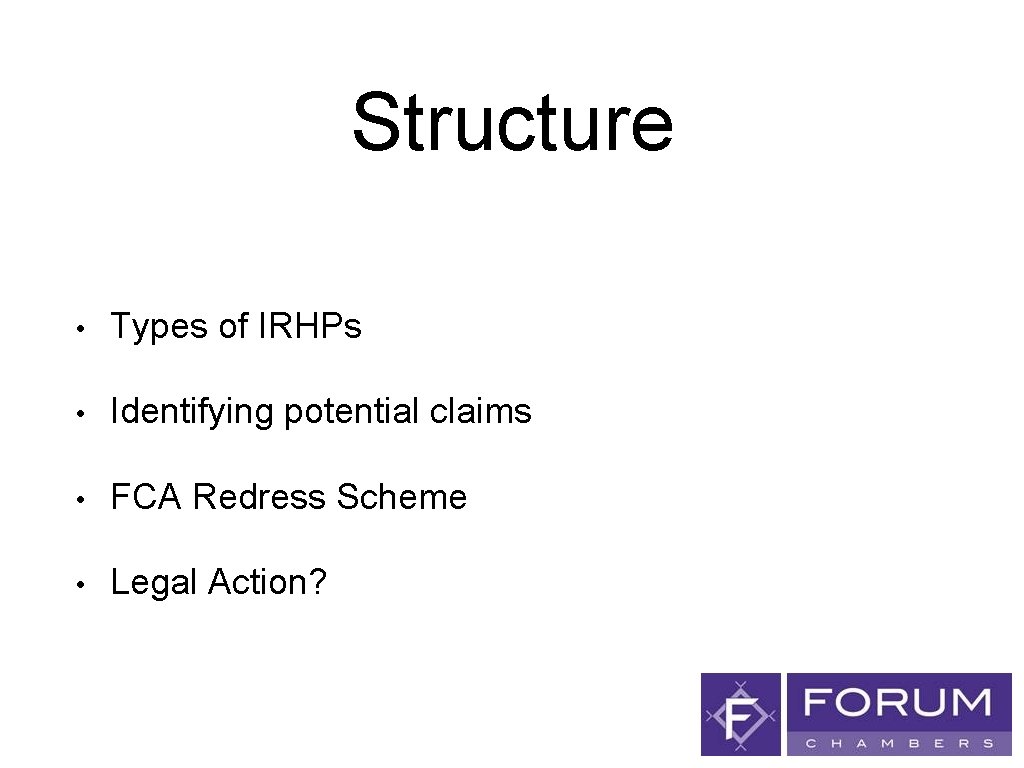
Structure • Types of IRHPs • Identifying potential claims • FCA Redress Scheme • Legal Action?
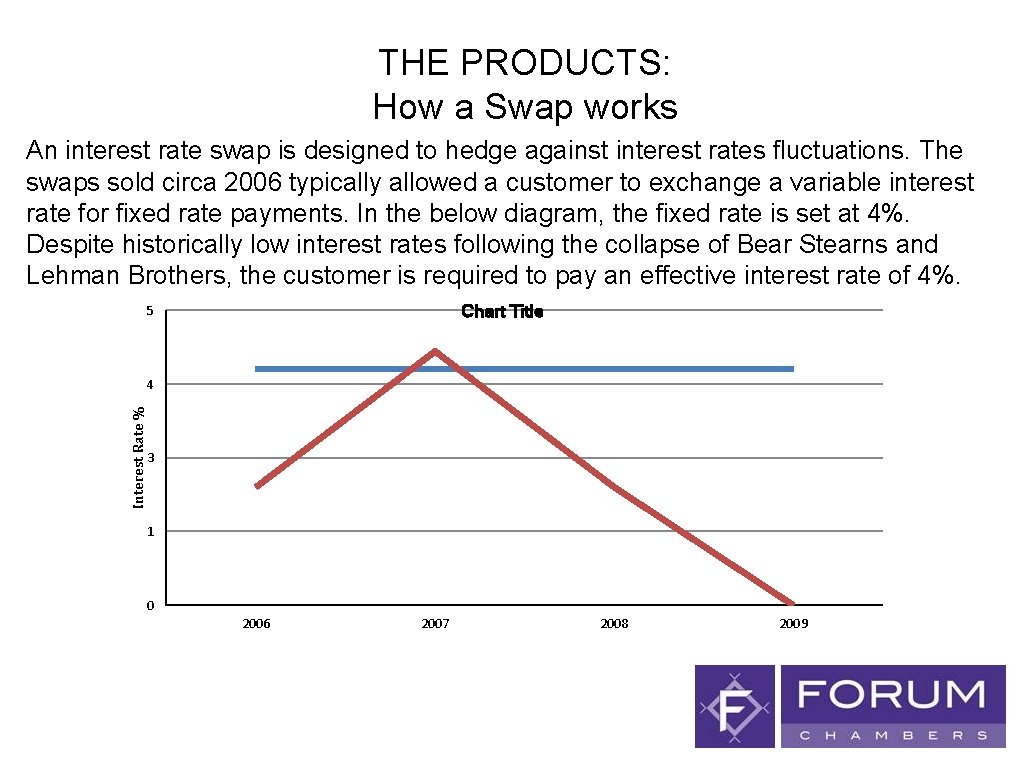
THE PRODUCTS: How a Swap works An interest rate swap is designed to hedge against interest rates fluctuations. The swaps sold circa 2006 typically allowed a customer to exchange a variable interest rate for fixed rate payments. In the below diagram, the fixed rate is set at 4%. Despite historically low interest rates following the collapse of Bear Stearns and Lehman Brothers, the customer is required to pay an effective interest rate of 4%. Chart Title 5 Interest Rate % 4 3 1 0 2006 2007 2008 2009
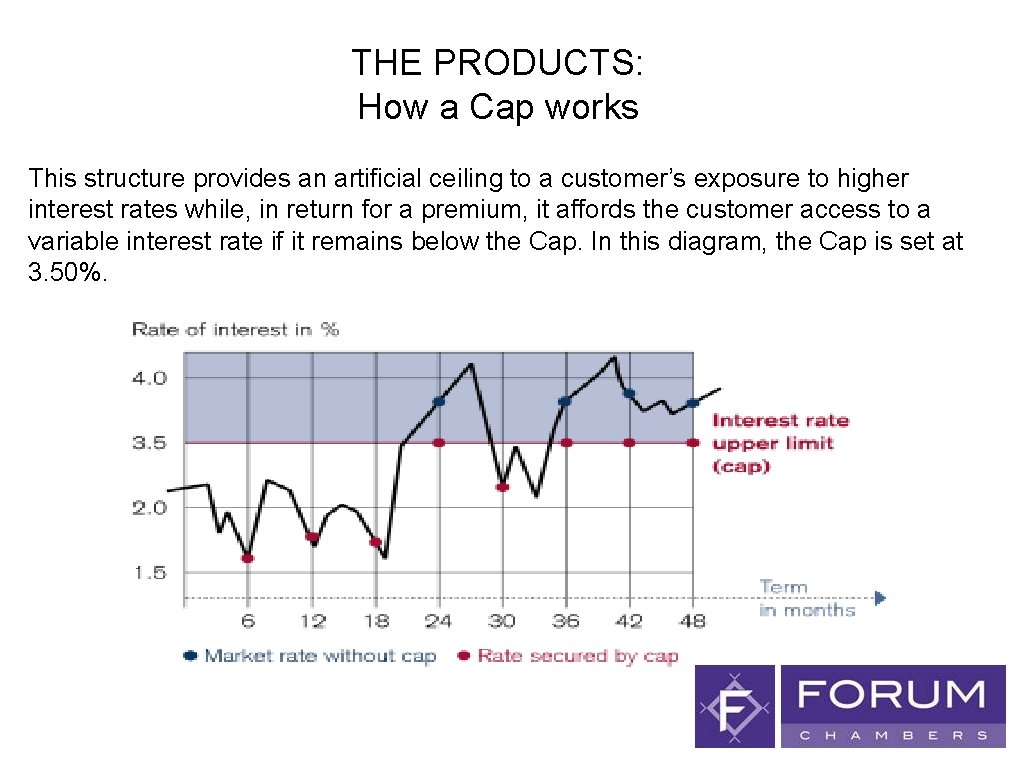
THE PRODUCTS: How a Cap works This structure provides an artificial ceiling to a customer’s exposure to higher interest rates while, in return for a premium, it affords the customer access to a variable interest rate if it remains below the Cap. In this diagram, the Cap is set at 3. 50%.
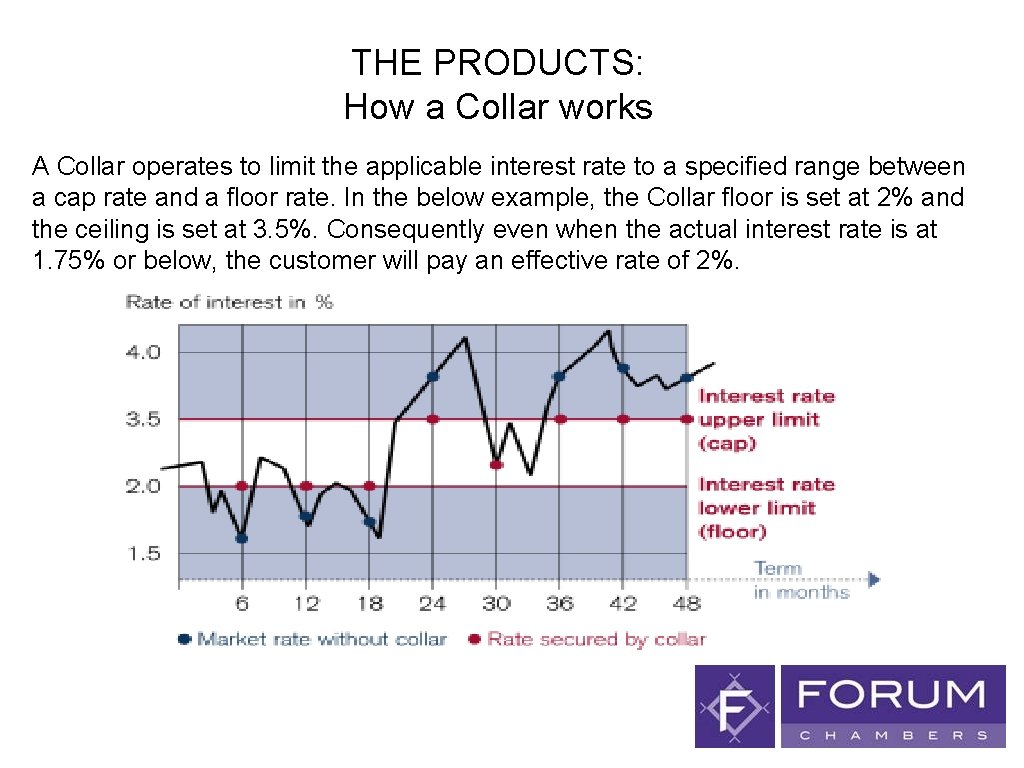
THE PRODUCTS: How a Collar works A Collar operates to limit the applicable interest rate to a specified range between a cap rate and a floor rate. In the below example, the Collar floor is set at 2% and the ceiling is set at 3. 5%. Consequently even when the actual interest rate is at 1. 75% or below, the customer will pay an effective rate of 2%.
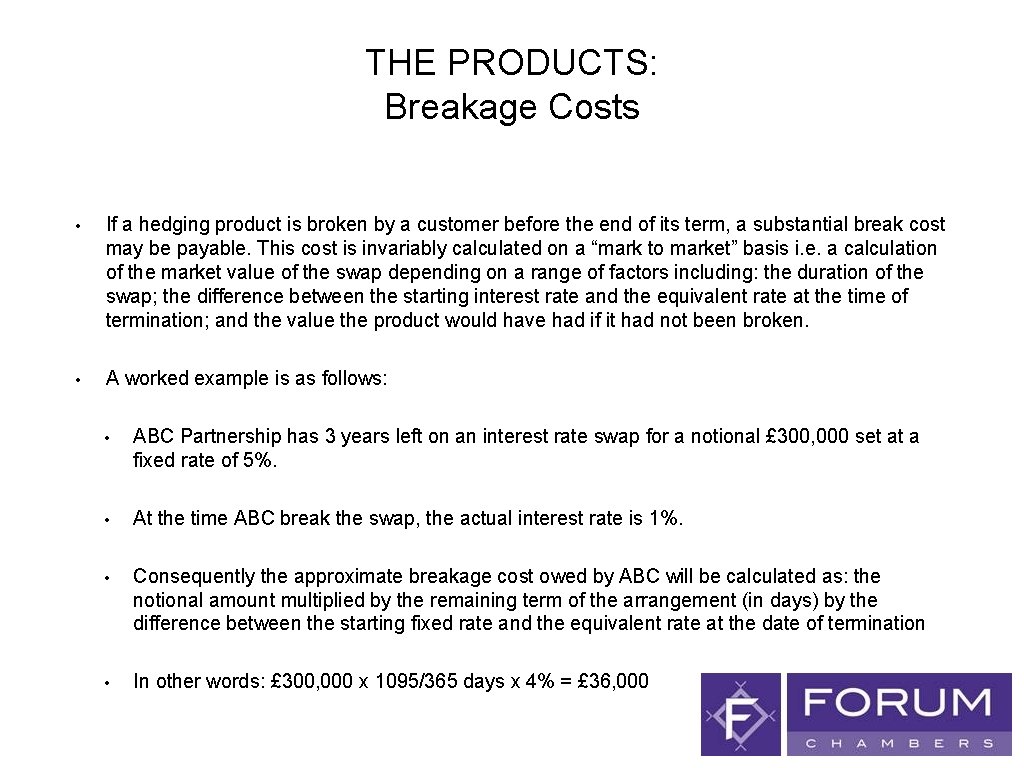
THE PRODUCTS: Breakage Costs • If a hedging product is broken by a customer before the end of its term, a substantial break cost may be payable. This cost is invariably calculated on a “mark to market” basis i. e. a calculation of the market value of the swap depending on a range of factors including: the duration of the swap; the difference between the starting interest rate and the equivalent rate at the time of termination; and the value the product would have had if it had not been broken. • A worked example is as follows: • ABC Partnership has 3 years left on an interest rate swap for a notional £ 300, 000 set at a fixed rate of 5%. • At the time ABC break the swap, the actual interest rate is 1%. • Consequently the approximate breakage cost owed by ABC will be calculated as: the notional amount multiplied by the remaining term of the arrangement (in days) by the difference between the starting fixed rate and the equivalent rate at the date of termination • In other words: £ 300, 000 x 1095/365 days x 4% = £ 36, 000
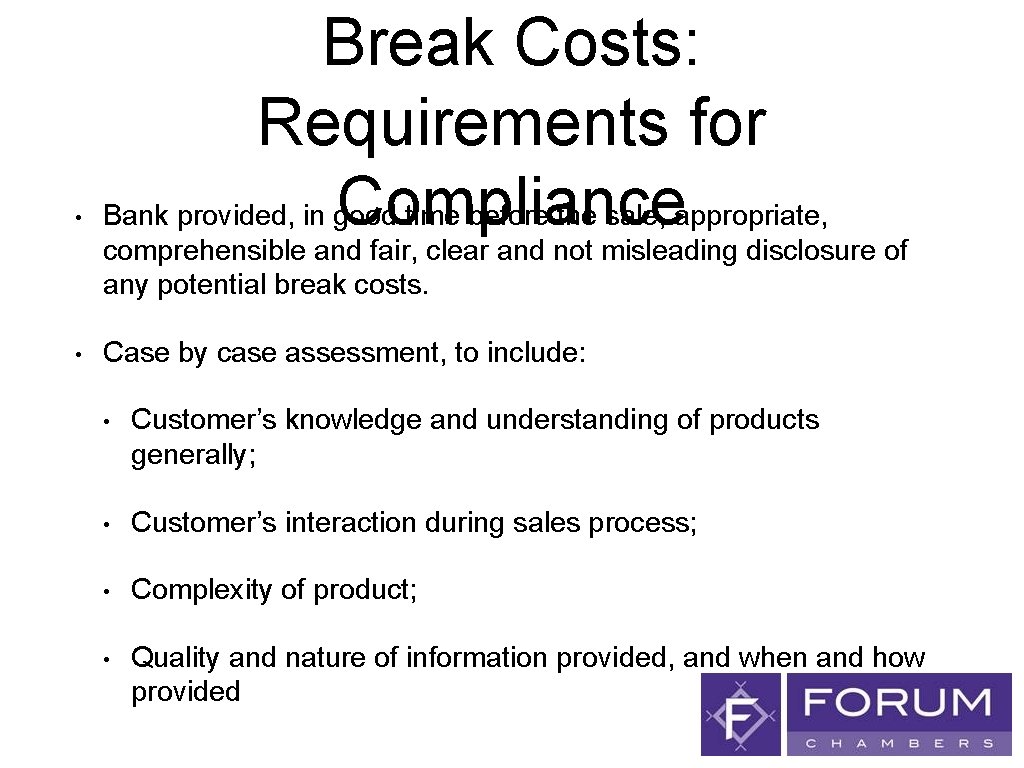
• Break Costs: Requirements for Compliance Bank provided, in good time before the sale, appropriate, comprehensible and fair, clear and not misleading disclosure of any potential break costs. • Case by case assessment, to include: • Customer’s knowledge and understanding of products generally; • Customer’s interaction during sales process; • Complexity of product; • Quality and nature of information provided, and when and how provided
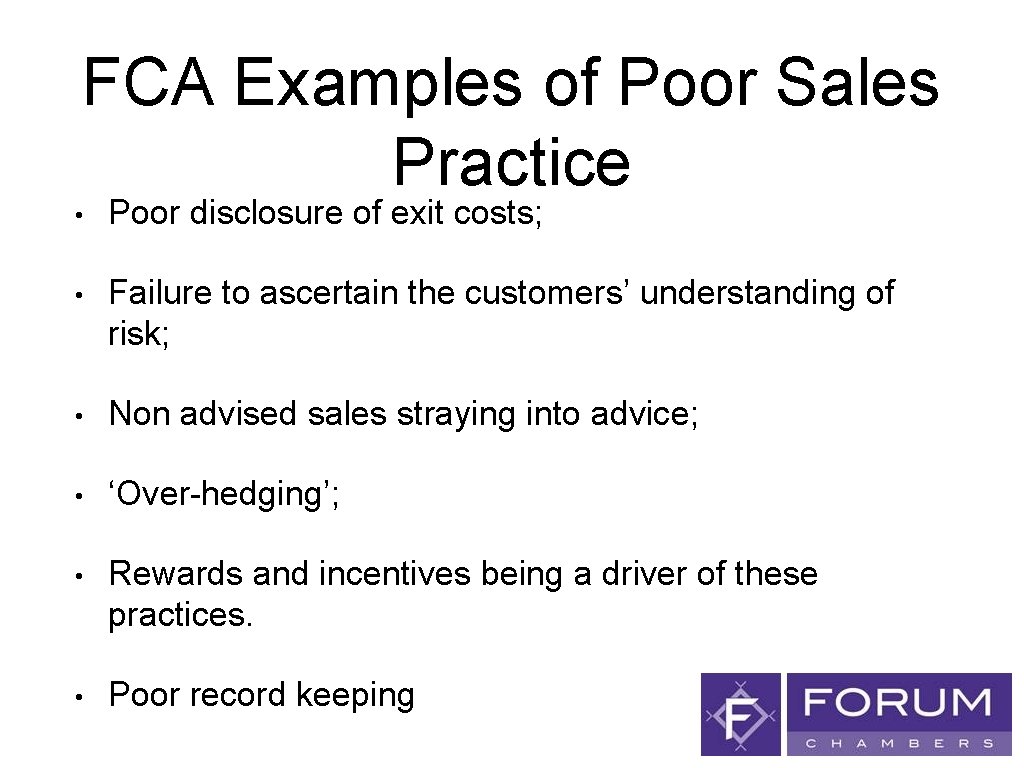
FCA Examples of Poor Sales Practice • Poor disclosure of exit costs; • Failure to ascertain the customers’ understanding of risk; • Non advised sales straying into advice; • ‘Over-hedging’; • Rewards and incentives being a driver of these practices. • Poor record keeping
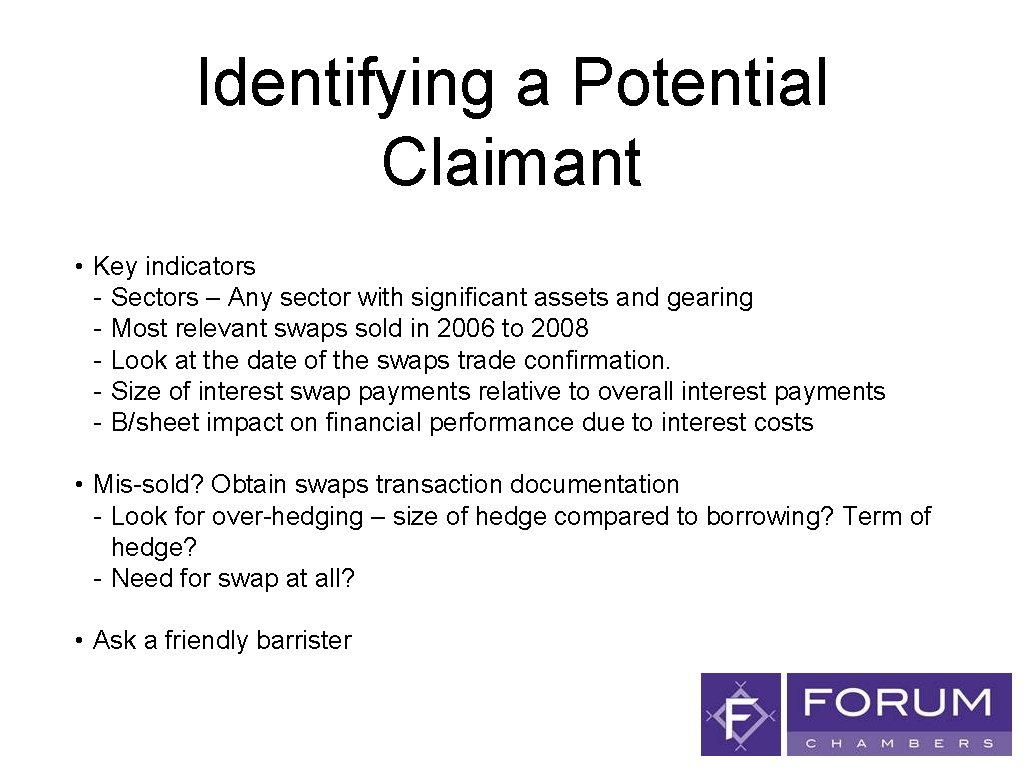
Identifying a Potential Claimant • Key indicators - Sectors – Any sector with significant assets and gearing - Most relevant swaps sold in 2006 to 2008 - Look at the date of the swaps trade confirmation. - Size of interest swap payments relative to overall interest payments - B/sheet impact on financial performance due to interest costs • Mis-sold? Obtain swaps transaction documentation - Look for over-hedging – size of hedge compared to borrowing? Term of hedge? - Need for swap at all? • Ask a friendly barrister
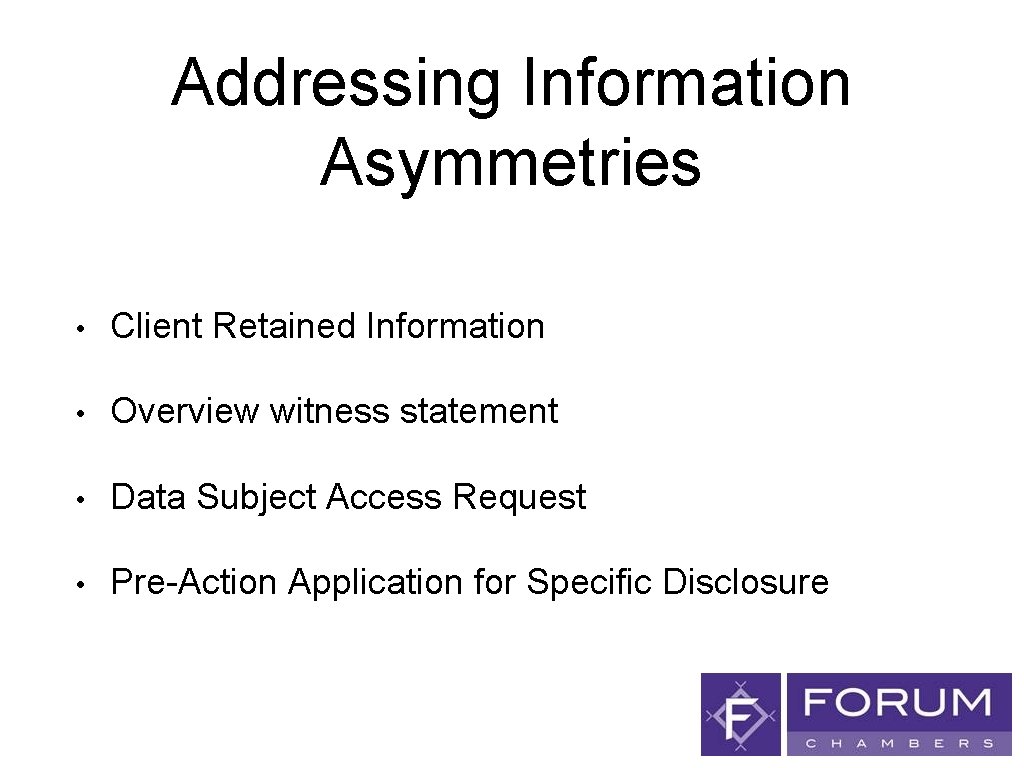
Addressing Information Asymmetries • Client Retained Information • Overview witness statement • Data Subject Access Request • Pre-Action Application for Specific Disclosure
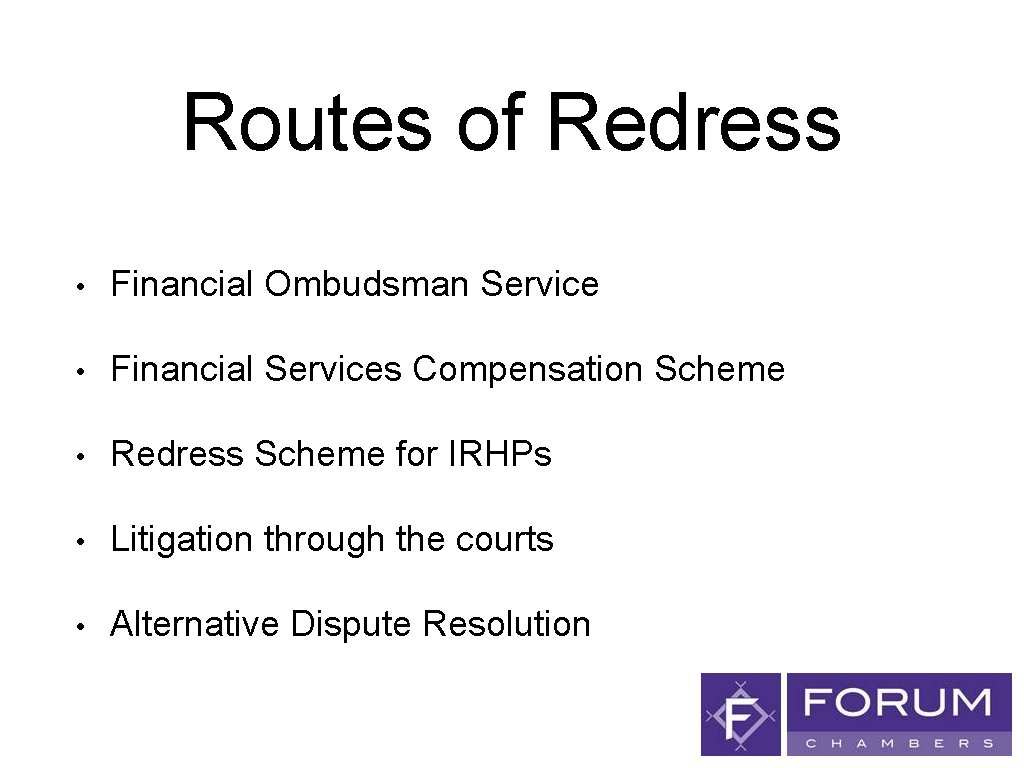
Routes of Redress • Financial Ombudsman Service • Financial Services Compensation Scheme • Redress Scheme for IRHPs • Litigation through the courts • Alternative Dispute Resolution
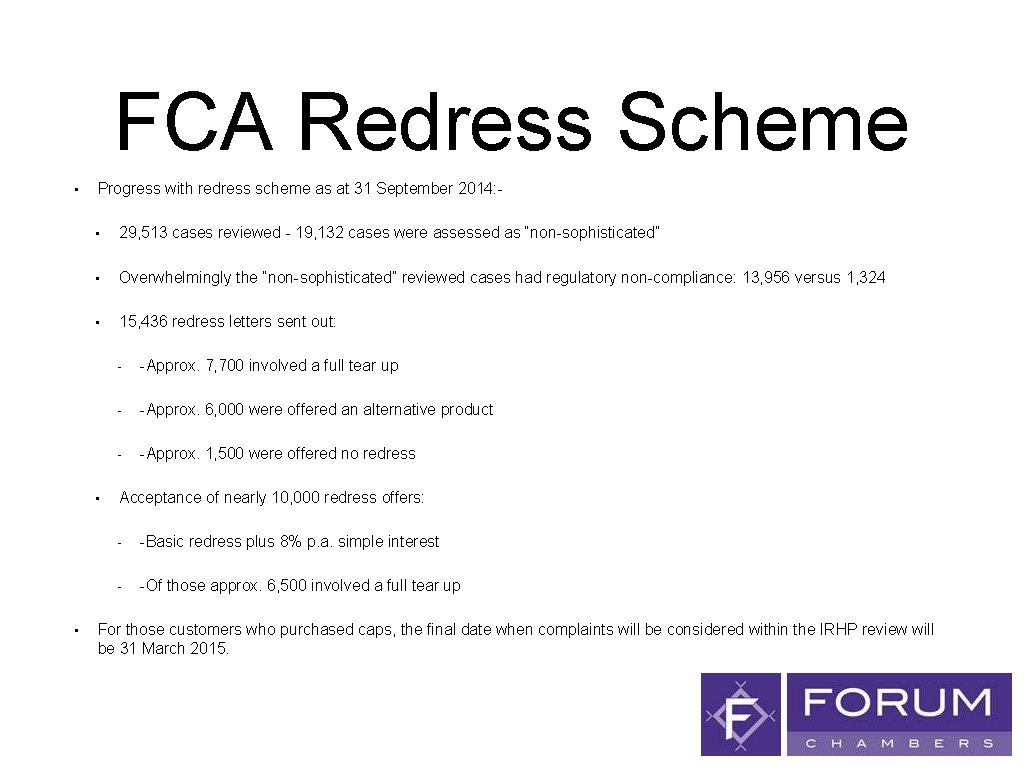
FCA Redress Scheme • Progress with redress scheme as at 31 September 2014: • 29, 513 cases reviewed - 19, 132 cases were assessed as “non-sophisticated” • Overwhelmingly the “non-sophisticated” reviewed cases had regulatory non-compliance: 13, 956 versus 1, 324 • 15, 436 redress letters sent out: • • - -Approx. 7, 700 involved a full tear up - -Approx. 6, 000 were offered an alternative product - -Approx. 1, 500 were offered no redress Acceptance of nearly 10, 000 redress offers: - -Basic redress plus 8% p. a. simple interest - -Of those approx. 6, 500 involved a full tear up For those customers who purchased caps, the final date when complaints will be considered within the IRHP review will be 31 March 2015.
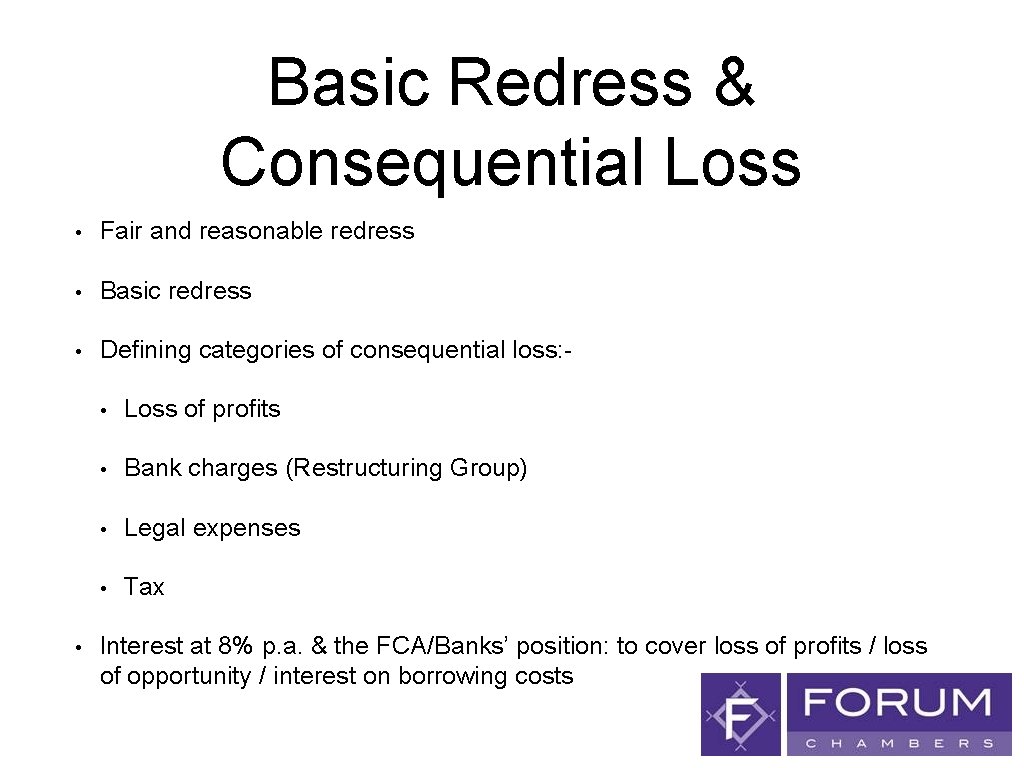
Basic Redress & Consequential Loss • Fair and reasonable redress • Basic redress • Defining categories of consequential loss: - • • Loss of profits • Bank charges (Restructuring Group) • Legal expenses • Tax Interest at 8% p. a. & the FCA/Banks’ position: to cover loss of profits / loss of opportunity / interest on borrowing costs
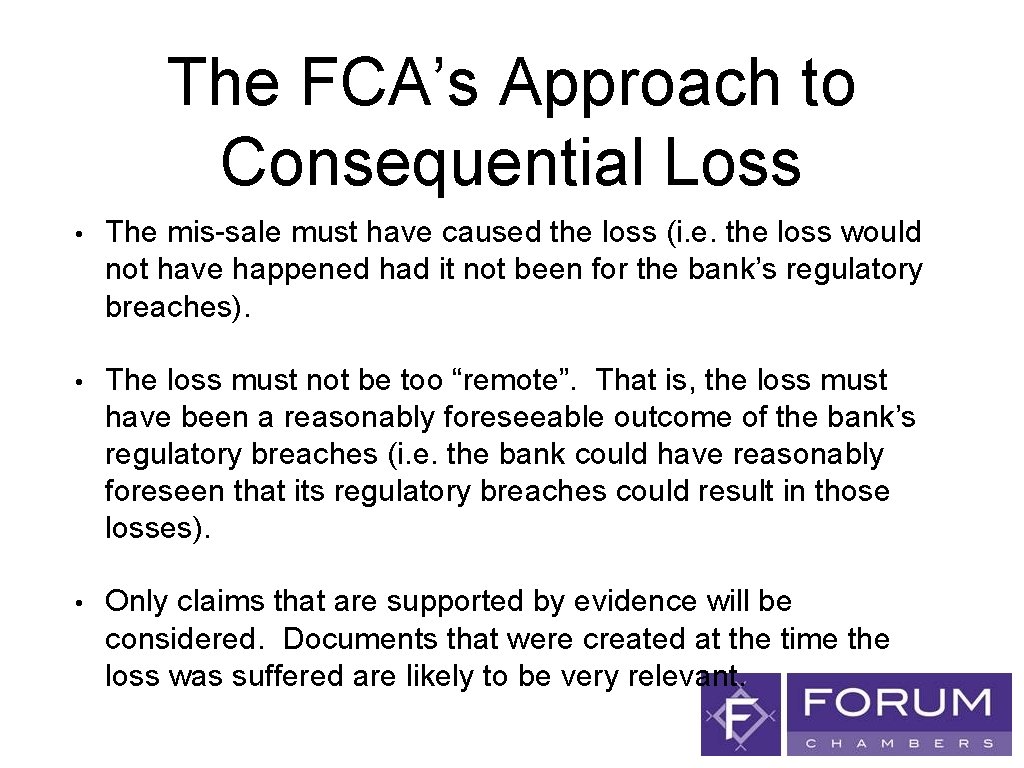
The FCA’s Approach to Consequential Loss • The mis-sale must have caused the loss (i. e. the loss would not have happened had it not been for the bank’s regulatory breaches). • The loss must not be too “remote”. That is, the loss must have been a reasonably foreseeable outcome of the bank’s regulatory breaches (i. e. the bank could have reasonably foreseen that its regulatory breaches could result in those losses). • Only claims that are supported by evidence will be considered. Documents that were created at the time the loss was suffered are likely to be very relevant.
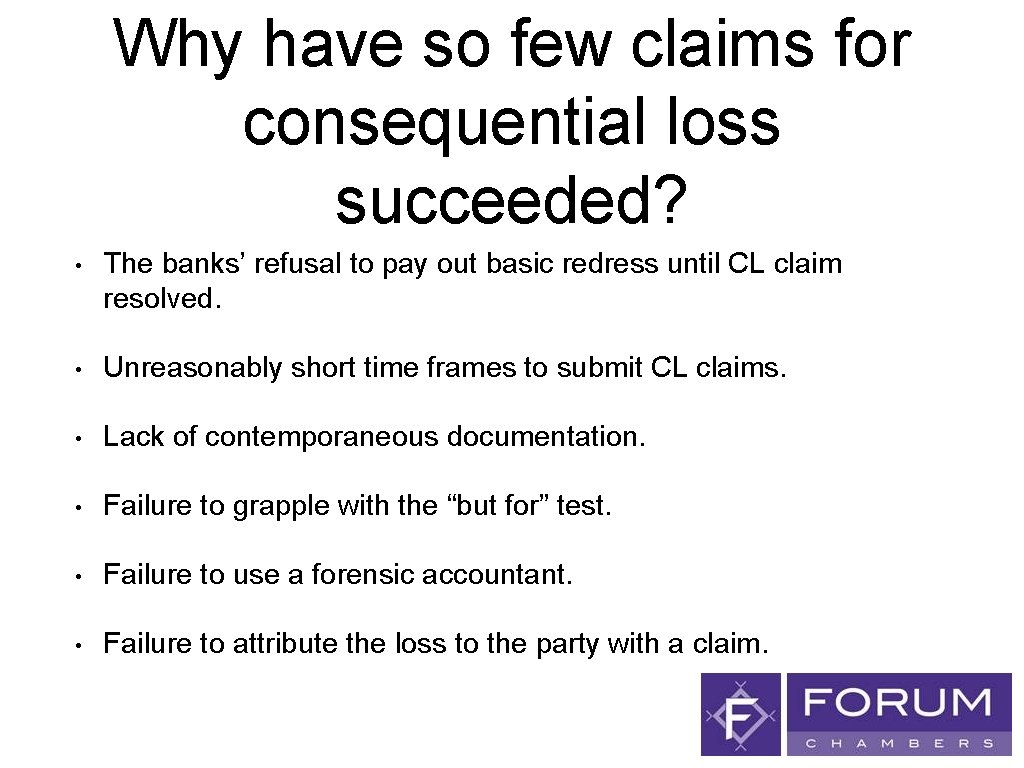
Why have so few claims for consequential loss succeeded? • The banks’ refusal to pay out basic redress until CL claim resolved. • Unreasonably short time frames to submit CL claims. • Lack of contemporaneous documentation. • Failure to grapple with the “but for” test. • Failure to use a forensic accountant. • Failure to attribute the loss to the party with a claim.
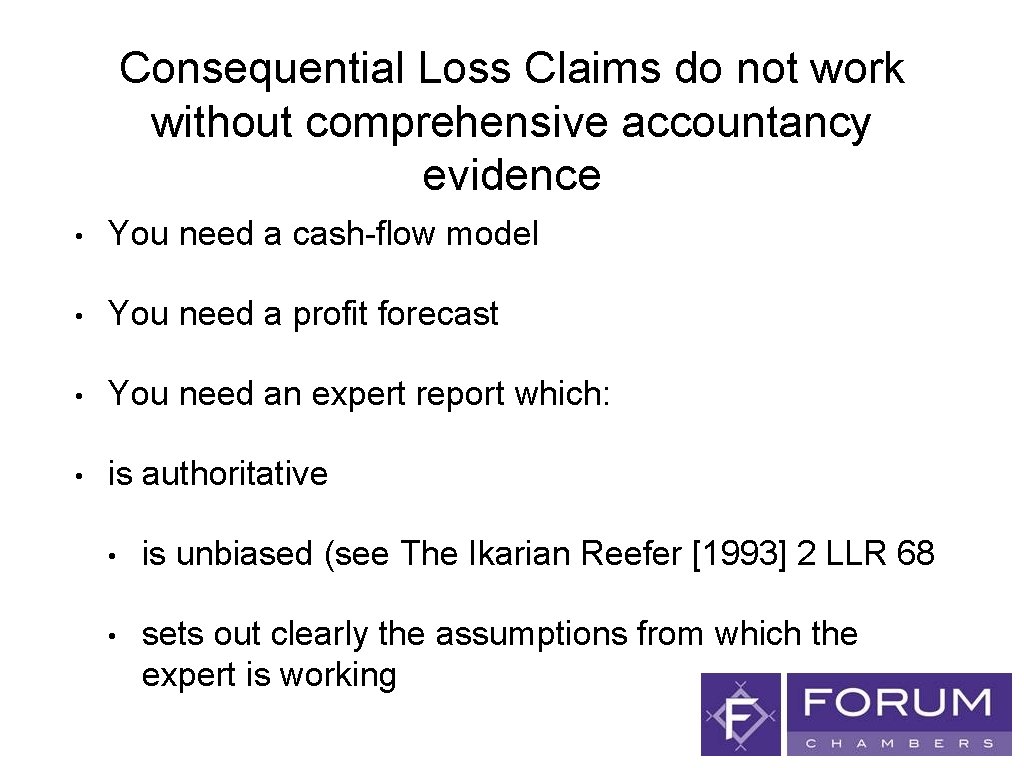
Consequential Loss Claims do not work without comprehensive accountancy evidence • You need a cash-flow model • You need a profit forecast • You need an expert report which: • is authoritative • is unbiased (see The Ikarian Reefer [1993] 2 LLR 68 • sets out clearly the assumptions from which the expert is working
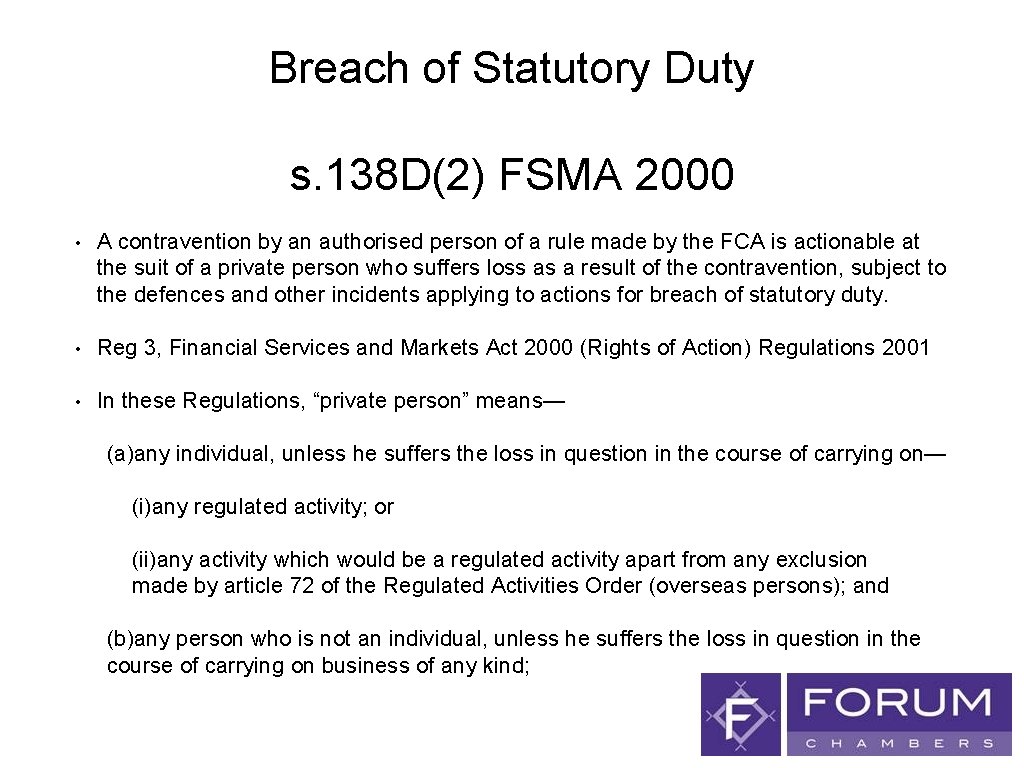
Breach of Statutory Duty s. 138 D(2) FSMA 2000 • A contravention by an authorised person of a rule made by the FCA is actionable at the suit of a private person who suffers loss as a result of the contravention, subject to the defences and other incidents applying to actions for breach of statutory duty. • Reg 3, Financial Services and Markets Act 2000 (Rights of Action) Regulations 2001 • In these Regulations, “private person” means— (a)any individual, unless he suffers the loss in question in the course of carrying on— (i)any regulated activity; or (ii)any activity which would be a regulated activity apart from any exclusion made by article 72 of the Regulated Activities Order (overseas persons); and (b)any person who is not an individual, unless he suffers the loss in question in the course of carrying on business of any kind;
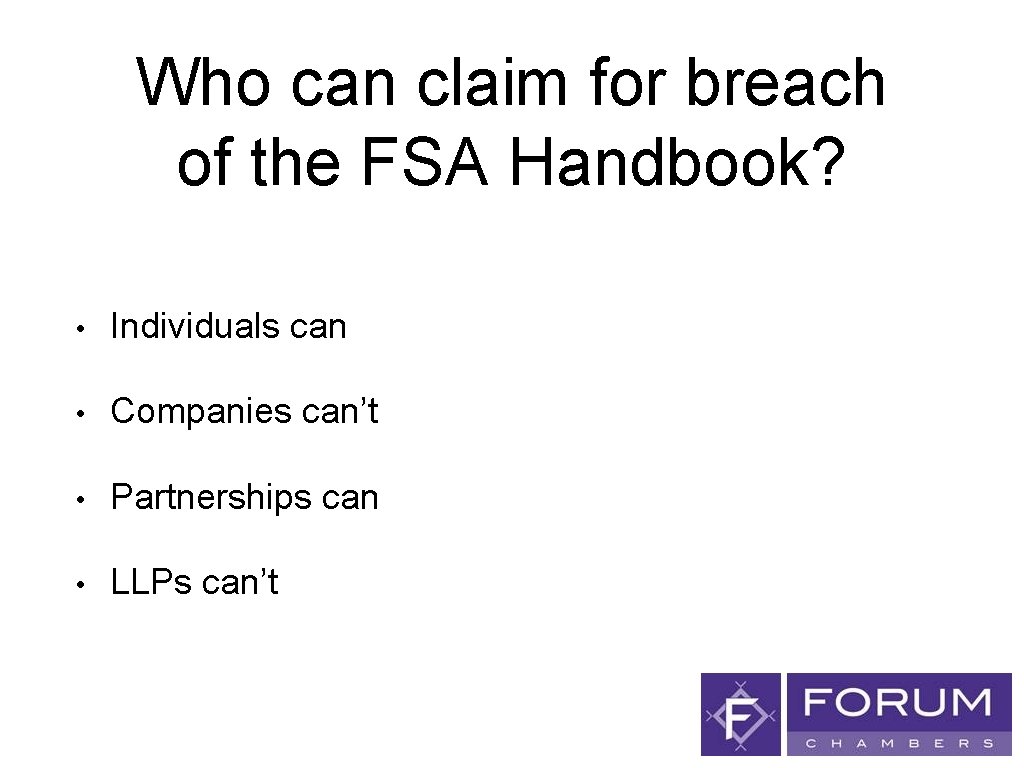
Who can claim for breach of the FSA Handbook? • Individuals can • Companies can’t • Partnerships can • LLPs can’t
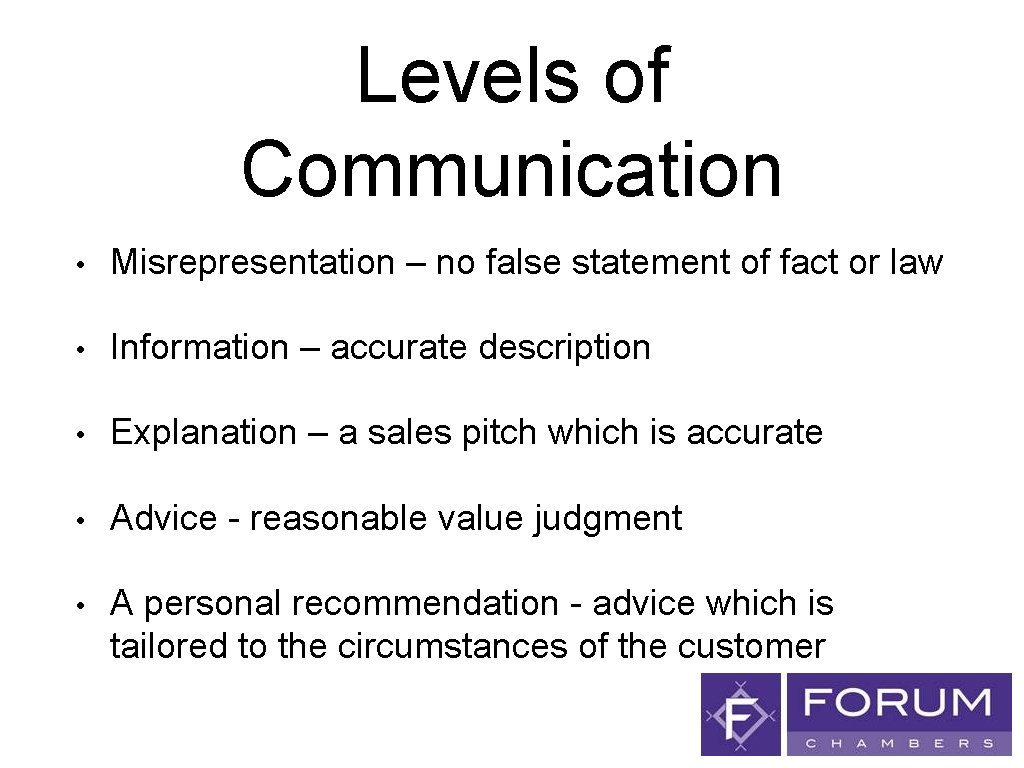
Levels of Communication • Misrepresentation – no false statement of fact or law • Information – accurate description • Explanation – a sales pitch which is accurate • Advice - reasonable value judgment • A personal recommendation - advice which is tailored to the circumstances of the customer
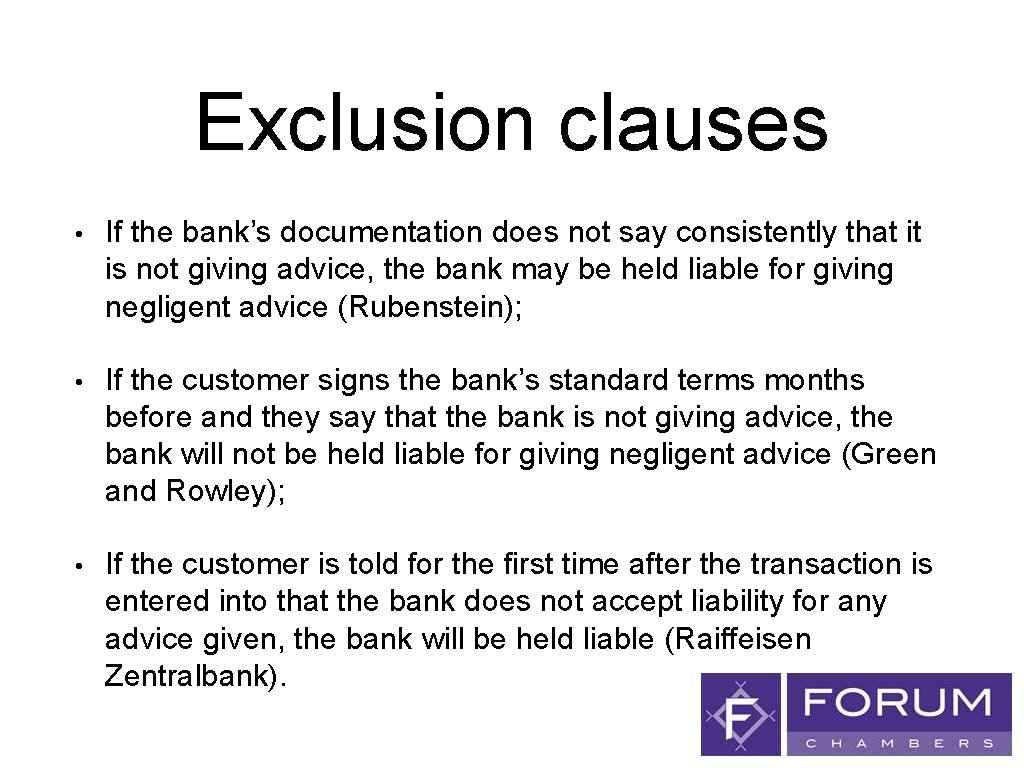
Exclusion clauses • If the bank’s documentation does not say consistently that it is not giving advice, the bank may be held liable for giving negligent advice (Rubenstein); • If the customer signs the bank’s standard terms months before and they say that the bank is not giving advice, the bank will not be held liable for giving negligent advice (Green and Rowley); • If the customer is told for the first time after the transaction is entered into that the bank does not accept liability for any advice given, the bank will be held liable (Raiffeisen Zentralbank).
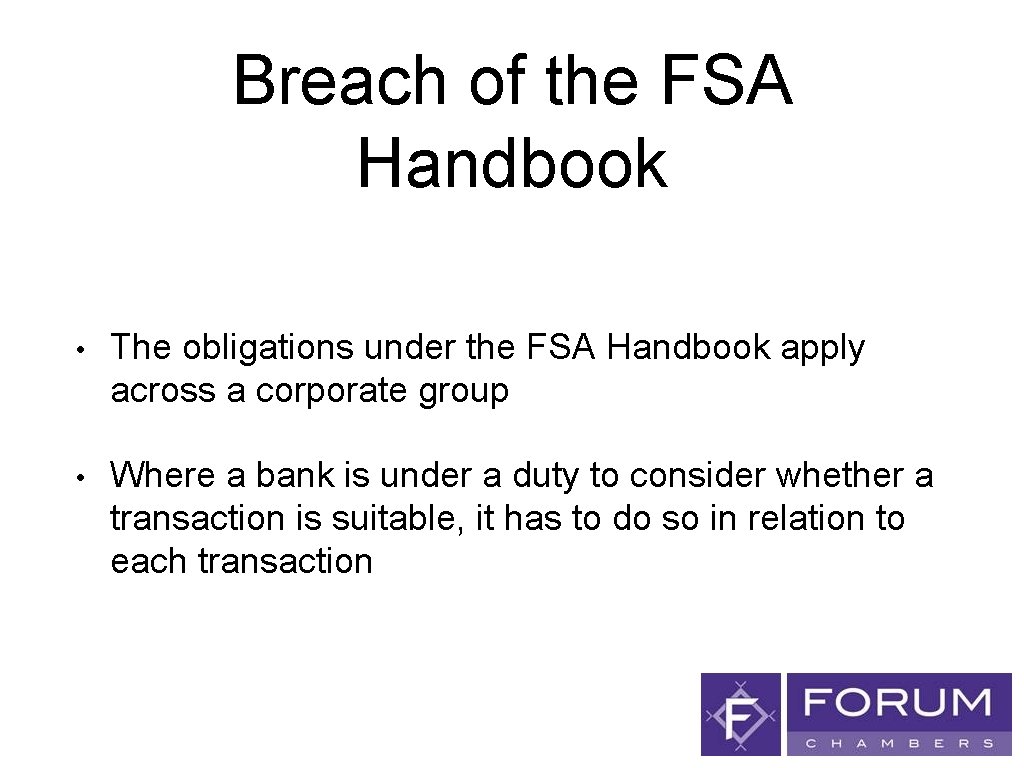
Breach of the FSA Handbook • The obligations under the FSA Handbook apply across a corporate group • Where a bank is under a duty to consider whether a transaction is suitable, it has to do so in relation to each transaction
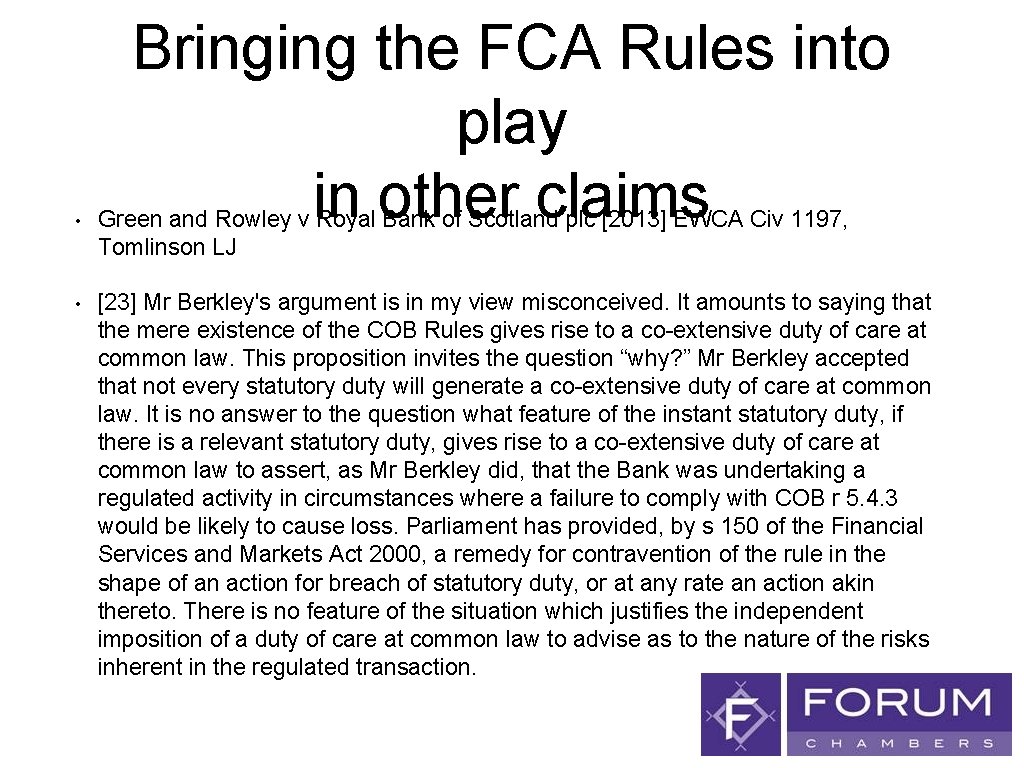
Bringing the FCA Rules into play in other claims • Green and Rowley v Royal Bank of Scotland plc [2013] EWCA Civ 1197, Tomlinson LJ • [23] Mr Berkley's argument is in my view misconceived. It amounts to saying that the mere existence of the COB Rules gives rise to a co-extensive duty of care at common law. This proposition invites the question “why? ” Mr Berkley accepted that not every statutory duty will generate a co-extensive duty of care at common law. It is no answer to the question what feature of the instant statutory duty, if there is a relevant statutory duty, gives rise to a co-extensive duty of care at common law to assert, as Mr Berkley did, that the Bank was undertaking a regulated activity in circumstances where a failure to comply with COB r 5. 4. 3 would be likely to cause loss. Parliament has provided, by s 150 of the Financial Services and Markets Act 2000, a remedy for contravention of the rule in the shape of an action for breach of statutory duty, or at any rate an action akin thereto. There is no feature of the situation which justifies the independent imposition of a duty of care at common law to advise as to the nature of the risks inherent in the regulated transaction.
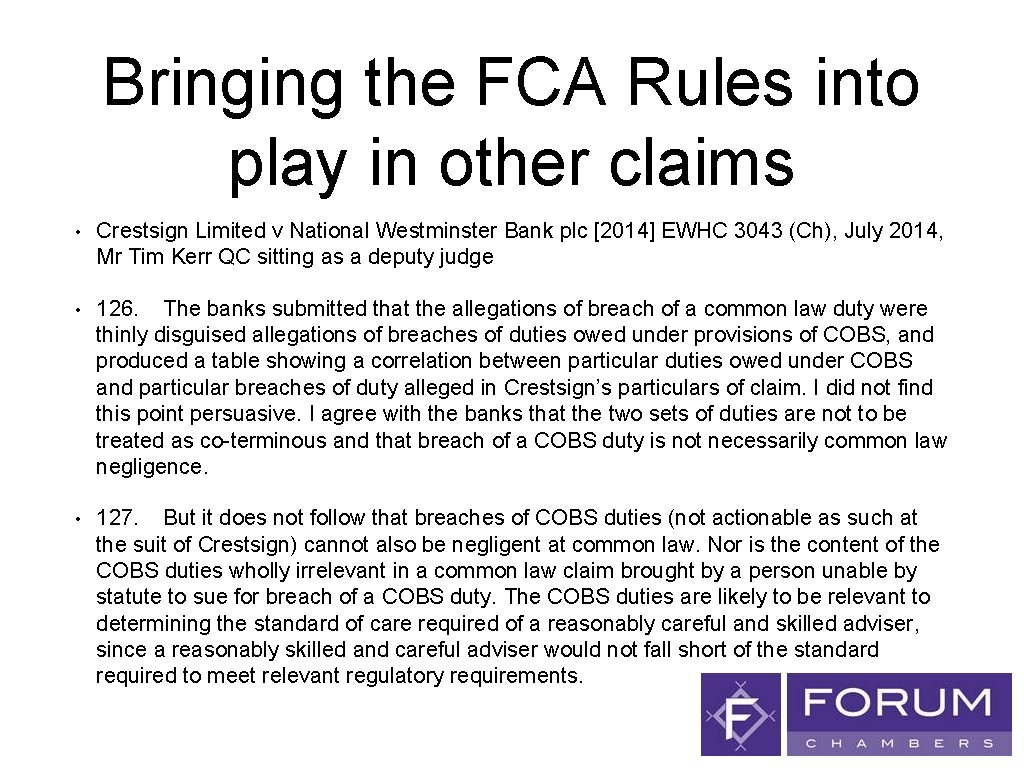
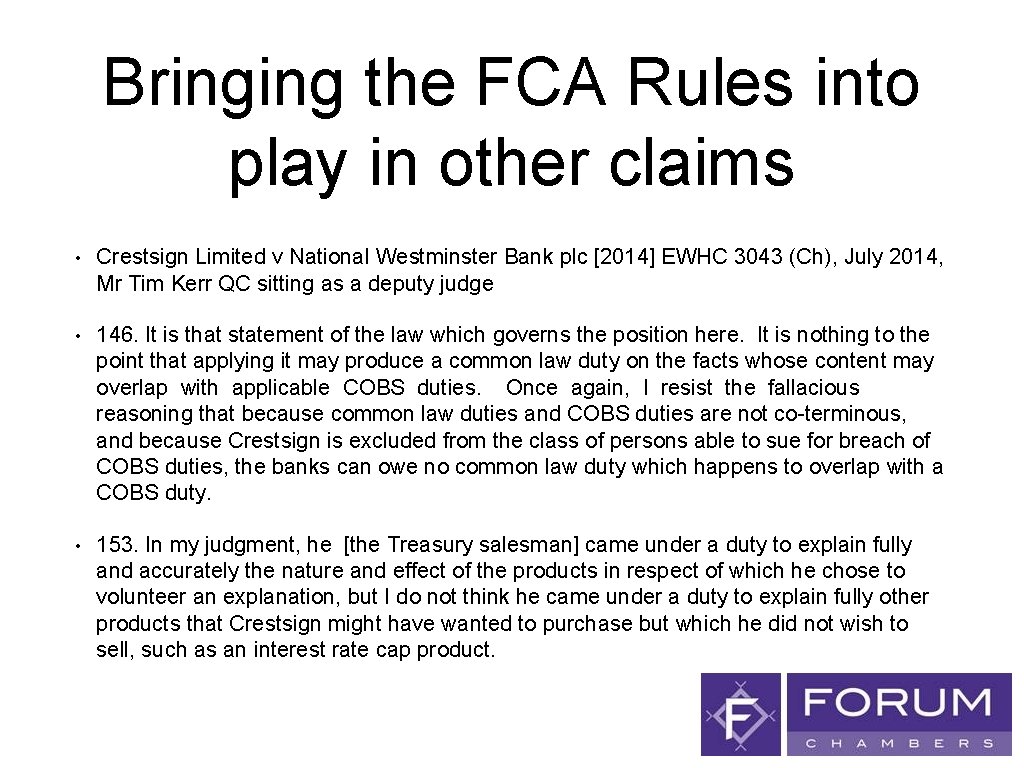
Bringing the FCA Rules into play in other claims • Crestsign Limited v National Westminster Bank plc [2014] EWHC 3043 (Ch), July 2014, Mr Tim Kerr QC sitting as a deputy judge • 126. The banks submitted that the allegations of breach of a common law duty were thinly disguised allegations of breaches of duties owed under provisions of COBS, and produced a table showing a correlation between particular duties owed under COBS and particular breaches of duty alleged in Crestsign’s particulars of claim. I did not find this point persuasive. I agree with the banks that the two sets of duties are not to be treated as co-terminous and that breach of a COBS duty is not necessarily common law negligence. • 127. But it does not follow that breaches of COBS duties (not actionable as such at the suit of Crestsign) cannot also be negligent at common law. Nor is the content of the COBS duties wholly irrelevant in a common law claim brought by a person unable by statute to sue for breach of a COBS duty. The COBS duties are likely to be relevant to determining the standard of care required of a reasonably careful and skilled adviser, since a reasonably skilled and careful adviser would not fall short of the standard required to meet relevant regulatory requirements.
Bringing the FCA Rules into play in other claims • Crestsign Limited v National Westminster Bank plc [2014] EWHC 3043 (Ch), July 2014, Mr Tim Kerr QC sitting as a deputy judge • 146. It is that statement of the law which governs the position here. It is nothing to the point that applying it may produce a common law duty on the facts whose content may overlap with applicable COBS duties. Once again, I resist the fallacious reasoning that because common law duties and COBS duties are not co-terminous, and because Crestsign is excluded from the class of persons able to sue for breach of COBS duties, the banks can owe no common law duty which happens to overlap with a COBS duty. • 153. In my judgment, he [the Treasury salesman] came under a duty to explain fully and accurately the nature and effect of the products in respect of which he chose to volunteer an explanation, but I do not think he came under a duty to explain fully other products that Crestsign might have wanted to purchase but which he did not wish to sell, such as an interest rate cap product.
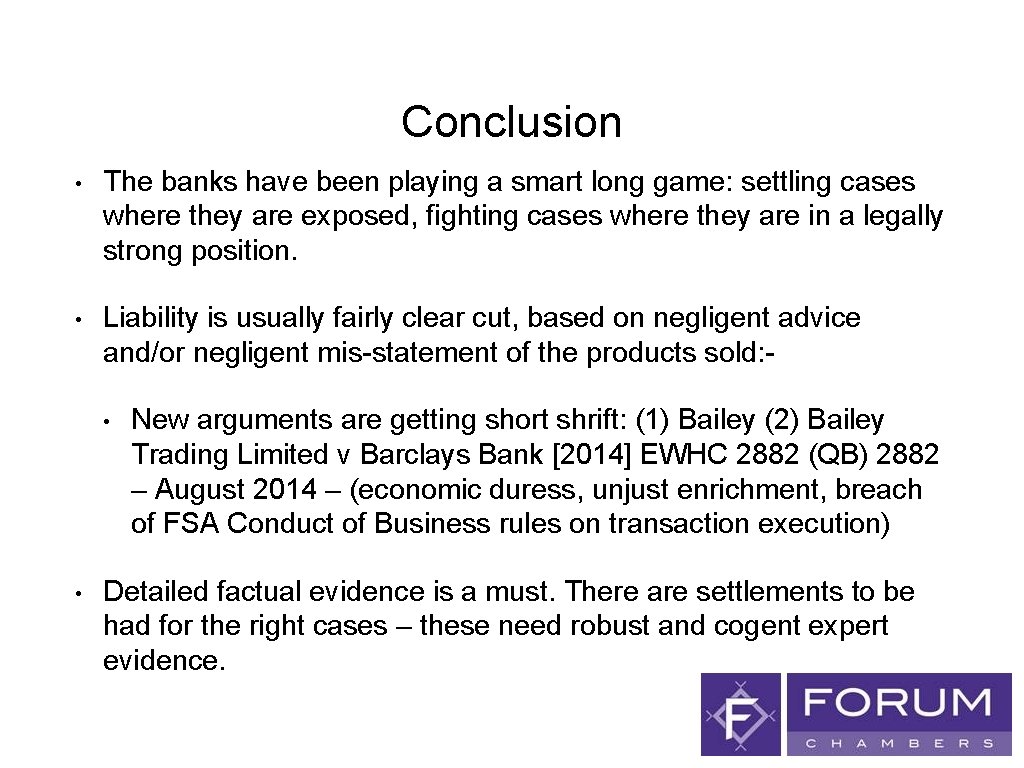
Conclusion • The banks have been playing a smart long game: settling cases where they are exposed, fighting cases where they are in a legally strong position. • Liability is usually fairly clear cut, based on negligent advice and/or negligent mis-statement of the products sold: • • New arguments are getting short shrift: (1) Bailey (2) Bailey Trading Limited v Barclays Bank [2014] EWHC 2882 (QB) 2882 – August 2014 – (economic duress, unjust enrichment, breach of FSA Conduct of Business rules on transaction execution) Detailed factual evidence is a must. There are settlements to be had for the right cases – these need robust and cogent expert evidence.
JUST ONE MORE QUESTION…
Darragh Connell DConnell@Forum. Chambers. com
ation post-insolvency after the Company ha Philip Currie Forum. Chambers. com
During Insolvency • IPs bring claim on behalf of Company • Assign to willing creditor or shareholder - Hockin v Marsden [2014] EWHC 763 (Ch)
After dissolution s. 1029 Companies Act 2006 • • Application to court if: - dissolved after company winding up - deemed dissolved after administration Application can be made by former director, former member, former liquidator
After dissolution s. 1032 Companies Act 2006 • Company deemed to have continued as if it had not been dissolved or struck of the register • Court may give directions
Directions on Restoration • Limitation Direction: - • period between striking off and restoration not to count for purposes of limitation defences Petition Direction: - deeming the date of presentation of winding-up petition to the date of striking off
Directions on Restoration • Davy v Pickering [2015] EWHC 380 (Ch): - Application by creditor of company - Limitation and Petition Directions granted - Not necessary to show that petition would have been presented in lost window of time, though might be a factor to consider ([41])
Directions on Restoration • Regent Leisuretime Ltd v Nat. West Fiance Ltd [2003] BCC 587 - Application by former directors - Seeking to bring a claim against the bank for fraudulent misrepresentations - Company had not brought claims and allowed itself to be struck off
Directions on Restoration • Regent Leisuretime Ltd v Nat. West Fiance Ltd [2003] BCC 587 - Limitation direction refused: “Whilst consideration of essential fairness may justify the giving of a limitation direction in favour of a third party, the same cannot so readily be said of a limitation direction in favour of the company being restored to the register” (Jonathan Parker LJ at [90])
Restoration post-administration • Rloans LLP v Registrar of Companies [2012] EWHC B 33 (Comm) - Application by creditor of company - Limitation Direction not appropriate in absence of former director
Restoration postadministration • Rloans LLP v Registrar of Companies [2012] EWHC B 33 (Comm) - Dissolution post-administration under Sch B 1 para 84 - Restoration ordered — deeming provision in s. 1032 CA 2006 means no dissolution took place - 3 month period for dissolution (para 84(7)(c) disapplied — because no dissolution had taken place
Restoration postadministration • Rloans LLP v Registrar of Companies [2012] EWHC B 33 (Comm) - Administration not extended to date of liquidation - Problem: events said to amount to a preference happened more than two years before onset of insolvency (s. 240)
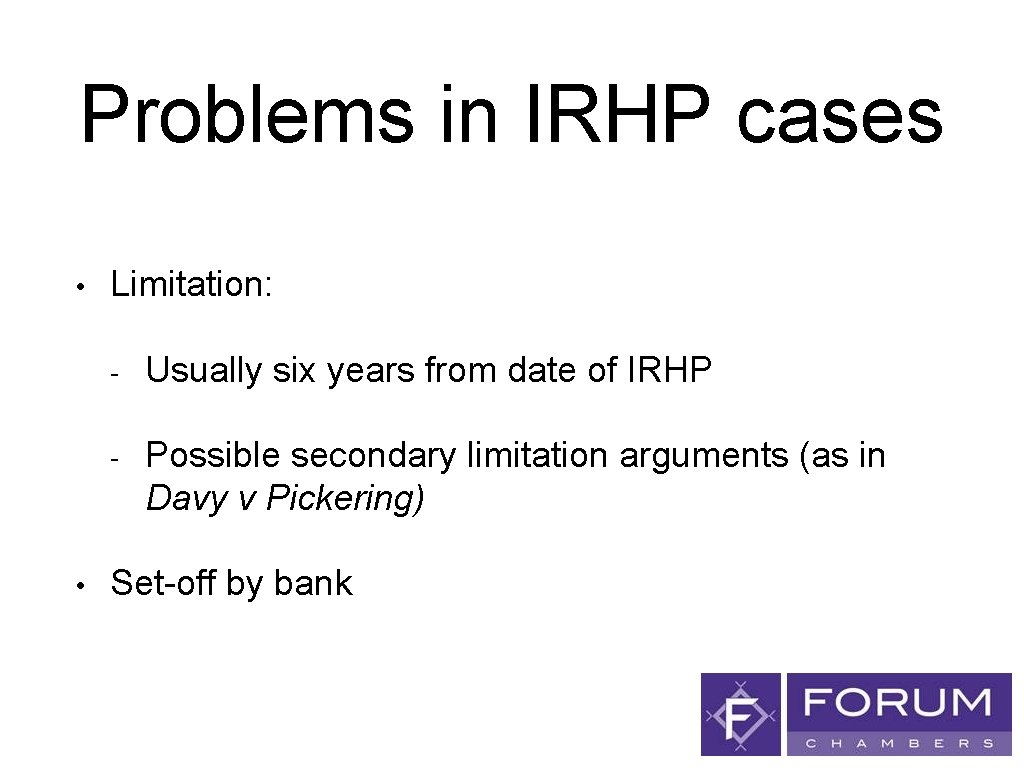
Problems in IRHP cases • • Limitation: - Usually six years from date of IRHP - Possible secondary limitation arguments (as in Davy v Pickering) Set-off by bank
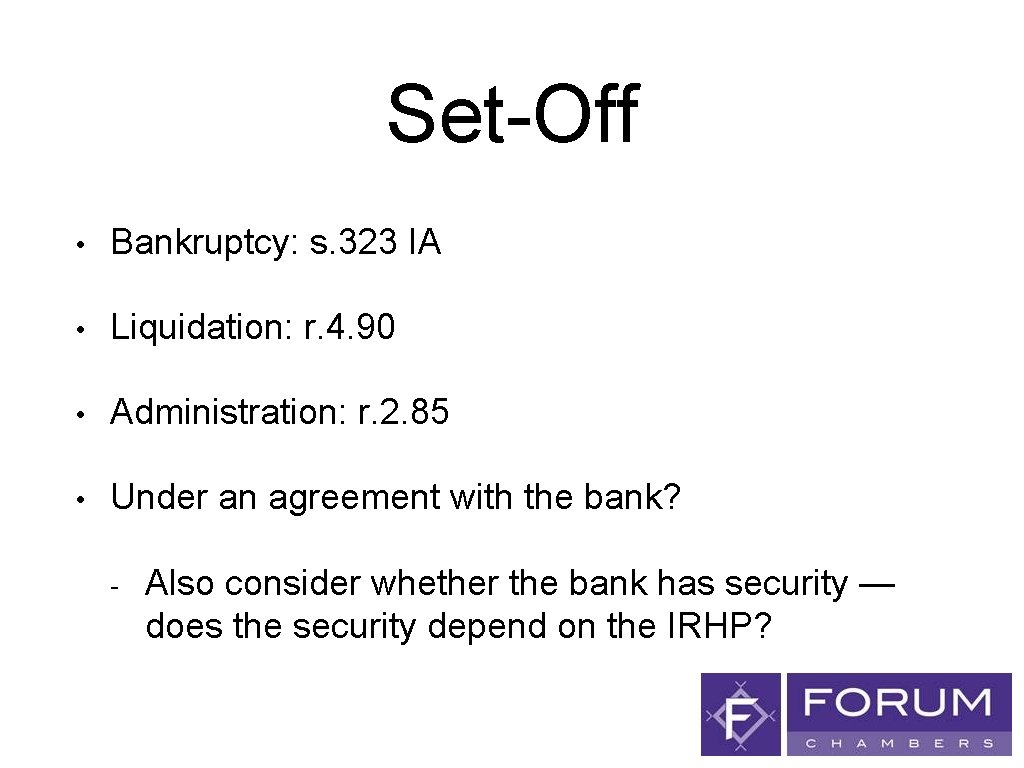
Set-Off • Bankruptcy: s. 323 IA • Liquidation: r. 4. 90 • Administration: r. 2. 85 • Under an agreement with the bank? - Also consider whether the bank has security — does the security depend on the IRHP?
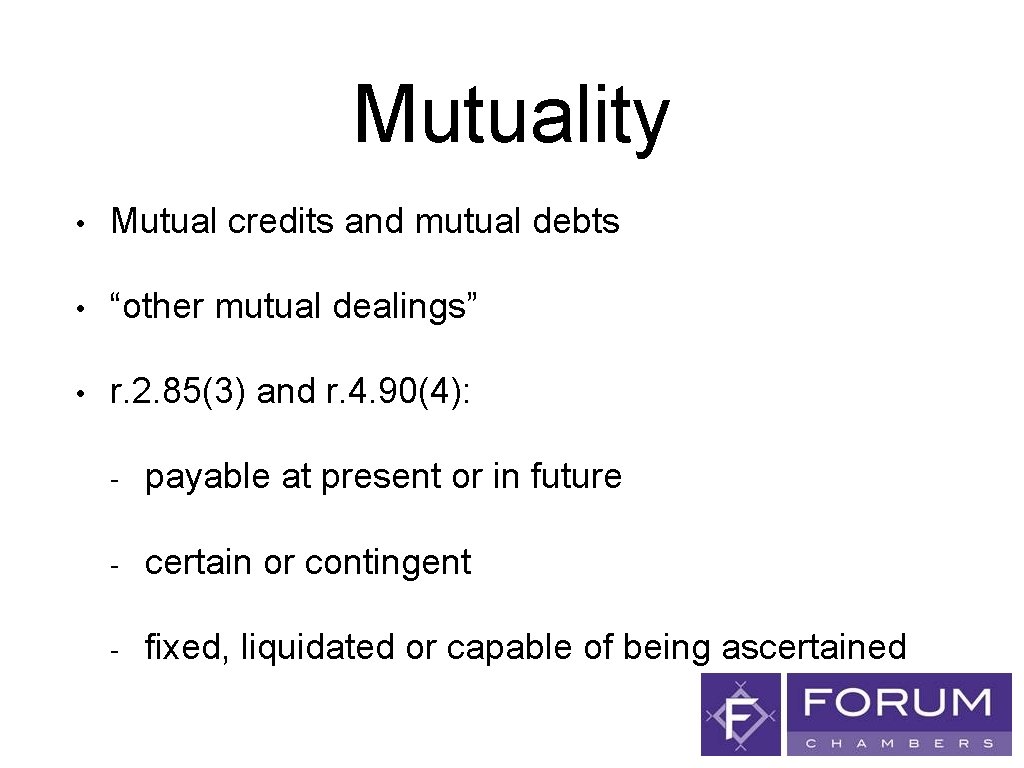
Mutuality • Mutual credits and mutual debts • “other mutual dealings” • r. 2. 85(3) and r. 4. 90(4): - payable at present or in future - certain or contingent - fixed, liquidated or capable of being ascertained
Mutuality • Stein v Blake [1996] AC 243 - Claim and cross-claim - Two causes of action cease to exist - Replaced by one claim for the balance
Is the claim worth pursuing? A question of cause and effect
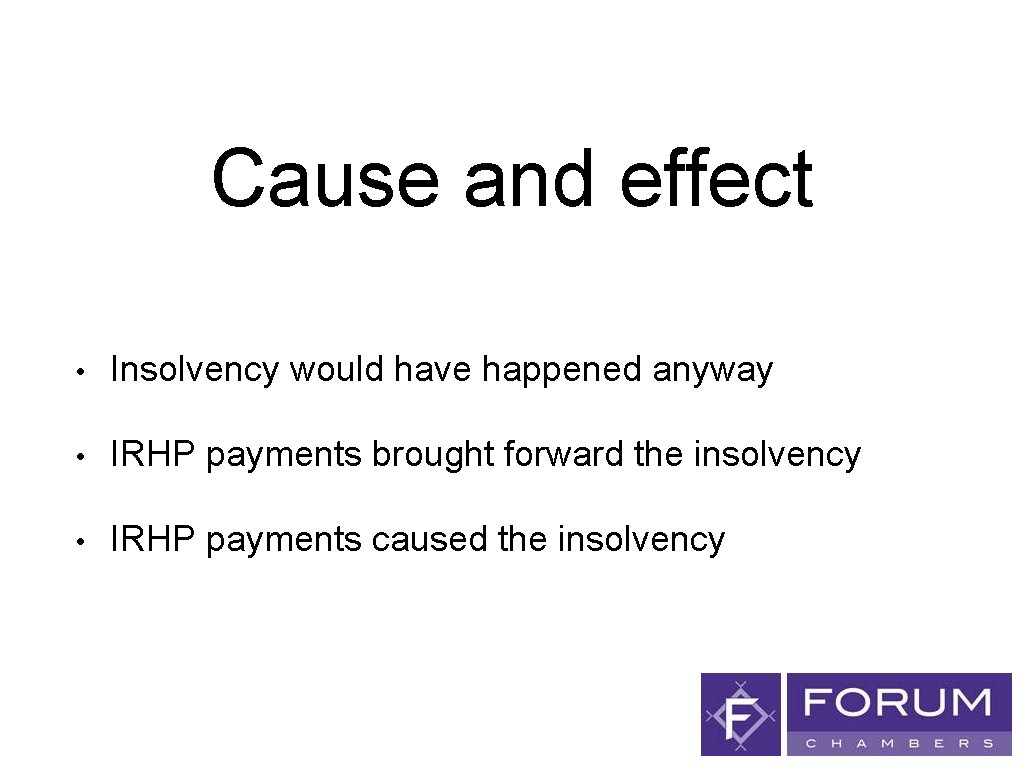
Cause and effect • Insolvency would have happened anyway • IRHP payments brought forward the insolvency • IRHP payments caused the insolvency
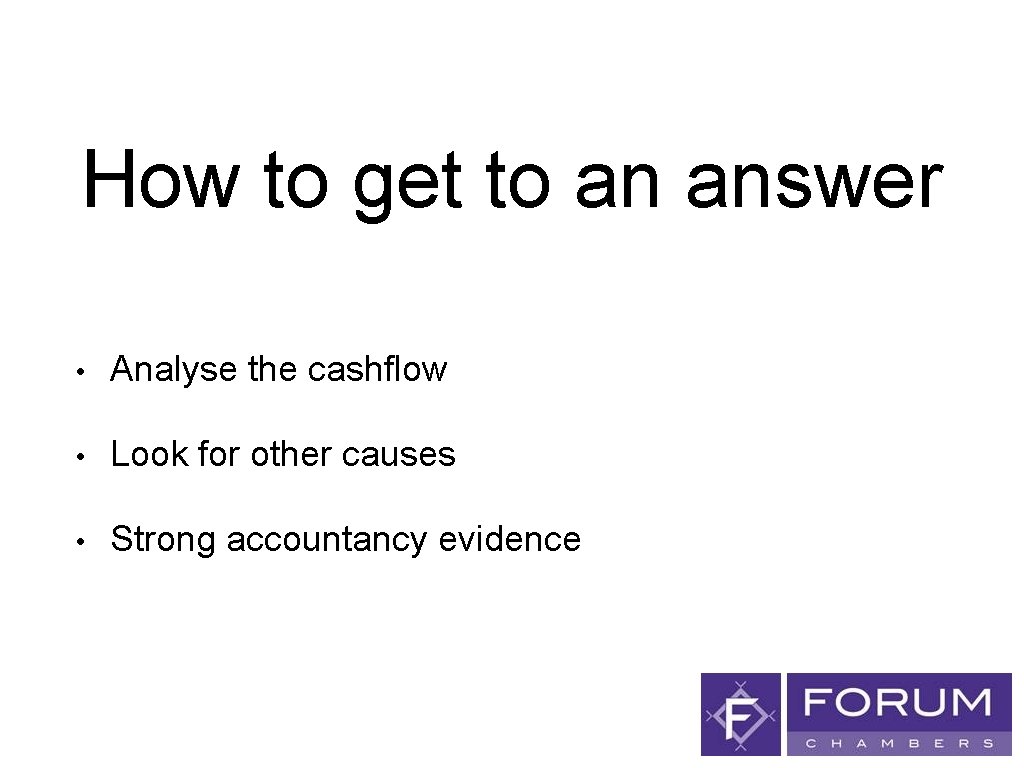
How to get to an answer • Analyse the cashflow • Look for other causes • Strong accountancy evidence
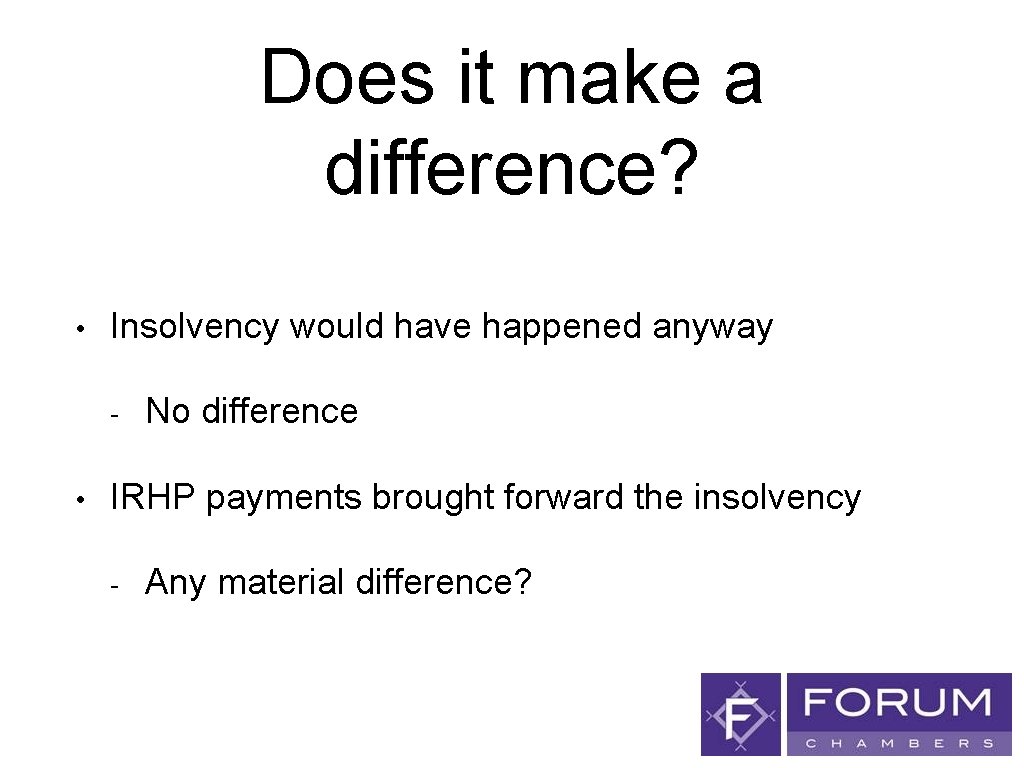
Does it make a difference? • Insolvency would have happened anyway - • No difference IRHP payments brought forward the insolvency - Any material difference?
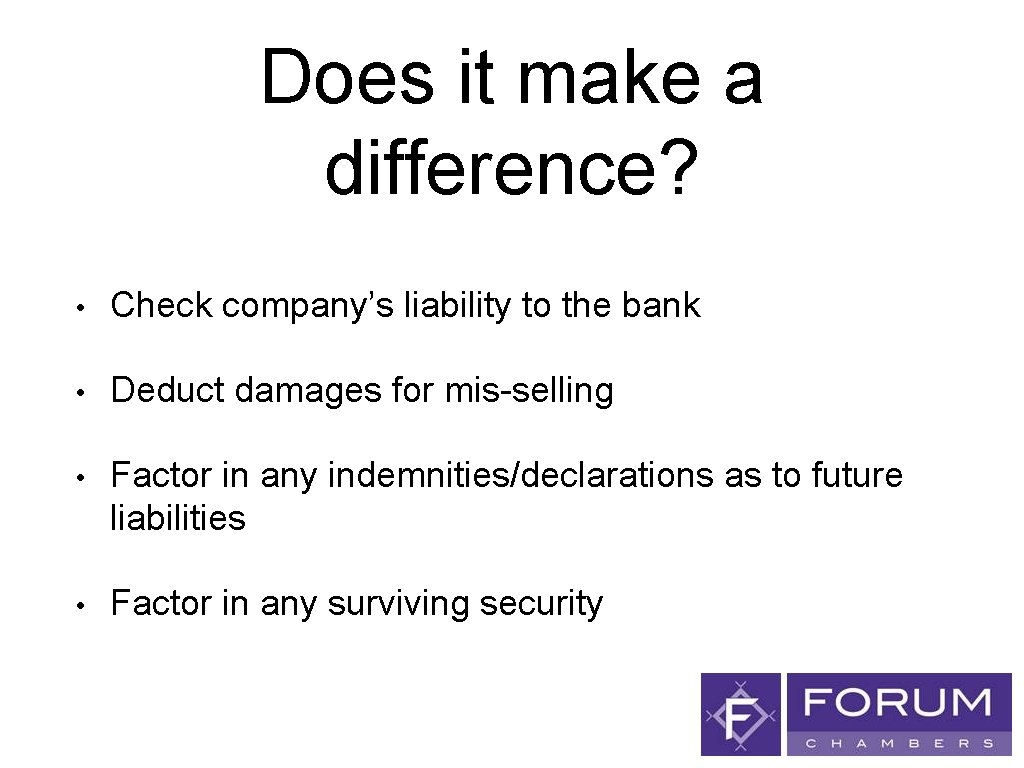
Does it make a difference? • Check company’s liability to the bank • Deduct damages for mis-selling • Factor in any indemnities/declarations as to future liabilities • Factor in any surviving security
Does it make a difference? • Check company’s liability to the bank • Deduct damages for mis-selling • Factor in any indemnities/declarations as to future liabilities • Factor in any surviving security
Philip Currie PCurrie@Forum. Chambers. com