
Compensation Benefits OBJECTIVES 1 COST HRM Assignment On
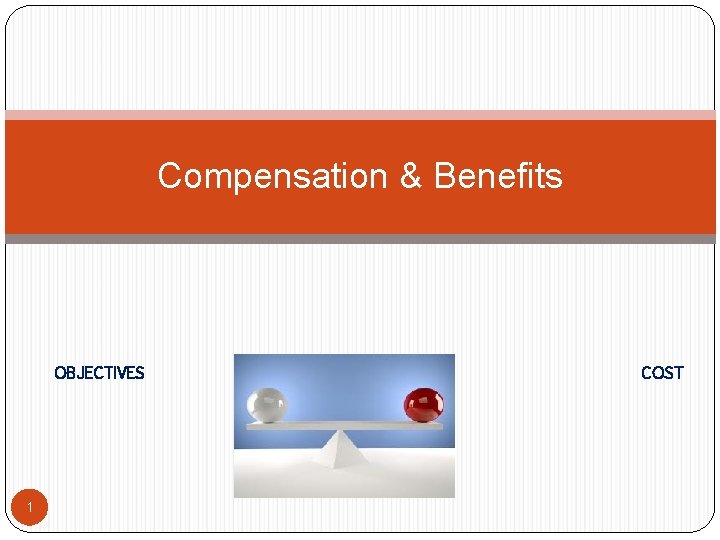
Compensation & Benefits OBJECTIVES 1 COST

HRM Assignment On any of the topics below: 1. 2. 3. 4. 5. 6. Human Resource Planning. Selection Practices. Training & Development. Performance Management. Reward & Compensation Systems. Change Management. Narrate details of Unique Practices in their organizations. Presentation on 29/9. All participants require to be present 2
The Compensation problem for Managers How much to pay employees; How much emphasis to place on financial compensation as part of the Total reward system; How much emphasis to place on attempting to hold down the rate of pay; Whether to implement a system of individual incentives to reward differences in performance and productivity and, if so, how much emphasis to place on these incentives 3
What is Compensation? Compensation represents both the intrinsic and extrinsic rewards employees receive for performing their jobs. 4
Intrinsic Compensation represents employees’ critical psychological states that result from performing their jobs Research indicates employees experience enhanced psychological states when their jobs rate high on five core job dimensions: skill variety, task identity, task significance, autonomy, and feedback. Jobs that lack these core characteristics do not provide much intrinsic compensation Intrinsic compensation may help reduce excessive turnover. Eg. New technologies, learning and training opportunities etc Also, provide the basis for nonmonetary recognition rewards 5
Intrinsic Compensation Skill variety : The degree to which the job requires the person to perform different tasks and involves different skills, abilities, and talents Task identity : The degree to which a job enables a person to complete an entire job from start to finish Task significance : The degree to which the job has an impact on the lives or work of other people 6
Intrinsic Compensation Autonomy : The amount of freedom, independence, and discretion the employee enjoys in determining how to perform the job Feedback : The degree to which the job or employer provides the employee with clear and direct information about job outcomes and performance 7
Extrinsic Compensation include both monetary and nonmonetary rewards Monetary compensation represents “core compensation” Non-monetary rewards(Employee benefits)include protection programs (i. e medical insurance), paid time off(i. e vacations), and services (i. e day care assistance) 8
Theories of Compensation 9
Theories of Remuneration Reinforcement theory Expectancy theory Equity theory Agency theory H u m a n R e s o u r c e M 10
Influencing Factors of Remuneration 11
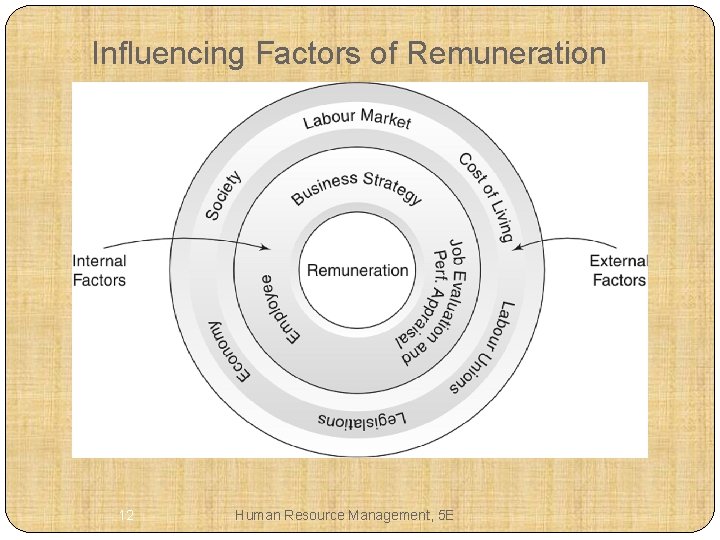
Influencing Factors of Remuneration 12 Human Resource Management, 5 E
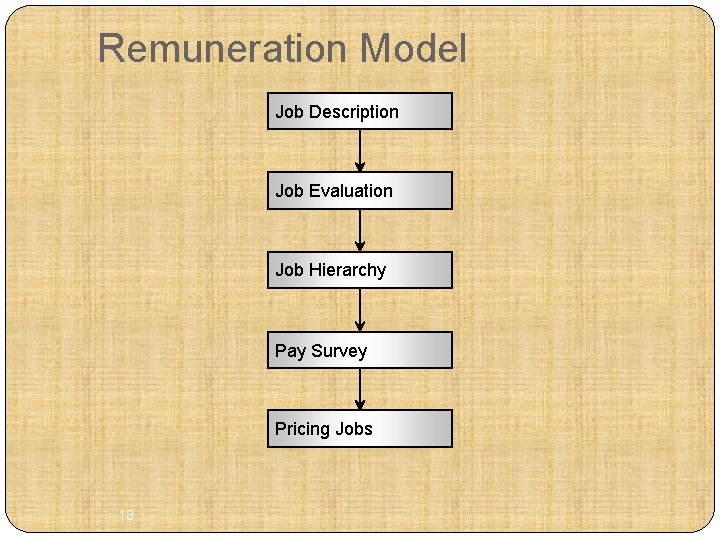
Remuneration Model Job Description Job Evaluation Job Hierarchy Pay Survey Pricing Jobs 13
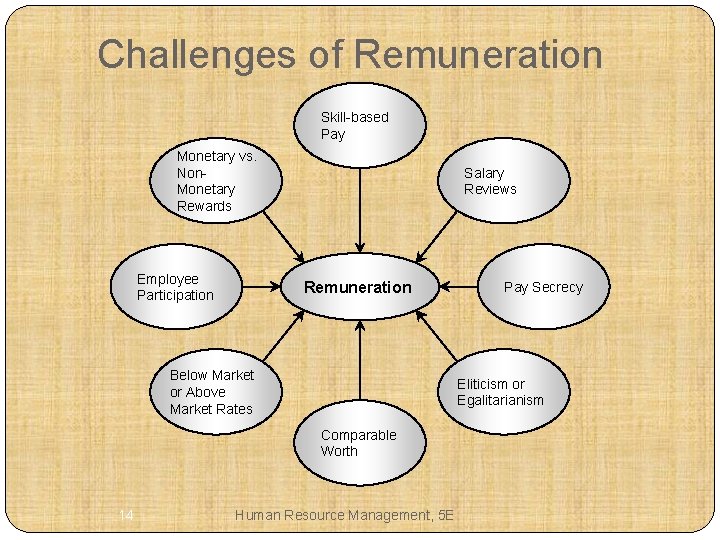
Challenges of Remuneration Skill-based Pay Monetary vs. Non. Monetary Rewards Employee Participation Salary Reviews Remuneration Below Market or Above Market Rates Eliticism or Egalitarianism Comparable Worth 14 Pay Secrecy Human Resource Management, 5 E
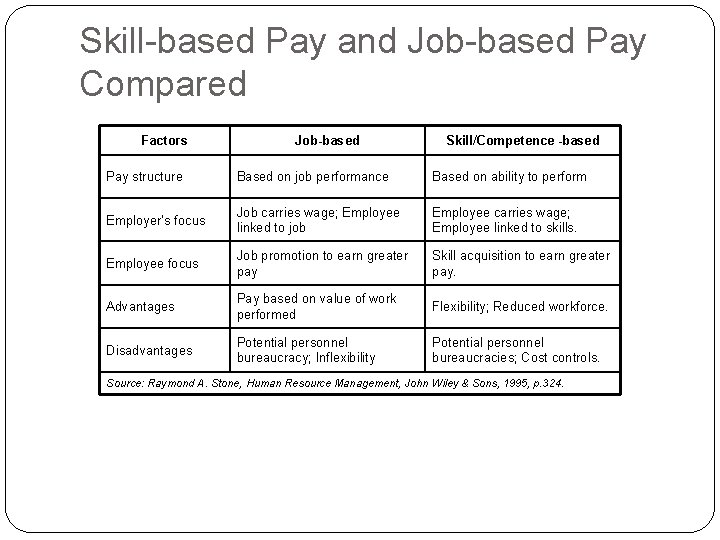
Skill-based Pay and Job-based Pay Compared Factors H u m a n R e s o u r c e M Job-based Skill/Competence -based Pay structure Based on job performance Based on ability to perform Employer’s focus Job carries wage; Employee linked to job Employee carries wage; Employee linked to skills. Employee focus Job promotion to earn greater pay Skill acquisition to earn greater pay. Advantages Pay based on value of work performed Flexibility; Reduced workforce. Disadvantages Potential personnel bureaucracy; Inflexibility Potential personnel bureaucracies; Cost controls. Source: Raymond A. Stone, Human Resource Management, John Wiley & Sons, 1995, p. 324. 15
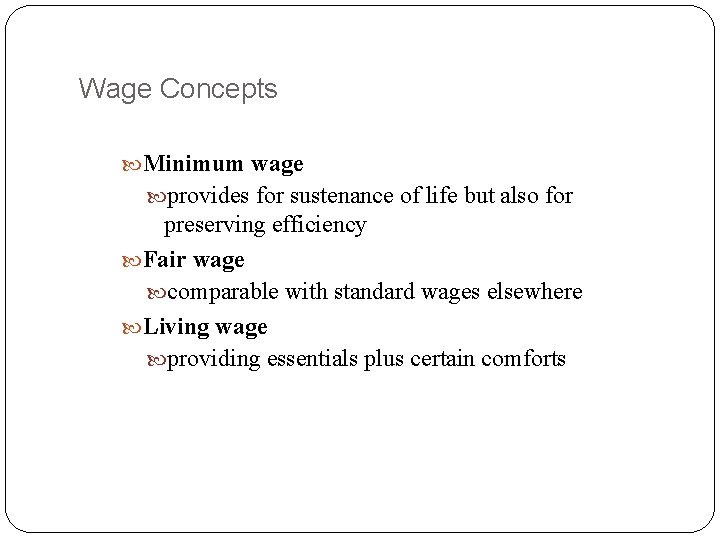
Wage Concepts Minimum wage provides for sustenance of life but also for H u m a n R e s o u r c e M preserving efficiency Fair wage comparable with standard wages elsewhere Living wage providing essentials plus certain comforts 16
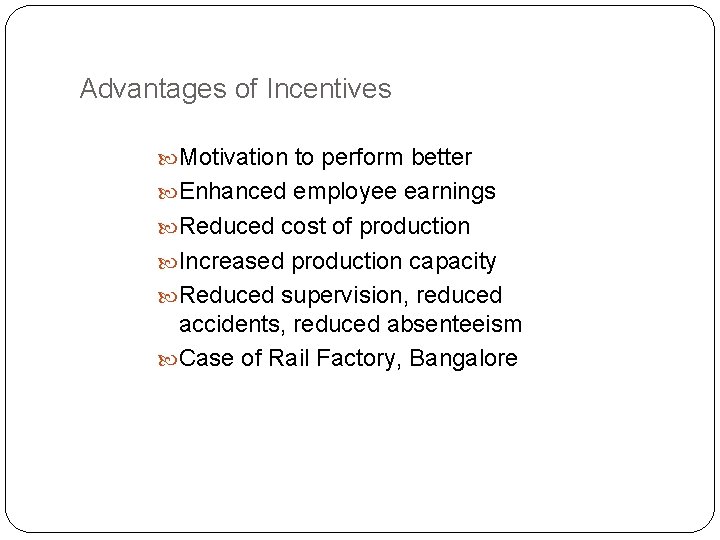
Advantages of Incentives Motivation to perform better Enhanced employee earnings Reduced cost of production Increased production capacity Reduced supervision, reduced accidents, reduced absenteeism Case of Rail Factory, Bangalore 17 Human Resource Management, 5 E
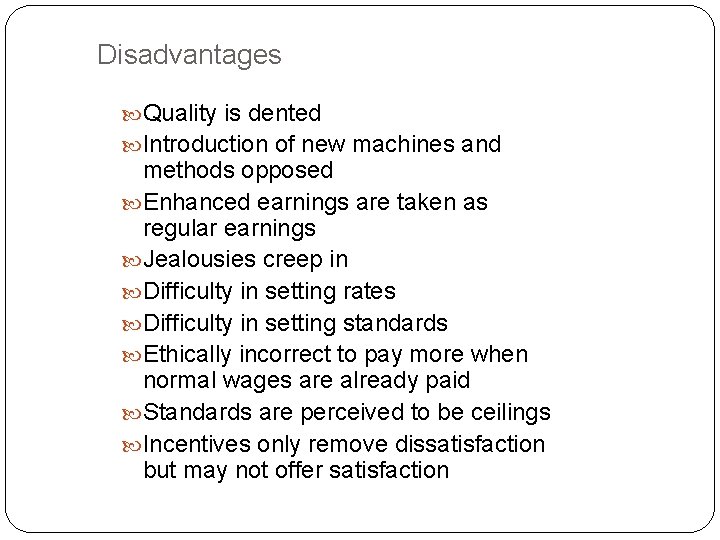
Disadvantages Quality is dented Introduction of new machines and methods opposed Enhanced earnings are taken as regular earnings Jealousies creep in Difficulty in setting rates Difficulty in setting standards Ethically incorrect to pay more when normal wages are already paid Standards are perceived to be ceilings Incentives only remove dissatisfaction but may not offer satisfaction 18 Human Resource Management, 5 E
The Compensation Process Cycle 19 Comp. & Ben. : XIMR, Mumbai : Devdatta Mahajan
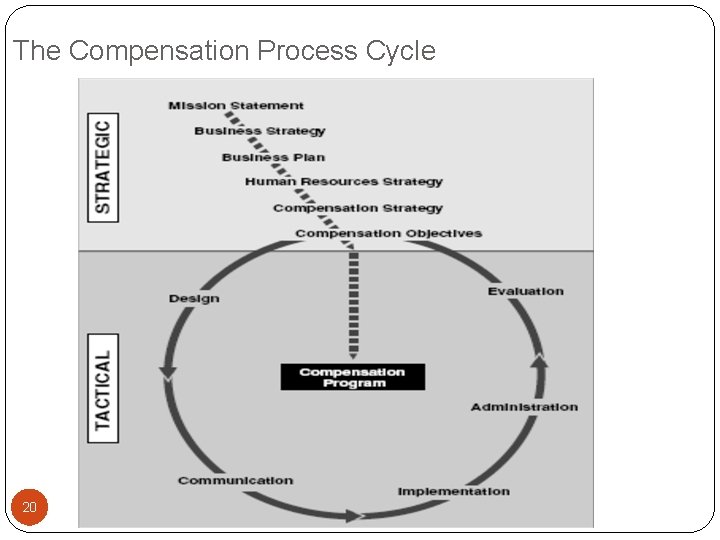
The Compensation Process Cycle 20
Strategic Perspective of Compensation 21 Comp. & Ben. : XIMR, Mumbai : Devdatta Mahajan
Strategic Perspective of Compensation The strategic perspective involves thinking about how compensation can assist in achieving organization success, while not being fixated on pay techniques.
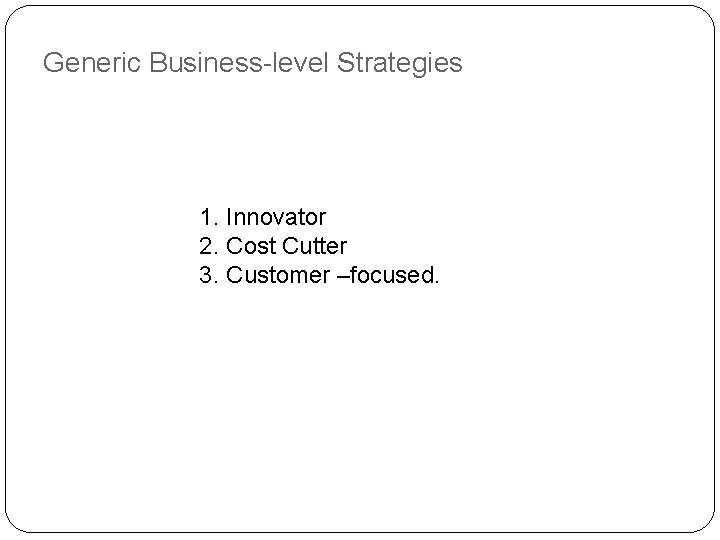
Generic Business-level Strategies 1. Innovator 2. Cost Cutter 3. Customer –focused.
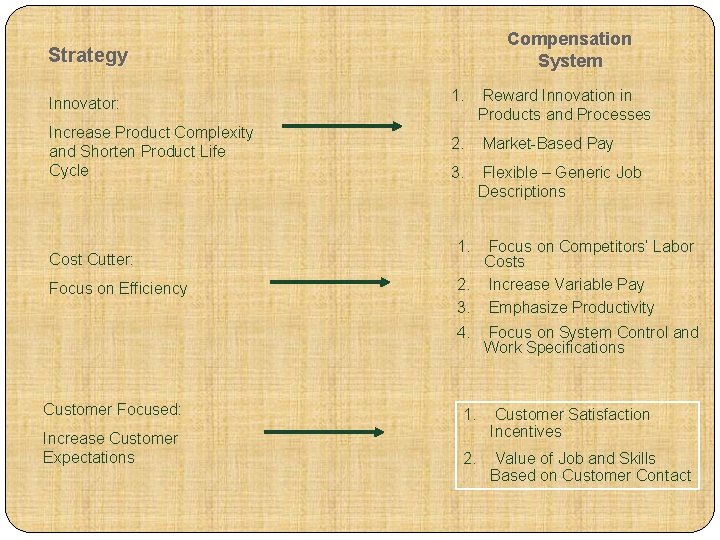
Compensation System Strategy Innovator: Increase Product Complexity and Shorten Product Life Cycle Cost Cutter: Focus on Efficiency 1. Reward Innovation in Products and Processes 2. Market-Based Pay 3. Flexible – Generic Job Descriptions 1. Focus on Competitors’ Labor Costs 2. Increase Variable Pay 3. Emphasize Productivity 4. Focus on System Control and Work Specifications Customer Focused: 1. Increase Customer Expectations Customer Satisfaction Incentives 2. Value of Job and Skills Based on Customer Contact
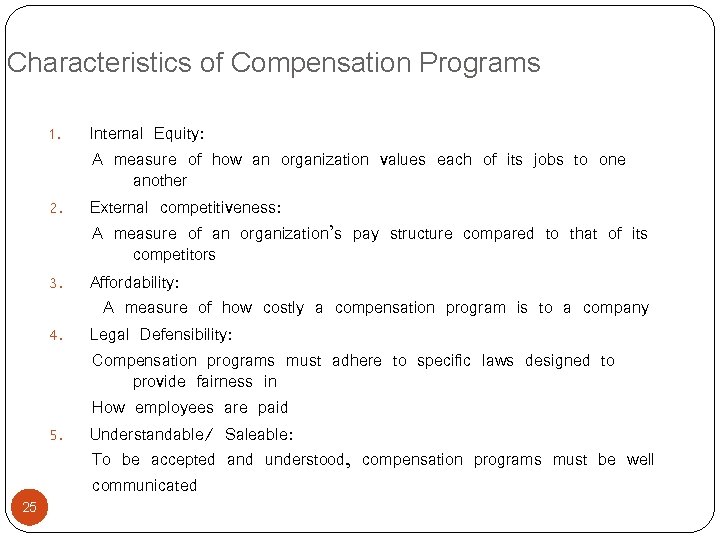
Characteristics of Compensation Programs 25 1. Internal Equity: A measure of how an organization values each of its jobs to one another 2. External competitiveness: A measure of an organization’s pay structure compared to that of its competitors 3. Affordability: A measure of how costly a compensation program is to a company 4. Legal Defensibility: Compensation programs must adhere to specific laws designed to provide fairness in How employees are paid 5. Understandable/ Saleable: To be accepted and understood, compensation programs must be well communicated
Characteristics of Compensation Programs 26 6. Efficient to Administer: Simple and straightforward, balanced between what appears to be the“best” program and what is efficient, effective and easy to administer 7. Safeguard organizational resources: Rewards should reflect both individual employee and company performance 8. Flexible: Capable of changing as needed without requiring a redesign every time a new need arises 9. Meets the organization’s unique needs: Unique characteristics of the organization (industry, geographical area etc. )
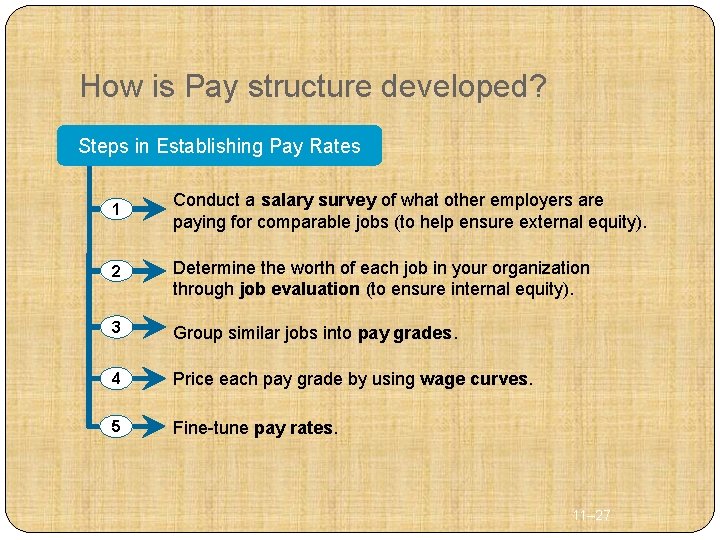
How is Pay structure developed? Steps in Establishing Pay Rates 1 Conduct a salary survey of what other employers are paying for comparable jobs (to help ensure external equity). 2 Determine the worth of each job in your organization through job evaluation (to ensure internal equity). 3 Group similar jobs into pay grades. 4 Price each pay grade by using wage curves. 5 Fine-tune pay rates. 11– 27
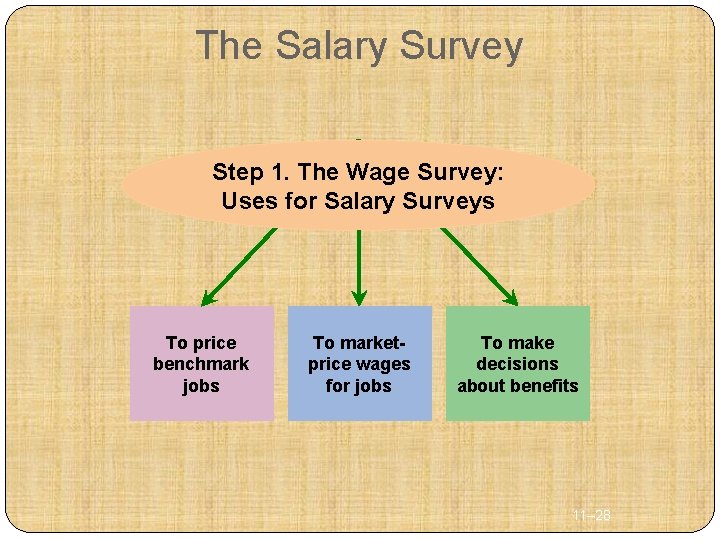
The Salary Survey Step 1. The Wage Survey: Uses for Salary Surveys To price benchmark jobs To marketprice wages for jobs To make decisions about benefits 11– 28
Job Evaluation 29 Job Evaluation : Formal process used to create a job-worth hierarchy within an organization. The hierarchy is called Job Grades (JG) Two major objectives: To develop internal standards of comparison To measure relative job values within the organization Used to establish pay differentials among employees within a company Job Analysis -> Job Documentation - > Job Evaluation
Compensable Factors Compensable factors are the key to quantitative methods of job evaluation Compensable factors can be defined as: a. Any criterion used to provide a basis for judging job value in order to create a jobworth hierarchy b. The elements used to measure a job’s worth c. Intrinsic elements in jobs that add value to the organization and for which it wants to pay For eg. Skill, effort, responsibility, Working conditions 30
Compensable Factors Skill Experience Knowledge Manual dexterity – relates to specific movements required Analytical ability Creativity Communication – verbal and written Complexity of the job Effort Physical demands of the job Mental exertion required 31
Compensable Factors Responsibility Supervisory duties Budgetary responsibility Decision making Accountability Impact the job has on the organization Working conditions Hazardous environment Temperature conditions Odors Loud noises Or lack of hazardous environment 32
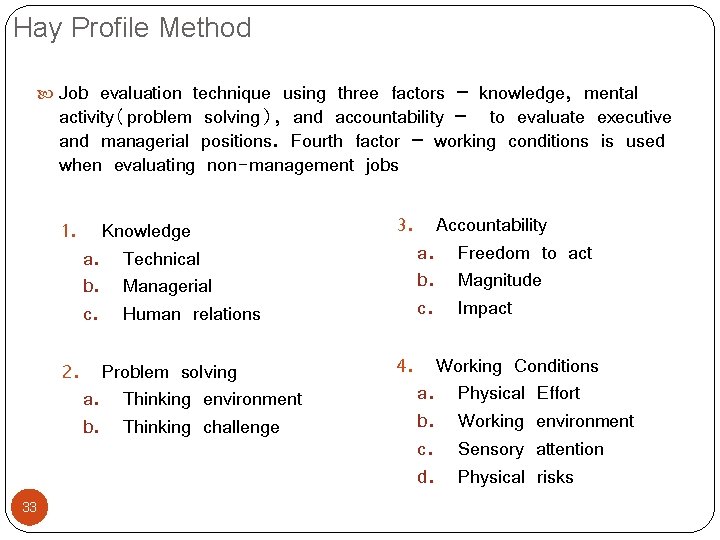
Hay Profile Method Job evaluation technique using three factors – knowledge, mental activity(problem solving), and accountability – to evaluate executive and managerial positions. Fourth factor – working conditions is used when evaluating non-management jobs 33 1. Knowledge a. Technical b. Managerial c. Human relations 3. Accountability a. Freedom to act b. Magnitude c. Impact 2. Problem solving a. Thinking environment b. Thinking challenge 4. Working Conditions a. Physical Effort b. Working environment c. Sensory attention d. Physical risks
Establishing Pay Rates (cont’d) Step 4. Price Each Pay Grade—Wage Curve Shows the pay rates paid for jobs in each pay grade, relative to the points or rankings assigned to each job or grade by the job evaluation. Shows the relationships between the value of the job as determined by one of the job evaluation methods and the current average pay rates for your grades. 11– 34
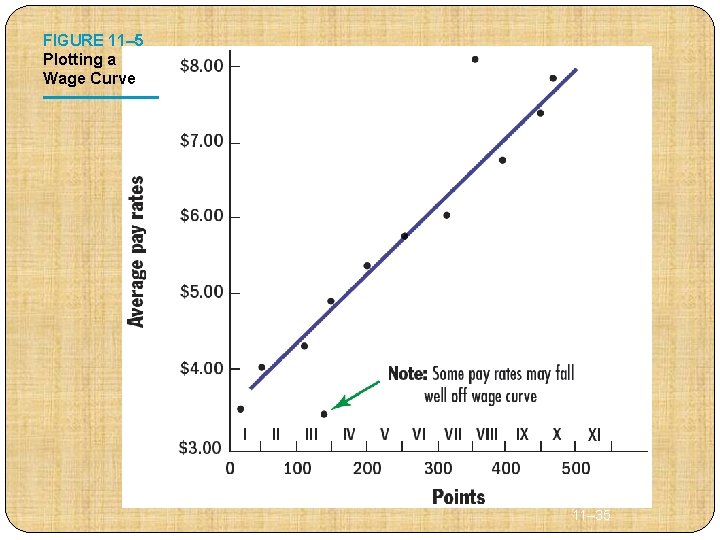
FIGURE 11– 5 Plotting a Wage Curve 11– 35
Establishing Pay Rates (cont’d) Step 5. Fine-Tune Pay Rates Developing pay ranges Flexibility in meeting external job market rates. Easier for employees to move into higher pay grades. Allows for rewarding performance differences and seniority. Correcting out-of-line rates Raising underpaid jobs to the minimum of the rate range for their pay grade. Freezing rates or cutting pay rates for overpaid (“red circle”) jobs to maximum in the pay range for their pay grade. 11– 36
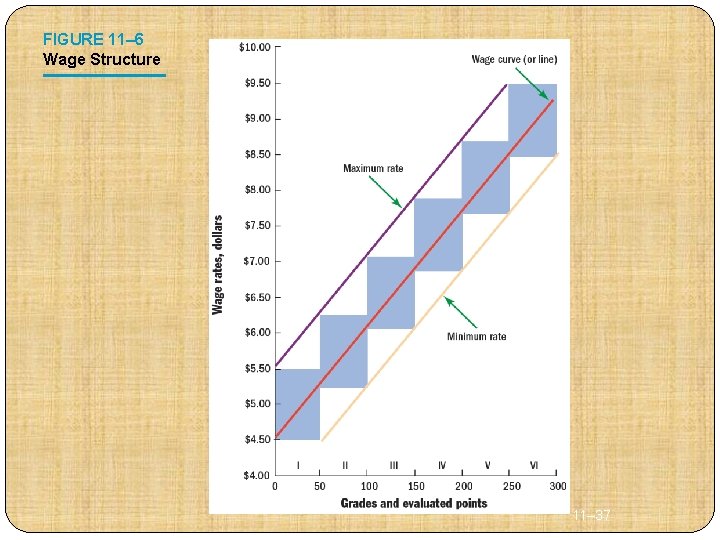
FIGURE 11– 6 Wage Structure 11– 37
Elements of Core Compensation Variable Pay : Discretionary compensation that is contingent upon performance or results achieved Based on organizational/group/individual performance Profit-Sharing plans Group/Team Incentives Individual incentives Short-term incentive plans Sales incentive plans/commissions Executive incentive plans Discretionary bonus (annual or spot) Equity-based compensation 38
What is a Pay Structure? Pay Structure : A series of pay ranges, or “grades”, each with a minimum and maximum pay rate Jobs are grouped together in ranges that represent similar internal and external worth The mid-point or middle-pay value for the range usually represents the competitive market value for the job or group of jobs Base-pay policy line: It connects the mid-points of the pay ranges in the pay structure 39
Anatomy of a Pay Structure Pay Ranges: A “pay range” has a minimum pay value, a maximum pay value and a “midpoint” or central value. Range Spread: The difference between the maximum and the minimum is the “range spread” Range Width: Range width usually is expressed as a percentage of the difference between the minimum and maximum divided by the minimum. To perform the calculation, one of the three points (minimum, midpoint or maximum) on the pay range needs to be specified along with the range width. 40
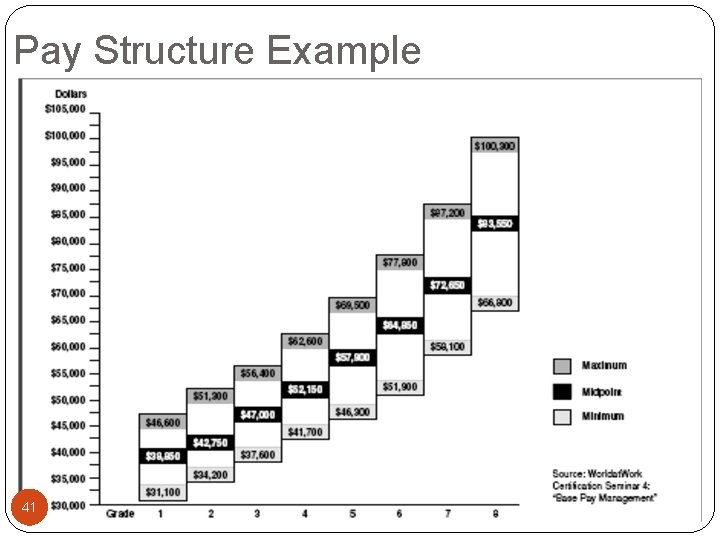
Pay Structure Example 41
Mid-point Central value of the pay range Key element in pay administration Used as a reference point in salary administration decisions as a point or “target. ” The midpoint is usually the reference used because it is typically set to equal the market average. Must not be an organization’s only market reference point. 42

Compa-Ratio : Monitoring Comp. Costs A statistic that expresses the relationship between base salary and the midpoint, or between the midpoint and market average. 43
Compa-Ratio: Monitoring Comp. Costs Compa-ratios can be calculated for individuals, groups of individuals and the company as a whole. Most companies strive to have the overall work force paid at or around a compa-ratio of 100 percent. Individual compa-ratios vary according to how long the individual has been in the job, previous work experience and job performance. A mature, long service work force will tend to have a higher compa-ratio (often above 100 percent) than a younger group of employees with a shorter service record 44
Why companies monitor Compa. Ratio? Important tool for managing compensation costs. In some cases, companies cap pay at the midpoint for the purpose of paying “at market” for base The remainder of the range is available only performers and often is paid on a lump-sum from year to year. These companies increase base salaries only range midpoints move and their compa-ratios below 100 percent. 45 salaries. to high basis when drop
Range Penetration Another tool to track an organization’s compensation Compare individual pay in relation to the total pay range It refers to how far into the range a individual’s salary has penetrated. Range penetration is calculated using maximum of a pay range. Range penetration is a preferred tool not focus on one number alone, the compa-ratio). 46 particular the minimum and because it does midpoint (like
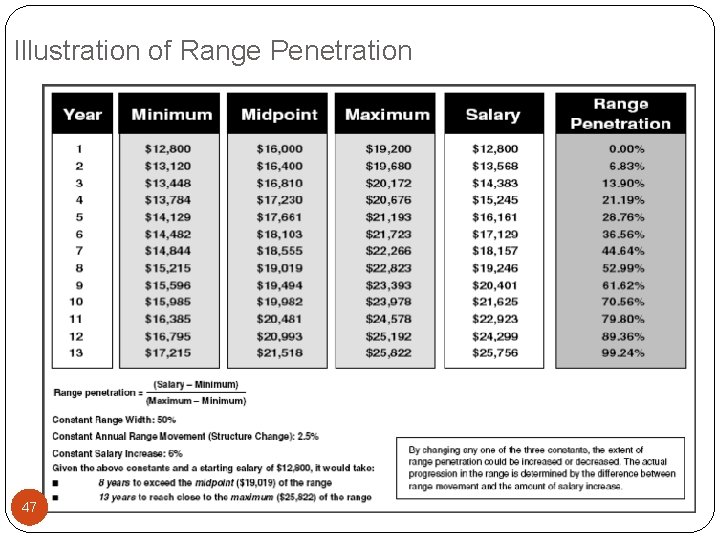
Illustration of Range Penetration 47
Pay Grades Groups of jobs within a particular class that are paid the same rate or rate range Multiple jobs that have similar value based on internal comparisons and external market data are grouped The purpose of grades is to be able to refer to a compensation range Grades need not always be numerical; alpha grades can serve the purpose just as well. There are many grades or levels within a pay structure. The number of grades will vary based on findings from market research as well as the company’s compensation policy. 48
Types of Structures for Base Pay Multiple grades with Salary Ranges Broadbanding 49
Multiple Grades with Salary ranges Roles or jobs are assigned a salary range with the midpoint closest to market value of the role or job Grades and corresponding salary ranges generally number 20 to 35 Range spreads are commonly 75% for management jobs and 50% for non-management jobs 50
Broadbanding (Career Bands) Broadbanding is the consolidation of traditional pay structures, consisting of 4 -5, narrow pay ranges into a few, wider ranges or bands. Broadbanding is intended to support agile, flatter, faster-paced, de-bureaucratized organizational cultures. Reasons for banding: Delegating pay decisions: drive pay decision-making downward (empowering managers) Supporting organizational flexibility: provide greater latitude in management pay decisions reduce use of promotions to increase pay Emphasizing the person over the job Enabling organizational mobility: promote lateral moves or in-grade promotions 51
Broadbanding (Career Bands) Structure: The broadband range spread is generally 100% to 400%. Minimum and Maximum are decided based on market As a band encompasses so many jobs of differing values, range mid-point is not used Most broadbanding companies use 10 bands: 2 for the executive level 4 for the managerial and professional level 4 for the non-managerial level Drawbacks : Increases the potential for employees to float to the top of the band, way out of sync with the market Lack the automatic cost-control mechanism inherent in narrow pay ranges 52
Elements of Core Compensation Base Pay : Non-discretionary compensation that does not regularly vary according to performance or results achieved Recurring in nature (until the employees remain in their jobs) Based upon the level of skill, effort, responsibility to perform the jobs, and severity of the working conditions. Referred to as “compensable factors” Salary, hourly, or piece rates Differentials: Shift, Weekend / Holiday, Expatriate 53
Elements of Core Compensation Base Pay : How Base pay is adjusted over time Cost-of-living adjustments : Linked to inflation (CPI) etc Seniority Pay: Time spent in the organization (human capital theory) Merit Pay : Recognizing efforts, performance Person-focused pay : Pay for knowledge and skill -based pay, competency-based pay Market-based adjustments 54
Incentive plans Individual Incentive plans: reward employees whose work is performed independently Group Incentive Plans: Rewards groups that rely on interdependent teams Promotes supportive, collaborative behavior among employees Company-wide plans – Ties compensation to company’s performance over a short-term 55
Individual Incentive Plan Appropriate under 3 conditions: 1. 2. 3. 56 Employees’ performance can be measured objectively Employees have sufficient control over work outcomes To prevent creation of a level of unhealthy competition

Individual Incentive Plan Types of Individual Incentive Plan 1. 2. 3. 4. Piecework plans – based on standard machine rate Management incentive plans – Divisional targets of sales, production, profit etc are met Behavioral incentive plans – Good attendance, Safety etc Referral plans – Referring new customers or successful job applicants 57 Comp. & Ben. : XIMR, Mumbai : Devdatta Mahajan
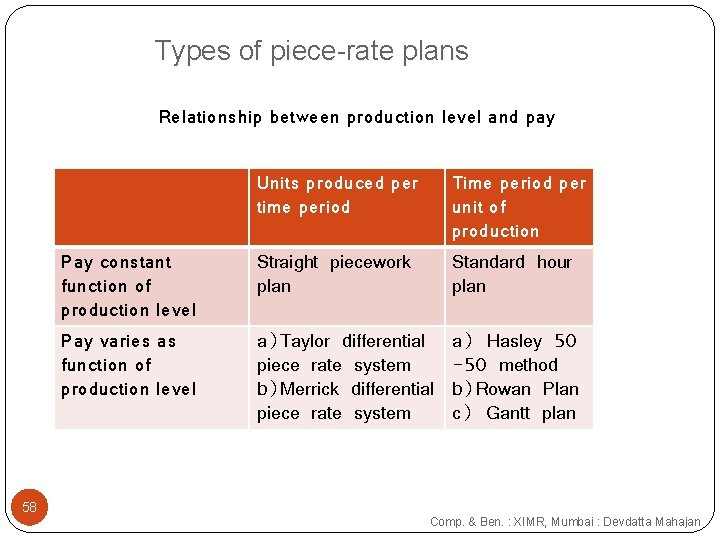
Types of piece-rate plans Relationship between production level and pay Units produced per time period Time period per unit of production Pay constant function of production level Straight piecework plan Standard hour plan Pay varies as function of production level a)Taylor differential piece rate system b)Merrick differential piece rate system a) Hasley 50 -50 method b)Rowan Plan c) Gantt plan 58 Comp. & Ben. : XIMR, Mumbai : Devdatta Mahajan
Types of piece-rate plans Straight Piecework plans Piece rate standard: 10 units/hour Guaranteed minimum if standard is not met: $5 per hour Incentive rate (over 10 units): $0. 50 per unit Standard hour plans Appropriate for long-cycle operations , non-repetitive and skillful jobs Taylor plan: Establishes two piecework rates viz. Incentive Higher if piecework rate is Faster than standard rate Incentive lower if piecework rate is slower than standard rate 59
Types of piece-rate plans Merrick plan: Establishes three piecework rates viz. Incentive Higher if piecework rate exceeding 100% of standard Incentive Medium if piecework rate is between 83% and 100% of standard Incentive Lower if piecework rate is less than 83% of standard Hasley 50 -50 method Savings shared 50 -50 between worker and employee Standard allowed time determined by time study If less than standard time, resulting savings shared 60 Comp. & Ben. : XIMR, Mumbai : Devdatta Mahajan
Types of piece-rate plans Rowan Plan Savings shared between worker and employee Standard allowed time determined by time study If less than standard time, resulting savings shared Workers bonus increases as time required to complete the task decreases For eg. 10 hrs to 7 hrs – 30% bonus 10 hrs to 6 hrs – 40% bonus 61 Comp. & Ben. : XIMR, Mumbai : Devdatta Mahajan
Types of piece-rate plans Gantt Plan Standard time for task is purposely set at a level requiring high effort to complete Below standard: Pre-established wage guaranteed If tasks completed in standard time or less: Earnings pegged at 120% of the time saved Hence, workers earnings increase faster whenever standard time is met or exceeded 62 Comp. & Ben. : XIMR, Mumbai : Devdatta Mahajan
Individual Incentive Plan Advantages: Promotes relationship between pay and performance 2. Promotes equitable distribution of compensation within companies 3. Recognizes individual performance and enhances the motivational value of individual incentive programs Disadvantages: 1. Promotes inflexibility 2. Poses measurement and management problems 3. May encourage undesirable behavior if the incentive plan rewards only one or a subset of dimensions that constitutes employees’ total job performance (quality, quantity, delivery etc. ). 1. 63

Group Incentive Plans Initiated by Japanese firms Team incentives led to superior product quality Promoted innovation in the workplace Encouraged team members to learn new skills Encouraged team members to assume broader responsibility Emphasized cooperation Rewards employees for their collective performance Financial reward for the attainment of a group goal Types of Group Incentive plans 1. Team-based or small-group incentive plans 2. Gain sharing plans 64 Comp. & Ben. : XIMR, Mumbai : Devdatta Mahajan

Team-based or small-group Incentive plans Types of Teams / Groups Work (Process) Teams – Encourages cross-training, can be supplemented by person-focused pay for skills acquired 2. Project Teams – One-time activity, roles defined, collaboration 3. Parallel Teams or task forces – Employees assigned to work on a specific task in addition to normal work duties, Temporary in nature Customer satisfaction, safety records, quality and production records 1. 65 Comp. & Ben. : XIMR, Mumbai : Devdatta Mahajan
Team-based or small-group Incentive plans Compensating Teams / Groups Equal incentives payments to all team members ü Reinforces cooperation 2. Differential incentive payments to team members based on their contribution to the team’s performance ü Recognizes individual performance within the group 3. Differential payments determined by a ratio of each team member’s base pay to total base pay of the group ü Assumes that employees with higher base pay contribute more to the company 1. 66 Comp. & Ben. : XIMR, Mumbai : Devdatta Mahajan
Gain Sharing Plans Reflects a management philosophy that emphasizes employee involvement Has 3 components: Leadership philosophy – refers to a cooperative organizational climate that promotes trust, open communications, and participation Employee involvement systems – drives organizational productivity improvements Bonus – Sharing bonuses when actual productivity exceeds targeted productivity level Typically gain sharing bonuses are paid on a monthly basis 67 Comp. & Ben. : XIMR, Mumbai : Devdatta Mahajan
Gain Sharing Plans: Types Scanlon Plan : Developed by Joseph Scanlon in 1935 2. Rucker Plan : Developed by Allan Rucker in 1933 Both Plans: Emphasize employee involvement Provide monetary incentives to encourage employee participation Differ in formulas for measuring productivity 3. Improshare Plan (Improved productivity through sharing) ü Developed by Mitchell Fein in 1973 1. 68 Comp. & Ben. : XIMR, Mumbai : Devdatta Mahajan
Gain Sharing Plans Scanlon Plan: Has 3 components: a. Emphasis on teamwork to reduce costs, assisted by management-supplied information on production concerns b. Suggestion systems that route cost-saving ideas from the workforce through a labor-management committee that evaluates and acts on accepted suggestions c. Monetary reward based on productivity improvements to encourage employee involvement 69 Comp. & Ben. : XIMR, Mumbai : Devdatta Mahajan
Gain Sharing Plans Scanlon Plan: Gain sharing formulas vary as per company needs Formulas are usually based upon the ratio between labor costs and sales value of production (SVOP) SVOP = Sales Revenue + Value of goods in inventory Smaller Scanlon ratio -> lower labor costs w. r. t SVOP Improvement in Scanlon ratio from the “baseline” Scanlon ratio will form the basis for gain sharing bonuses 70 Comp. & Ben. : XIMR, Mumbai : Devdatta Mahajan
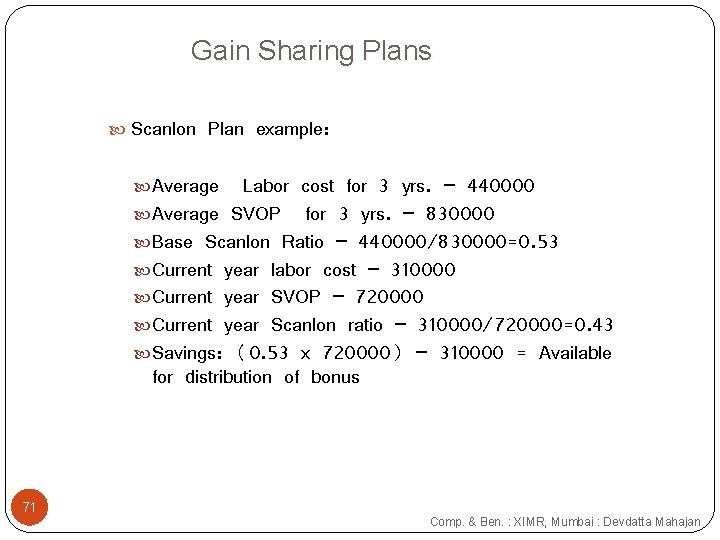
Gain Sharing Plans Scanlon Plan example: Average Labor cost for 3 yrs. – 440000 Average SVOP for 3 yrs. – 830000 Base Scanlon Ratio – 440000/830000=0. 53 Current year labor cost – 310000 Current year SVOP – 720000 Current year Scanlon ratio – 310000/720000=0. 43 Savings: (0. 53 x 720000) – 310000 = Available for distribution of bonus 71 Comp. & Ben. : XIMR, Mumbai : Devdatta Mahajan
Gain Sharing Plans Rucker Plan: Uses a value-added formula to measure productivity Value added: Difference between value of sales price of a product and the value of materials purchased to make a product Concept of value added: Can be explained based on a sequence of events For example, to sell bread to consumers – a. Growing wheat (Farmer) b. Milling wheat (Miller) c. Adding wheat to other ingredients to make the bread (Bakery) d. Selling bread to consumers (Retailer) 72 Comp. & Ben. : XIMR, Mumbai : Devdatta Mahajan
Gain Sharing Plans Rucker Plan: Ratio of Value added to total employment costs Larger Rucker ratio indicates value added is greater than total employment costs Bonus distribution under Rucker plan: Improvement in Rucker ratio from the “baseline” Rucker ratio will form the basis for gain sharing bonuses 73 Comp. & Ben. : XIMR, Mumbai : Devdatta Mahajan
Gain Sharing Plans Impro share Plan (Improved productivity through sharing): Measures productivity physically (instead of money savings) Aims to produce more products with fewer labor hours Emphasis on providing employees with an incentive to finish products Employee participation not a feature Based on labor hour ratio formula Standard labor hours versus actual 74 Comp. & Ben. : XIMR, Mumbai : Devdatta Mahajan
Group Incentives Advantages Performance measures easy to develop Fewer groups than individuals Greater group cohesion improving effectiveness Disadvantages Leads to feelings of inequity May lead to employee turnover because of “free-rider effect” 75 Comp. & Ben. : XIMR, Mumbai : Devdatta Mahajan
Company-wide Incentive Plans Profit sharing programs Makes workers’ and owners’ goals more compatible Types of Company-wide Incentive plans: Profit sharing plans Stock option plans 76 Comp. & Ben. : XIMR, Mumbai : Devdatta Mahajan
Company-wide Incentive Plans Profit sharing Plans: Pay a portion of company profits to employees Two types: a. b. Current profit sharing plan: Awards cash to employees, typically on a quarterly or annual basis (Taxable) Deferred profit sharing plans: Awards cash in trust accounts for employees (Nontaxable) 77 Comp. & Ben. : XIMR, Mumbai : Devdatta Mahajan
Company-wide Incentive Plans Profit sharing Plans: Three methods to determining pool of profit sharing money a. Fixed first-dollar-of-profits: Specific percentage of pre-tax or post-tax annual profits b. Graduated first-dollar-of-profits: Percentage Slabs, motivates employees to strive for extraordinary profit targets by sharing more of the incremental gain c. Profitability threshold: Sharing when profits are between minimum and maximum i. Minimum threshold - Guarantees a return to shareholders before distribution ii. Maximum threshold – Profits beyond this level is attributed to factors other than employee productivity 78
Company-wide Incentive Plans Profit sharing Plans: Advantages: Enable employees to share in companies’ fortunes Greater financial flexibility to companies Disadvantages: May undermine economic security of employees, particularly if profit sharing represents a sizable portion of direct compensation May affect their saving and buying behavior as profits vary Y-o-Y Attrition of excellent performers Not motivating as employees may not see the direct linkage between performance and profits 79

Company-wide Incentive Plans Stock option plans: Two types: 1. 2. 80 Employee Stock ownership plans: Place company stock in trust accounts for employees. Similar to deferred profit sharing Stock compensation plans : Deferred compensation for Executives 1. Purpose is to create a sense of ownership, aligning the interests of the executive with those of the owners or shareholders of the company
Company-wide Incentive Plans Employee Stock option plans: 1. Grants employees right to purchase shares of company stock 2. Company stock=Total equity 3. Company stock Share= Equity segments of equal value 4. Employees do not own stock until they exercise the stock option rights Grant price/ Strike price: Price, set at grant, at which the employee is entitled to purchase his or her options at some point in future 81
Company-wide Incentive Plans Exercise price: 1. Price at which purchase is exercised 2. Exercise is done at a designated price after a company -chosen time period lapses (usually not more than 5 yrs) 3. Grant price and Exercise price may differ for indexed stock options, discounted stock options, and performance based stock options 82
Company-wide Incentive Plans Employee Stock Option Plans: Advantages: Employee i. Receives a financial interest in the appreciation of the company’s stock ii. Can realize financial gain while still employed iii. No upfront investment needed iv. Depending on plan design, can receive assistance in financing the exercise Advantages : Employer i. Provides employees with substantial cash without use of cash resources ii. Can target key employees, rather than all employees iii. Balanced perspective between short-term and longterm business goals 83
Company-wide Incentive Plans Employee Stock Option Plans: Disadvantages: Employee i. ii. Employee investment required Tax liability Disadvantages : Employer i. ii. 84 Increased dilution May lead to fall in stock prices
Stock option plans Employee Stock purchase plan (ESPP): Gives the employee a chance to buy stock, usually through payroll deductions over a threetwenty seven month “offering” period 2. Price is usually discounted up to 15% of market price Phantom equity: Refers to plans such as phantom stock or Stock appreciation rights (SARs) that provide employees with a payout, usually in cash, based on increase in the company’s stock value Restricted Stock: Involves an outright grant of stock, usually at nominal or no cost 1. 85
- Slides: 85