
Compass surveying Traversing A traverse consists of a


- Slides: 37
Compass surveying
Traversing A traverse consists of a series of straight lines of known length related to one another by known angles between the lines. The points defining the ends of the traverse lines are called the traverse stations. Traverse survey is a method of establishing control points, their positions being determined by measuring the distances between the traverse stations which serve as control points and the angles subtended at the various stations by their adjacent stations. 3
Types of Traverse There are two types of traverse • Open traverse • Closed traverse 4
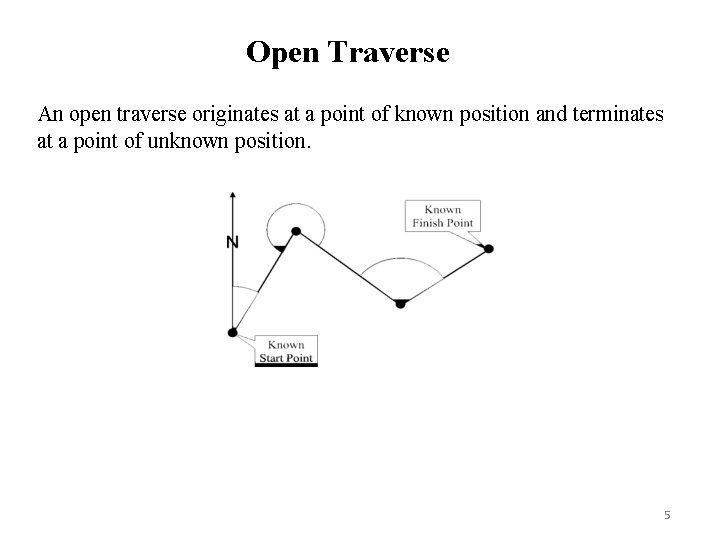
Open Traverse An open traverse originates at a point of known position and terminates at a point of unknown position. 5
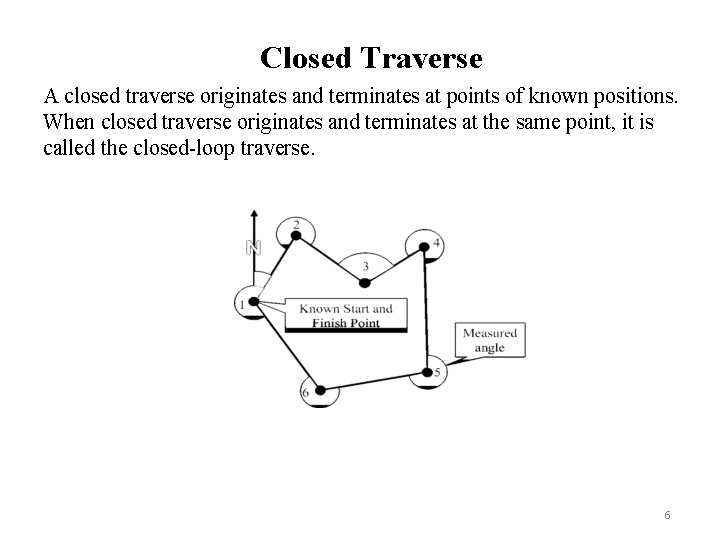
Closed Traverse A closed traverse originates and terminates at points of known positions. When closed traverse originates and terminates at the same point, it is called the closed-loop traverse. 6
Method Of Traversing There are four methods by which the direction of the survey lines are determined are as follow. 1. By the chain angle 2. By the free or loose needle method 3. By the fast needle method 4. By the measurement of angles between the successive lines. 7
1. By The Chain Angle Method/ Chain Traversing In this method, the entire work is done with a chain/tape only and the angle between the successive lines is measured with the chain. Angles fixed by the measurements are known as chain angle. 2. Free Or Loose Needle Method In this method, an angular instrument such as compass or theodolite, is set up at each of the successive stations and the bearing of each lines is taken with reference to the magnetic meridian and not with reference to the adjacent lines. 8
3. Fast Needle Method In this method, a theodolite is used to determine the bearing of each line. The bearing of first line is measured with the magnetic meridians and the bearing of the successive lines are found from the deflection angle or from the included angle. 9
4. Method Of Measurement Of Angles In this method, a theodolite is used for measurement of angles. The horizontal angles measured in a traverse may be • Included angles or • Deflection angles (between the successive lines) This is the most accurate method and is generally used for large surveys and accurate work. 10
Instruments For Measurement Of Angles The instruments commonly used are: • Compass • Theodolite • Total station • Box sextant 11
Compass
Compass The compass is an instrument used for measuring the bearing i. e. the angle between the magnetic meridian and the line. Some special types of compass used in survey are: • Prismatic compass • Lensetic compass • Trough compass • Surveyor’s compass. 13
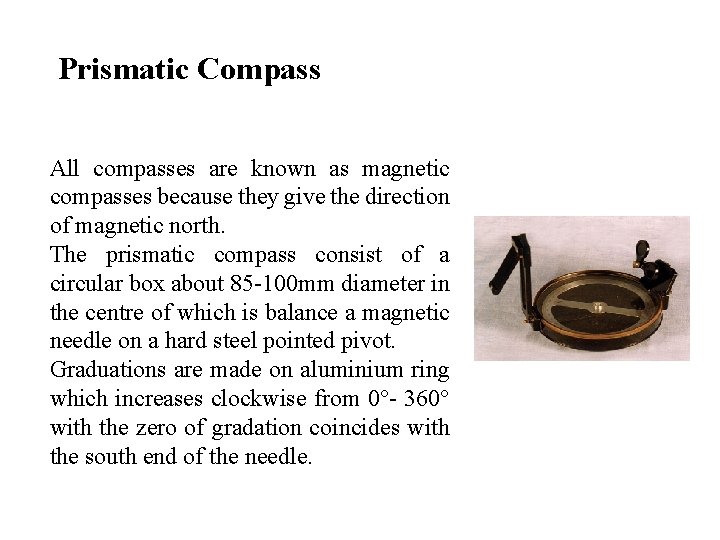
Prismatic Compass All compasses are known as magnetic compasses because they give the direction of magnetic north. The prismatic compass consist of a circular box about 85 -100 mm diameter in the centre of which is balance a magnetic needle on a hard steel pointed pivot. Graduations are made on aluminium ring which increases clockwise from 0°- 360° with the zero of gradation coincides with the south end of the needle.
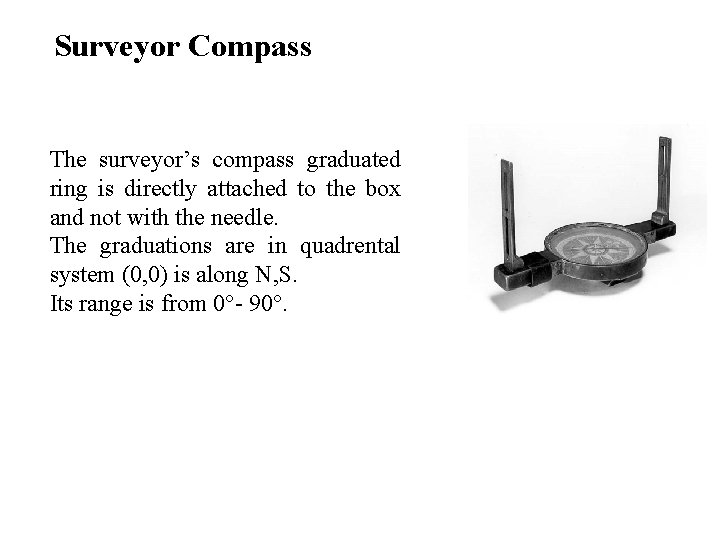
Surveyor Compass The surveyor’s compass graduated ring is directly attached to the box and not with the needle. The graduations are in quadrental system (0, 0) is along N, S. Its range is from 0°- 90°.
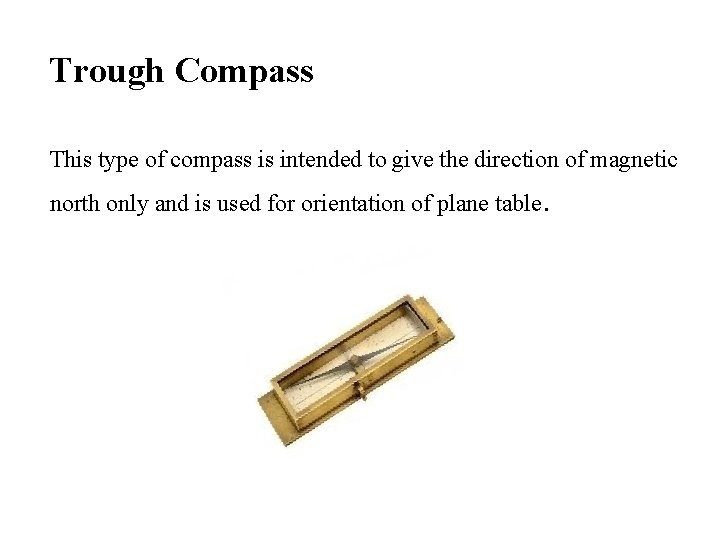
Trough Compass This type of compass is intended to give the direction of magnetic north only and is used for orientation of plane table .
Temporary Adjustments of Compass The adjustments required to be made every time the compass is set up are called its temporary adjustments and are as follows: 1. Centring 2. Levelling 3. Focussing the Prism
1. Centring A Tripod is placed over the station with its legs spread well apart so that it is at a workable height. The compass is fixed on the tripod. It is then centred over the station, where the bearing is to be taken (i. e. the centre of the compass, the pivot is brought exactly above the ground station). A plum bob is hung from the centre of compass. In case the arrangement for a plum bob is not provided, a stone is dropped from below the compass and it should fall on the peg marking the ground station.
2. Levelling The compass is levelled by eye judgement. This is essential so that the graduated ring swings freely. Sometimes, in surveyor’s compass, two plate levels at right angles are also provided to level the instrument. The levelling is achieved by a ball and socket arrangements which is adjusted till the bubbles become central in both the plate levels.
3. Focussing the Prism The adjustment is done only in a prismatic compass. The prism is moved up or down till the figures and graduations are seen clearly.
Theodolite
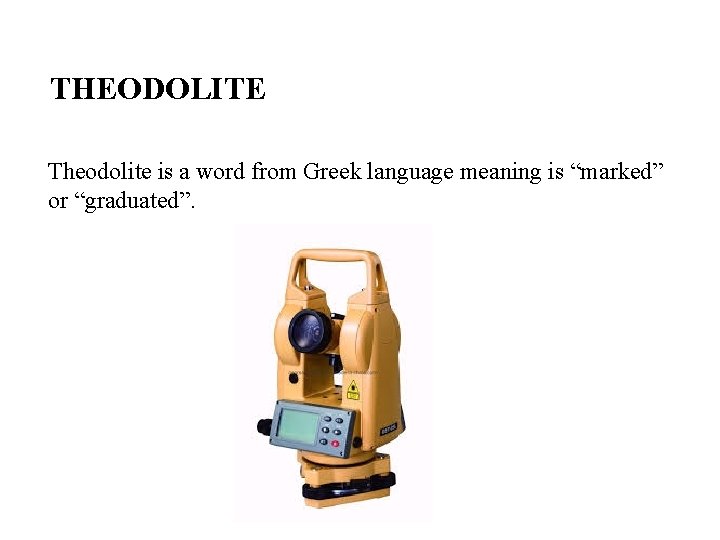
THEODOLITE Theodolite is a word from Greek language meaning is “marked” or “graduated”.
USES OF THEODOLITE 1. 2. 3. 4. Measurement of Horizontal Angles. Measurement of vertical angles. It is use for finding the heights of the object. It is also used for measuring the height of inaccessible object (e. g. Heights or peaks of hills). 5. It is used to find the horizontal distances between different points. 6. It is used to measure the deflection angle. 7. It is used for layout of different engineering structures (e. g. layout of building, roads, vertical or Horizontal curves, mosques, commercial zone).
TERMINOLOGIES 1. Centring is a process in which the centre of instrument (Theodolite, Prismatic Compass) is plot vertically on ground or vertical line is form. 2. Transiting is the method on the process of tuning the telescope in the vertical plane about the horizontal axis is called as Transiting. 3. Face Left It is the position of the Theodolite. It means the vertical circle of theodolite is on the left side of observer while taking reading.
TERMINOLOGIES 4. Face Right It is the position of the instrument when vertical circle is on the right side of the observer when taking reading. 5. Changing Face It is the operation of bringing the vertical circle from right to left and vice versa. 8. Horizontal Axis It is the axis of rotation of telescope in vertical plane. 9. Vertical Axis The movement or rotation of telescope in the Horizontal plane is about the vertical axis.
Total Station 26
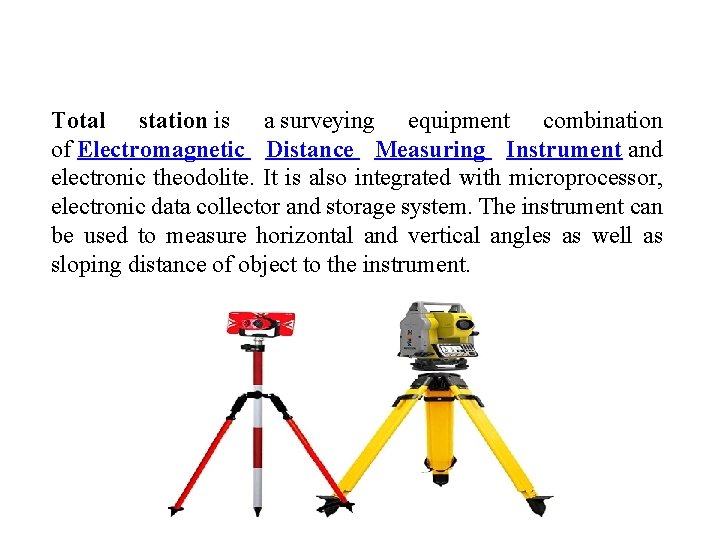
Total station is a surveying equipment combination of Electromagnetic Distance Measuring Instrument and electronic theodolite. It is also integrated with microprocessor, electronic data collector and storage system. The instrument can be used to measure horizontal and vertical angles as well as sloping distance of object to the instrument.
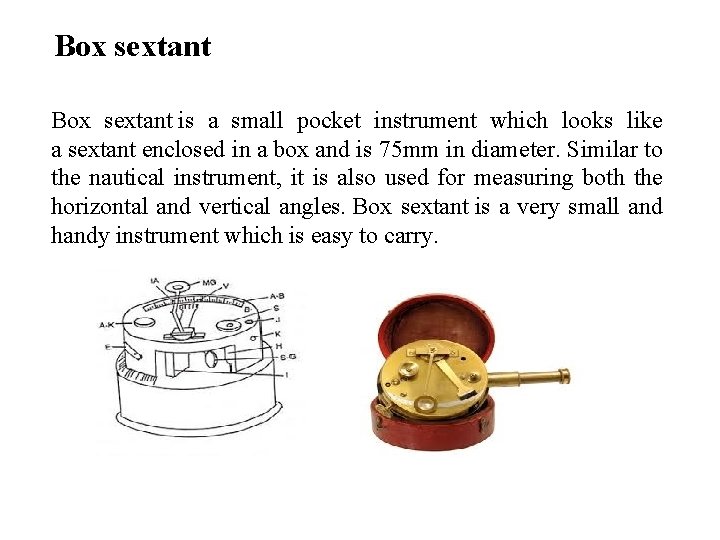
Box sextant is a small pocket instrument which looks like a sextant enclosed in a box and is 75 mm in diameter. Similar to the nautical instrument, it is also used for measuring both the horizontal and vertical angles. Box sextant is a very small and handy instrument which is easy to carry.
Bearing of line The horizontal angle between the reference meridian and the survey line is termed as bearing of the survey line. Types of bearing 1. 2. 3. 4. 5. True Bearing Magnetic Bearing Arbitrary Bearing Grid Meridian 29
Measurement Of Bearing
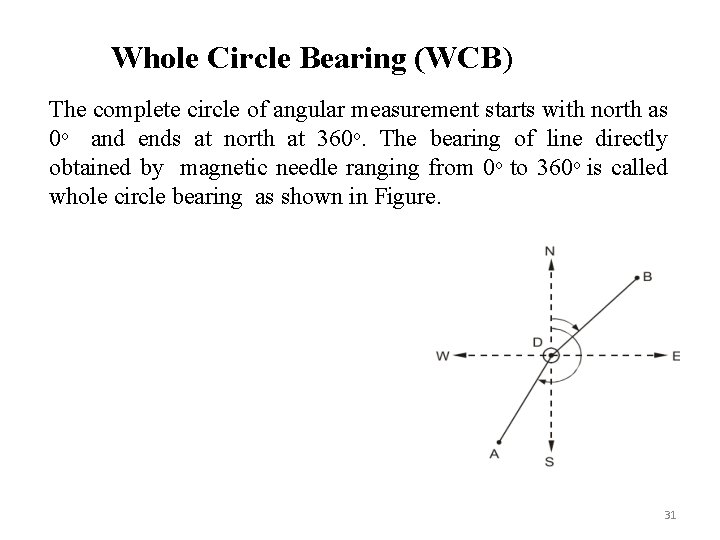
Whole Circle Bearing (WCB) The complete circle of angular measurement starts with north as 0 o and ends at north at 360 o. The bearing of line directly obtained by magnetic needle ranging from 0 o to 360 o is called whole circle bearing as shown in Figure. 31
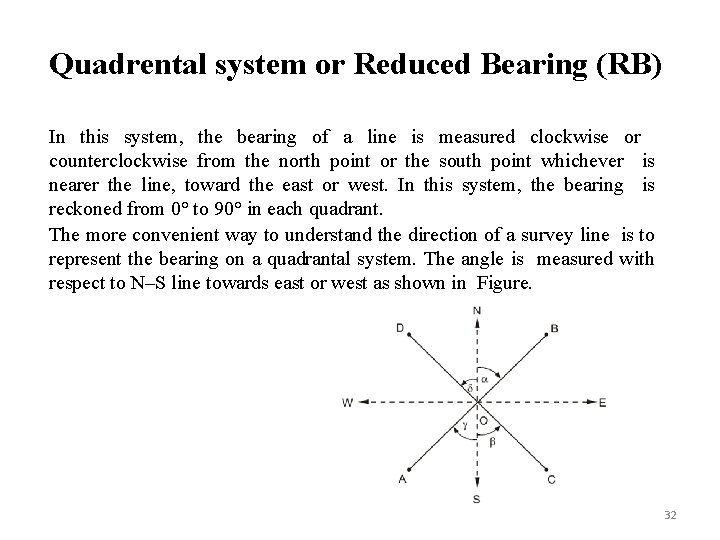
Quadrental system or Reduced Bearing (RB) In this system, the bearing of a line is measured clockwise or counterclockwise from the north point or the south point whichever is nearer the line, toward the east or west. In this system, the bearing is reckoned from 0° to 90° in each quadrant. The more convenient way to understand the direction of a survey line is to represent the bearing on a quadrantal system. The angle is measured with respect to N–S line towards east or west as shown in Figure. 32
Magnetic Declination
Magnetic Declination And Its Variations The horizontal angle between true north and magnetic north at the time of observation is defined as magnetic declination. Variation in Magnetic Declination The declination at any place keeps on changing from time to time. These variations may be classified as follows: Secular Variation Annual Variation Diurnal Variation Irregular Variation
1. Secular Variation The magnetic meridian swings like a pendulum. It swings in one direction for about 100 -150 years, gradually comes to rest, and then swings in other direction. This is known as secular variation. 2. Annual Variation It is the change in the declination at a place over a period of 1 year. It is caused because of the rotation of earth about sun. It is found that the annual variation is about 1 -2 min.
3. Irregular Variation The variation caused due to magnetic disturbances or storms are listed under irregular variation. 4. Diurnal Variation It is the change in the declination at a place in 24 hr. It is due to the rotation of earth about its own axis.