
COMPASS SURVEY COMPASS SURVEYTRAVERSING A traverse survey is

- Slides: 30
COMPASS SURVEY
COMPASS SURVEY(TRAVERSING) • A traverse survey is one in which the framework consists of a series of connected lines , the lengths and directions of which are measured with a chain or a tape and with an angular instrument respectively. • 1. 2. Traverse can be of two types: Open Traverse Closed traverse
Bearing of a line § It is the horizontal angle that a line makes with some reference direction or meridian. § Reference direction may be: 1. True meridian 2. Magnetic meridian 3. Arbitrary or assumed meridian
True Meridian § Points of intersection of earth’s axis and the surface of earth are known as north geographic pole and south geographic pole. § The true meridian is the line joining the geographical north and south bearings. § Horizontal angle between the true meridian and a line is called a true bearing of the line. It is also known as the azimuth.
Magnetic meridian It is the direction indicated by a freely suspended and properly balanced magnetic needle, unaffected by local attractive forces. § The angle which a line makes with the magnetic meridian is called the magnetic bearing or simply bearing of a line. § The angle is always measured in the clockwise direction
Arbitrary Meridian § For small surveys, any convenient direction may be taken as a meridian. § Angle between this meridian and a line is known as an arbitrary/ assumed bearing of a line.
Designation of bearings § Whole Circle Bearing System (WCB) § Quadrantial System / Reduced Bearing system
Whole Circle Bearing System (WCB) § Bearing of a line is always measured clockwise from the north point of the reference meridian towards the line right round the circle. § It can have value between 0 to 360 degrees. § Bearings observed with prismatic compass and theodolite are WCB.
Quadrantial System / Reduced Bearing system § Bearing is measured clockwise or counter-clockwise from the north point or south point whichever is nearer to the line towards east/west. § The plane around a station is divided into 4 quadrants. § Letters N, S, E or W is used to show the directions and the quadrants. § Bearings are reckoned from 0 to 90 degrees in each quadrant.
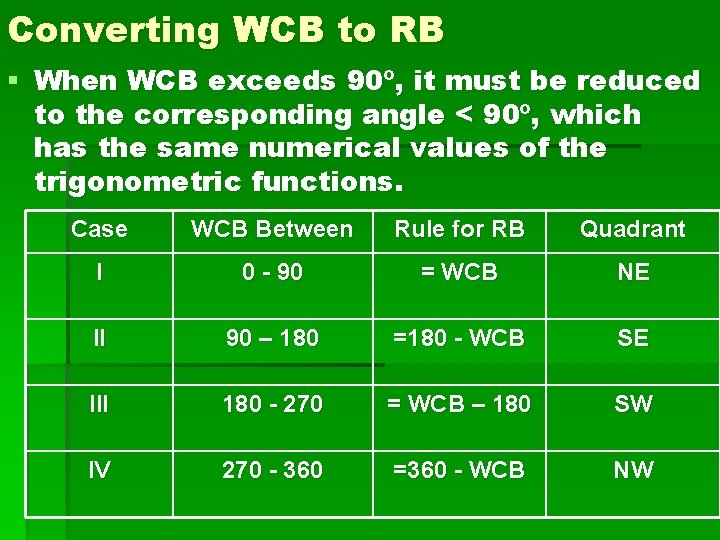
Converting WCB to RB § When WCB exceeds 90º, it must be reduced to the corresponding angle < 90º, which has the same numerical values of the trigonometric functions. Case WCB Between Rule for RB Quadrant I 0 - 90 = WCB NE II 90 – 180 =180 - WCB SE III 180 - 270 = WCB – 180 SW IV 270 - 360 =360 - WCB NW
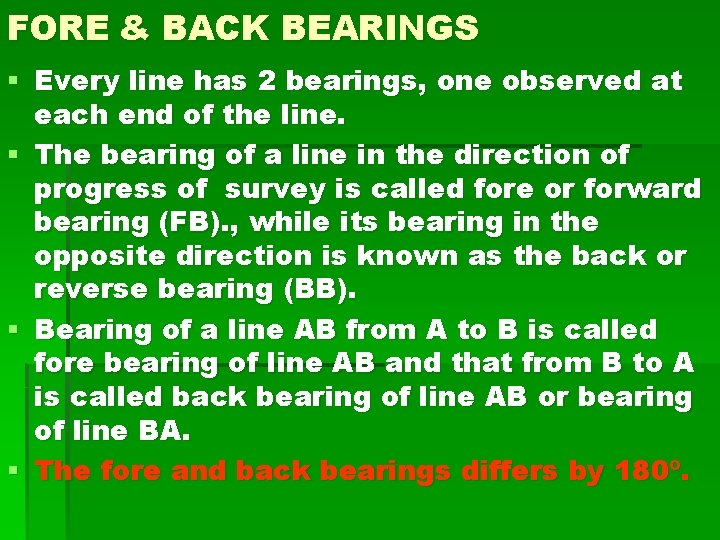
FORE & BACK BEARINGS § Every line has 2 bearings, one observed at each end of the line. § The bearing of a line in the direction of progress of survey is called fore or forward bearing (FB). , while its bearing in the opposite direction is known as the back or reverse bearing (BB). § Bearing of a line AB from A to B is called fore bearing of line AB and that from B to A is called back bearing of line AB or bearing of line BA. § The fore and back bearings differs by 180º.
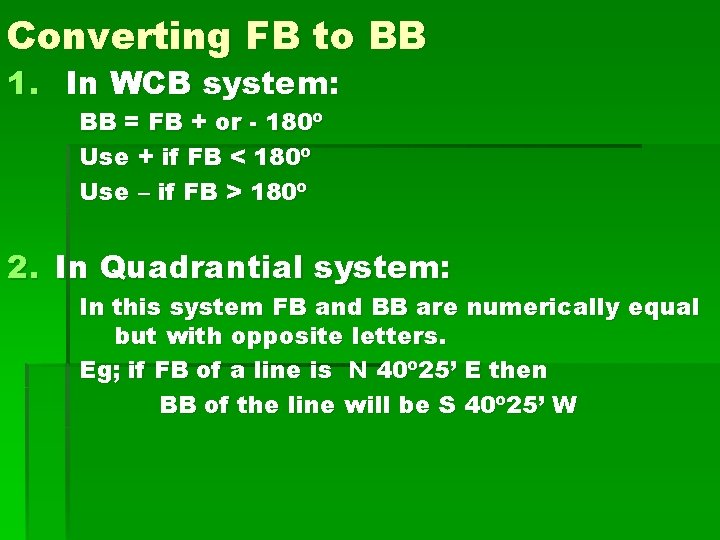
Converting FB to BB 1. In WCB system: BB = FB + or - 180º Use + if FB < 180º Use – if FB > 180º 2. In Quadrantial system: In this system FB and BB are numerically equal but with opposite letters. Eg; if FB of a line is N 40º 25’ E then BB of the line will be S 40º 25’ W
Numericals:
Calculation of angles from bearings: § When 2 lines intersect at a point 2 angles are formed § One interior and the other exterior. ØCase 1: When WCB of lines are given ØCase 2: when reduced bearings of lines are given
Calculation of angles from bearings: § Numericals:
Local Attraction § local attraction is the influence caused on the measured bearings of lines due to the presence of materials like railway track, current carrying wires or cables, etc. ,
Detecting Local Attraction § To detect its presence, it is only necessary to observe the bearings of each line from both its ends. § If FB and BB differs by 180 degrees then no local attraction otherwise local attraction has to be corrected.
Correcting Local Attraction § Method 1: True included angles at the affected stations are computed from the observed bearings. Commencing from, the unaffected line and using the included angles, the corrected bearings of the successive lines are computed. § Method 2: The amount & direction of the error due to local attraction at each of the affected stations is found out. Starting from the bearing unaffected by local attraction, the bearings of the successive lines are adjusted by applying the corrections to the observed bearings.
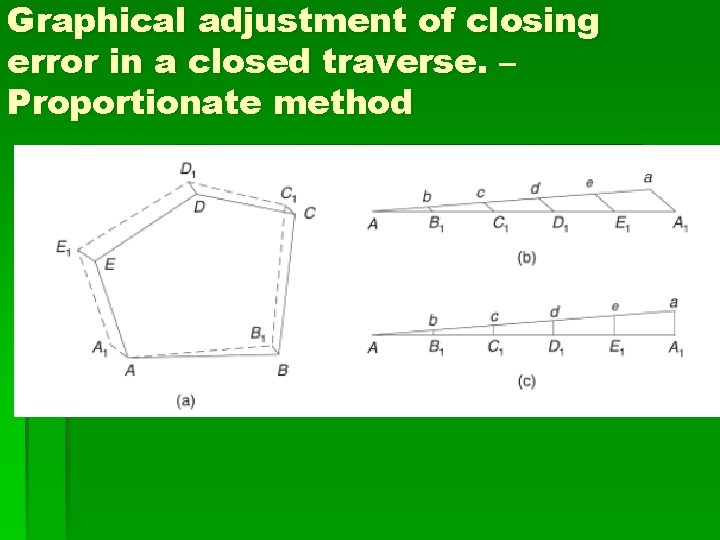
Graphical adjustment of closing error in a closed traverse. – Proportionate method
Elements Of Earth's Magnetic Field § Declination § Angle of dip (or Inclination)
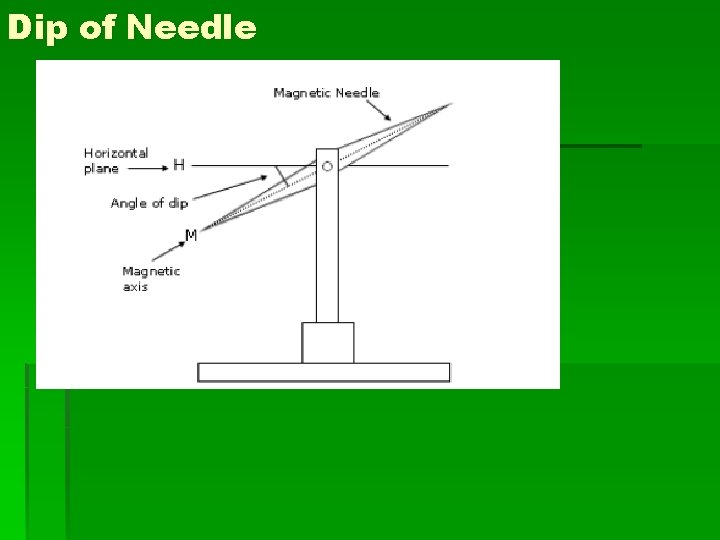
Dip of Needle
Dip of Needle § if we take a magnetic needle which is free to rotate in the vertical plane, then it will not remain perfectly horizontal. § The compass needle makes a certain angle with the horizontal direction. § In fact, in the Northern Hemisphere of Earth, the North Pole of the magnetic needle dips below the horizontal line. § At any place, the magnetic needle points in the direction of the resultant intensity of Earth's magnetic field at the place.
Dip of Needle Angle of Dip at the Poles § The magnetic lines of force at the poles of Earth are vertical due to which the magnetic needle becomes vertical. The angle of dip at the magnetic poles of Earth is 90 o. Angle of Dip at the Equator § The lines of force around the magnetic equator of the Earth are perfectly horizontal. So the magnetic needle will become horizontal there. Thus, the angle of dip at the magnetic equator of the Earth will be 0 o. The angle of dip varies from place to place.
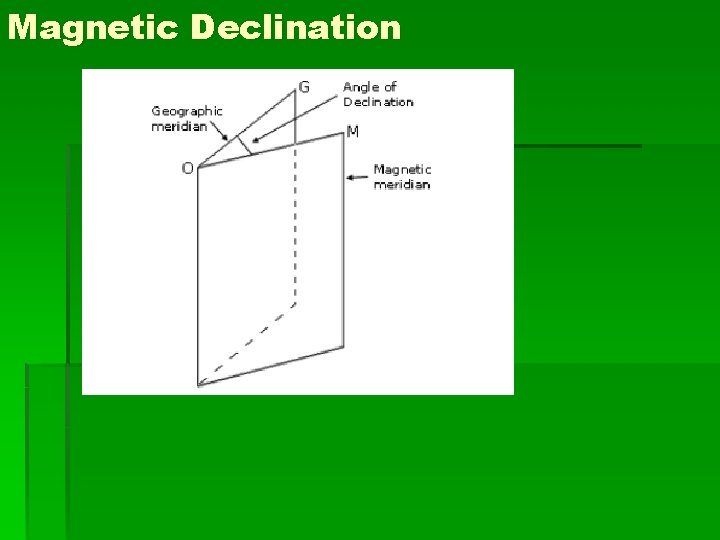
Magnetic Declination § The angle between the magnetic meridian and the geographic meridian at a place is called declination at that place. § The value of the angle of declination is different at different places on Earth. § To find the exact geographic directions (North and South) at a place by using a magnetic compass, we should know the angle of declination at that place.
Magnetic Declination § The declination is expressed in degrees East (o E) or degrees West (o W). § For example a declination of 2°E means the compass will point 2°east of true geographical North. § Thus, the knowledge of declination at a place helps in finding the true geographical directions at that place. § In every map used by surveyors, mariners and air pilots, declination for different places is indicated. It should be noted that at the places of zero declination, the compass North will coincide with the true geographical North
Magnetic Declination
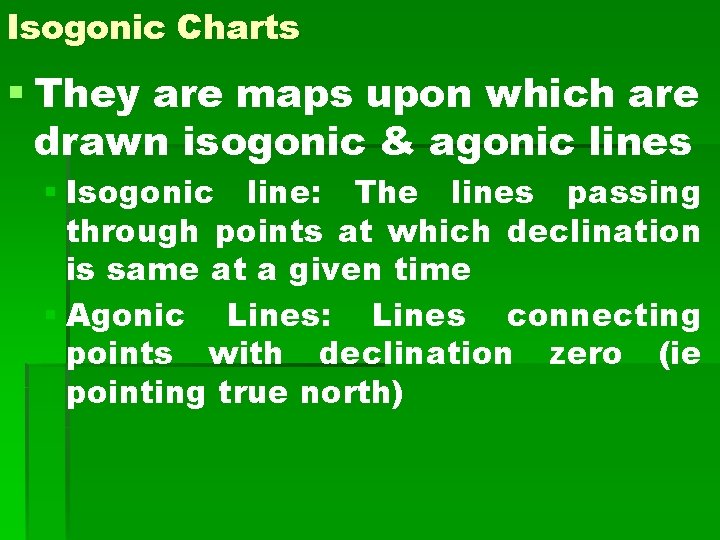
Isogonic Charts § They are maps upon which are drawn isogonic & agonic lines § Isogonic line: The lines passing through points at which declination is same at a given time § Agonic Lines: Lines connecting points with declination zero (ie pointing true north)
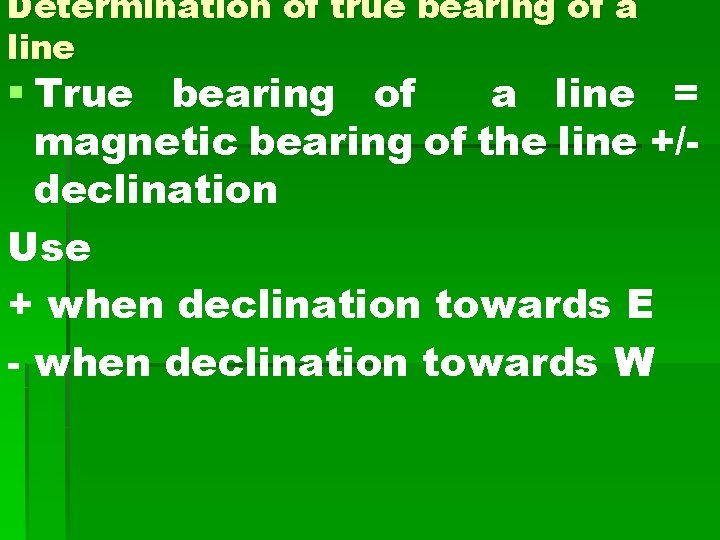
Determination of true bearing of a line § True bearing of a line = magnetic bearing of the line +/declination Use + when declination towards E - when declination towards W
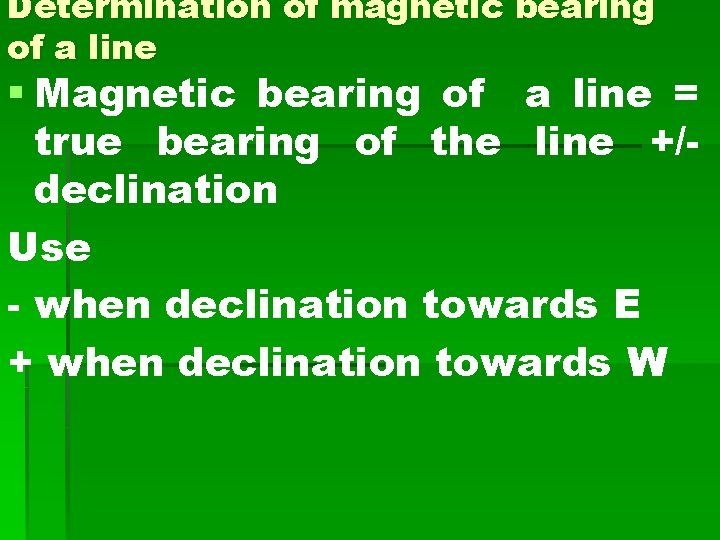
Determination of magnetic bearing of a line § Magnetic bearing of a line = true bearing of the line +/declination Use - when declination towards E + when declination towards W
Numericals