
Compass Observation and Feedback Module Module Outline This
Compass Observation and Feedback Module
Module Outline This module is divided into three topics. • Part A: Overview • Part B: Preparing to Monitor Progress (Observation and Feedback) • Part C: Monitoring Progress (Observation and Feedback) • Appendix: Deepen Understanding Preparation In preparation for the activities that follow, take time to access: Louisiana Principals’ Teaching and Learning Guidebook Compass Teacher Rubric Compass Leader Rubric 2
PART A: OVERVIEW
Goals By the end of this module, you will be prepared to: 1. align observation and feedback practices to goals 2. implement observation and feedback practices that provide an opportunity to monitor progress toward goals 4

Compass Improvements Louisiana educators helped create a more authentic educator evaluation process. The Act 240 Subcommittee reviewed Compass and noted that all schools need a leader who: 1. Sets academic improvement goals and the direction for the school 2. Implements structures and processes designed to improve instruction 3. Uses multiple measures to evaluate and provide feedback to all teachers The Department will support principals in this work through: • Policy Improvements based on recommendations • Resources to provide principals support with instructional decisions • Direct supports that target school-wide instructional structures and skill development Louisiana Believes. 5

Compass Improvements: Policy Improvements based on recommendations: 1. Transition policies extended to ensure all educators and students have time to learn higher expectations 2. Trusting principals through removal of the ineffective override 3. Multiple measures of student growth considered for teachers 4. Aligned principal accountability through goals based in SPS Louisiana Believes. 6
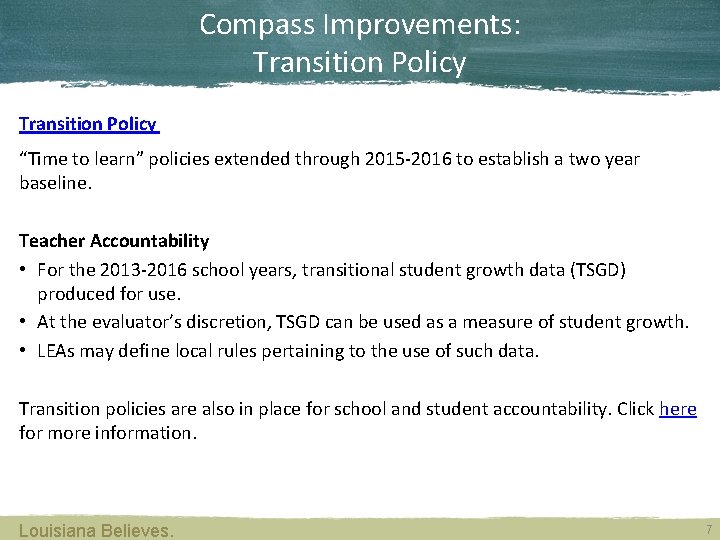
Compass Improvements: Transition Policy “Time to learn” policies extended through 2015 -2016 to establish a two year baseline. Teacher Accountability • For the 2013 -2016 school years, transitional student growth data (TSGD) produced for use. • At the evaluator’s discretion, TSGD can be used as a measure of student growth. • LEAs may define local rules pertaining to the use of such data. Transition policies are also in place for school and student accountability. Click here for more information. Louisiana Believes. 7
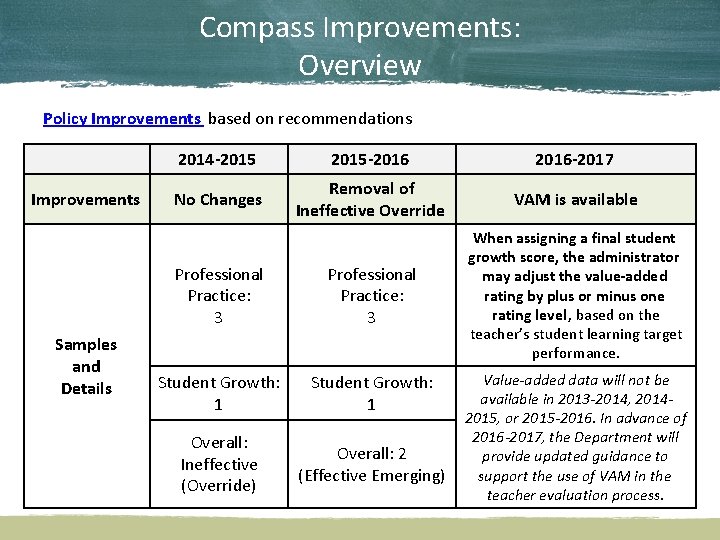
Compass Improvements: Overview Policy Improvements based on recommendations Improvements Samples and Details 2014 -2015 -2016 -2017 No Changes Removal of Ineffective Override VAM is available Professional Practice: 3 When assigning a final student growth score, the administrator may adjust the value-added rating by plus or minus one rating level, based on the teacher’s student learning target performance. Student Growth: 1 Overall: Ineffective (Override) Overall: 2 (Effective Emerging) Value-added data will not be available in 2013 -2014, 20142015, or 2015 -2016. In advance of 2016 -2017, the Department will provide updated guidance to support the use of VAM in the teacher evaluation process.
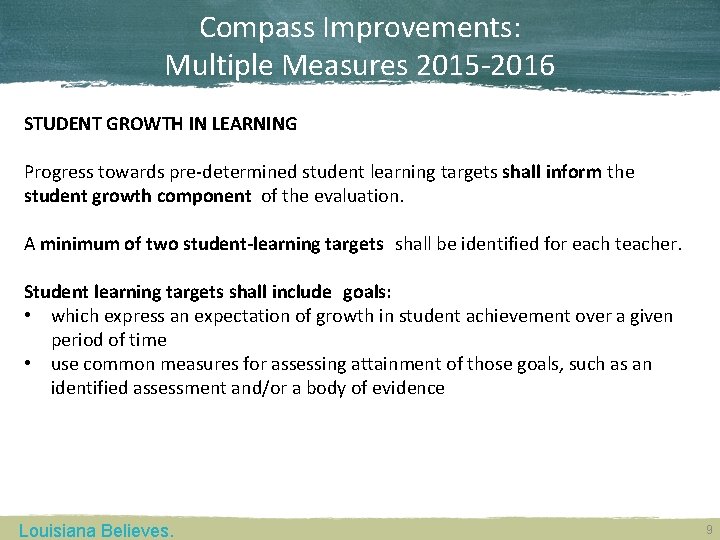
Compass Improvements: Multiple Measures 2015 -2016 STUDENT GROWTH IN LEARNING Progress towards pre-determined student learning targets shall inform the student growth component of the evaluation. A minimum of two student-learning targets shall be identified for each teacher. Student learning targets shall include goals: • which express an expectation of growth in student achievement over a given period of time • use common measures for assessing attainment of those goals, such as an identified assessment and/or a body of evidence Louisiana Believes. 9

Compass Improvements: Multiple Measures 2016 -2017 STUDENT GROWTH IN LEARNING WHEN VALUE ADDED DATA IS AVAILABLE • Progress towards pre-determined student learning targets shall inform the student growth component of the evaluation. • A minimum of two student-learning targets shall be identified for each teacher. • When assigning a final student growth score, the administrator may adjust the value-added rating by plus or minus one rating level , based on the teacher’s student learning target performance (e. g. , the overall student growth rating may be a 2. 0 (effective: emerging) or 4. 0 (highly effective) if the valueadded rating is 3. 0 (effective: proficient)). Value-added data will not be available in 2013 -2014, 2014 -2015, or 2015 -2016. In advance of 2016 -2017, the Department will provide updated guidance to support the use of VAM in the teacher evaluation process. Louisiana Believes. 10
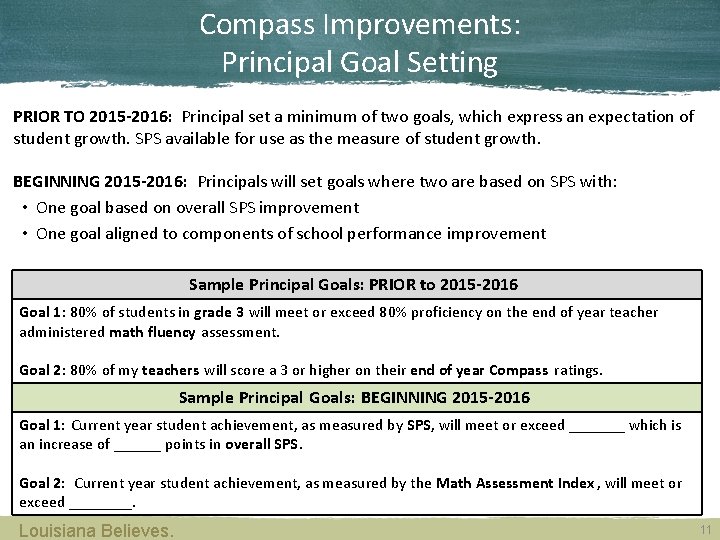
Compass Improvements: Principal Goal Setting PRIOR TO 2015 -2016: Principal set a minimum of two goals, which express an expectation of student growth. SPS available for use as the measure of student growth. BEGINNING 2015 -2016: Principals will set goals where two are based on SPS with: • One goal based on overall SPS improvement • One goal aligned to components of school performance improvement Sample Principal Goals: PRIOR to 2015 -2016 Goal 1: 80% of students in grade 3 will meet or exceed 80% proficiency on the end of year teacher administered math fluency assessment. Goal 2: 80% of my teachers will score a 3 or higher on their end of year Compass ratings. Sample Principal Goals: BEGINNING 2015 -2016 Goal 1: Current year student achievement, as measured by SPS, will meet or exceed _______ which is an increase of ______ points in overall SPS. Goal 2: Current year student achievement, as measured by the Math Assessment Index , will meet or exceed ____. Louisiana Believes. 11
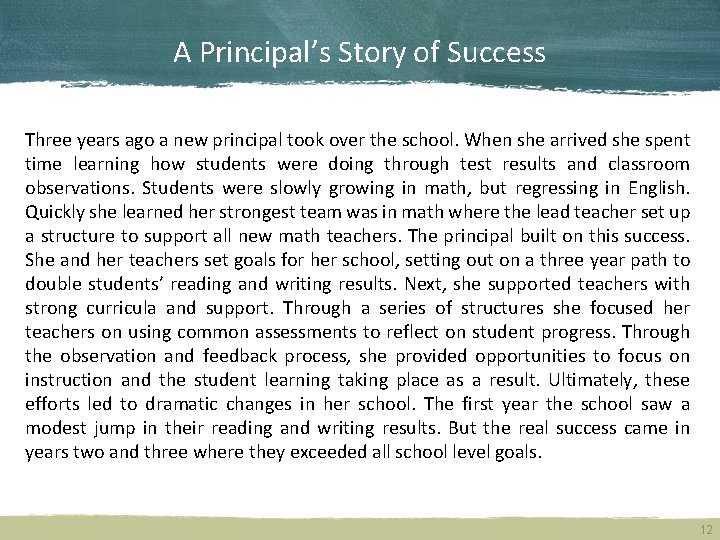
A Principal’s Story of Success Three years ago a new principal took over the school. When she arrived she spent time learning how students were doing through test results and classroom observations. Students were slowly growing in math, but regressing in English. Quickly she learned her strongest team was in math where the lead teacher set up a structure to support all new math teachers. The principal built on this success. She and her teachers set goals for her school, setting out on a three year path to double students’ reading and writing results. Next, she supported teachers with strong curricula and support. Through a series of structures she focused her teachers on using common assessments to reflect on student progress. Through the observation and feedback process, she provided opportunities to focus on instruction and the student learning taking place as a result. Ultimately, these efforts led to dramatic changes in her school. The first year the school saw a modest jump in their reading and writing results. But the real success came in years two and three where they exceeded all school level goals. 12
What led to this principal’s success? What evidence connects to the principal’s success ? Which actions are related to the goals set by the principal? How did the principal support instructional improvements? 13
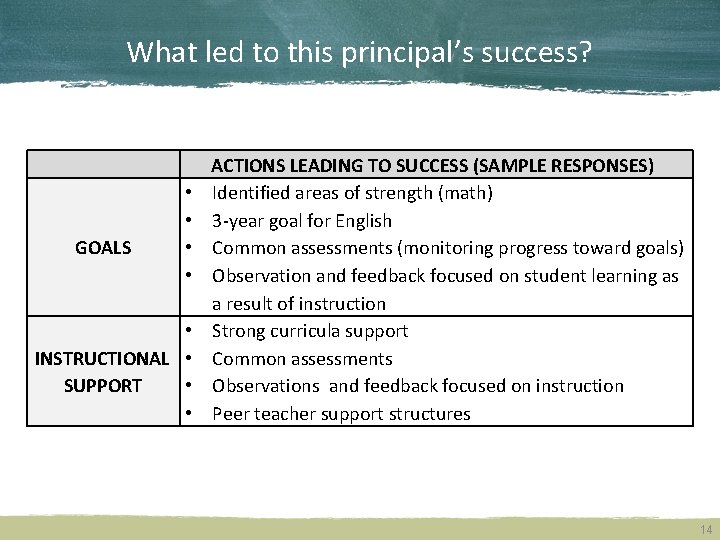
What led to this principal’s success? GOALS • • • INSTRUCTIONAL • SUPPORT • • ACTIONS LEADING TO SUCCESS (SAMPLE RESPONSES) Identified areas of strength (math) 3 -year goal for English Common assessments (monitoring progress toward goals) Observation and feedback focused on student learning as a result of instruction Strong curricula support Common assessments Observations and feedback focused on instruction Peer teacher support structures 14
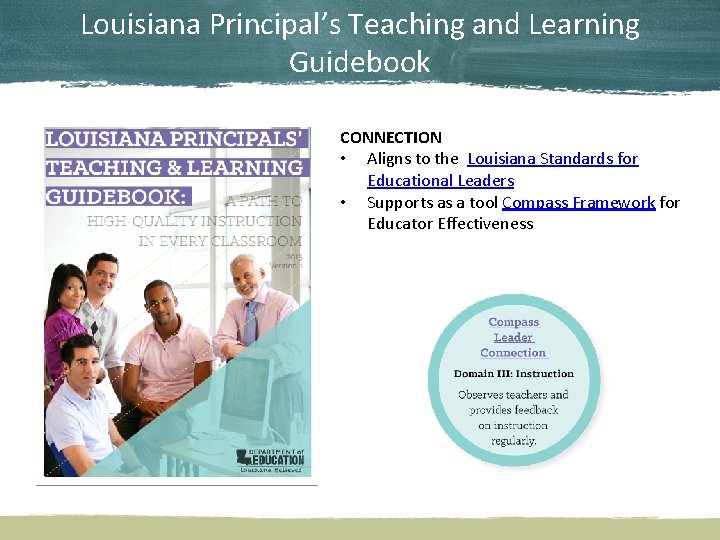
Louisiana Principal’s Teaching and Learning Guidebook CONNECTION • Aligns to the Louisiana Standards for Educational Leaders • Supports as a tool Compass Framework for Educator Effectiveness
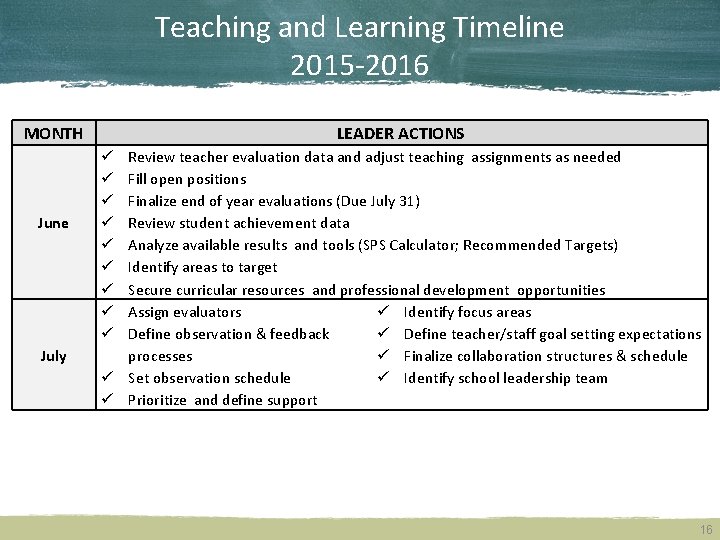
Teaching and Learning Timeline 2015 -2016 MONTH June July LEADER ACTIONS Review teacher evaluation data and adjust teaching assignments as needed Fill open positions Finalize end of year evaluations (Due July 31) Review student achievement data Analyze available results and tools (SPS Calculator; Recommended Targets) Identify areas to target Secure curricular resources and professional development opportunities Assign evaluators Identify focus areas Define observation & feedback Define teacher/staff goal setting expectations processes Finalize collaboration structures & schedule Set observation schedule Identify school leadership team Prioritize and define support 16
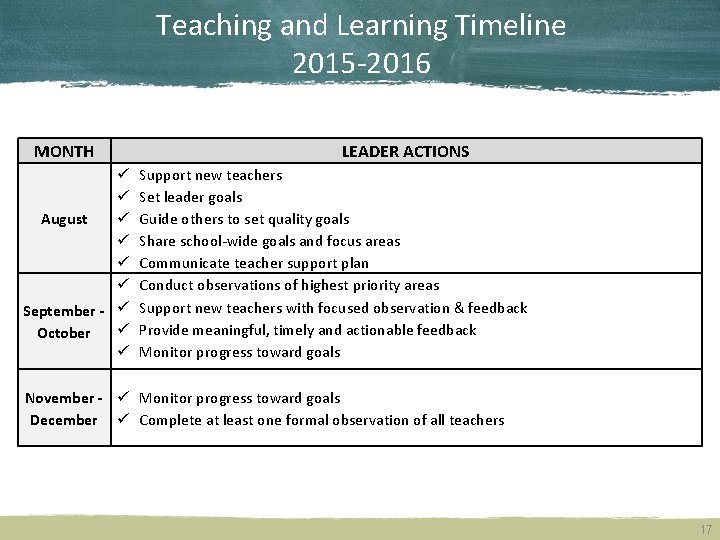
Teaching and Learning Timeline 2015 -2016 MONTH August September - October LEADER ACTIONS Support new teachers Set leader goals Guide others to set quality goals Share school-wide goals and focus areas Communicate teacher support plan Conduct observations of highest priority areas Support new teachers with focused observation & feedback Provide meaningful, timely and actionable feedback Monitor progress toward goals November - Monitor progress toward goals December Complete at least one formal observation of all teachers 17
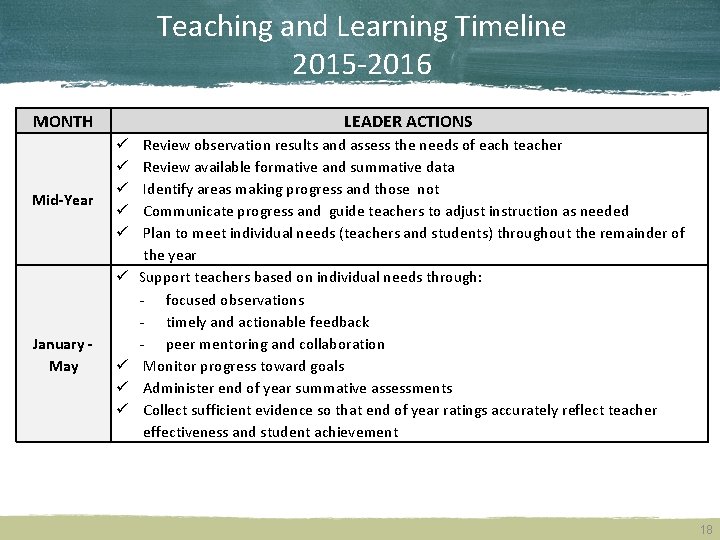
Teaching and Learning Timeline 2015 -2016 MONTH Mid-Year LEADER ACTIONS January May Review observation results and assess the needs of each teacher Review available formative and summative data Identify areas making progress and those not Communicate progress and guide teachers to adjust instruction as needed Plan to meet individual needs (teachers and students) throughout the remainder of the year Support teachers based on individual needs through: - focused observations - timely and actionable feedback - peer mentoring and collaboration Monitor progress toward goals Administer end of year summative assessments Collect sufficient evidence so that end of year ratings accurately reflect teacher effectiveness and student achievement 18
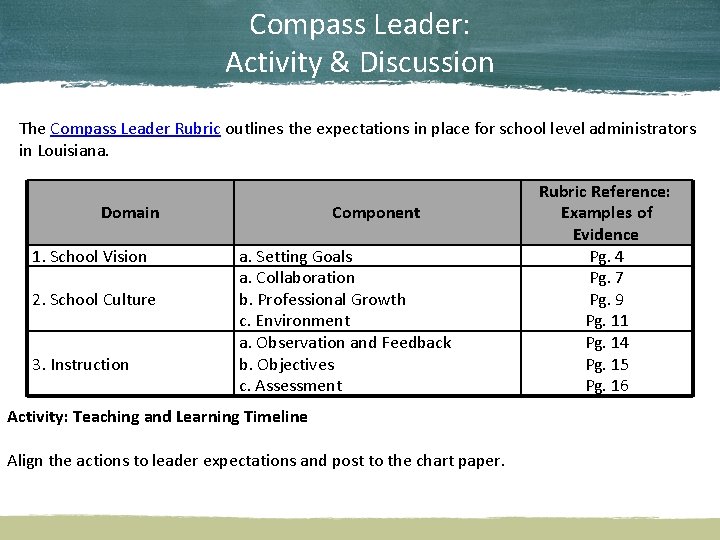
Compass Leader: Activity & Discussion The Compass Leader Rubric outlines the expectations in place for school level administrators in Louisiana. Domain 1. School Vision 2. School Culture 3. Instruction Component a. Setting Goals a. Collaboration b. Professional Growth c. Environment a. Observation and Feedback b. Objectives c. Assessment Activity: Teaching and Learning Timeline Align the actions to leader expectations and post to the chart paper. Rubric Reference: Examples of Evidence Pg. 4 Pg. 7 Pg. 9 Pg. 11 Pg. 14 Pg. 15 Pg. 16
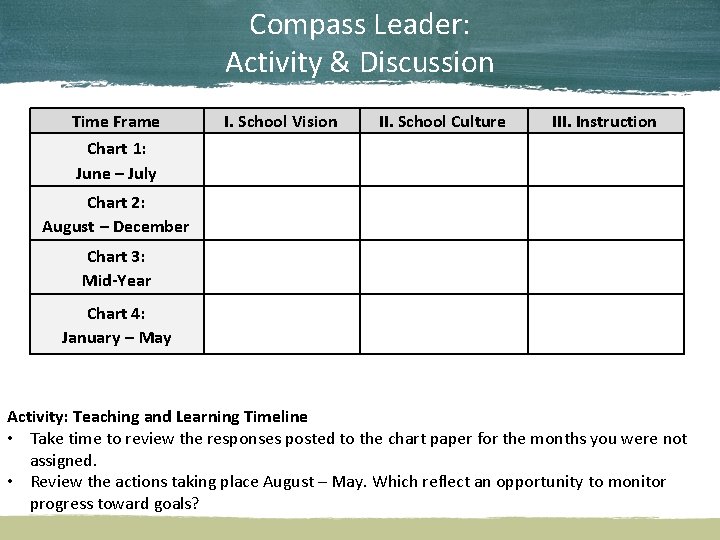
Compass Leader: Activity & Discussion Time Frame Chart 1: June – July I. School Vision II. School Culture III. Instruction Chart 2: August – December Chart 3: Mid-Year Chart 4: January – May Activity: Teaching and Learning Timeline • Take time to review the responses posted to the chart paper for the months you were not assigned. • Review the actions taking place August – May. Which reflect an opportunity to monitor progress toward goals?
Compass Framework Compass, the state’s framework for educator support and evaluation: • promotes a cycle of continuous improvement • includes an end of year rating process where Professional Practice and Student Achievement each contribute equally • defines minimum requirements and provides the opportunity for additional criteria to support educators as defined in Bulletin 130. Evaluators decide how to structure the observation/feedback process. These decisions include: • Determining the duration and frequency of observations beyond the one, full-lesson observation • Choosing how to rate observations and assign a professional practice rating 21
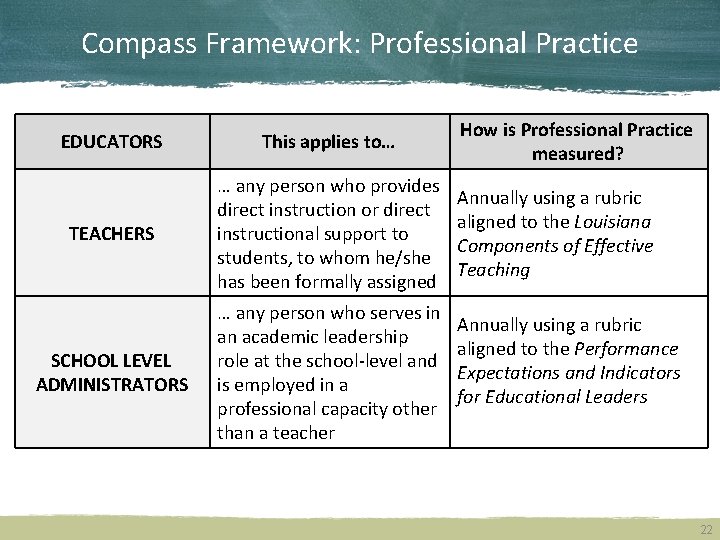
Compass Framework: Professional Practice EDUCATORS This applies to… TEACHERS … any person who provides direct instruction or direct instructional support to students, to whom he/she has been formally assigned SCHOOL LEVEL ADMINISTRATORS … any person who serves in an academic leadership role at the school-level and is employed in a professional capacity other than a teacher How is Professional Practice measured? Annually using a rubric aligned to the Louisiana Components of Effective Teaching Annually using a rubric aligned to the Performance Expectations and Indicators for Educational Leaders 22
Compass Framework: Observation Practices THROUGHOUT THE YEAR Observation practices that best support individual educators include: • classroom/site visits to observe practice that occur more frequently than the minimum • meaningful feedback to include a combination of face to face conversations and written messages throughout the year • a series of focused observations (i. e. walkthroughs) to support individual teacher improvement • the collection of sufficient information in order to make end of year determinations END OF THE YEAR The Compass Framework provides a method for evaluators to use a holistic approach to collect sufficient information to be used when making end of year determinations. Such an approach applied to the professional practice component allows for the use of evidence collected through various methods. • For teachers, this might include a series of focused observations (e. g. , walk-throughs) completed by the assigned evaluator or other designees. • Evaluators of school administrators could include an evaluation of work products or evidence gathered when observing instructional leadership activities (e. g. , PLCs) 23
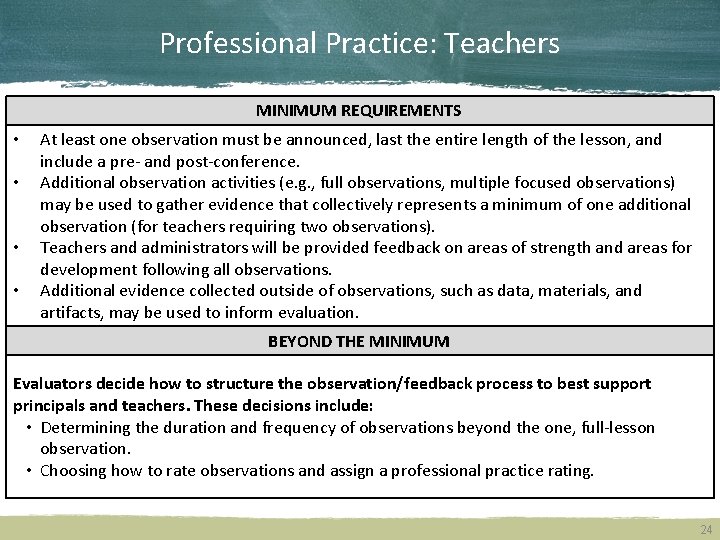
Professional Practice: Teachers MINIMUM REQUIREMENTS • • At least one observation must be announced, last the entire length of the lesson, and include a pre- and post-conference. Additional observation activities (e. g. , full observations, multiple focused observations) may be used to gather evidence that collectively represents a minimum of one additional observation (for teachers requiring two observations). Teachers and administrators will be provided feedback on areas of strength and areas for development following all observations. Additional evidence collected outside of observations, such as data, materials, and artifacts, may be used to inform evaluation. BEYOND THE MINIMUM Evaluators decide how to structure the observation/feedback process to best support principals and teachers. These decisions include: • Determining the duration and frequency of observations beyond the one, full-lesson observation. • Choosing how to rate observations and assign a professional practice rating. 24
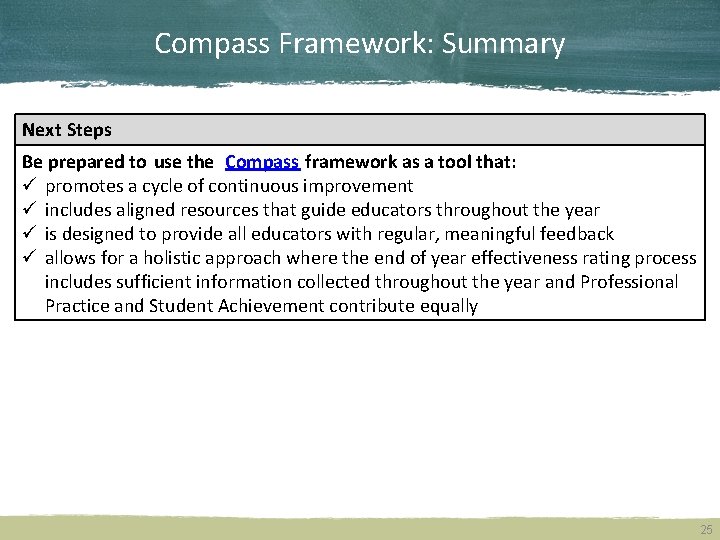
Compass Framework: Summary Next Steps Be prepared to use the Compass framework as a tool that: promotes a cycle of continuous improvement includes aligned resources that guide educators throughout the year is designed to provide all educators with regular, meaningful feedback allows for a holistic approach where the end of year effectiveness rating process includes sufficient information collected throughout the year and Professional Practice and Student Achievement contribute equally 25
PART B: PREPARING TO MONITOR PROGRESS
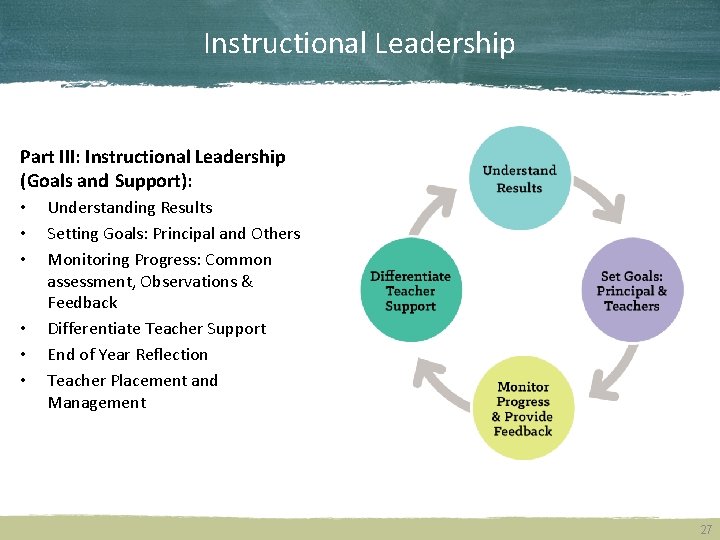
Instructional Leadership Part III: Instructional Leadership (Goals and Support): • • • Understanding Results Setting Goals: Principal and Others Monitoring Progress: Common assessment, Observations & Feedback Differentiate Teacher Support End of Year Reflection Teacher Placement and Management 27
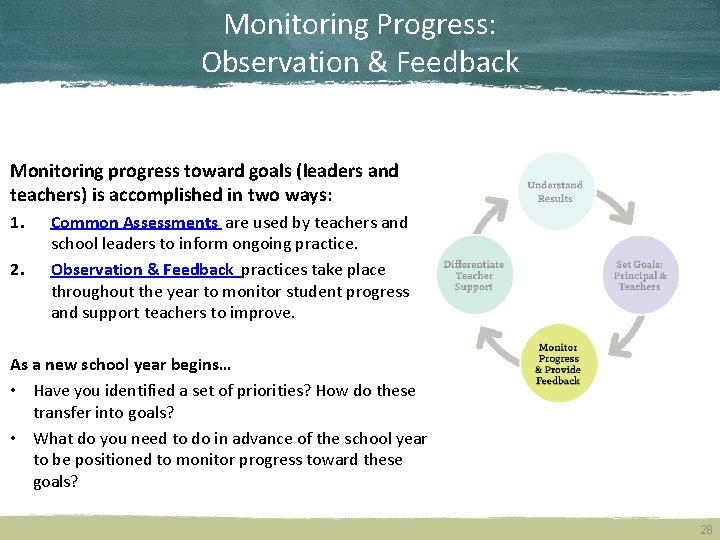
Monitoring Progress: Observation & Feedback Monitoring progress toward goals (leaders and teachers) is accomplished in two ways: 1. 2. Common Assessments are used by teachers and school leaders to inform ongoing practice. Observation & Feedback practices take place throughout the year to monitor student progress and support teachers to improve. As a new school year begins… • Have you identified a set of priorities? How do these transfer into goals? • What do you need to do in advance of the school year to be positioned to monitor progress toward these goals? 28

Observation & Feedback: Overview Guidebook Pgs. 13 & 18 The observation process is used by principals and teachers to : • Assess and provide feedback on instructional skills and decisions • Assess how students are performing relative to student achievement goals (Student Learning Targets) • Determine a teacher’s strengths and areas for improvement • Develop clear next steps that support teacher improvement and ultimately increase student learning The following actions guide principals as they prepare to support teachers : • Adopt a Fundamental Set of Beliefs • Assign Evaluators and Define the Process • Set the Observation Schedule • Develop a Teacher Support Plan 29
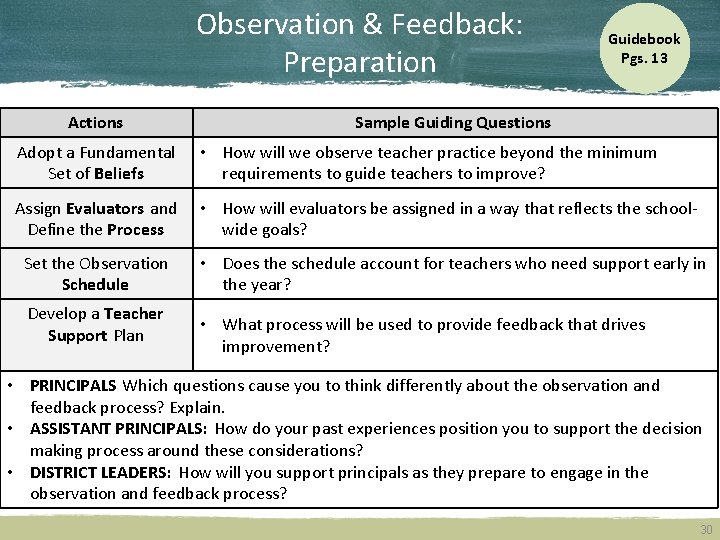
Observation & Feedback: Preparation Actions Guidebook Pgs. 13 Sample Guiding Questions Adopt a Fundamental Set of Beliefs • How will we observe teacher practice beyond the minimum requirements to guide teachers to improve? Assign Evaluators and Define the Process • How will evaluators be assigned in a way that reflects the schoolwide goals? Set the Observation Schedule • Does the schedule account for teachers who need support early in the year? Develop a Teacher Support Plan • What process will be used to provide feedback that drives improvement? • PRINCIPALS Which questions cause you to think differently about the observation and feedback process? Explain. • ASSISTANT PRINCIPALS: How do your past experiences position you to support the decision making process around these considerations? • DISTRICT LEADERS: How will you support principals as they prepare to engage in the observation and feedback process? 30
Case Study Discussion: Preparing for Observations Guidebook Pgs. 22 and 48 CASE STUDY ACTIVITY Identified Focus Areas • Foundation Elementary School: Mathematics • Success High School: English Review the actions taken by the principal and consider how these decisions align to the goals they set? How does this position them to monitor progress toward their goals? • Assigning Evaluators (Case Study Reference: Table B; pg. 22 and 48) • Set the Observation Schedule (Case Study Reference: Table C; pg. 22 and 49) School Level Leaders How will preparing in this way help you monitor progress toward goals and ensure students are learning? District Level Leaders: How do these actions influence your support of principals as they monitor progress toward goals and support teachers throughout the year? 31
Preparing: Teacher Support Guidebook Pg. 39 The principals in the case study collaborate with other leaders to develop a Teacher Support Plan. 1. Which teachers bring students to high levels of achievement? What strategies do they employ and how can they support others? a. review by content area and grade level b. identify teachers most likely to support others to success c. identify methods for sharing and duplicating successful practices d. create a collaborative structure that gives teachers the time and space to collaborate with peers 2. What role will the leadership team and other resources play in supporting teachers ? a. peer observations b. model lessons c. professional development opportunities 32
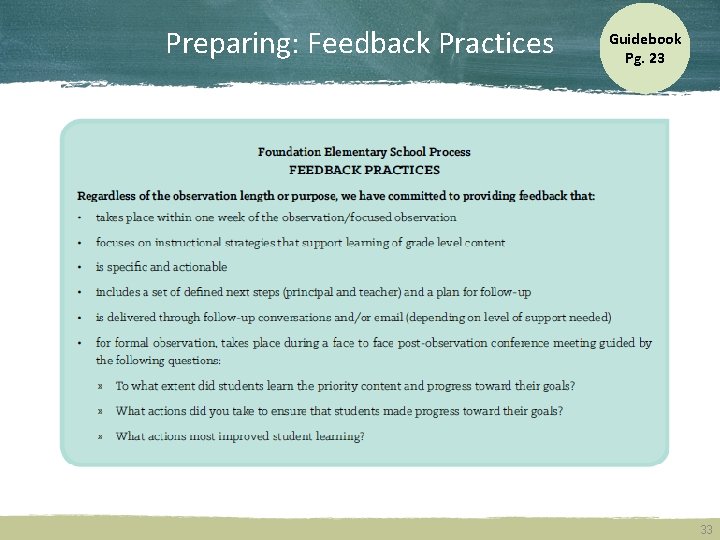
Preparing: Feedback Practices Guidebook Pg. 23 33
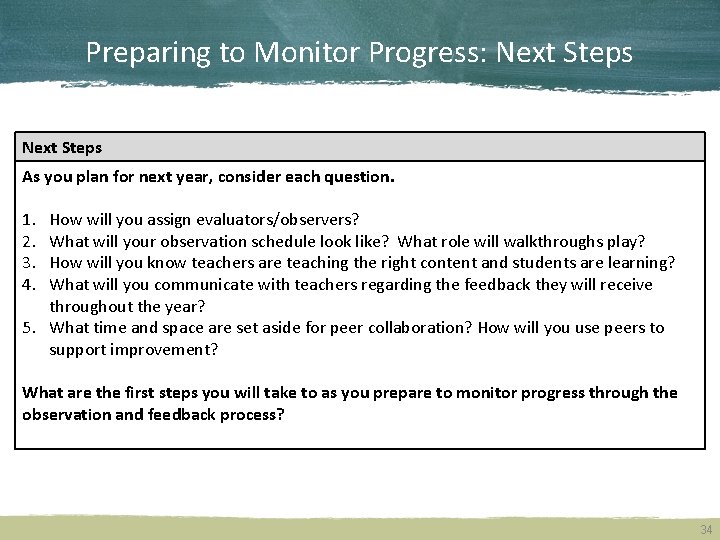
Preparing to Monitor Progress: Next Steps As you plan for next year, consider each question. 1. 2. 3. 4. How will you assign evaluators/observers? What will your observation schedule look like? What role will walkthroughs play? How will you know teachers are teaching the right content and students are learning? What will you communicate with teachers regarding the feedback they will receive throughout the year? 5. What time and space are set aside for peer collaboration? How will you use peers to support improvement? What are the first steps you will take to as you prepare to monitor progress through the observation and feedback process? 34
PART C: MONITORING PROGRESS OBSERVATION AND FEEDBACK

Case Study Activity & Discussion: Teacher Professional Practice Guidebook Pg. 28 or 53 CASE STUDY ACTIVITY Select either the math or English teacher support cycle as outlined below and included in the Principal Guidebook. Foundation Elementary Principal Goals: Overall SPS and Math Assessment Index - Math Teacher Formal Observation: pg. 28 Success High School Principal Goals: Overall SPS, Math Assessment Index, ACT - English Teacher Formal Observation: pg. 53 How does the principal ensure student learning is the focus of: • Pre-Observation Conference • Formal Observation: CIS Entry 36
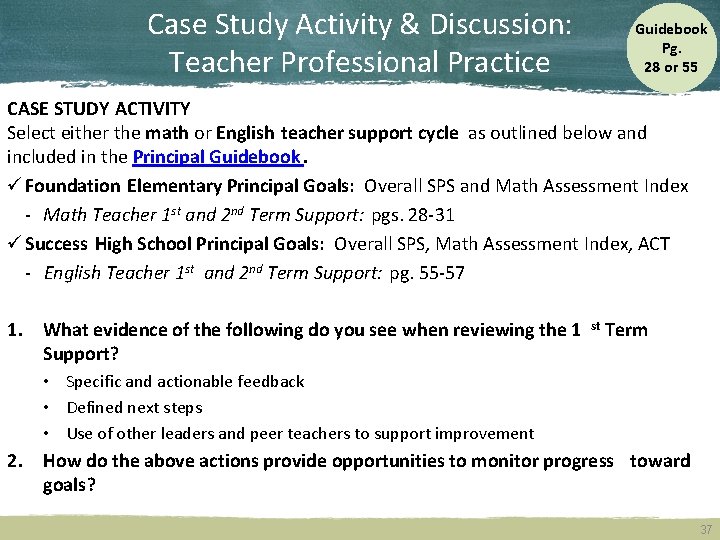
Case Study Activity & Discussion: Teacher Professional Practice Guidebook Pg. 28 or 55 CASE STUDY ACTIVITY Select either the math or English teacher support cycle as outlined below and included in the Principal Guidebook. Foundation Elementary Principal Goals: Overall SPS and Math Assessment Index - Math Teacher 1 st and 2 nd Term Support: pgs. 28 -31 Success High School Principal Goals: Overall SPS, Math Assessment Index, ACT - English Teacher 1 st and 2 nd Term Support: pg. 55 -57 1. What evidence of the following do you see when reviewing the 1 Support? st Term • Specific and actionable feedback • Defined next steps • Use of other leaders and peer teachers to support improvement 2. How do the above actions provide opportunities to monitor progress toward goals? 37
Case Study Activity & Discussion: End of Year Conversation Guidebook Pgs. 58 -59 CASE STUDY ACTIVITY Review the End of Year Conversation as outlined in the Principal Guidebook. Math Teacher: pg. 33 -34 (End of Year Conversation) English Teacher: pg. 58 -59 (End of Year Conversation) Discussion Question How does the end of year conversation further reflect the use of the observation and feedback process to monitor progress toward goals and focus on student learning? 38
Reflection As an evaluator of teachers or principals, what will you do to ensure observation and feedback processes: 1. align to the goals set at the beginning of the year? 2. provide an opportunity to monitor progress toward goals? 39
APPENDIX: DEEPEN UNDERSTANDING
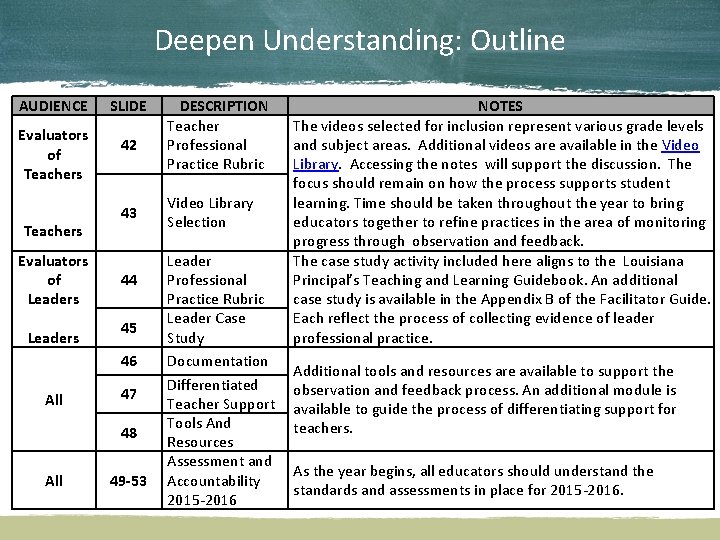
Deepen Understanding: Outline AUDIENCE Evaluators of Teachers Evaluators of Leaders SLIDE 42 43 44 45 46 All 47 48 All 49 -53 DESCRIPTION Teacher Professional Practice Rubric Video Library Selection Leader Professional Practice Rubric Leader Case Study Documentation Differentiated Teacher Support Tools And Resources Assessment and Accountability 2015 -2016 NOTES The videos selected for inclusion represent various grade levels and subject areas. Additional videos are available in the Video Library. Accessing the notes will support the discussion. The focus should remain on how the process supports student learning. Time should be taken throughout the year to bring educators together to refine practices in the area of monitoring progress through observation and feedback. The case study activity included here aligns to the Louisiana Principal’s Teaching and Learning Guidebook. An additional case study is available in the Appendix B of the Facilitator Guide. Each reflect the process of collecting evidence of leader professional practice. Additional tools and resources are available to support the observation and feedback process. An additional module is available to guide the process of differentiating support for teachers. As the year begins, all educators should understand the standards and assessments in place for 2015 -2016.
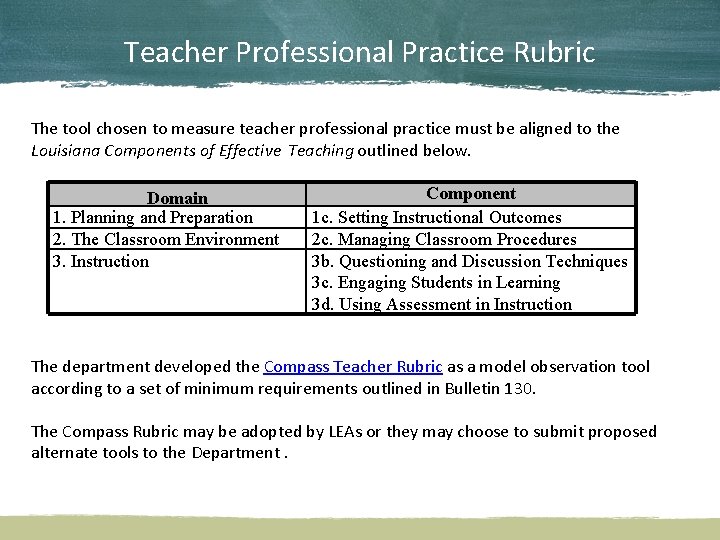
Teacher Professional Practice Rubric The tool chosen to measure teacher professional practice must be aligned to the Louisiana Components of Effective Teaching outlined below. Domain 1. Planning and Preparation 2. The Classroom Environment 3. Instruction Component 1 c. Setting Instructional Outcomes 2 c. Managing Classroom Procedures 3 b. Questioning and Discussion Techniques 3 c. Engaging Students in Learning 3 d. Using Assessment in Instruction The department developed the Compass Teacher Rubric as a model observation tool according to a set of minimum requirements outlined in Bulletin 130. The Compass Rubric may be adopted by LEAs or they may choose to submit proposed alternate tools to the Department.
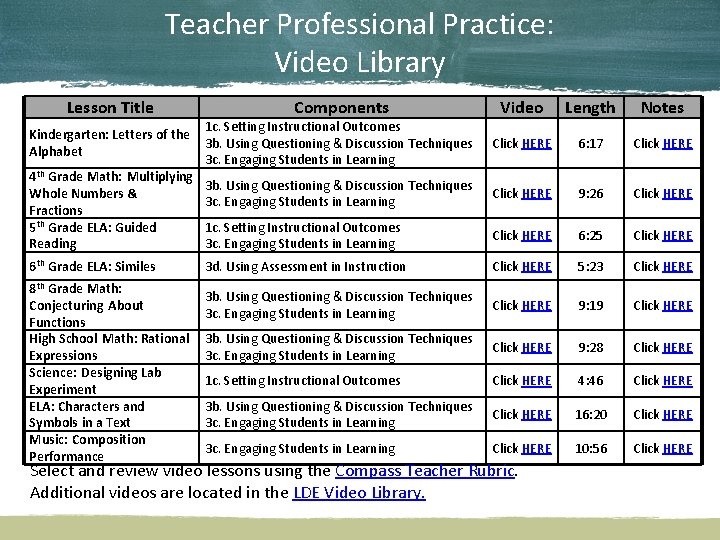
Teacher Professional Practice: Video Library Lesson Title Kindergarten: Letters of the Alphabet 4 th Grade Math: Multiplying Whole Numbers & Fractions 5 th Grade ELA: Guided Reading 6 th Grade ELA: Similes 8 th Grade Math: Conjecturing About Functions High School Math: Rational Expressions Science: Designing Lab Experiment ELA: Characters and Symbols in a Text Music: Composition Performance Components 1 c. Setting Instructional Outcomes 3 b. Using Questioning & Discussion Techniques 3 c. Engaging Students in Learning Video Length Notes Click HERE 6: 17 Click HERE 3 b. Using Questioning & Discussion Techniques 3 c. Engaging Students in Learning Click HERE 9: 26 Click HERE 1 c. Setting Instructional Outcomes 3 c. Engaging Students in Learning Click HERE 6: 25 Click HERE 3 d. Using Assessment in Instruction Click HERE 5: 23 Click HERE 3 b. Using Questioning & Discussion Techniques 3 c. Engaging Students in Learning Click HERE 9: 19 Click HERE 3 b. Using Questioning & Discussion Techniques 3 c. Engaging Students in Learning Click HERE 9: 28 Click HERE 1 c. Setting Instructional Outcomes Click HERE 4: 46 Click HERE 3 b. Using Questioning & Discussion Techniques 3 c. Engaging Students in Learning Click HERE 16: 20 Click HERE 3 c. Engaging Students in Learning Click HERE 10: 56 Click HERE Select and review video lessons using the Compass Teacher Rubric. Additional videos are located in the LDE Video Library.
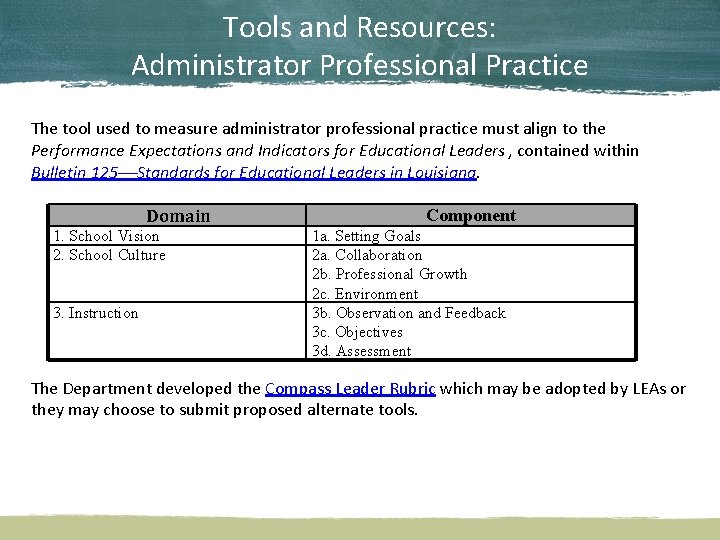
Tools and Resources: Administrator Professional Practice The tool used to measure administrator professional practice must align to the Performance Expectations and Indicators for Educational Leaders , contained within Bulletin 125 Standards for Educational Leaders in Louisiana. Domain 1. School Vision 2. School Culture 3. Instruction Component 1 a. Setting Goals 2 a. Collaboration 2 b. Professional Growth 2 c. Environment 3 b. Observation and Feedback 3 c. Objectives 3 d. Assessment The Department developed the Compass Leader Rubric which may be adopted by LEAs or they may choose to submit proposed alternate tools.
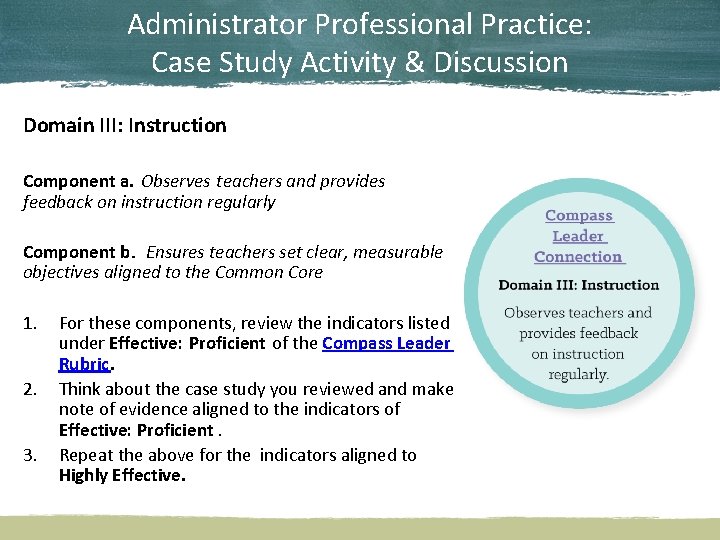
Administrator Professional Practice: Case Study Activity & Discussion Domain III: Instruction Component a. Observes teachers and provides feedback on instruction regularly Component b. Ensures teachers set clear, measurable objectives aligned to the Common Core 1. 2. 3. For these components, review the indicators listed under Effective: Proficient of the Compass Leader Rubric. Think about the case study you reviewed and make note of evidence aligned to the indicators of Effective: Proficient. Repeat the above for the indicators aligned to Highly Effective.

Tools and Resources: Documentation As evaluators support educators, it is important to identify the process for documenting the actions taking place throughout the year. The Teacher Support Evidence Collection Form is available for use to help document, communicate and track progress. The Compass Information System (CIS) is a web-based system that is available to districts and charter schools to support their implementation of Compass. Districts and charter schools are able to define how the system will be used to collect evidence throughout the year in a way that best meets their needs. End of year evaluation ratings (student growth, professional practice and overall) must be submitted annually to CIS per the guidance and timelines established by the Department.
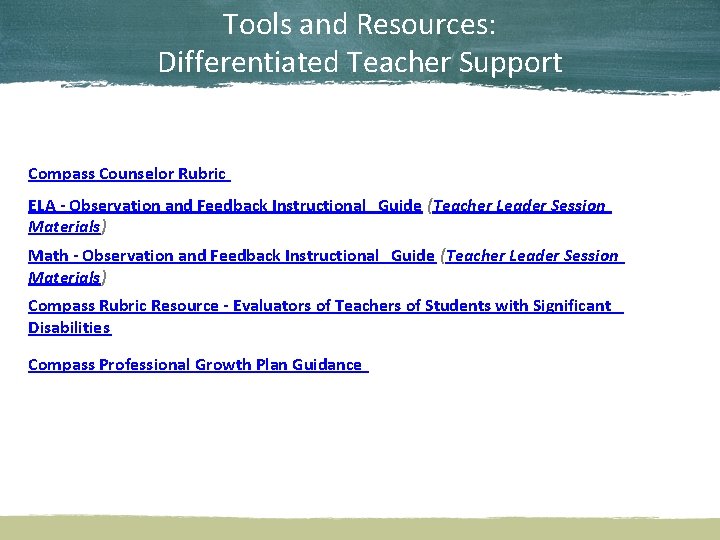
Tools and Resources: Differentiated Teacher Support Compass Counselor Rubric ELA - Observation and Feedback Instructional Guide (Teacher Leader Session Materials) Math - Observation and Feedback Instructional Guide (Teacher Leader Session Materials) Compass Rubric Resource - Evaluators of Teachers of Students with Significant Disabilities Compass Professional Growth Plan Guidance
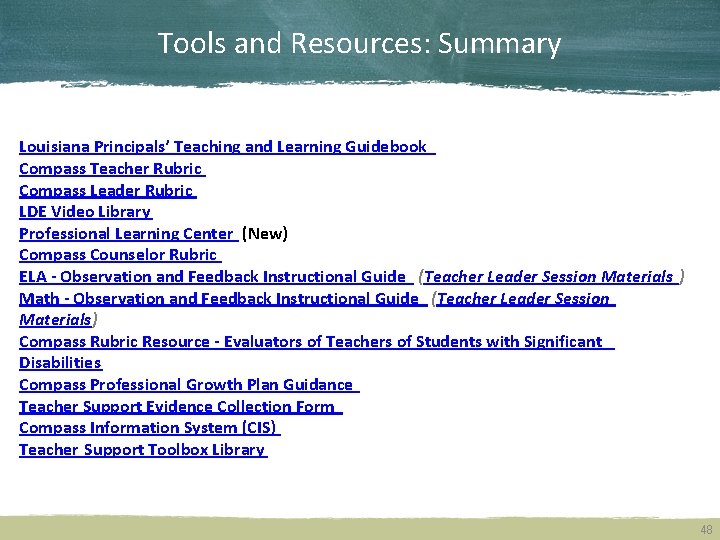
Tools and Resources: Summary Louisiana Principals’ Teaching and Learning Guidebook Compass Teacher Rubric Compass Leader Rubric LDE Video Library Professional Learning Center (New) Compass Counselor Rubric ELA - Observation and Feedback Instructional Guide (Teacher Leader Session Materials ) Math - Observation and Feedback Instructional Guide (Teacher Leader Session Materials) Compass Rubric Resource - Evaluators of Teachers of Students with Significant Disabilities Compass Professional Growth Plan Guidance Teacher Support Evidence Collection Form Compass Information System (CIS) Teacher Support Toolbox Library 48
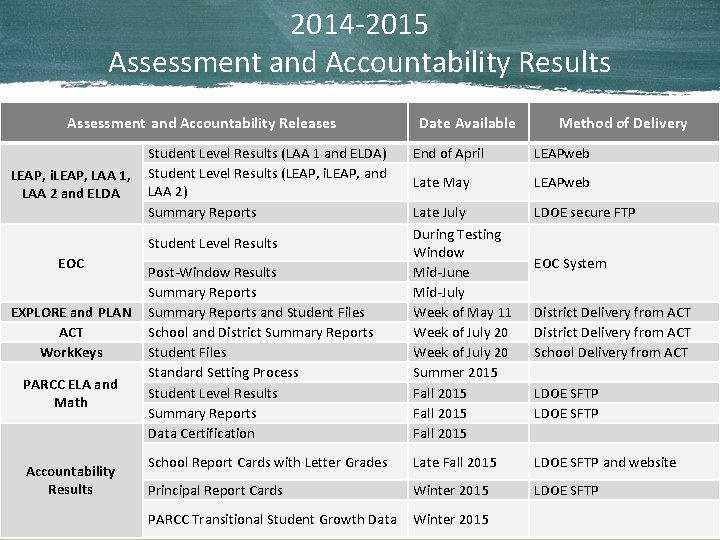
2014 -2015 Assessment and Accountability Results Assessment and Accountability Releases LEAP, i. LEAP, LAA 1, LAA 2 and ELDA Student Level Results (LAA 1 and ELDA) Student Level Results (LEAP, i. LEAP, and LAA 2) Summary Reports EXPLORE and PLAN ACT Work. Keys PARCC ELA and Math Accountability Results Method of Delivery End of April LEAPweb Late May LEAPweb LDOE secure FTP Post-Window Results Summary Reports and Student Files School and District Summary Reports Student Files Standard Setting Process Student Level Results Summary Reports Data Certification Late July During Testing Window Mid-June Mid-July Week of May 11 Week of July 20 Summer 2015 Fall 2015 School Report Cards with Letter Grades Late Fall 2015 LDOE SFTP and website Principal Report Cards Winter 2015 LDOE SFTP PARCC Transitional Student Growth Data Winter 2015 Student Level Results EOC Date Available Louisiana Believes EOC System District Delivery from ACT School Delivery from ACT LDOE SFTP 49
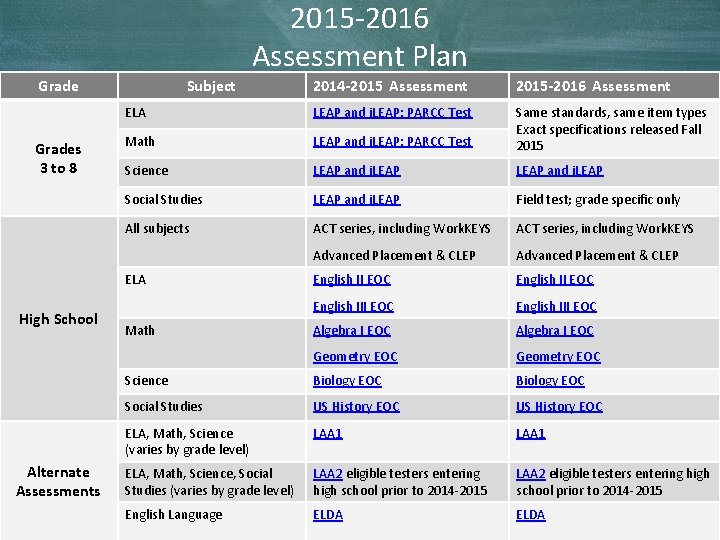
2015 -2016 Assessment Plan Grades 3 to 8 Subject 2014 -2015 Assessment 2015 -2016 Assessment ELA LEAP and i. LEAP: PARCC Test Math LEAP and i. LEAP: PARCC Test Same standards, same item types Exact specifications released Fall 2015 Science LEAP and i. LEAP Social Studies LEAP and i. LEAP Field test; grade specific only All subjects ACT series, including Work. KEYS Advanced Placement & CLEP English II EOC English III EOC Algebra I EOC Geometry EOC Science Biology EOC Social Studies US History EOC ELA, Math, Science (varies by grade level) LAA 1 ELA, Math, Science, Social Studies (varies by grade level) LAA 2 eligible testers entering high school prior to 2014 -2015 English Language ELDA ELA High School Alternate Assessments Math Louisiana Believes 50
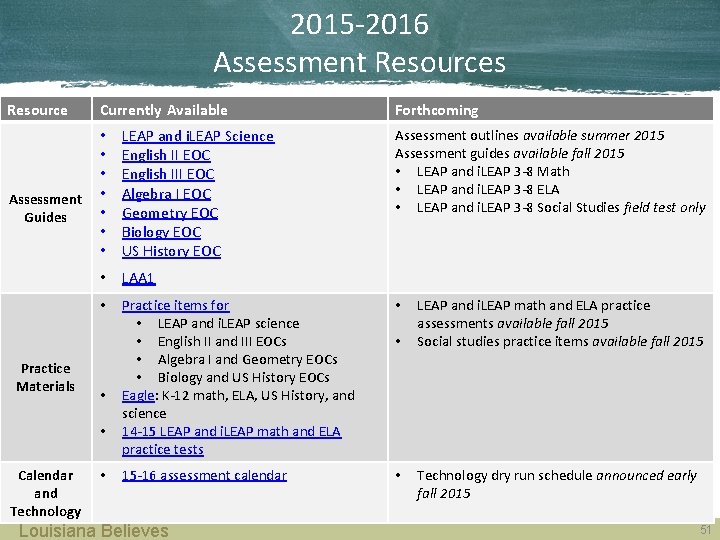
2015 -2016 Assessment Resources Resource Assessment Guides Practice Materials Currently Available • • LEAP and i. LEAP Science English II EOC English III EOC Algebra I EOC Geometry EOC Biology EOC US History EOC • LAA 1 • Practice items for • LEAP and i. LEAP science • English II and III EOCs • Algebra I and Geometry EOCs • Biology and US History EOCs Eagle: K-12 math, ELA, US History, and science 14 -15 LEAP and i. LEAP math and ELA practice tests • 15 -16 assessment calendar • • • Calendar and Technology Forthcoming • Louisiana Believes Assessment outlines available summer 2015 Assessment guides available fall 2015 • LEAP and i. LEAP 3 -8 Math • LEAP and i. LEAP 3 -8 ELA • LEAP and i. LEAP 3 -8 Social Studies field test only • LEAP and i. LEAP math and ELA practice assessments available fall 2015 Social studies practice items available fall 2015 Technology dry run schedule announced early fall 2015 51
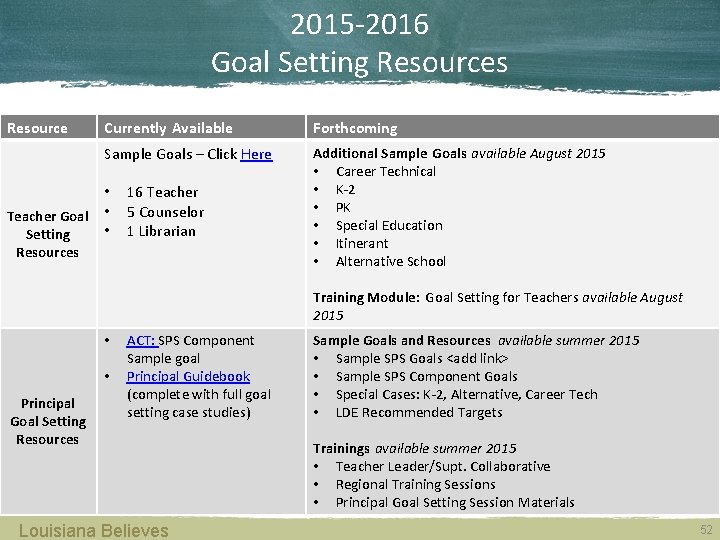
2015 -2016 Goal Setting Resources Resource Currently Available Forthcoming Sample Goals – Click Here Additional Sample Goals available August 2015 • Career Technical • K-2 • PK • Special Education • Itinerant • Alternative School • Teacher Goal • • Setting 16 Teacher 5 Counselor 1 Librarian Resources Training Module: Goal Setting for Teachers available August 2015 • • Principal Goal Setting Resources ACT: SPS Component Sample goal Principal Guidebook (complete with full goal setting case studies) Louisiana Believes Sample Goals and Resources available summer 2015 • Sample SPS Goals <add link> • Sample SPS Component Goals • Special Cases: K-2, Alternative, Career Tech • LDE Recommended Targets Trainings available summer 2015 • Teacher Leader/Supt. Collaborative • Regional Training Sessions • Principal Goal Setting Session Materials 52
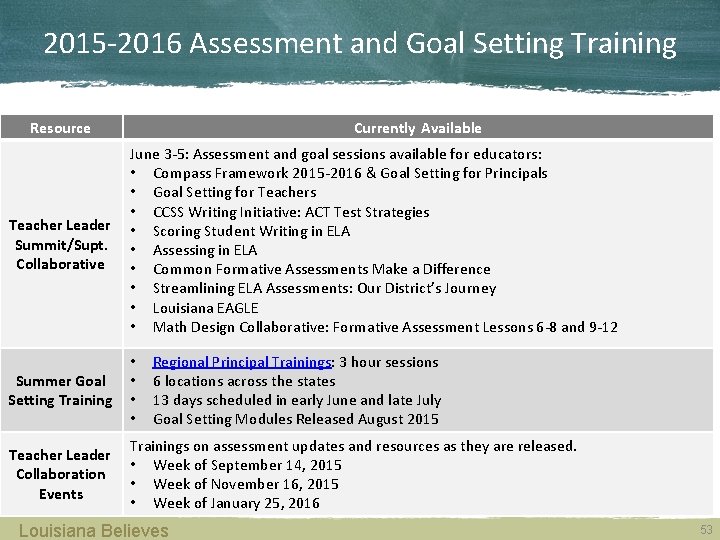
2015 -2016 Assessment and Goal Setting Training Resource Currently Available Teacher Leader Summit/Supt. Collaborative June 3 -5: Assessment and goal sessions available for educators: • Compass Framework 2015 -2016 & Goal Setting for Principals • Goal Setting for Teachers • CCSS Writing Initiative: ACT Test Strategies • Scoring Student Writing in ELA • Assessing in ELA • Common Formative Assessments Make a Difference • Streamlining ELA Assessments: Our District’s Journey • Louisiana EAGLE • Math Design Collaborative: Formative Assessment Lessons 6 -8 and 9 -12 Summer Goal Setting Training • • Teacher Leader Collaboration Events Trainings on assessment updates and resources as they are released. • Week of September 14, 2015 • Week of November 16, 2015 • Week of January 25, 2016 Regional Principal Trainings: 3 hour sessions 6 locations across the states 13 days scheduled in early June and late July Goal Setting Modules Released August 2015 Louisiana Believes 53
- Slides: 53