
COMPARISONS BETWEEN MAGNETIC FIELD PERTURBATIONS AND MODEL DIPOLE
COMPARISONS BETWEEN MAGNETIC FIELD PERTURBATIONS AND MODEL DIPOLE MOMENTS AT EUROPA Derek Podowitz EAS 4480 4/28/2011
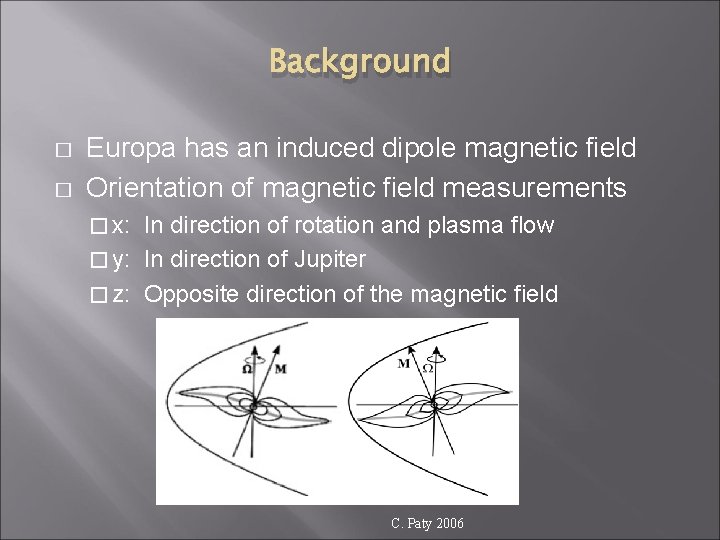
Background � � Europa has an induced dipole magnetic field Orientation of magnetic field measurements � x: In direction of rotation and plasma flow � y: In direction of Jupiter � z: Opposite direction of the magnetic field C. Paty 2006
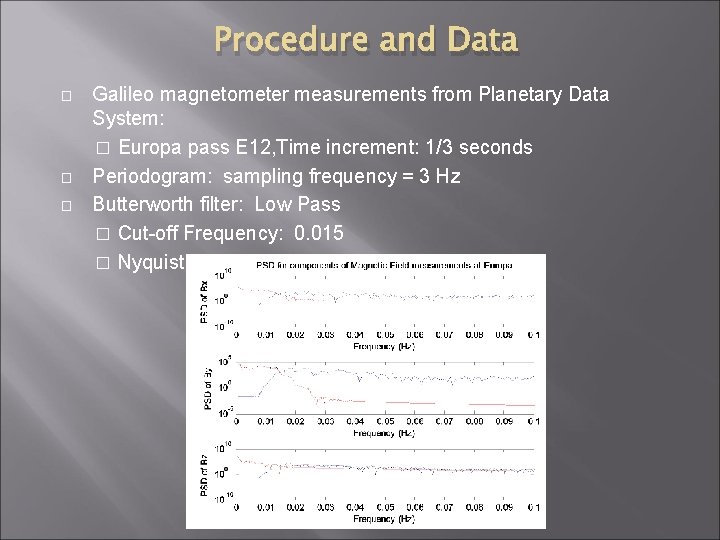
Procedure and Data � � � Galileo magnetometer measurements from Planetary Data System: � Europa pass E 12, Time increment: 1/3 seconds Periodogram: sampling frequency = 3 Hz Butterworth filter: Low Pass � Cut-off Frequency: 0. 015 � Nyquist Frequency: 3/0. 5 = 1. 5
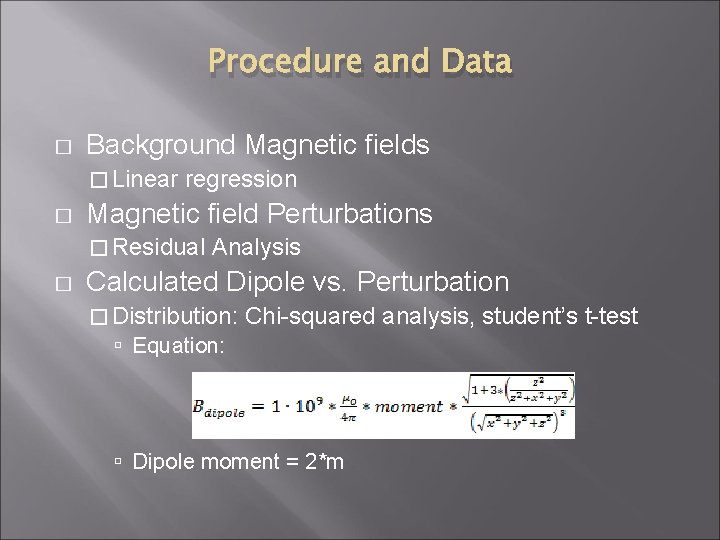
Procedure and Data � Background Magnetic fields � Linear � regression Magnetic field Perturbations � Residual � Analysis Calculated Dipole vs. Perturbation � Distribution: Chi-squared analysis, student’s t-test Equation: Dipole moment = 2*m
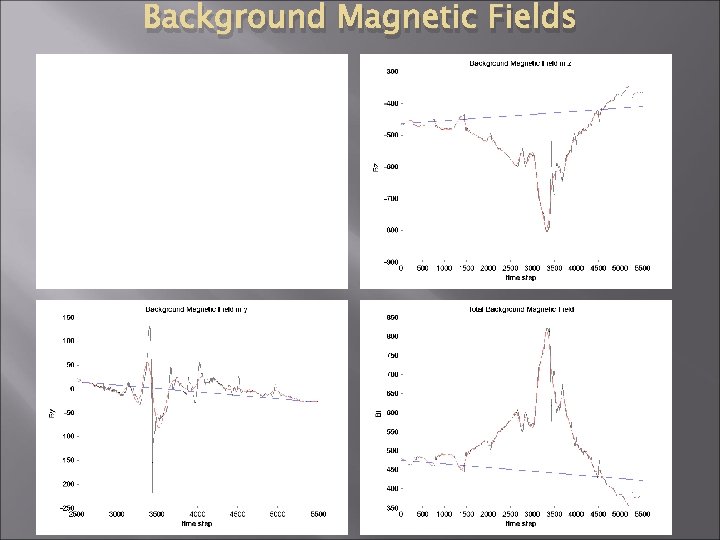
Background Magnetic Fields
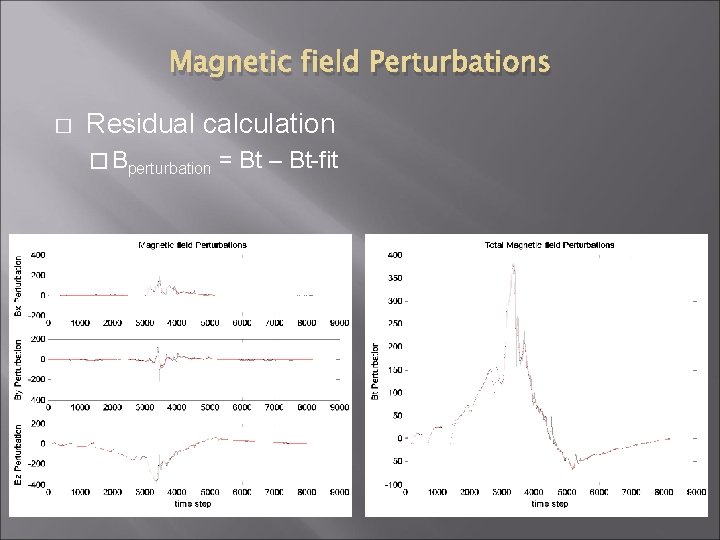
Magnetic field Perturbations � Residual calculation � Bperturbation = Bt – Bt-fit
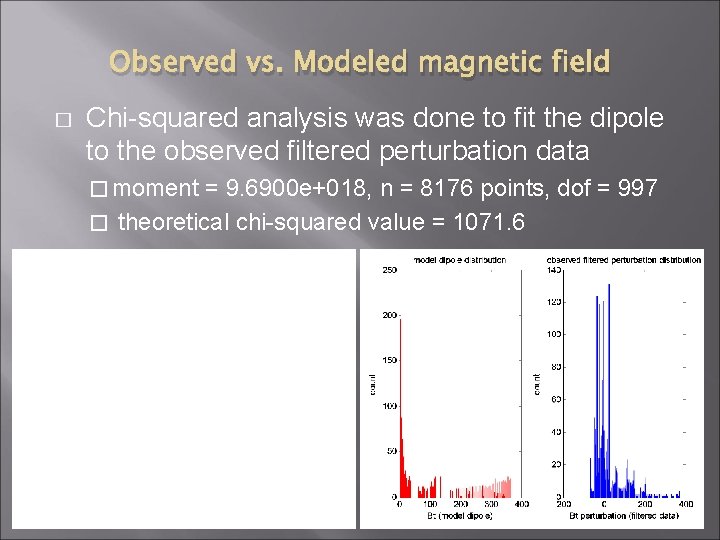
Observed vs. Modeled magnetic field � Chi-squared analysis was done to fit the dipole to the observed filtered perturbation data � moment = 9. 6900 e+018, n = 8176 points, dof = 997 � theoretical chi-squared value = 1071. 6
Conclusion � � Low pass filter is a better choice to filter the data Testing for permanent Dipole moment � Chi-squared test showed that Europa’s magnetic field signature is not a normal distribution: B_chi 2 = 16153 � The student’s t test: The means are not equivalent � mean_difference = 37. 1531 � Bt_mean = 36. 8775 � 95% confidence interval = 34. 2281 - 40. 0780 � Dipole_mean 74. 0306 � � Other factors at play to produce signatures Possible corrections: Using more strict parameters when analyzing background magnetic field to obtain better approximation of perturbations
References � � Kivelson M. G. , et al. Galileo Magnetometer Measurements: Stronger Case for a Subsurface Ocean at Europa, Science 289, 1340 (2000). Paty, C. 'Ganymede’s Magnetosphere: Unraveling the Ganymede-Jupiter Interaction through Combining Multifluid Simulations and Observations. ' Ph. D thesis. University of Washington, Seattle, WA. (2006). PDS: The Planetary Data System. JPL/NASA. 2/2011. http: //pds. jpl. nasa. gov/index. shtml. Hand, Kevin P. and Christopher F. Chyba. Empirical constraints on the salinity of the europan ocean and implications for a thin ice shell. Icarus Volume 189, Issue 2, August 2007, Pages 424 -438
References � Project 4480
- Slides: 10