
Comparison of VISX Wave Scan aberrometer with NIDEK
Comparison of VISX Wave. Scan aberrometer with NIDEK OPD-Scan. David Sungmin Kim, MD 1, Julio Narvaez, MD 2, Jabin Krassin, MD 2, Khaled Bahjri, MD, MPH 3. 1 Loma Linda University Medical Center, Loma Linda, CA, 2 Department of Ophthalmology, Loma Linda University Health Care, Loma Linda, CA, 3 Health Research Consulting Group, Loma Linda University School of Public Health, Loma Linda, CA. The authors of this study do not have any financial or proprietary interest in any product, method, or material discussed.

Zernike Pyramid This figure was created by and used with modifications with the permission of Patrick Maeda.
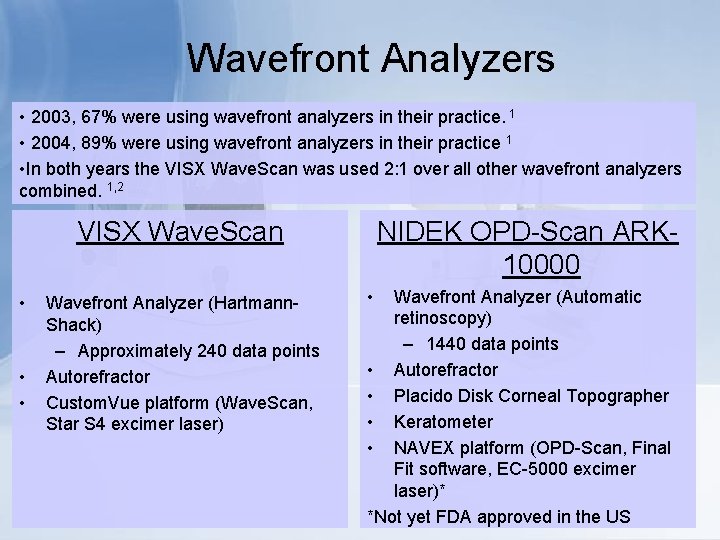
Wavefront Analyzers • 2003, 67% were using wavefront analyzers in their practice. 1 • 2004, 89% were using wavefront analyzers in their practice 1 • In both years the VISX Wave. Scan was used 2: 1 over all other wavefront analyzers combined. 1, 2 VISX Wave. Scan • • • Wavefront Analyzer (Hartmann. Shack) – Approximately 240 data points Autorefractor Custom. Vue platform (Wave. Scan, Star S 4 excimer laser) NIDEK OPD-Scan ARK 10000 • Wavefront Analyzer (Automatic retinoscopy) – 1440 data points • Autorefractor • Placido Disk Corneal Topographer • Keratometer • NAVEX platform (OPD-Scan, Final Fit software, EC-5000 excimer laser)* *Not yet FDA approved in the US
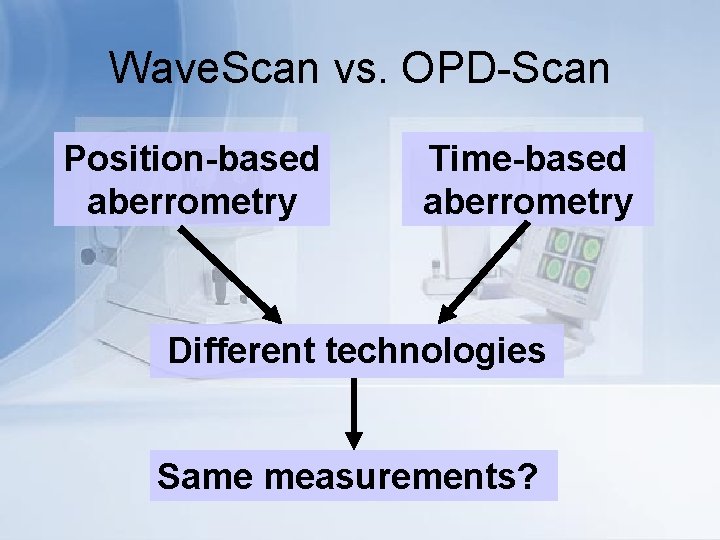
Wave. Scan vs. OPD-Scan Position-based aberrometry Time-based aberrometry Different technologies Same measurements?
Purpose • To compare measurements obtained with the VISX Wave. Scan and NIDEK OPDScan (ARK 10000).
Subjects • 92 eyes of 51 patients (measured with both aberrometers) • Pupil size ≥ 6. 0 mm • No ocular abnormality or surgery • BCVA ≥ 20/30 • Average sphere -2. 85 D (-6. 75 to 5. 00 D) • Average cylinder -0. 73 D (-3. 25 to 1. 75)
Methods • Zernike coefficient values normalized to a 6. 0 mm pupil (Schwiegerling)3 • Normalized values used to calculate RMS values: – – – – 2 nd-6 th radial orders 2 nd-6 th angular orders Total higher-order aberrations (3 rd-6 th radial order) 3 rd-order trefoil (Z 33 and Z 33) 3 rd-order coma (Z 3 -1 and Z 31) Total spherical aberration (Z 40 and Z 60) Total coma (Z 3 -1, Z 31, Z 5 -1, and Z 51) • Automated refractions versus manifest refractions • Automated refractions versus automated refractions
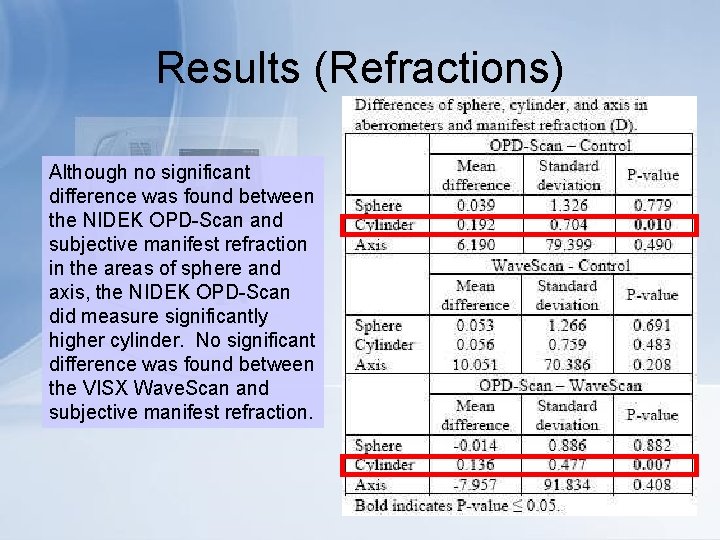
Results (Refractions) Although no significant difference was found between the NIDEK OPD-Scan and subjective manifest refraction in the areas of sphere and axis, the NIDEK OPD-Scan did measure significantly higher cylinder. No significant difference was found between the VISX Wave. Scan and subjective manifest refraction.
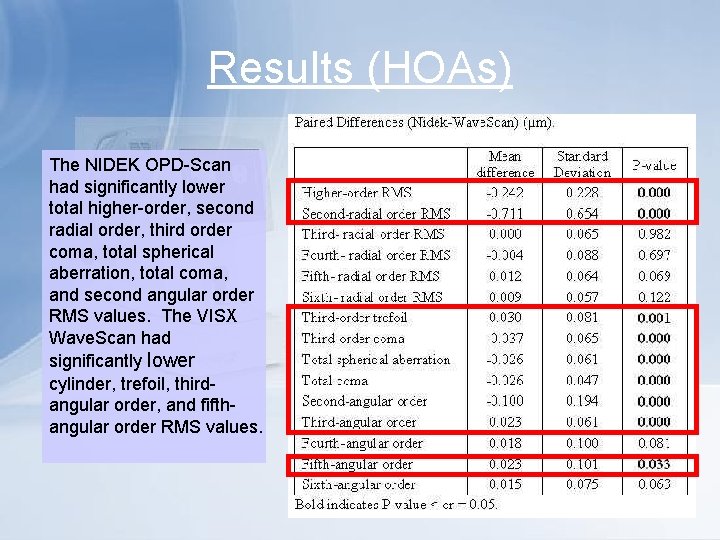
Results (HOAs) The NIDEK OPD-Scan had significantly lower total higher-order, second radial order, third order coma, total spherical aberration, total coma, and second angular order RMS values. The VISX Wave. Scan had significantly lower cylinder, trefoil, thirdangular order, and fifthangular order RMS values.
Results summary • The two aberrometers are not interchangeable or equivalent • The aberrometers had many significant differences, particularly in HOAs. • The Wave. Scan with significantly higher values in more measurements.
Discussion The VISX Wave. Scan and the NIDEK OPD-Scan use two different technologies. One could speculate that the differences in the magnitude of the aberration may be due to the differences between the two technologies. One uses a Hartman-Shack method while the other uses a dynamic skiascopy method. The VISX uses from approximately 240 data points for measurement while the NIDEK OPD-Scan uses 1440 data points. The wavelength used for measurement by the VISX Wave. Scan and the NIDEK OPD-Scan are 780 nm and 808 nm, respectively. The VISX Wave. Scan uses line of sight (the line connecting the fixation point, pupil center, and the fovea) as its measurement axis, while the NIDEK OPD-Scan uses the visual axis (the line connecting the fixation point, eye’s nodal points, and the fovea). 4, 5 Although both have the capacity to offer the same measurements, there are many possibilities to explain why they might not. The results raise many important questions including the following: Are these differences clinically significant? Which machine represents better measurements? These questions would be best answered with large well-designed studies comparing objective and subjective outcomes following customized refractive surgeries using both aberrometers. The development of a gold standard would also make a great impact on refractive surgery - a device such as that which the Optical Society of America's taskforce is attempting to construct. 4 Such a device would ideally allow all aberrometers to be calibrated to a certain standard. Overall, this study emphasizes the importance and need for more studies comparing wavefront aberrometers.
References 1. Duffey RJ, Leaming D. US Trends in Refractive Surgery: 2003 ISRS/AAO Survey. J Refract Surg. 2005; 21: 87 -91. 2. Duffey RJ, Leaming D. US Trends in Refractive Surgery: 2004 ISRS/AAO Survey. J Refract Surg. 2005; 21: 742748. 3. Schwiegerling J. Scaling Zernike expansion coefficients to different pupil sizes. J Opt Soc Am A. 2002; 19(10): 19371945. 4. Thibos LN, Applegate RA, Schwiegerling JT, Webb R. Standards for reporting the optical aberrations of eyes. J Refract Surg 2002; 18: S 652 -S 661. 5. Rozema JJ, Van Dyck DEM, Tassignon MJ. Clinical comparison of 6 aberrometers. Part 1: Technical Specifications. J Cataract Refract Surg 2005; 31: 11141127.
- Slides: 12