
Comparison of the Decision Tree Models to Intelligent
- Slides: 1
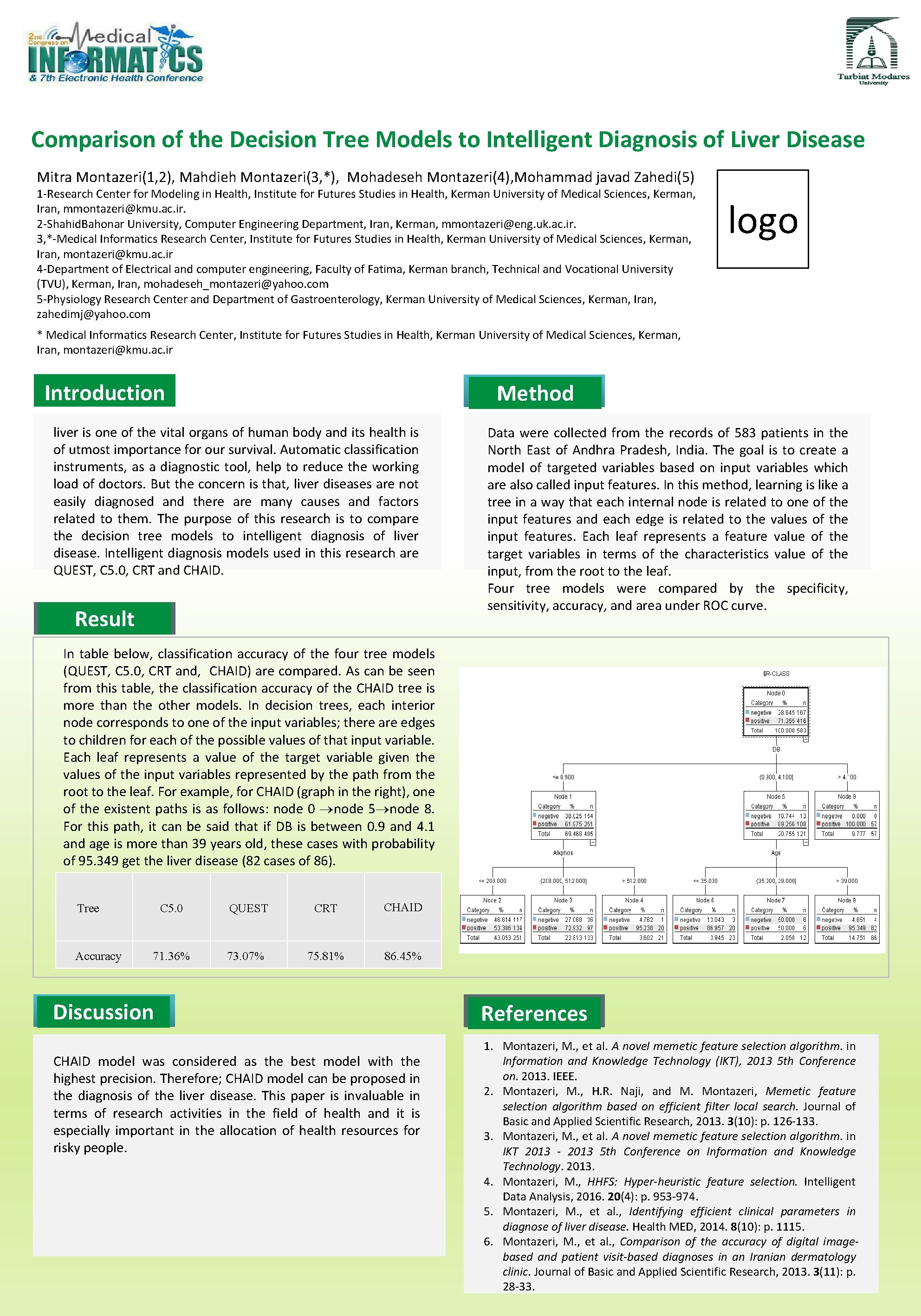
Comparison of the Decision Tree Models to Intelligent Diagnosis of Liver Disease Mitra Montazeri(1, 2), Mahdieh Montazeri(3, *), Mohadeseh Montazeri(4), Mohammad javad Zahedi(5) 1 -Research Center for Modeling in Health, Institute for Futures Studies in Health, Kerman University of Medical Sciences, Kerman, Iran, mmontazeri@kmu. ac. ir. 2 -Shahid. Bahonar University, Computer Engineering Department, Iran, Kerman, mmontazeri@eng. uk. ac. ir. 3, *-Medical Informatics Research Center, Institute for Futures Studies in Health, Kerman University of Medical Sciences, Kerman, Iran, montazeri@kmu. ac. ir 4 -Department of Electrical and computer engineering, Faculty of Fatima, Kerman branch, Technical and Vocational University (TVU), Kerman, Iran, mohadeseh_montazeri@yahoo. com 5 -Physiology Research Center and Department of Gastroenterology, Kerman University of Medical Sciences, Kerman, Iran, zahedimj@yahoo. com logo * Medical Informatics Research Center, Institute for Futures Studies in Health, Kerman University of Medical Sciences, Kerman, Iran, montazeri@kmu. ac. ir Introduction Method liver is one of the vital organs of human body and its health is of utmost importance for our survival. Automatic classification instruments, as a diagnostic tool, help to reduce the working load of doctors. But the concern is that, liver diseases are not easily diagnosed and there are many causes and factors related to them. The purpose of this research is to compare the decision tree models to intelligent diagnosis of liver disease. Intelligent diagnosis models used in this research are QUEST, C 5. 0, CRT and CHAID. Result Data were collected from the records of 583 patients in the North East of Andhra Pradesh, India. The goal is to create a model of targeted variables based on input variables which are also called input features. In this method, learning is like a tree in a way that each internal node is related to one of the input features and each edge is related to the values of the input features. Each leaf represents a feature value of the target variables in terms of the characteristics value of the input, from the root to the leaf. Four tree models were compared by the specificity, sensitivity, accuracy, and area under ROC curve. In table below, classification accuracy of the four tree models (QUEST, C 5. 0, CRT and, CHAID) are compared. As can be seen from this table, the classification accuracy of the CHAID tree is more than the other models. In decision trees, each interior node corresponds to one of the input variables; there are edges to children for each of the possible values of that input variable. Each leaf represents a value of the target variable given the values of the input variables represented by the path from the root to the leaf. For example, for CHAID (graph in the right), one of the existent paths is as follows: node 0 node 5 node 8. For this path, it can be said that if DB is between 0. 9 and 4. 1 and age is more than 39 years old, these cases with probability of 95. 349 get the liver disease (82 cases of 86). C 5. 0 QUEST CRT CHAID 71. 36% 73. 07% 75. 81% 86. 45% Tree Accuracy Discussion CHAID model was considered as the best model with the highest precision. Therefore; CHAID model can be proposed in the diagnosis of the liver disease. This paper is invaluable in terms of research activities in the field of health and it is especially important in the allocation of health resources for risky people. References 1. Montazeri, M. , et al. A novel memetic feature selection algorithm. in Information and Knowledge Technology (IKT), 2013 5 th Conference on. 2013. IEEE. 2. Montazeri, M. , H. R. Naji, and M. Montazeri, Memetic feature selection algorithm based on efficient filter local search. Journal of Basic and Applied Scientific Research, 2013. 3(10): p. 126 -133. 3. Montazeri, M. , et al. A novel memetic feature selection algorithm. in IKT 2013 - 2013 5 th Conference on Information and Knowledge Technology. 2013. 4. Montazeri, M. , HHFS: Hyper-heuristic feature selection. Intelligent Data Analysis, 2016. 20(4): p. 953 -974. 5. Montazeri, M. , et al. , Identifying efficient clinical parameters in diagnose of liver disease. Health MED, 2014. 8(10): p. 1115. 6. Montazeri, M. , et al. , Comparison of the accuracy of digital imagebased and patient visit-based diagnoses in an Iranian dermatology clinic. Journal of Basic and Applied Scientific Research, 2013. 3(11): p. 28 -33.