
Comparison of selfexpanding bioprostheses for transcatheter aortic valve
Comparison of self-expanding bioprostheses for transcatheter aortic valve replacement in patients with symptomatic severe aortic stenosis: the SCOPE II randomised clinical trial Corrado Tamburino, Sabine Bleiziffer, Holger Thiele, Smita Scholtz, David Hildick-Smith, Michael Cunnington, Alexander Wolf, Marco Barbanti, Didier Tchetchè, Philippe Garot, Paolo Pagnotta, Martine Gilard, Francesco Bedogni, Eric Van Belle, Mariuca Vasa-Nicotera, Alaide Chieffo, Oliver Deutsch, Jörg Kempfert, Lars Søndergaard, Christian Butter, Ramiro Trillo-Nouche, Shahram Lotfi, Helge Möllmann, Michael Joner, Mohamed Abdel. Wahab, Kris Bogaerts, Christian Hengstenberg, Davide Capodanno, on behalf of the SCOPE II Investigators
Disclosure statement of financial interest I, Corrado Tamburino, I have the following financial interest/arrangement or affiliation with one or more organizations that could be perceived as a real or apparent conflict of interest in the context of the subject of this presentation. Disclosure: Speaker fees from Medtronic.
Background Essential To establish TAVR as firstline therapy for patients with severe aortic stenosis are demonstration of long-term durability and improvements with regards to a number of adverse procedural outcomes, including paravalvular leakage and the need for new permanent pacemaker implantation. New TAVR systems Should undergo head-tohead comparisons and be tested in randomised controlled trials similar to what has been accomplished in the field of coronary stents. A new generation Transcatheter valve delivered via transfemoral access is the ACURATE neo (Boston Scientific, Marlborough, MA, USA), which gained CE mark approval in June 2014. In the SCOPE I trial, the ACURATE neo valve proved inferior to the balloon-expandable, intra-annular Sapien 3 valve at 30 days.
Objective The SCOPE II trial was designed to compare the early and mid-term performance of the ACURATE neo to the Core. Valve Evolut (Medtronic Inc. , Minneapolis, MN, USA) self-expanding, supra-annular transcatheter valve.
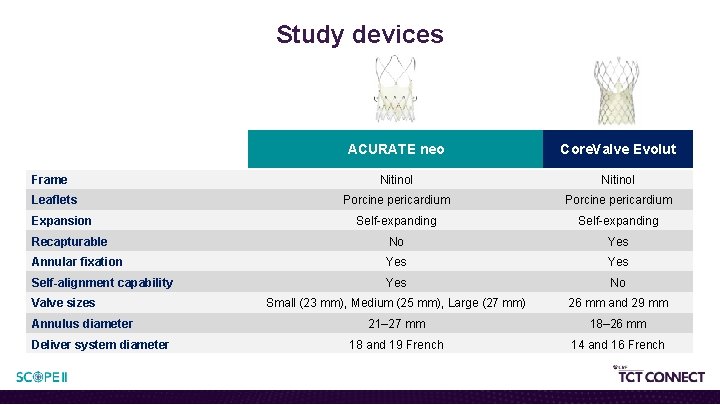
Study devices ACURATE neo Core. Valve Evolut Nitinol Porcine pericardium Self-expanding Recapturable No Yes Annular fixation Yes Self-alignment capability Yes No Small (23 mm), Medium (25 mm), Large (27 mm) 26 mm and 29 mm 21– 27 mm 18– 26 mm 18 and 19 French 14 and 16 French Frame Leaflets Expansion Valve sizes Annulus diameter Deliver system diameter
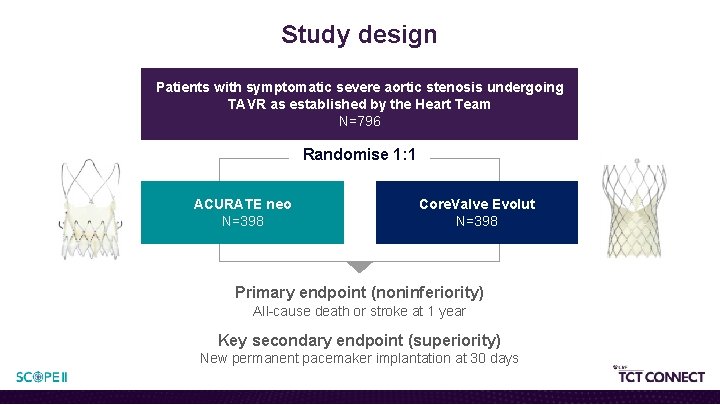
Study design Patients with symptomatic severe aortic stenosis undergoing TAVR as established by the Heart Team N=796 Randomise 1: 1 ACURATE neo N=398 Core. Valve Evolut N=398 Primary endpoint (noninferiority) All-cause death or stroke at 1 year Key secondary endpoint (superiority) New permanent pacemaker implantation at 30 days
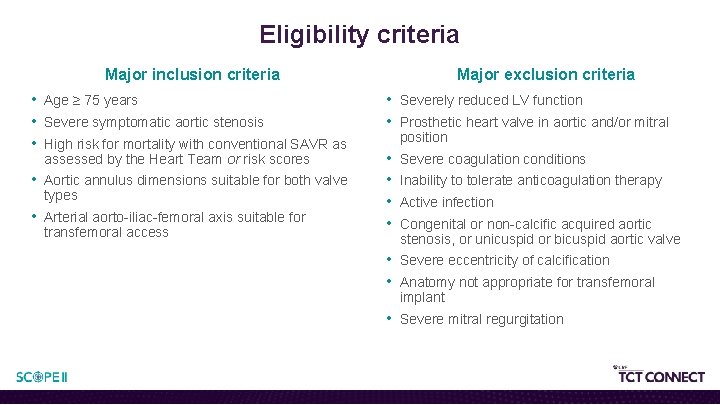
Eligibility criteria Major inclusion criteria Major exclusion criteria • Age ≥ 75 years • Severe symptomatic aortic stenosis • High risk for mortality with conventional SAVR as • Severely reduced LV function • Prosthetic heart valve in aortic and/or mitral • Aortic annulus dimensions suitable for both valve Inability to tolerate anticoagulation therapy assessed by the Heart Team or risk scores types • Arterial aorto-iliac-femoral axis suitable for transfemoral access position • • Severe coagulation conditions Active infection Congenital or non-calcific acquired aortic stenosis, or unicuspid or bicuspid aortic valve • Severe eccentricity of calcification • Anatomy not appropriate for transfemoral implant • Severe mitral regurgitation
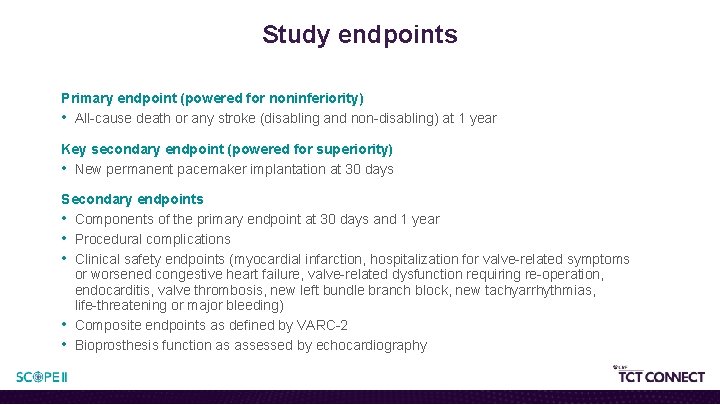
Study endpoints Primary endpoint (powered for noninferiority) • All-cause death or any stroke (disabling and non-disabling) at 1 year Key secondary endpoint (powered for superiority) • New permanent pacemaker implantation at 30 days Secondary endpoints • Components of the primary endpoint at 30 days and 1 year • Procedural complications • Clinical safety endpoints (myocardial infarction, hospitalization for valve-related symptoms or worsened congestive heart failure, valve-related dysfunction requiring re-operation, endocarditis, valve thrombosis, new left bundle branch block, new tachyarrhythmias, life-threatening or major bleeding) • Composite endpoints as defined by VARC-2 • Bioprosthesis function as assessed by echocardiography
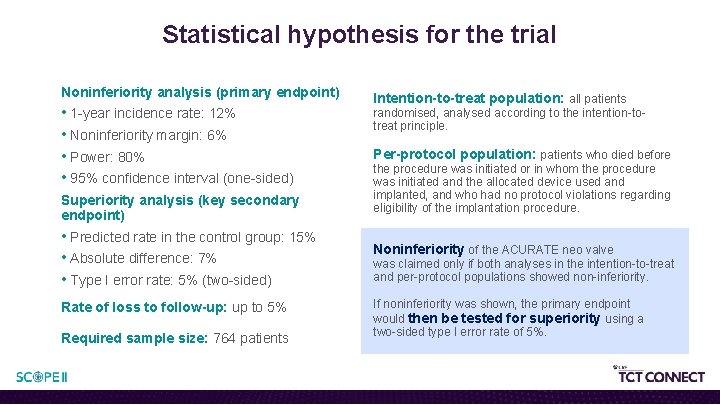
Statistical hypothesis for the trial Noninferiority analysis (primary endpoint) • 1 -year incidence rate: 12% • Noninferiority margin: 6% • Power: 80% • 95% confidence interval (one-sided) Superiority analysis (key secondary endpoint) • Predicted rate in the control group: 15% • Absolute difference: 7% • Type I error rate: 5% (two-sided) Rate of loss to follow-up: up to 5% Required sample size: 764 patients Intention-to-treat population: all patients randomised, analysed according to the intention-totreat principle. Per-protocol population: patients who died before the procedure was initiated or in whom the procedure was initiated and the allocated device used and implanted, and who had no protocol violations regarding eligibility of the implantation procedure. Noninferiority of the ACURATE neo valve was claimed only if both analyses in the intention-to-treat and per-protocol populations showed non-inferiority. If noninferiority was shown, the primary endpoint would then be tested for superiority using a two-sided type I error rate of 5%.
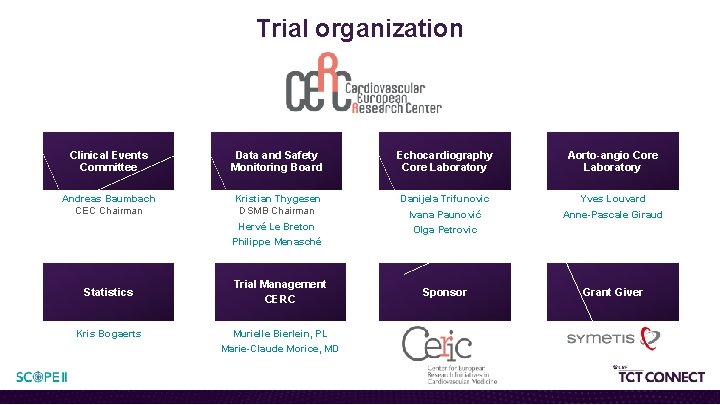
Trial organization Clinical Events Committee Data and Safety Monitoring Board Echocardiography Core Laboratory Aorto-angio Core Laboratory Andreas Baumbach CEC Chairman Kristian Thygesen DSMB Chairman Danijela Trifunovic Yves Louvard Ivana Paunović Anne-Pascale Giraud Hervé Le Breton Olga Petrovic Philippe Menasché Statistics Trial Management CERC Kris Bogaerts Murielle Bierlein, PL Marie-Claude Morice, MD Sponsor Grant Giver
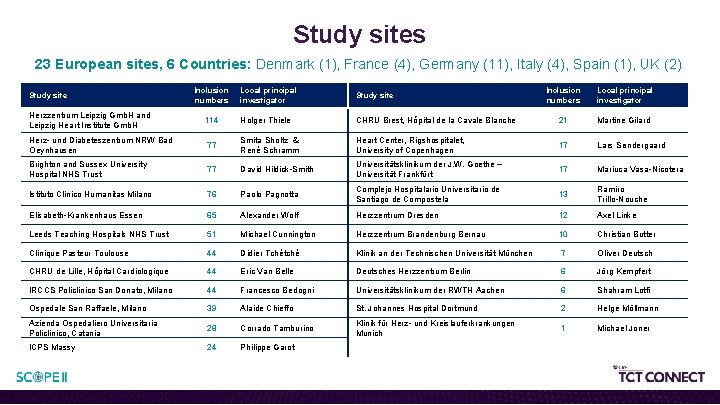
Study sites 23 European sites, 6 Countries: Denmark (1), France (4), Germany (11), Italy (4), Spain (1), UK (2) Study site Inclusion numbers Local principal investigator Herzzentrum Leipzig Gmb. H and Leipzig Heart Institute Gmb. H 114 Holger Thiele CHRU Brest, Hôpital de la Cavale Blanche 21 Martine Gilard Herz- und Diabeteszentrum NRW Bad Oeynhausen 77 Smita Sholtz & René Schramm Heart Center, Rigshospitalet, University of Copenhagen 17 Lars Søndergaard Brighton and Sussex University Hospital NHS Trust 77 David Hildick-Smith Universitätsklinikum der J. W. Goethe – Universität Frankfürt 17 Mariuca Vasa-Nicotera Istituto Clinico Humanitas Milano 76 Paolo Pagnotta Complejo Hospitalario Universitario de Santiago de Compostela 13 Ramiro Trillo-Nouche Elisabeth-Krankenhaus Essen 65 Alexander Wolf Herzzentrum Dresden 12 Axel Linke Leeds Teaching Hospitals NHS Trust 51 Michael Cunnington Herzzentrum Brandenburg Bernau 10 Christian Butter Clinique Pasteur Toulouse 44 Didier Tchétché Klinik an der Technischen Universität München 7 Oliver Deutsch CHRU de Lille, Hôpital Cardiologique 44 Eric Van Belle Deutsches Herzzentrum Berlin 6 Jörg Kempfert IRCCS Policlinico San Donato, Milano 44 Francesco Bedogni Universitätsklinikum der RWTH Aachen 6 Shahram Lotfi Ospedale San Raffaele, Milano 39 Alaide Chieffo St. Johannes Hospital Dortmund 2 Helge Möllmann Azienda Ospedaliero Universitaria Policlinico, Catania 28 Corrado Tamburino Klinik für Herz- und Kreislauferkrankungen Munich 1 Michael Joner ICPS Massy 24 Philippe Garot
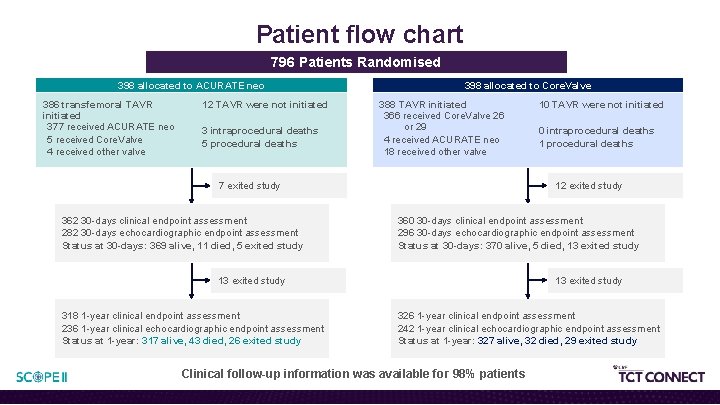
Patient flow chart 796 Patients Randomised 398 allocated to ACURATE neo 386 transfemoral TAVR initiated 377 received ACURATE neo 5 received Core. Valve 4 received other valve 12 TAVR were not initiated 3 intraprocedural deaths 5 procedural deaths 398 allocated to Core. Valve 388 TAVR initiated 366 received Core. Valve 26 or 29 4 received ACURATE neo 18 received other valve 360 30 -days clinical endpoint assessment 296 30 -days echocardiographic endpoint assessment Status at 30 -days: 370 alive, 5 died, 13 exited study 318 1 -year clinical endpoint assessment 236 1 -year clinical echocardiographic endpoint assessment Status at 1 -year: 317 alive, 43 died, 26 exited study 0 intraprocedural deaths 12 exited study 7 exited study 362 30 -days clinical endpoint assessment 282 30 -days echocardiographic endpoint assessment Status at 30 -days: 369 alive, 11 died, 5 exited study 10 TAVR were not initiated 13 exited study 326 1 -year clinical endpoint assessment 242 1 -year clinical echocardiographic endpoint assessment Status at 1 -year: 327 alive, 32 died, 29 exited study Clinical follow-up information was available for 98% patients
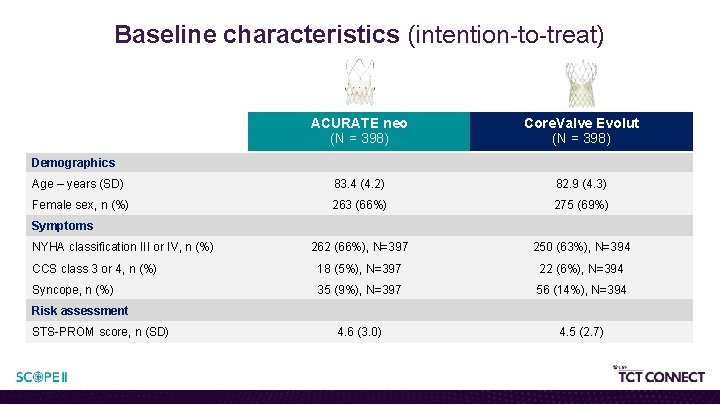
Baseline characteristics (intention-to-treat) ACURATE neo (N = 398) Core. Valve Evolut (N = 398) Age – years (SD) 83. 4 (4. 2) 82. 9 (4. 3) Female sex, n (%) 263 (66%) 275 (69%) 262 (66%), N=397 250 (63%), N=394 CCS class 3 or 4, n (%) 18 (5%), N=397 22 (6%), N=394 Syncope, n (%) 35 (9%), N=397 56 (14%), N=394 4. 6 (3. 0) 4. 5 (2. 7) Demographics Symptoms NYHA classification III or IV, n (%) Risk assessment STS-PROM score, n (SD)
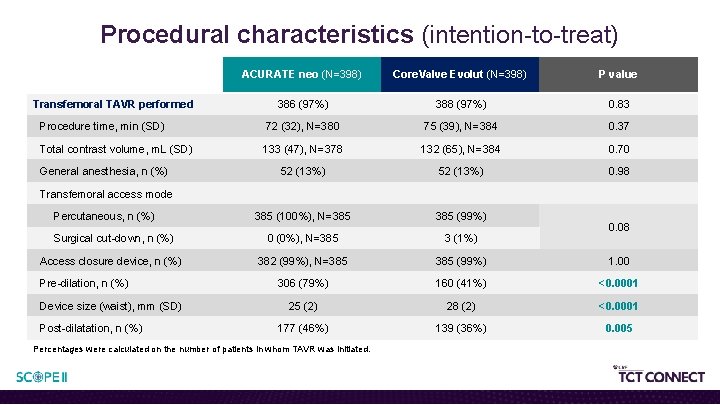
Procedural characteristics (intention-to-treat) ACURATE neo (N=398) Core. Valve Evolut (N=398) P value 386 (97%) 388 (97%) 0. 83 Procedure time, min (SD) 72 (32), N=380 75 (39), N=384 0. 37 Total contrast volume, m. L (SD) 133 (47), N=378 132 (65), N=384 0. 70 52 (13%) 0. 98 385 (100%), N=385 (99%) Surgical cut-down, n (%) 0 (0%), N=385 3 (1%) Access closure device, n (%) 382 (99%), N=385 (99%) 1. 00 306 (79%) 160 (41%) <0. 0001 25 (2) 28 (2) <0. 0001 177 (46%) 139 (36%) 0. 005 Transfemoral TAVR performed General anesthesia, n (%) Transfemoral access mode Percutaneous, n (%) Pre-dilation, n (%) Device size (waist), mm (SD) Post-dilatation, n (%) Percentages were calculated on the number of patients in whom TAVR was initiated. 0. 08
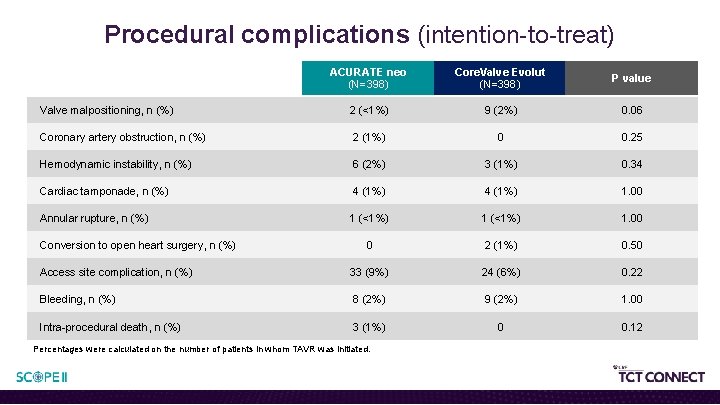
Procedural complications (intention-to-treat) ACURATE neo (N=398) Core. Valve Evolut (N=398) P value Valve malpositioning, n (%) 2 (<1%) 9 (2%) 0. 06 Coronary artery obstruction, n (%) 2 (1%) 0 0. 25 Hemodynamic instability, n (%) 6 (2%) 3 (1%) 0. 34 Cardiac tamponade, n (%) 4 (1%) 1. 00 Annular rupture, n (%) 1 (<1%) 1. 00 0 2 (1%) 0. 50 Access site complication, n (%) 33 (9%) 24 (6%) 0. 22 Bleeding, n (%) 8 (2%) 9 (2%) 1. 00 Intra-procedural death, n (%) 3 (1%) 0 0. 12 Conversion to open heart surgery, n (%) Percentages were calculated on the number of patients in whom TAVR was initiated.
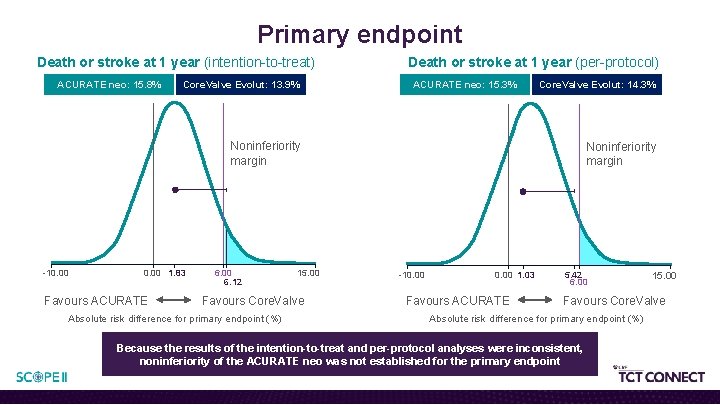
Primary endpoint Death or stroke at 1 year (intention-to-treat) ACURATE neo: 15. 8% Core. Valve Evolut: 13. 9% Death or stroke at 1 year (per-protocol) ACURATE neo: 15. 3% Noninferiority margin -10. 00 1. 83 Favours ACURATE 6. 00 6. 12 15. 00 Favours Core. Valve Absolute risk difference for primary endpoint (%) Core. Valve Evolut: 14. 3% Noninferiority margin -10. 00 1. 03 Favours ACURATE 5. 42 6. 00 15. 00 Favours Core. Valve Absolute risk difference for primary endpoint (%) Because the results of the intention-to-treat and per-protocol analyses were inconsistent, noninferiority of the ACURATE neo was not established for the primary endpoint
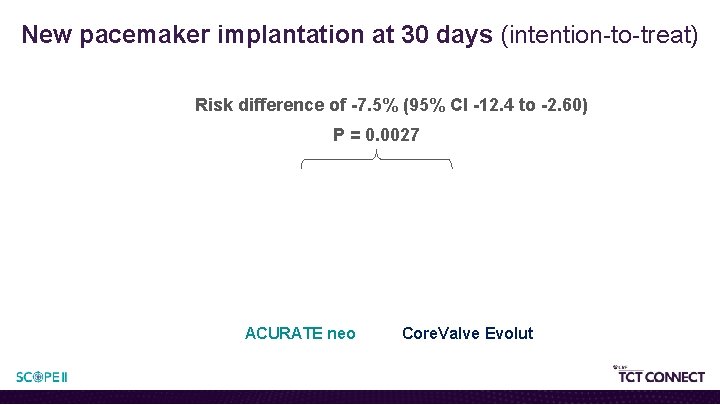
New pacemaker implantation at 30 days (intention-to-treat) Risk difference of -7. 5% (95% CI -12. 4 to -2. 60) P = 0. 0027 ACURATE neo Core. Valve Evolut
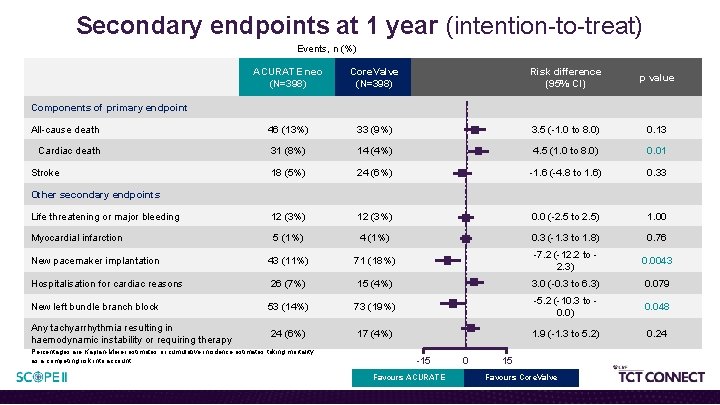
Secondary endpoints at 1 year (intention-to-treat) Events, n (%) ACURATE neo (N=398) Core. Valve (N=398) Risk difference (95% CI) p value All-cause death 46 (13%) 33 (9%) 3. 5 (-1. 0 to 8. 0) 0. 13 Cardiac death 31 (8%) 14 (4%) 4. 5 (1. 0 to 8. 0) 0. 01 18 (5%) 24 (6%) -1. 6 (-4. 8 to 1. 6) 0. 33 Life threatening or major bleeding 12 (3%) 0. 0 (-2. 5 to 2. 5) 1. 00 Myocardial infarction 5 (1%) 4 (1%) 0. 3 (-1. 3 to 1. 8) 0. 76 New pacemaker implantation 43 (11%) 71 (18%) -7. 2 (-12. 2 to 2. 3) 0. 0043 Hospitalisation for cardiac reasons 26 (7%) 15 (4%) 3. 0 (-0. 3 to 6. 3) 0. 079 New left bundle branch block 53 (14%) 73 (19%) -5. 2 (-10. 3 to 0. 0) 0. 048 Any tachyarrhythmia resulting in haemodynamic instability or requiring therapy 24 (6%) 17 (4%) 1. 9 (-1. 3 to 5. 2) 0. 24 Components of primary endpoint Stroke Other secondary endpoints Percentages are Kaplan-Meier estimates or cumulative incidence estimates taking mortality as a competing risk into account -15 Favours ACURATE 0 15 Favours Core. Valve
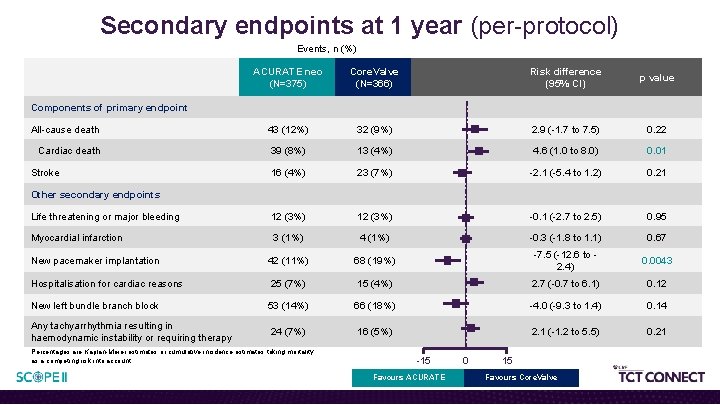
Secondary endpoints at 1 year (per-protocol) Events, n (%) ACURATE neo (N=375) Core. Valve (N=366) Risk difference (95% CI) p value All-cause death 43 (12%) 32 (9%) 2. 9 (-1. 7 to 7. 5) 0. 22 Cardiac death 39 (8%) 13 (4%) 4. 6 (1. 0 to 8. 0) 0. 01 16 (4%) 23 (7%) -2. 1 (-5. 4 to 1. 2) 0. 21 Life threatening or major bleeding 12 (3%) -0. 1 (-2. 7 to 2. 5) 0. 95 Myocardial infarction 3 (1%) 4 (1%) -0. 3 (-1. 8 to 1. 1) 0. 67 New pacemaker implantation 42 (11%) 68 (19%) -7. 5 (-12. 6 to 2. 4) 0. 0043 Hospitalisation for cardiac reasons 25 (7%) 15 (4%) 2. 7 (-0. 7 to 6. 1) 0. 12 New left bundle branch block 53 (14%) 66 (18%) -4. 0 (-9. 3 to 1. 4) 0. 14 Any tachyarrhythmia resulting in haemodynamic instability or requiring therapy 24 (7%) 16 (5%) 2. 1 (-1. 2 to 5. 5) 0. 21 Components of primary endpoint Stroke Other secondary endpoints Percentages are Kaplan-Meier estimates or cumulative incidence estimates taking mortality as a competing risk into account -15 Favours ACURATE 0 15 Favours Core. Valve
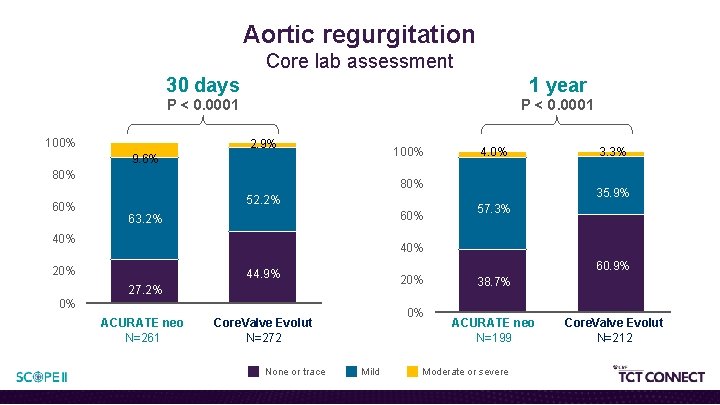
Aortic regurgitation Core lab assessment 30 days 1 year P < 0. 0001 100% P < 0. 0001 2. 9% 100% 9. 6% 80% 60% 4. 0% 80% 52. 2% 60% 63. 2% 40% 3. 3% 35. 9% 57. 3% 40% 20% 60. 9% 44. 9% 20% 27. 2% 0% ACURATE neo N=261 0% Core. Valve Evolut N=272 None or trace Mild 38. 7% ACURATE neo N=199 Moderate or severe Core. Valve Evolut N=212
Study limitations The trial was not powered to show differences with regard to individual clinical endpoints, with the exception of new permanent pacemaker implantation at 30 days. Follow-up is limited at 1 year, which precludes meaningful evaluations of differences in long-term clinical outcomes and valve durability. Follow-up echocardiography was available only for a proportion of the initial population.
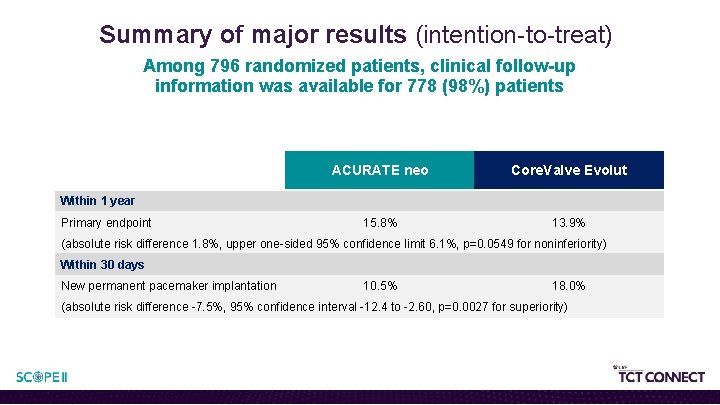
Summary of major results (intention-to-treat) Among 796 randomized patients, clinical follow-up information was available for 778 (98%) patients ACURATE neo Core. Valve Evolut 15. 8% 13. 9% Within 1 year Primary endpoint (absolute risk difference 1. 8%, upper one-sided 95% confidence limit 6. 1%, p=0. 0549 for noninferiority) Within 30 days New permanent pacemaker implantation 10. 5% 18. 0% (absolute risk difference -7. 5%, 95% confidence interval -12. 4 to -2. 60, p=0. 0027 for superiority)
Conclusions TAVR with the ACURATE neo valve did not meet noninferiority compared with the Core. Valve Evolut bioprosthesis with respect to a composite of death or stroke at 1 year. In a secondary analysis with limited statistical power, cardiac death was increased at 1 year in patients who received the ACURATE neo valve. The two bioprostheses differed with respect to technical characteristics such as degree of aortic regurgitation and need for new permanent pacemaker implantation.
Simultaneous publication (October 15, 2020) https: //www. ahajournals. org/journal/circ Tamburino C, Bleiziffer S, Thiele H, Scholtz S, Hildick-Smith D, Cunnington M, Wolf A, Barbanti M, Tchetchè D, Garot D, Pagnotta P, Gilard M, Bedogni F, Van Belle E, Vasa-Nicotera M, Chieffo A, Deutsch O, Kempfert J, Søndergaard L, Butter C, Trillo-Nouche R, Lotfi S, Möllmann H, Joner M, Abdel-Wahab M, Bogaerts K, Hengstenberg C, Capodanno D. Comparison of self-expanding bioprostheses for transcatheter aortic valve replacement in patients with symptomatic severe aortic stenosis: the SCOPE 2 randomized clinical trial Circulation. 2020 [e. Pub ahead of print]
- Slides: 24