
Comparison of Methods used for DNA Quantification Method

- Slides: 5
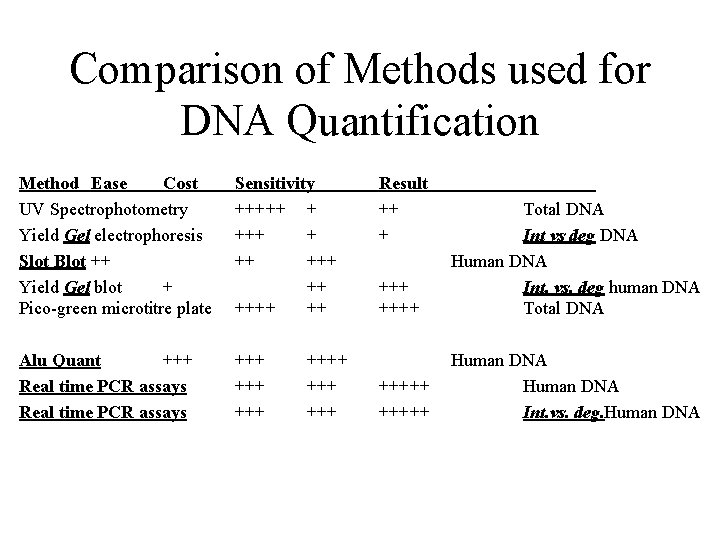
Comparison of Methods used for DNA Quantification Method Ease Cost UV Spectrophotometry Yield Gel electrophoresis Slot Blot ++ Yield Gel blot + Pico-green microtitre plate Sensitivity +++++ ++ ++++ ++ Alu Quant +++ Real time PCR assays +++ ++++ +++ Result ++ + ++++ Total DNA Int vs deg DNA Human DNA Int. vs. deg human DNA Total DNA +++++ Human DNA Int. vs. deg. Human DNA
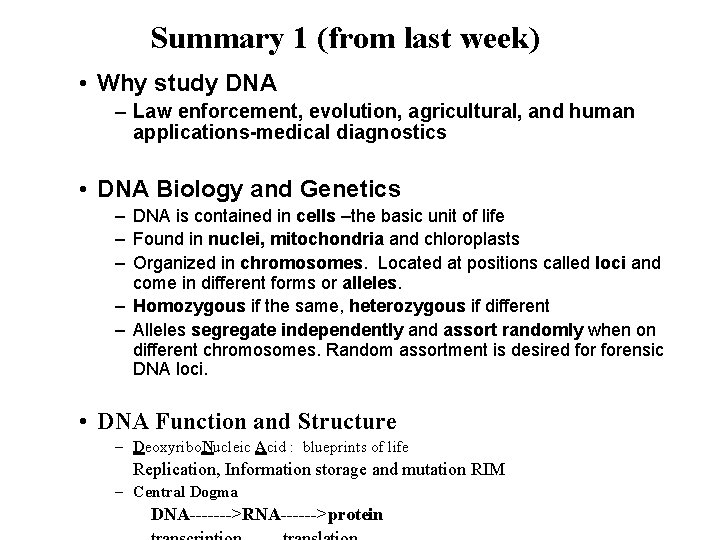
Summary 1 (from last week) • Why study DNA – Law enforcement, evolution, agricultural, and human applications-medical diagnostics • DNA Biology and Genetics – DNA is contained in cells –the basic unit of life – Found in nuclei, mitochondria and chloroplasts – Organized in chromosomes. Located at positions called loci and come in different forms or alleles. – Homozygous if the same, heterozygous if different – Alleles segregate independently and assort randomly when on different chromosomes. Random assortment is desired forensic DNA loci. • DNA Function and Structure – Deoxyribo. Nucleic Acid : blueprints of life Replication, Information storage and mutation RIM – Central Dogma DNA------->RNA------>protein
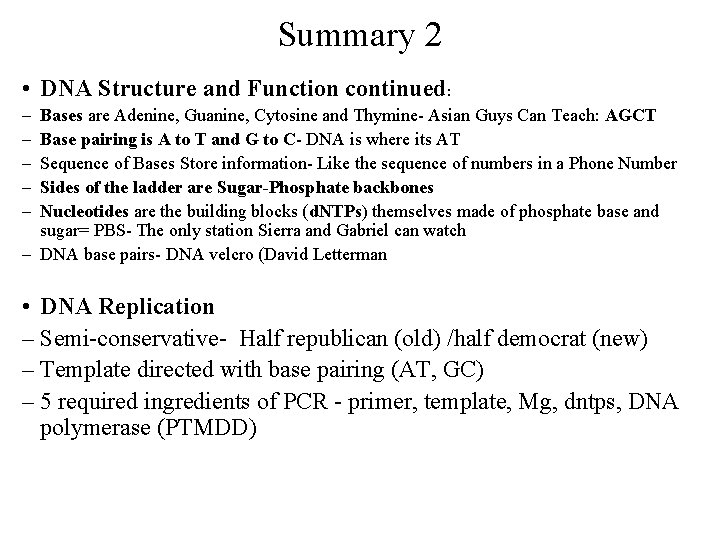
Summary 2 • DNA Structure and Function continued: – – – Bases are Adenine, Guanine, Cytosine and Thymine- Asian Guys Can Teach: AGCT Base pairing is A to T and G to C- DNA is where its AT Sequence of Bases Store information- Like the sequence of numbers in a Phone Number Sides of the ladder are Sugar-Phosphate backbones Nucleotides are the building blocks (d. NTPs) themselves made of phosphate base and sugar= PBS- The only station Sierra and Gabriel can watch – DNA base pairs- DNA velcro (David Letterman • DNA Replication – Semi-conservative- Half republican (old) /half democrat (new) – Template directed with base pairing (AT, GC) – 5 required ingredients of PCR - primer, template, Mg, dntps, DNA polymerase (PTMDD)
Summary 3 • Steps in forensic DNA typing are – Evaluation, Extraction, Quantification, Typing and Interpretation – 1) Evaluation- Is it there? Screen- blood? Semen? Saliva, human? – 2) Extraction- Get and clean DNA • Open cells -Get DNA • Organic, Chelex and FTA extractions • Quantify- Determine quality and quantity? – How good and how much did you get? – Yield Gels, Slot Blots, Real time PCR assays
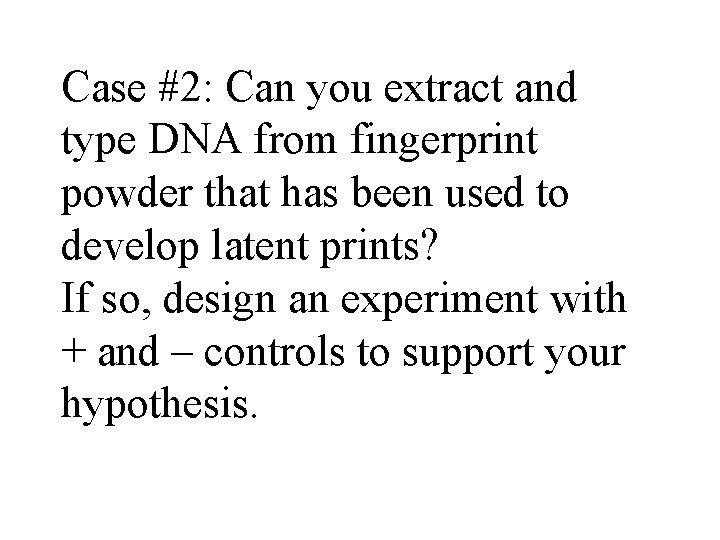
Case #2: Can you extract and type DNA from fingerprint powder that has been used to develop latent prints? If so, design an experiment with + and – controls to support your hypothesis.