
Comparison Of High Resolution Terrestrial Laser Scanning And

- Slides: 22
Comparison Of High Resolution Terrestrial Laser Scanning And Terrestrial Photogrammetry For Modeling Applications Samed ÖZDEMİR 1 Temel BAYRAK 2 1 Gümüşhane University, Geomatics Engineering, Gümüşhane, Turkey 2 Sinop University, Geomatics Engineering, Sinop, Turkey Corresponding Author: samedozdemirr@gmail. com European Geosciences Union General Assembly 2016
OUTLINE 1. Introduction 1. 1. Laser Scanner 1. 2. Terrestrial Photogrammetry 2. Test Cases 2. 1. Test Setup 2. 2. Time of Flight Laser Scanner 2. 3. Accuracy of Single Measurements 2. 4. 3 D Geometry Comparison 2. 5. Planimetric and Volumetric Comparison 3. Conclusions European Geosciences Union General Assembly 2016
1. Introduction 2. Test Cases 3. Conclusions • In this study, terrestrial laser scanner and terrestrial photogrammetric methods’ spatial and model accuracies investigated under various conditions which include measuring targets at different instrument to object distances then investigating the accuracy of these measurements, modeling an irregular shaped surface to compare two surfaces volume and surface areas, at last comparing dimensions of known geometrical shaped small objects. Also terrestrial laser scanners and terrestrial photogrammetric methods most suitable application conditions investigated in terms of cost, time, mobility and accuracy. European Geosciences Union General Assembly 2016
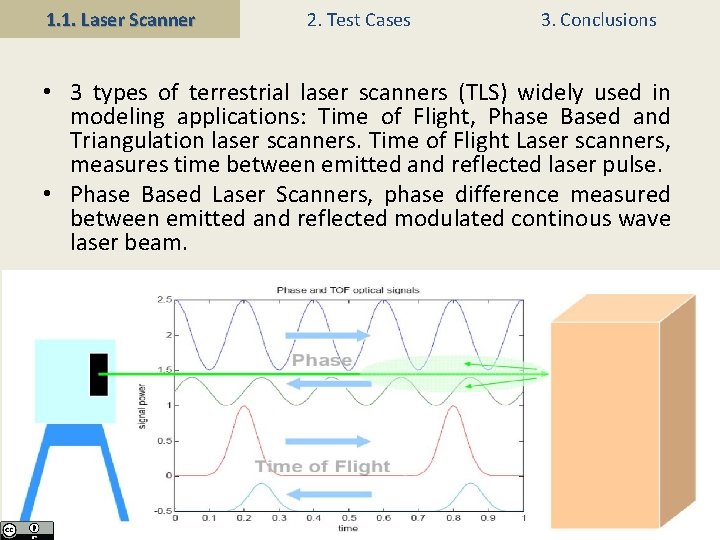
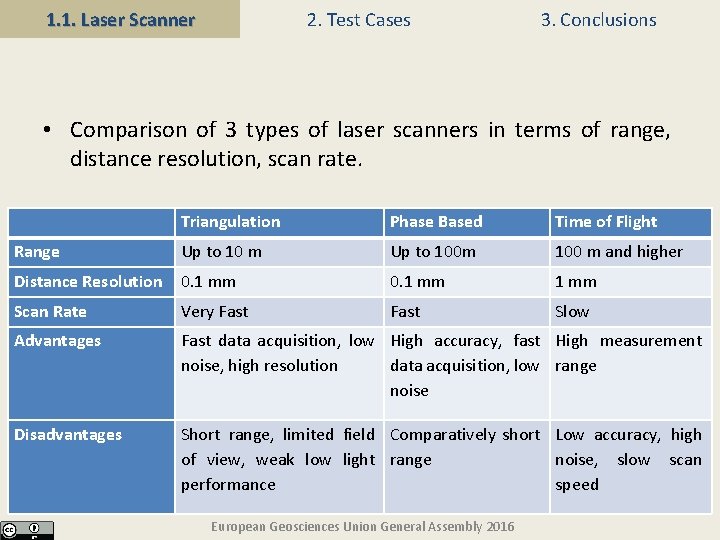
1. 1. Laser Scanner 2. Test Cases 3. Conclusions • 3 types of terrestrial laser scanners (TLS) widely used in modeling applications: Time of Flight, Phase Based and Triangulation laser scanners. Time of Flight Laser scanners, measures time between emitted and reflected laser pulse. • Phase Based Laser Scanners, phase difference measured between emitted and reflected modulated continous wave laser beam. European Geosciences Union General Assembly 2016
1. 1. Laser Scanner 2. Test Cases 3. Conclusions • Comparison of 3 types of laser scanners in terms of range, distance resolution, scan rate. Triangulation Phase Based Time of Flight Range Up to 10 m Up to 100 m 100 m and higher Distance Resolution 0. 1 mm Scan Rate Very Fast Slow Advantages Fast data acquisition, low High accuracy, fast High measurement noise, high resolution data acquisition, low range noise Disadvantages Short range, limited field Comparatively short Low accuracy, high of view, weak low light range noise, slow scan performance speed European Geosciences Union General Assembly 2016
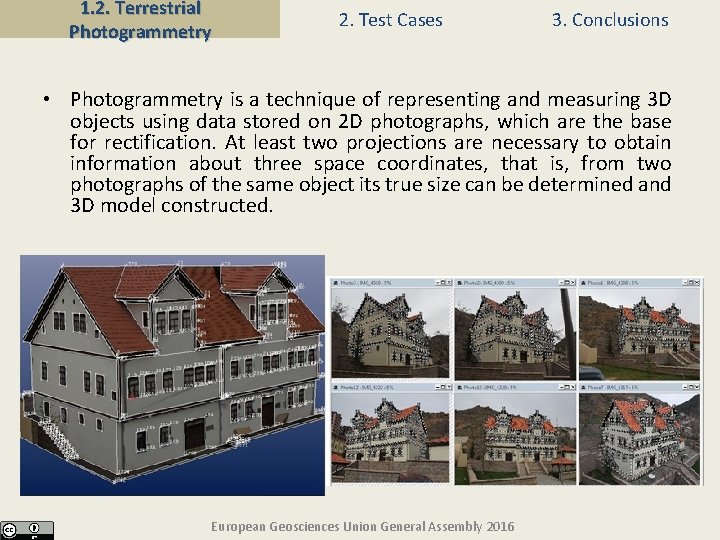
1. 2. Terrestrial Photogrammetry 2. Test Cases 3. Conclusions • Photogrammetry is a technique of representing and measuring 3 D objects using data stored on 2 D photographs, which are the base for rectification. At least two projections are necessary to obtain information about three space coordinates, that is, from two photographs of the same object its true size can be determined and 3 D model constructed. European Geosciences Union General Assembly 2016
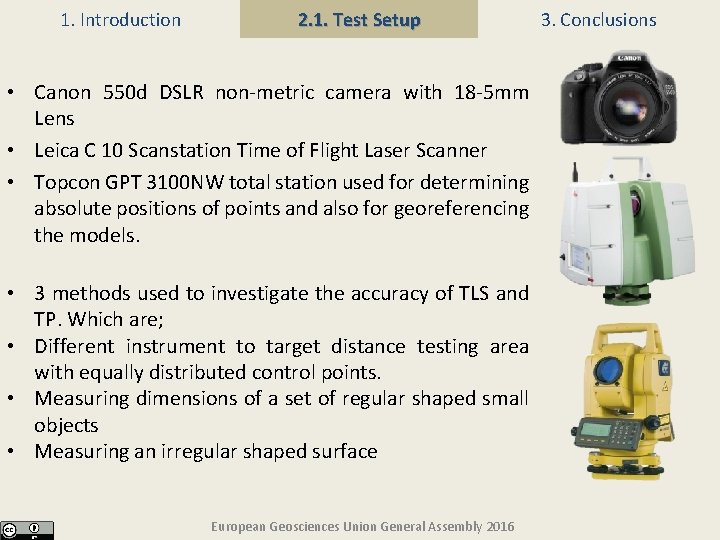
1. Introduction 2. 1. Test Setup • Canon 550 d DSLR non-metric camera with 18 -5 mm Lens • Leica C 10 Scanstation Time of Flight Laser Scanner • Topcon GPT 3100 NW total station used for determining absolute positions of points and also for georeferencing the models. • 3 methods used to investigate the accuracy of TLS and TP. Which are; • Different instrument to target distance testing area with equally distributed control points. • Measuring dimensions of a set of regular shaped small objects • Measuring an irregular shaped surface European Geosciences Union General Assembly 2016 3. Conclusions
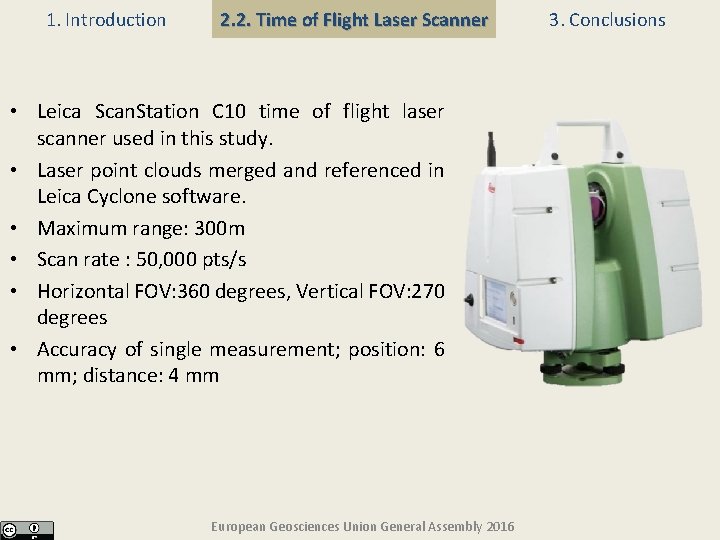
1. Introduction 2. 2. Time of Flight Laser Scanner • Leica Scan. Station C 10 time of flight laser scanner used in this study. • Laser point clouds merged and referenced in Leica Cyclone software. • Maximum range: 300 m • Scan rate : 50, 000 pts/s • Horizontal FOV: 360 degrees, Vertical FOV: 270 degrees • Accuracy of single measurement; position: 6 mm; distance: 4 mm European Geosciences Union General Assembly 2016 3. Conclusions
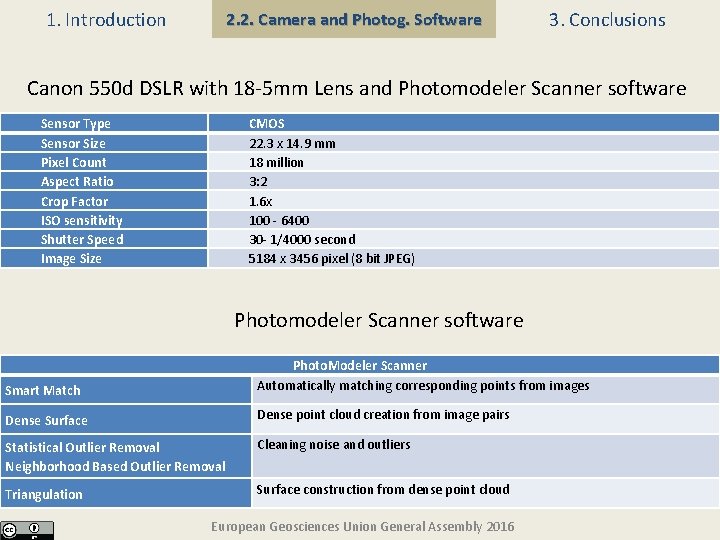
1. Introduction 2. 2. Camera and Photog. Software 3. Conclusions Canon 550 d DSLR with 18 -5 mm Lens and Photomodeler Scanner software Sensor Type Sensor Size Pixel Count Aspect Ratio Crop Factor ISO sensitivity Shutter Speed Image Size CMOS 22. 3 x 14. 9 mm 18 million 3: 2 1. 6 x 100 - 6400 30 - 1/4000 second 5184 x 3456 pixel (8 bit JPEG) Photomodeler Scanner software Smart Match Photo. Modeler Scanner Automatically matching corresponding points from images Dense Surface Dense point cloud creation from image pairs Statistical Outlier Removal Neighborhood Based Outlier Removal Cleaning noise and outliers Triangulation Surface construction from dense point cloud European Geosciences Union General Assembly 2016
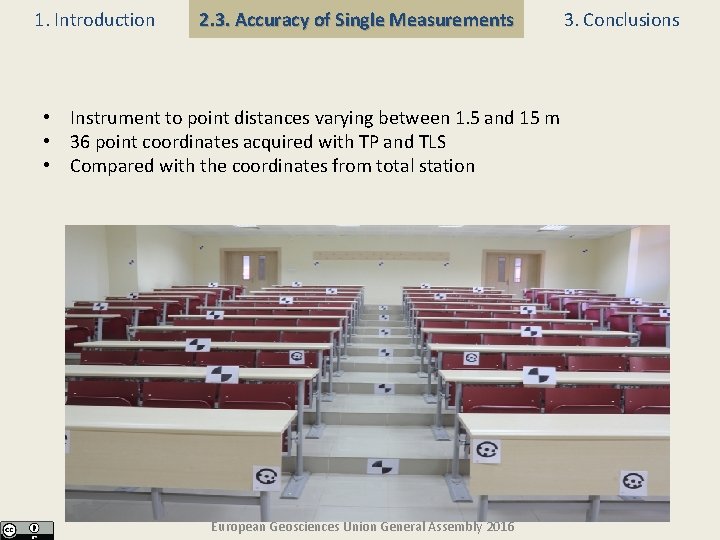
1. Introduction 2. 3. Accuracy of Single Measurements • Instrument to point distances varying between 1. 5 and 15 m • 36 point coordinates acquired with TP and TLS • Compared with the coordinates from total station European Geosciences Union General Assembly 2016 3. Conclusions
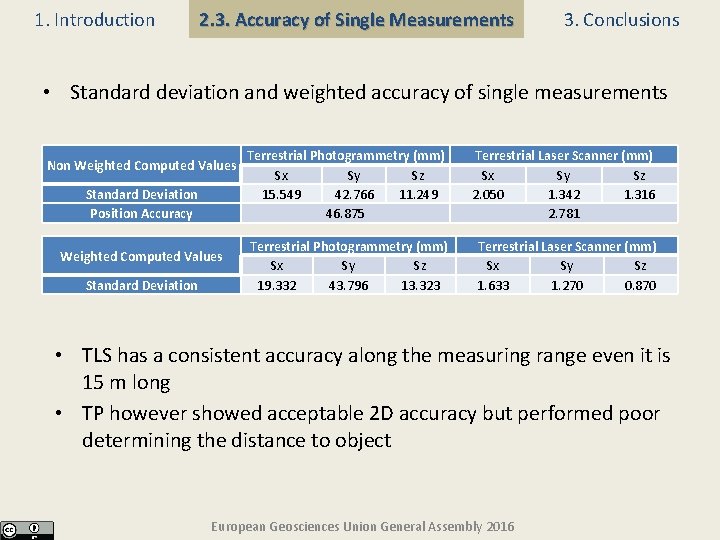
1. Introduction 2. 3. Accuracy of Single Measurements 3. Conclusions • Standard deviation and weighted accuracy of single measurements Non Weighted Computed Values Standard Deviation Position Accuracy Weighted Computed Values Standard Deviation Terrestrial Photogrammetry (mm) Sx Sy Sz 15. 549 42. 766 11. 249 46. 875 Terrestrial Laser Scanner (mm) Sx Sy Sz 2. 050 1. 342 1. 316 2. 781 Terrestrial Photogrammetry (mm) Sx Sy Sz 19. 332 43. 796 13. 323 Terrestrial Laser Scanner (mm) Sx Sy Sz 1. 633 1. 270 0. 870 • TLS has a consistent accuracy along the measuring range even it is 15 m long • TP however showed acceptable 2 D accuracy but performed poor determining the distance to object European Geosciences Union General Assembly 2016
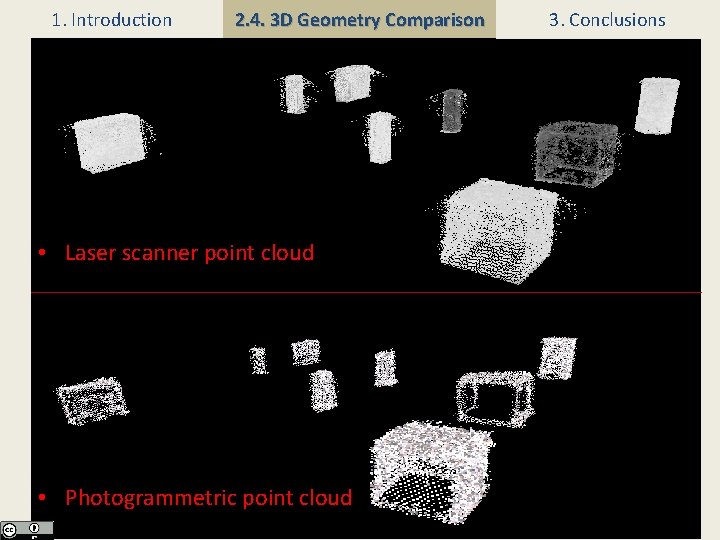
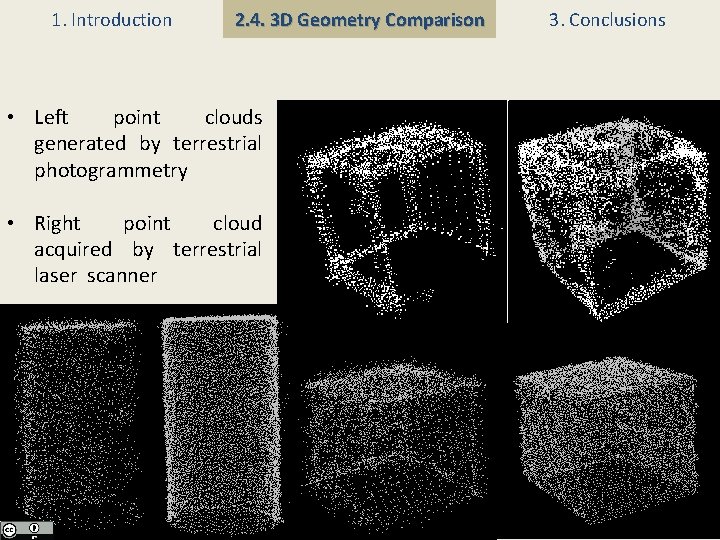
1. Introduction 2. 4. 3 D Geometry Comparison • Laser scanner point cloud • Photogrammetric point cloud 3. Conclusions
1. Introduction 2. 4. 3 D Geometry Comparison • Left point clouds generated by terrestrial photogrammetry • Right point cloud acquired by terrestrial laser scanner 3. Conclusions
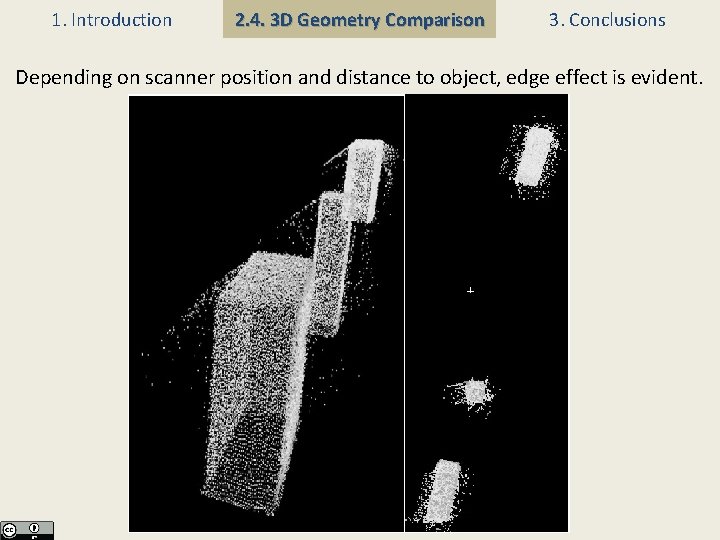
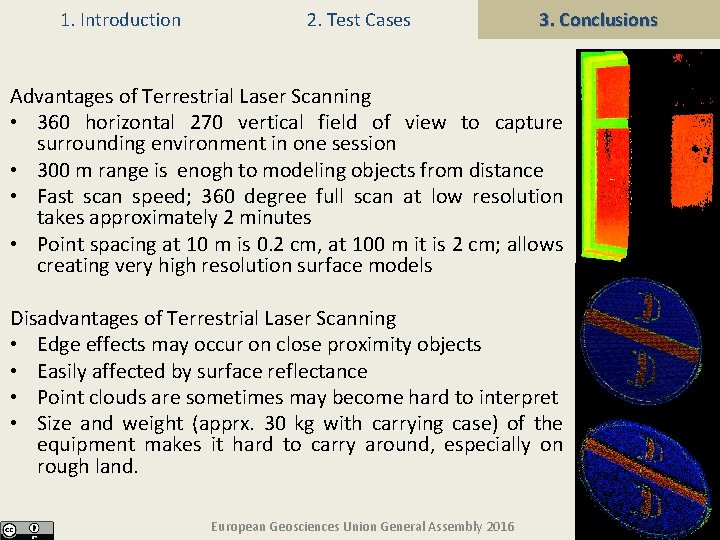
1. Introduction 2. 4. 3 D Geometry Comparison 3. Conclusions Depending on scanner position and distance to object, edge effect is evident.
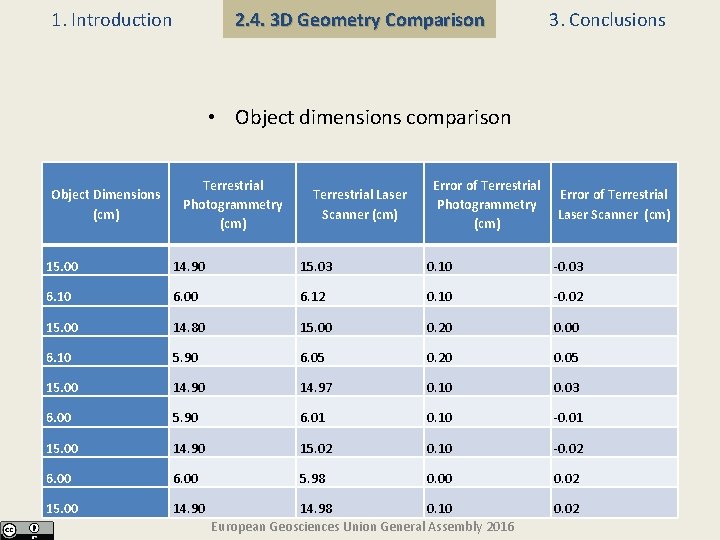
1. Introduction 2. 4. 3 D Geometry Comparison 3. Conclusions • Object dimensions comparison Object Dimensions (cm) Terrestrial Photogrammetry (cm) Terrestrial Laser Scanner (cm) Error of Terrestrial Photogrammetry Laser Scanner (cm) 15. 00 14. 90 15. 03 0. 10 -0. 03 6. 10 6. 00 6. 12 0. 10 -0. 02 15. 00 14. 80 15. 00 0. 20 0. 00 6. 10 5. 90 6. 05 0. 20 0. 05 15. 00 14. 97 0. 10 0. 03 6. 00 5. 90 6. 01 0. 10 -0. 01 15. 00 14. 90 15. 02 0. 10 -0. 02 6. 00 5. 98 0. 00 0. 02 15. 00 14. 98 0. 10 European Geosciences Union General Assembly 2016 0. 02
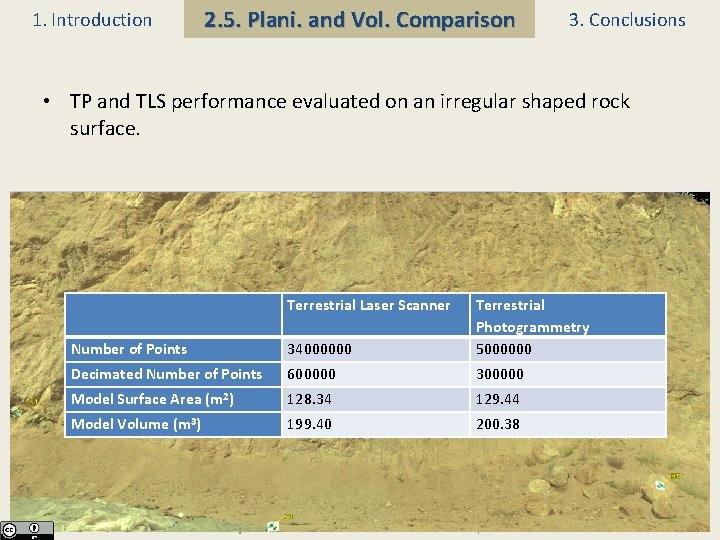
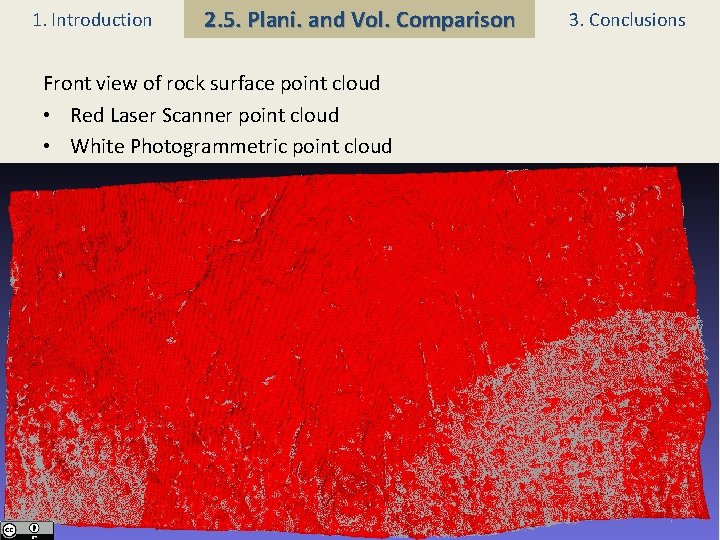
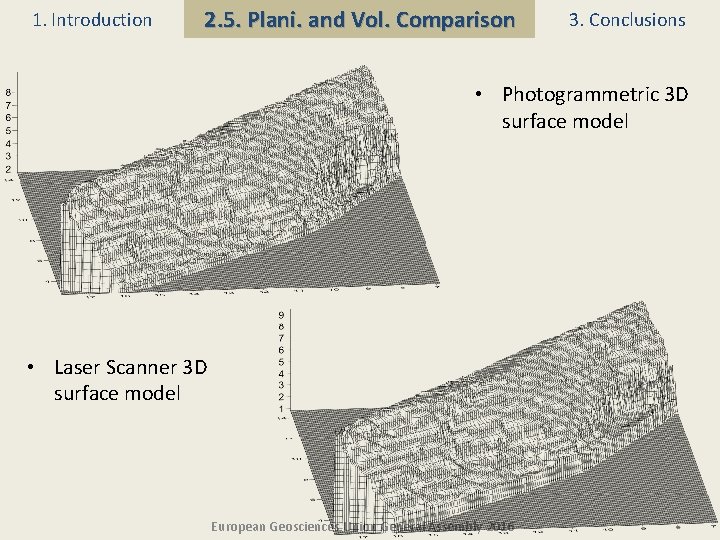
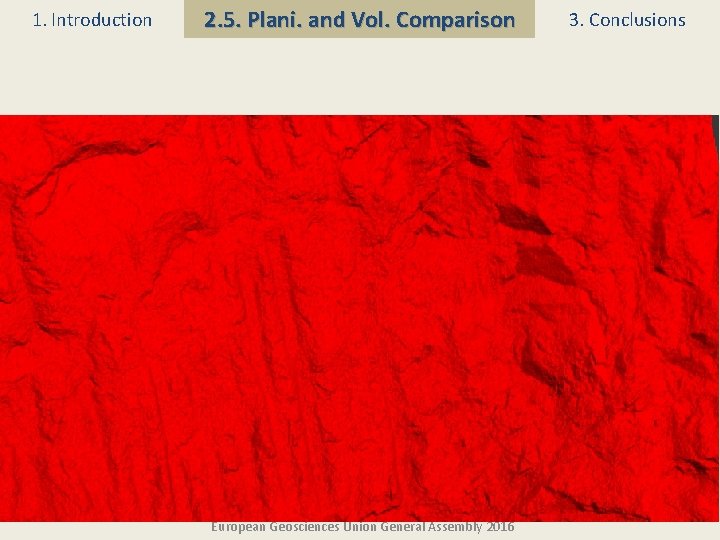
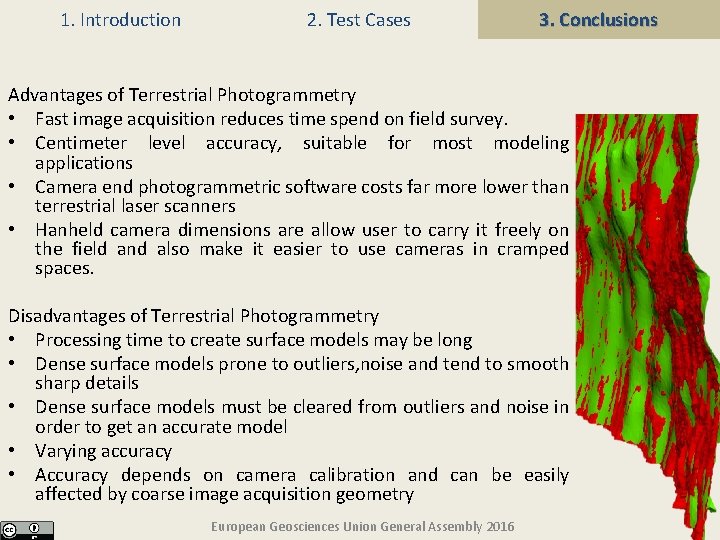
1. Introduction 2. 5. Plani. and Vol. Comparison 3. Conclusions • TP and TLS performance evaluated on an irregular shaped rock surface. Terrestrial Laser Scanner Number of Points 34000000 Terrestrial Photogrammetry 5000000 Decimated Number of Points 600000 300000 Model Surface Area (m 2) 128. 34 129. 44 Model Volume (m 3) 199. 40 200. 38 European Geosciences Union General Assembly 2016
1. Introduction 2. 5. Plani. and Vol. Comparison Front view of rock surface point cloud • Red Laser Scanner point cloud • White Photogrammetric point cloud European Geosciences Union General Assembly 2016 3. Conclusions
1. Introduction 2. 5. Plani. and Vol. Comparison 3. Conclusions • Photogrammetric 3 D surface model • Laser Scanner 3 D surface model European Geosciences Union General Assembly 2016
1. Introduction 2. 5. Plani. and Vol. Comparison European Geosciences Union General Assembly 2016 3. Conclusions
1. Introduction 2. Test Cases 3. Conclusions Advantages of Terrestrial Laser Scanning • 360 horizontal 270 vertical field of view to capture surrounding environment in one session • 300 m range is enogh to modeling objects from distance • Fast scan speed; 360 degree full scan at low resolution takes approximately 2 minutes • Point spacing at 10 m is 0. 2 cm, at 100 m it is 2 cm; allows creating very high resolution surface models Disadvantages of Terrestrial Laser Scanning • Edge effects may occur on close proximity objects • Easily affected by surface reflectance • Point clouds are sometimes may become hard to interpret • Size and weight (apprx. 30 kg with carrying case) of the equipment makes it hard to carry around, especially on rough land. European Geosciences Union General Assembly 2016
1. Introduction 2. Test Cases 3. Conclusions Advantages of Terrestrial Photogrammetry • Fast image acquisition reduces time spend on field survey. • Centimeter level accuracy, suitable for most modeling applications • Camera end photogrammetric software costs far more lower than terrestrial laser scanners • Hanheld camera dimensions are allow user to carry it freely on the field and also make it easier to use cameras in cramped spaces. Disadvantages of Terrestrial Photogrammetry • Processing time to create surface models may be long • Dense surface models prone to outliers, noise and tend to smooth sharp details • Dense surface models must be cleared from outliers and noise in order to get an accurate model • Varying accuracy • Accuracy depends on camera calibration and can be easily affected by coarse image acquisition geometry European Geosciences Union General Assembly 2016
Thanks For Your Attention… European Geosciences Union General Assembly 2016