
Comparison of full depletion voltage extracted from CV

- Slides: 13
Comparison of full depletion voltage extracted from C-V, I-V and Q-V characteristics for a highly irradiated Epi-detector E. Fretwurst , N. Hoffmann*, F. Hönniger, G. Lindström Institute for Experimental Physics, Univ. of Hamburg *DESY summer student 2005 ¿ Motivation ¿ C-V measurements, frequency dependence (10 k. Hz – 800 k. Hz), I-V, Q-V measurements and annealing behavior, comparison of extracted Vfd values ¿ Conclusion 1 E. Fretwurst, Univ. Hamburg, RD 50 workshop, CERN, November 2005
Motivation Ø What is the meaning of „full depletion voltage Vfd“ in case of heavily damaged epitaxial silicon detectors? Ø Comparison of Vfd values extracted from different measurements: C-V characteristics, frequency dependence: space charge concentration, shallow and deep defect levels I-V characteristics: concentration of generation centers Q-V characteristics (charge collection measurements): electric field distribution and trapping Ø Which Vfd values are relevant for the evaluation of the detector properties under practical operation in experiments at S-LHC? 2 E. Fretwurst, Univ. Hamburg, RD 50 workshop, CERN, November 2005
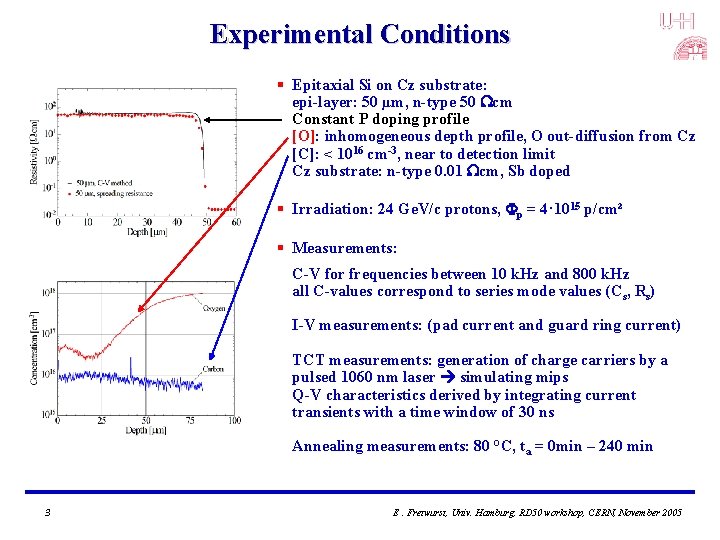
Experimental Conditions § Epitaxial Si on Cz substrate: epi-layer: 50 µm, n-type 50 cm Constant P doping profile [O]: inhomogeneous depth profile, O out-diffusion from Cz [C]: < 1016 cm-3, near to detection limit Cz substrate: n-type 0. 01 cm, Sb doped § Irradiation: 24 Ge. V/c protons, p = 4· 1015 p/cm² § Measurements: C-V for frequencies between 10 k. Hz and 800 k. Hz all C-values correspond to series mode values (Cs, Rs) I-V measurements: (pad current and guard ring current) TCT measurements: generation of charge carriers by a pulsed 1060 nm laser simulating mips Q-V characteristics derived by integrating current transients with a time window of 30 ns Annealing measurements: 80 °C, ta = 0 min – 240 min 3 E. Fretwurst, Univ. Hamburg, RD 50 workshop, CERN, November 2005
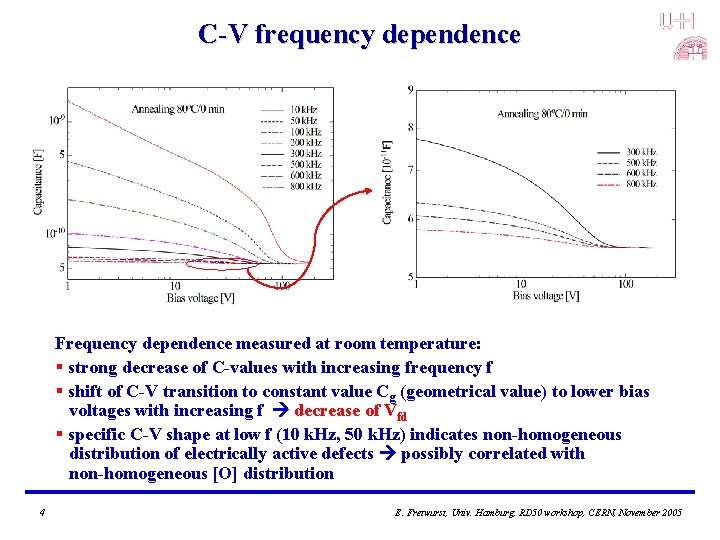
C-V frequency dependence Frequency dependence measured at room temperature: § strong decrease of C-values with increasing frequency f § shift of C-V transition to constant value Cg (geometrical value) to lower bias voltages with increasing f decrease of Vfd § specific C-V shape at low f (10 k. Hz, 50 k. Hz) indicates non-homogeneous distribution of electrically active defects possibly correlated with non-homogeneous [O] distribution 4 E. Fretwurst, Univ. Hamburg, RD 50 workshop, CERN, November 2005
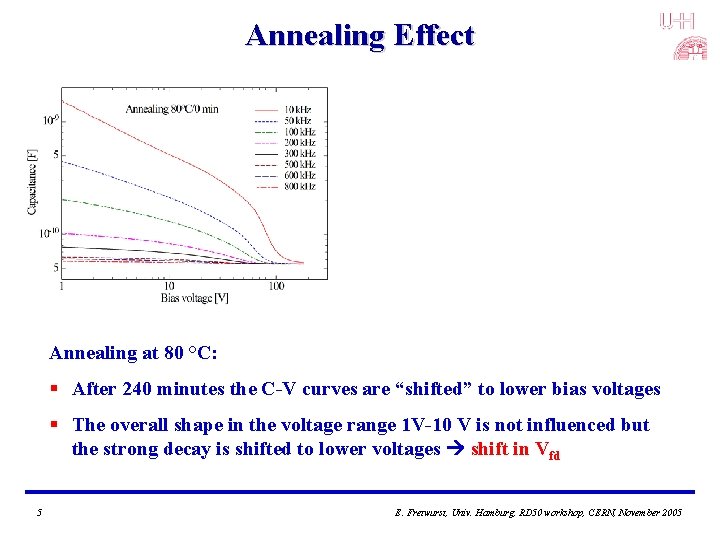
Annealing Effect Annealing at 80 °C: § After 240 minutes the C-V curves are “shifted” to lower bias voltages § The overall shape in the voltage range 1 V-10 V is not influenced but the strong decay is shifted to lower voltages shift in Vfd 5 E. Fretwurst, Univ. Hamburg, RD 50 workshop, CERN, November 2005
Vfd frequency dependence § Vfd decreases with increasing frequency but saturates § Saturation at about 300 k. Hz for 0 min and 8 min § Saturation between 100 k. Hz and 200 k. Hz for 120 min § Relative change Vfd, sat/Vfd, 10 k. Hz 50 % 6 E. Fretwurst, Univ. Hamburg, RD 50 workshop, CERN, November 2005
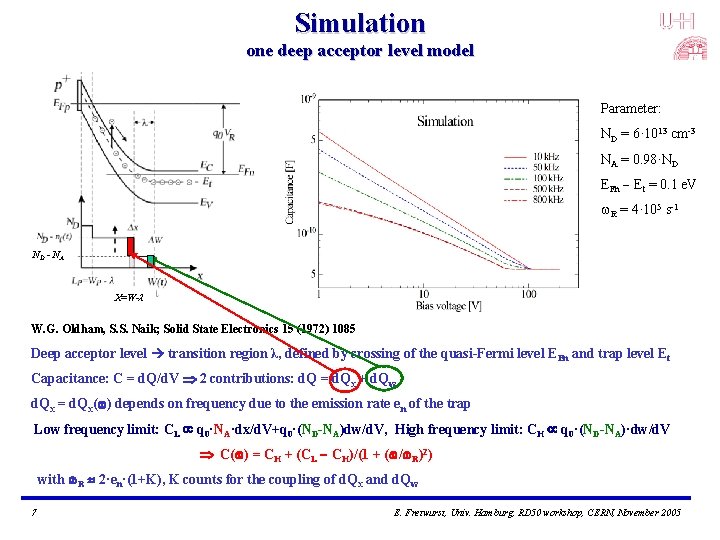
Simulation one deep acceptor level model Parameter: ND = 6· 1013 cm-3 NA = 0. 98·ND EFn Et = 0. 1 e. V R = 4· 105 s-1 ND - N A X=W-λ W. G. Oldham, S. S. Naik; Solid State Electronics 15 (1972) 1085 Deep acceptor level transition region λ, defined by crossing of the quasi-Fermi level EFn and trap level Et Capacitance: C = d. Q/d. V 2 contributions: d. Q = d. Qx + d. Qw d. Qx = d. Qx( ) depends on frequency due to the emission rate en of the trap Low frequency limit: CL q 0·NA·dx/d. V+q 0·(ND-NA)dw/d. V, High frequency limit: CH q 0·(ND-NA)·dw/d. V C( ) = CH + (CL CH)/(1 + ( / R)2) with R 2·en·(1+K), K counts for the coupling of d. Qx and d. Qw 7 E. Fretwurst, Univ. Hamburg, RD 50 workshop, CERN, November 2005
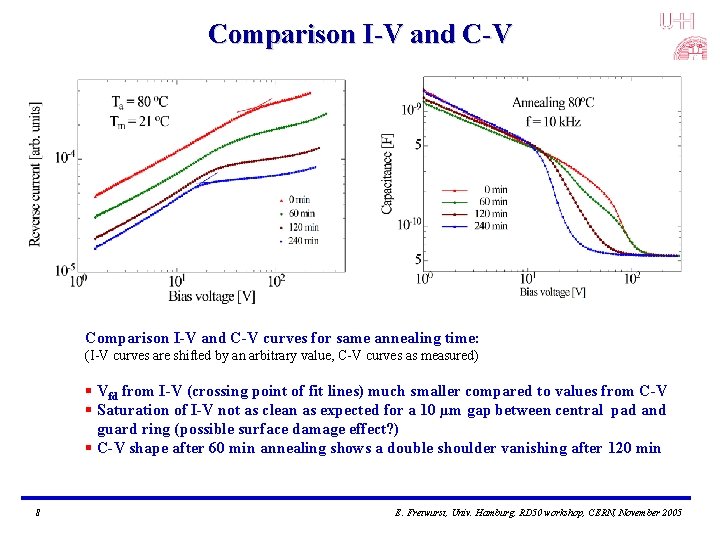
Comparison I-V and C-V curves for same annealing time: (I-V curves are shifted by an arbitrary value, C-V curves as measured) § Vfd from I-V (crossing point of fit lines) much smaller compared to values from C-V § Saturation of I-V not as clean as expected for a 10 µm gap between central pad and guard ring (possible surface damage effect? ) § C-V shape after 60 min annealing shows a double shoulder vanishing after 120 min 8 E. Fretwurst, Univ. Hamburg, RD 50 workshop, CERN, November 2005
Vfd Annealing Curves § Nearly identical time dependence for all frequencies § Shift due to frequency dependent charging and discharging of deep defects § Slightly different annealing behavior of Vfd from I-V, values are comparable with values from C-V at high frequencies 9 E. Fretwurst, Univ. Hamburg, RD 50 workshop, CERN, November 2005
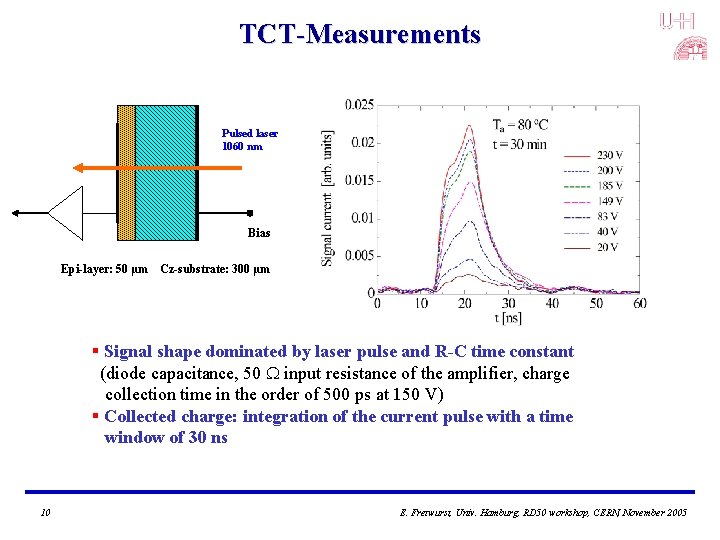
TCT-Measurements Pulsed laser 1060 nm Bias Epi-layer: 50 µm Cz-substrate: 300 µm § Signal shape dominated by laser pulse and R-C time constant (diode capacitance, 50 input resistance of the amplifier, charge collection time in the order of 500 ps at 150 V) § Collected charge: integration of the current pulse with a time window of 30 ns 10 E. Fretwurst, Univ. Hamburg, RD 50 workshop, CERN, November 2005
Q-V characteristics and annealing Q-V curves shifted by an arbitrary value Measurements performed at 20 °C § Extraction of Vfd indicated for the Q-V curves taken at 0 min and 240 min annealing § In the log-log presentation the slope of the increasing part of Q-V increases from about 0. 8 at 0 min to 1. 1 at 240 min § Charge trapping is clearly seen above “full depletion” and annealing time 120 min 11 E. Fretwurst, Univ. Hamburg, RD 50 workshop, CERN, November 2005
Comparison of Vfd annealing from Q-V and C-V § Vfd values from Q-V are in between the values from C-V taken at 10 k. Hz and 50 k. Hz at 0 min and for ta > 30 min the Q-V values coincide almost with those at 10 k. Hz § The time dependence is nearly identical § This indicates that “full charge collection” is achieved when the transition region λ of the space charge region (low field region) becomes zero as approximately deduced from C-V measurements at low frequencies 12 E. Fretwurst, Univ. Hamburg, RD 50 workshop, CERN, November 2005
Conclusion Ø The meaning of “full depletion voltage” Vfd has to be taken with care: Vfd depends strongly on type of measurement (C-V, I-V, Q-V) and method of extraction Ø Systematic studies on a highly irradiated Epi-device show: C-V: Vfd decreases with increasing frequency, but saturates I-V: Vfd comparable with those from C-V at high frequencies (> 500 k. Hz) Q-V: Vfd comparable with those from C-V at low frequencies ( 10 k. Hz) Ø Which Vfd value is relevant for detector operation? The values extracted from Q-V which coincide with values from C-V at low frequencies, but keep in mind: Vfd from Q-V depends on integration time and trapping: For 50 µm thick layers the integration time is less important than for 300 µm (matter of collection time) Ø Proposed interpretation of relevant Vfd for non-inverted Epi-detectors: The “voltage for full depletion” is achieved when the low field region of the transition region λ vanishes or the crossing point x of the quasi-Fermi level with the deep acceptor level approaches the rear contact (x=d, d=detector thickness) 13 E. Fretwurst, Univ. Hamburg, RD 50 workshop, CERN, November 2005