
Comparison of crash test standards DISCLAIMER This material

- Slides: 40
Comparison of crash test standards DISCLAIMER: This material is for internal use only and may not be forwarded to third parties
Content 1. 2. 3. 4. 5. Objective Objects of comparison Differences – Test parameters Differences – Test deliverables Conclusion DISCLAIMER: This material is for internal use only and may not be forwarded to third parties
Objective International crash test standards Identify Understand Act § Identify the commonalities and differences of the standards § Understand the major implications of the differences § Act based on the product certification available for the product you are trying to sell DISCLAIMER: This material is for internal use only and may not be forwarded to third parties
Objective International crash test standards Communalities: § Scope: Standards describe a test method to assess the performance of VSB* (+ foundation) when subjected to a single horizontal impact § Execution: Crash tests must only be conducted by an approved test facility § Result/deliverables: Test report/certificate from an independent organisation as proof of impact rating confirmed by manufacturer * Vehicle Security Barrier (VSB) DISCLAIMER: This material is for internal use only and may not be forwarded to third parties
Objective International crash test standards Differences: § Test parameters § Resulting performance classifications DISCLAIMER: This material is for internal use only and may not be forwarded to third parties
Objects of comparison ASTM F 2656 -07 PAS 68: 2013 DISCLAIMER: This material is for internal use only and may not be forwarded to third parties IWA 14 -1: 2013
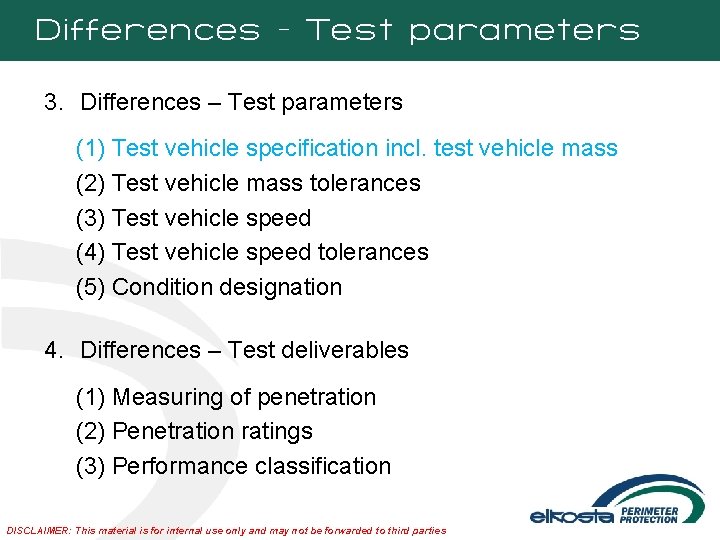
Differences - Test parameters 3. Differences – Test parameters (1) Test vehicle specification incl. test vehicle mass (2) Test vehicle mass tolerances (3) Test vehicle speed (4) Test vehicle speed tolerances (5) Condition designation 4. Differences – Test deliverables (1) Measuring of penetration (2) Penetration ratings (3) Performance classification DISCLAIMER: This material is for internal use only and may not be forwarded to third parties
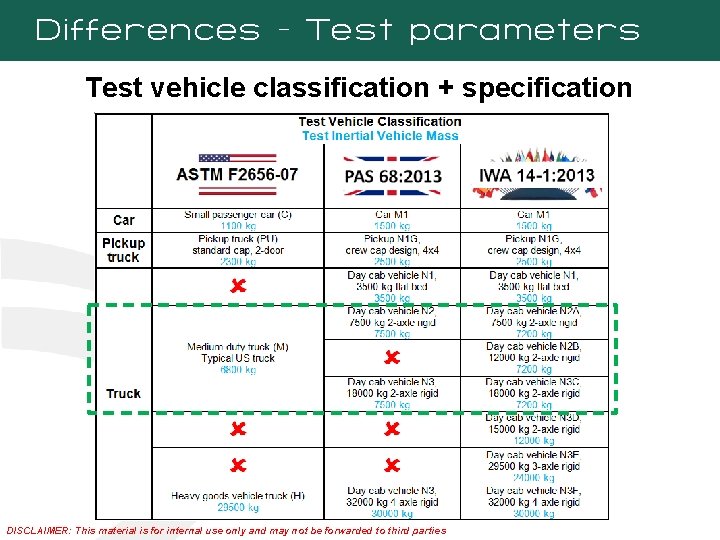
Differences - Test parameters Test vehicle classification + specification DISCLAIMER: This material is for internal use only and may not be forwarded to third parties
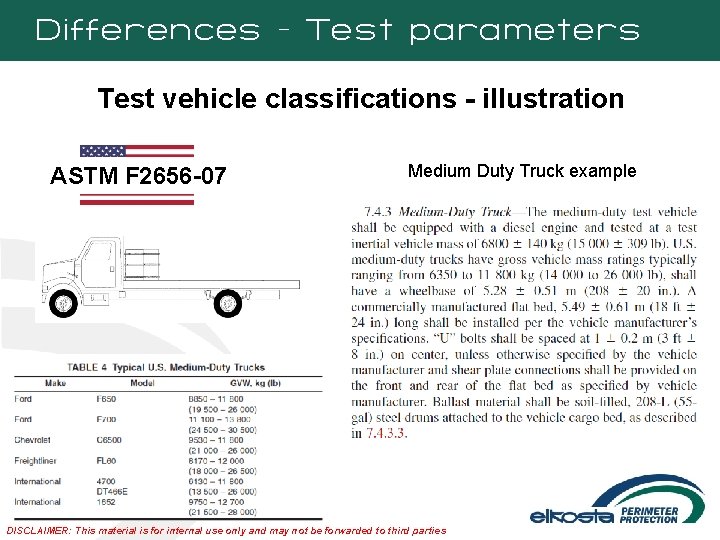
Differences - Test parameters Test vehicle classifications - illustration ASTM F 2656 -07 Medium Duty Truck example DISCLAIMER: This material is for internal use only and may not be forwarded to third parties
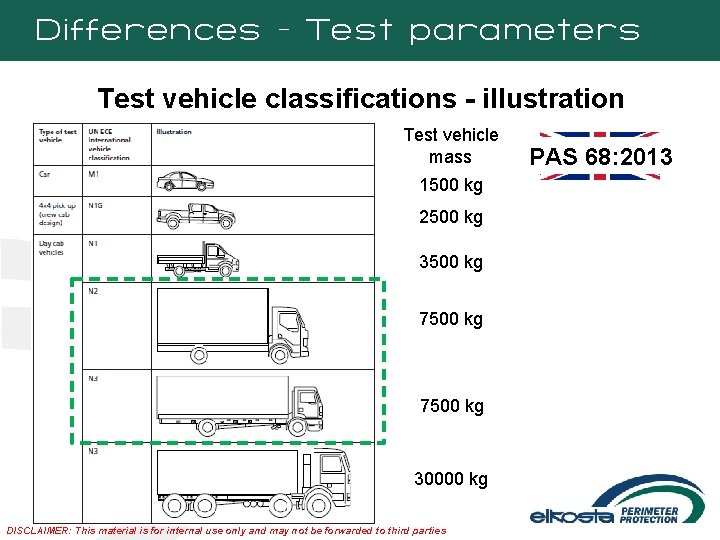
Differences - Test parameters Test vehicle classifications - illustration Test vehicle mass 1500 kg 2500 kg 3500 kg 7500 kg 30000 kg DISCLAIMER: This material is for internal use only and may not be forwarded to third parties PAS 68: 2013
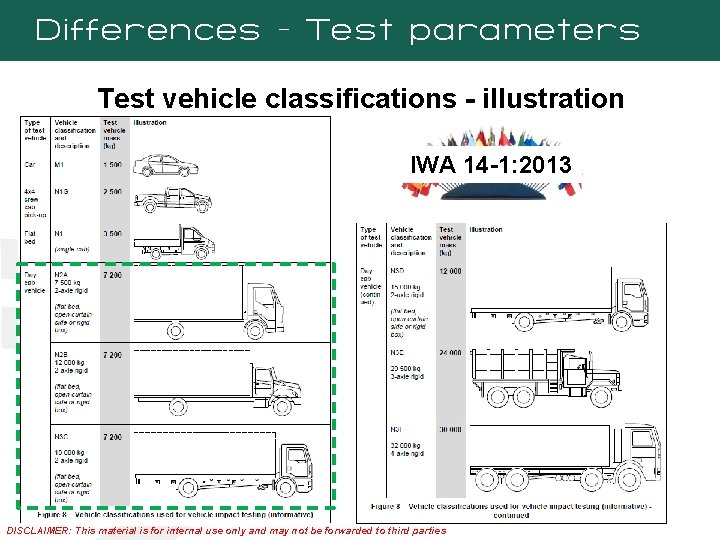
Differences - Test parameters Test vehicle classifications - illustration IWA 14 -1: 2013 DISCLAIMER: This material is for internal use only and may not be forwarded to third parties
Differences - Test parameters 3. Differences – Test parameters (1) Test vehicle specification incl. test vehicle mass (2) Test vehicle mass tolerances (3) Test vehicle speed (4) Test vehicle speed tolerances (5) Condition designation 4. Differences – Test deliverables (1) Measuring of penetration (2) Penetration ratings (3) Performance classification DISCLAIMER: This material is for internal use only and may not be forwarded to third parties
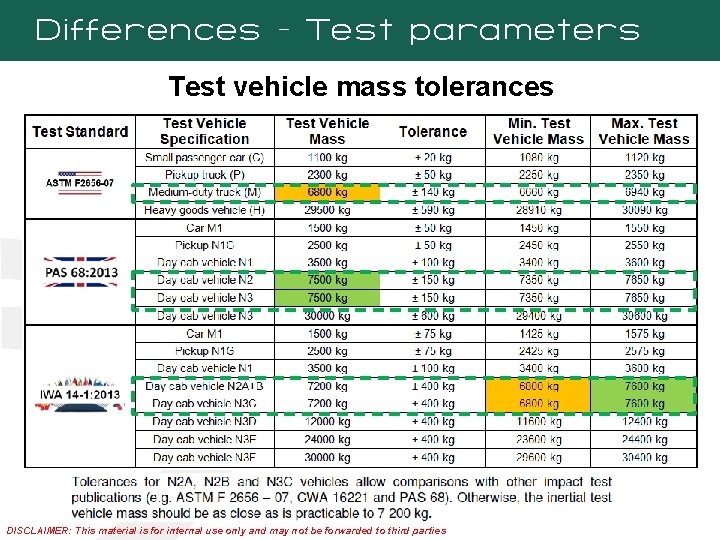
Differences - Test parameters Test vehicle mass tolerances DISCLAIMER: This material is for internal use only and may not be forwarded to third parties
Differences - Test parameters 3. Differences – Test parameters (1) Test vehicle specification incl. test vehicle mass (2) Test vehicle mass tolerances (3) Test vehicle speed (4) Test vehicle speed tolerances (5) Condition designation 4. Differences – Test deliverables (1) Measuring of penetration (2) Penetration ratings (3) Performance classification DISCLAIMER: This material is for internal use only and may not be forwarded to third parties
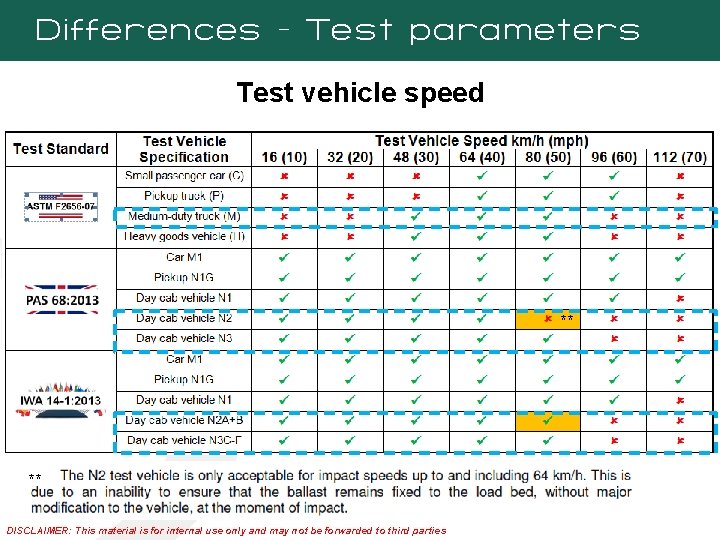
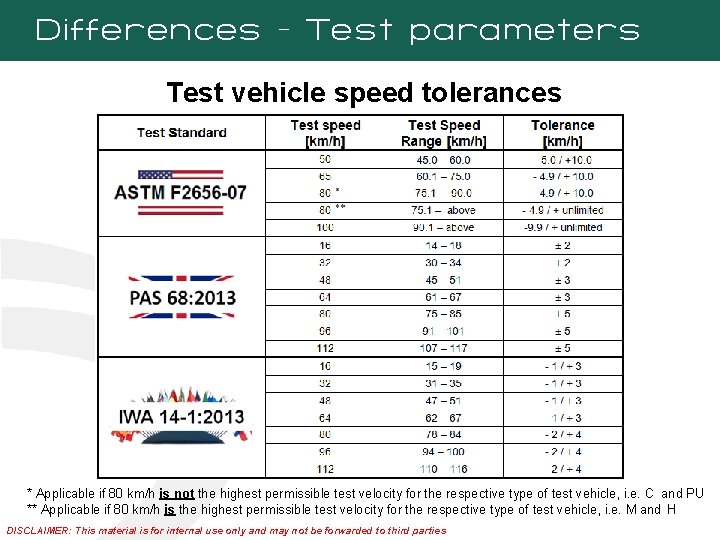
Differences - Test parameters Test vehicle speed ** ** DISCLAIMER: This material is for internal use only and may not be forwarded to third parties
Differences - Test parameters 3. Differences – Test parameters (1) Test vehicle specification incl. test vehicle mass (2) Test vehicle mass tolerances (3) Test vehicle speed (4) Test vehicle speed tolerances (5) Condition designation 4. Differences – Test deliverables (1) Measuring of penetration (2) Penetration ratings (3) Performance classification DISCLAIMER: This material is for internal use only and may not be forwarded to third parties
Differences - Test parameters Test vehicle speed tolerances * Applicable if 80 km/h is not the highest permissible test velocity for the respective type of test vehicle, i. e. C and PU ** Applicable if 80 km/h is the highest permissible test velocity for the respective type of test vehicle, i. e. M and H DISCLAIMER: This material is for internal use only and may not be forwarded to third parties
Differences - Test parameters 3. Differences – Test parameters (1) Test vehicle specification incl. test vehicle mass (2) Test vehicle mass tolerances (3) Test vehicle speed (4) Test vehicle speed tolerances (5) Condition designation 4. Differences – Test deliverables (1) Measuring of penetration (2) Penetration ratings (3) Performance classification DISCLAIMER: This material is for internal use only and may not be forwarded to third parties
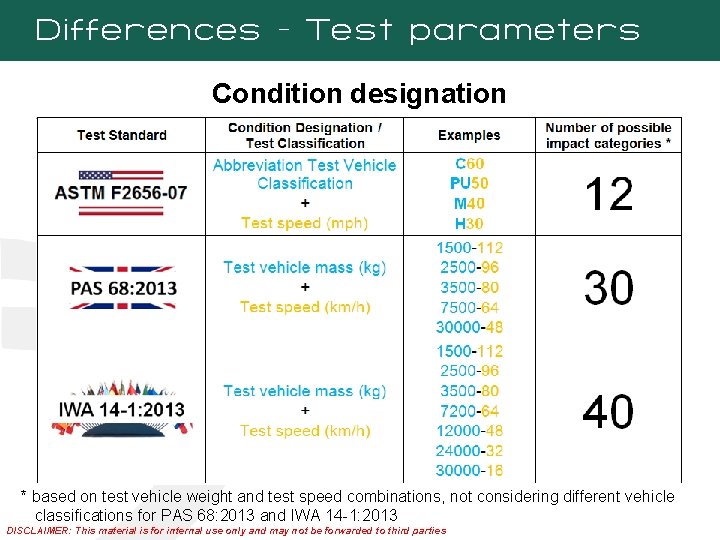
Differences - Test parameters Condition designation * based on test vehicle weight and test speed combinations, not considering different vehicle classifications for PAS 68: 2013 and IWA 14 -1: 2013 DISCLAIMER: This material is for internal use only and may not be forwarded to third parties
Differences – Test deliverables 3. Differences – Test parameters (1) Test vehicle specification incl. test vehicle mass (2) Test vehicle mass tolerances (3) Test vehicle speed (4) Test vehicle speed tolerances (5) Condition designation 4. Differences – Test deliverables (1) Measuring of penetration (2) Penetration ratings (3) Performance classification DISCLAIMER: This material is for internal use only and may not be forwarded to third parties
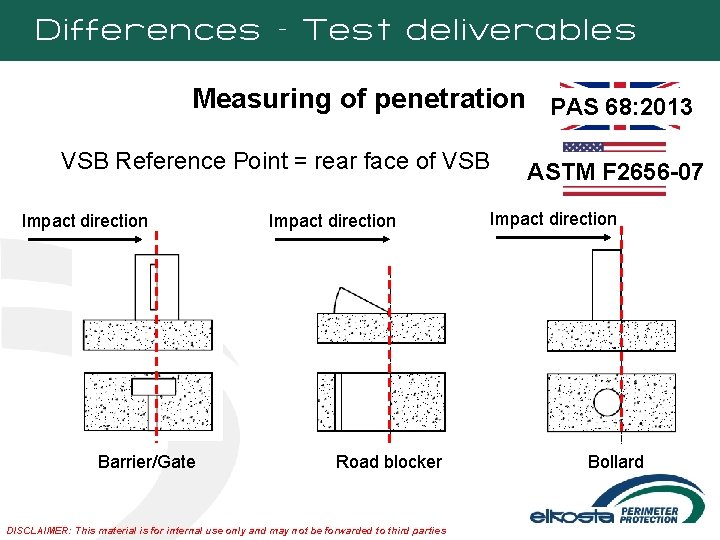
Differences – Test deliverables Measuring of penetration PAS 68: 2013 VSB Reference Point = rear face of VSB Impact direction Barrier/Gate Impact direction Road blocker DISCLAIMER: This material is for internal use only and may not be forwarded to third parties ASTM F 2656 -07 Impact direction Bollard
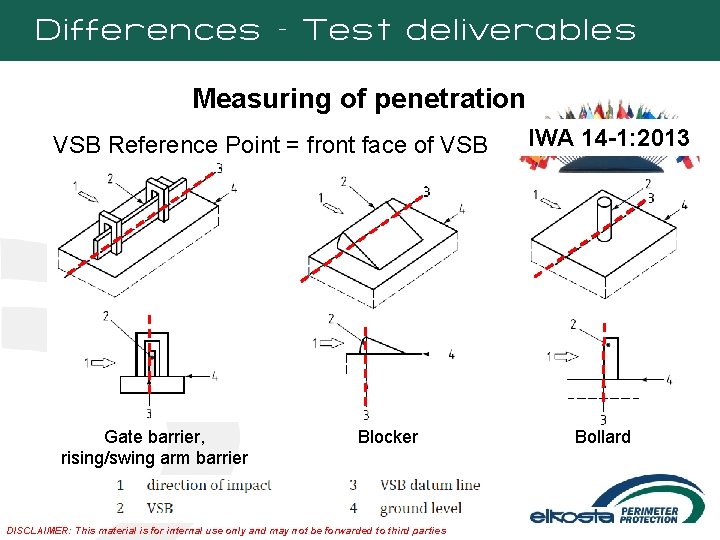
Differences – Test deliverables Measuring of penetration VSB Reference Point = front face of VSB Gate barrier, rising/swing arm barrier Blocker DISCLAIMER: This material is for internal use only and may not be forwarded to third parties IWA 14 -1: 2013 Bollard
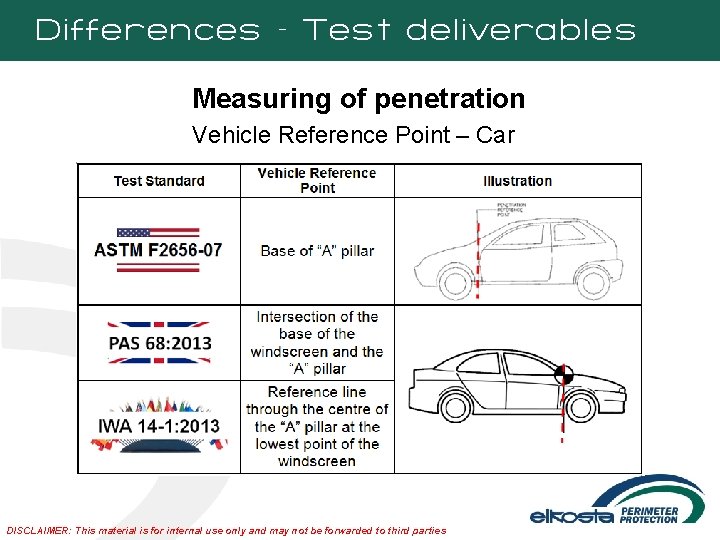
Differences – Test deliverables Measuring of penetration Vehicle Reference Point – Car DISCLAIMER: This material is for internal use only and may not be forwarded to third parties
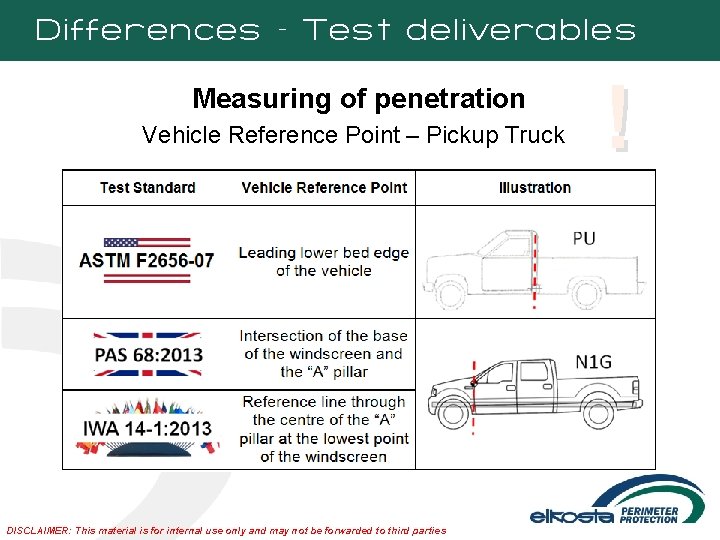
Differences – Test deliverables Measuring of penetration Vehicle Reference Point – Pickup Truck DISCLAIMER: This material is for internal use only and may not be forwarded to third parties !
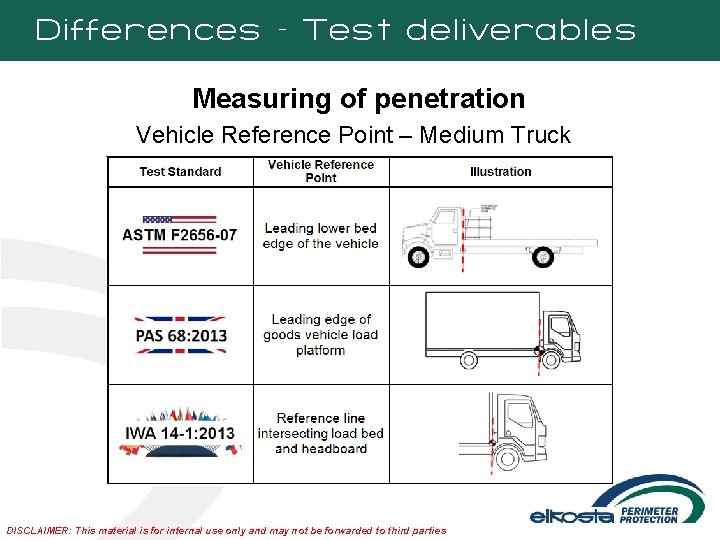
Differences – Test deliverables Measuring of penetration Vehicle Reference Point – Medium Truck DISCLAIMER: This material is for internal use only and may not be forwarded to third parties
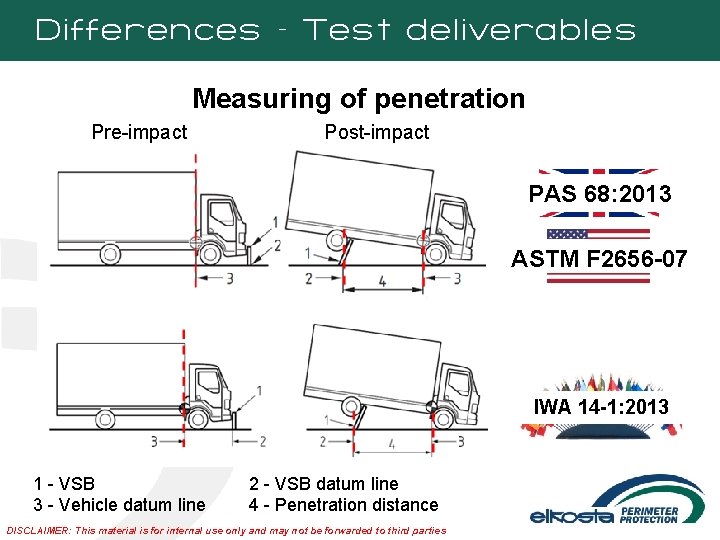
Differences – Test deliverables Measuring of penetration Pre-impact Post-impact PAS 68: 2013 ASTM F 2656 -07 IWA 14 -1: 2013 1 - VSB 3 - Vehicle datum line 2 - VSB datum line 4 - Penetration distance DISCLAIMER: This material is for internal use only and may not be forwarded to third parties
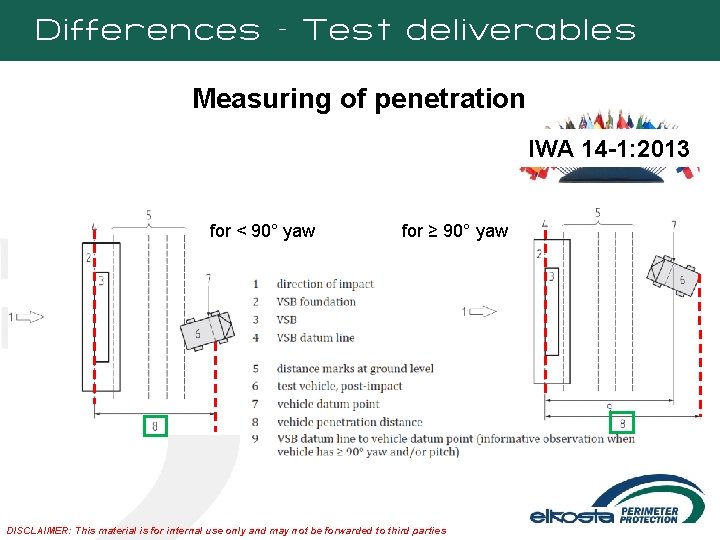
Differences – Test deliverables Measuring of penetration IWA 14 -1: 2013 for < 90° yaw for ≥ 90° yaw DISCLAIMER: This material is for internal use only and may not be forwarded to third parties
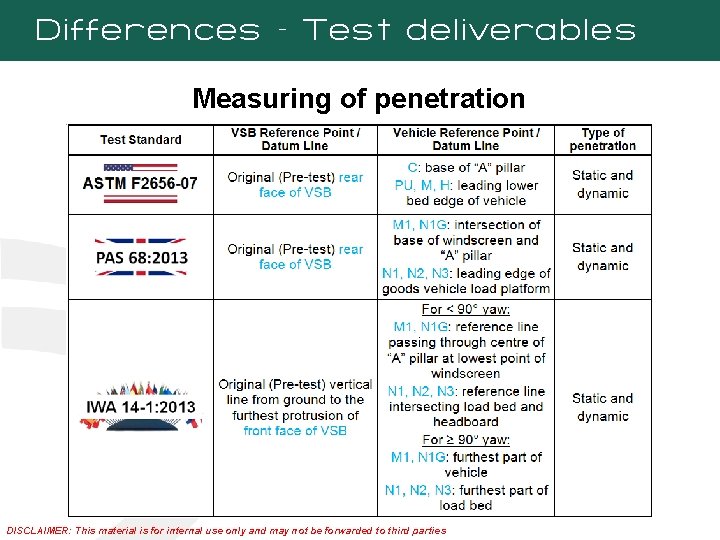
Differences – Test deliverables Measuring of penetration DISCLAIMER: This material is for internal use only and may not be forwarded to third parties
Differences – Test deliverables 3. Differences – Test parameters (1) Test vehicle specification incl. test vehicle mass (2) Test vehicle mass tolerances (3) Test vehicle speed (4) Test vehicle speed tolerances (5) Condition designation 4. Differences – Test deliverables (1) Measuring of penetration (2) Penetration ratings (3) Performance classification DISCLAIMER: This material is for internal use only and may not be forwarded to third parties
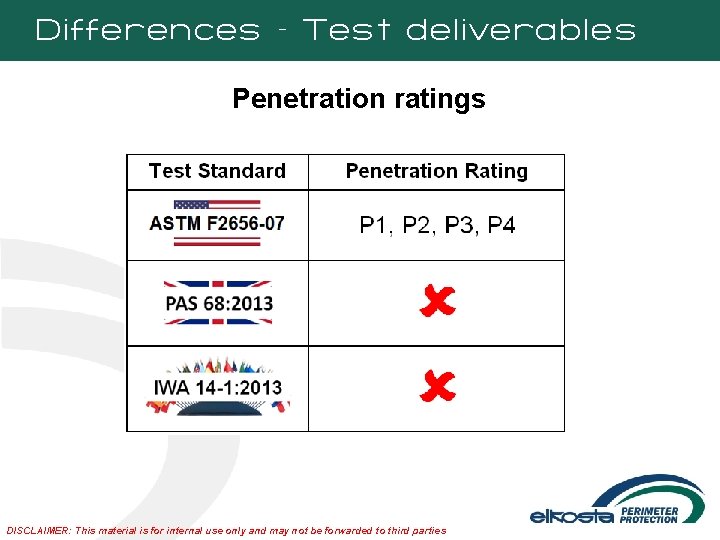
Differences – Test deliverables Penetration ratings DISCLAIMER: This material is for internal use only and may not be forwarded to third parties
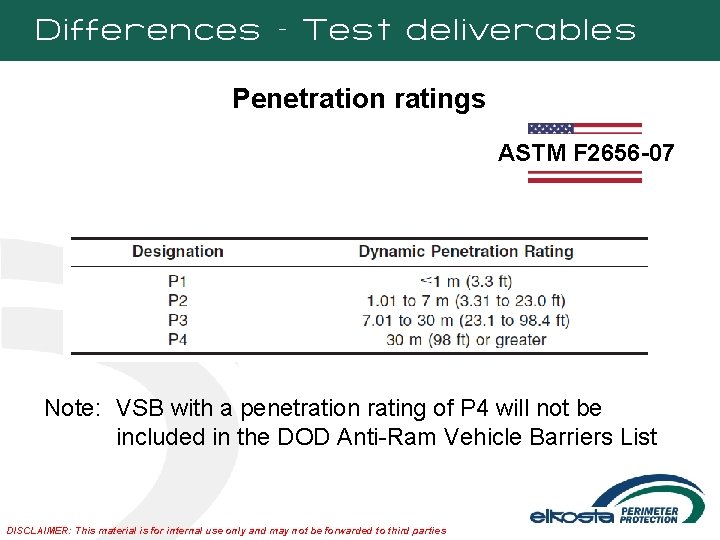
Differences – Test deliverables Penetration ratings ASTM F 2656 -07 Note: VSB with a penetration rating of P 4 will not be included in the DOD Anti-Ram Vehicle Barriers List DISCLAIMER: This material is for internal use only and may not be forwarded to third parties
Differences – Test deliverables 3. Differences – Test parameters (1) Test vehicle specification incl. test vehicle mass (2) Test vehicle mass tolerances (3) Test vehicle speed (4) Test vehicle speed tolerances (5) Condition designation 4. Differences – Test deliverables (1) Measuring of penetration (2) Penetration ratings (3) Performance classification DISCLAIMER: This material is for internal use only and may not be forwarded to third parties
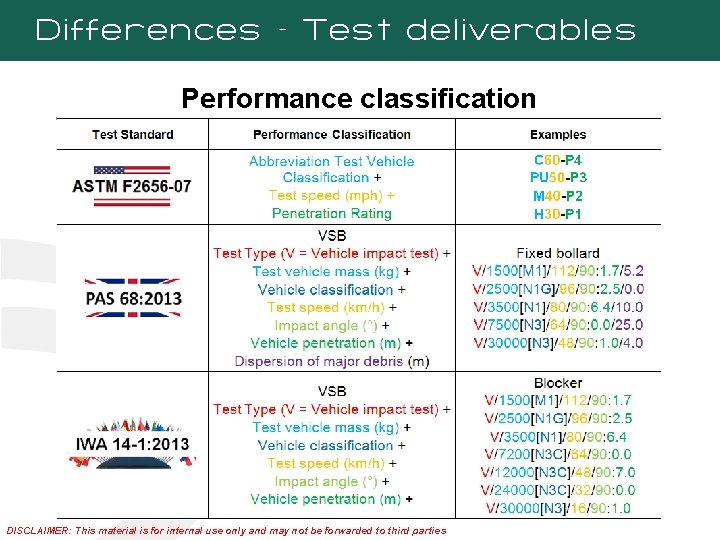
Differences – Test deliverables Performance classification DISCLAIMER: This material is for internal use only and may not be forwarded to third parties
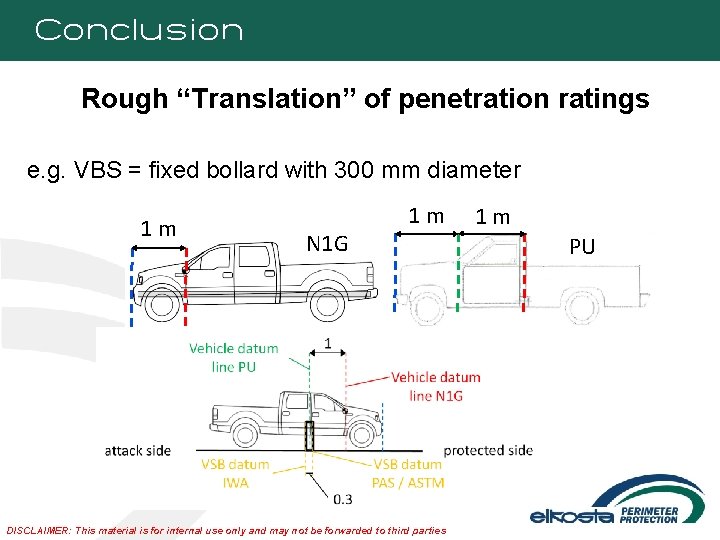
Conclusion Rough “Translation” of penetration ratings e. g. VBS = fixed bollard with 300 mm diameter 1 m N 1 G 1 m DISCLAIMER: This material is for internal use only and may not be forwarded to third parties 1 m PU
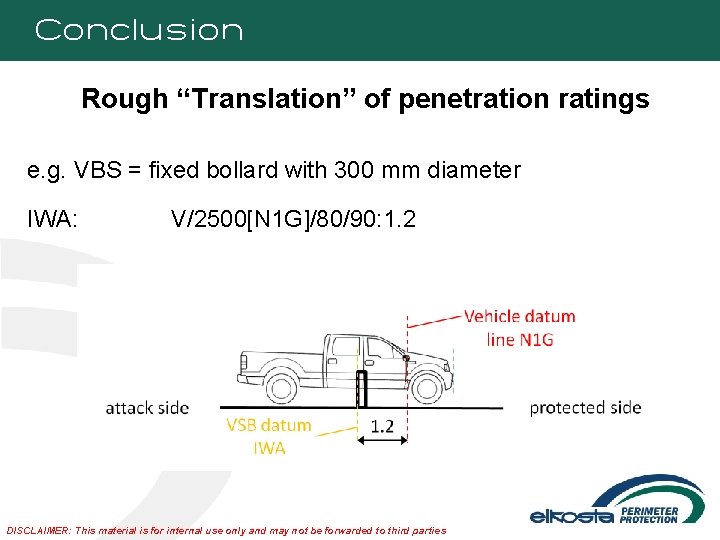
Conclusion Rough “Translation” of penetration ratings e. g. VBS = fixed bollard with 300 mm diameter IWA: V/2500[N 1 G]/80/90: 1. 2 DISCLAIMER: This material is for internal use only and may not be forwarded to third parties
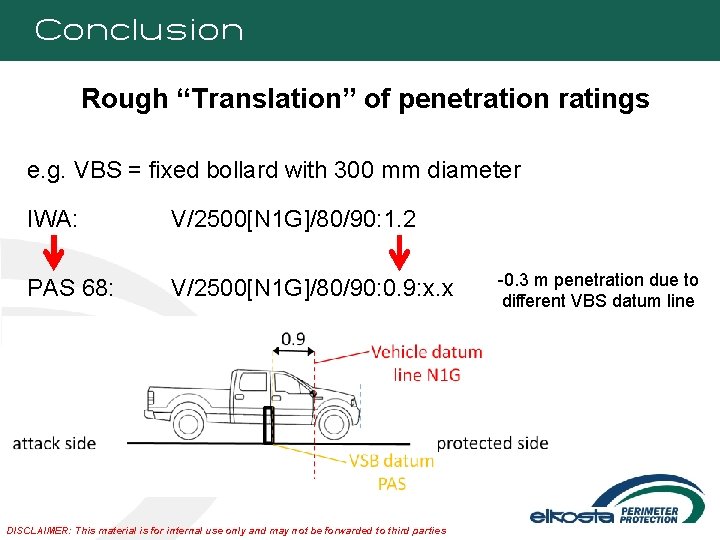
Conclusion Rough “Translation” of penetration ratings e. g. VBS = fixed bollard with 300 mm diameter IWA: V/2500[N 1 G]/80/90: 1. 2 PAS 68: V/2500[N 1 G]/80/90: 0. 9: x. x DISCLAIMER: This material is for internal use only and may not be forwarded to third parties -0. 3 m penetration due to different VBS datum line
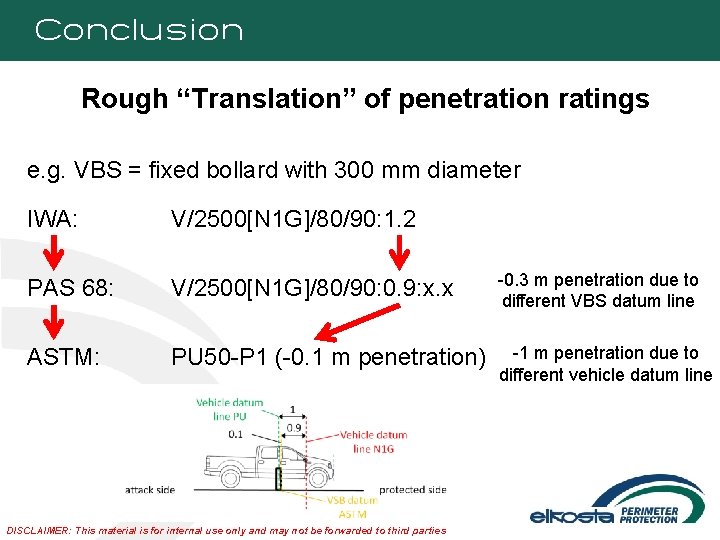
Conclusion Rough “Translation” of penetration ratings e. g. VBS = fixed bollard with 300 mm diameter IWA: V/2500[N 1 G]/80/90: 1. 2 PAS 68: V/2500[N 1 G]/80/90: 0. 9: x. x -0. 3 m penetration due to different VBS datum line ASTM: PU 50 -P 1 (-0. 1 m penetration) -1 m penetration due to different vehicle datum line DISCLAIMER: This material is for internal use only and may not be forwarded to third parties
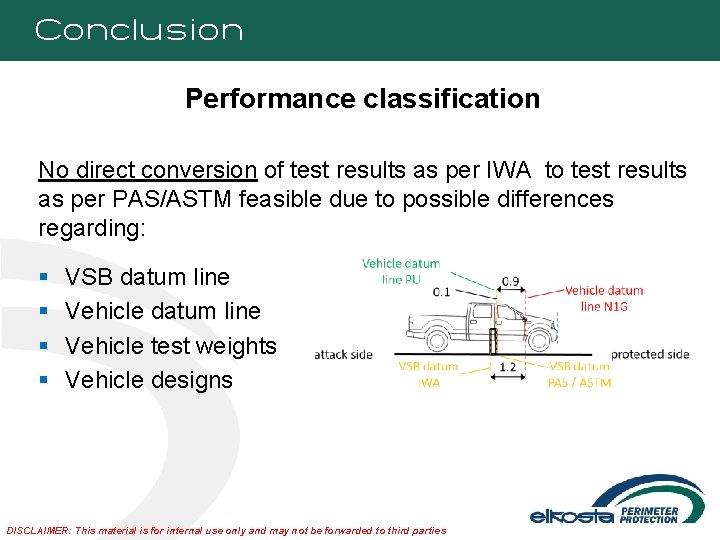
Conclusion Performance classification No direct conversion of test results as per IWA to test results as per PAS/ASTM feasible due to possible differences regarding: § § VSB datum line Vehicle test weights Vehicle designs DISCLAIMER: This material is for internal use only and may not be forwarded to third parties
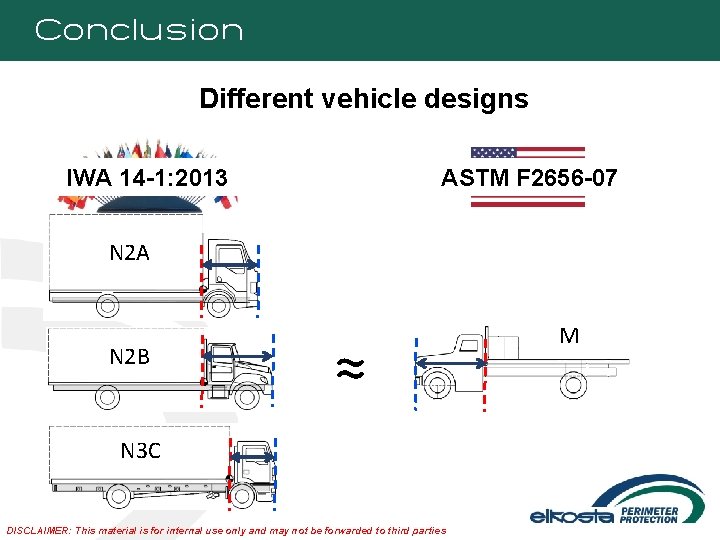
Conclusion Different vehicle designs ASTM F 2656 -07 IWA 14 -1: 2013 N 2 A N 2 B ≈ N 3 C DISCLAIMER: This material is for internal use only and may not be forwarded to third parties M
www. perimeterprotection. net