
Comparison of coronally advanced flap and connective tissue
- Slides: 1
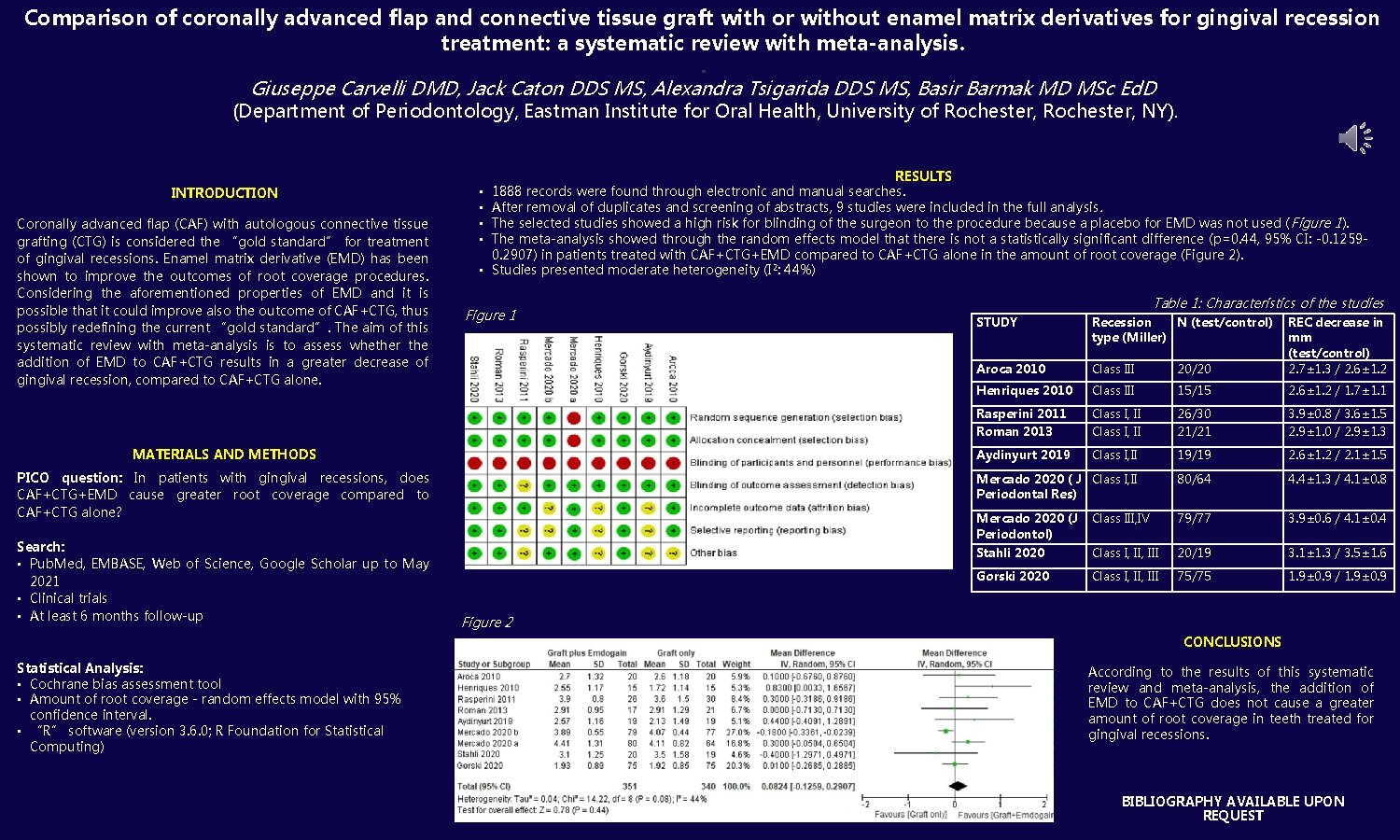
Comparison of coronally advanced flap and connective tissue graft with or without enamel matrix derivatives for gingival recession treatment: a systematic review with meta-analysis. . Giuseppe Carvelli DMD, Jack Caton DDS MS, Alexandra Tsigarida DDS MS, Basir Barmak MD MSc Ed. D (Department of Periodontology, Eastman Institute for Oral Health, University of Rochester, NY). INTRODUCTION Coronally advanced flap (CAF) with autologous connective tissue grafting (CTG) is considered the “gold standard” for treatment of gingival recessions. Enamel matrix derivative (EMD) has been shown to improve the outcomes of root coverage procedures. Considering the aforementioned properties of EMD and it is possible that it could improve also the outcome of CAF+CTG, thus possibly redefining the current “gold standard”. The aim of this systematic review with meta-analysis is to assess whether the addition of EMD to CAF+CTG results in a greater decrease of gingival recession, compared to CAF+CTG alone. • • • RESULTS 1888 records were found through electronic and manual searches. After removal of duplicates and screening of abstracts, 9 studies were included in the full analysis. The selected studies showed a high risk for blinding of the surgeon to the procedure because a placebo for EMD was not used ( Figure 1). The meta-analysis showed through the random effects model that there is not a statistically significant difference (p=0. 44, 95% CI: -0. 12590. 2907) in patients treated with CAF+CTG+EMD compared to CAF+CTG alone in the amount of root coverage (Figure 2). Studies presented moderate heterogeneity (I 2: 44%) Figure 1 MATERIALS AND METHODS PICO question: In patients with gingival recessions, does CAF+CTG+EMD cause greater root coverage compared to CAF+CTG alone? Search: • Pub. Med, EMBASE, Web of Science, Google Scholar up to May 2021 • Clinical trials • At least 6 months follow-up Table 1: Characteristics of the studies STUDY Recession N (test/control) type (Miller) Aroca 2010 Class III 20/20 REC decrease in mm (test/control) 2. 7± 1. 3 / 2. 6± 1. 2 Henriques 2010 Class III 15/15 2. 6± 1. 2 / 1. 7± 1. 1 Rasperini 2011 Roman 2013 Class I, II 26/30 21/21 3. 9± 0. 8 / 3. 6± 1. 5 2. 9± 1. 0 / 2. 9± 1. 3 Aydinyurt 2019 Class I, II 19/19 2. 6± 1. 2 / 2. 1± 1. 5 Mercado 2020 ( J Class I, II Periodontal Res) 80/64 4. 4± 1. 3 / 4. 1± 0. 8 Mercado 2020 (J Periodontol) Class III, IV 79/77 3. 9± 0. 6 / 4. 1± 0. 4 Stahli 2020 Class I, III 20/19 3. 1± 1. 3 / 3. 5± 1. 6 Gorski 2020 Class I, III 75/75 1. 9± 0. 9 / 1. 9± 0. 9 Figure 2 CONCLUSIONS Statistical Analysis: • Cochrane bias assessment tool • Amount of root coverage - random effects model with 95% confidence interval. • “R” software (version 3. 6. 0; R Foundation for Statistical Computing) According to the results of this systematic review and meta-analysis, the addition of EMD to CAF+CTG does not cause a greater amount of root coverage in teeth treated for gingival recessions. BIBLIOGRAPHY AVAILABLE UPON REQUEST