
Comparison of Collision Detection Algorithms Tony Young M













- Slides: 117
Comparison of Collision Detection Algorithms Tony Young M. Math Candidate July 19 th, 2004
Outline • Collision Detection Background – What is collision detection? – Applications and Importance • Detection Algorithms – Bounding Boxes – Bounding Spheres – BSP Trees – Hubbard
What is Collision Detection? • Collision detection is the processing of two object’s bounds to determine if those bounds intersect at any time, t • Collision detection is a difficult problem to solve in constant or linear time • Collision detection schemes are used in many applications
Applications and Importance • Marine, Land Air navigation – Detecting if/when collisions between two vehicles will take place – Aiding in avoiding collisions with alerts to captains, drivers and pilots
Applications and Importance • Accident Alerts – Automatically notifying police of collisions at intersections, on highways, etc. – Aids in response time and provides details as to the speed of collision, etc. – Potentially saves lives!
Applications and Importance • Graphics Rendering – Important for rendering a scene – We want realistic things to happen
Applications and Importance • Simulation – Simulations should be as accurate to life as possible – Objects move according to impacts
Applications and Importance • Animation – In order to properly render animations we must know when fabrics are pulled tight against bodies, items are resting on tables, etc. – Lifelike animation requires lifelike modeling of collisions, and this requires collision detection
Applications and Importance • Computer Games – In order to determine when a player is hit, or how an object should move in a scene, collisions must be detected
Applications and Importance • Overriding themes – Safety – Entertainment – Research – Three opposites, but both very important to our current value system in North America
Bounding Boxes • Place a box around an object – Box should completely enclose the object and be of minimal volume – Fairly simple to construct • Test intersections between the boxes to find intersections
Bounding Boxes • Each box has 6 faces (planes) in 3 D – Simple algebra to test for intersections between planes – If one of the planes intersects another, the objects are said to collide
Bounding Boxes • Example bounding boxes
Bounding Boxes • Space complexity – Each object must store 8 points representing the bounding box – Therefore, space is O(8) and Ω(8)
Bounding Boxes • Time complexity – Each face of each object must be tested against each face of each other object – Therefore, O((6 n)2) = O(n 2) • n is the number of objects
Bounding Boxes • Pro – Very easy to implement – Very little extra space needed • Con – Very coarse detection – Very slow with many objects in the scene
Bounding Spheres • Similar to bounding boxes, but instead we use spheres – Must decide on a “center” point for the object that minimizes the radius – Can be tough to find such a sphere that minimizes in all directions – Spheres could leave a lot of extra space around the object!
Bounding Spheres • Each sphere has a center point and a radius – Can build an equation for the circle – Simple algebra to test for intersection between the two circles
Bounding Spheres • Example bounding spheres
Bounding Spheres • Space complexity – Each object must store 2 values - center and radius - to represent the sphere – Therefore, space is O(2) and Ω(2) – Space is slightly less than bounding boxes
Bounding Spheres • Time complexity – Each object must test it’s bounding sphere for intersection with each other bounding sphere in the scene – Therefore, O(n 2) • n is the number of objects – Significantly fewer calculations than bounding boxes!
Bounding Spheres • Pro – Even easier to implement (than bounding boxes) – Even less space needed (than bounding boxes) • Con – Still fairly coarse detection – Still fairly slow with many objects
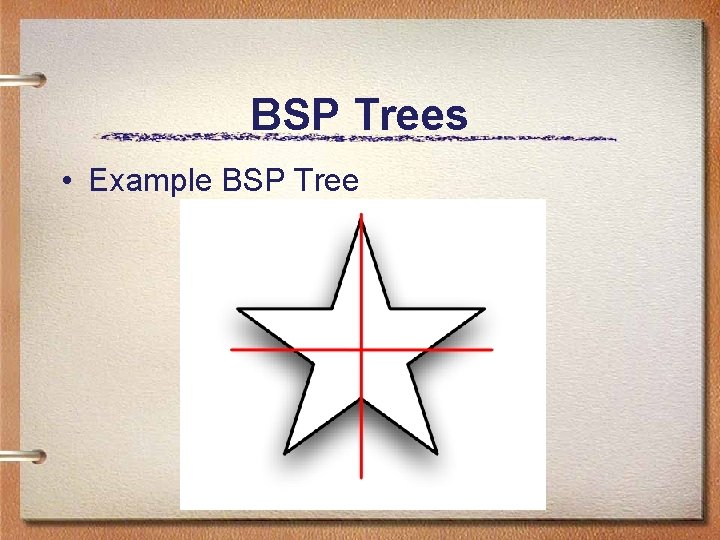
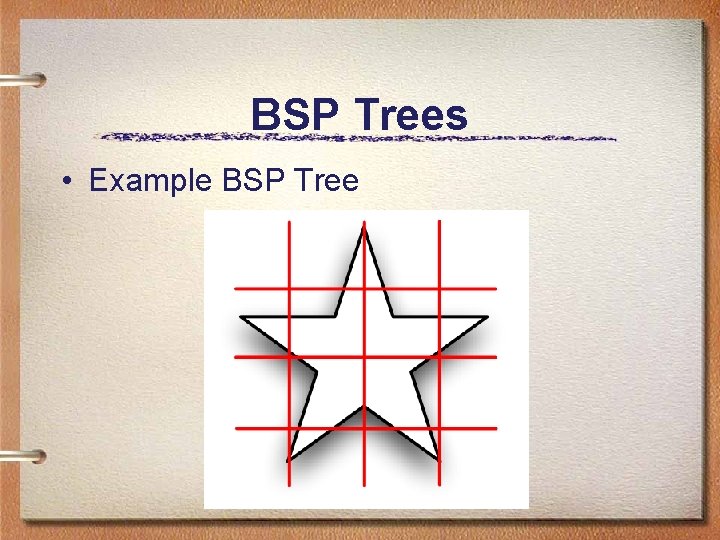
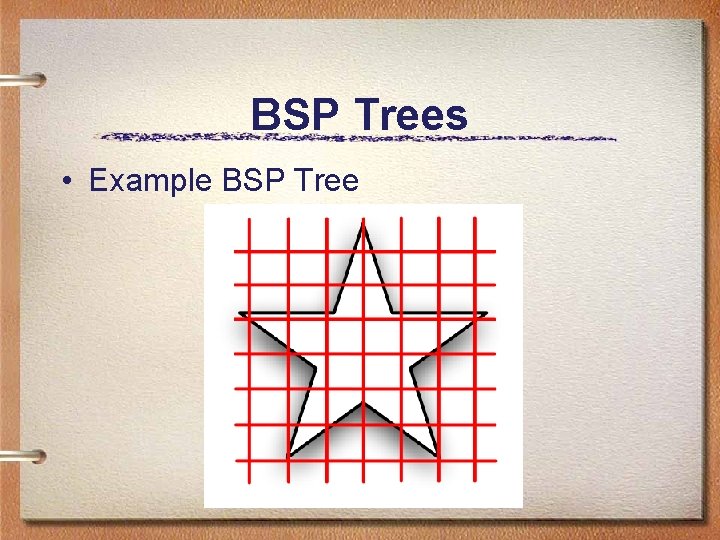
BSP Trees • BSP (Binary Space Partitioning) trees are used to break a 3 D object into pieces for easier comparison – Object is recursively broken into pieces and pieces are inserted into the tree – Intersection between pieces of two object’s spaces is tested
BSP Trees • We refine our BSP trees by recursively defining the children to contain a subset of the objects of the parent – Stop refining on one of a few cases: • Case 1: We have reached a minimum physical size for the section (ie: one pixel, ten pixels, etc) • Case 2: We have reached a maximum tree depth (ie: 6 levels, 10 levels, etc) • Case 3: We have placed each polygon in a leaf node • Etc… - Depends on the implementer
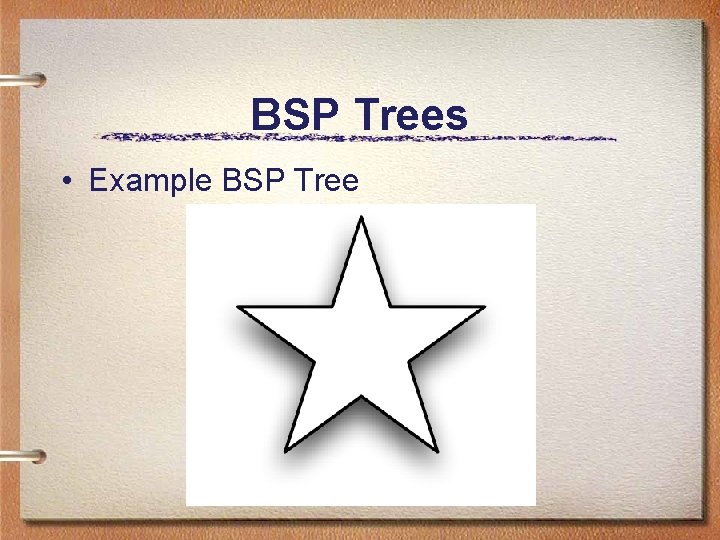
BSP Trees • Example BSP Tree
BSP Trees • Example BSP Tree
BSP Trees • Example BSP Tree
BSP Trees • Example BSP Tree
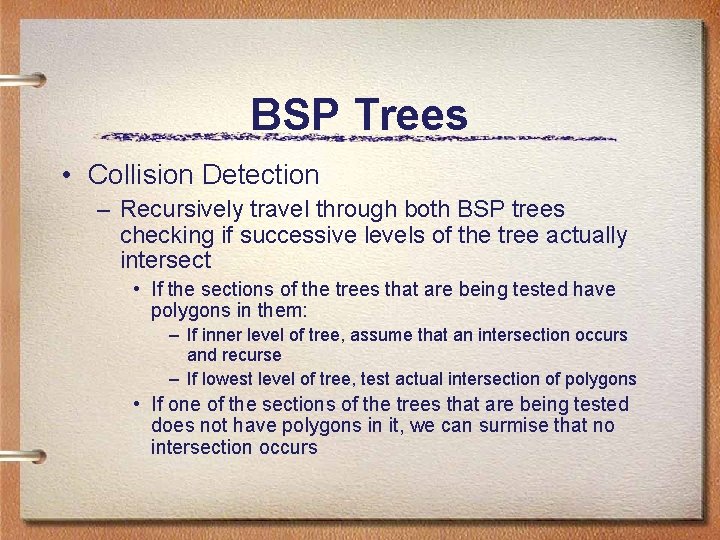
BSP Trees • Collision Detection – Recursively travel through both BSP trees checking if successive levels of the tree actually intersect • If the sections of the trees that are being tested have polygons in them: – If inner level of tree, assume that an intersection occurs and recurse – If lowest level of tree, test actual intersection of polygons • If one of the sections of the trees that are being tested does not have polygons in it, we can surmise that no intersection occurs
BSP Trees • Collision Detection Example
BSP Trees • Collision Detection Example
BSP Trees • Collision Detection Example
BSP Trees • Collision Detection Example
BSP Trees • Collision Detection Example
BSP Trees • Space Complexity – Each object must store a BSP tree with links to children – Leaf nodes are polygons with geometries as integer coordinates – Therefore, space depends on number of levels of tree, h, and number of polygons (assume convex triangles - most common), n – Therefore, space is O(4 h + 3 n) and Ω(4 h + 3 n)
BSP Trees • Time Complexity – Each object must be tested against every other object - n 2 – If intersection at level 0, must go through the tree - O(h) • Assume all trees of same height – Depends on number of intersections, m – Therefore, O(n 2 + m*h) and Ω(n 2)
BSP Trees • Pros – Fairly fine grain detection • Cons – Complex to implement – Still fairly slow – Requires lots of space
Hubbard • Makes use of Sphere Trees and Spacetime Bounds to iteratively refine it’s accuracy • Two phases – Broad Phase: constructs space-time bounds and does coarse comparisons – Narrow Phase: run only if broad phase detects a collision; refines detection to determine if there really was a collision
Hubbard - Broad Phase • Constructs space-time bounds – 4 D structure giving conservative estimate of where objects might be in the future • Finds intersections between space-time bounds at time ti for objects O 1 & O 2 – Can stop processing until ti arrives
Hubbard - Broad Phase – At ti, checks O 1 & O 2’s bounding spheres to determine if an intersection occurs – If yes, refers objects to narrow phase – If no, recalculate space-time bounds and start again
Hubbard - Narrow Phase • Progressively refines intersection test accuracy – Uses better approximations to O 1 and O 2 through the constructed sphere trees – Each level of a sphere tree fits object more tightly – Can recursively check for intersections on small parts of the tree
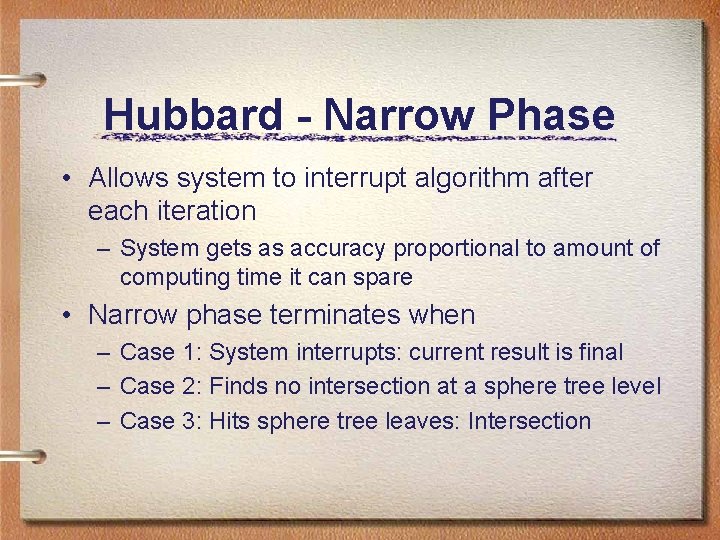
Hubbard - Narrow Phase • Allows system to interrupt algorithm after each iteration – System gets as accuracy proportional to amount of computing time it can spare • Narrow phase terminates when – Case 1: System interrupts: current result is final – Case 2: Finds no intersection at a sphere tree level – Case 3: Hits sphere tree leaves: Intersection
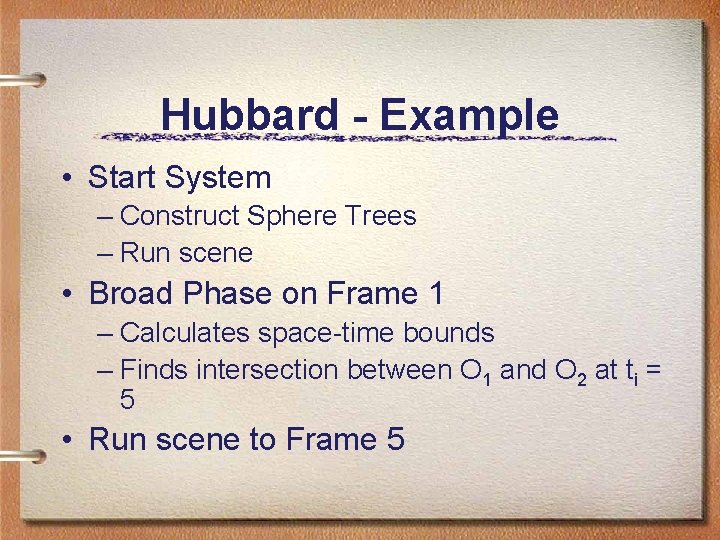
Hubbard - Example • Start System – Construct Sphere Trees – Run scene • Broad Phase on Frame 1 – Calculates space-time bounds – Finds intersection between O 1 and O 2 at ti = 5 • Run scene to Frame 5
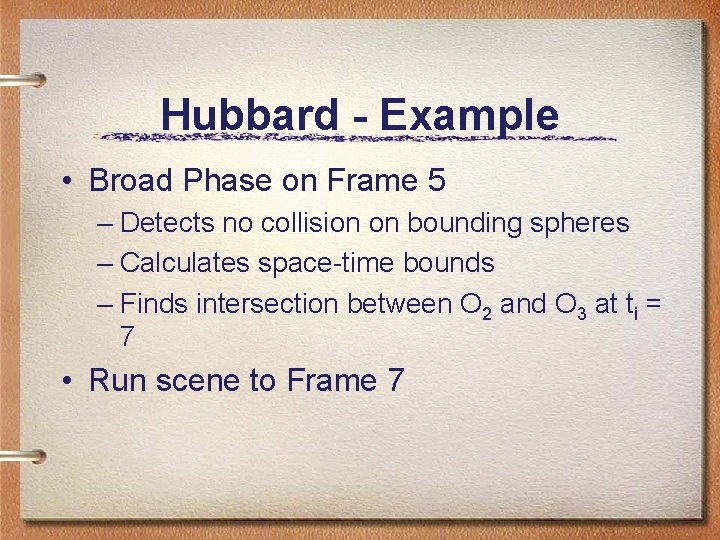
Hubbard - Example • Broad Phase on Frame 5 – Detects no collision on bounding spheres – Calculates space-time bounds – Finds intersection between O 2 and O 3 at ti = 7 • Run scene to Frame 7
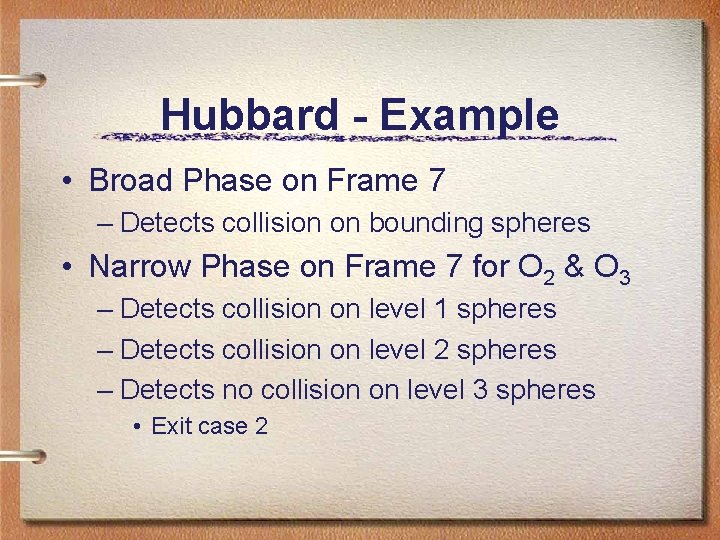
Hubbard - Example • Broad Phase on Frame 7 – Detects collision on bounding spheres • Narrow Phase on Frame 7 for O 2 & O 3 – Detects collision on level 1 spheres – Detects collision on level 2 spheres – Detects no collision on level 3 spheres • Exit case 2
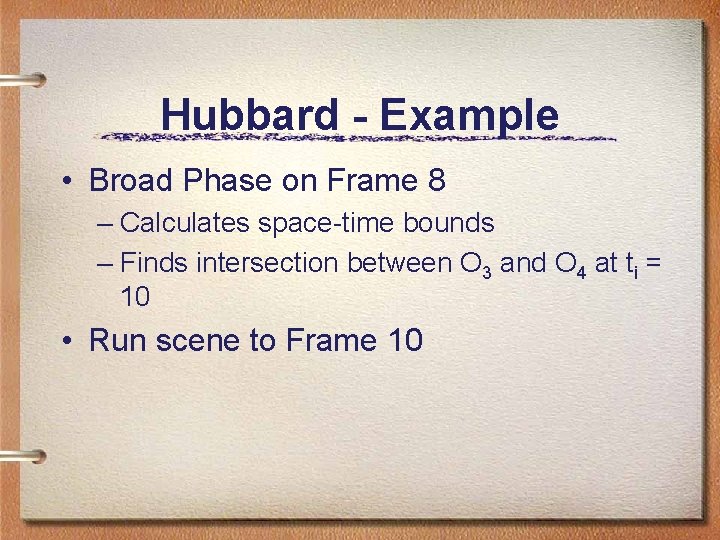
Hubbard - Example • Broad Phase on Frame 8 – Calculates space-time bounds – Finds intersection between O 3 and O 4 at ti = 10 • Run scene to Frame 10
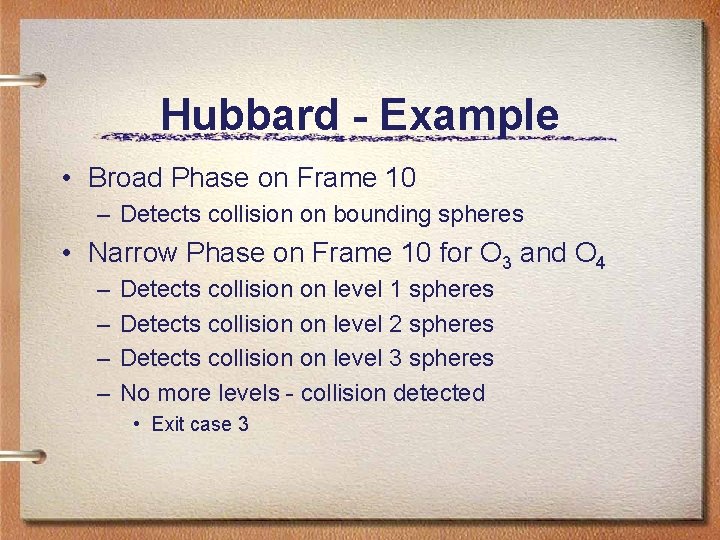
Hubbard - Example • Broad Phase on Frame 10 – Detects collision on bounding spheres • Narrow Phase on Frame 10 for O 3 and O 4 – – Detects collision on level 1 spheres Detects collision on level 2 spheres Detects collision on level 3 spheres No more levels - collision detected • Exit case 3
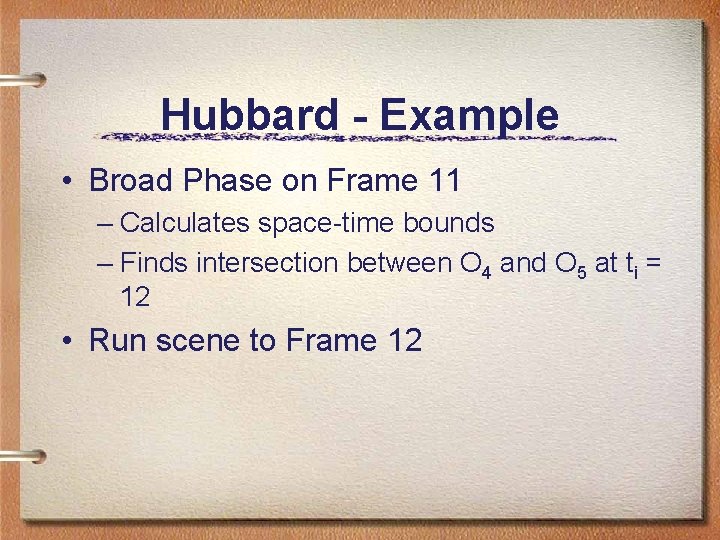
Hubbard - Example • Broad Phase on Frame 11 – Calculates space-time bounds – Finds intersection between O 4 and O 5 at ti = 12 • Run scene to Frame 12
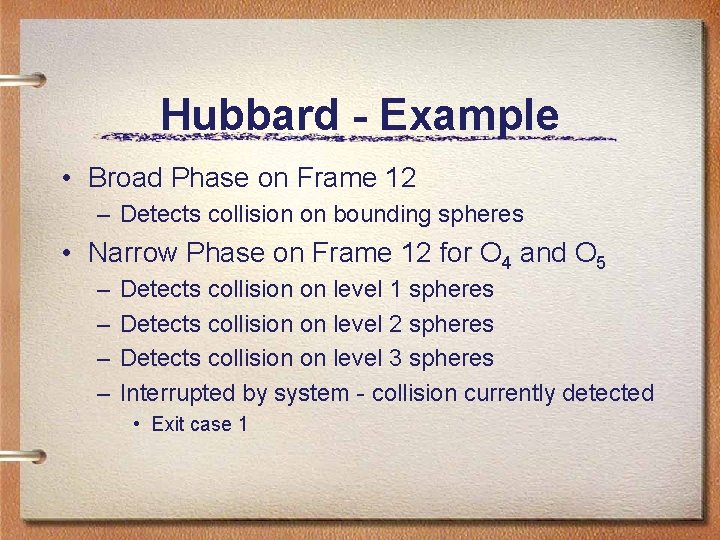
Hubbard - Example • Broad Phase on Frame 12 – Detects collision on bounding spheres • Narrow Phase on Frame 12 for O 4 and O 5 – – Detects collision on level 1 spheres Detects collision on level 2 spheres Detects collision on level 3 spheres Interrupted by system - collision currently detected • Exit case 1
Hubbard - Problem! • Collision may not be present further down the tree – Collision is reported anyway because system interrupted without narrow phase completing – Leads to false positives
Hubbard - Space-Time Bounds • Space-time bounds are 4 D structures – represent object’s possible location in 3 D over time • System knows – Object’s position - p(x, y, z) – Object’s velocity - v(x, y, z) – Object’s acceleration - a(x, y, z) – Value, M, such that | a(t) | ≤ M until t = tj
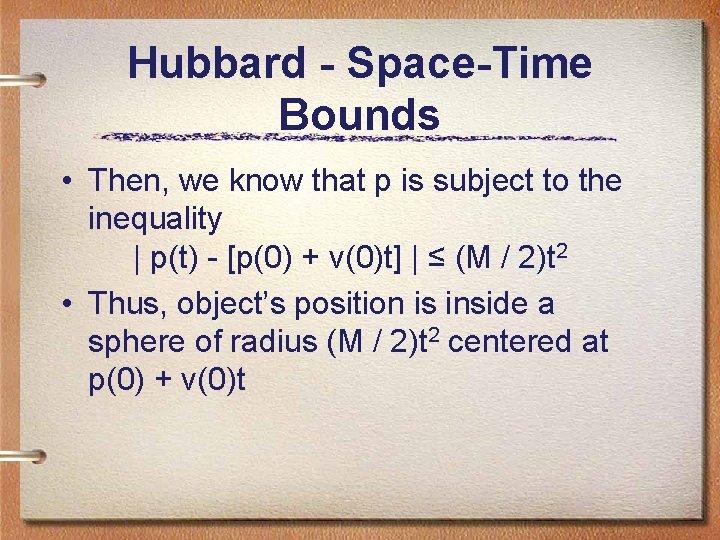
Hubbard - Space-Time Bounds • Then, we know that p is subject to the inequality | p(t) - [p(0) + v(0)t] | ≤ (M / 2)t 2 • Thus, object’s position is inside a sphere of radius (M / 2)t 2 centered at p(0) + v(0)t
Hubbard - Space-Time Bounds - Example • Position of p at t = 0
Hubbard - Space-Time Bounds - Example • Possible position of p at t = 0. 1
Hubbard - Space-Time Bounds - Example • Possible position of p at t = 0. 2
Hubbard - Space-Time Bounds - Example • Possible position of p at 0 ≤ t ≤ 1
Hubbard - Space-Time Bounds - Example • Possible enclosing hypertrapezoid
Hubbard - Space-Time Bounds • This approximation results in large amounts of conservatism – Hypertrapezoid bounds areas that object could never occupy • If we know that acceleration is limited to a certain directional vector, d(t), we can generate a cutting plane behind object’s position
Hubbard - Space-Time Bounds • Cutting plane – allows us to reduce the size of the hypertrapezoid – Allows us to make more accurate broad phase detections – Requires application to provide d(t)
Hubbard - Space-Time Bounds • A complete space-time bound, B, requires – Application provided M – Application provided d(t) – Calculated hypertrapezoid - T – Calculated cutting plane - P
Hubbard - Space-Time Bounds - Example • Possible complete space-time bound
Hubbard - Using Bounds • How do we use space-time bounds? – Recall: If they intersect, we have detected a coarse collision • Intersection of bound B 1 and B 2 can happen in three ways: – (1) A face, f 1, of T 1 intersects a face, f 2, of T 2
Hubbard - Using Bounds • Intersection of bound B 1 and B 2 can happen in three ways: – (2) A face, f, of a T intersects a cutting plane, P, of a T • Object can never be behind the cutting plane • Only care about part of f in front of P • To get in front of P, f must intersect another face • Only care about intersection of two faces
Hubbard - Using Bounds • Intersection of bound B 1 and B 2 can happen in three ways: – (3) A cutting plane, P 1, of T 1 intersects a cutting plane, P 2, of T 2 • Object can never be behind the cutting plane • Only care about part of P 1 in front of P 2 and vs. • To get in front of P 1, a face from T 1 must intersect a face from T 2 • Only care about intersection of two faces
Hubbard - Using Bounds • Reduced three cases of intersection to one that we care about • How do we find intersections? – Projection – Subdivision
Hubbard - Finding Intersections • Relies on three axioms (proved in papers, not here) – Each face f of a hypertrapezoid T is “normal” to one of the axis of the coordinate system – Each face f is included in a face set, Fa = { f | f is normal to axis a}, a in {x, y, z} – Each intersection takes place between two faces in the same Fa
Hubbard - Finding Intersections • Algorithm can test each combination in each face set
Hubbard - Finding Intersections: Projection • Step 1: Project each face in a face set, Fa, onto the a-t plane. – Faces will appear as 2 D lines on the plane – Intersection of these lines is necessary but not sufficient for an intersection of two faces
Hubbard - Finding Intersections: Projection • Step 2: Find intersections between 2 D line segments – Trivial algebra and mathematics – Keep track of each intersection, I, as a set of intersecting faces, and the point on the t plane where they intersect
Hubbard - Finding Intersections: Projection • Step 3: Check intersection of cube cross -sections of the hypertrapezoids that the two faces in I belong to at time t – Trivial algebra and mathematics – If intersection no longer present, drop faces – If intersection still present, keep faces
Hubbard - Finding Intersections: Projection • Step 4: Determine if point of intersection is behind a cutting plane for either hypertrapezoid – If so, intersection is discarded – If not, intersection is real and is reported • Remember: We are only interested in the EARLIEST intersection!
Hubbard - Projection Example
Hubbard - Projection Example • Faces in the 3 D plane
Hubbard - Projection Example • Faces projected onto t-z plane
Hubbard - Projection Example • Projections intersect at t=1
Hubbard - Projection Example • Cube cross-sections intersect
Hubbard - Projection Example • Intersection below cutting plane
Hubbard - Finding Intersections: Subdivision • Recoursively divide hypertrapezoids into 3 D cubes along the t-axis – Test for intersections between any pair of cube faces in 3 D – If there is an intersection, subdivide the cubes and check again • Aim is to find time t at which intersection takes place – Base case is an application-provided ∆t
Hubbard - Subdivision Example • Check first section
Hubbard - Subdivision Example • Intersection: subdivide
Hubbard - Subdivision Example • Intersection: subdivide again
Hubbard - Subdivision Example • ∆t reached with intersection at t=1
Hubbard - Projection vs. Subdivision • Projection is more difficult to implement • Subdivision might suffer from false positives due to bad ∆t • Projection executed faster during empirical tests and is thus used in the final version of the algorithm – Tests used 200 sets of randomly distributed hypertrapezoids of varying parameters (ie: position, velocity, etc. )
Hubbard • Space-time bounds are nice, but are only half the equation • We need sphere trees for each object in the scene in order to run our narrow phase
Hubbard - Sphere Trees • Sphere trees are a constant refinement of a bounding sphere for an object – An object is represented as a set of overlapping spheres – The overlapping spheres are represented as a set of tighter overlapping spheres, etc. until we reach the application’s requested accuracy level
Hubbard - Sphere Trees – Progressively more spheres are used at each level of the tree in order to approximate the object closer – The spheres at level i + 1 more tightly cover the area that the spheres at level i cover – Spheres are very easy to compare for intersection
Hubbard - Sphere Trees Example • Level 0: the root
Hubbard - Sphere Trees Example • Level 1
Hubbard - Sphere Trees Example • Level 2: etc…
Hubbard - Sphere Trees • Accuracy of sphere tree, or “tightness of fit”, is important to ensure that we have proper accuracy – Algorithm could stop narrow phase at any point – Want to make sure that we have the most accurate detection possible to that point
Hubbard - Sphere Trees • Construction of sphere tree is a form of multiresolution modeling – Very complex task – Tough to automate efficiently • Many algorithms – We will look at Medial-Axis Surface method
Hubbard - Sphere Trees • Medial-axis surface – Corresponds to the “skeleton” of an object – Difficult to build for a 3 D polyhedron • Algorithm works backwards – Covers the object with tightly fitting spheres first – Combine spheres into larger ones at next step – Sphere tree is constructed bottom-up
Hubbard - Sphere Trees • Start by making the smallest sphere that covers an area of the object and touches it at eight points – Repeat until the entire object is enclosed in these spheres • Continue by combining adjacent spheres into larger ones – Stop when we combine all remaining spheres into one large sphere
Hubbard - Sphere Trees Example • Possible first computation of medial-axis surface algorithm
Hubbard - Problem • This process takes a HUGE amount of time! – An object with 626 triangles took 12. 4 minutes to generate a sphere tree! – Note that sphere trees are also constructed prior to running the scene
Hubbard Putting it all together • Take scene as input – Object models – Values of M and d(t) • Generate sphere tree for each object • Calculate first space-time bound – Calculate hypertrapezoid and cutting plane – Calculate ti where first intersection takes place • Start scene and broad/narrow phase testing
Hubbard - Example • Sample scene
Hubbard - Example • Sphere trees
Hubbard - Example • Initial space-time bound
Hubbard - Example • Initial intersection
Hubbard - Example • Initial intersection above cut plane: ti=5
Hubbard - Example • Run scene to t=5 • Recalculate space-time bounds – Still intersects • Run narrow phase at t=5
Hubbard - Example • Sphere trees intersect at level 0
Hubbard - Example • Sphere trees intersect at level 0
Hubbard - Example • Sphere trees intersect at level 1
Hubbard - Example • Sphere trees intersect at level 2
Hubbard - Example • No levels left - intersection reported • Could have exited if application interrupted us – Since we had an intersection at each level, we would have reported an intersection • Could have exited if we found no intersection at a lower level – We had no lower levels to resort to
Hubbard - Evaluation • Tested against Turk’s method which tests for intersections between spheres stored in BSP trees (no space-time bounds) – If detections are found very early in the simulation (before 0. 25 sec), Hubbard is slower than Turk – Otherwise, Hubbard experiences a detection speed boost of approximately 10 times over Turk
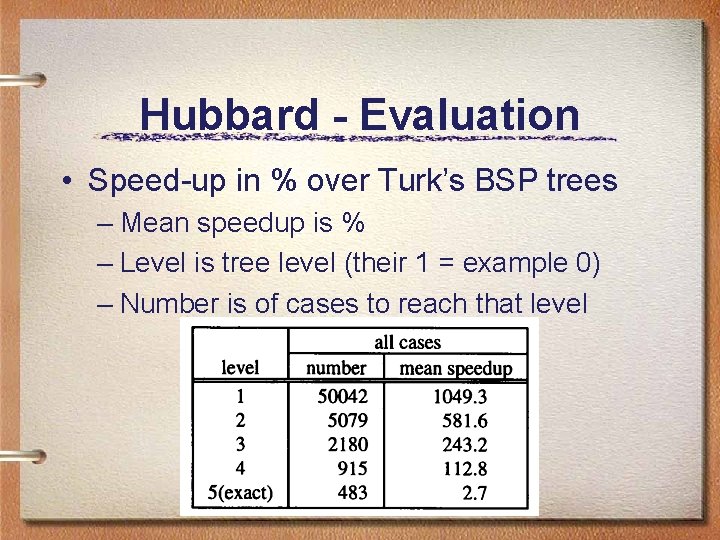
Hubbard - Evaluation • Speed-up in % over Turk’s BSP trees – Mean speedup is % – Level is tree level (their 1 = example 0) – Number is of cases to reach that level
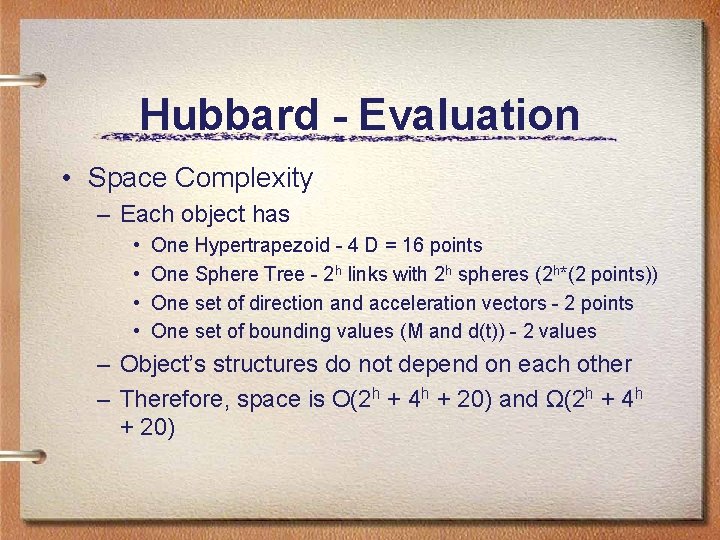
Hubbard - Evaluation • Space Complexity – Each object has • • One Hypertrapezoid - 4 D = 16 points One Sphere Tree - 2 h links with 2 h spheres (2 h*(2 points)) One set of direction and acceleration vectors - 2 points One set of bounding values (M and d(t)) - 2 values – Object’s structures do not depend on each other – Therefore, space is O(2 h + 4 h + 20) and Ω(2 h + 4 h + 20)
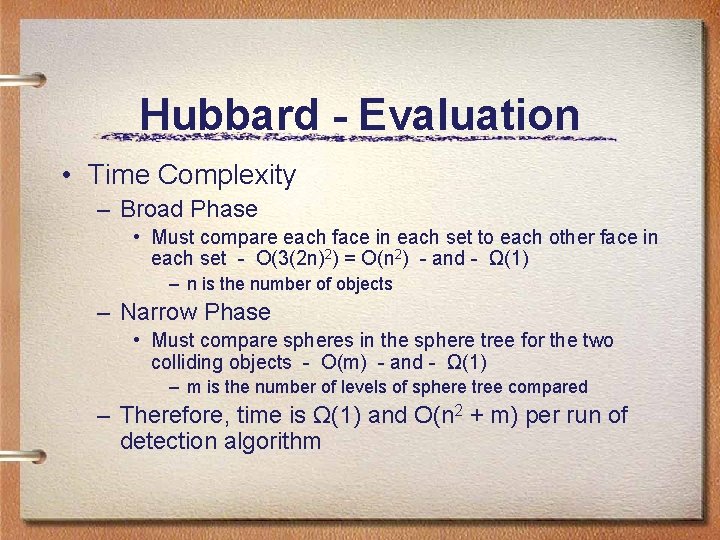
Hubbard - Evaluation • Time Complexity – Broad Phase • Must compare each face in each set to each other face in each set - O(3(2 n)2) = O(n 2) - and - Ω(1) – n is the number of objects – Narrow Phase • Must compare spheres in the sphere tree for the two colliding objects - O(m) - and - Ω(1) – m is the number of levels of sphere tree compared – Therefore, time is Ω(1) and O(n 2 + m) per run of detection algorithm
Hubbard - Conclusions • Algorithm allows average-case real-time collision detection • Faster than Turk’s algorithm (previously thought to be the best) • May have false positives if application interrupts processing too early in narrow phase (doesn’t get far enough down the tree) • Constructing sphere trees is slow
Summary • Collision detection is a difficult problem – Many different strategies – Most based on object models – Tough to do in real time • Collision detection strategies have not progressed significantly – Some small advances in speed and space – No major new developments • Most focus is now on collision detection through image processing
Summary • Bounding Boxes – Space but not time efficient – Very inaccurate detection – Not real-time • Bounding Spheres – Space but not time efficient – Relatively inaccurate detection – Not real-time
Summary • BSP Trees – Inefficient in time and space – Quite accurate detection – Not real-time • Hubbard – Relatively efficient in time but not space – Highly accurate detection – Not real-time (but can be close)
Summary • The clear winner depends on the application – Hubbard performs best for most “real world” applications where objects are known ahead of time (ie: games, animation, ATC, etc. ) – BSP trees are good for objects that are not known ahead of time (ie: auto collision – Bounding boxes / spheres are good for objects of that approximate shape, or for very fast detection (ie: primitive games, primitive scene animation)
Questions?