
Comparison of central pattern generators and locomotor movements
- Slides: 16
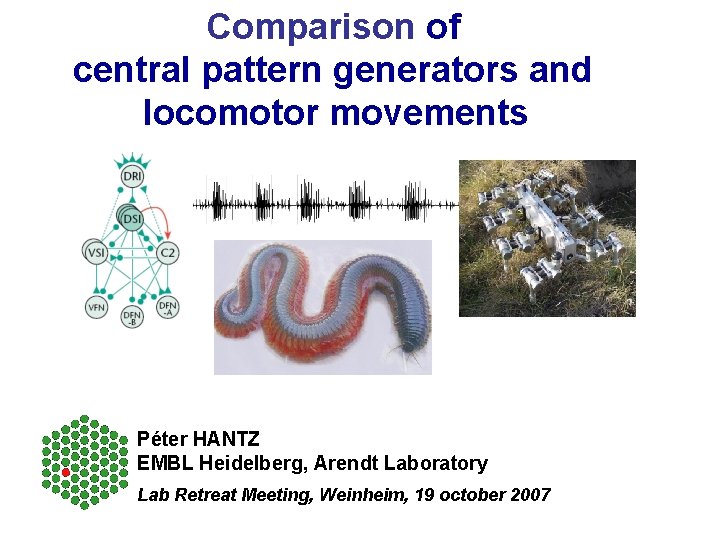
Comparison of central pattern generators and locomotor movements Péter HANTZ EMBL Heidelberg, Arendt Laboratory Lab Retreat Meeting, Weinheim, 19 october 2007
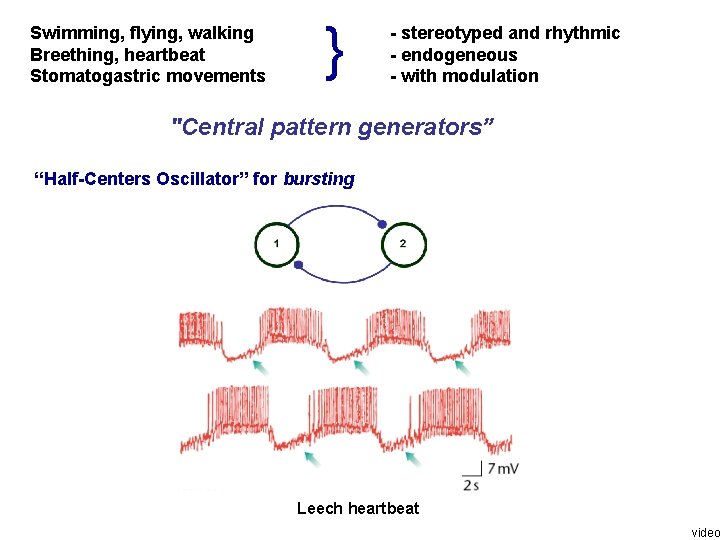
Swimming, flying, walking Breething, heartbeat Stomatogastric movements } - stereotyped and rhythmic - endogeneous - with modulation "Central pattern generators” “Half-Centers Oscillator” for bursting Leech heartbeat video
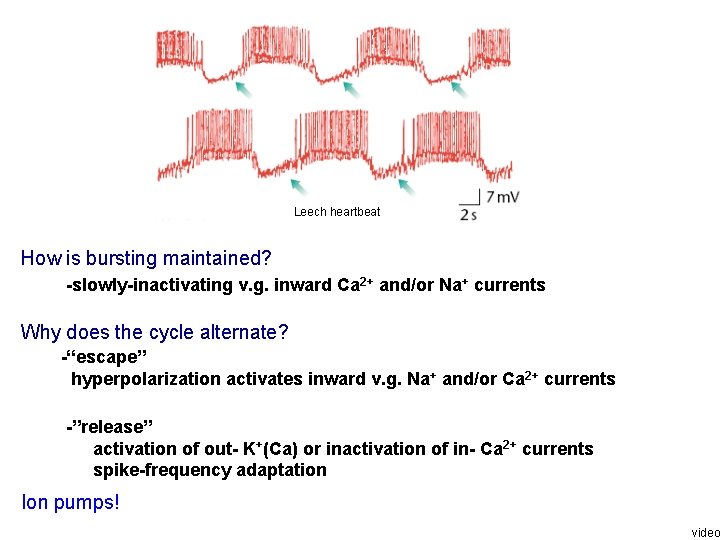
Leech heartbeat How is bursting maintained? -slowly-inactivating v. g. inward Ca 2+ and/or Na+ currents Why does the cycle alternate? -“escape” hyperpolarization activates inward v. g. Na+ and/or Ca 2+ currents -”release” activation of out- K+(Ca) or inactivation of in- Ca 2+ currents spike-frequency adaptation Ion pumps! video
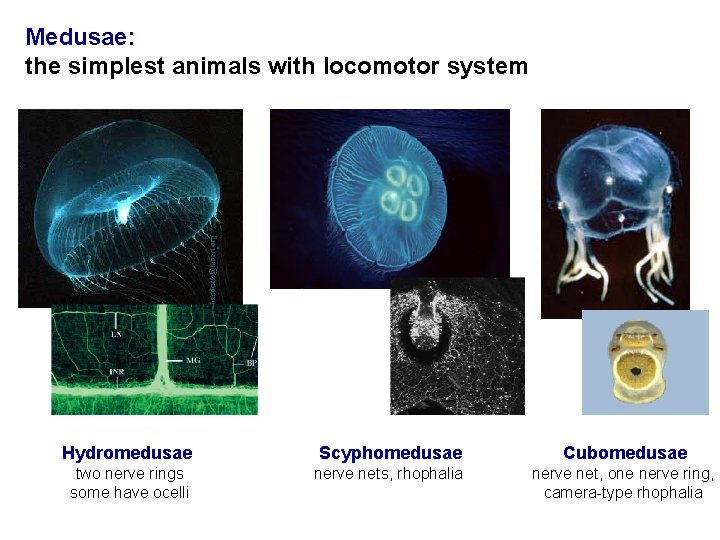
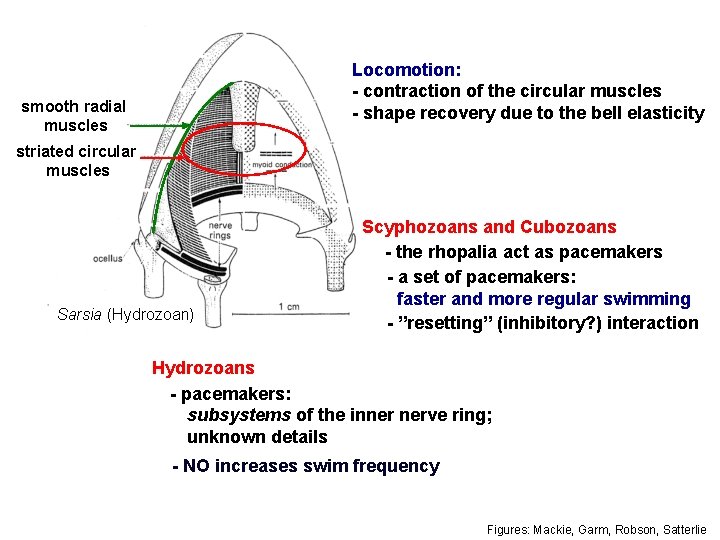
Medusae: the simplest animals with locomotor system Hydromedusae Scyphomedusae Cubomedusae two nerve rings some have ocelli nerve nets, rhophalia nerve net, one nerve ring, camera-type rhophalia
Locomotion: - contraction of the circular muscles - shape recovery due to the bell elasticity smooth radial muscles striated circular muscles Nerve rings Sarsia (Hydrozoan) Scyphozoans and Cubozoans - the rhopalia act as pacemakers - a set of pacemakers: faster and more regular swimming - ”resetting” (inhibitory? ) interaction Hydrozoans - pacemakers: subsystems of the inner nerve ring; unknown details - NO increases swim frequency Figures: Mackie, Garm, Robson, Satterlie
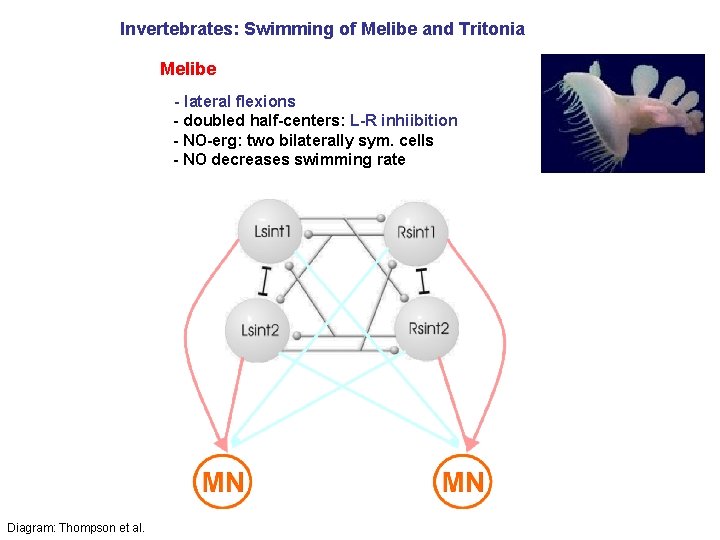
Invertebrates: Swimming of Melibe and Tritonia Melibe - lateral flexions - doubled half-centers: L-R inhiibition - NO-erg: two bilaterally sym. cells - NO decreases swimming rate Diagram: Thompson et al.
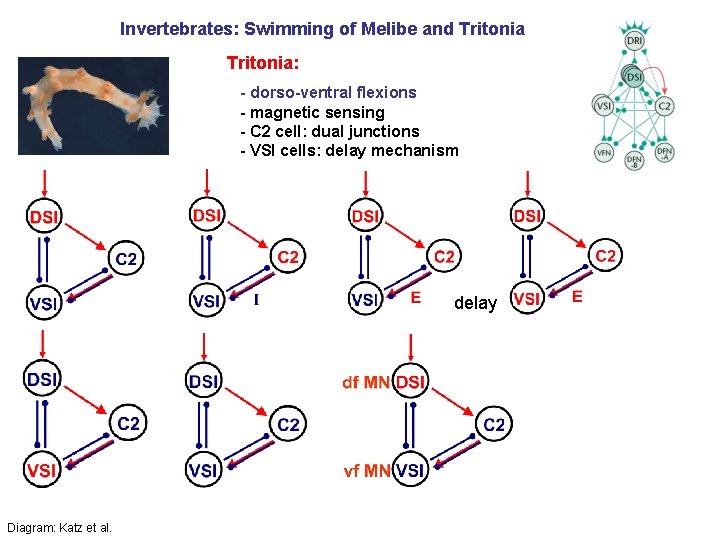
Invertebrates: Swimming of Melibe and Tritonia: - dorso-ventral flexions - magnetic sensing - C 2 cell: dual junctions - VSI cells: delay mechanism delay Diagram: Katz et al.
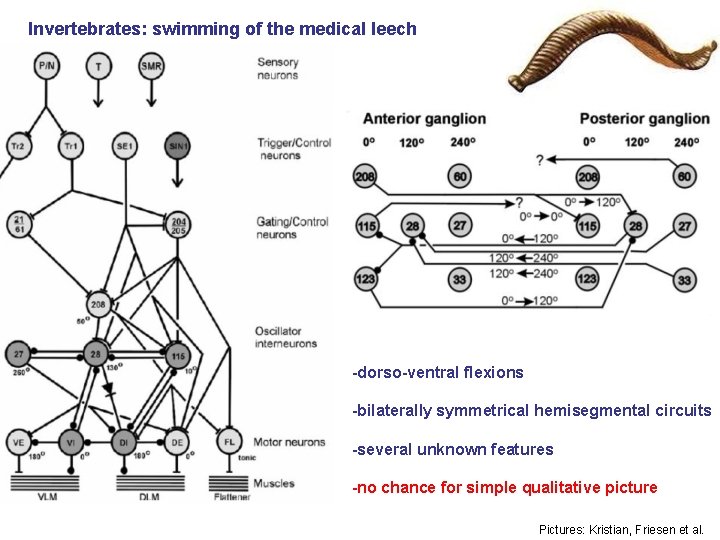
Invertebrates: swimming of the medical leech -dorso-ventral flexions -bilaterally symmetrical hemisegmental circuits -several unknown features -no chance for simple qualitative picture Pictures: Kristian, Friesen et al.
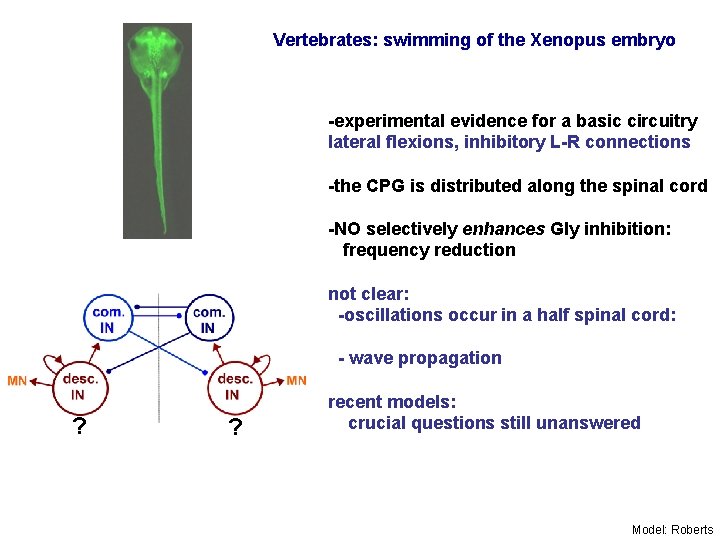
Vertebrates: swimming of the Xenopus embryo -experimental evidence for a basic circuitry lateral flexions, inhibitory L-R connections -the CPG is distributed along the spinal cord -NO selectively enhances Gly inhibition: frequency reduction not clear: -oscillations occur in a half spinal cord: - wave propagation ? ? recent models: crucial questions still unanswered Model: Roberts
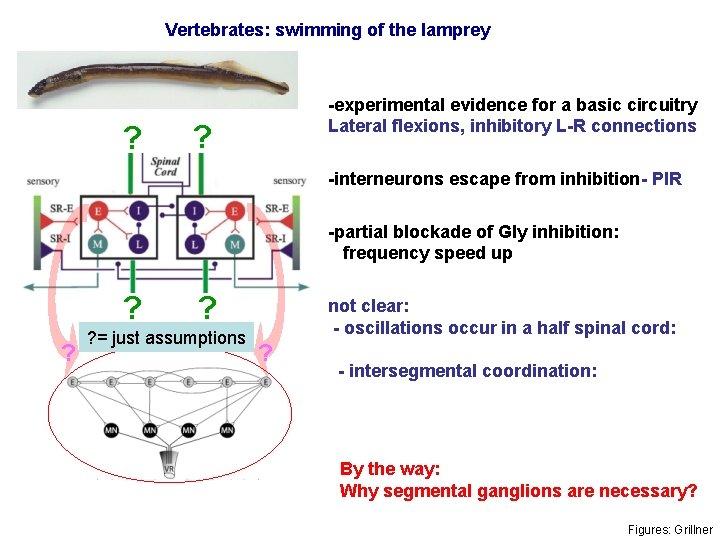
Vertebrates: swimming of the lamprey ? -experimental evidence for a basic circuitry Lateral flexions, inhibitory L-R connections ? -interneurons escape from inhibition- PIR -partial blockade of Gly inhibition: frequency speed up ? ? ? ? = just assumptions not clear: - oscillations occur in a half spinal cord: ? - intersegmental coordination: By the way: Why segmental ganglions are necessary? Figures: Grillner
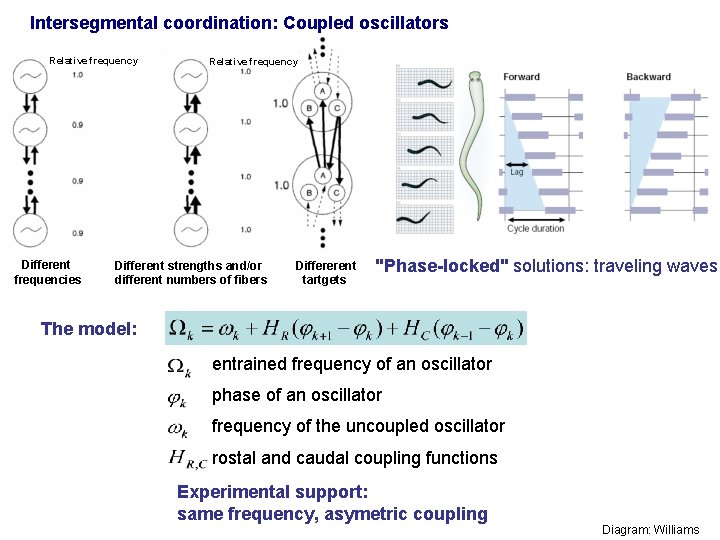
Intersegmental coordination: Coupled oscillators Relative frequency Different frequencies Relative frequency Different strengths and/or different numbers of fibers Differerent tartgets "Phase-locked" solutions: traveling waves The model: entrained frequency of an oscillator phase of an oscillator frequency of the uncoupled oscillator rostal and caudal coupling functions Experimental support: same frequency, asymetric coupling Diagram: Williams
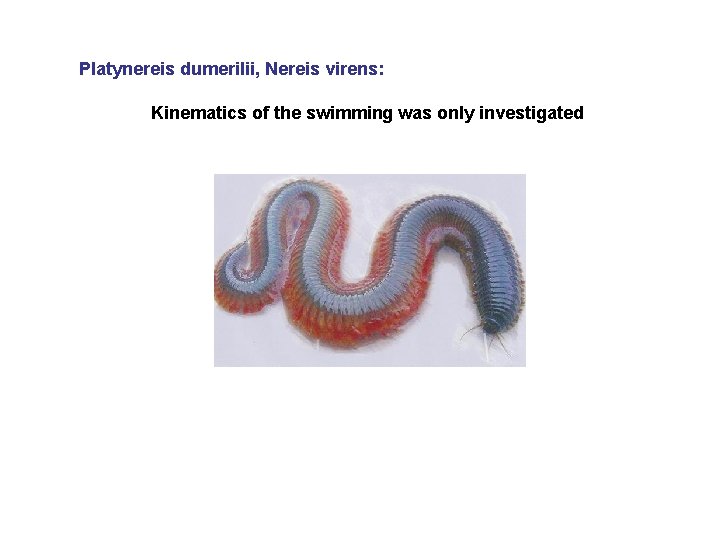
Platynereis dumerilii, Nereis virens: Kinematics of the swimming was only investigated
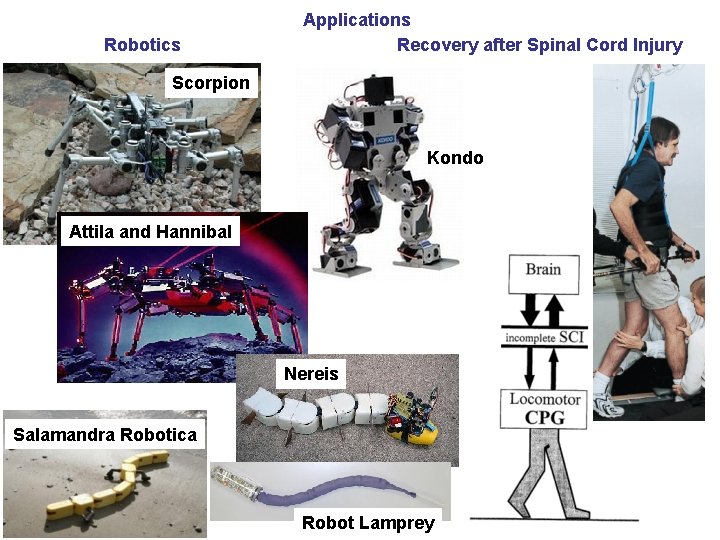
Robotics Applications Recovery after Spinal Cord Injury Scorpion Kondo Attila and Hannibal Nereis Salamandra Robotica Robot Lamprey
Progress Report Immunohistochemistry: • Attempt for classical staining with styril-based dyes, in cooperation with Young-Tae Chang, National University of Singapore • In vivo methylene blue techniques (Smith, 1956) • Successfull permeabilization by freezning New Antibodies • Choline Acetyltransferase • Glutamic Acid Decarboxylase • perhaps Nitric Oxide Synthase first: staining NADPH-diaphorase histochemistry
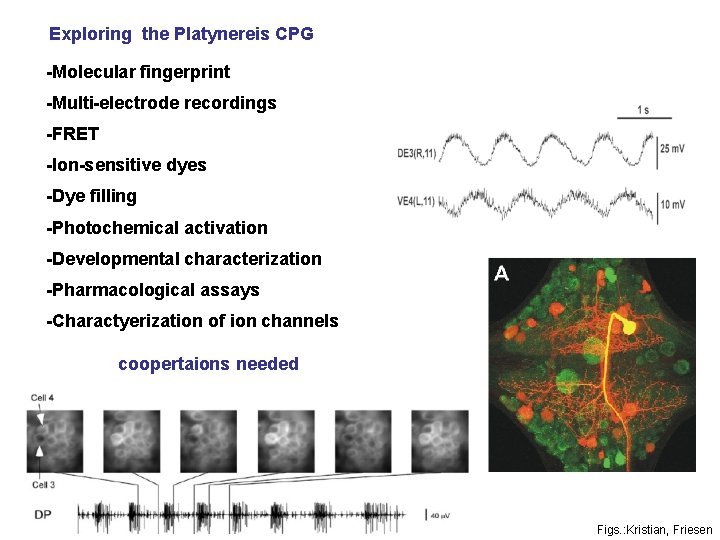
Exploring the Platynereis CPG -Molecular fingerprint -Multi-electrode recordings -FRET -Ion-sensitive dyes -Dye filling -Photochemical activation -Developmental characterization -Pharmacological assays -Charactyerization of ion channels coopertaions needed Figs. : Kristian, Friesen
Acknowledgements Arendt Group Detlev Arendt Foteini Christodoulou Alexandru Denes Antje Fischer Keren Guy Florian Raible Heidi Snyman Kristin Tessmar Raju Tomer Benjamin Backfisch Carmen Döring Nicola Kegel Katharina Willmann Dirk Bucher Otto Friesen Anders Garm Balázs Gulyás Alan Roberts Gáspár Jékely Paul S. Katz György Kemenes William Kristian Lajos László George Mackie Péter Somogyi Andrew Spencer Fellowship: Federation of European Biochemical Societies