
Comparison of BCNF and 3 NF Losslessjoin Decomposition

Comparison of BCNF and 3 NF
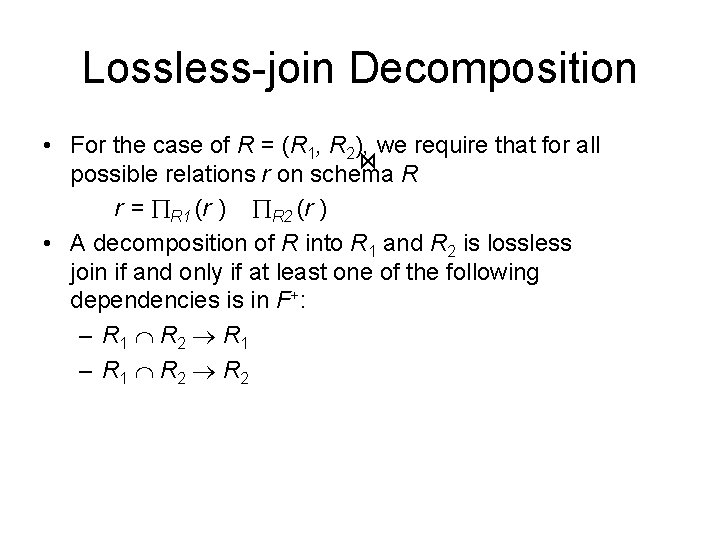
Lossless-join Decomposition • For the case of R = (R 1, R 2), we require that for all possible relations r on schema R r = R 1 (r ) R 2 (r ) • A decomposition of R into R 1 and R 2 is lossless join if and only if at least one of the following dependencies is in F+: – R 1 R 2 R 1 – R 1 R 2
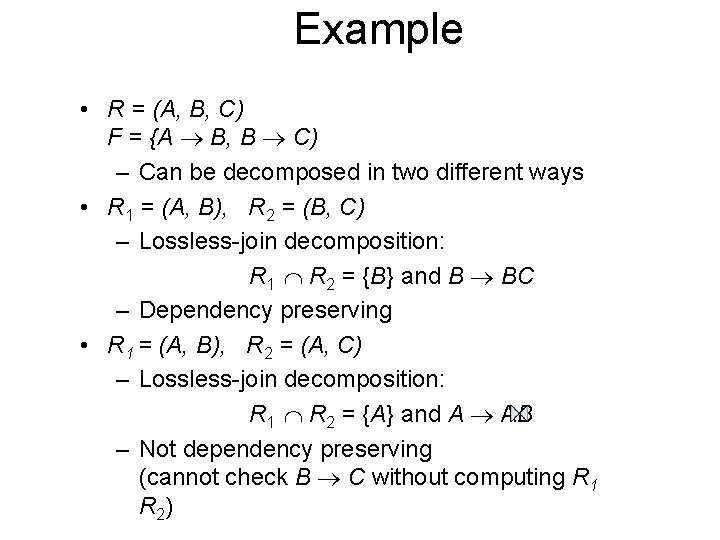
Example • R = (A, B, C) F = {A B, B C) – Can be decomposed in two different ways • R 1 = (A, B), R 2 = (B, C) – Lossless-join decomposition: R 1 R 2 = {B} and B BC – Dependency preserving • R 1 = (A, B), R 2 = (A, C) – Lossless-join decomposition: R 1 R 2 = {A} and A AB – Not dependency preserving (cannot check B C without computing R 1 R 2)
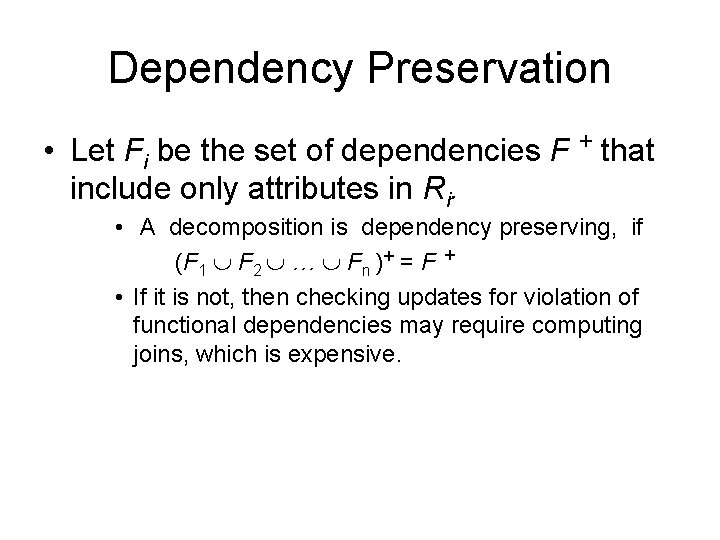
Dependency Preservation • Let Fi be the set of dependencies F + that include only attributes in Ri. • A decomposition is dependency preserving, if (F 1 F 2 … Fn )+ = F + • If it is not, then checking updates for violation of functional dependencies may require computing joins, which is expensive.
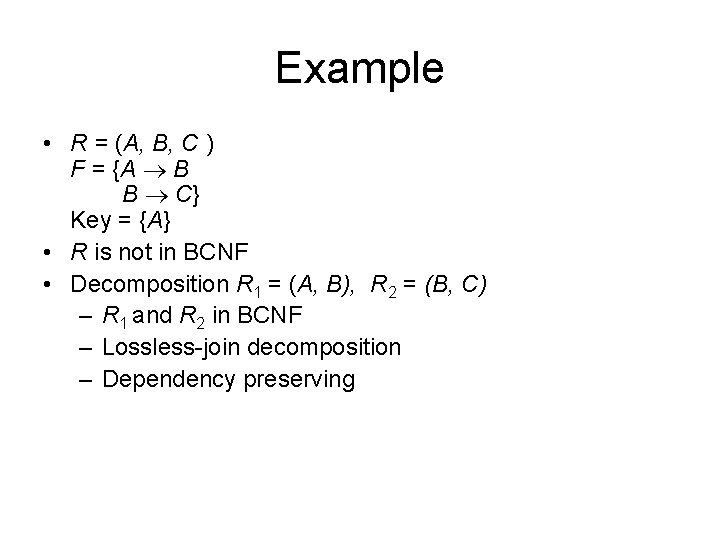
Example • R = (A, B, C ) F = {A B B C} Key = {A} • R is not in BCNF • Decomposition R 1 = (A, B), R 2 = (B, C) – R 1 and R 2 in BCNF – Lossless-join decomposition – Dependency preserving
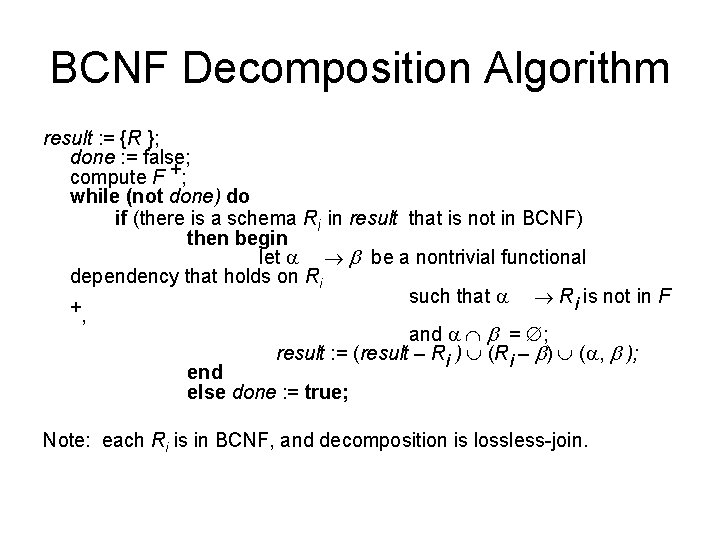
BCNF Decomposition Algorithm result : = {R }; done : = false; compute F +; while (not done) do if (there is a schema Ri in result that is not in BCNF) then begin let be a nontrivial functional dependency that holds on Ri such that Ri is not in F +, and = ; result : = (result – Ri ) (Ri – ) ( , ); end else done : = true; Note: each Ri is in BCNF, and decomposition is lossless-join.
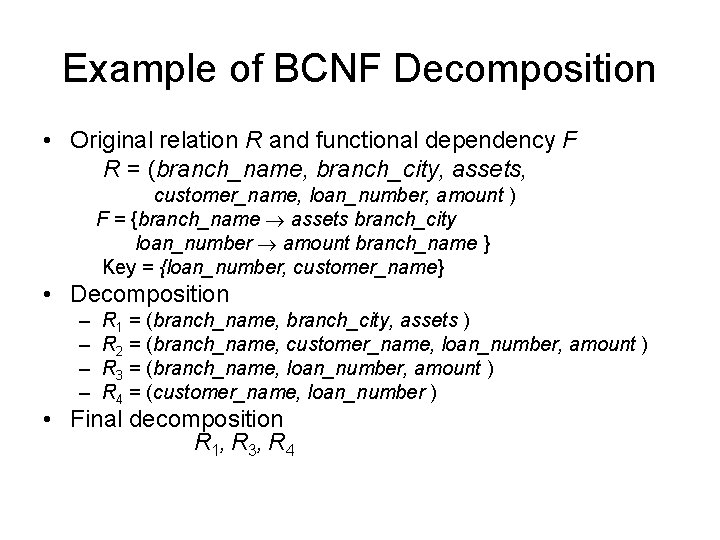
Example of BCNF Decomposition • Original relation R and functional dependency F R = (branch_name, branch_city, assets, customer_name, loan_number, amount ) F = {branch_name assets branch_city loan_number amount branch_name } Key = {loan_number, customer_name} • Decomposition – – R 1 = (branch_name, branch_city, assets ) R 2 = (branch_name, customer_name, loan_number, amount ) R 3 = (branch_name, loan_number, amount ) R 4 = (customer_name, loan_number ) • Final decomposition R 1, R 3, R 4
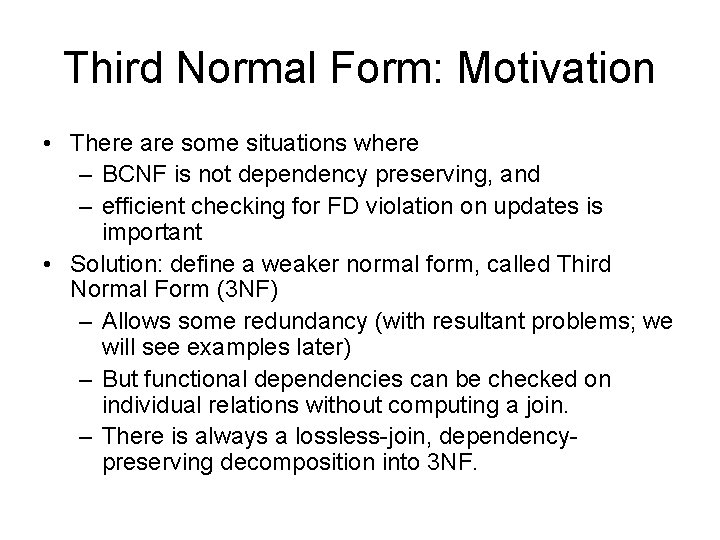
Third Normal Form: Motivation • There are some situations where – BCNF is not dependency preserving, and – efficient checking for FD violation on updates is important • Solution: define a weaker normal form, called Third Normal Form (3 NF) – Allows some redundancy (with resultant problems; we will see examples later) – But functional dependencies can be checked on individual relations without computing a join. – There is always a lossless-join, dependencypreserving decomposition into 3 NF.
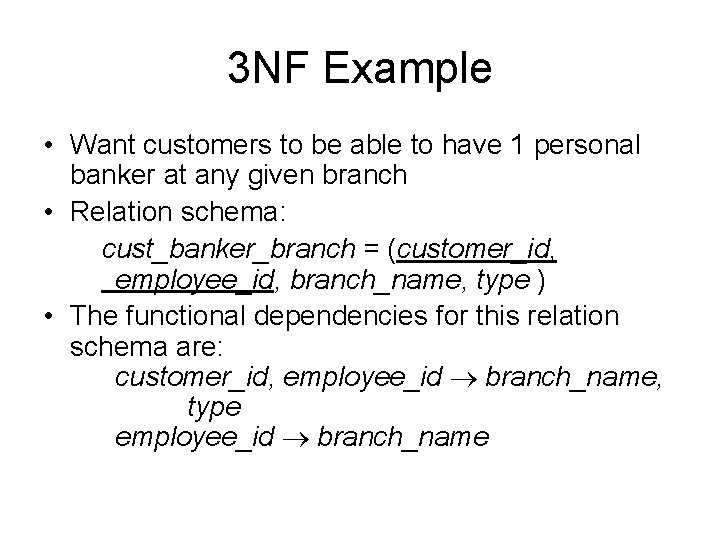
3 NF Example • Want customers to be able to have 1 personal banker at any given branch • Relation schema: cust_banker_branch = (customer_id, employee_id, branch_name, type ) • The functional dependencies for this relation schema are: customer_id, employee_id branch_name, type employee_id branch_name
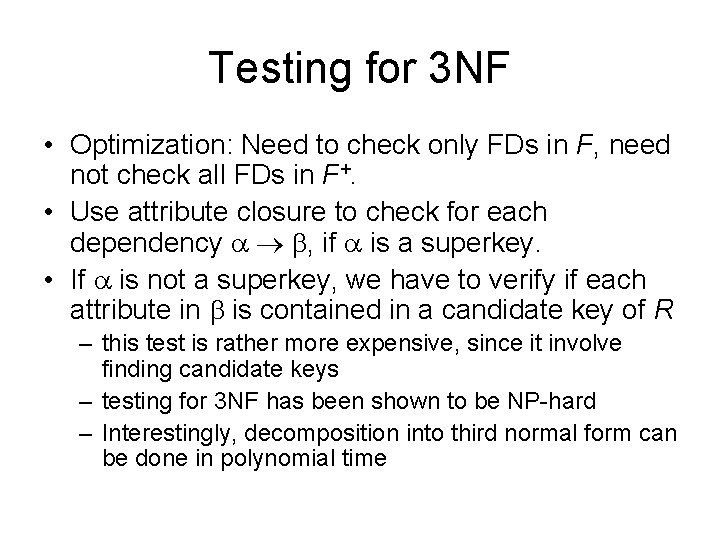
Testing for 3 NF • Optimization: Need to check only FDs in F, need not check all FDs in F+. • Use attribute closure to check for each dependency , if is a superkey. • If is not a superkey, we have to verify if each attribute in is contained in a candidate key of R – this test is rather more expensive, since it involve finding candidate keys – testing for 3 NF has been shown to be NP-hard – Interestingly, decomposition into third normal form can be done in polynomial time
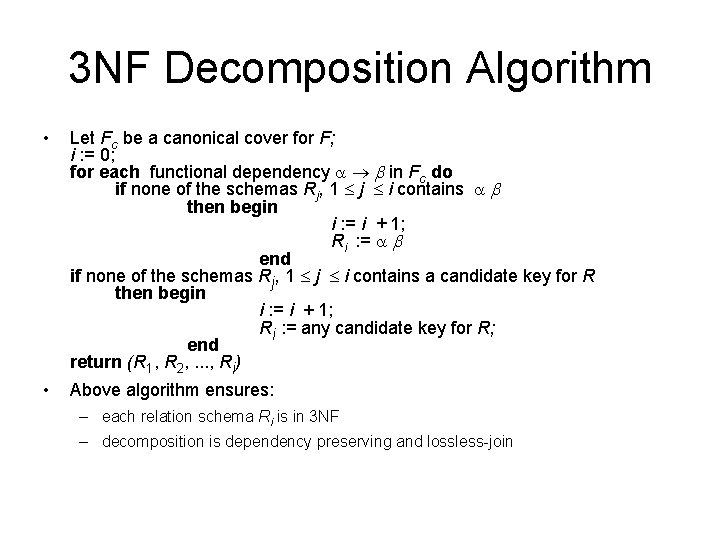
3 NF Decomposition Algorithm • Let Fc be a canonical cover for F; i : = 0; for each functional dependency in Fc do if none of the schemas Rj, 1 j i contains then begin i : = i + 1; Ri : = end if none of the schemas Rj, 1 j i contains a candidate key for R then begin i : = i + 1; Ri : = any candidate key for R; end return (R 1, R 2, . . . , Ri) • Above algorithm ensures: – each relation schema Ri is in 3 NF – decomposition is dependency preserving and lossless-join
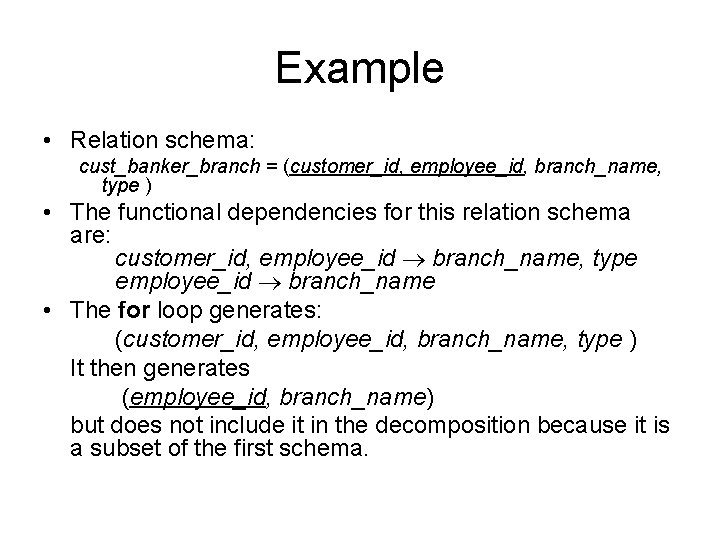
Example • Relation schema: cust_banker_branch = (customer_id, employee_id, branch_name, type ) • The functional dependencies for this relation schema are: customer_id, employee_id branch_name, type employee_id branch_name • The for loop generates: (customer_id, employee_id, branch_name, type ) It then generates (employee_id, branch_name) but does not include it in the decomposition because it is a subset of the first schema.
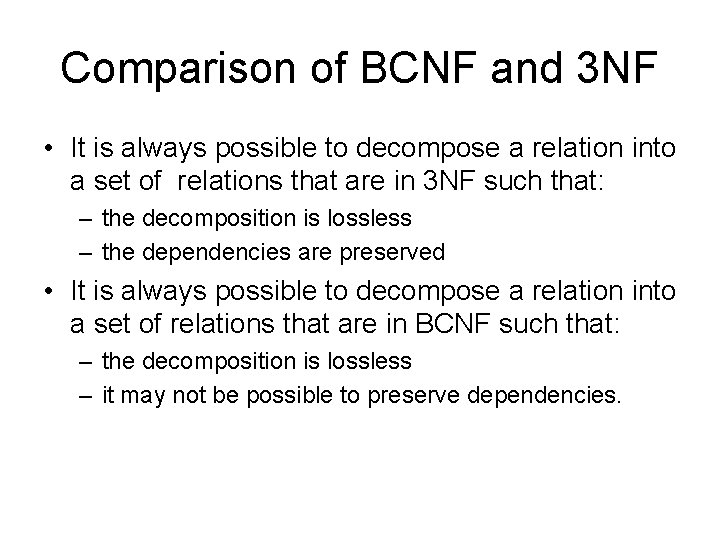
Comparison of BCNF and 3 NF • It is always possible to decompose a relation into a set of relations that are in 3 NF such that: – the decomposition is lossless – the dependencies are preserved • It is always possible to decompose a relation into a set of relations that are in BCNF such that: – the decomposition is lossless – it may not be possible to preserve dependencies.
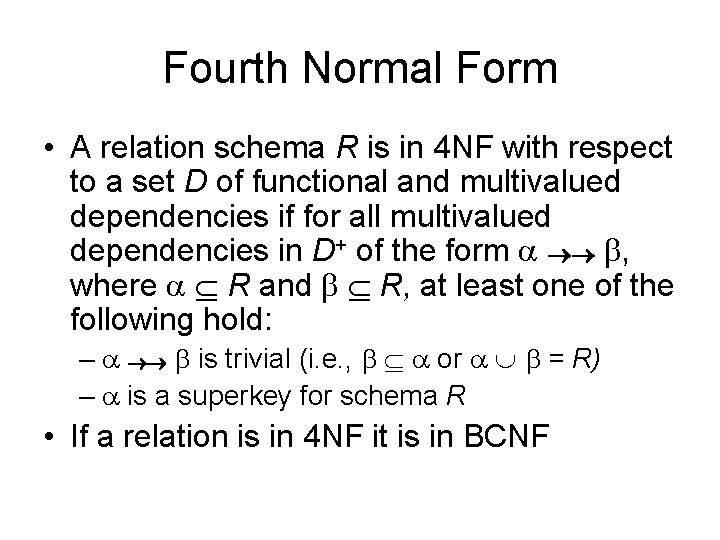
Fourth Normal Form • A relation schema R is in 4 NF with respect to a set D of functional and multivalued dependencies if for all multivalued dependencies in D+ of the form , where R and R, at least one of the following hold: – is trivial (i. e. , or = R) – is a superkey for schema R • If a relation is in 4 NF it is in BCNF
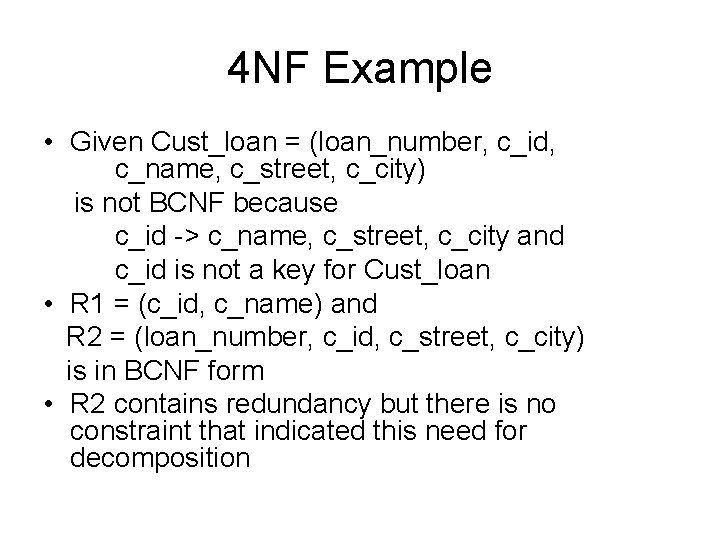
4 NF Example • Given Cust_loan = (loan_number, c_id, c_name, c_street, c_city) is not BCNF because c_id -> c_name, c_street, c_city and c_id is not a key for Cust_loan • R 1 = (c_id, c_name) and R 2 = (loan_number, c_id, c_street, c_city) is in BCNF form • R 2 contains redundancy but there is no constraint that indicated this need for decomposition
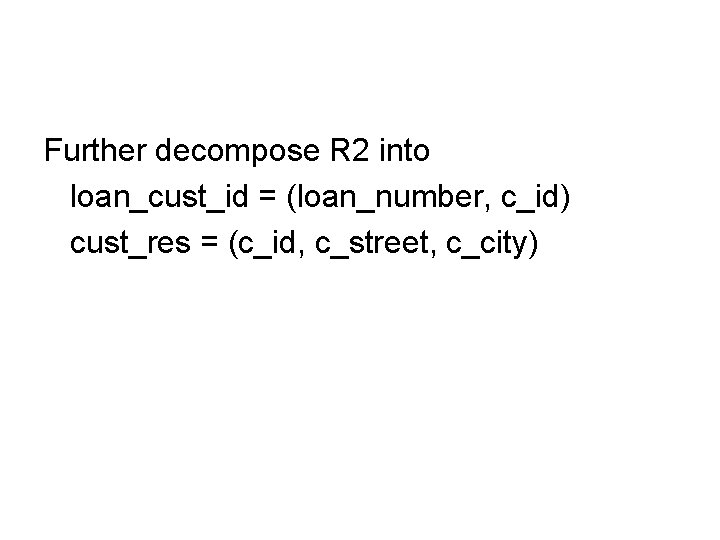
Further decompose R 2 into loan_cust_id = (loan_number, c_id) cust_res = (c_id, c_street, c_city)
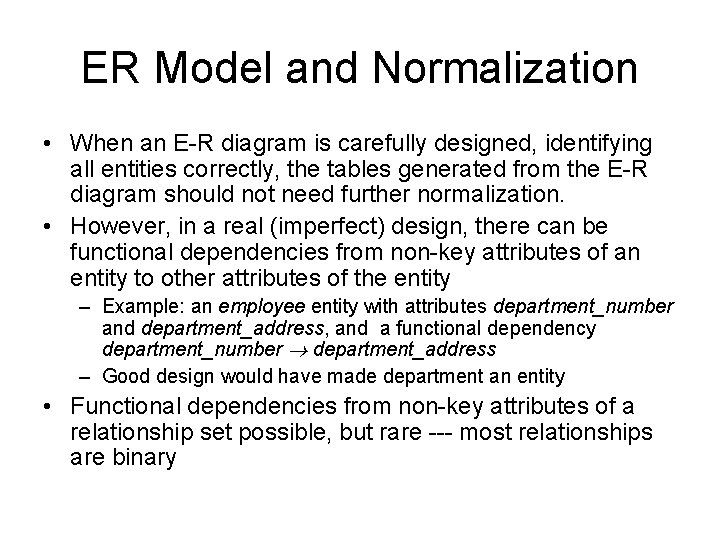
ER Model and Normalization • When an E-R diagram is carefully designed, identifying all entities correctly, the tables generated from the E-R diagram should not need further normalization. • However, in a real (imperfect) design, there can be functional dependencies from non-key attributes of an entity to other attributes of the entity – Example: an employee entity with attributes department_number and department_address, and a functional dependency department_number department_address – Good design would have made department an entity • Functional dependencies from non-key attributes of a relationship set possible, but rare --- most relationships are binary
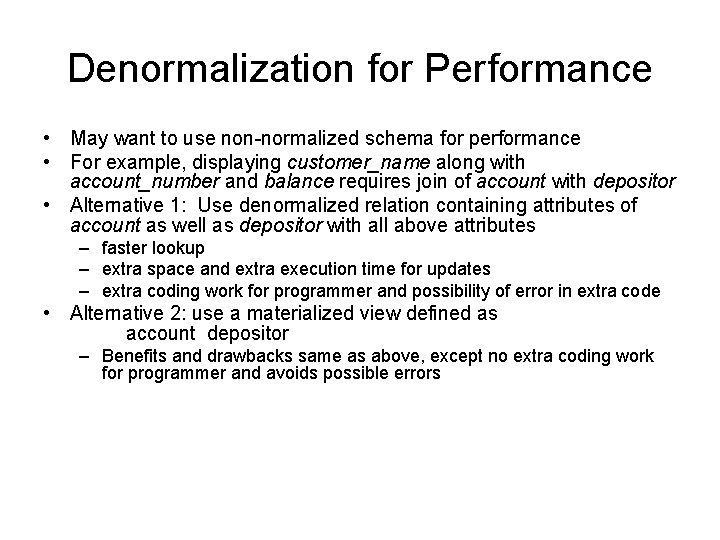
Denormalization for Performance • May want to use non-normalized schema for performance • For example, displaying customer_name along with account_number and balance requires join of account with depositor • Alternative 1: Use denormalized relation containing attributes of account as well as depositor with all above attributes – faster lookup – extra space and extra execution time for updates – extra coding work for programmer and possibility of error in extra code • Alternative 2: use a materialized view defined as account depositor – Benefits and drawbacks same as above, except no extra coding work for programmer and avoids possible errors
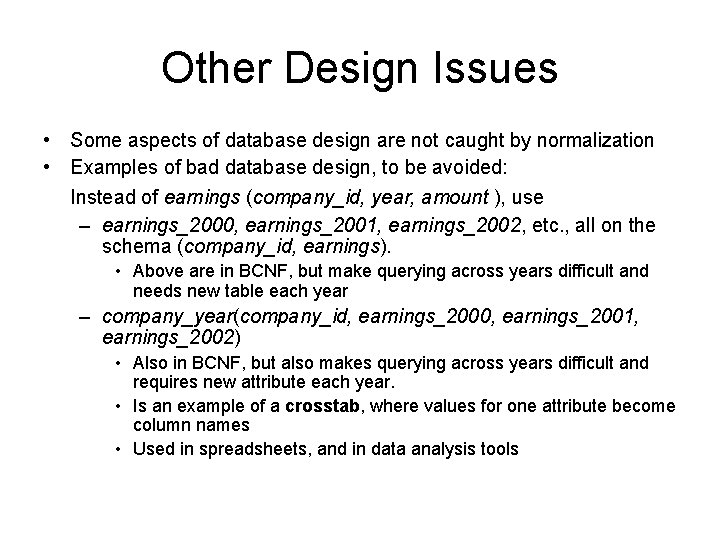
Other Design Issues • Some aspects of database design are not caught by normalization • Examples of bad database design, to be avoided: Instead of earnings (company_id, year, amount ), use – earnings_2000, earnings_2001, earnings_2002, etc. , all on the schema (company_id, earnings). • Above are in BCNF, but make querying across years difficult and needs new table each year – company_year(company_id, earnings_2000, earnings_2001, earnings_2002) • Also in BCNF, but also makes querying across years difficult and requires new attribute each year. • Is an example of a crosstab, where values for one attribute become column names • Used in spreadsheets, and in data analysis tools
- Slides: 19