
Comparison of Amplifier Configurations Midband Characteristics These are
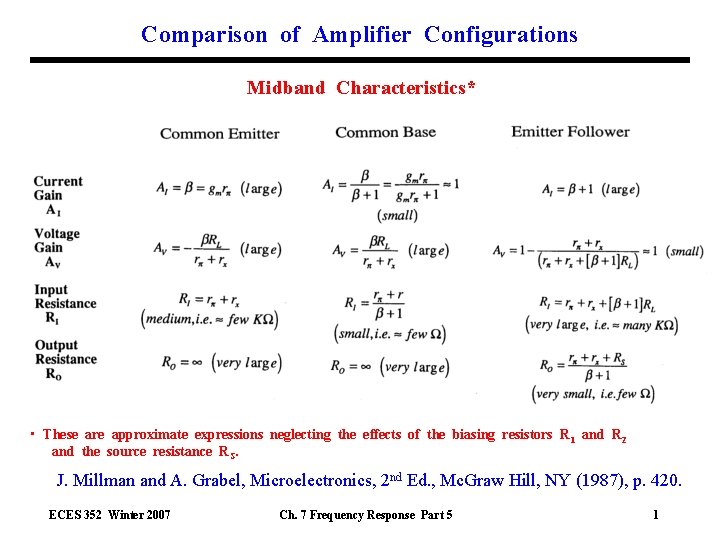
Comparison of Amplifier Configurations Midband Characteristics* • These are approximate expressions neglecting the effects of the biasing resistors R 1 and R 2 and the source resistance RS. J. Millman and A. Grabel, Microelectronics, 2 nd Ed. , Mc. Graw Hill, NY (1987), p. 420. ECES 352 Winter 2007 Ch. 7 Frequency Response Part 5 1
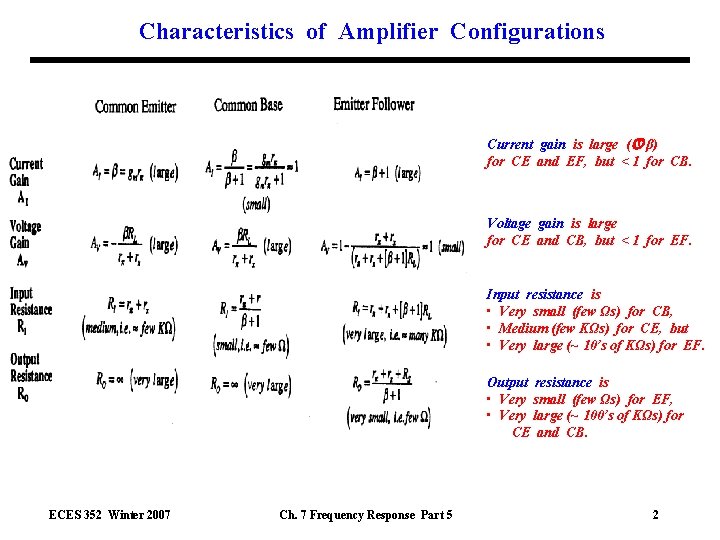
Characteristics of Amplifier Configurations Current gain is large ( β) for CE and EF, but < 1 for CB. Voltage gain is large for CE and CB, but < 1 for EF. Input resistance is • Very small (few Ωs) for CB, • Medium (few KΩs) for CE, but • Very large (~ 10’s of KΩs) for EF. Output resistance is • Very small (few Ωs) for EF, • Very large (~ 100’s of KΩs) for CE and CB. ECES 352 Winter 2007 Ch. 7 Frequency Response Part 5 2
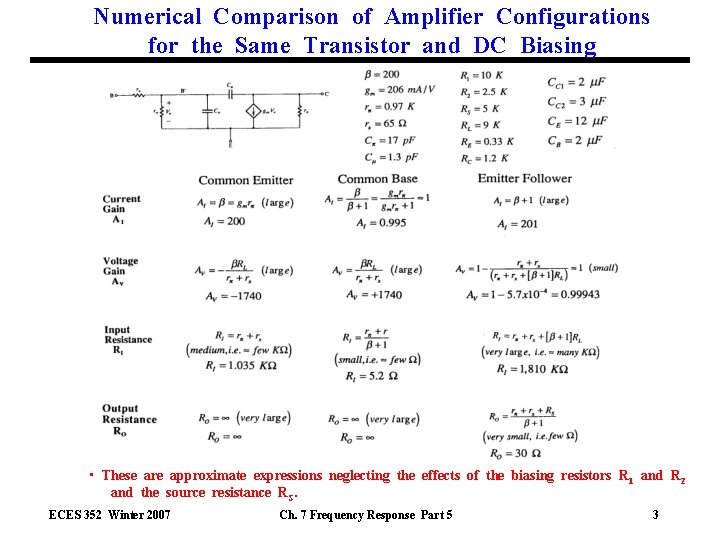
Numerical Comparison of Amplifier Configurations for the Same Transistor and DC Biasing • These are approximate expressions neglecting the effects of the biasing resistors R 1 and R 2 and the source resistance RS. ECES 352 Winter 2007 Ch. 7 Frequency Response Part 5 3
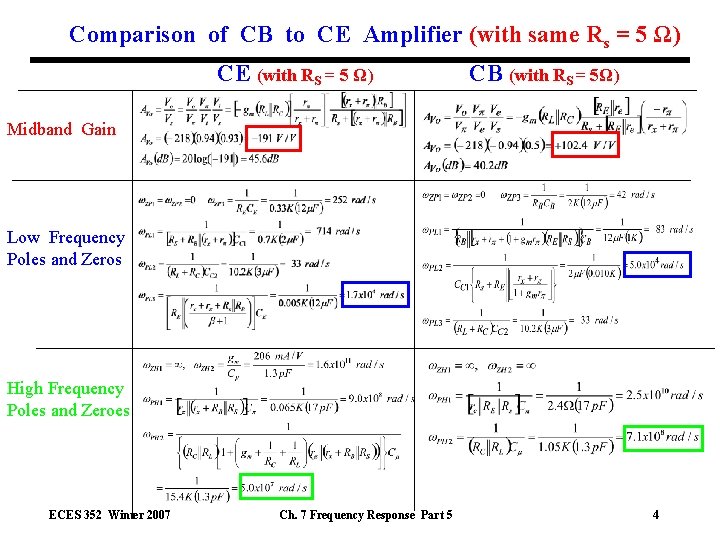
Comparison of CB to CE Amplifier (with same Rs = 5 Ω) CE (with RS = 5 Ω) CB (with RS = 5Ω) Midband Gain Low Frequency Poles and Zeros High Frequency Poles and Zeroes ECES 352 Winter 2007 Ch. 7 Frequency Response Part 5 4
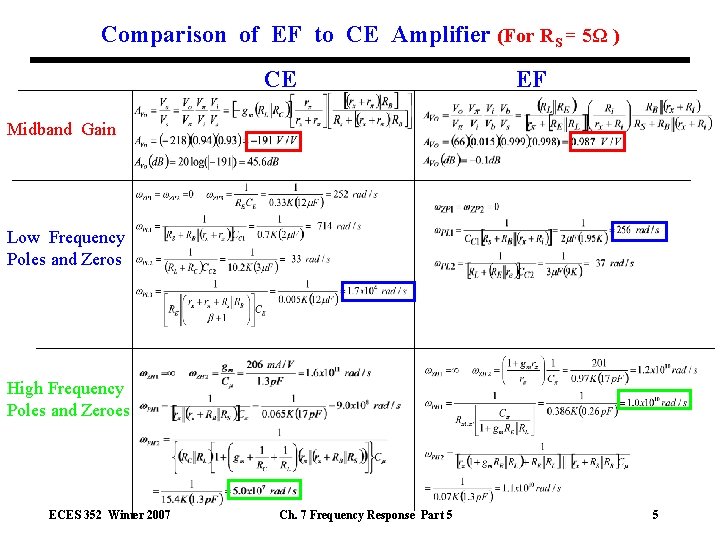
Comparison of EF to CE Amplifier (For RS = 5Ω ) CE EF Midband Gain Low Frequency Poles and Zeros High Frequency Poles and Zeroes ECES 352 Winter 2007 Ch. 7 Frequency Response Part 5 5
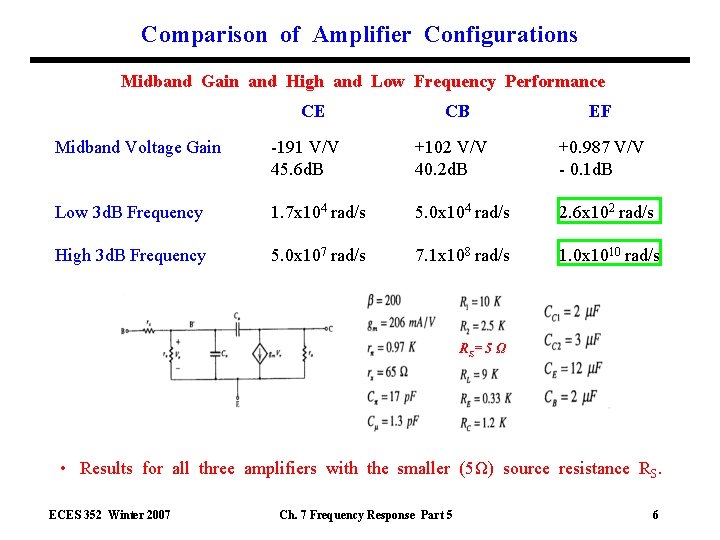
Comparison of Amplifier Configurations Midband Gain and High and Low Frequency Performance CE CB EF Midband Voltage Gain -191 V/V 45. 6 d. B +102 V/V 40. 2 d. B +0. 987 V/V - 0. 1 d. B Low 3 d. B Frequency 1. 7 x 10⁴ rad/s 5. 0 x 104 rad/s 2. 6 x 10² rad/s High 3 d. B Frequency 5. 0 x 107 rad/s 7. 1 x 10⁸ rad/s 1. 0 x 1010 rad/s RS= 5 Ω • Results for all three amplifiers with the smaller (5Ω) source resistance RS. ECES 352 Winter 2007 Ch. 7 Frequency Response Part 5 6
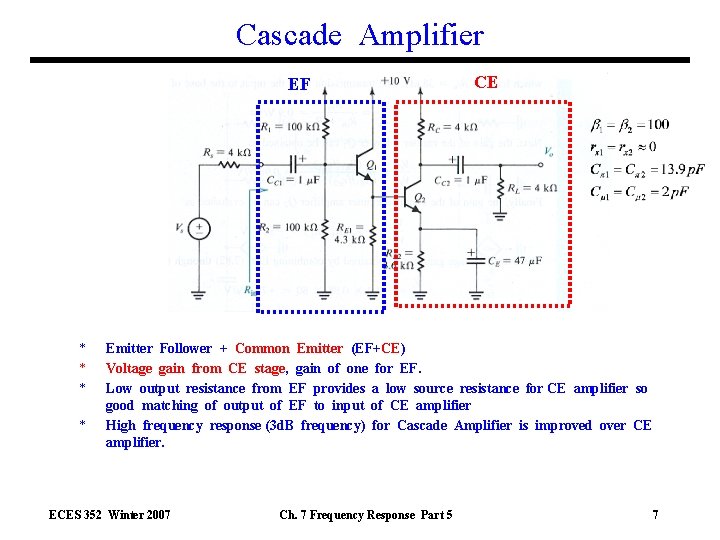
Cascade Amplifier EF * * CE Emitter Follower + Common Emitter (EF+CE) Voltage gain from CE stage, gain of one for EF. Low output resistance from EF provides a low source resistance for CE amplifier so good matching of output of EF to input of CE amplifier High frequency response (3 d. B frequency) for Cascade Amplifier is improved over CE amplifier. ECES 352 Winter 2007 Ch. 7 Frequency Response Part 5 7

Cascade Amplifier - DC analysis IB 1 IE 1 IB 2 IRE 1 Small Signal Parameters ECES 352 Winter 2007 Ch. 7 Frequency Response Part 5 8
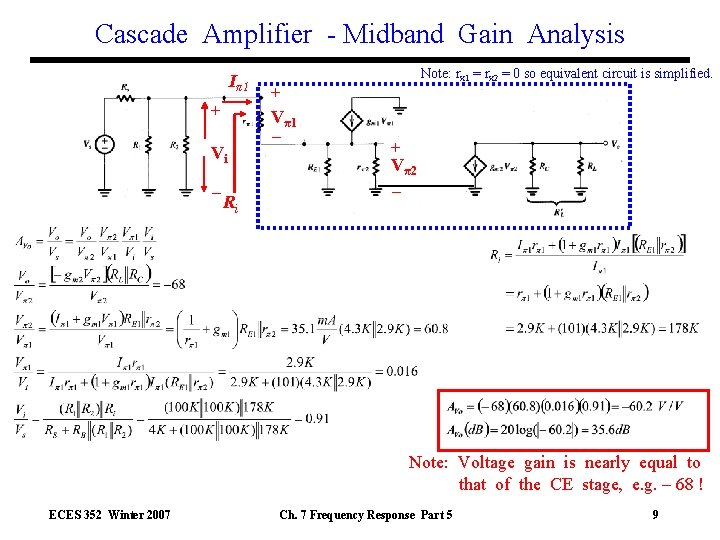
Cascade Amplifier - Midband Gain Analysis Iπ1 + Vi _ Ri Note: rx 1 = rx 2 = 0 so equivalent circuit is simplified. + Vπ1 _ + Vπ2 _ Note: Voltage gain is nearly equal to that of the CE stage, e. g. – 68 ! ECES 352 Winter 2007 Ch. 7 Frequency Response Part 5 9
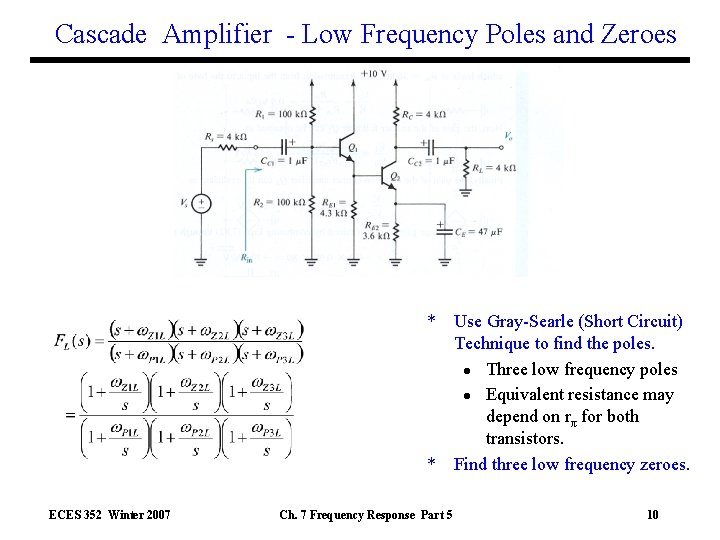
Cascade Amplifier - Low Frequency Poles and Zeroes * Use Gray-Searle (Short Circuit) Technique to find the poles. ● Three low frequency poles ● Equivalent resistance may depend on rπ for both transistors. * Find three low frequency zeroes. ECES 352 Winter 2007 Ch. 7 Frequency Response Part 5 10
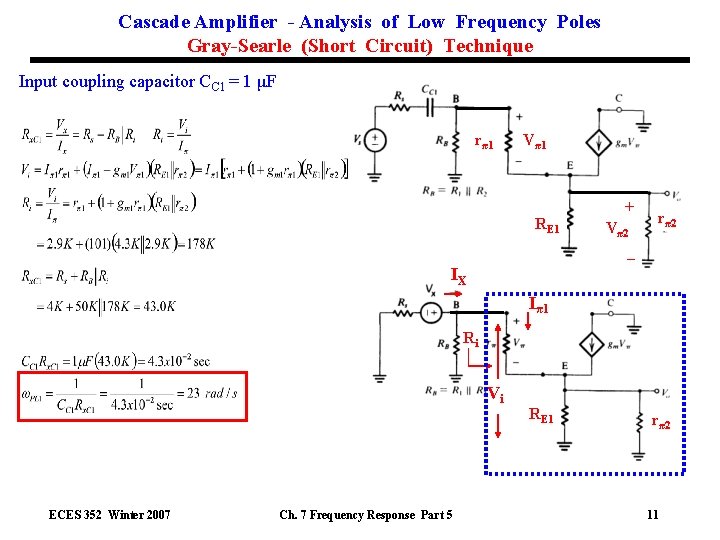
Cascade Amplifier - Analysis of Low Frequency Poles Gray-Searle (Short Circuit) Technique Input coupling capacitor CC 1 = 1 μF rπ1 Vπ1 RE 1 + Vπ2 _ rπ2 IX Iπ1 Ri Vi ECES 352 Winter 2007 Ch. 7 Frequency Response Part 5 RE 1 rπ2 11
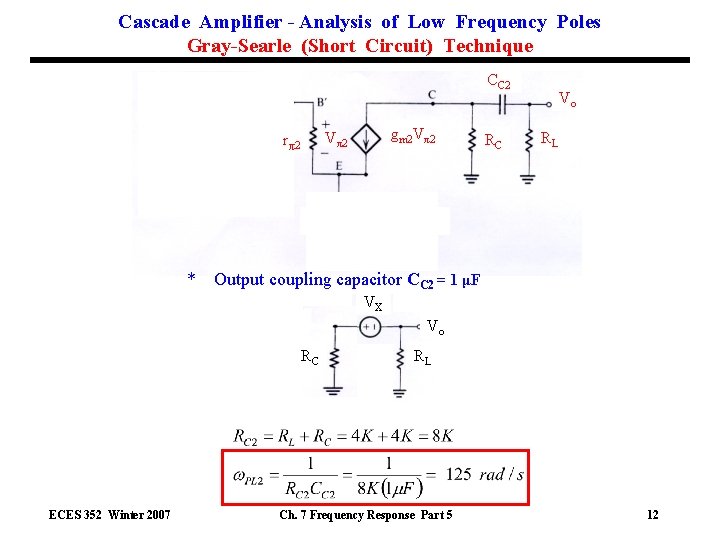
Cascade Amplifier - Analysis of Low Frequency Poles Gray-Searle (Short Circuit) Technique CC 2 r. X 2 gm 2 Vπ2 rπ 2 RE 2 RC Vo RL CE * Output coupling capacitor CC 2 = 1 μF VX Vo RC ECES 352 Winter 2007 RL Ch. 7 Frequency Response Part 5 12
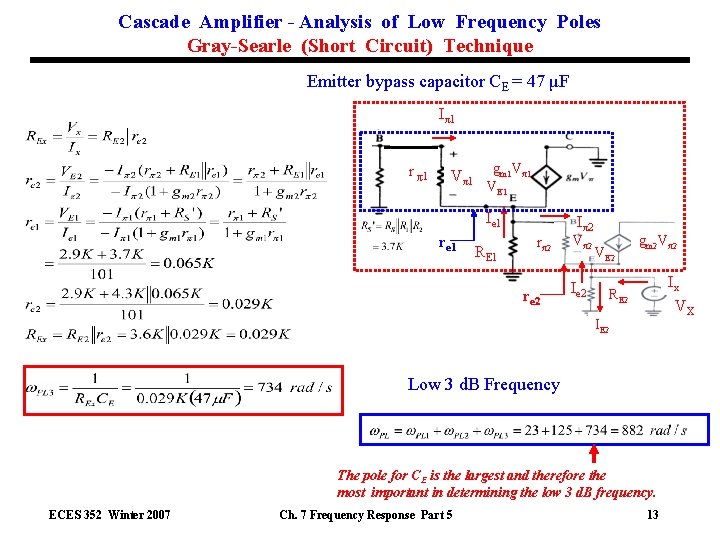
Cascade Amplifier - Analysis of Low Frequency Poles Gray-Searle (Short Circuit) Technique Emitter bypass capacitor CE = 47 μF Iπ1 r π1 Vπ1 gm 1 Vπ1 VE 1 Ie 1 re 1 RE 1 Iπ2 re 2 Vπ2 Ie 2 VE 2 gm 2 Vπ2 Ix VX RE 2 IE 2 Low 3 d. B Frequency The pole for CE is the largest and therefore the most important in determining the low 3 d. B frequency. ECES 352 Winter 2007 Ch. 7 Frequency Response Part 5 13
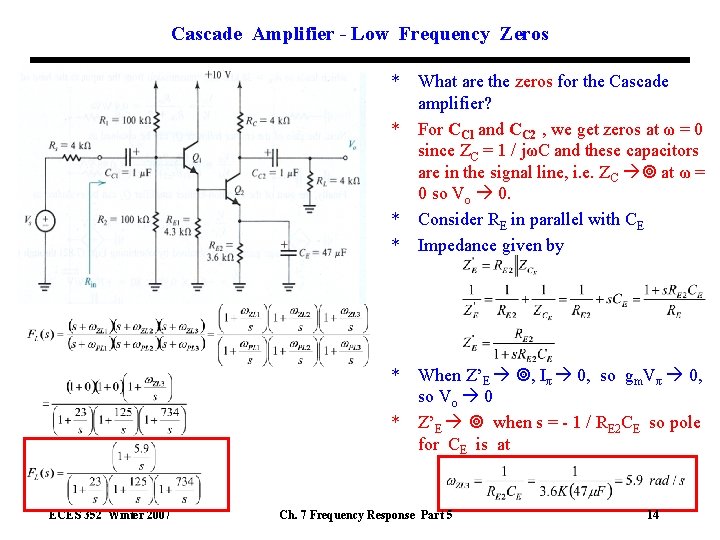
Cascade Amplifier - Low Frequency Zeros * What are the zeros for the Cascade amplifier? * For CC 1 and CC 2 , we get zeros at ω = 0 since ZC = 1 / jωC and these capacitors are in the signal line, i. e. ZC at ω = 0 so Vo 0. * Consider RE in parallel with CE * Impedance given by * When Z’E , Iπ 0, so gm. Vπ 0, so Vo 0 * Z’E when s = - 1 / RE 2 CE so pole for CE is at ECES 352 Winter 2007 Ch. 7 Frequency Response Part 5 14
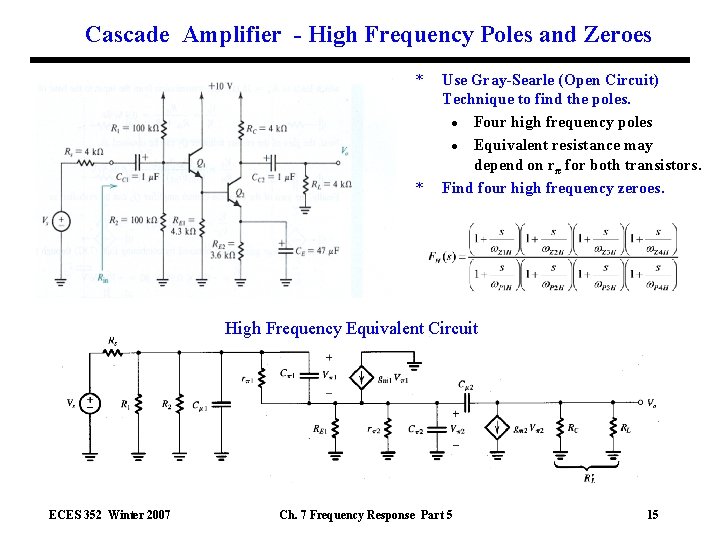
Cascade Amplifier - High Frequency Poles and Zeroes * * Use Gray-Searle (Open Circuit) Technique to find the poles. ● Four high frequency poles ● Equivalent resistance may depend on rπ for both transistors. Find four high frequency zeroes. High Frequency Equivalent Circuit ECES 352 Winter 2007 Ch. 7 Frequency Response Part 5 15
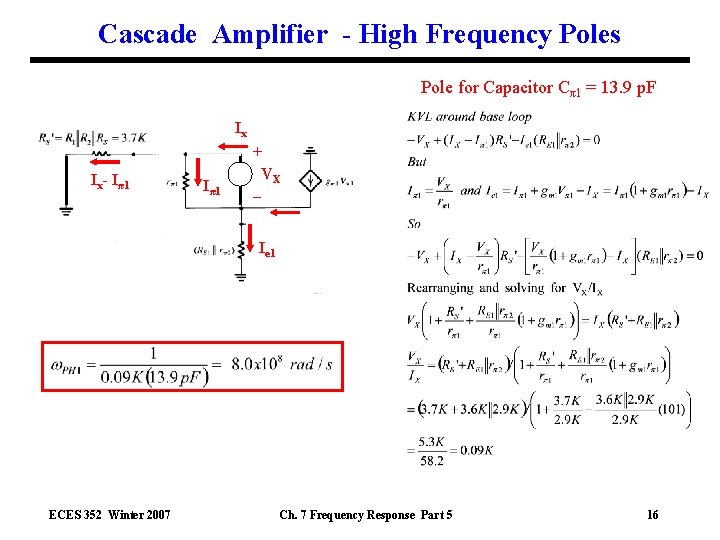
Cascade Amplifier - High Frequency Poles Pole for Capacitor Cπ1 = 13. 9 p. F Ix Ix- Iπ1 + VX _ Ie 1 ECES 352 Winter 2007 Ch. 7 Frequency Response Part 5 16
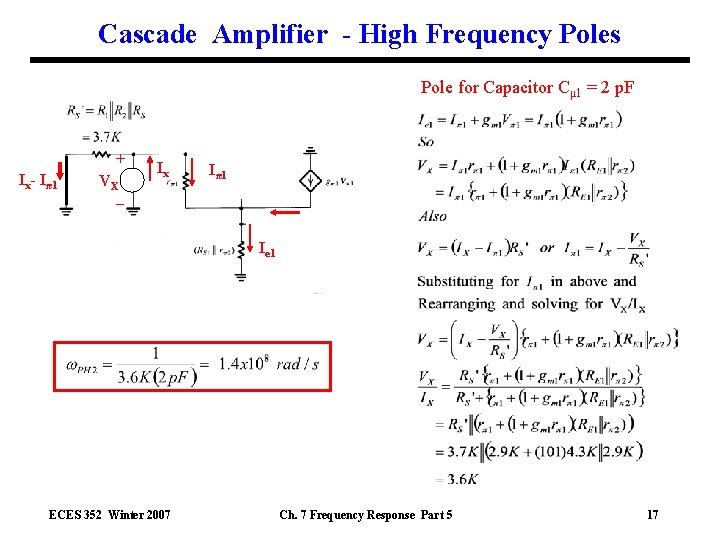
Cascade Amplifier - High Frequency Poles Pole for Capacitor Cμ 1 = 2 p. F + Ix- Iπ1 VX _ Ix Iπ1 Ie 1 ECES 352 Winter 2007 Ch. 7 Frequency Response Part 5 17
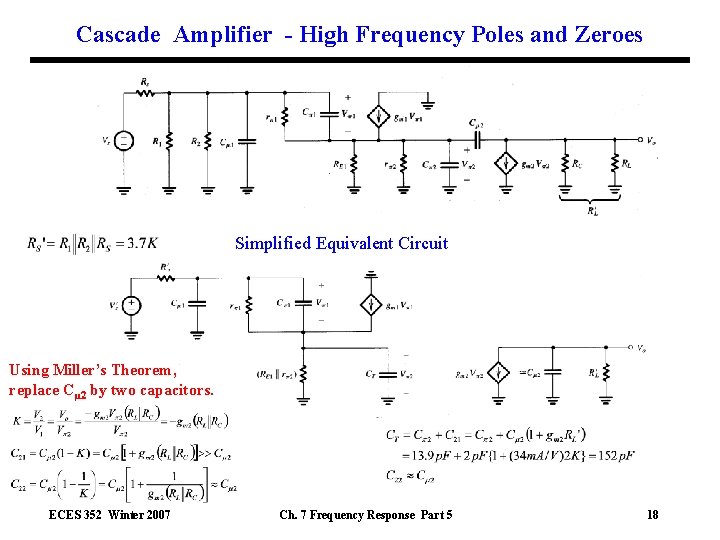
Cascade Amplifier - High Frequency Poles and Zeroes Simplified Equivalent Circuit Using Miller’s Theorem, replace Cμ 2 by two capacitors. ECES 352 Winter 2007 Ch. 7 Frequency Response Part 5 18
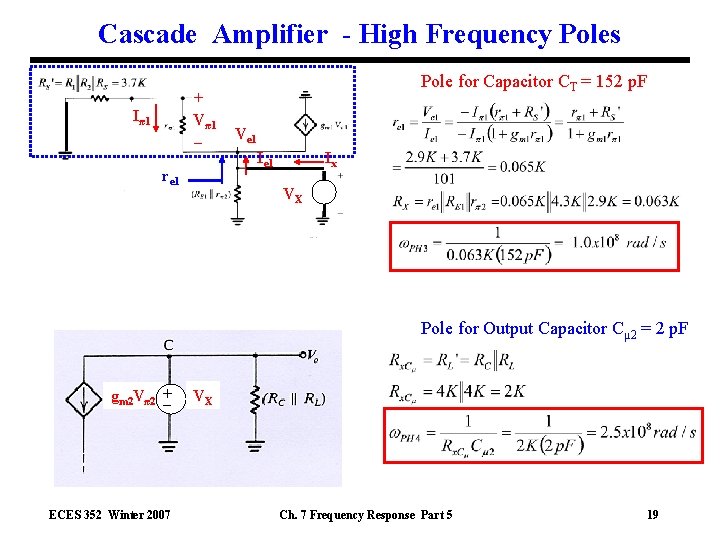
Cascade Amplifier - High Frequency Poles + Vπ1 _ Iπ1 Pole for Capacitor CT = 152 p. F Ve 1 Ie 1 re 1 Ix VX Pole for Output Capacitor Cμ 2 = 2 p. F gm 2 Vπ2 + _ ECES 352 Winter 2007 VX Ch. 7 Frequency Response Part 5 19
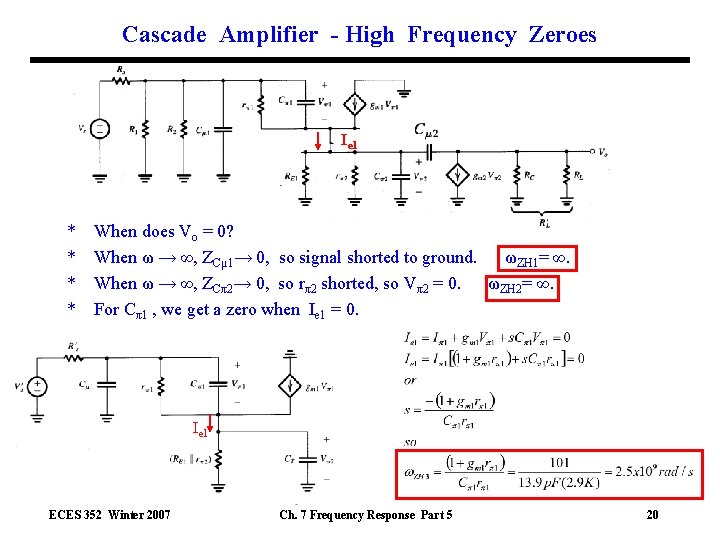
Cascade Amplifier - High Frequency Zeroes Ie 1 * * When does Vo = 0? When ω → ∞, ZCμ 1→ 0, so signal shorted to ground. ωZH 1= ∞. When ω → ∞, ZCπ2→ 0, so rπ2 shorted, so Vπ2 = 0. ωZH 2= ∞. For Cπ1 , we get a zero when Ie 1 = 0. Ie 1 ECES 352 Winter 2007 Ch. 7 Frequency Response Part 5 20
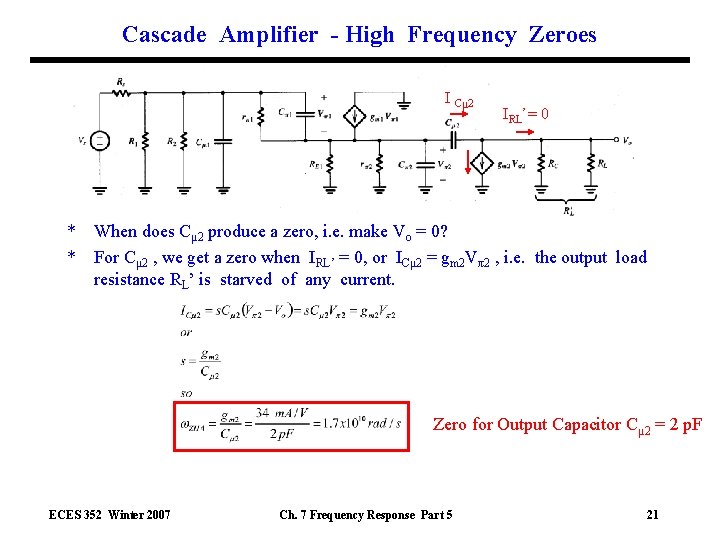
Cascade Amplifier - High Frequency Zeroes I Cμ 2 IRL’= 0 * When does Cμ 2 produce a zero, i. e. make Vo = 0? * For Cμ 2 , we get a zero when IRL’ = 0, or ICμ 2 = gm 2 Vπ2 , i. e. the output load resistance RL’ is starved of any current. Zero for Output Capacitor Cμ 2 = 2 p. F ECES 352 Winter 2007 Ch. 7 Frequency Response Part 5 21
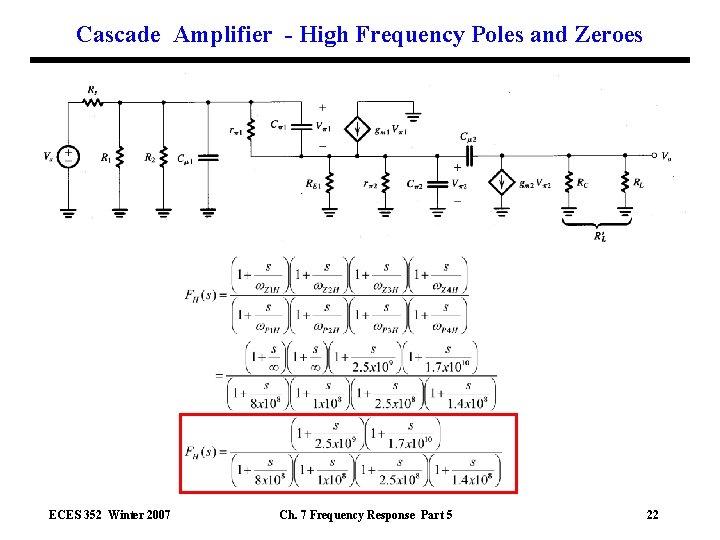
Cascade Amplifier - High Frequency Poles and Zeroes ECES 352 Winter 2007 Ch. 7 Frequency Response Part 5 22
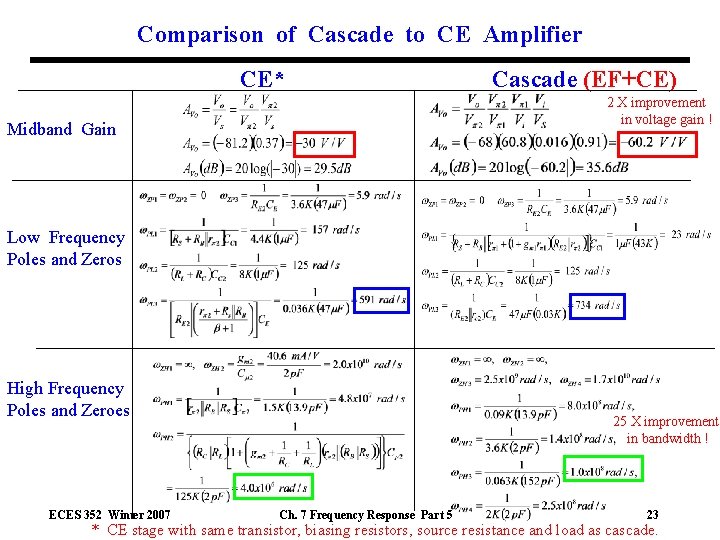
Comparison of Cascade to CE Amplifier CE* Cascade (EF+CE) 2 X improvement in voltage gain ! Midband Gain Low Frequency Poles and Zeros High Frequency Poles and Zeroes ECES 352 Winter 2007 25 X improvement in bandwidth ! Ch. 7 Frequency Response Part 5 23 * CE stage with same transistor, biasing resistors, source resistance and load as cascade.
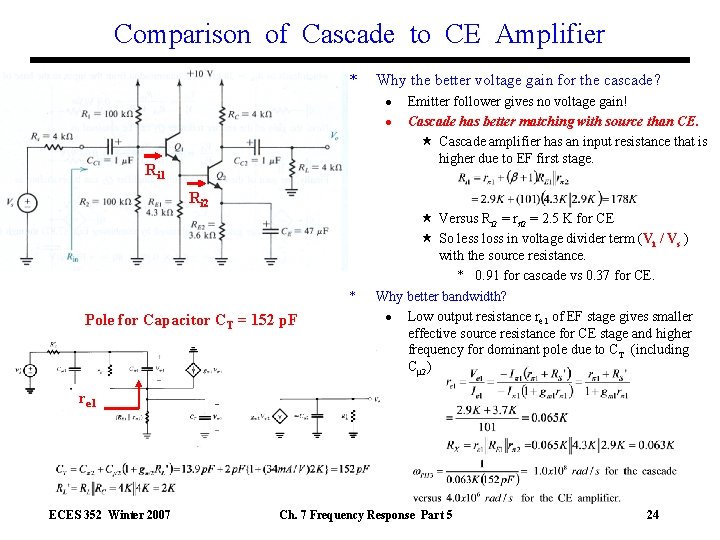
Comparison of Cascade to CE Amplifier * Why the better voltage gain for the cascade? ● ● Ri 1 Emitter follower gives no voltage gain! Cascade has better matching with source than CE. « Cascade amplifier has an input resistance that is higher due to EF first stage. Ri 2 * Pole for Capacitor CT = 152 p. F « Versus Ri 2 = rπ2 = 2. 5 K for CE « So less loss in voltage divider term (Vi / Vs ) with the source resistance. * 0. 91 for cascade vs 0. 37 for CE. Why better bandwidth? ● Low output resistance re 1 of EF stage gives smaller effective source resistance for CE stage and higher frequency for dominant pole due to CT (including Cμ 2) re 1 ECES 352 Winter 2007 Ch. 7 Frequency Response Part 5 24
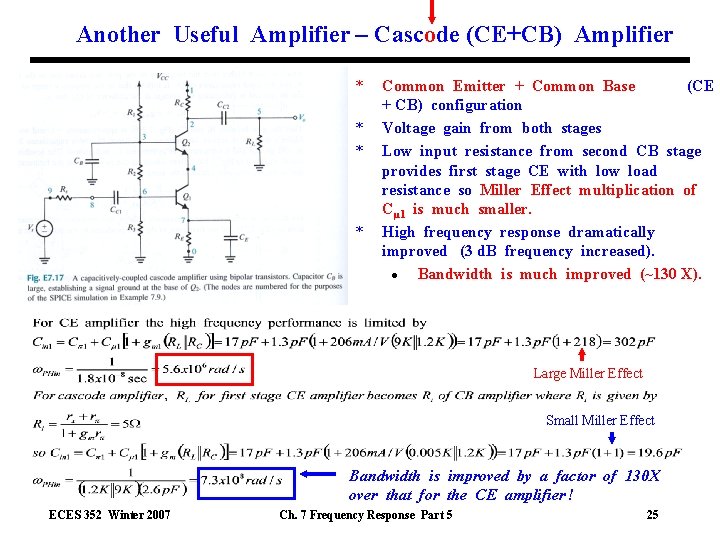
Another Useful Amplifier – Cascode (CE+CB) Amplifier * * Common Emitter + Common Base (CE + CB) configuration Voltage gain from both stages Low input resistance from second CB stage provides first stage CE with low load resistance so Miller Effect multiplication of Cμ 1 is much smaller. High frequency response dramatically improved (3 d. B frequency increased). ● Bandwidth is much improved (~130 X). Large Miller Effect Small Miller Effect Bandwidth is improved by a factor of 130 X over that for the CE amplifier ! ECES 352 Winter 2007 Ch. 7 Frequency Response Part 5 25
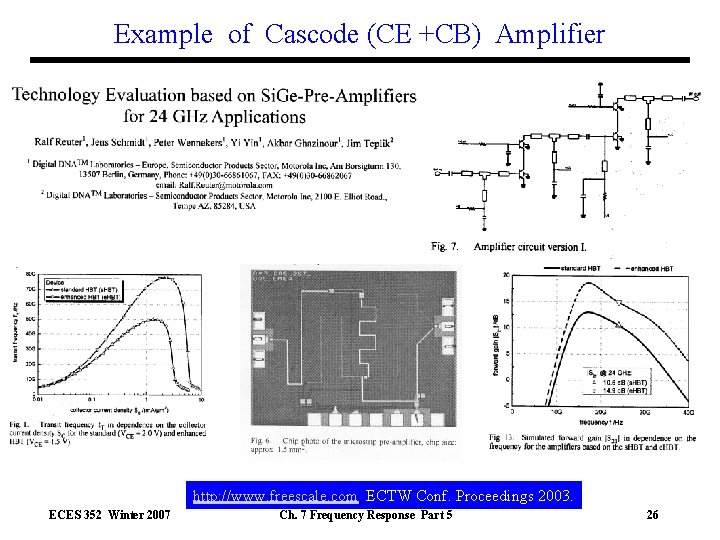
Example of Cascode (CE +CB) Amplifier http: //www. freescale. com ECTW Conf. Proceedings 2003. ECES 352 Winter 2007 Ch. 7 Frequency Response Part 5 26
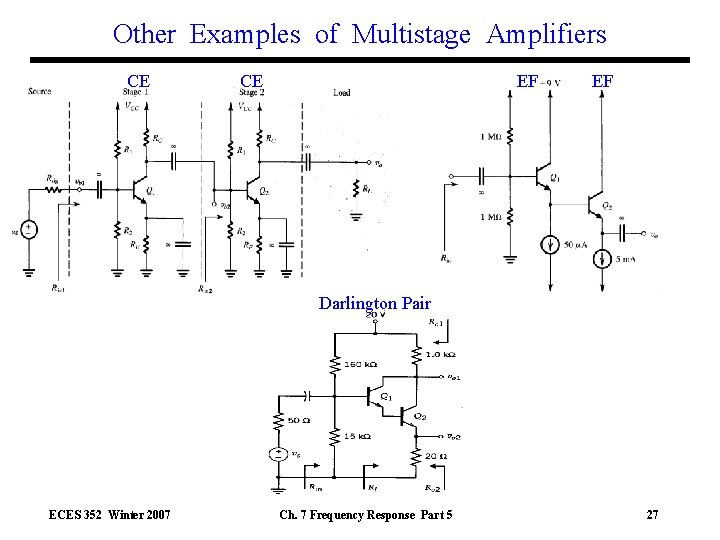
Other Examples of Multistage Amplifiers CE CE EF EF Darlington Pair ECES 352 Winter 2007 Ch. 7 Frequency Response Part 5 27
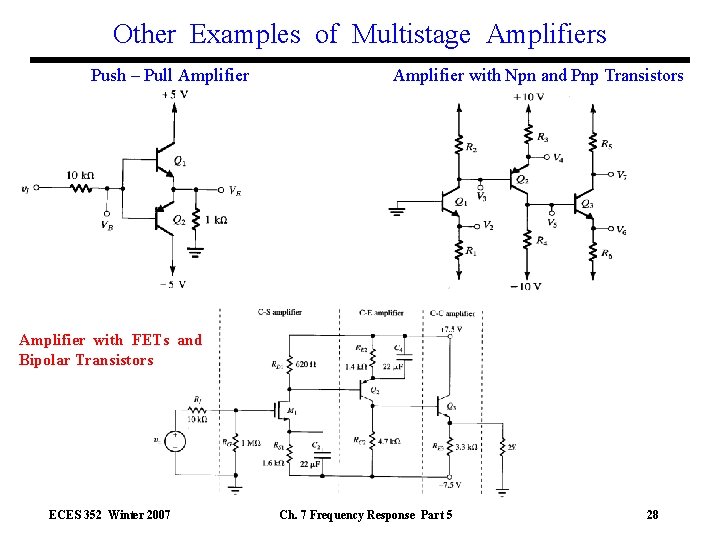
Other Examples of Multistage Amplifiers Push – Pull Amplifier with Npn and Pnp Transistors Amplifier with FETs and Bipolar Transistors ECES 352 Winter 2007 Ch. 7 Frequency Response Part 5 28
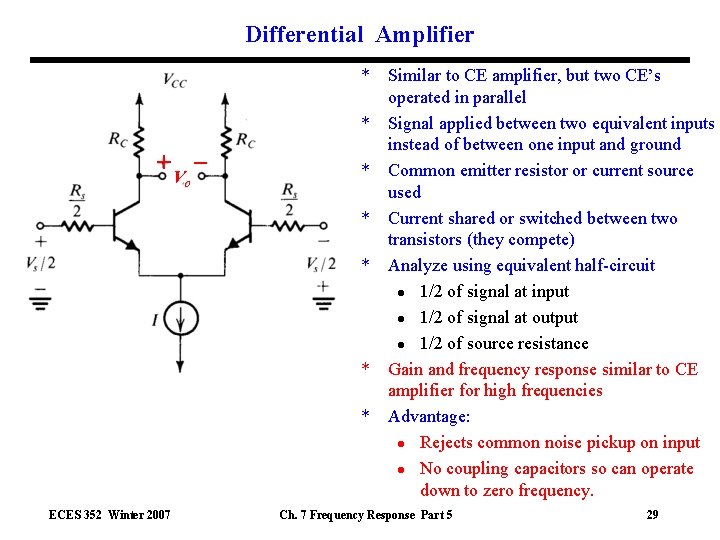
Differential Amplifier +V ECES 352 Winter 2007 _ o * Similar to CE amplifier, but two CE’s operated in parallel * Signal applied between two equivalent inputs instead of between one input and ground * Common emitter resistor or current source used * Current shared or switched between two transistors (they compete) * Analyze using equivalent half-circuit ● 1/2 of signal at input ● 1/2 of signal at output ● 1/2 of source resistance * Gain and frequency response similar to CE amplifier for high frequencies * Advantage: ● Rejects common noise pickup on input ● No coupling capacitors so can operate down to zero frequency. Ch. 7 Frequency Response Part 5 29
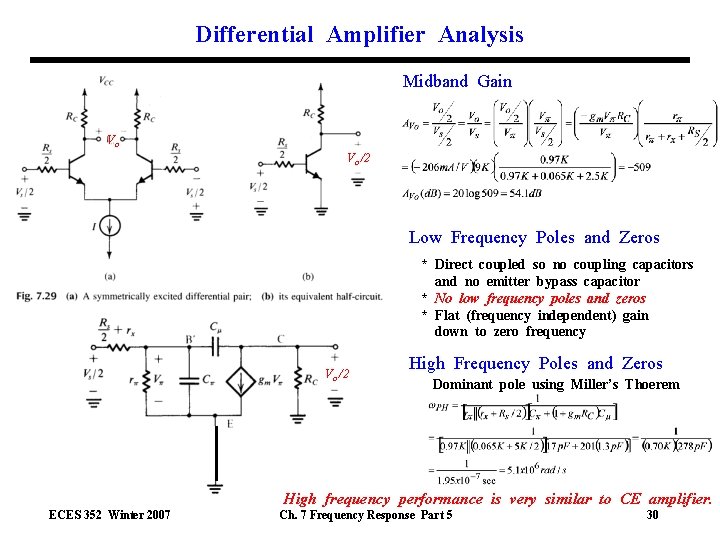
Differential Amplifier Analysis Midband Gain Vo Vo /2 Low Frequency Poles and Zeros * Direct coupled so no coupling capacitors and no emitter bypass capacitor * No low frequency poles and zeros * Flat (frequency independent) gain down to zero frequency Vo /2 High Frequency Poles and Zeros Dominant pole using Miller’s Thoerem High frequency performance is very similar to CE amplifier. ECES 352 Winter 2007 Ch. 7 Frequency Response Part 5 30
Summary * In this chapter we have shown how to analyze the high and low frequency dependence of the gain for an amplifier. ● Analyzed the effects of the coupling capacitors on the low frequency response « Found the expressions for the corresponding poles and zeros. « Demonstrated Bode plots of magnitude and phase. ● Analyzed the effects of the capacitances within the transistor on the high frequency response. « Found the expressions for the corresponding poles and zeros. « Demonstrated Bode plots of the magnitude and phase. * Analyzed the high and low frequency performance of the three bipolar transistor amplifiers: common emitter, common base and emitter follower. ● Found the expressions for the corresponding poles and zeros. ● Demonstrated Bode plots of the magnitude and phase. * Demonstrated how to find the expressions for the gain and the high and low frequency poles and zeros for multistage amplifiers. ECES 352 Winter 2007 Ch. 7 Frequency Response Part 5 31
- Slides: 31