
Comparison of a GratitudeBased and a Cognitive Restructuring
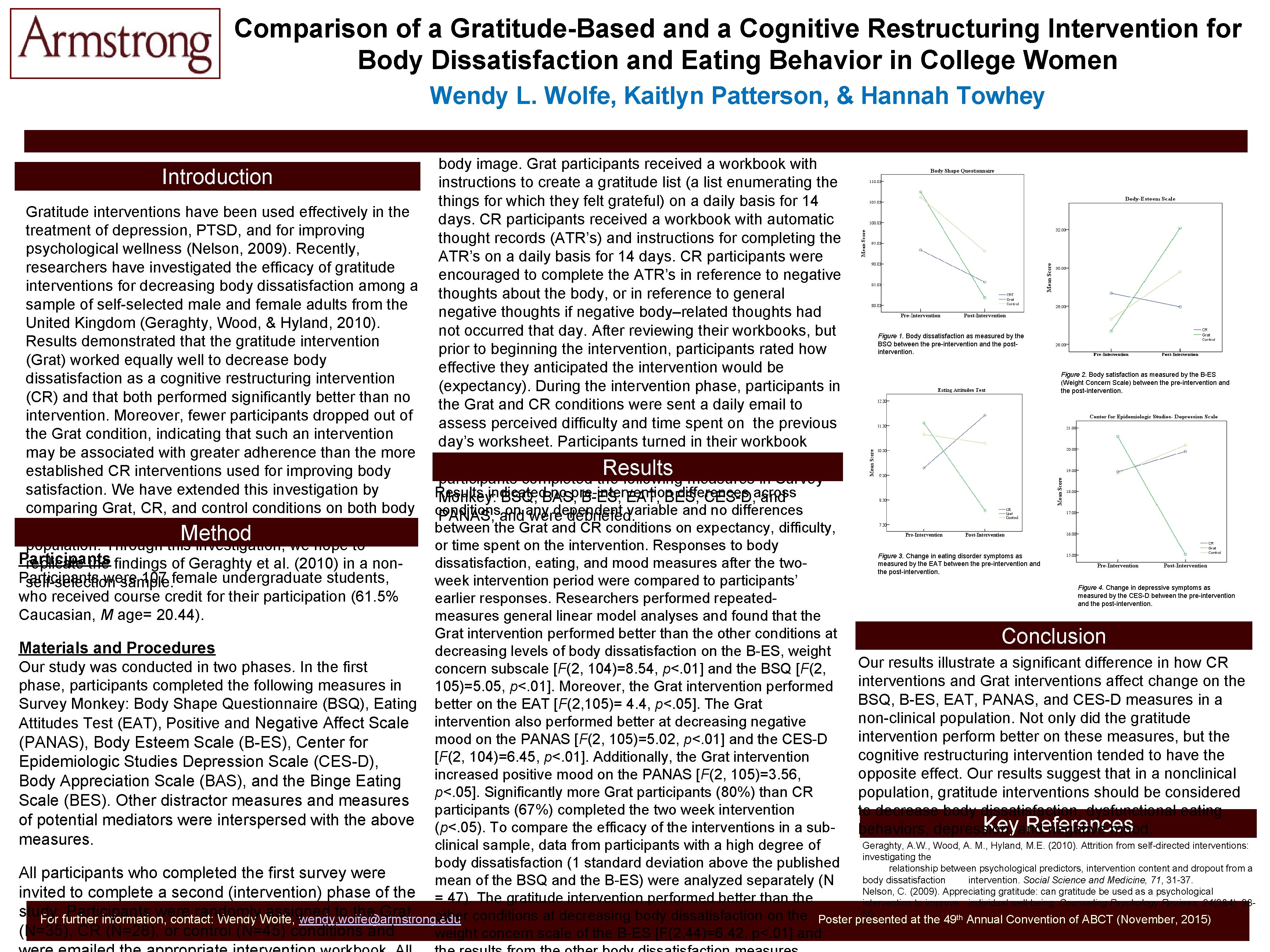
Comparison of a Gratitude-Based and a Cognitive Restructuring Intervention for Body Dissatisfaction and Eating Behavior in College Women Wendy L. Wolfe, Kaitlyn Patterson, & Hannah Towhey body image. Grat participants received a workbook with Introduction instructions to create a gratitude list (a list enumerating the things for which they felt grateful) on a daily basis for 14 Gratitude interventions have been used effectively in the days. CR participants received a workbook with automatic treatment of depression, PTSD, and for improving thought records (ATR’s) and instructions for completing the psychological wellness (Nelson, 2009). Recently, ATR’s on a daily basis for 14 days. CR participants were researchers have investigated the efficacy of gratitude encouraged to complete the ATR’s in reference to negative interventions for decreasing body dissatisfaction among a thoughts about the body, or in reference to general sample of self-selected male and female adults from the negative thoughts if negative body–related thoughts had United Kingdom (Geraghty, Wood, & Hyland, 2010). not occurred that day. After reviewing their workbooks, but Figure 1. Body dissatisfaction as measured by the BSQ between the pre-intervention and the post. Results demonstrated that the gratitude intervention prior to beginning the intervention, participants rated how intervention. (Grat) worked equally well to decrease body effective they anticipated the intervention would be Figure 2. Body satisfaction as measured by the B-ES dissatisfaction as a cognitive restructuring intervention (Weight Concern Scale) between the pre-intervention and (expectancy). During the intervention phase, participants in the post-intervention. (CR) and that both performed significantly better than no the Grat and CR conditions were sent a daily email to intervention. Moreover, fewer participants dropped out of assess perceived difficulty and time spent on the previous the Grat condition, indicating that such an intervention day’s worksheet. Participants turned in their workbook may be associated with greater adherence than the more pages at the end of each week. At the end of the 14 days, Results established CR interventions used for improving body participants completed the following measures in Survey satisfaction. We have extended this investigation by Results indicated no pre-intervention differences Monkey: BSQ, BAS, B-ES, EAT, BES, CES-D, across and comparing Grat, CR, and control conditions on both body conditions on any dependent variable and no differences PANAS, and were debriefed. dissatisfaction and eating behaviors in a college female between the Grat and CR conditions on expectancy, difficulty, Method population. Through this investigation, we hope to or time spent on the intervention. Responses to body Figure 3. Change in eating disorder symptoms as Participants measured by the EAT between the pre-intervention and dissatisfaction, eating, and mood measures after the tworeplicate the findings of Geraghty et al. (2010) in a nonthe post-intervention. Participants were 107 female undergraduate students, week intervention period were compared to participants’ self-selection sample. Figure 4. Change in depressive symptoms as measured by the CES-D between the pre-intervention who received course credit for their participation (61. 5% earlier responses. Researchers performed repeatedand the post-intervention. Caucasian, M age= 20. 44). measures general linear model analyses and found that the Grat intervention performed better than the other conditions at Conclusion Materials and Procedures decreasing levels of body dissatisfaction on the B-ES, weight Our results illustrate a significant difference in how CR Our study was conducted in two phases. In the first concern subscale [F(2, 104)=8. 54, p<. 01] and the BSQ [F(2, interventions and Grat interventions affect change on the phase, participants completed the following measures in 105)=5. 05, p<. 01]. Moreover, the Grat intervention performed BSQ, B-ES, EAT, PANAS, and CES-D measures in a Survey Monkey: Body Shape Questionnaire (BSQ), Eating better on the EAT [F(2, 105)= 4. 4, p<. 05]. The Grat non-clinical population. Not only did the gratitude intervention also performed better at decreasing negative Attitudes Test (EAT), Positive and Negative Affect Scale intervention perform better on these measures, but the mood on the PANAS [F(2, 105)=5. 02, p<. 01] and the CES-D (PANAS), Body Esteem Scale (B-ES), Center for cognitive restructuring intervention tended to have the [F(2, 104)=6. 45, p<. 01]. Additionally, the Grat intervention Epidemiologic Studies Depression Scale (CES-D), opposite effect. Our results suggest that in a nonclinical increased positive mood on the PANAS [F(2, 105)=3. 56, Body Appreciation Scale (BAS), and the Binge Eating p<. 05]. Significantly more Grat participants (80%) than CR population, gratitude interventions should be considered Scale (BES). Other distractor measures and measures participants (67%) completed the two week intervention to decrease body dissatisfaction, dysfunctional eating of potential mediators were interspersed with the above (p<. 05). To compare the efficacy of the interventions in a sub. Keyand References behaviors, depression, negative mood. measures. clinical sample, data from participants with a high degree of Geraghty, A. W. , Wood, A. M. , Hyland, M. E. (2010). Attrition from self-directed interventions: investigating the body dissatisfaction (1 standard deviation above the published relationship between psychological predictors, intervention content and dropout from a All participants who completed the first survey were body dissatisfaction intervention. Social Science and Medicine, 71, 31 -37. mean of the BSQ and the B-ES) were analyzed separately (N Nelson, C. (2009). Appreciating gratitude: can gratitude be used as a psychological invited to complete a second (intervention) phase of the = 47). The gratitude intervention performed better than the intervention to improve individual well-being. Counseling Psychology Reviews, 24(3&4), 38 study. Participants were randomly assigned to the Grat 50. other conditions at decreasing body dissatisfaction on the For further information, contact: Wendy Wolfe, wendy. wolfe@armstrong. edu Poster presented at the 49 th Annual Convention of ABCT (November, 2015) (N=35), CR (N=28), or control (N=45) conditions and weight concern scale of the B-ES [F(2, 44)=6. 42, p<. 01] and
- Slides: 1