
COMPARISON BETWEEN STUDENTS WITH AND WITHOUT LEARNING DISABILITIES
COMPARISON BETWEEN STUDENTS WITH AND WITHOUT LEARNING DISABILITIES IN ELABORATING AND COMPREHENDING POEMS M. Voulgaraki & I. Agaliotis University of Macedonia, Thessaloniki, GREECE marigakivou@gmail. com, iagal@uom. gr

INTRODUCTION
Poetry as a medium for the promotion of literacy skills Reading poetry can contribute to the enhancement of: • • • phonological awareness, vocabulary, decoding, comprehension, and writing (Cunningham & Allington, 2002), conceptual understanding and students’ attention during reading (Sekeres & Gregg, 2007), understanding the characters, the story, and the narrative point of view (Kucan, 2007).
Poetry as a medium for the promotion of psychosocial skills Τhere is evidence that poem reading and writing improves motivation and student confidence (Wilfong, 2008).
Poetry and Learning Disabilities I Students with Learning Disabilities (LD) usually have restricted literacy skills (Lerner & Beverley, 2014). Due to these restrictions students with LD may be unable to access poems and profit from dealing with them.
Poetry and Learning Disabilities II In one of the very few studies on possible differences between students with LD and their typical peers in comprehending poems, Lee and Hughes (2012) established that students with LD have increased difficulties in: understanding an extended metaphor, moving beyond the surface meaning of the poems, placing due emphasis on understood rather than on evoked emotions in their poetic processing.
Poetry and Learning Disabilities III On the other hand Lee and Hughes (2012) found that students with LD: effectively used as many interpretive operations as their peers, adopted an aesthetic stance to reading, performed more like experts than novices and even outperformed slightly their typical peers in identifying figurative devices (e. g. personification).
Research questions Small samples and lack of inferential statistics limit drastically the generalizability of results from existing studies. Hence, the present research sought to answer the following questions: What are the differences between students with LD and their typical peers in comprehending poems? What are the differences between students with LD and their typical peers in the knowledge of poetic devices? What are the differences between students with LD and their typical peers in the strategies for accessing poems’ content?

METHODOLOGY
Participants I 80 students of the 5 th and 6 th grades (11 -12 years of age) of 13 primary schools situated in the wider area of Thessaloniki, Greece. 40 of those students (50%) were diagnosed as presenting Learning Disability. Males: 52. 5% Females: 47. 5% (see Table 1)
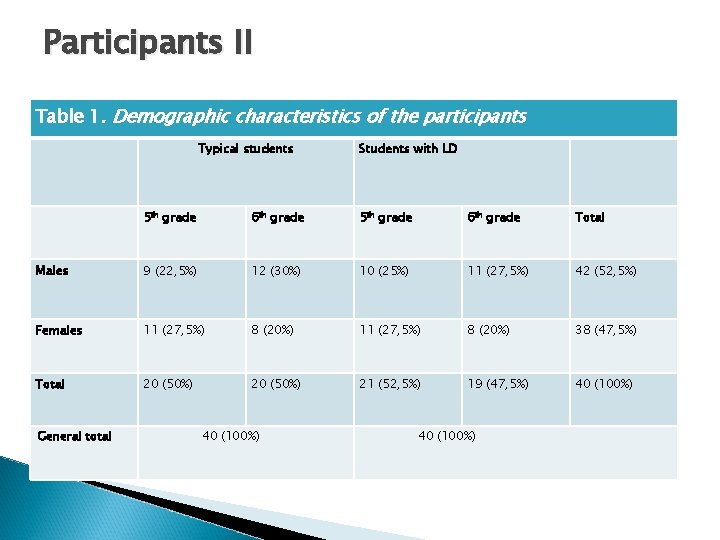
Participants II Table 1. Demographic characteristics of the participants Typical students Students with LD 5 th grade 6 th grade Total Males 9 (22, 5%) 12 (30%) 10 (25%) 11 (27, 5%) 42 (52, 5%) Females 11 (27, 5%) 8 (20%) 38 (47, 5%) Total 20 (50%) 21 (52, 5%) 19 (47, 5%) 40 (100%) General total 40 (100%)
Measures and procedures I Poems: One traditional (titled “The beach”, by N. Kampas, 1880) and one contemporary (titled “Meeting with the sea”, by N. Vrettakos, 1991). Both poems are referring to marine landscapes. They differ in terms of style and structure.
Measures and procedures II Questionnaire based on the instrument used by Lee and Hughes (2012) 28 items Questions referring to: § participants’ literature preferences and their relationship to poetry, § poem’s comprehension and interpretation, § representation of poem’s content and its relation to their personal experiences, § participants’ knowledge and understanding of poetic devices, § participants’ emotions and enjoyment.
Measures and procedures III A pilot study was used to improve the questionnaire’s functionality. The feedback given by 3 language arts teachers majored in literacy instruction was taken into consideration. The researchers randomly chose 10% of the participants’ answers and coded them. They asked 4 language arts teachers to evaluate the same answers. The inter-rater agreement reached the level of 91%.
Measures and procedures IV Two 20 -minutes sessions per student were allocated for the completion of the questionnaire. All proceedings were videotaped.

RESULTS
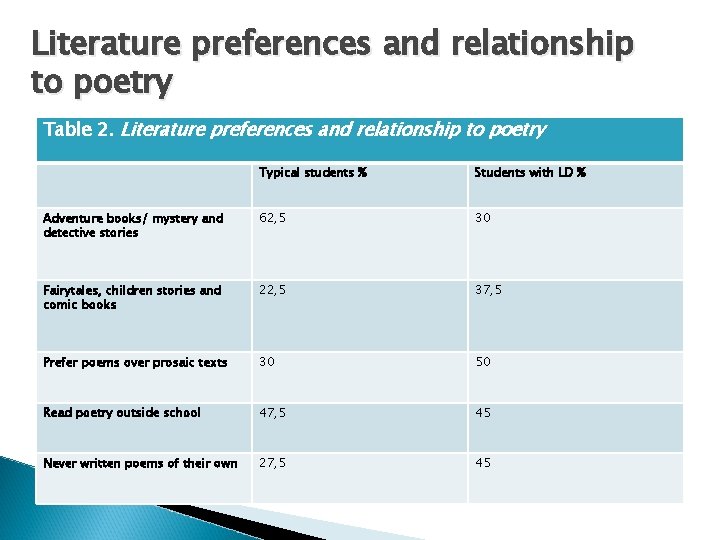
Literature preferences and relationship to poetry Table 2. Literature preferences and relationship to poetry Typical students % Students with LD % Adventure books/ mystery and detective stories 62, 5 30 Fairytales, children stories and comic books 22, 5 37, 5 Prefer poems over prosaic texts 30 50 Read poetry outside school 47, 5 45 Never written poems of their own 27, 5 45
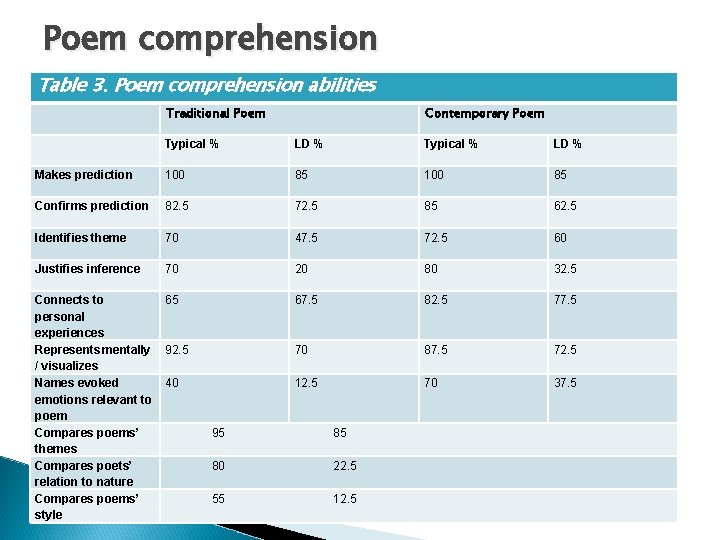
Poem comprehension Table 3. Poem comprehension abilities Traditional Poem Contemporary Poem Typical % LD % Makes prediction 100 85 Confirms prediction 82. 5 72. 5 85 62. 5 Identifies theme 70 47. 5 72. 5 60 Justifies inference 70 20 80 32. 5 Connects to personal experiences Represents mentally / visualizes Names evoked emotions relevant to poem Compares poems’ themes Compares poets’ relation to nature Compares poems’ style 65 67. 5 82. 5 77. 5 92. 5 70 87. 5 72. 5 40 12. 5 70 37. 5 95 85 80 22. 5 55 12. 5
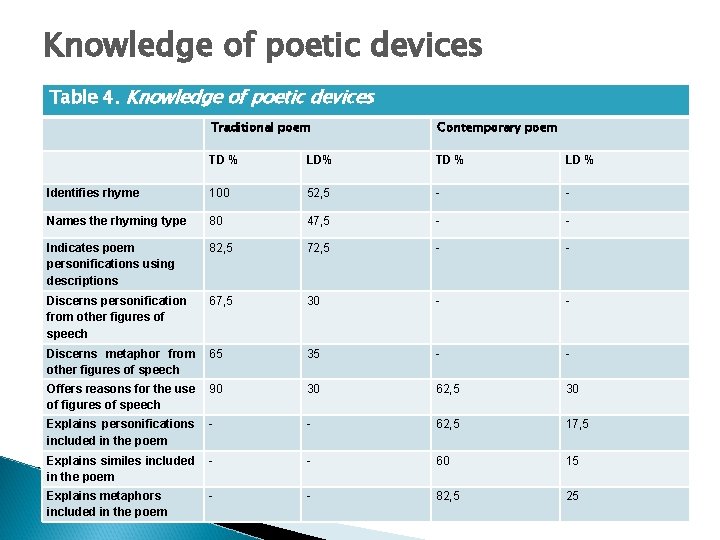
Knowledge of poetic devices Table 4. Knowledge of poetic devices Traditional poem Contemporary poem TD % LD% TD % LD % Identifies rhyme 100 52, 5 - - Names the rhyming type 80 47, 5 - - Indicates poem personifications using descriptions 82, 5 72, 5 - - Discerns personification from other figures of speech 67, 5 30 - - Discerns metaphor from other figures of speech 65 35 - - Offers reasons for the use of figures of speech 90 30 62, 5 30 Explains personifications included in the poem - - 62, 5 17, 5 Explains similes included in the poem - - 60 15 Explains metaphors included in the poem - - 82, 5 25
CONCLUSIONSDISCUSSION
Poem comprehension I Students with LD: Have difficulties in predicting the poem’s content based just on its title, even with the use of hints. This result is in tune with the view of Carliste and Rice (2002). In contrast, the difference between the two groups in confirming their predictions was rather small. This result is in line with the Lee and Hughes (2012).
Poem comprehension II The differences between typical and learning disabled students in the identification of the poems’ main idea and the justification of the inferences drawn by the poets, may be due to difficulties in: differentiation between the central and the peripheral information of the text, the appropriate vocabulary, knowledge of syntax and morphology, functional conceptual development, familiarization with text structures, focusing their attention, and memory skills (Porpodas, 2002; Swanson, Kehler, & Jerman, 2010).
Poem comprehension III In the present context the aforementioned processing weaknesses may have been seriously challenged by the conceptual density, the ellipticity and the abstraction characterizing the poetic genre.
Relationship between reader and poem I a) Relate the poems to their personal experiences: The high percentage of participants from both groups who could connect the poems to their personal experiences corroborates findings from the Sipe (2000) study.
Relationship between reader and poem II (b) Mentally represent and describe images from the poems: The difficulty of students with LD to refer to mental pictures of the landscapes could be due to the restrictions often found in this population in shortand long- term memory, vocabulary, transformation of information coming from one sensory source to a form corresponding to another, and oral language (Cain & Oakhill, 1999).
Relationship between reader and poem III (c) Mention emotions evoked after reading / listening the poem: The quantitative and qualitative differences between typical and learning disabled students could be attributed to weaknesses in self – awareness, vocabulary, and especially empathy, reported to have been found in the population of students with LD (e. g. Bauminger, Edelsztein, & Morash, 2005).
Ability to understand poets’ relation to nature and poems’ style The well-established deficiencies of the LD population in identifying, organizing and retaining important information, vocabulary, syntax, and sentence structure, combining information in order to draw conclusions (e. g. Lerner & Beverley, 2014) may serve as context for explaining these difficulties.
Knowledge and identification of poetic devices I Students with LD have significantly more difficulties than their typical peers in identifying rhyme. This deficiency could be connected to the poor phonological skills often characterizing students with LD (Vellutino, 1991; Stanovich, 1992).
Knowledge and identification of poetic devices II Students with LD have considerable difficulties in interpreting metaphors and explaining similes and personifications. This is in line with findings from the studies conducted by Nippold & Fey (1983), Seidenberg & Bernstein (1986), and Lee & Kamhi (1990).
Use of hints Students with LD: required on average 25. 5% more hints than their typical peers in order to provide correct answers. This testifies their inferiority in recalling information in comparison to their typical peers. However, it also denotes that oftentimes students with LD possess knowledge that can be retrieved and used to improve their performance, provided that the appropriate questioning technique is utilized.
Limitations of the study No differentiation of possible sub-groups in the population of students with LD. No data on the participants’ opportunities to be exposed to literature experiences in their family context.
Proposals I Instruction should be oriented toward the improvement of: vocabulary, syntactic schemes’ understanding, information organization and categorization, and inductive reasoning.
Proposals II Metaphors should become an independent objective in the context of instruction. Special emphasis should be laid on empathy issues and emotional expressions. Improvement of decoding ability: phonological awareness and grapheme – phoneme correspondence should be supported appropriately.
![REFERENCES [1] Cunningham, P. M. & Allington, R. L. (2002). Classrooms That Work: They](http://slidetodoc.com/presentation_image_h/758f268d558ae46d459de369fb233b7b/image-34.jpg "REFERENCES [1] Cunningham, P. M. & Allington, R. L. (2002). Classrooms That Work: They")
REFERENCES [1] Cunningham, P. M. & Allington, R. L. (2002). Classrooms That Work: They Can All Read and Write. NY: Pearson Education. [2] Sekeres, D. C. , & Gregg, M. (2007). Poetry in third grade: Getting started. The Reading Teacher, 60(5), 466 -475. [3] Kucan, L. (2007). “I” poems: Invitations for students to deepen literacy understanding. The Reading Teacher, 60(6), 518 -525. [4] Wilfong, L. G. (2008). Building Fluency, Word-Recognition Ability, and Confidence in Struggling Readers: The Poetry Academy. The Reading Teacher, 62(1), 4– 13. [5] Lerner, J. , & Beverley, J. (2014). Learning Disabilities and Related Disabilities: Strategies for Success. Stamford, CT: Cengage Learning. [6] Lee, G. G. & Hughes, M. T. (2012). The Interpretive Strategies Utilized by Elementary Students with and without Learning Disabilities in Comprehending Poems. International Electronic journal of Elementary Education, 4(3), 489 -506. [7] Kampas, N. (1880). In Politis, L. (1977). Poetry Anthology, Book 6 (pp. 14 -15). Athens: Dodoni. (in Greek) [8] Vrettakos, N. (1991). Meeting with the sea. Athens: Tria fylla. (in Greek)
![REFERENCES [9] Carlisle, J. F. & Rice, M. S. (2002). In S. Panteliadou &](http://slidetodoc.com/presentation_image_h/758f268d558ae46d459de369fb233b7b/image-35.jpg "REFERENCES [9] Carlisle, J. F. & Rice, M. S. (2002). In S. Panteliadou &")
REFERENCES [9] Carlisle, J. F. & Rice, M. S. (2002). In S. Panteliadou & G. Mpotsas (2007). Learning Difficulties: basic concepts and characteristics. Volos: Grafima. (in Greek) [10] Porpodas, K. (2002). Reading. Patras, GR: Author. (in Greek) [11] Swanson, H. L. , Kehler, P. , & Jerman, O. (2010). Working Memory, Strategy Knowledge, and Strategy Instruction in Children With Reading Disabilities. Journal of Learning Disabilities, 43(1), 24 -47. [12] Sipe, L. (2000). In G. G. Lee & M. T. Hughes (2012). The Interpretive Strategies Utilized by Elementary Students with and without Learning Disabilities in Comprehending Poems. International Electronic journal of Elementary Education, 4(3), 489 -506. [13] Cain, K. & Oakhill, J. V. (1999). Inference making ability and its relation to comprehension failure in young children. Reading and Writing: An Interdisciplinary, 11(6), 489 -503. [14] Bauminger, N. , Edelsztein, H. S. , & Morash, J. (2005). Social information processing and emotional understanding in children with LD. Journal of Learning Disabilities, 38, 45– 61.
![REFERENCES [15] Vellutino, F. R. (1991). Introduction to three studies on reading acquisition: Convergent](http://slidetodoc.com/presentation_image_h/758f268d558ae46d459de369fb233b7b/image-36.jpg "REFERENCES [15] Vellutino, F. R. (1991). Introduction to three studies on reading acquisition: Convergent")
REFERENCES [15] Vellutino, F. R. (1991). Introduction to three studies on reading acquisition: Convergent findings on theoretical foundations of codeoriented versus whole-language approaches to reading instruction. Journal of Educational Psychology, 83, 437– 443. [16] Stanovich, K. E. (1992). Speculation on the causes and consequences of individual differences in early reading acquisition. In P. Gough, L. Ehri, & R. Treiman (Eds. ), Reading Acquisition (pp. 307 -342). Hillsdale, NJ Laurence Erlbaum. [17] Nippold, M. , & Fey, S. (1983). In R. F. Lee & A. G. Kamhi (1990). Metaphoric competence in children with learning disabilities. Journal of Learning Disabilities, 23, 476 -482. [18] Seidenberg, P. , & Bernstein, D. (1986). In R. F. Lee & A. G. Kamhi (1990). Metaphoric competence in children with learning disabilities. Journal of Learning Disabilities, 23, 476 -482. [19] Lee, R. F. , & Kamhi, A. G. (1990). Metaphoric competence in children with learning disabilities. Journal of Learning Disabilities, 23, 476 -482.
- Slides: 36