
Comparison and validation of Aeolus winds to AIRS
- Slides: 13
Comparison and validation of Aeolus winds to AIRS 3 D winds, rawinsondes, and reanalyses David Santek, Brett Hoover, Hong Zhang University of Wisconsin-Madison Space Science and Engineering Center (SSEC) Cooperative Institute for Meteorological Satellite Studies (CIMSS) NOAA NA 15 NES 4320001 NASA ROSES 80 NSSC 18 K 0984 NOAA-NASA Working Group on Space-based Lidar Winds 2020 1
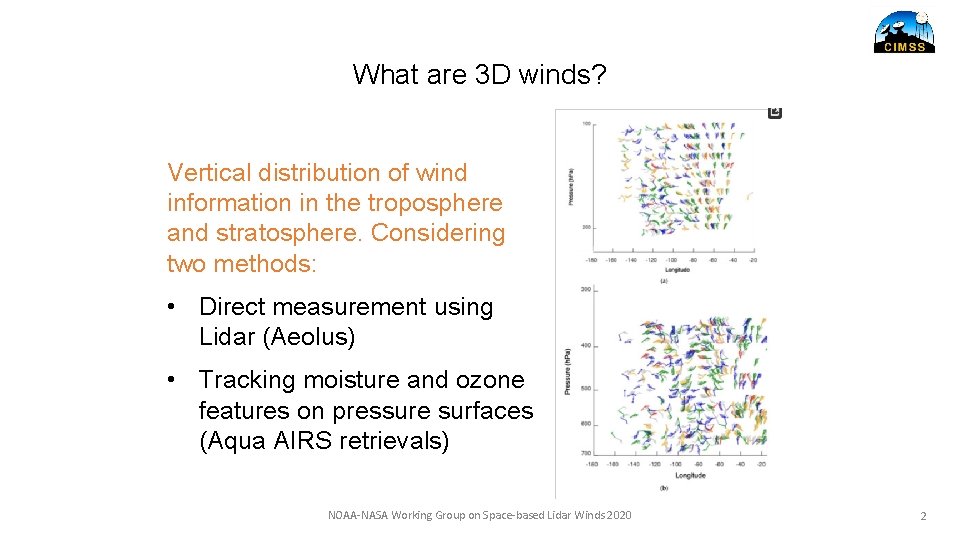
What are 3 D winds? Vertical distribution of wind information in the troposphere and stratosphere. Considering two methods: • Direct measurement using Lidar (Aeolus) • Tracking moisture and ozone features on pressure surfaces (Aqua AIRS retrievals) NOAA-NASA Working Group on Space-based Lidar Winds 2020 2
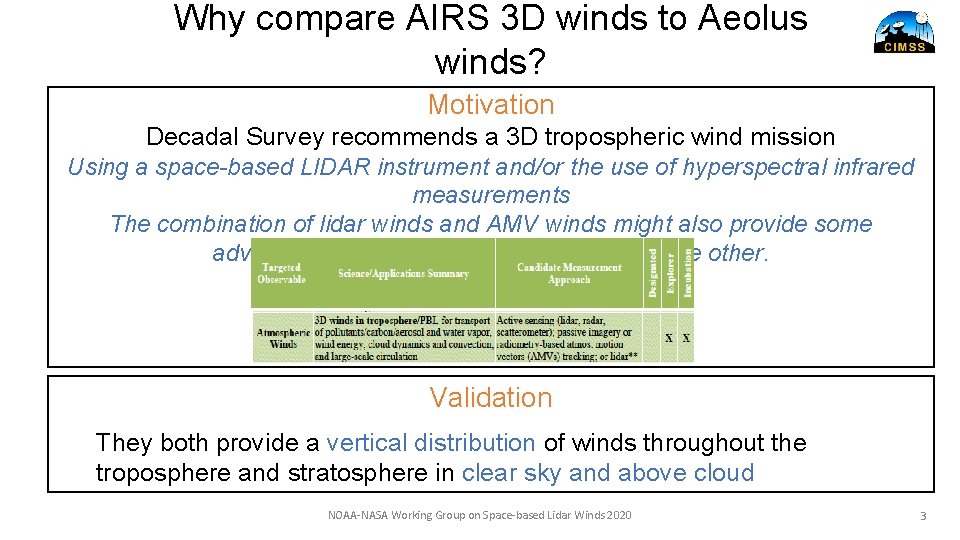
Why compare AIRS 3 D winds to Aeolus winds? Motivation Decadal Survey recommends a 3 D tropospheric wind mission Using a space-based LIDAR instrument and/or the use of hyperspectral infrared measurements The combination of lidar winds and AMV winds might also provide some advantages where one is used to calibrate the other. Validation They both provide a vertical distribution of winds throughout the troposphere and stratosphere in clear sky and above cloud NOAA-NASA Working Group on Space-based Lidar Winds 2020 3
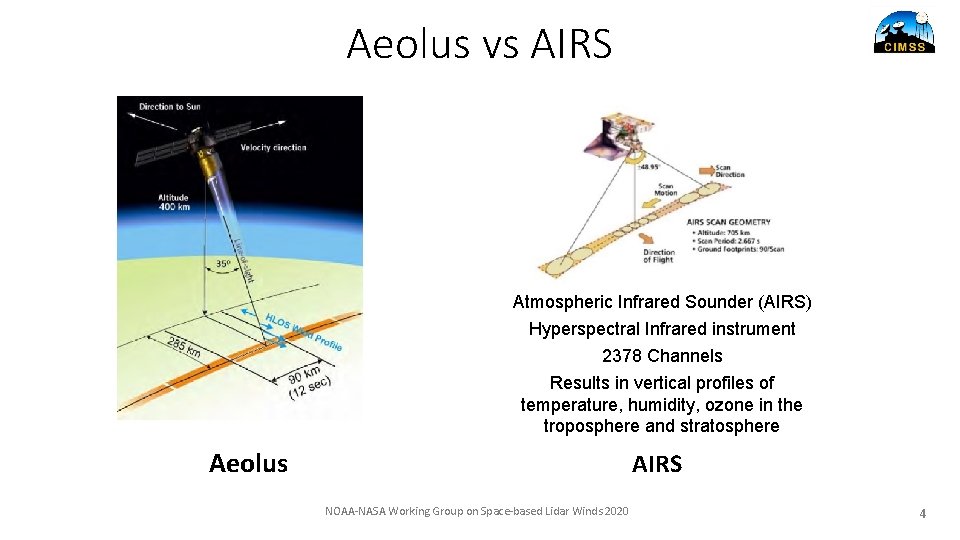
Aeolus vs AIRS Atmospheric Infrared Sounder (AIRS) Hyperspectral Infrared instrument 2378 Channels Results in vertical profiles of temperature, humidity, ozone in the troposphere and stratosphere Aeolus AIRS NOAA-NASA Working Group on Space-based Lidar Winds 2020 4
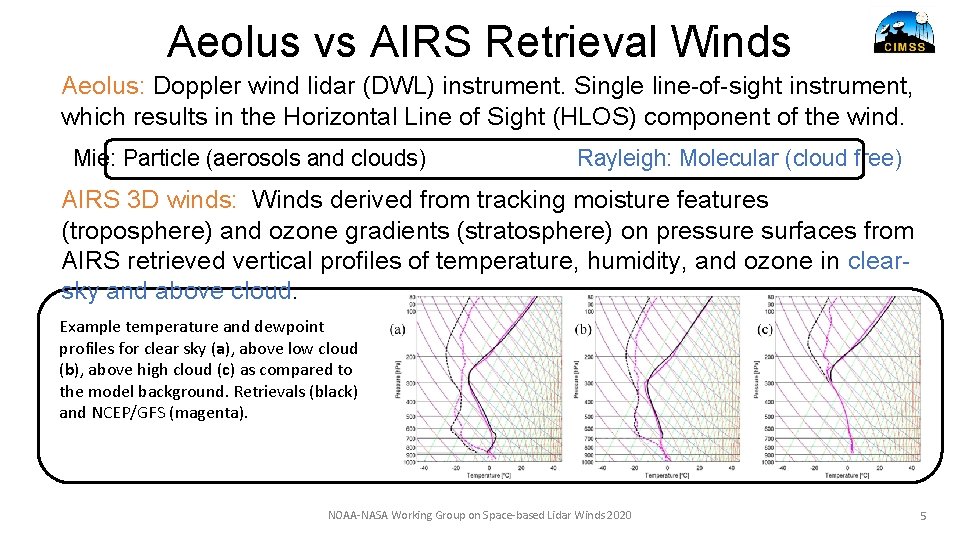
Aeolus vs AIRS Retrieval Winds Aeolus: Doppler wind lidar (DWL) instrument. Single line-of-sight instrument, which results in the Horizontal Line of Sight (HLOS) component of the wind. Mie: Particle (aerosols and clouds) Rayleigh: Molecular (cloud free) AIRS 3 D winds: Winds derived from tracking moisture features (troposphere) and ozone gradients (stratosphere) on pressure surfaces from AIRS retrieved vertical profiles of temperature, humidity, and ozone in clearsky and above cloud. Example temperature and dewpoint profiles for clear sky (a), above low cloud (b), above high cloud (c) as compared to the model background. Retrievals (black) and NCEP/GFS (magenta). NOAA-NASA Working Group on Space-based Lidar Winds 2020 5
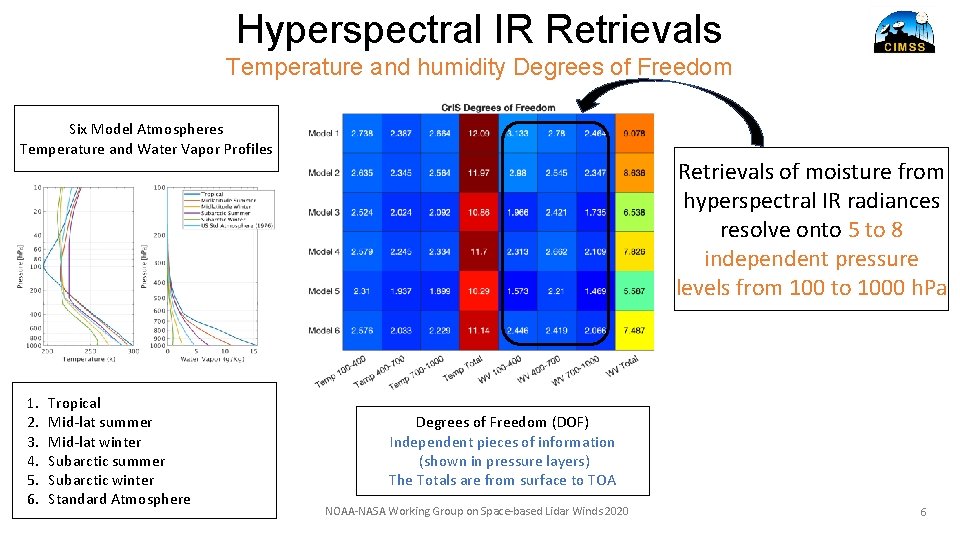
Hyperspectral IR Retrievals Temperature and humidity Degrees of Freedom Six Model Atmospheres Temperature and Water Vapor Profiles 1. 2. 3. 4. 5. 6. Tropical Mid-lat summer Mid-lat winter Subarctic summer Subarctic winter Standard Atmosphere Retrievals of moisture from hyperspectral IR radiances resolve onto 5 to 8 independent pressure levels from 100 to 1000 h. Pa Degrees of Freedom (DOF) Independent pieces of information (shown in pressure layers) The Totals are from surface to TOA NOAA-NASA Working Group on Space-based Lidar Winds 2020 6
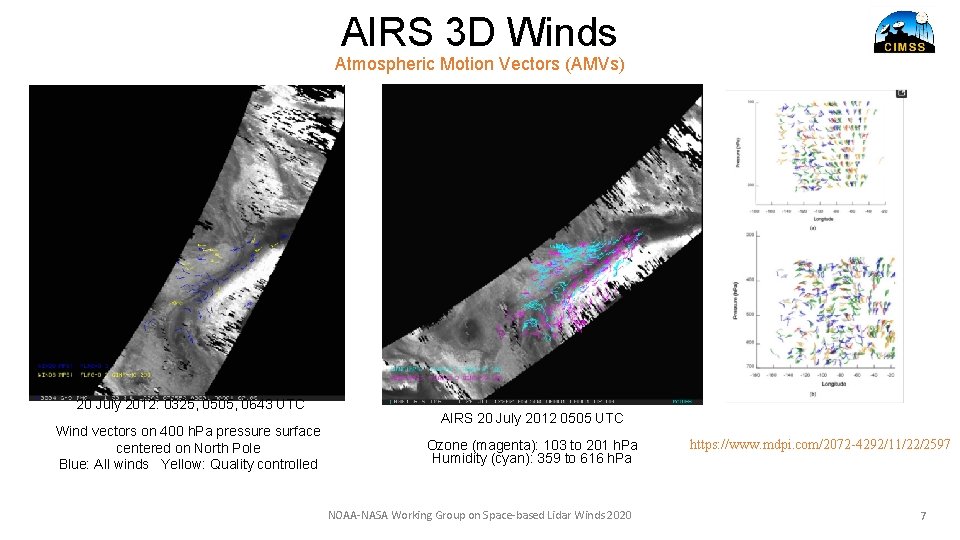
AIRS 3 D Winds Atmospheric Motion Vectors (AMVs) 20 July 2012: 0325, 0505, 0643 UTC Wind vectors on 400 h. Pa pressure surface centered on North Pole Blue: All winds Yellow: Quality controlled AIRS 20 July 2012 0505 UTC Ozone (magenta): 103 to 201 h. Pa Humidity (cyan): 359 to 616 h. Pa NOAA-NASA Working Group on Space-based Lidar Winds 2020 https: //www. mdpi. com/2072 -4292/11/22/2597 7
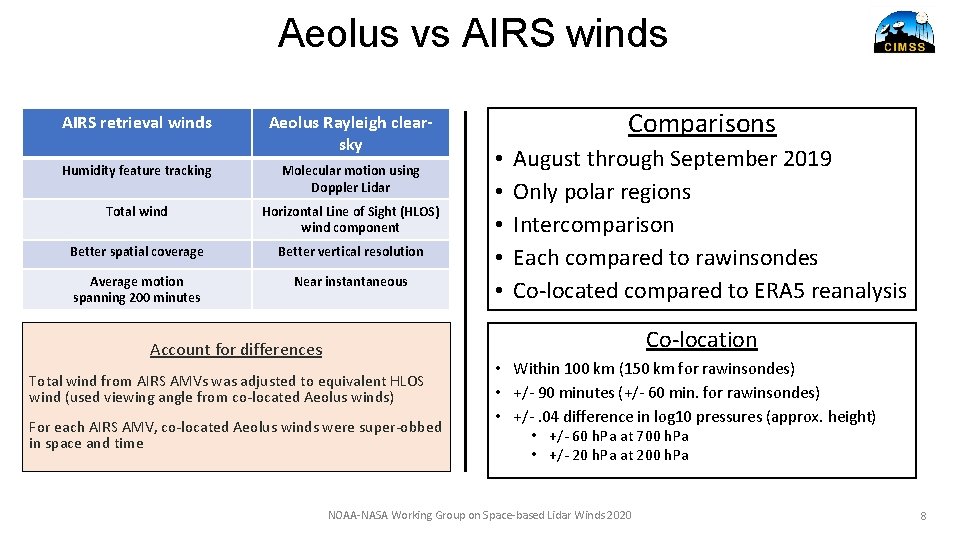
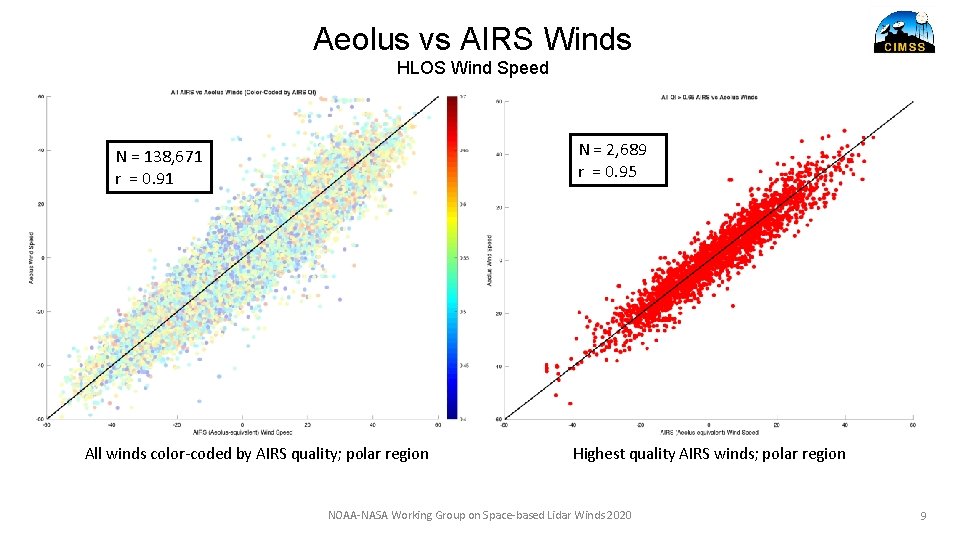
Aeolus vs AIRS winds AIRS retrieval winds Aeolus Rayleigh clearsky Humidity feature tracking Molecular motion using Doppler Lidar Total wind Horizontal Line of Sight (HLOS) wind component Better spatial coverage Better vertical resolution Average motion spanning 200 minutes Near instantaneous Comparisons • • • August through September 2019 Only polar regions Intercomparison Each compared to rawinsondes Co-located compared to ERA 5 reanalysis Co-location Account for differences Total wind from AIRS AMVs was adjusted to equivalent HLOS wind (used viewing angle from co-located Aeolus winds) For each AIRS AMV, co-located Aeolus winds were super-obbed in space and time • Within 100 km (150 km for rawinsondes) • +/- 90 minutes (+/- 60 min. for rawinsondes) • +/-. 04 difference in log 10 pressures (approx. height) • +/- 60 h. Pa at 700 h. Pa • +/- 20 h. Pa at 200 h. Pa NOAA-NASA Working Group on Space-based Lidar Winds 2020 8
Aeolus vs AIRS Winds HLOS Wind Speed N = 2, 689 r = 0. 95 N = 138, 671 r = 0. 91 All winds color-coded by AIRS quality; polar region Highest quality AIRS winds; polar region NOAA-NASA Working Group on Space-based Lidar Winds 2020 9
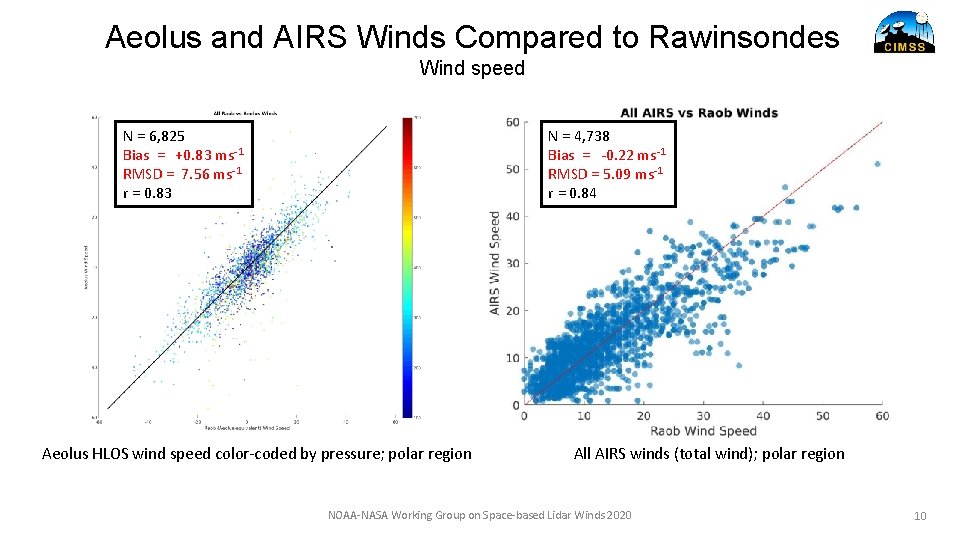
Aeolus and AIRS Winds Compared to Rawinsondes Wind speed N = 6, 825 Bias = +0. 83 ms-1 RMSD = 7. 56 ms-1 r = 0. 83 N = 4, 738 Bias = -0. 22 ms-1 RMSD = 5. 09 ms-1 r = 0. 84 Aeolus HLOS wind speed color-coded by pressure; polar region All AIRS winds (total wind); polar region NOAA-NASA Working Group on Space-based Lidar Winds 2020 10
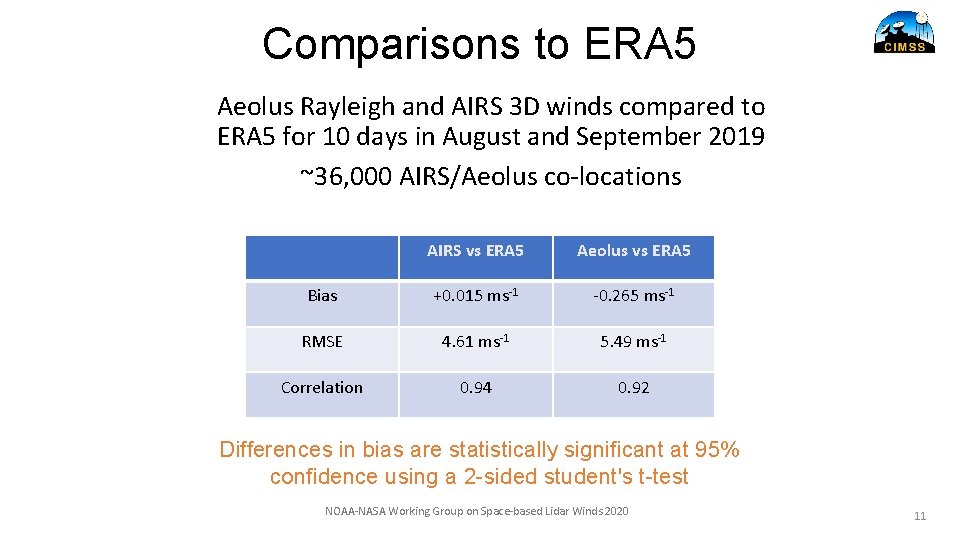
Comparisons to ERA 5 Aeolus Rayleigh and AIRS 3 D winds compared to ERA 5 for 10 days in August and September 2019 ~36, 000 AIRS/Aeolus co-locations AIRS vs ERA 5 Aeolus vs ERA 5 Bias +0. 015 ms-1 -0. 265 ms-1 RMSE 4. 61 ms-1 5. 49 ms-1 Correlation 0. 94 0. 92 Differences in bias are statistically significant at 95% confidence using a 2 -sided student's t-test NOAA-NASA Working Group on Space-based Lidar Winds 2020 11
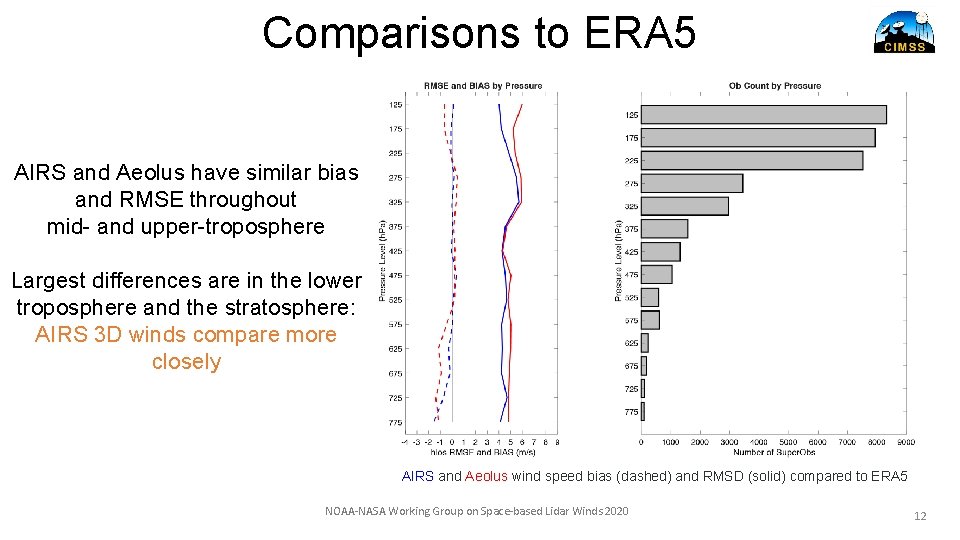
Comparisons to ERA 5 AIRS and Aeolus have similar bias and RMSE throughout mid- and upper-troposphere Largest differences are in the lower troposphere and the stratosphere: AIRS 3 D winds compare more closely AIRS and Aeolus wind speed bias (dashed) and RMSD (solid) compared to ERA 5 NOAA-NASA Working Group on Space-based Lidar Winds 2020 12
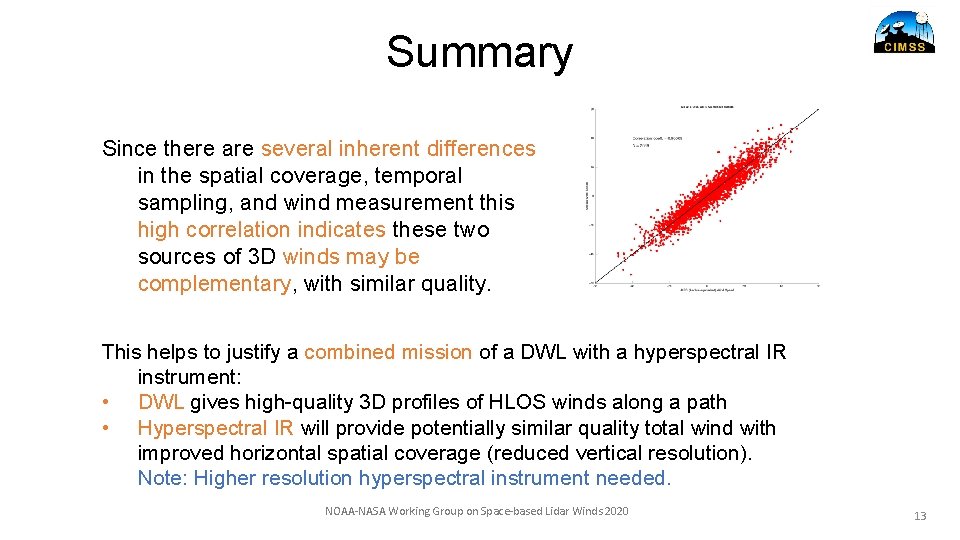
Summary Since there are several inherent differences in the spatial coverage, temporal sampling, and wind measurement this high correlation indicates these two sources of 3 D winds may be complementary, with similar quality. Aeolus vs AIRS HLOS-equivalent wind speed This helps to justify a combined mission of a DWL with a hyperspectral IR instrument: • DWL gives high-quality 3 D profiles of HLOS winds along a path • Hyperspectral IR will provide potentially similar quality total wind with improved horizontal spatial coverage (reduced vertical resolution). Note: Higher resolution hyperspectral instrument needed. NOAA-NASA Working Group on Space-based Lidar Winds 2020 13