
Comparison and Contrast Strategies for Rhetorical Analysis Basic

Comparison and Contrast Strategies for Rhetorical Analysis
Basic Structure for All Essays Introduction—Leads readers into essay, provides contexts, and so on. Often ends with thesis statement. Body—Presents as many paragraphs as necessary to fully support and develop thesis. Conclusion—Does not just repeat the introduction.

Rhetorical Analysis: Sample Chart Mc. Carthy Persona/Tone/ Narrator Genre, Subject/ Attitude (of Author) Language/ Style Target Audience Cisneros

Another Chart for Comparing/Contrasting Similarities Cisneros Mc. Carthy Differences
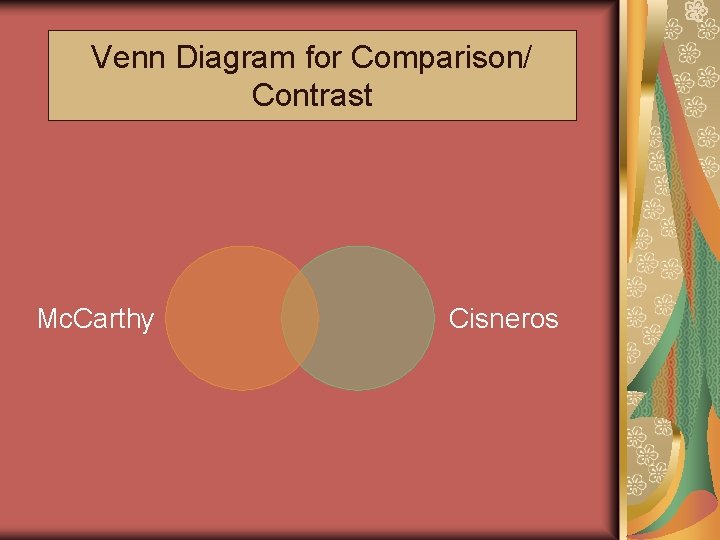
Venn Diagram for Comparison/ Contrast Mc. Carthy Cisneros
Mary Mc. Carthy Memories of a Catholic Girlhood White hair, glasses, soft skin, wrinkles, needlework—all the paraphernalia of motherliness were hers; yet it was a cold, grudging, disputatious old woman who sat all day in her sunroom making tapestries from a pattern, scanning religious periodicals, and setting her iron jaw against any infraction of her ways.
Mary Mc. Carthy (continued) Combativeness was, I suppose, the dominant trait in my grandmother’s nature. An aggressive churchgoer, she was quite without Christian feeling; the mercy of the Lord Jesus had never entered her heart. Her piety was an act of war against the Protestant ascendancy. The religious magazines on her table furnished her not with food for meditation but with fresh pretexts for anger; articles attacking birth control, divorce, mixed marriages, Darwin and secular education were her favorite reading. The teachings of the Church did not interest her, except as they were a rebuke to others; “Honor thy father and thy mother, ” a commandment she was no longer called upon to practice, was the one most frequently on her lips. .
Mary Mc. Carthy (continued) The extermination of Protestantism, rather than spiritual perfection, was the boon she prayed for. Her mind was preoccupied with conversion; the capture of a soul for God much diverted her fancy—it made one less Protestant in the world. Foreign missions, with their overtones of good will and social service, appealed to her less strongly; it was not a harvest of souls that my grandmother had in mind
Sandra Cisneros The House on Mango Street (Vintage Books, 1991) Everybody in our family has different hair. My Papa's hair is like a broom, all up in the air. And me, my hair is lazy. It never obeys barrettes or bands. Carlos' hair is thick and straight. He doesn't need to comb it. Nenny's hair is slippery--slides out of your hand. And Kiki, who is the youngest, has hair like fur.
Sandra Cisneros (continued) But my mother's hair, like little rosettes, like little candy circles all curly and pretty because she pinned it in pin-curls all day, sweet to put your nose into when she is holding you, holding you and you feel safe, is the warm smell of bread before you bake it, is the smell when she makes room for you on her side of the bed still warm with her skin, and you sleep near her, the rain outside falling and Papa snoring. The snoring, the rain, and Mama's hair that smells like bread.
In-Class Group Work Using the elements of the Rhetorical Situation (or Aristotle’s schema), compare and contrast the paragraphs by Mc. Carthy and Cisneros. Pay close attention to the way these professional authors use details and language.

Sample Structures for Comparison/Contrast Essays Introduction Whole work #1 Work #1—Element A Work #2—Element A Whole work #2 Compare/contrast both # 1 and #2 Conclusion Work #1—Element B Work #2—Element B Work #1—Element C Work #2—Element C Conclusion/summary

Comparing/Contrasting Texts Mc. Carthy—Persona, Tone, Attitude, Subject, Style, Target Audience Cisneros--Persona, Tone, Attitude, Subject, Style, Target Audience Mc. Carthy and Cisneros compared/contrasted Mc. Carthy and Cisneros. Persona Mc. Carthy and Cisneros. Tone and Attitude Mc. Carthy and Cisneros. Style Mc. Carthy and Cisneros. Target Audience
How to Decide The structure an author chooses depends upon his/her purpose and the materials discussed. Some essays and articles require extensive use of comparison/contrast (college exams, buying guides, classification systems, etc. ). Many other essays use the technique only for particular sections.
- Slides: 14