
Comparing Water Models Ability to Simulate Supercritical water
Comparing Water Models Ability to Simulate Supercritical water

Supercritical Water • Holds properties of both the liquid and gas states of water 647. 3 K • Created when pressure and temperature reach the critical point • Many real world applications like decaffeination 273. 16 K
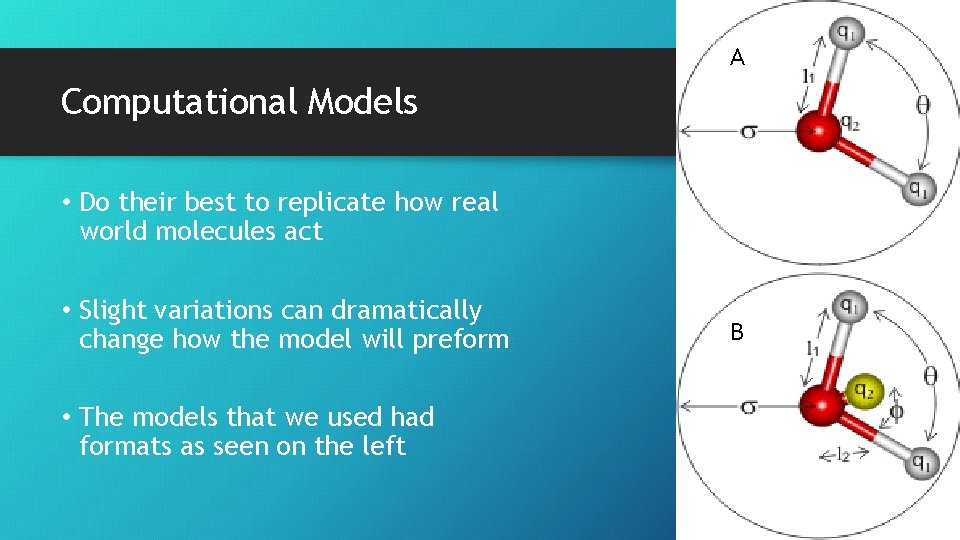
A Computational Models • Do their best to replicate how real world molecules act • Slight variations can dramatically change how the model will preform • The models that we used had formats as seen on the left B
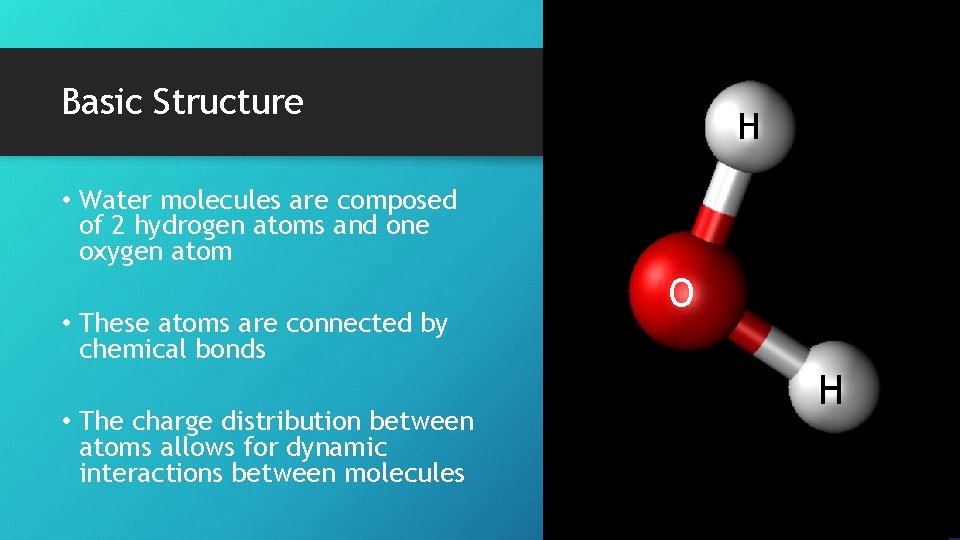
Basic Structure H • Water molecules are composed of 2 hydrogen atoms and one oxygen atom • These atoms are connected by chemical bonds • The charge distribution between atoms allows for dynamic interactions between molecules O H
Research objectives • Determine how effectively these models simulate supercritical water
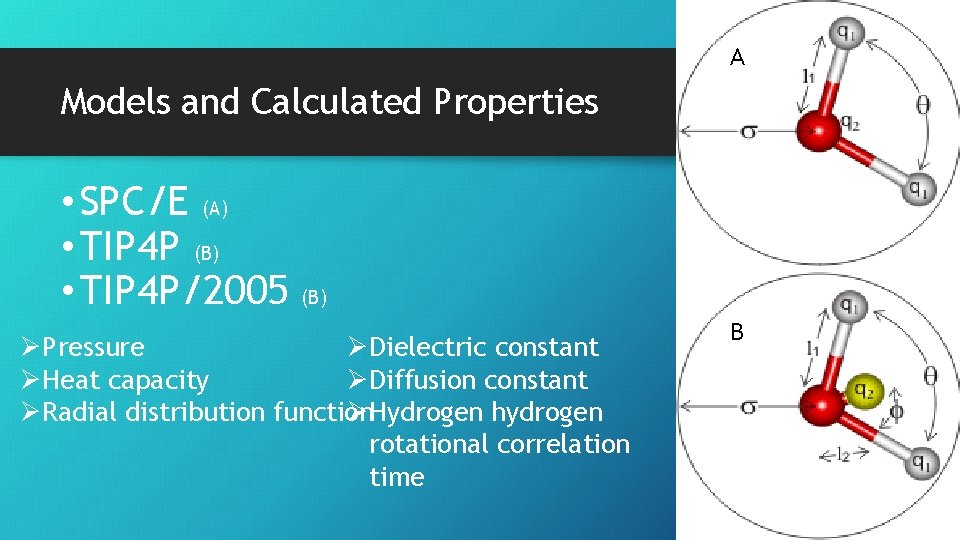
A Models and Calculated Properties • SPC/E (A) • TIP 4 P (B) • TIP 4 P/2005 (B) ØPressure ØDielectric constant ØHeat capacity ØDiffusion constant ØRadial distribution function ØHydrogen hydrogen rotational correlation time B
Simulation foundation Classical Quantum • Simulations are relatively short • Simulations take much longer • Doesn't account for electrons • Figures in electrons interactions • Solves for Newton’s equation • Solves for Schrodinger equation
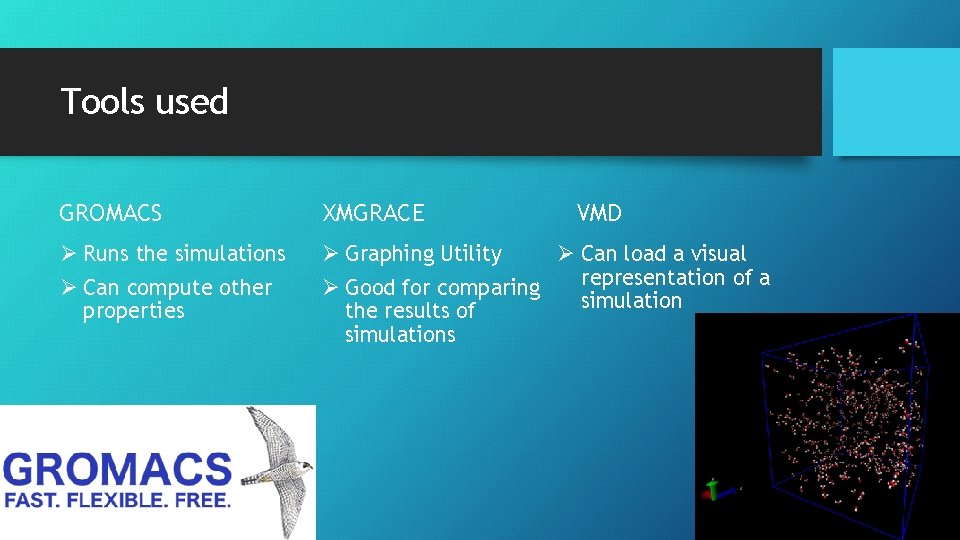
Tools used GROMACS XMGRACE Ø Runs the simulations Ø Graphing Utility Ø Can compute other properties VMD Ø Can load a visual representation of a Ø Good for comparing simulation the results of simulations

Thermodynamic Properties
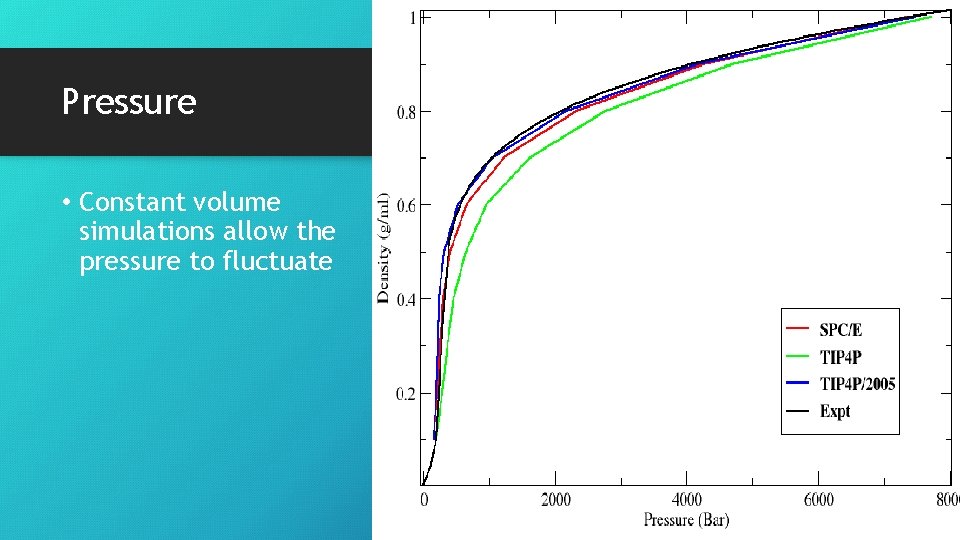
Pressure • Constant volume simulations allow the pressure to fluctuate
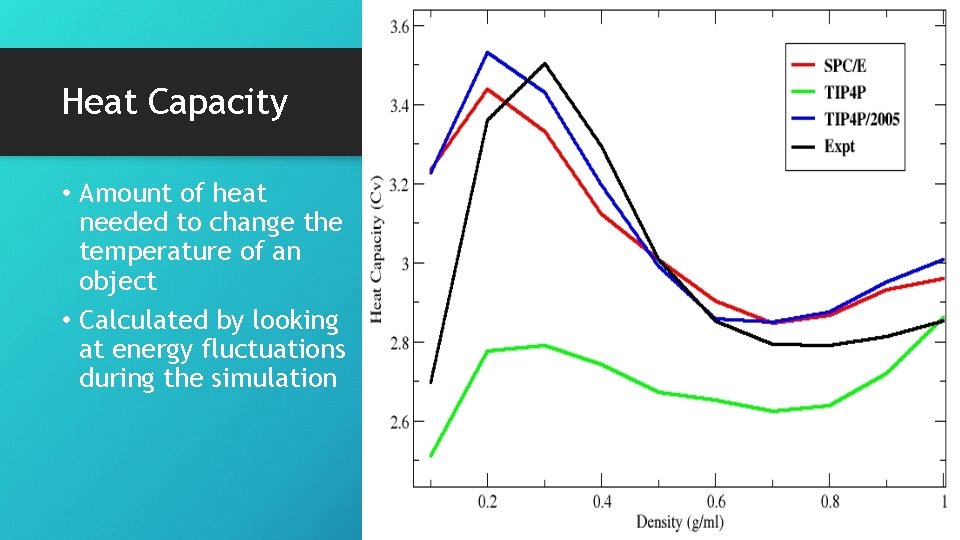
Heat Capacity • Amount of heat needed to change the temperature of an object • Calculated by looking at energy fluctuations during the simulation

Structural Properties
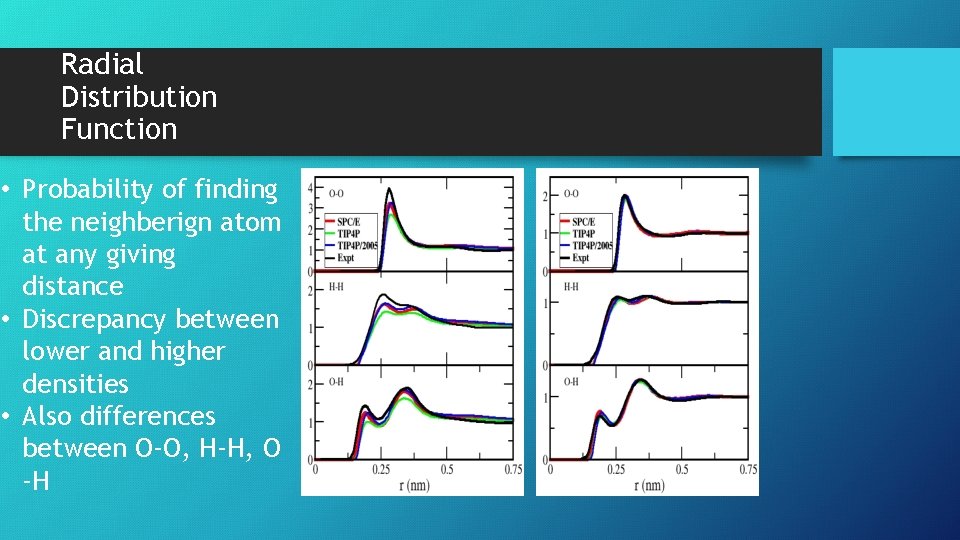
Radial Distribution Function • Probability of finding the neighberign atom at any giving distance • Discrepancy between lower and higher densities • Also differences between O-O, H-H, O -H

Dynamic Properties
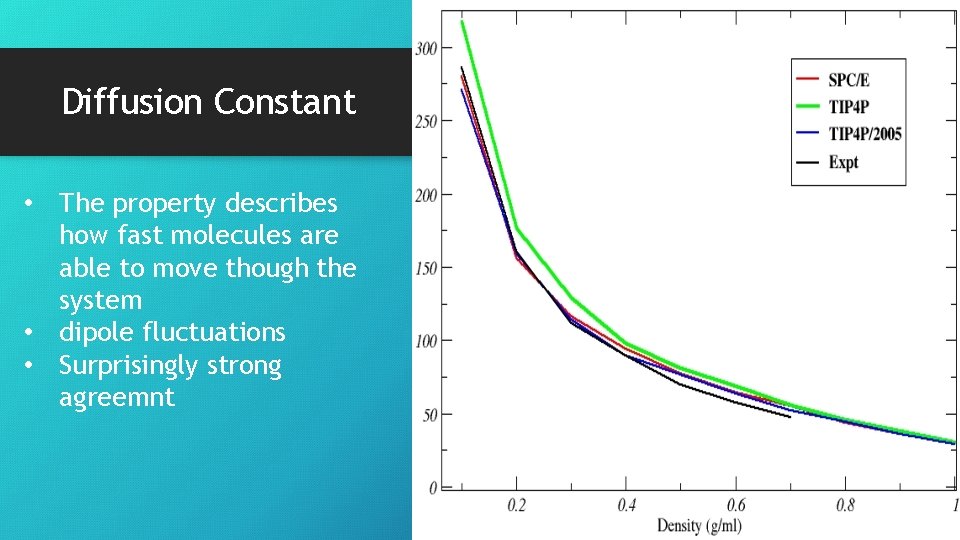
Diffusion Constant • The property describes how fast molecules are able to move though the system • dipole fluctuations • Surprisingly strong agreemnt
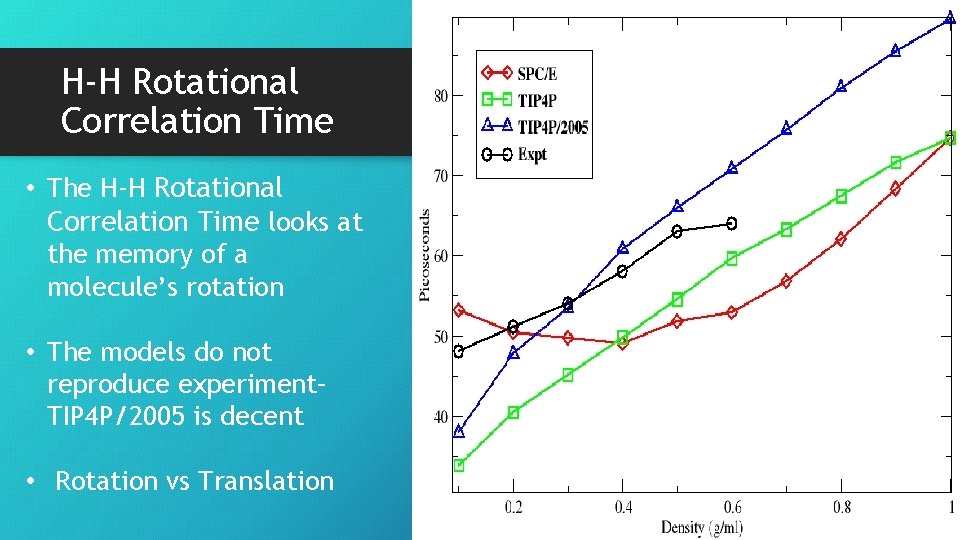
H-H Rotational Correlation Time • The H-H Rotational Correlation Time looks at the memory of a molecule’s rotation • The models do not reproduce experiment– TIP 4 P/2005 is decent • Rotation vs Translation

Dielectric Properties
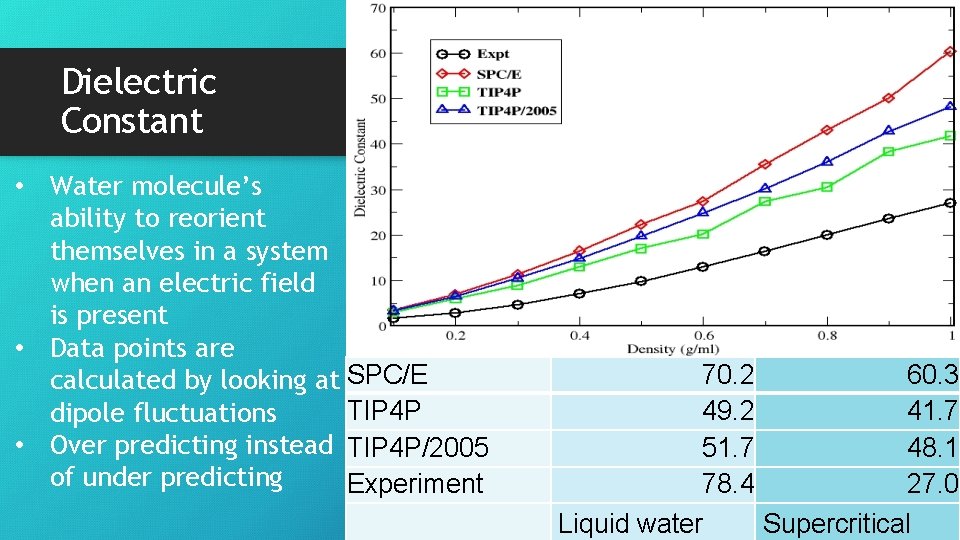
Dielectric Constant • Water molecule’s ability to reorient themselves in a system when an electric field is present • Data points are calculated by looking at SPC/E TIP 4 P dipole fluctuations • Over predicting instead TIP 4 P/2005 of under predicting Experiment 70. 2 60. 3 49. 2 41. 7 51. 7 48. 1 78. 4 27. 0 Liquid water Supercritical
Conclusions • TIP 4 P/2005 still can reliably simulate the properties of supercritical water with the exception of the dielectric constant • It’s highly likely that these models don’t describe the rotation of the molecules correctly but can still describe how they translate though a system

Thank you
- Slides: 20