
Comparing the Properties of a Semiconductor Diode Laser
- Slides: 1
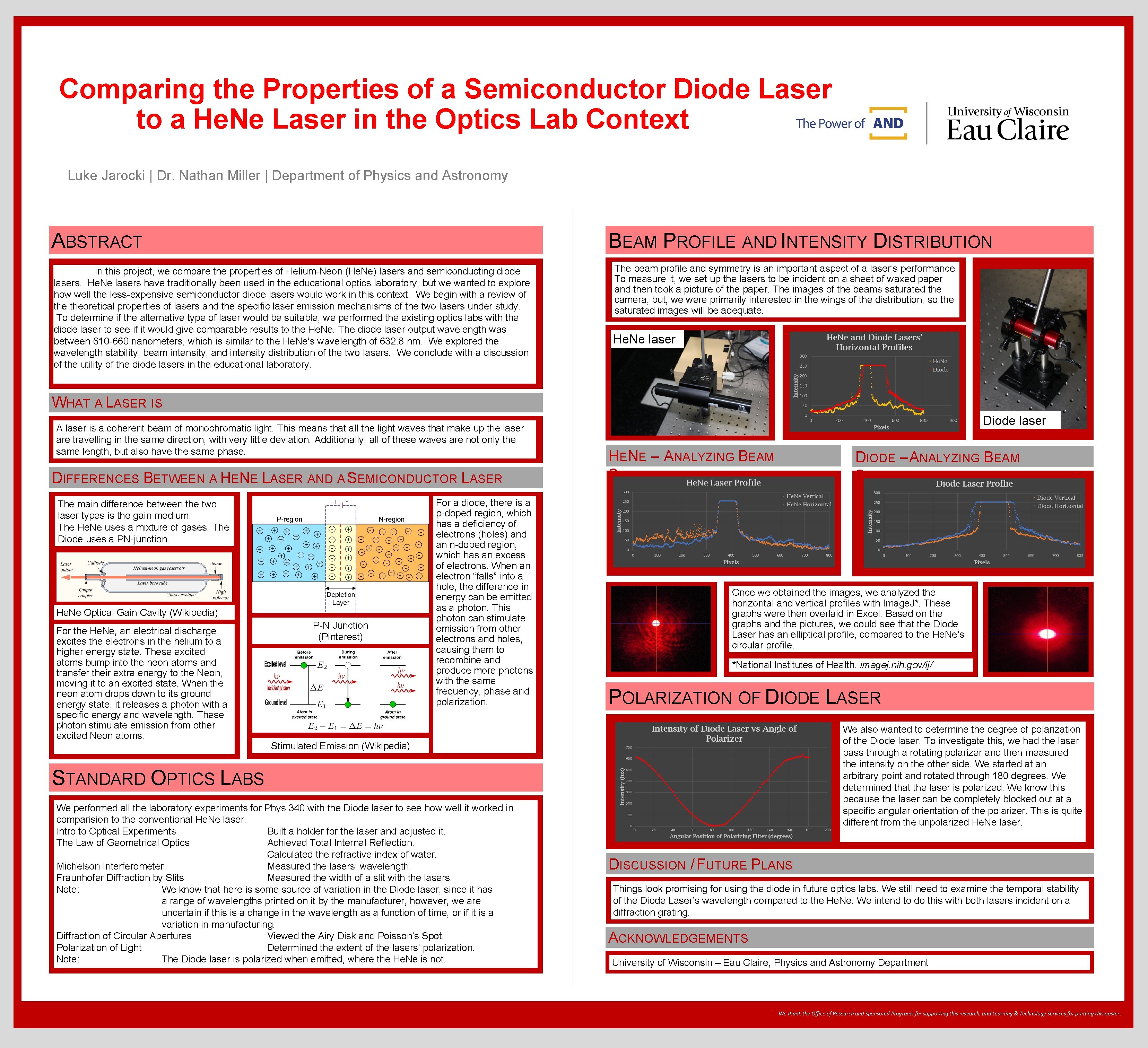
Comparing the Properties of a Semiconductor Diode Laser to a He. Ne Laser in the Optics Lab Context Luke Jarocki | Dr. Nathan Miller | Department of Physics and Astronomy BEAM PROFILE AND INTENSITY DISTRIBUTION ABSTRACT In this project, we compare the properties of Helium-Neon (He. Ne) lasers and semiconducting diode lasers. He. Ne lasers have traditionally been used in the educational optics laboratory, but we wanted to explore how well the less-expensive semiconductor diode lasers would work in this context. We begin with a review of theoretical properties of lasers and the specific laser emission mechanisms of the two lasers under study. To determine if the alternative type of laser would be suitable, we performed the existing optics labs with the diode laser to see if it would give comparable results to the He. Ne. The diode laser output wavelength was between 610 -660 nanometers, which is similar to the He. Ne’s wavelength of 632. 8 nm. We explored the wavelength stability, beam intensity, and intensity distribution of the two lasers. We conclude with a discussion of the utility of the diode lasers in the educational laboratory. The beam profile and symmetry is an important aspect of a laser’s performance. To measure it, we set up the lasers to be incident on a sheet of waxed paper and then took a picture of the paper. The images of the beams saturated the camera, but, we were primarily interested in the wings of the distribution, so the saturated images will be adequate. He. Ne laser WHAT A LASER IS A laser is a coherent beam of monochromatic light. This means that all the light waves that make up the laser are travelling in the same direction, with very little deviation. Additionally, all of these waves are not only the same length, but also have the same phase. DIFFERENCES BETWEEN A HENE LASER AND A SEMICONDUCTOR LASER The main difference between the two laser types is the gain medium. The He. Ne uses a mixture of gases. The Diode uses a PN-junction. He. Ne Optical Gain Cavity (Wikipedia) For the He. Ne, an electrical discharge excites the electrons in the helium to a higher energy state. These excited atoms bump into the neon atoms and transfer their extra energy to the Neon, moving it to an excited state. When the neon atom drops down to its ground energy state, it releases a photon with a specific energy and wavelength. These photon stimulate emission from other excited Neon atoms. P-N Junction (Pinterest) For a diode, there is a p-doped region, which has a deficiency of electrons (holes) and an n-doped region, which has an excess of electrons. When an electron “falls” into a hole, the difference in energy can be emitted as a photon. This photon can stimulate emission from other electrons and holes, causing them to recombine and produce more photons with the same frequency, phase and polarization. Diode laser HENE – ANALYZING BEAM SYMMETRY Once we obtained the images, we analyzed the horizontal and vertical profiles with Image. J*. These graphs were then overlaid in Excel. Based on the graphs and the pictures, we could see that the Diode Laser has an elliptical profile, compared to the He. Ne’s circular profile. *National Institutes of Health. imagej. nih. gov/ij/ POLARIZATION OF DIODE LASER We also wanted to determine the degree of polarization of the Diode laser. To investigate this, we had the laser pass through a rotating polarizer and then measured the intensity on the other side. We started at an arbitrary point and rotated through 180 degrees. We determined that the laser is polarized. We know this because the laser can be completely blocked out at a specific angular orientation of the polarizer. This is quite different from the unpolarized He. Ne laser. Stimulated Emission (Wikipedia) STANDARD OPTICS LABS We performed all the laboratory experiments for Phys 340 with the Diode laser to see how well it worked in comparision to the conventional He. Ne laser. Intro to Optical Experiments Built a holder for the laser and adjusted it. The Law of Geometrical Optics Achieved Total Internal Reflection. Calculated the refractive index of water. Michelson Interferometer Measured the lasers’ wavelength. Fraunhofer Diffraction by Slits Measured the width of a slit with the lasers. Note: We know that here is some source of variation in the Diode laser, since it has a range of wavelengths printed on it by the manufacturer, however, we are uncertain if this is a change in the wavelength as a function of time, or if it is a variation in manufacturing. Diffraction of Circular Apertures Viewed the Airy Disk and Poisson’s Spot. Polarization of Light Determined the extent of the lasers’ polarization. Note: The Diode laser is polarized when emitted, where the He. Ne is not. DIODE – ANALYZING BEAM SYMMETRY DISCUSSION / FUTURE PLANS Things look promising for using the diode in future optics labs. We still need to examine the temporal stability of the Diode Laser’s wavelength compared to the He. Ne. We intend to do this with both lasers incident on a diffraction grating. ACKNOWLEDGEMENTS University of Wisconsin – Eau Claire, Physics and Astronomy Department We thank the Office of Research and Sponsored Programs for supporting this research, and Learning & Technology Services for printing this poster.