
Comparing Structured Thinking Tools on a Problem Construction
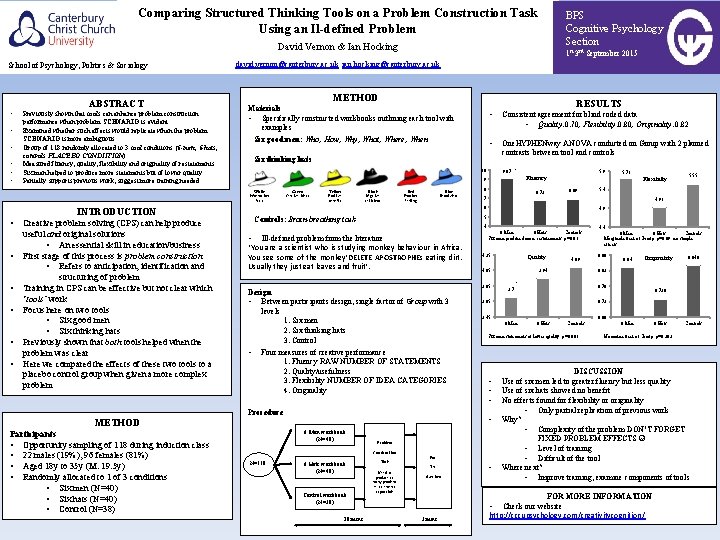
Comparing Structured Thinking Tools on a Problem Construction Task Using an Il-defined Problem BPS Cognitive Psychology Section David Vernon & Ian Hocking School of Psychology, Politics & Sociology ABSTRACT • • • Previously shown that tools can enhance problem construction performance when problem SCENARIO is evident Examined whether such effects would replicate when the problem SCENARIO is more ambiguous Group of 118 randomly allocated to 3 tool conditions (6 -men; 6 -hats; controls PLACEBO CONDIITION) Measured fluency, quality, flexibility and originality of restatements Six men helped to produce more statements but of lower quality Partially supports previous work, suggest more training needed METHOD Six good men: Who; How; Why; What; Where; When • • • Consistent agreement for blind coded data • Quality: 0. 70, Flexibility: 0. 80, Originality: 0. 82 • One. HYPHENway ANOVA conducted on Group with 2 planned contrasts between tool and controls 10 9. 07 * Green Creative, ideas Yellow Positive, benefits Black Negative, criticisms Red Emotion, feeling Blue Broad view 5. 9 Fluency 9 8 6. 72 6. 89 7 4. 91 4. 9 4 • Ill-defined problem from the literature ‘You are a scientist who is studying monkey behaviour in Africa. You see some of the monkey’DELETE APOSTROPHEs eating dirt. Usually they just eat leaves and fruit’. Design • Between participants design, single factor of Group with 3 levels 1. Six men 2. Six thinking hats 3. Control • Four measures of creative performance 1. Fluency RAW NUMBER OF STATEMENTS 2. Quality/usefulness 3. Flexibility NUMBER OF IDEA CATEGORIES 4. Originality Procedure 6 Men 6 Hats Controls Six men produced more restatements, p=0. 01 4. 25 3. 85 Control workbook (N=38) 20 mins Test • Questions 0. 88 0. 84 Originality 0. 846 0. 738 0. 73 6 Hats Controls 0. 68 6 Men 6 Hats Controls No main effect of Group, p=0. 203 DISCUSSION Use of six men led to greater fluency but less quality Use of six hats showed no benefit No effects found for flexibility or originality • Only partial replication of previous work Why? • Complexity of the problem DON’T FORGET FIXED PROBLEM EFFECTS • Level of training • Difficult of the tool Where next? • Improve training, examine components of tools FOR MORE INFORMATION Check our website http: //cccupsychology. com/creativitycognition/ • 3 mins 6 Men 6 Hats Controls Marginal effect of Group, p=0. 09, no simple effects 0. 78 Six men statements of lower quality, p=0. 001 • • • 4. 4 0. 83 3. 7 6 Men Post Need to produce as many problem re-statements as possible 3. 94 * 3. 45 Problem Task 4. 09 3. 65 • 6 Hats workbook (N=40) Quality 4. 05 Construction N=118 5. 55 5. 4 5 Controls: Brain-breathing task 6 Men workbook (N=40) 5. 71 Flexibilty 6 METHOD Participants • Opportunity sampling of 118 during induction class • 22 males (19%), 96 females (81%) • Aged 18 y to 35 y (M: 19. 5 y) • Randomly allocated to 1 of 3 conditions • Six men (N=40) • Six hats (N=40) • Control (N=38) • Six thinking hats INTRODUCTION Creative problem solving (CPS) can help produce useful and original solutions • An essential skill in education/business First stage of this process is problem construction • Refers to anticipation, identification and structuring of problem Training in CPS can be effective but not clear which ‘tools’ work Focus here on two tools • Six good men • Six thinking hats Previously shown that both tools helped when the problem was clear Here we compared the effects of these two tools to a placebo control group when given a more complex problem RESULTS Materials • Specifically constructed workbooks outlining each tool with examples White Information, facts • 1 st 3 rd September 2015 david. vernon@canterbury. ac. uk ian. hocking@canterbury. ac. uk
- Slides: 1