
COMPARING SET OF DATA MEAN MEDIAN MODE RANGE
- Slides: 11
COMPARING SET OF DATA MEAN, MEDIAN, MODE, RANGE.
• By having the skills to compare data it allows students to compare their heights, distances from home to school, children in their family, test scores, sports times, etc… • By having a basic understanding of the key elements in this unit it allows concepts in other subjects to be easily understood e. g. science, average rate of speed, average time, results of different experiments, etc… • The four major components is mean, median, mode, range.
DEFINITIONS • MEAN (COMMONLY KNOWN AS THE AVERAGE) – To find the mean value of a set of numbers 3 steps are involved; 1. Find the sum of all the numbers in the set. 2. Divide by the number of numbers in the set. 3. Round the answer, if necessary. Example: Find the mean score of these numbers; 1. 22, 54, 18, 33, 69, 44 Solution – Total sum of numbers 240. 2. 240 = 40 6 Therefore Answer = 40.
ACTIVITY - MEAN Find the mean of the following numbers: 1. 55, 88, 27, 35, 49, 72, 61, 92, 26, 43
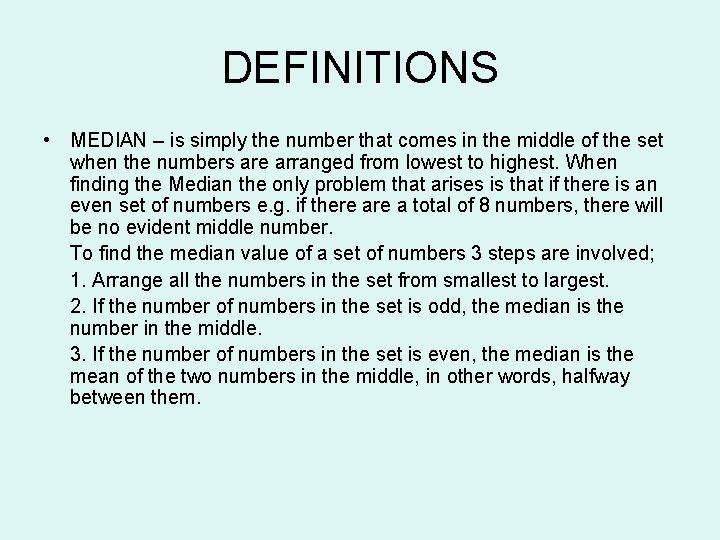
DEFINITIONS • MEDIAN – is simply the number that comes in the middle of the set when the numbers are arranged from lowest to highest. When finding the Median the only problem that arises is that if there is an even set of numbers e. g. if there a total of 8 numbers, there will be no evident middle number. To find the median value of a set of numbers 3 steps are involved; 1. Arrange all the numbers in the set from smallest to largest. 2. If the number of numbers in the set is odd, the median is the number in the middle. 3. If the number of numbers in the set is even, the median is the mean of the two numbers in the middle, in other words, halfway between them.
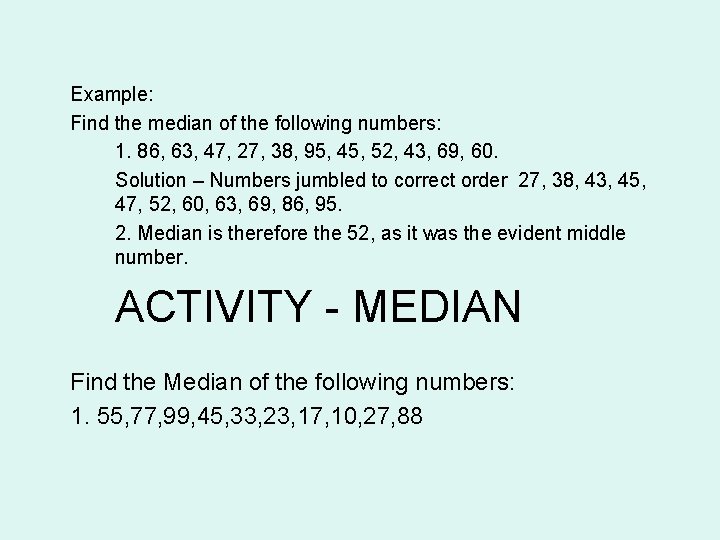
Example: Find the median of the following numbers: 1. 86, 63, 47, 27, 38, 95, 45, 52, 43, 69, 60. Solution – Numbers jumbled to correct order 27, 38, 43, 45, 47, 52, 60, 63, 69, 86, 95. 2. Median is therefore the 52, as it was the evident middle number. ACTIVITY - MEDIAN Find the Median of the following numbers: 1. 55, 77, 99, 45, 33, 23, 17, 10, 27, 88
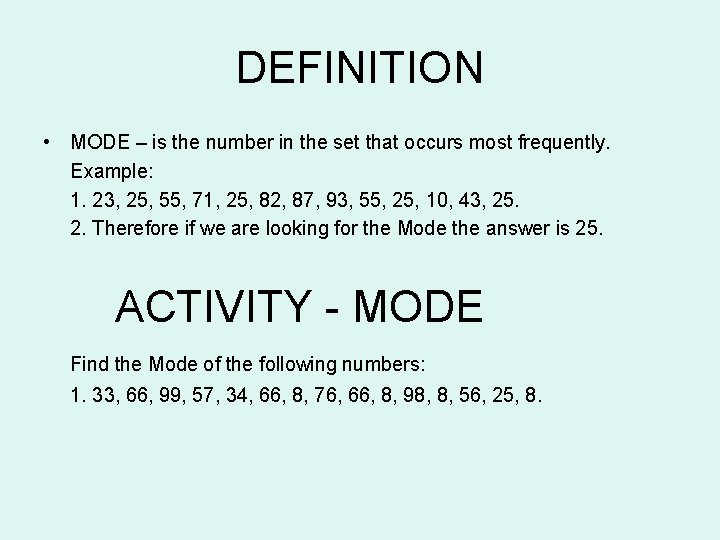
DEFINITION • MODE – is the number in the set that occurs most frequently. Example: 1. 23, 25, 55, 71, 25, 82, 87, 93, 55, 25, 10, 43, 25. 2. Therefore if we are looking for the Mode the answer is 25. ACTIVITY - MODE Find the Mode of the following numbers: 1. 33, 66, 99, 57, 34, 66, 8, 76, 66, 8, 98, 8, 56, 25, 8.
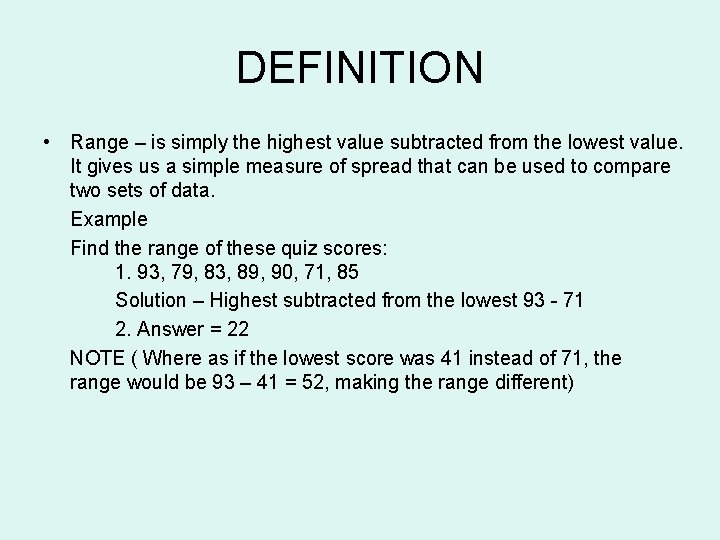
DEFINITION • Range – is simply the highest value subtracted from the lowest value. It gives us a simple measure of spread that can be used to compare two sets of data. Example Find the range of these quiz scores: 1. 93, 79, 83, 89, 90, 71, 85 Solution – Highest subtracted from the lowest 93 - 71 2. Answer = 22 NOTE ( Where as if the lowest score was 41 instead of 71, the range would be 93 – 41 = 52, making the range different)
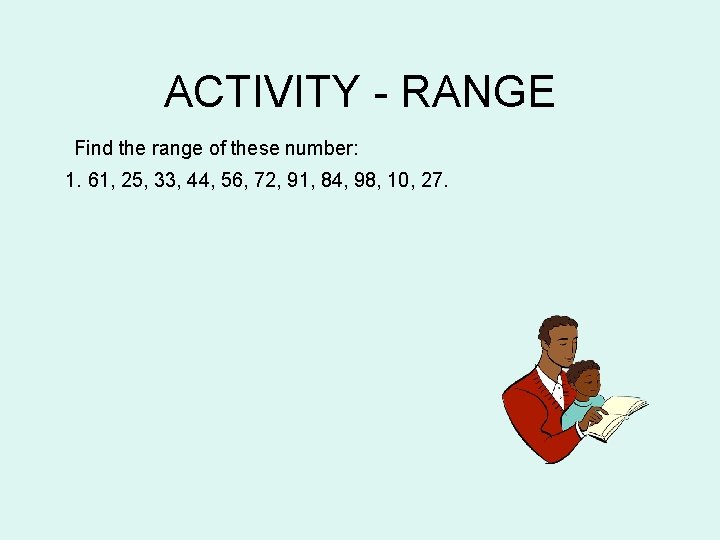
ACTIVITY - RANGE Find the range of these number: 1. 61, 25, 33, 44, 56, 72, 91, 84, 98, 10, 27.
ACTIVITY We are going to find the total members of the students immediate family within the class. From that information we will find the mean, median, mode, range of the class.
REFERENCE • D. HAYLOCK, 2006, Mathematics Explained for primary teachers third edition, SAGE Publications Ltd • Mrs. Glosser's Math Goodies, 2008, www. mathgoodies. com