
Comparing Purpose and Structure of Texts ENGLISH YEAR
- Slides: 16
Comparing Purpose and Structure of Texts ENGLISH YEAR 1 TERM 4, WEEK 2: UNIT 7: LESSON 6 2017
Resources: Year One Edstudio: https: //staff. learningplace. eq. edu. au/lp/pages/default. aspx? cid=16191 Text Warm-ups. Nayar, N and Roy, P 2009, What shall I make? , Frances Lincoln Children’s Books, London. PBS Kids Go! ‘ed’ song https: //www. youtube. com/watch? v=jxl 28 KQOHy 4 Nessy reading strategy: ‘ed’ past tense https: //www. youtube. com/watch? v=jxl 28 KQOHy 4 Word Families Song U-Tube https: //www. youtube. com/watch? v=Vh. GTm. I 8 KO 5 E
I DO Unit 7 Lesson 6 – Comparing Purpose and Structure of Texts In this unit, students listen to, read, view and interpret traditional and digital multimodal texts, to explore the language and text structures of procedure in imaginative and informative contexts. Students create a digital presentation of a procedure from a literary context.
I DO Unit 7 Lesson 6 – Comparing Purpose and Structure of Texts WALT – We Are Learning To: Understand that the purpose of texts shapes their structures in predictable ways Understand how to explain characters and events, making connections to personal experiences WILF – What I’m Looking For: Using text processing strategies to decode words, compare different texts and make connections to personal experiences.
WE DO Unit 7 Lesson 6 – Comparing Purpose and Structure of Texts In this lesson, you are going to listen to a story that uses two story elements — words and pictures — to tell a story. • Show students the cover of the book What shall I make? • Read the title and author names to students. • Read What shall I make? to students. • Walk through the story, exploring words, illustrations and layout. Note and discuss the words that come from another culture (for example: chapattis, tava).
I DO Unit 7 Lesson 6 – Comparing Purpose and Structure of Texts Prepare a reading of the book What shall I make? for students to practise decoding words. This decoding session focuses on using phonic knowledge (the sounds letters make) to make meaningful predictions. • Select eight to ten words and only one word on a page. • Leave an initial letter or final letter, blend or digraph (two letters that make one sound) uncovered on the word. For example: in the word ‘with’, cover the ‘th’ or in the word ‘snake’ cover the ‘ake’. Text processing strategies (prediction, monitoring meaning and re-reading): the strategies a reader uses to decode the text, or work out the words. In Year 1, these include: • prediction (I predicted what word would go there, thinking about the book we just read) • monitoring meaning (I thought about what would make sense) • re-reading (I re-read the sentence to see what the word could be, I re-read the sentence to see if the word I picked made sense).
IWE DODO Unit 7 Lesson 6 – Comparing Purpose and Structure of Texts Compare different texts Show students examples of: a. a procedure: the last page of the picture book b. a persuasive text: Making your own chapattis! — Sheet 6 — Children need to cook. Read these texts to students and explain that Making your own chapattis! is an informative text, and Children need to cook is a persuasive text.
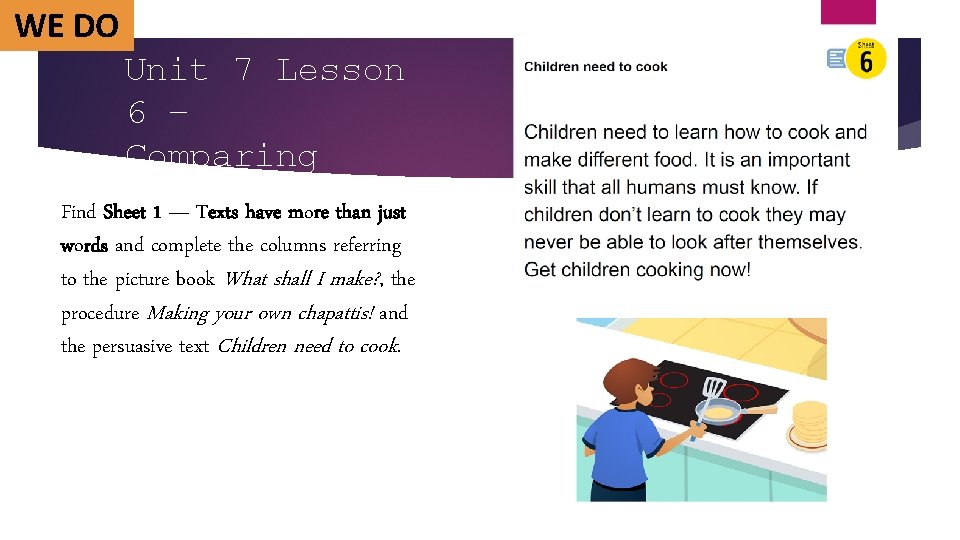
WE DO Unit 7 Lesson 6 – Comparing Purpose and Find Sheet 1 — Texts have more than just words and complete the columns referring Structure of to the picture book What shall I make? , the Texts procedure Making your own chapattis! and the persuasive text Children need to cook.
WE DO Unit 7 Lesson 6 – Comparing Purpose and Structure of Texts Discuss with students the similarities and differences between the imaginative text What shall I make? , the informative text Making your own chapattis!, and the persuasive text Children need to cook. Focus questions Q. What is the same about these texts? Q. What is different about these texts? Q. What would happen if you used a persuasive or imaginative text to give instructions?
WE DO Unit 7 Lesson 6 – Comparing Purpose and Structure of Texts Focus questions Q. What is the same about these texts? A. All the texts are about the same topic and have words and images. Q. What is different about these texts? A. One is telling a story, one provides a list of instructions with numbers and one is explaining why children should learn to cook. Q. What would happen if you used a persuasive or imaginative text to give instructions? A. The instructions would not be clear and would be difficult for the reader to follow. The goal of the instructions might not be achieved.
I DO Imaginative Text Is a story that could be a real or true event, The pictures are drawn as cartoon-like and tell us about the imaginative events that are happening in Neeraj’s mind (for example: through the use of thought bubbles). The story has a beginning, middle and end, with different events happening to entertain the reader and keep them interested.
I DO Informative Text. Making your own Chappatis It is a procedure This that tells the reader what to do, or how to do something. procedure is a recipe that tells somebody how to cook a chapatti. It is set out clearly with a list of ingredients (what you need) And a method (what you do) so that someone can follow exactly what needs to be done. The In steps in a method need to follow an exact order. Making your own chapattis! the steps are not numbered but you can see them easily because each new step starts on a new line.
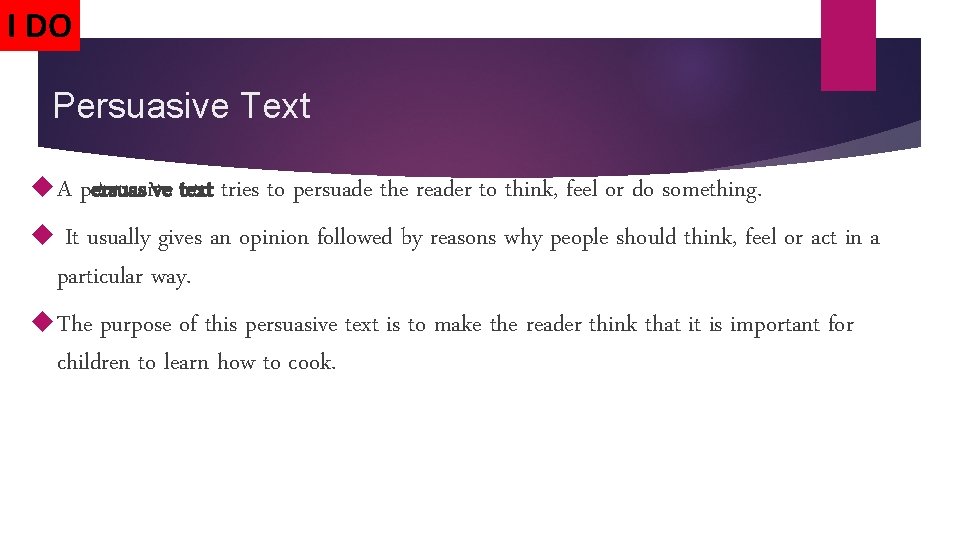
I DO Persuasive Text A persuasive text tries to persuade the reader to think, feel or do something. It usually gives an opinion followed by reasons why people should think, feel or act in a particular way. The purpose of this persuasive text is to make the reader think that it is important for children to learn how to cook.
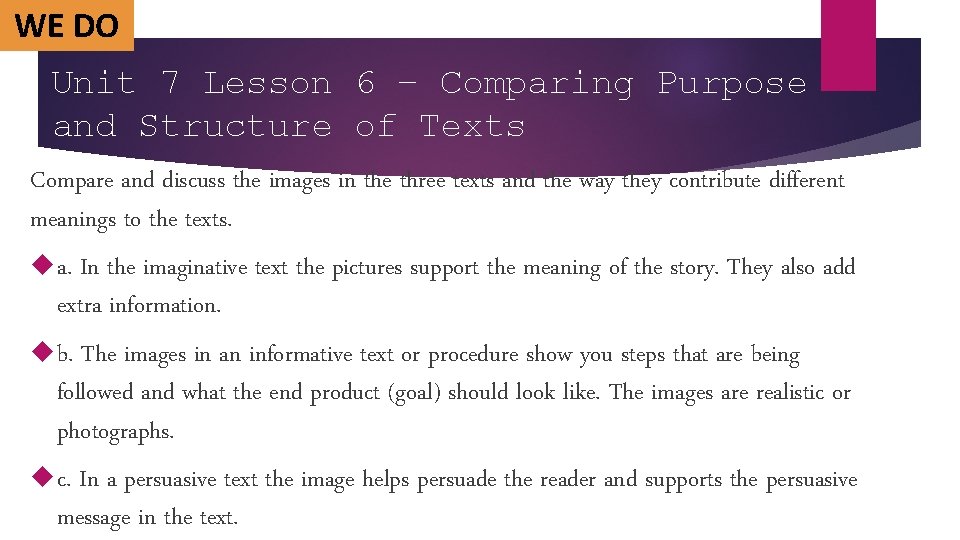
WE DO Unit 7 Lesson 6 – Comparing Purpose and Structure of Texts Compare and discuss the images in the three texts and the way they contribute different meanings to the texts. a. In the imaginative text the pictures support the meaning of the story. They also add extra information. b. The images in an informative text or procedure show you steps that are being followed and what the end product (goal) should look like. The images are realistic or photographs. c. In a persuasive text the image helps persuade the reader and supports the persuasive message in the text.
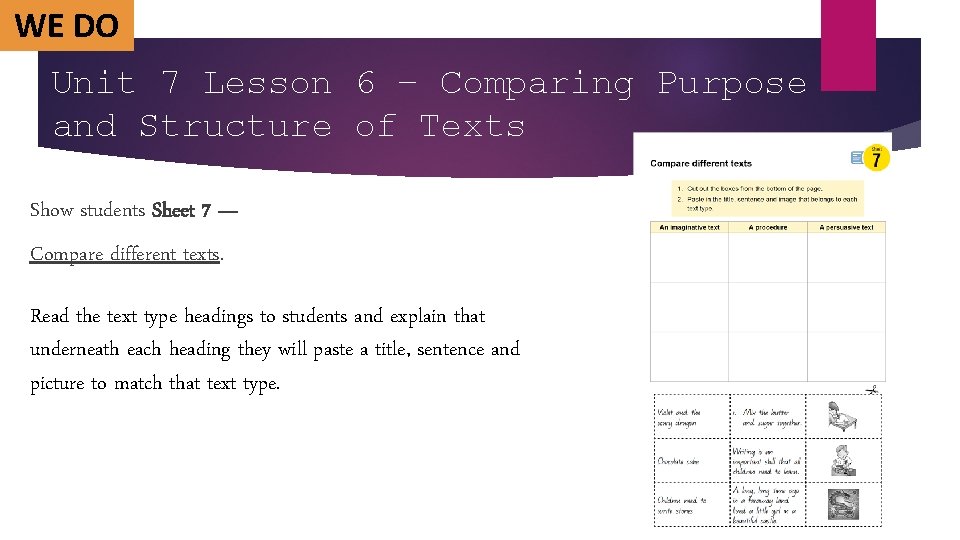
WE DO Unit 7 Lesson 6 – Comparing Purpose and Structure of Texts Show students Sheet 7 — Compare different texts. Read the text type headings to students and explain that underneath each heading they will paste a title, sentence and picture to match that text type.
WE DO Unit 7 Lesson 6 – Comparing Purpose and Structure of Texts Discuss and explain characters and events in the text, What shall I make? by making connections to personal experiences. Focus questions Q. What do the events in this story remind you of? Q. Have you ever made dough with an adult? What happened? How was it the same as Neeraj’s experience? How was it different?