
Comparing Mutually Exclusive Alternatives Lecture No 18 Chapter
- Slides: 16
Comparing Mutually Exclusive Alternatives Lecture No. 18 Chapter 5 Contemporary Engineering Economics Copyright © 2016 Contemporary Engineering Economics, 6 e, GE Park Copyright © 2016, Pearson Education, Ltd. All Rights Reserved
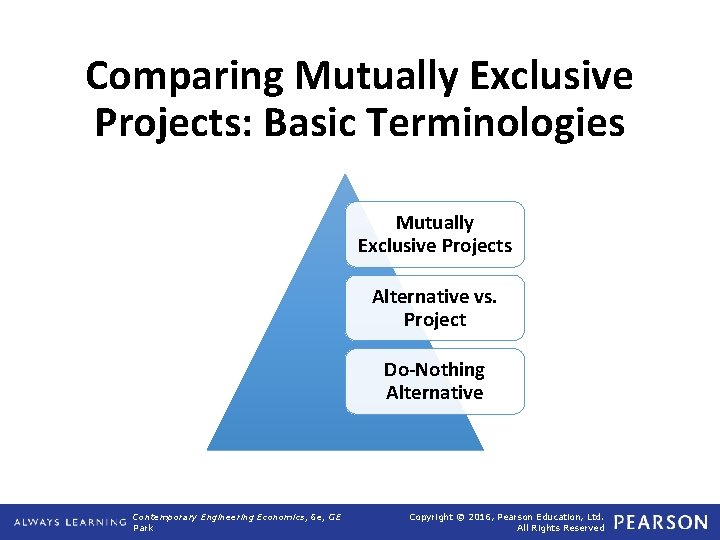
Comparing Mutually Exclusive Projects: Basic Terminologies Mutually Exclusive Projects Alternative vs. Project Do-Nothing Alternative Contemporary Engineering Economics, 6 e, GE Park Copyright © 2016, Pearson Education, Ltd. All Rights Reserved
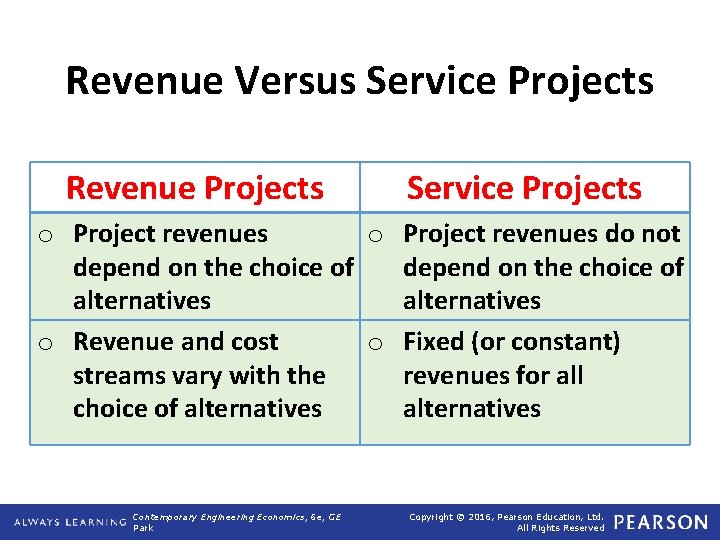
Revenue Versus Service Projects Revenue Projects Service Projects o Project revenues do not depend on the choice of alternatives o Revenue and cost o Fixed (or constant) streams vary with the revenues for all choice of alternatives Contemporary Engineering Economics, 6 e, GE Park Copyright © 2016, Pearson Education, Ltd. All Rights Reserved
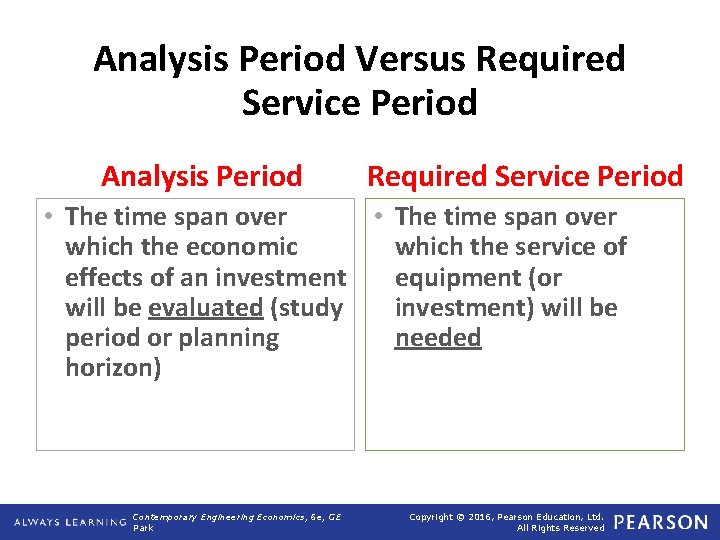
Analysis Period Versus Required Service Period Analysis Period Required Service Period • The time span over which the economic which the service of effects of an investment equipment (or will be evaluated (study investment) will be period or planning needed horizon) Contemporary Engineering Economics, 6 e, GE Park Copyright © 2016, Pearson Education, Ltd. All Rights Reserved
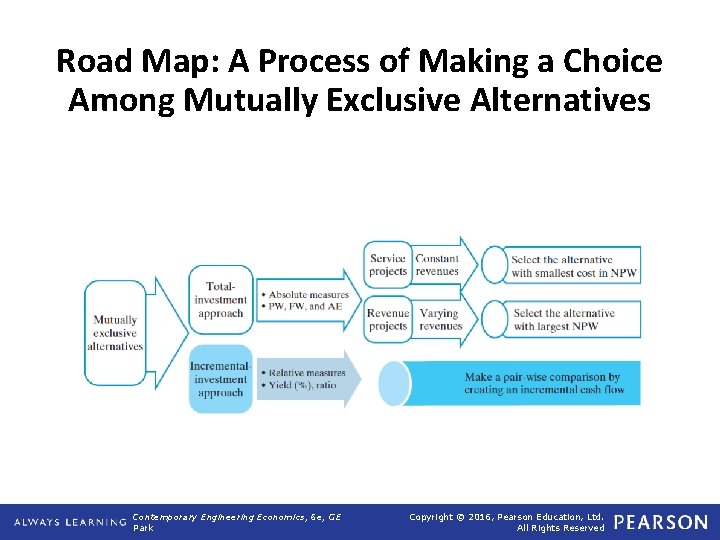
Road Map: A Process of Making a Choice Among Mutually Exclusive Alternatives Contemporary Engineering Economics, 6 e, GE Park Copyright © 2016, Pearson Education, Ltd. All Rights Reserved
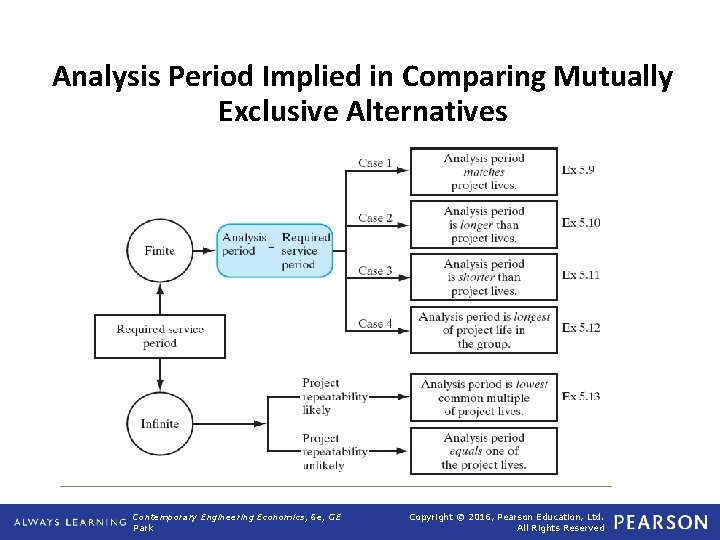
Comparing Mutually Exclusive Projects q. Principle: Projects must be compared over an equal time span. q. Rule of Thumb: If the required service period is given, the analysis period should be the same as the required service period. Contemporary Engineering Economics, 6 e, GE Park Copyright © 2016, Pearson Education, Ltd. All Rights Reserved
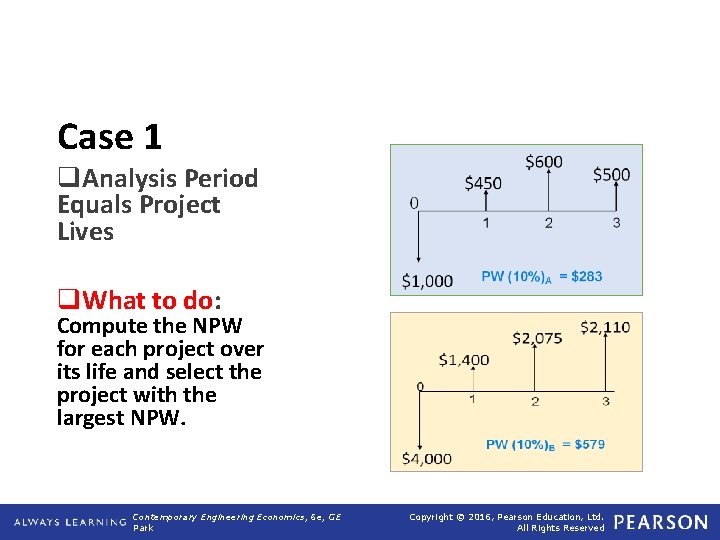
Case 1 q. Analysis Period Equals Project Lives q. What to do: Compute the NPW for each project over its life and select the project with the largest NPW. Contemporary Engineering Economics, 6 e, GE Park Copyright © 2016, Pearson Education, Ltd. All Rights Reserved
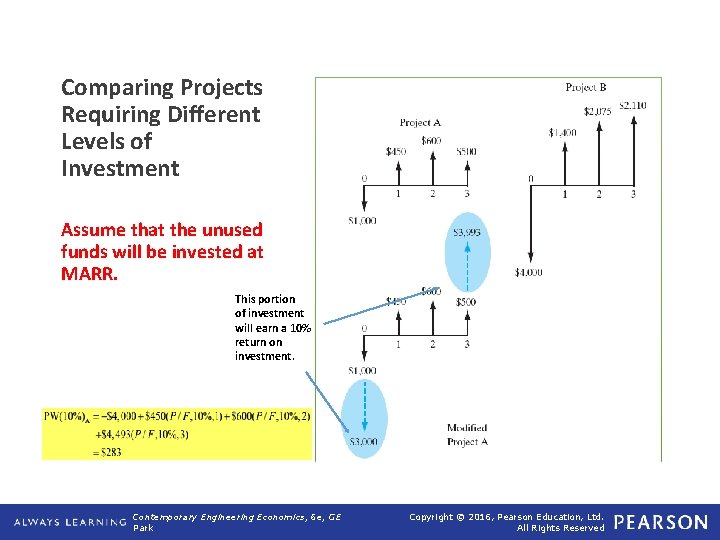
Comparing Projects Requiring Different Levels of Investment Assume that the unused funds will be invested at MARR. This portion of investment will earn a 10% return on investment. Contemporary Engineering Economics, 6 e, GE Park Copyright © 2016, Pearson Education, Ltd. All Rights Reserved
Analysis Period Implied in Comparing Mutually Exclusive Alternatives Contemporary Engineering Economics, 6 e, GE Park Copyright © 2016, Pearson Education, Ltd. All Rights Reserved
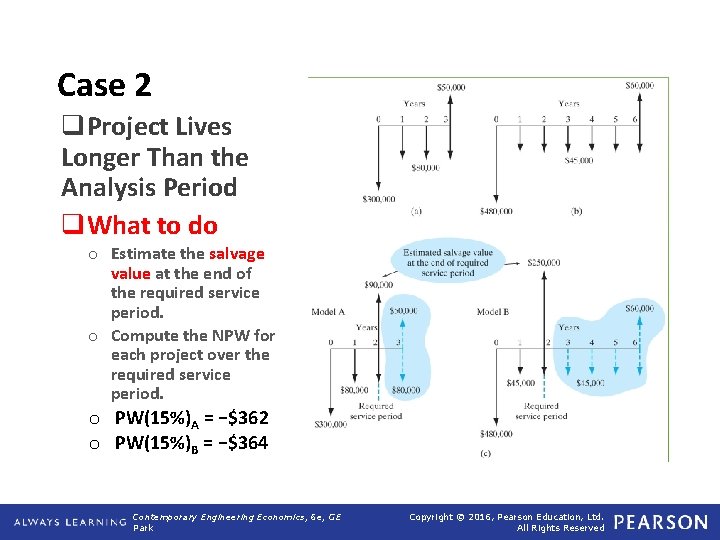
Case 2 q. Project Lives Longer Than the Analysis Period q. What to do o Estimate the salvage value at the end of the required service period. o Compute the NPW for each project over the required service period. o PW(15%)A = −$362 o PW(15%)B = −$364 Contemporary Engineering Economics, 6 e, GE Park Copyright © 2016, Pearson Education, Ltd. All Rights Reserved
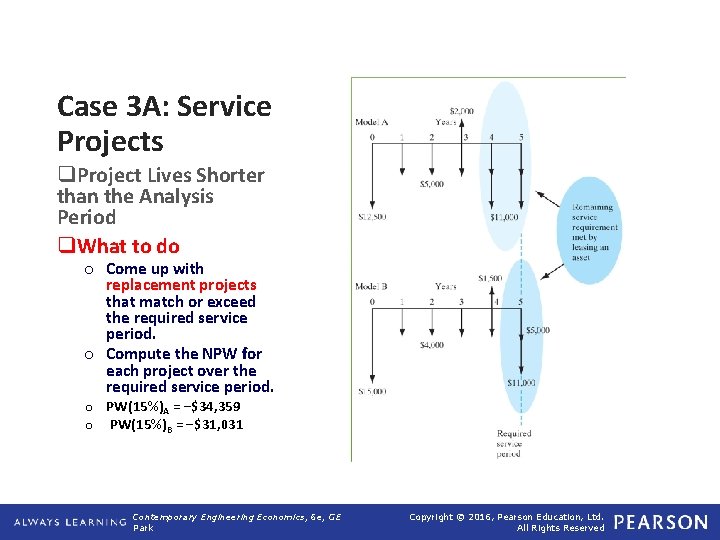
Case 3 A: Service Projects q. Project Lives Shorter than the Analysis Period q. What to do o Come up with replacement projects that match or exceed the required service period. o Compute the NPW for each project over the required service period. o PW(15%)A = −$34, 359 o PW(15%)B = −$31, 031 Contemporary Engineering Economics, 6 e, GE Park Copyright © 2016, Pearson Education, Ltd. All Rights Reserved
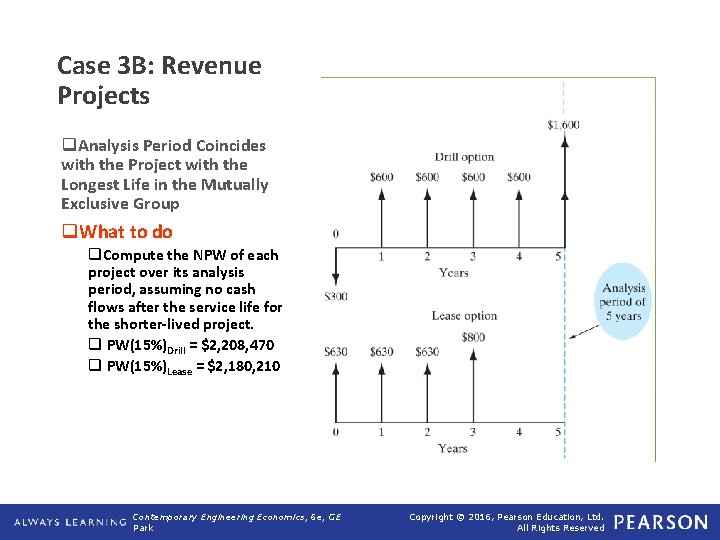
Case 3 B: Revenue Projects q. Analysis Period Coincides with the Project with the Longest Life in the Mutually Exclusive Group q. What to do q. Compute the NPW of each project over its analysis period, assuming no cash flows after the service life for the shorter-lived project. q PW(15%)Drill = $2, 208, 470 q PW(15%)Lease = $2, 180, 210 Contemporary Engineering Economics, 6 e, GE Park Copyright © 2016, Pearson Education, Ltd. All Rights Reserved
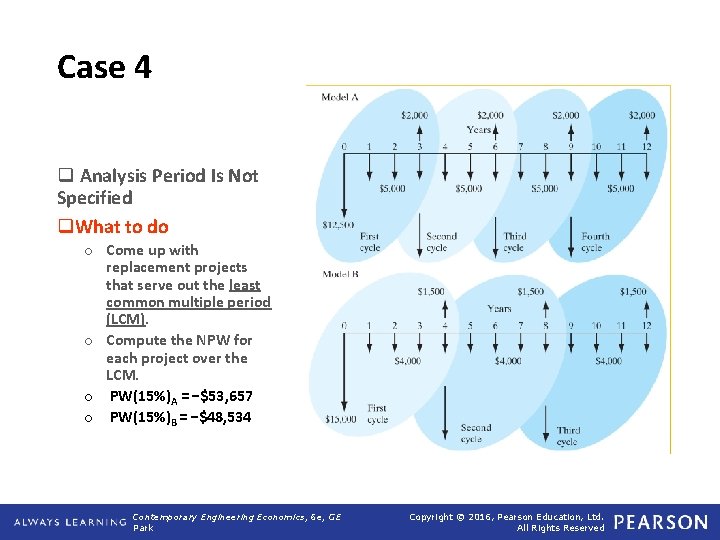
Case 4 q Analysis Period Is Not Specified q. What to do o Come up with replacement projects that serve out the least common multiple period (LCM). o Compute the NPW for each project over the LCM. o PW(15%)A = −$53, 657 o PW(15%)B = −$48, 534 Contemporary Engineering Economics, 6 e, GE Park Copyright © 2016, Pearson Education, Ltd. All Rights Reserved
Summary • • Present worth is an equivalence method of analysis in which a project’s cash flows are discounted to a lump sum amount at the present time. The MARR, or minimum attractive rate of return, is the interest rate at which a firm can always earn or borrow money. MARR is generally dictated by management and is the rate at which NPW analysis should be conducted. Two measures of investment, the net future worth and the capitalized equivalent worth, are variations of the NPW criterion. Contemporary Engineering Economics, 6 e, GE Park Copyright © 2016, Pearson Education, Ltd. All Rights Reserved
• The term mutually exclusive means that when one of several alternatives that meet the same need is selected, the others will be rejected. • Revenue projects are those for which the income generated depends on the choice of project. • Service projects are those for which income remains the same, regardless of which project is selected. • The analysis period (study period) is the time span over which the economic effects of an investment will be evaluated. Contemporary Engineering Economics, 6 e, GE Park Copyright © 2016, Pearson Education, Ltd. All Rights Reserved
• The required service period is the time span over which the service of equipment (or investment) will be needed. • The analysis period should be chosen to cover the required service period. • When not specified by management or company policy, the analysis period to use in a comparison of mutually exclusive projects may be chosen by the individual analyst. Contemporary Engineering Economics, 6 e, GE Park Copyright © 2016, Pearson Education, Ltd. All Rights Reserved