
Comparing Mutation Testing at the Levels of Source

![SRC Mutation Example (C Language) int max(int arr[], int size) { int i; int](https://slidetodoc.com/presentation_image_h/032a3edd8d4c82e80b183bddcef555dd/image-3.jpg "SRC Mutation Example (C Language) int max(int arr[], int size) { int i; int")
![SRC Mutation Example (C Language) int max(int arr[], int size) { int i; int](https://slidetodoc.com/presentation_image_h/032a3edd8d4c82e80b183bddcef555dd/image-4.jpg "SRC Mutation Example (C Language) int max(int arr[], int size) { int i; int")

- Slides: 36
Comparing Mutation Testing at the Levels of Source Code and Compiler Intermediate Representation Farah Hariri, August Shi, Vimuth Fernando, Suleman Mahmood, Darko Marinov CCF-1421503 CCF-1629431 CNS-1646305 CNS-1740916 ICST 2019 Xi’an, China 4/24/2019
Mutation Testing • Check quality of test suite Program Mutant Generation Higher mutation score Better test suite Mut 1 Run Tests Survived Mut 2 Run Tests Killed … Mutation Operators SRC or IR? 2
SRC Mutation Example (C Language) int max(int arr[], int size) { int i; int max = INT_MIN; for (i = 0; i < size; i++) { if (arr[i] > max) { max = arr[i]; } } return max; } void test. Single() { int arr[1] = {5}; assert(5 == max(arr, 1)); } Test Passes void test. Multi() { int arr[3] = {1, 3, 2}; assert(3 == max(arr, 3)); } Test Passes 3
SRC Mutation Example (C Language) int max(int arr[], int size) { int i; int max = INT_MIN; for (i = 1; i < size; i++) { if (arr[i] > max) { max = arr[i]; } } return max; } void test. Single() { int arr[1] = {5}; assert(5 == max(arr, 1)); } Test Fails void test. Multi() { int arr[3] = {1, 3, 2}; assert(3 == max(arr, 3)); } Test Passes Integer Constant Replacement Change 0 to 1 4
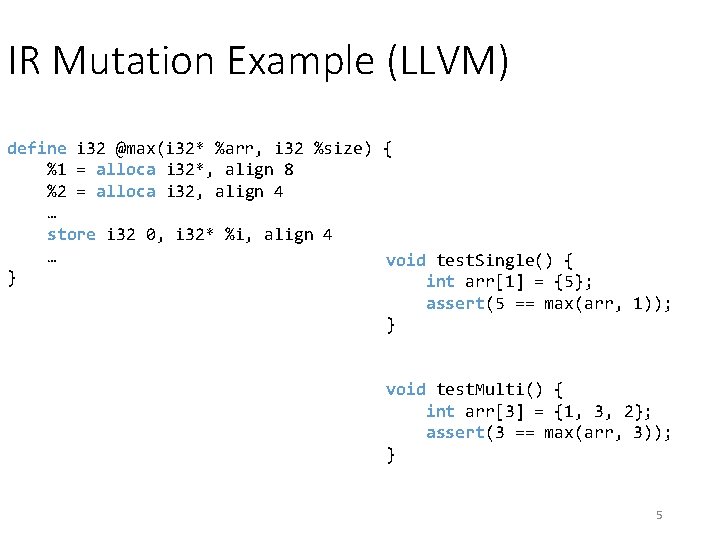
IR Mutation Example (LLVM) define i 32 @max(i 32* %arr, i 32 %size) { %1 = alloca i 32*, align 8 %2 = alloca i 32, align 4 … store i 32 0, i 32* %i, align 4 … void test. Single() { } int arr[1] = {5}; assert(5 == max(arr, 1)); } void test. Multi() { int arr[3] = {1, 3, 2}; assert(3 == max(arr, 3)); } 5
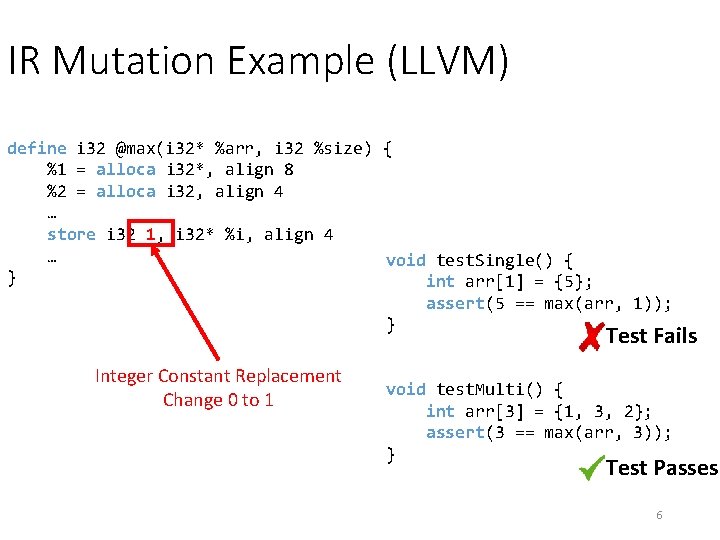
IR Mutation Example (LLVM) define i 32 @max(i 32* %arr, i 32 %size) { %1 = alloca i 32*, align 8 %2 = alloca i 32, align 4 … store i 32 1, i 32* %i, align 4 … void test. Single() { } int arr[1] = {5}; assert(5 == max(arr, 1)); } Test Fails Integer Constant Replacement Change 0 to 1 void test. Multi() { int arr[3] = {1, 3, 2}; assert(3 == max(arr, 3)); } Test Passes 6
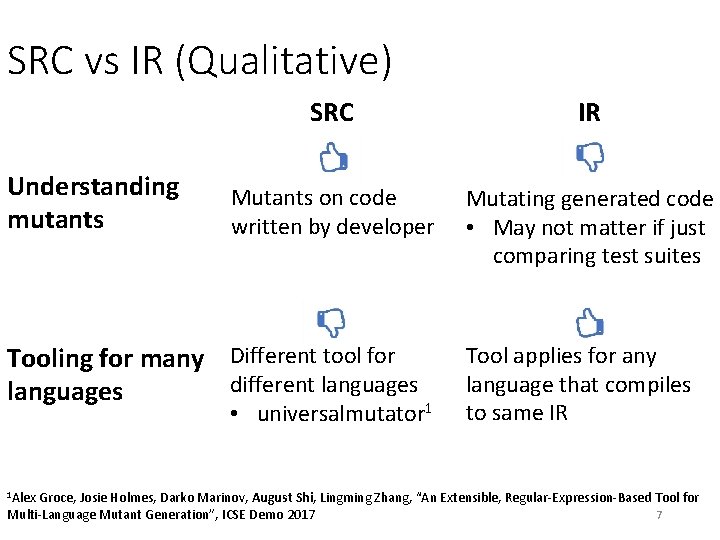
SRC vs IR (Qualitative) Understanding mutants SRC IR Mutants on code written by developer Mutating generated code • May not matter if just comparing test suites Tooling for many Different tool for different languages 1 • universalmutator 1 Alex Groce, Josie Holmes, Darko Marinov, August Tool applies for any language that compiles to same IR Shi, Lingming Zhang, “An Extensible, Regular-Expression-Based Tool for 7 Multi-Language Mutant Generation”, ICSE Demo 2017
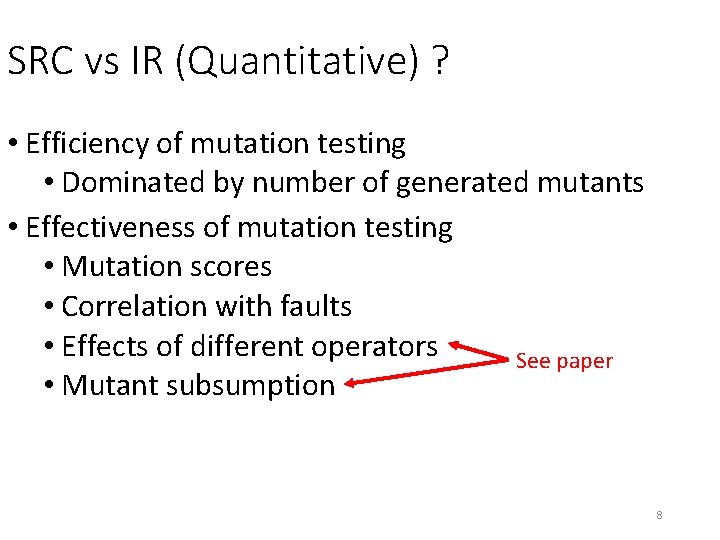
SRC vs IR (Quantitative) ? • Efficiency of mutation testing • Dominated by number of generated mutants • Effectiveness of mutation testing • Mutation scores • Correlation with faults • Effects of different operators See paper • Mutant subsumption 8
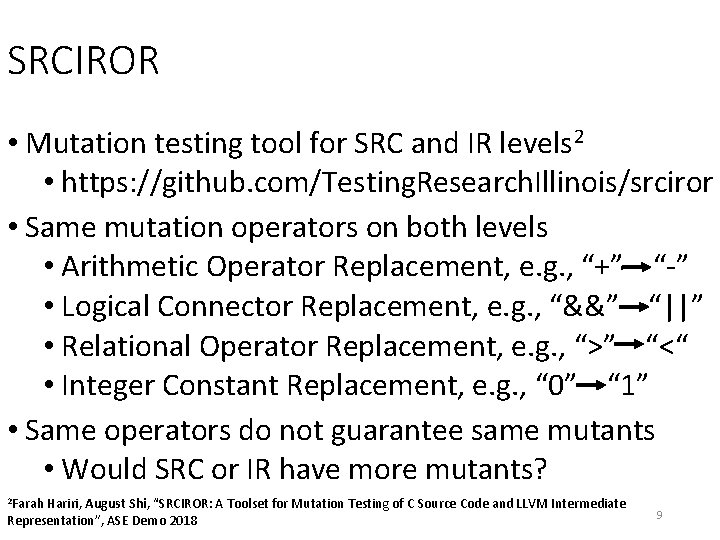
SRCIROR • Mutation testing tool for SRC and IR levels 2 • https: //github. com/Testing. Research. Illinois/srciror • Same mutation operators on both levels • Arithmetic Operator Replacement, e. g. , “+” “-” • Logical Connector Replacement, e. g. , “&&” “||” • Relational Operator Replacement, e. g. , “>” “<“ • Integer Constant Replacement, e. g. , “ 0” “ 1” • Same operators do not guarantee same mutants • Would SRC or IR have more mutants? 2 Farah Hariri, August Shi, “SRCIROR: A Toolset for Mutation Testing of C Source Code and LLVM Intermediate Representation”, ASE Demo 2018 9
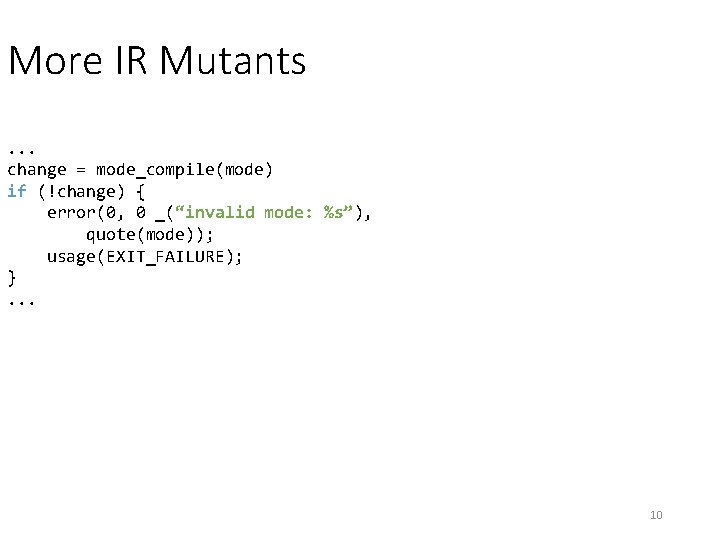
More IR Mutants. . . change = mode_compile(mode) if (!change) { error(0, 0 _(“invalid mode: %s”), quote(mode)); usage(EXIT_FAILURE); }. . . 10
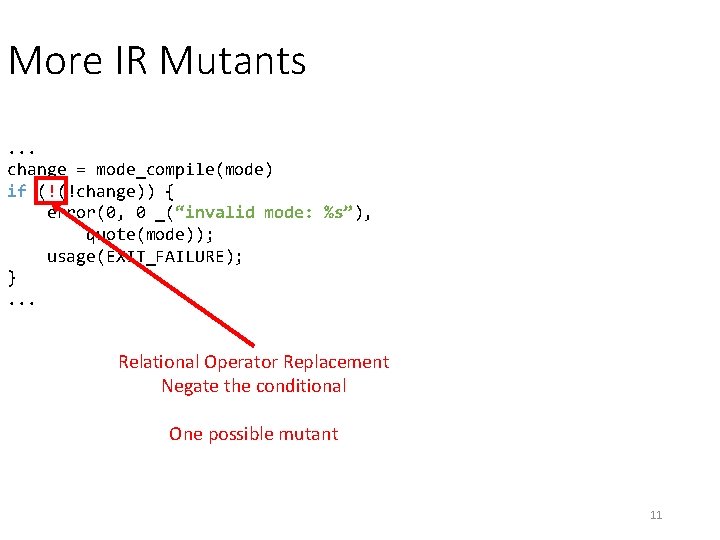
More IR Mutants. . . change = mode_compile(mode) if (!(!change)) { error(0, 0 _(“invalid mode: %s”), quote(mode)); usage(EXIT_FAILURE); }. . . Relational Operator Replacement Negate the conditional One possible mutant 11
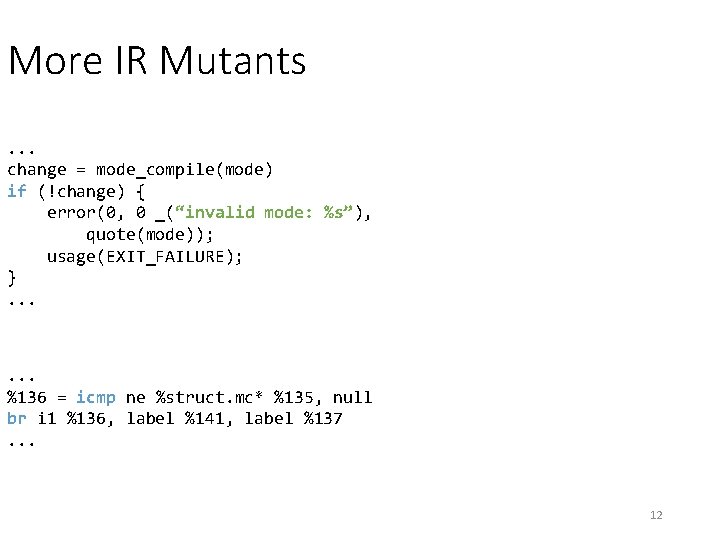
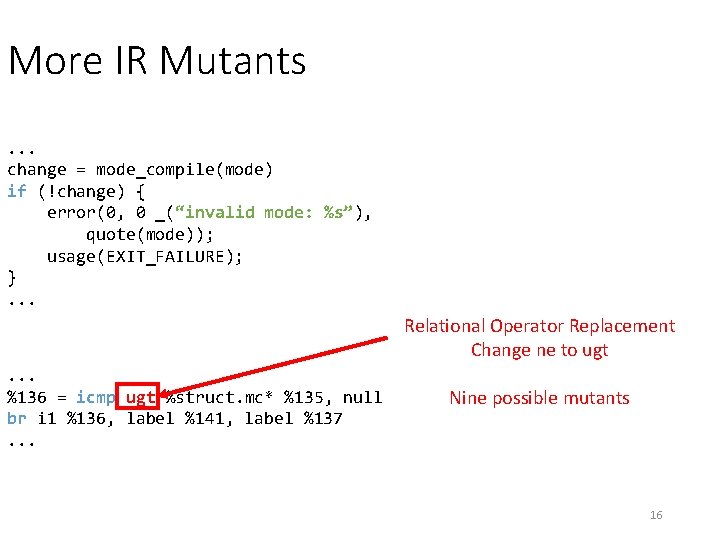
More IR Mutants. . . change = mode_compile(mode) if (!change) { error(0, 0 _(“invalid mode: %s”), quote(mode)); usage(EXIT_FAILURE); }. . . %136 = icmp ne %struct. mc* %135, null br i 1 %136, label %141, label %137. . . 12
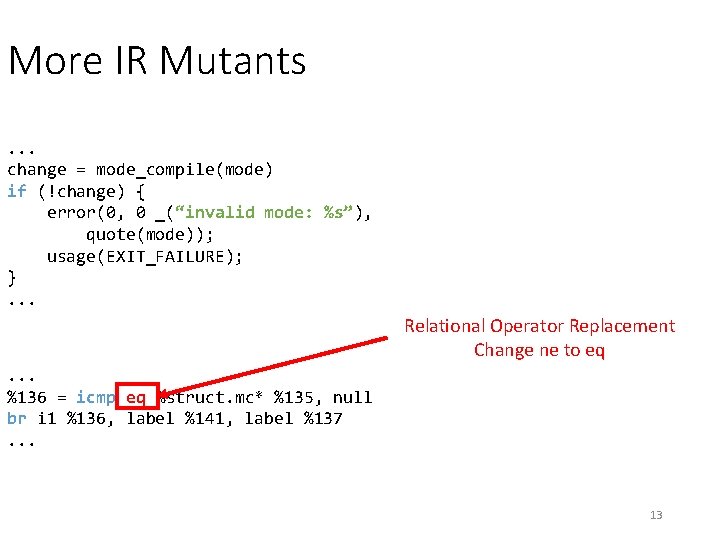
More IR Mutants. . . change = mode_compile(mode) if (!change) { error(0, 0 _(“invalid mode: %s”), quote(mode)); usage(EXIT_FAILURE); }. . . Relational Operator Replacement Change ne to eq. . . %136 = icmp eq %struct. mc* %135, null br i 1 %136, label %141, label %137. . . 13
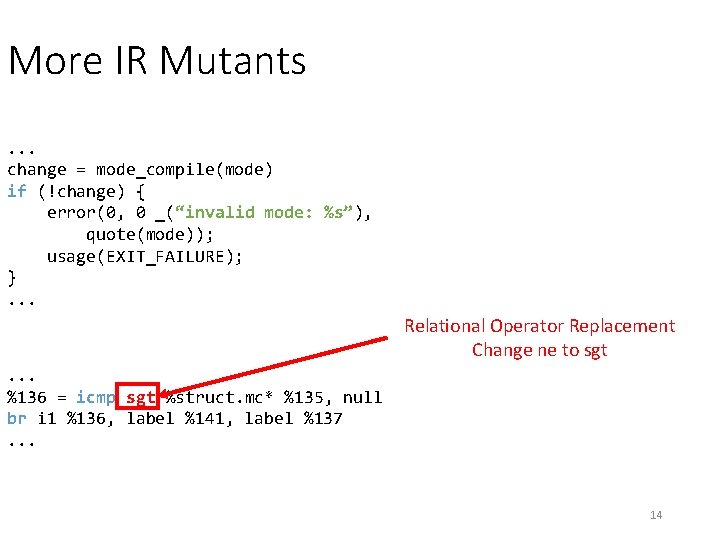
More IR Mutants. . . change = mode_compile(mode) if (!change) { error(0, 0 _(“invalid mode: %s”), quote(mode)); usage(EXIT_FAILURE); }. . . Relational Operator Replacement Change ne to sgt. . . %136 = icmp sgt %struct. mc* %135, null br i 1 %136, label %141, label %137. . . 14
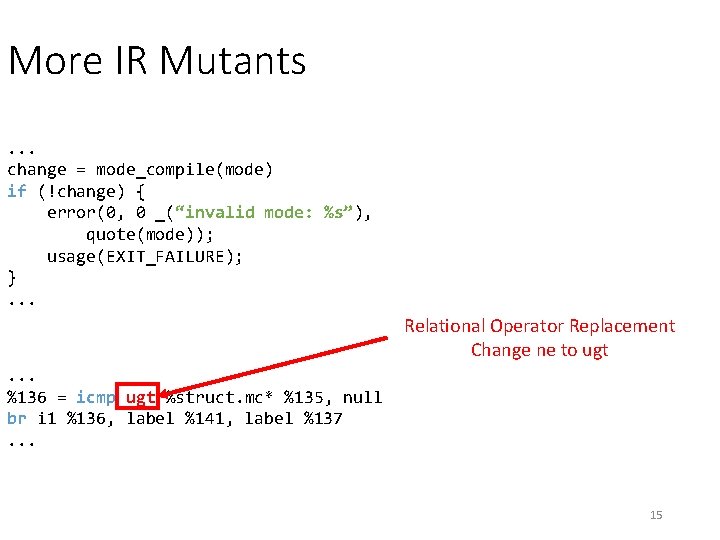
More IR Mutants. . . change = mode_compile(mode) if (!change) { error(0, 0 _(“invalid mode: %s”), quote(mode)); usage(EXIT_FAILURE); }. . . Relational Operator Replacement Change ne to ugt. . . %136 = icmp ugt %struct. mc* %135, null br i 1 %136, label %141, label %137. . . 15
More IR Mutants. . . change = mode_compile(mode) if (!change) { error(0, 0 _(“invalid mode: %s”), quote(mode)); usage(EXIT_FAILURE); }. . . Relational Operator Replacement Change ne to ugt. . . %136 = icmp ugt %struct. mc* %135, null br i 1 %136, label %141, label %137. . . Nine possible mutants 16
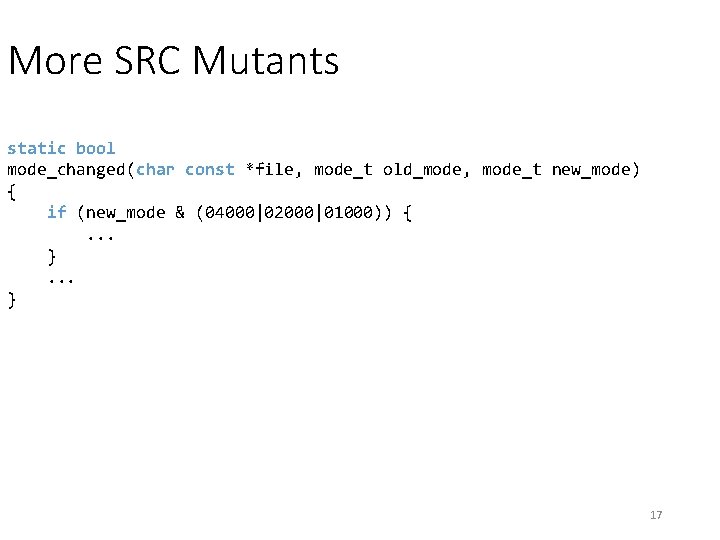
More SRC Mutants static bool mode_changed(char const *file, mode_t old_mode, mode_t new_mode) { if (new_mode & (04000|02000|01000)) {. . . } 17
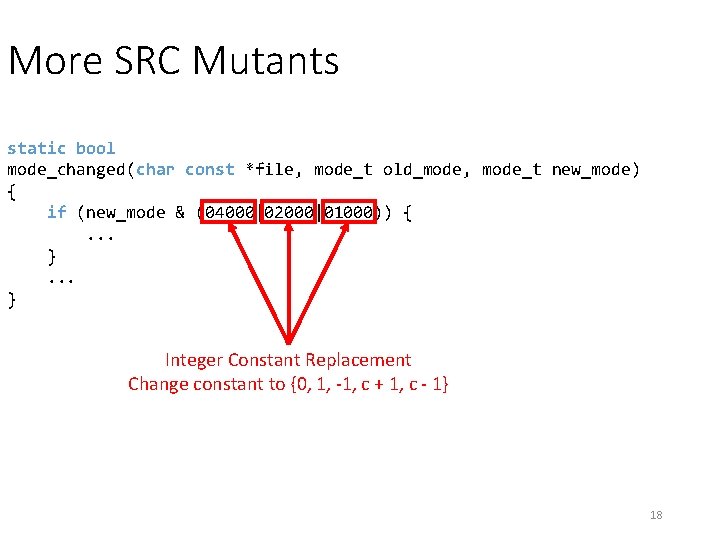
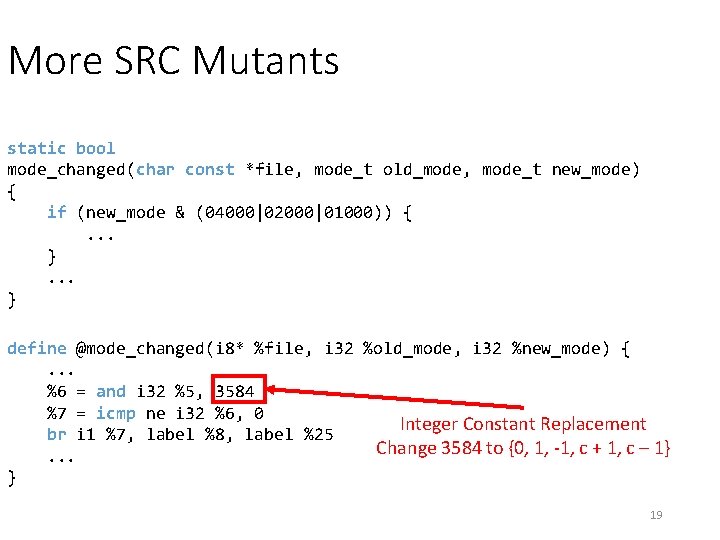
More SRC Mutants static bool mode_changed(char const *file, mode_t old_mode, mode_t new_mode) { if (new_mode & (04000|02000|01000)) {. . . } Integer Constant Replacement Change constant to {0, 1, -1, c + 1, c - 1} 3 x 5 = 15 possible mutants 18
More SRC Mutants static bool mode_changed(char const *file, mode_t old_mode, mode_t new_mode) { if (new_mode & (04000|02000|01000)) {. . . } define @mode_changed(i 8* %file, i 32 %old_mode, i 32 %new_mode) {. . . %6 = and i 32 %5, 3584 %7 = icmp ne i 32 %6, 0 Integer Constant Replacement br i 1 %7, label %8, label %25 Change 3584 to {0, 1, -1, c + 1, c – 1}. . . } 1 x 5 = 5 possible mutants 19
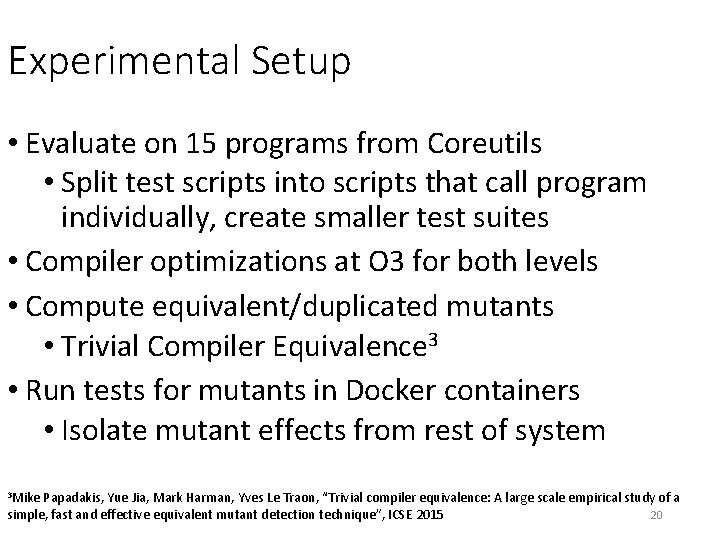
Experimental Setup • Evaluate on 15 programs from Coreutils • Split test scripts into scripts that call program individually, create smaller test suites • Compiler optimizations at O 3 for both levels • Compute equivalent/duplicated mutants • Trivial Compiler Equivalence 3 • Run tests for mutants in Docker containers • Isolate mutant effects from rest of system 3 Mike Papadakis, Yue Jia, Mark Harman, Yves Le Traon, “Trivial compiler equivalence: A large scale empirical study of a simple, fast and effective equivalent mutant detection technique”, ICSE 2015 20
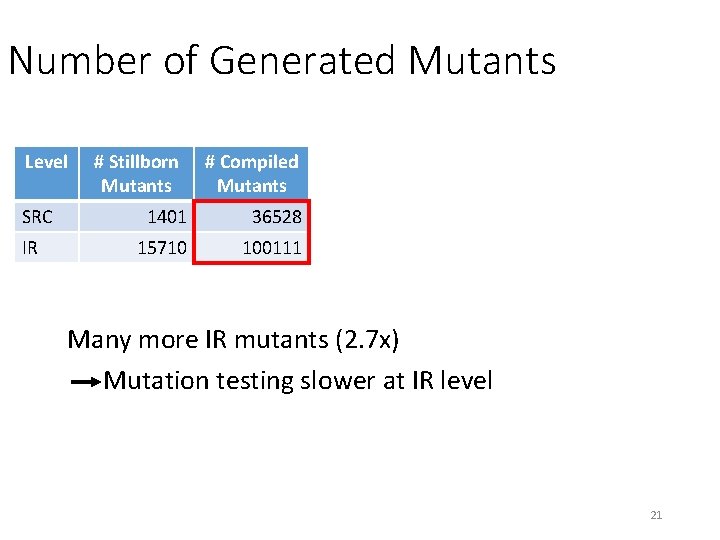
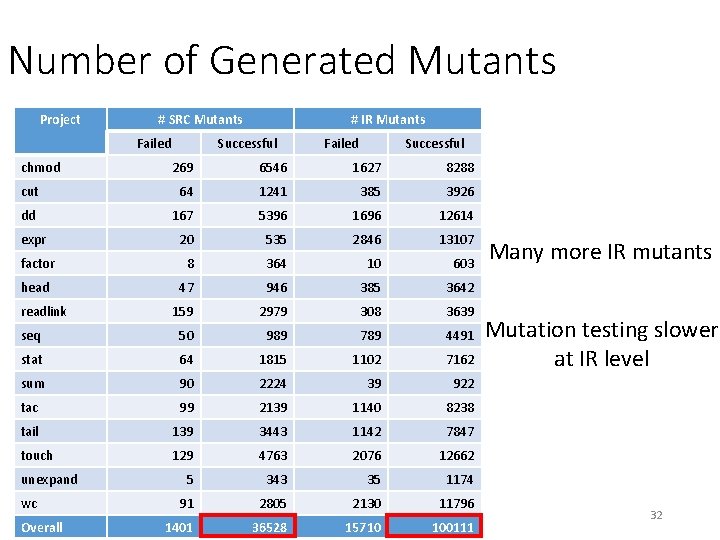
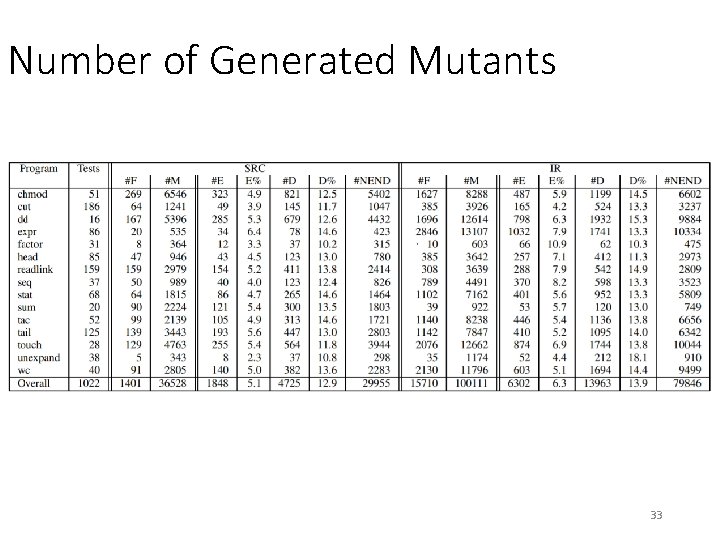
Number of Generated Mutants Level SRC IR # Stillborn Mutants # Compiled Mutants # Equiv % Equiv # Dup % Dup # NEND 1401 36528 1848 5. 1% 4725 12. 9% 29955 15710 100111 6302 6. 3% 13963 13. 9% 79846 Many more IR mutants (2. 7 x) Mutation testing slower at IR level 21
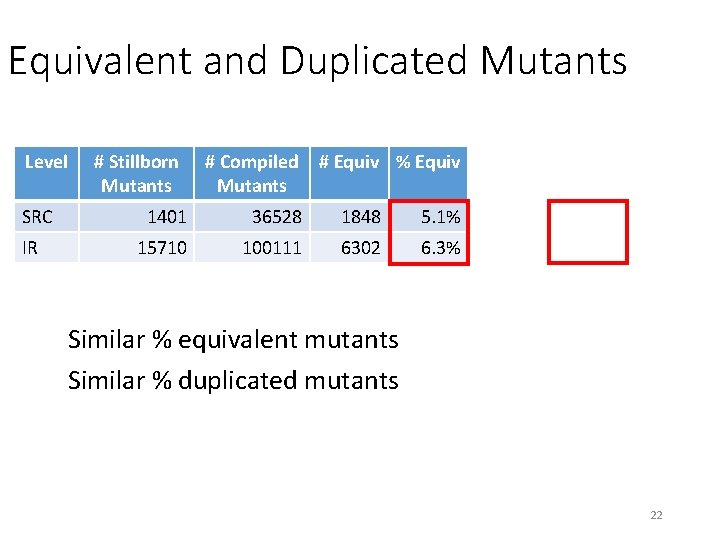
Equivalent and Duplicated Mutants Level SRC IR # Stillborn Mutants # Compiled Mutants # Equiv % Equiv # Dup % Dup # NEND 1401 36528 1848 5. 1% 4725 12. 9% 29955 15710 100111 6302 6. 3% 13963 13. 9% 79846 Similar % equivalent mutants Similar % duplicated mutants 22
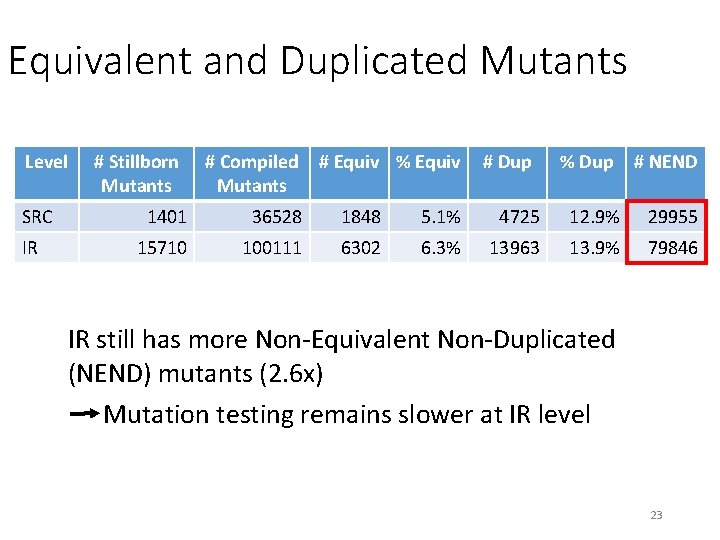
Equivalent and Duplicated Mutants Level SRC IR # Stillborn Mutants # Compiled Mutants # Equiv % Equiv # Dup % Dup # NEND 1401 36528 1848 5. 1% 4725 12. 9% 29955 15710 100111 6302 6. 3% 13963 13. 9% 79846 IR still has more Non-Equivalent Non-Duplicated (NEND) mutants (2. 6 x) Mutation testing remains slower at IR level 23
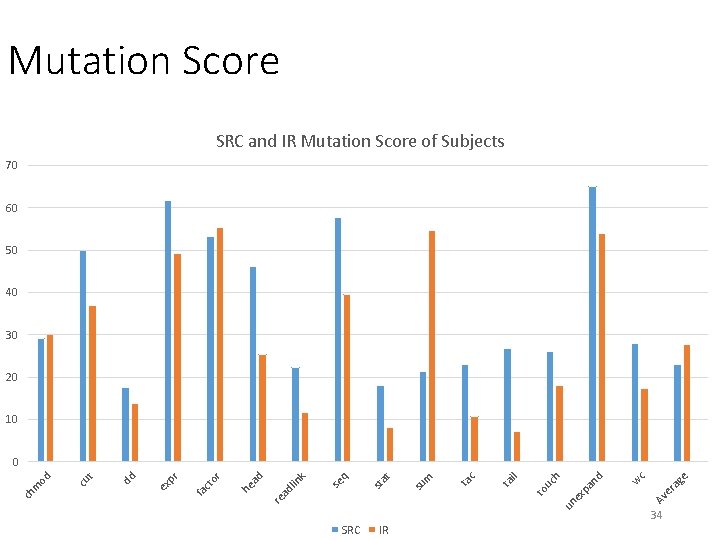
Mutation Score = median = mean Quite similar mutation scores How do they correlate? 24
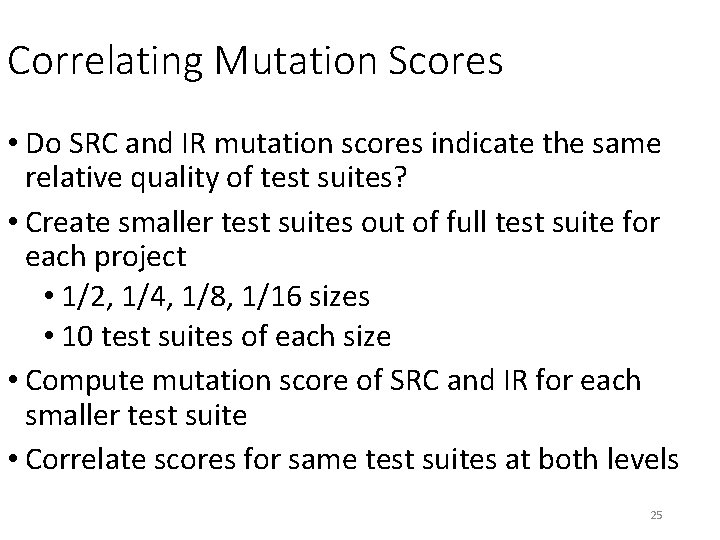
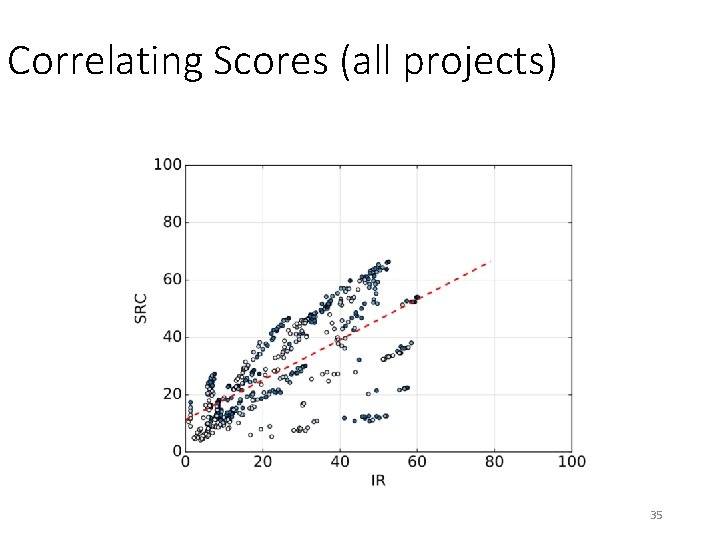
Correlating Mutation Scores • Do SRC and IR mutation scores indicate the same relative quality of test suites? • Create smaller test suites out of full test suite for each project • 1/2, 1/4, 1/8, 1/16 sizes • 10 test suites of each size • Compute mutation score of SRC and IR for each smaller test suite • Correlate scores for same test suites at both levels 25
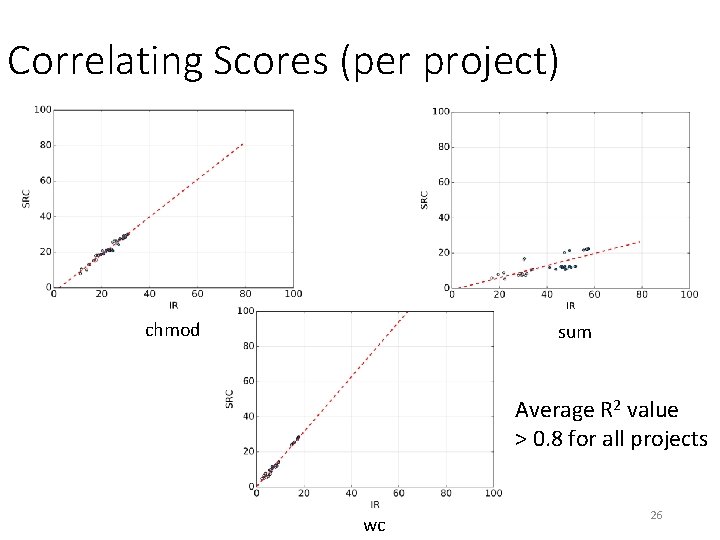
Correlating Scores (per project) chmod sum Average R 2 value > 0. 8 for all projects wc 26
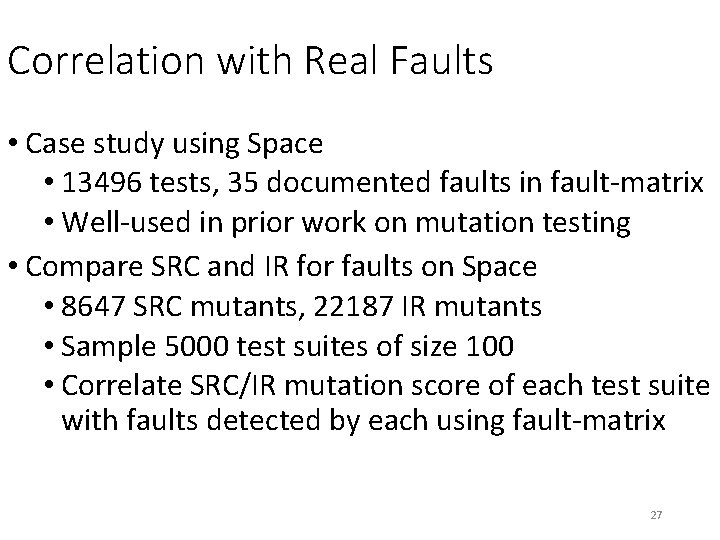
Correlation with Real Faults • Case study using Space • 13496 tests, 35 documented faults in fault-matrix • Well-used in prior work on mutation testing • Compare SRC and IR for faults on Space • 8647 SRC mutants, 22187 IR mutants • Sample 5000 test suites of size 100 • Correlate SRC/IR mutation score of each test suite with faults detected by each using fault-matrix 27
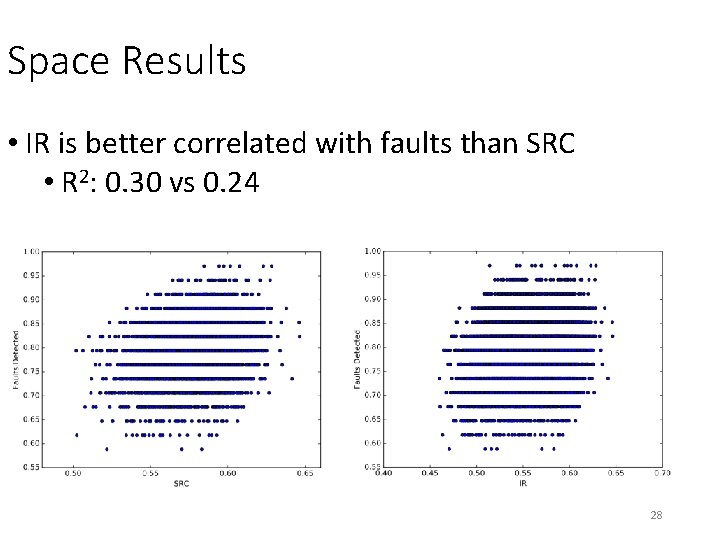
Space Results • IR is better correlated with faults than SRC • R 2: 0. 30 vs 0. 24 28
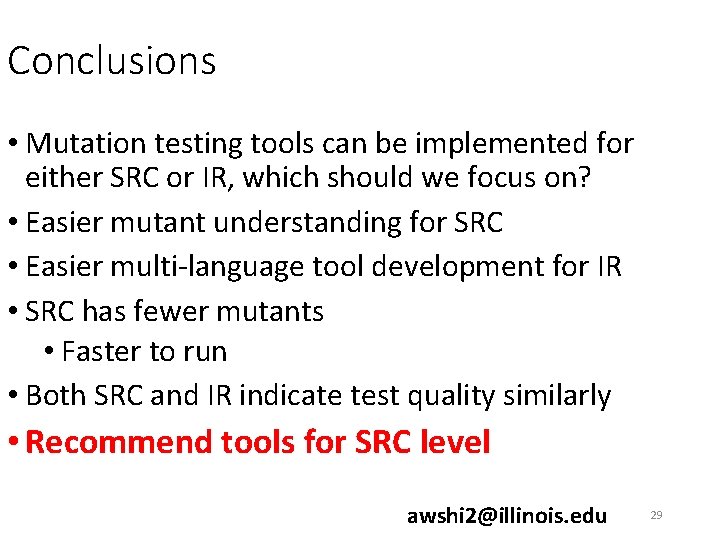
Conclusions • Mutation testing tools can be implemented for either SRC or IR, which should we focus on? • Easier mutant understanding for SRC • Easier multi-language tool development for IR • SRC has fewer mutants • Faster to run • Both SRC and IR indicate test quality similarly • Recommend tools for SRC level awshi 2@illinois. edu 29
BACKUP
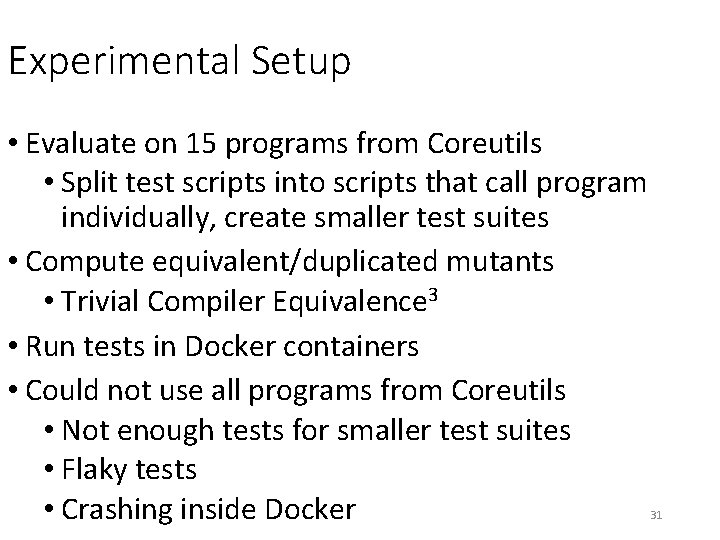
Experimental Setup • Evaluate on 15 programs from Coreutils • Split test scripts into scripts that call program individually, create smaller test suites • Compute equivalent/duplicated mutants • Trivial Compiler Equivalence 3 • Run tests in Docker containers • Could not use all programs from Coreutils • Not enough tests for smaller test suites • Flaky tests • Crashing inside Docker 31
Number of Generated Mutants Project # SRC Mutants Failed chmod # IR Mutants Successful Failed Successful 269 6546 1627 8288 cut 64 1241 385 3926 dd 167 5396 1696 12614 20 535 2846 13107 factor 8 364 10 603 head 47 946 385 3642 159 2979 308 3639 seq 50 989 789 4491 stat 64 1815 1102 7162 sum 90 2224 39 922 tac 99 2139 1140 8238 tail 139 3443 1142 7847 touch 129 4763 2076 12662 5 343 35 1174 91 2805 2130 11796 1401 36528 15710 100111 expr readlink unexpand wc Overall Many more IR mutants Mutation testing slower at IR level 32
Number of Generated Mutants 33
Mutation Score SRC and IR Mutation Score of Subjects 70 60 50 40 30 20 10 SRC IR e c er ag w Av un ex pa nd h uc to il ta ta c m su at st q se k lin ad re ad he r to pr ex dd t cu fa c ch m od 0 34
Correlating Scores (all projects) 35
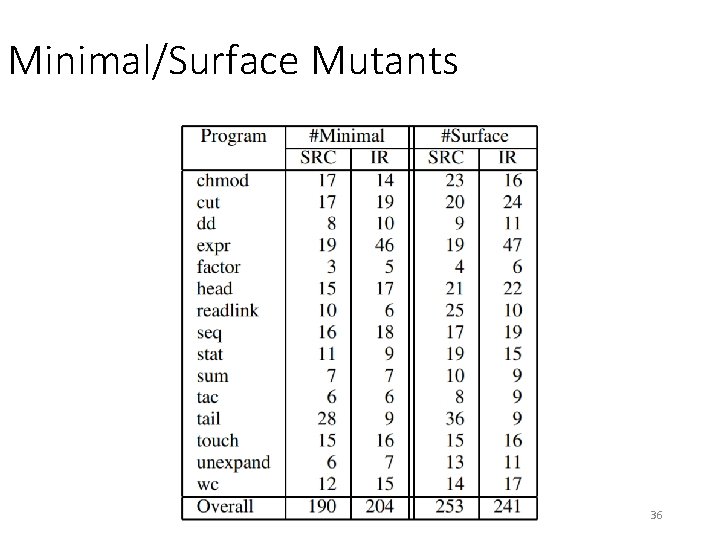
Minimal/Surface Mutants 36