
Comparing Large Underground Neutrino Detector Technologies Liquid Argon
- Slides: 18
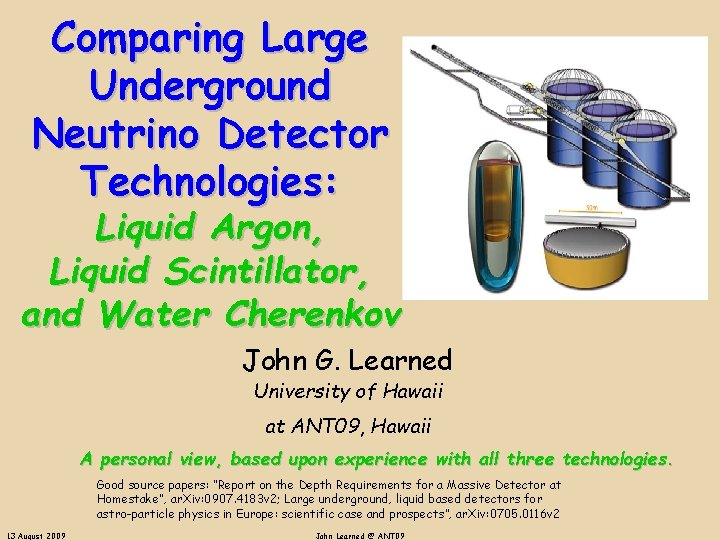
Comparing Large Underground Neutrino Detector Technologies: Liquid Argon, Liquid Scintillator, and Water Cherenkov John G. Learned University of Hawaii at ANT 09, Hawaii A personal view, based upon experience with all three technologies. Good source papers: “Report on the Depth Requirements for a Massive Detector at Homestake”, ar. Xiv: 0907. 4183 v 2; Large underground, liquid based detectors for astro-particle physics in Europe: scientific case and prospects”, ar. Xiv: 0705. 0116 v 2 13 August 2009 John Learned @ ANT 09
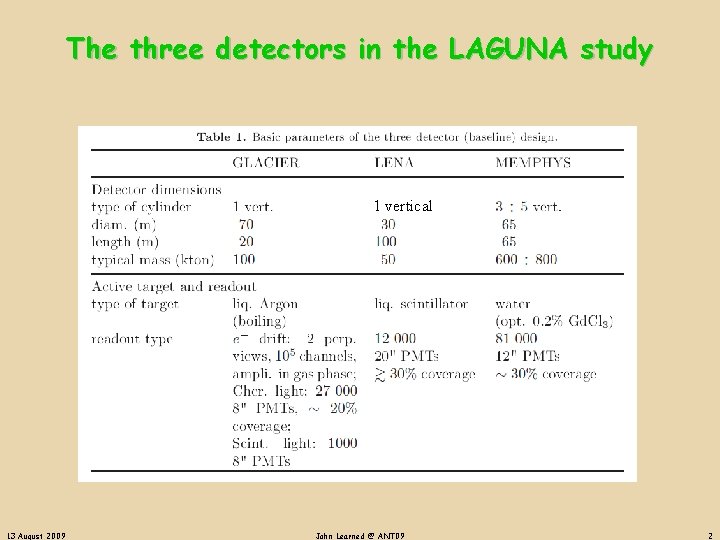
The three detectors in the LAGUNA study 1 vertical 13 August 2009 John Learned @ ANT 09 2
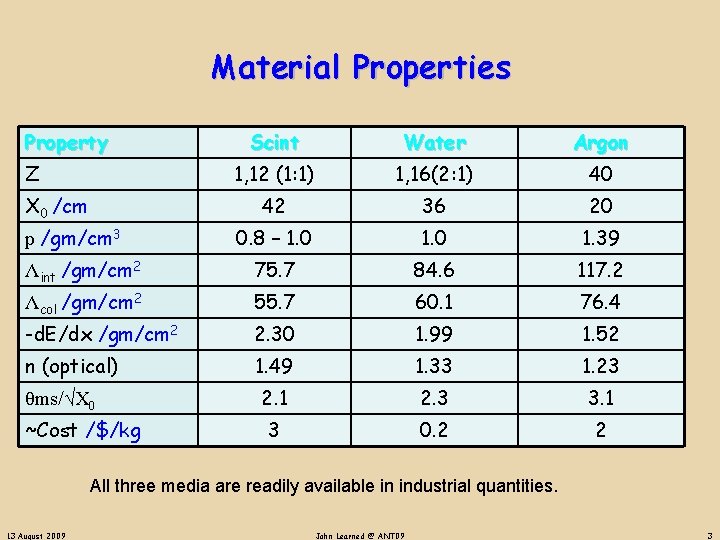
Material Properties Property Scint Water Argon 1, 12 (1: 1) 1, 16(2: 1) 40 42 36 20 0. 8 – 1. 0 1. 39 Λint /gm/cm 2 75. 7 84. 6 117. 2 Λcol /gm/cm 2 55. 7 60. 1 76. 4 -d. E/dx /gm/cm 2 2. 30 1. 99 1. 52 n (optical) 1. 49 1. 33 1. 23 2. 1 2. 3 3. 1 3 0. 2 2 Z X 0 /cm p /gm/cm 3 θms/√X 0 ~Cost /$/kg All three media are readily available in industrial quantities. 13 August 2009 John Learned @ ANT 09 3
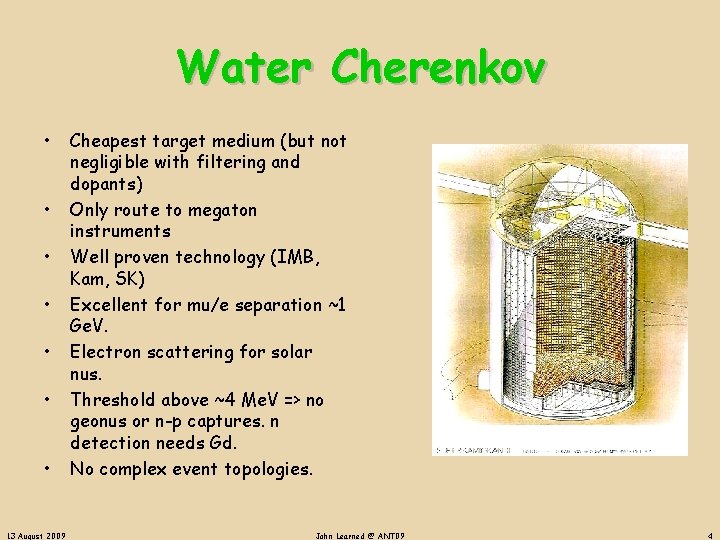
Water Cherenkov • • 13 August 2009 Cheapest target medium (but not negligible with filtering and dopants) Only route to megaton instruments Well proven technology (IMB, Kam, SK) Excellent for mu/e separation ~1 Ge. V. Electron scattering for solar nus. Threshold above ~4 Me. V => no geonus or n-p captures. n detection needs Gd. No complex event topologies. John Learned @ ANT 09 4
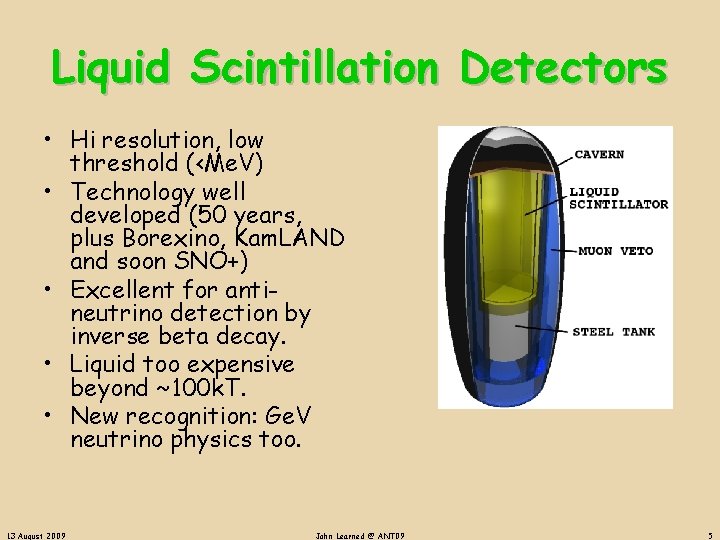
Liquid Scintillation Detectors • Hi resolution, low threshold (<Me. V) • Technology well developed (50 years, plus Borexino, Kam. LAND and soon SNO+) • Excellent for antineutrino detection by inverse beta decay. • Liquid too expensive beyond ~100 k. T. • New recognition: Ge. V neutrino physics too. 13 August 2009 John Learned @ ANT 09 5
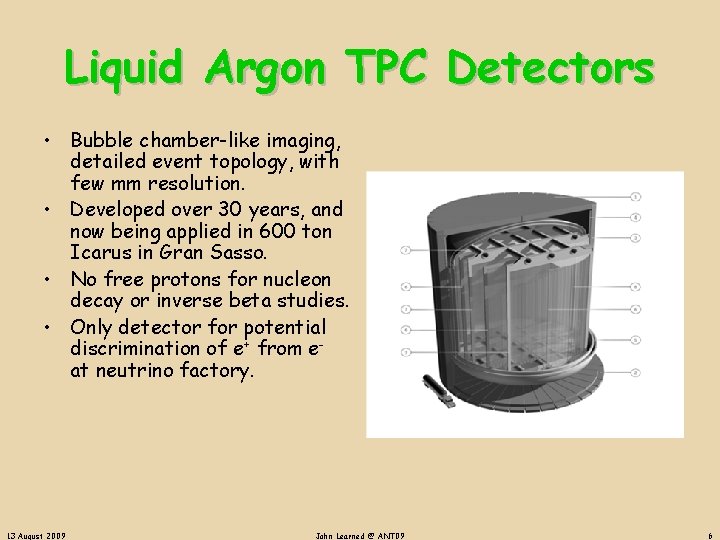
Liquid Argon TPC Detectors • Bubble chamber-like imaging, detailed event topology, with few mm resolution. • Developed over 30 years, and now being applied in 600 ton Icarus in Gran Sasso. • No free protons for nucleon decay or inverse beta studies. • Only detector for potential discrimination of e+ from eat neutrino factory. 13 August 2009 John Learned @ ANT 09 6
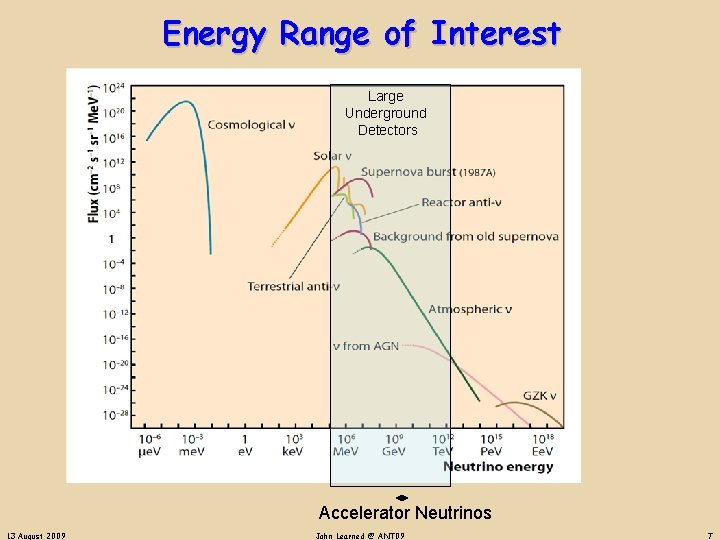
Energy Range of Interest Large Underground Detectors Accelerator Neutrinos 13 August 2009 John Learned @ ANT 09 7
Liquid Treatment • All three require special facilities, all expensive and a bit hard to compare. • Lesson of past: do great job on first fill into superclean detector, detector have radon tight system, and do not have to recirculate much or at all. 13 August 2009 John Learned @ ANT 09 8
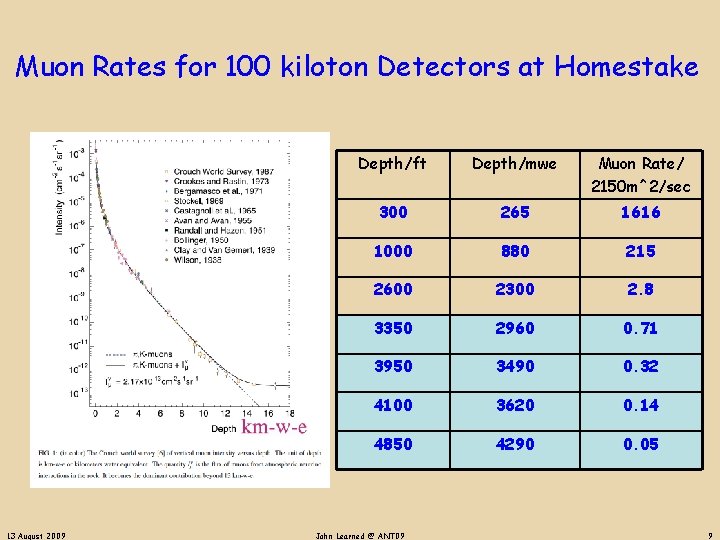
Muon Rates for 100 kiloton Detectors at Homestake 13 August 2009 Depth/ft Depth/mwe Muon Rate/ 2150 m^2/sec 300 265 1616 1000 880 215 2600 2300 2. 8 3350 2960 0. 71 3950 3490 0. 32 4100 3620 0. 14 4850 4290 0. 05 John Learned @ ANT 09 9
Depth Requirements • All depends upon physics goals… • Also depends upon detector size… external backgrounds (eg. from muon showers in rock); worst for small instruments. Big detectors take hit near periphery. • Great depth only needed for Me. V measurements (geonus, low end of solar). • PDK, accelerator studies, atm nus, SN, DSNB all can be done at much less depth… exact depth arguable depending upon technique and physics. 13 August 2009 John Learned @ ANT 09 10
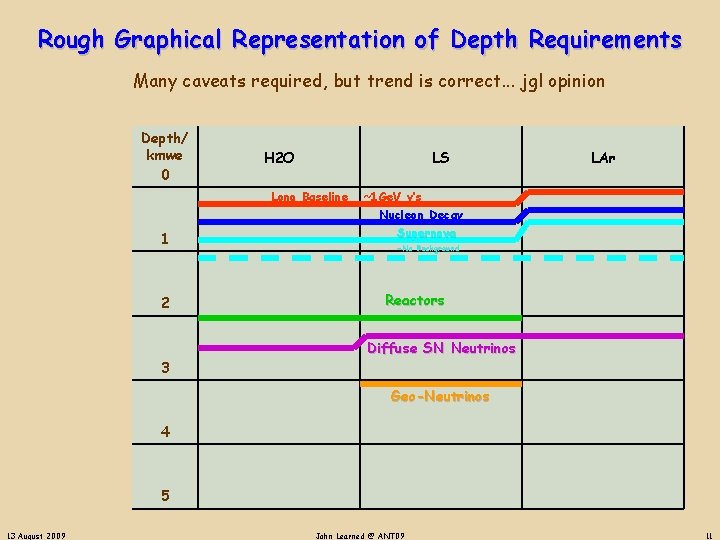
Rough Graphical Representation of Depth Requirements Many caveats required, but trend is correct. . . jgl opinion Depth/ kmwe 0 H 2 O LS Long Baseline 1 2 3 LAr ~1 Ge. V ν’s Nucleon Decay Supernova ~No Background Reactors Diffuse SN Neutrinos Geo-Neutrinos 4 5 13 August 2009 John Learned @ ANT 09 11
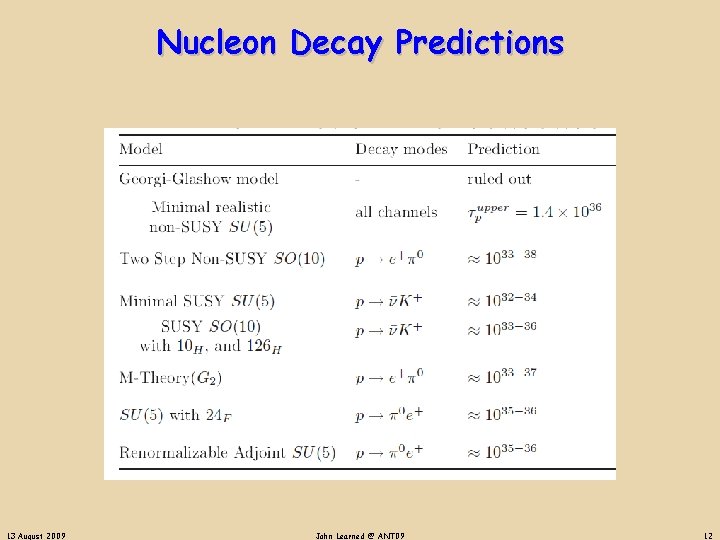
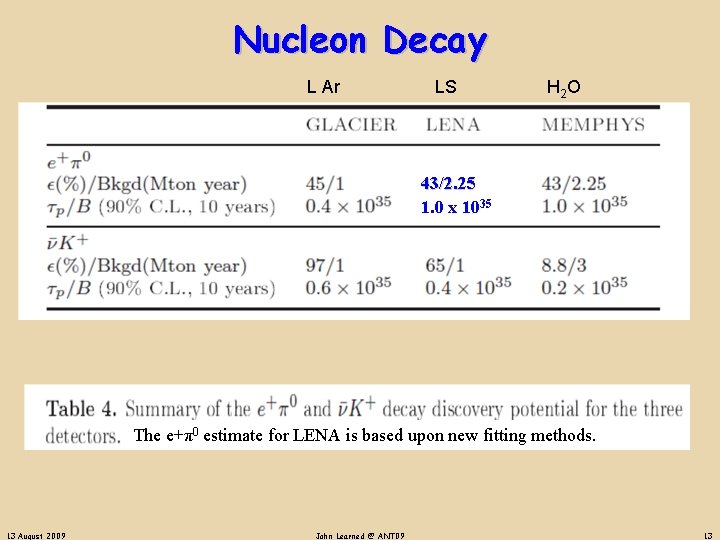
Nucleon Decay Predictions 13 August 2009 John Learned @ ANT 09 12
Nucleon Decay L Ar LS H 2 O 43/2. 25 1. 0 x 1035 The e+π0 estimate for LENA is based upon new fitting methods. 13 August 2009 John Learned @ ANT 09 13
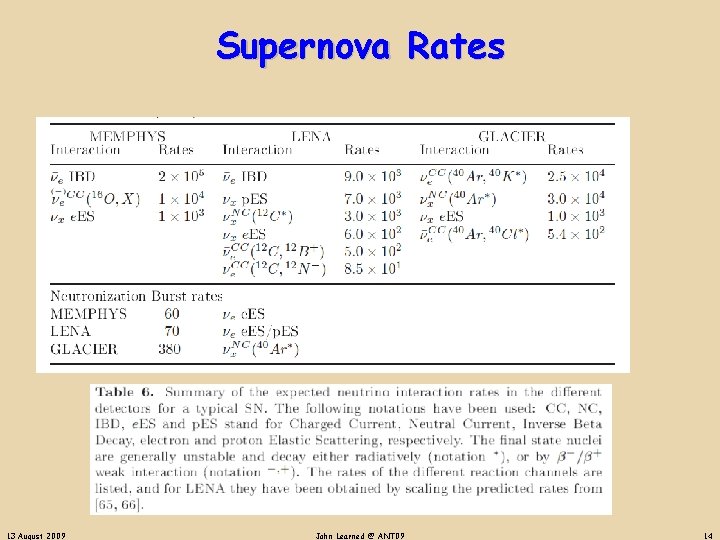
Supernova Rates 13 August 2009 John Learned @ ANT 09 14
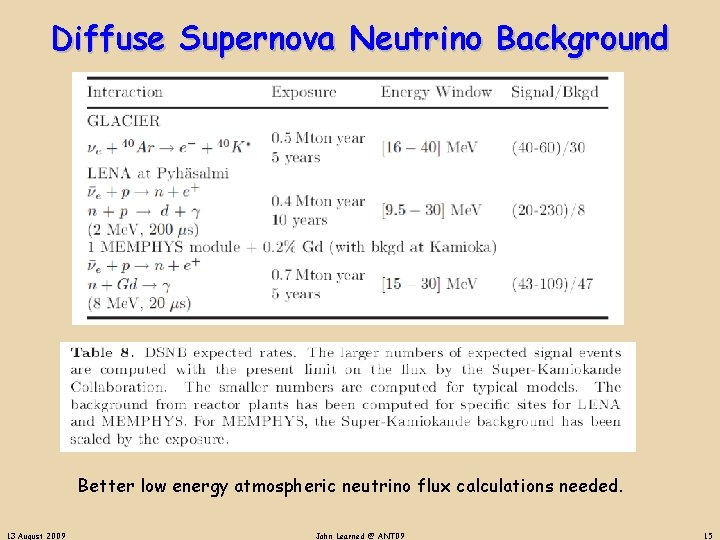
Diffuse Supernova Neutrino Background Better low energy atmospheric neutrino flux calculations needed. 13 August 2009 John Learned @ ANT 09 15
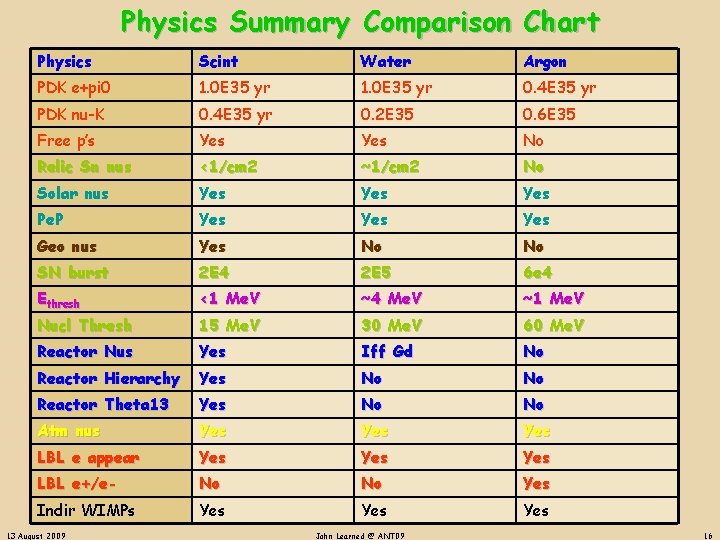
Physics Summary Comparison Chart Physics Scint Water Argon PDK e+pi 0 1. 0 E 35 yr 0. 4 E 35 yr PDK nu-K 0. 4 E 35 yr 0. 2 E 35 0. 6 E 35 Free p’s Yes No Relic Sn nus <1/cm 2 ~1/cm 2 No Solar nus Yes Yes Pe. P Yes Yes Geo nus Yes No No SN burst 2 E 4 2 E 5 6 e 4 Ethresh <1 Me. V ~4 Me. V ~1 Me. V Nucl Thresh 15 Me. V 30 Me. V 60 Me. V Reactor Nus Yes Iff Gd No Reactor Hierarchy Yes No No Reactor Theta 13 Yes No No Atm nus Yes Yes LBL e appear Yes Yes LBL e+/e- No No Yes Indir WIMPs Yes Yes 13 August 2009 John Learned @ ANT 09 16
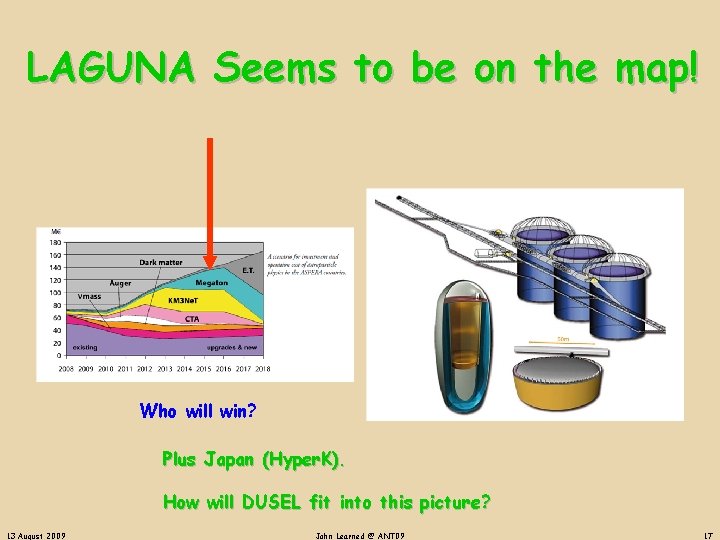
LAGUNA Seems to be on the map! Who will win? Plus Japan (Hyper. K). How will DUSEL fit into this picture? 13 August 2009 John Learned @ ANT 09 17
Bottom Line • Each has strengths • Long range: LAr wins for detailed neutrino physics in LBL, tho nice anytime • Great sizes (megaton): H 2 O wins • Low energies: Liquid Scint wins (particularly for geonus) • Cost/vol hierarchy: LAr: LS: H 2 O • Readiness: LS & H 2 O > LAr • I like them all!! 13 August 2009 John Learned @ ANT 09 18