
Comparing Job Offers 1 1 3 Take Charge

Comparing Job Offers 1. 1. 3 Take Charge of Your Finances Family Economics and Financial Education

1. 1. 3. G 1 Apply Smart Goals to your Career Pathway • • • S M A R T © Family Economics & Financial Education – Revised May 2009 – Career Development Unit – Comparing Job Offers – Slide 2 Funded by a grant from Take Charge America, Inc. to the Norton School of Family and Consumer Sciences at the University of Arizona

1. 1. 3. G 1 What happens in step 2 in the cycle of career planning and management? 1. 3. Job Search Résumés Networking Interviewing Applications Career Planning And Management Self-Assessment Interests Skills Personality Values 2. Career Exploration Occupational Outlook Employment Trends Education & Training Cost of Living © Family Economics & Financial Education – Revised May 2009 – Career Development Unit – Comparing Job Offers – Slide 3 Funded by a grant from Take Charge America, Inc. to the Norton School of Family and Consumer Sciences at the University of Arizona
1. 1. 3. G 1 Supply and Demand • The availability of jobs and the rate of pay is dependent upon the economic concept of supply and demand. – Supply – the relationship of prices to the quantities of a good or service that sellers are willing to sell at any given point in time. – Demand – the relationship between prices and the corresponding quantities of a good or service individuals are willing to purchase at © Family Economics & Financial Education – Revised May 2009 – Career Development Unit – Comparing Job Offers – Slide 4 Funded by a grant from Take Charge America, Inc. to the Norton School of Family and Consumer Sciences at the University of Arizona

1. 1. 3. G 1 Congratulations! • Sara just graduated from college with a teaching degree and received two job offers. Which is the best deal? © Family Economics & Financial Education – Revised May 2009 – Career Development Unit – Comparing Job Offers – Slide 5 Funded by a grant from Take Charge America, Inc. to the Norton School of Family and Consumer Sciences at the University of Arizona
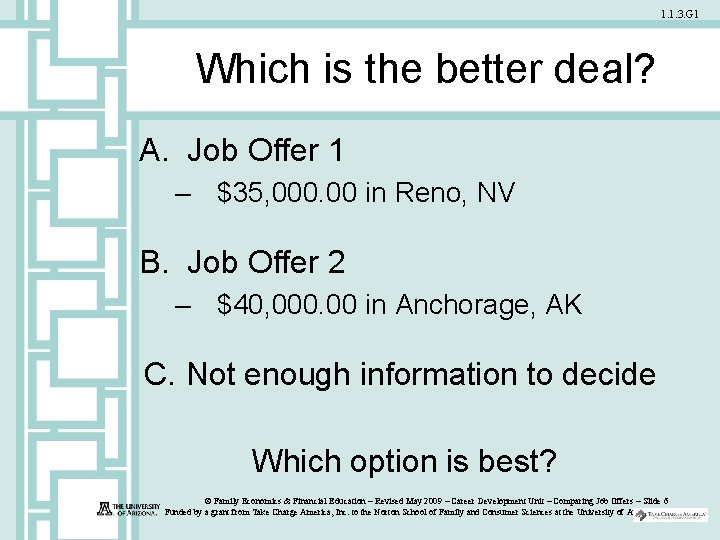
1. 1. 3. G 1 Which is the better deal? A. Job Offer 1 – $35, 000. 00 in Reno, NV B. Job Offer 2 – $40, 000. 00 in Anchorage, AK C. Not enough information to decide Which option is best? © Family Economics & Financial Education – Revised May 2009 – Career Development Unit – Comparing Job Offers – Slide 6 Funded by a grant from Take Charge America, Inc. to the Norton School of Family and Consumer Sciences at the University of Arizona
1. 1. 3. G 1 Cost of Living • Cost of living – includes housing, food, transportation, and other everyday expenses. –Rural communities often have a lower cost of living than urban communities. • Index form – rates communities on a scale of 100. 0 and gives an average cost community a rating of 100. 0. –A lower index means a lower cost of living. –A higher index means a higher cost of living. © Family Economics & Financial Education – Revised May 2009 – Career Development Unit – Comparing Job Offers – Slide 7 Funded by a grant from Take Charge America, Inc. to the Norton School of Family and Consumer Sciences at the University of Arizona
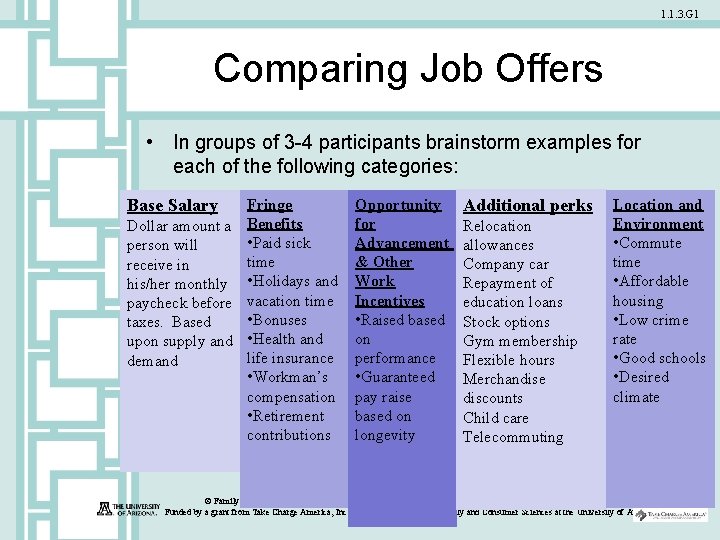
1. 1. 3. G 1 Comparing Job Offers • In groups of 3 -4 participants brainstorm examples for each of the following categories: Fringe Dollar amount a Benefits • Paid sick person will time receive in his/her monthly • Holidays and paycheck before vacation time • Bonuses taxes. Based upon supply and • Health and life insurance demand • Workman’s compensation • Retirement contributions Base Salary Opportunity for Advancement & Other Work Incentives • Raised based on performance • Guaranteed pay raise based on longevity Additional perks Relocation allowances Company car Repayment of education loans Stock options Gym membership Flexible hours Merchandise discounts Child care Telecommuting Location and Environment • Commute time • Affordable housing • Low crime rate • Good schools • Desired climate © Family Economics & Financial Education – Revised May 2009 – Career Development Unit – Comparing Job Offers – Slide 8 Funded by a grant from Take Charge America, Inc. to the Norton School of Family and Consumer Sciences at the University of Arizona
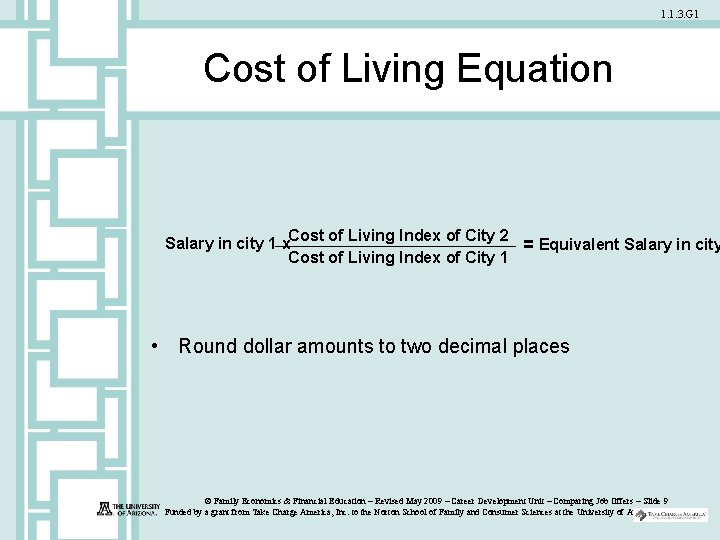
1. 1. 3. G 1 Cost of Living Equation Cost of Living Index of City 2 Salary in city 1 x = Equivalent Salary in city Cost of Living Index of City 1 • Round dollar amounts to two decimal places © Family Economics & Financial Education – Revised May 2009 – Career Development Unit – Comparing Job Offers – Slide 9 Funded by a grant from Take Charge America, Inc. to the Norton School of Family and Consumer Sciences at the University of Arizona
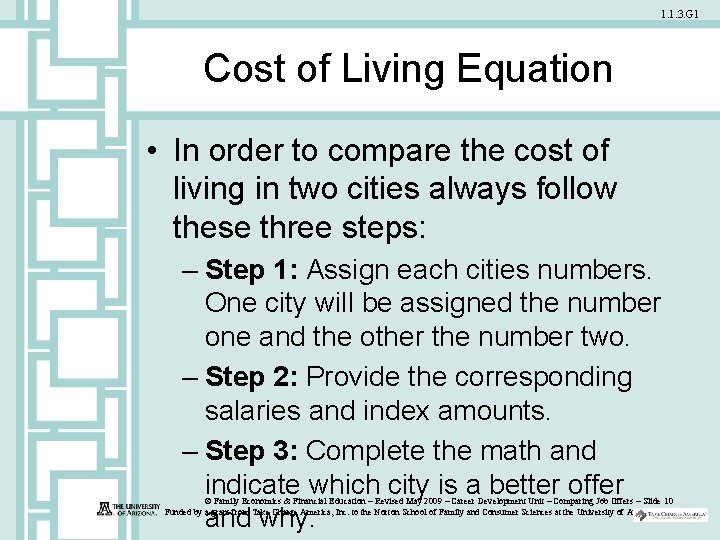
1. 1. 3. G 1 Cost of Living Equation • In order to compare the cost of living in two cities always follow these three steps: – Step 1: Assign each cities numbers. One city will be assigned the number one and the other the number two. – Step 2: Provide the corresponding salaries and index amounts. – Step 3: Complete the math and indicate which city is a better offer and why. © Family Economics & Financial Education – Revised May 2009 – Career Development Unit – Comparing Job Offers – Slide 10 Funded by a grant from Take Charge America, Inc. to the Norton School of Family and Consumer Sciences at the University of Arizona
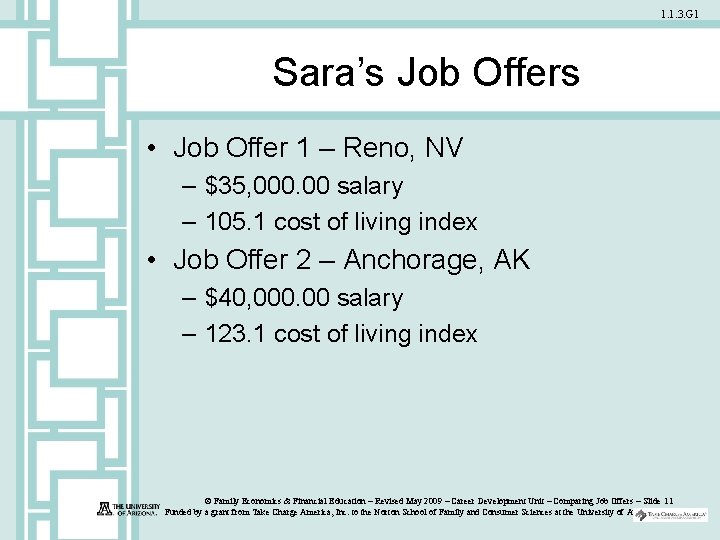
1. 1. 3. G 1 Sara’s Job Offers • Job Offer 1 – Reno, NV – $35, 000. 00 salary – 105. 1 cost of living index • Job Offer 2 – Anchorage, AK – $40, 000. 00 salary – 123. 1 cost of living index © Family Economics & Financial Education – Revised May 2009 – Career Development Unit – Comparing Job Offers – Slide 11 Funded by a grant from Take Charge America, Inc. to the Norton School of Family and Consumer Sciences at the University of Arizona
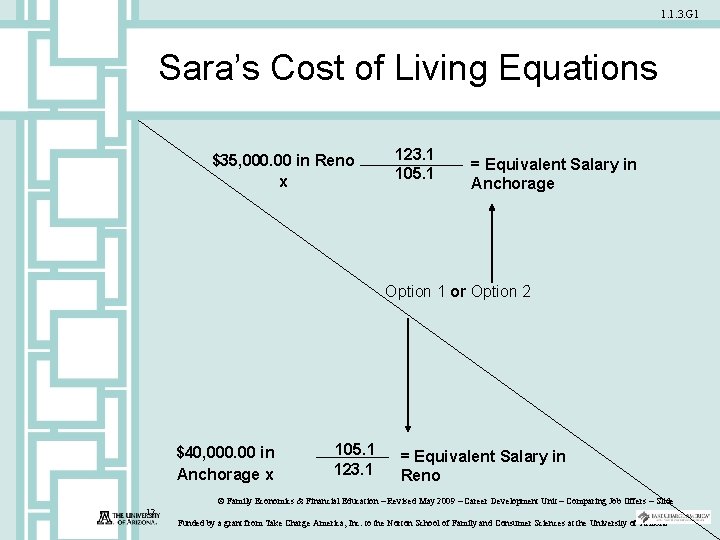
1. 1. 3. G 1 Sara’s Cost of Living Equations $35, 000. 00 in Reno x 123. 1 105. 1 = Equivalent Salary in Anchorage Option 1 or Option 2 $40, 000. 00 in Anchorage x 105. 1 123. 1 = Equivalent Salary in Reno © Family Economics & Financial Education – Revised May 2009 – Career Development Unit – Comparing Job Offers – Slide 12 Funded by a grant from Take Charge America, Inc. to the Norton School of Family and Consumer Sciences at the University of Arizona
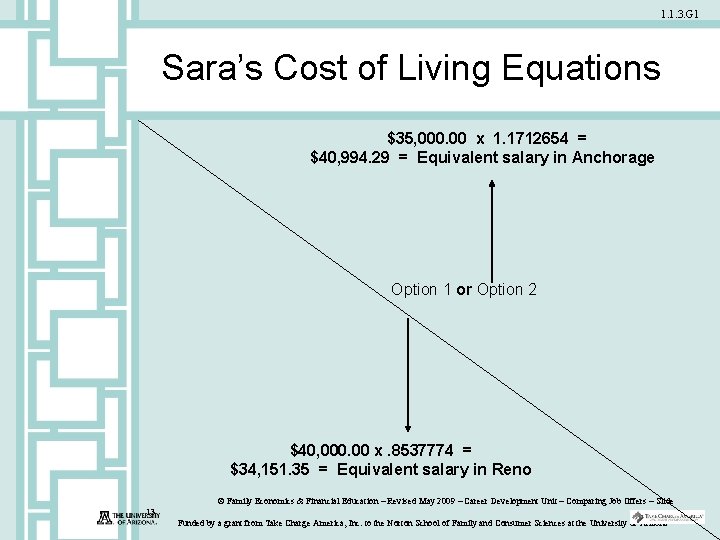
1. 1. 3. G 1 Sara’s Cost of Living Equations $35, 000. 00 x 1. 1712654 = $40, 994. 29 = Equivalent salary in Anchorage Option 1 or Option 2 $40, 000. 00 x. 8537774 = $34, 151. 35 = Equivalent salary in Reno © Family Economics & Financial Education – Revised May 2009 – Career Development Unit – Comparing Job Offers – Slide 13 Funded by a grant from Take Charge America, Inc. to the Norton School of Family and Consumer Sciences at the University of Arizona
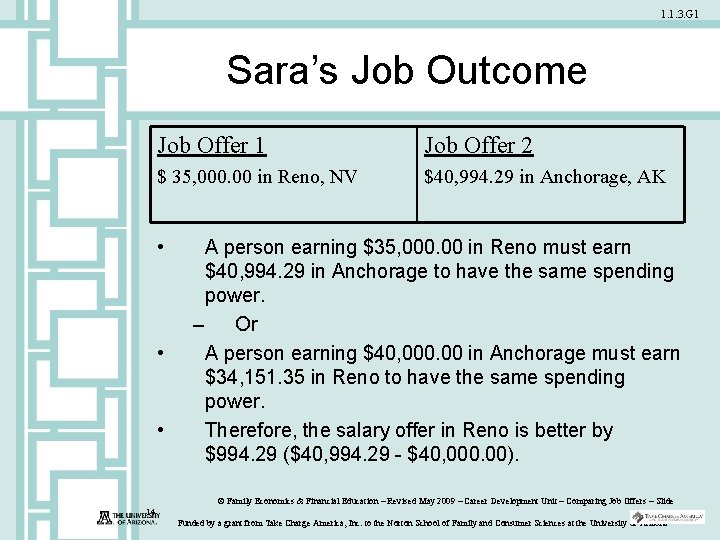
1. 1. 3. G 1 Sara’s Job Outcome Job Offer 1 Job Offer 2 $ 35, 000. 00 in Reno, NV $40, 994. 29 in Anchorage, AK • • • A person earning $35, 000. 00 in Reno must earn $40, 994. 29 in Anchorage to have the same spending power. – Or A person earning $40, 000. 00 in Anchorage must earn $34, 151. 35 in Reno to have the same spending power. Therefore, the salary offer in Reno is better by $994. 29 ($40, 994. 29 - $40, 000. 00). © Family Economics & Financial Education – Revised May 2009 – Career Development Unit – Comparing Job Offers – Slide 14 Funded by a grant from Take Charge America, Inc. to the Norton School of Family and Consumer Sciences at the University of Arizona
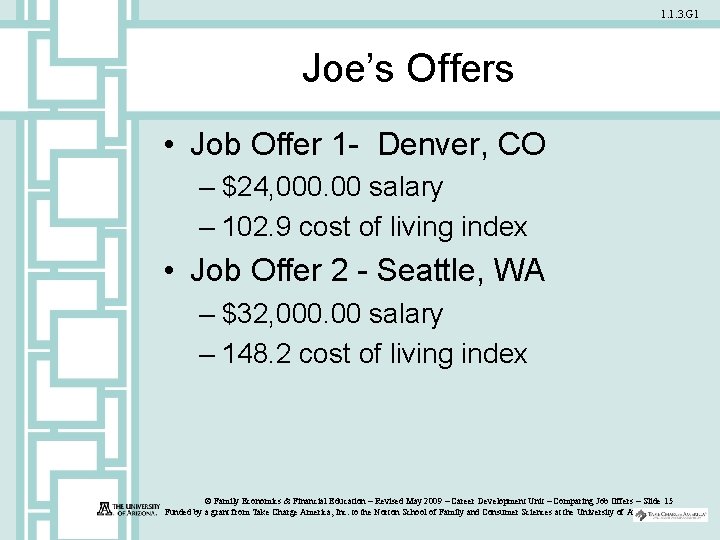
1. 1. 3. G 1 Joe’s Offers • Job Offer 1 - Denver, CO – $24, 000. 00 salary – 102. 9 cost of living index • Job Offer 2 - Seattle, WA – $32, 000. 00 salary – 148. 2 cost of living index © Family Economics & Financial Education – Revised May 2009 – Career Development Unit – Comparing Job Offers – Slide 15 Funded by a grant from Take Charge America, Inc. to the Norton School of Family and Consumer Sciences at the University of Arizona
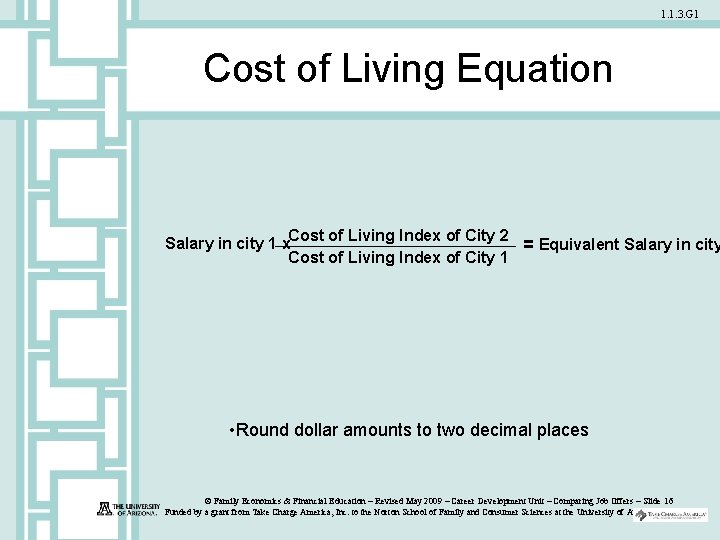
1. 1. 3. G 1 Cost of Living Equation Cost of Living Index of City 2 Salary in city 1 x = Equivalent Salary in city Cost of Living Index of City 1 • Round dollar amounts to two decimal places © Family Economics & Financial Education – Revised May 2009 – Career Development Unit – Comparing Job Offers – Slide 16 Funded by a grant from Take Charge America, Inc. to the Norton School of Family and Consumer Sciences at the University of Arizona
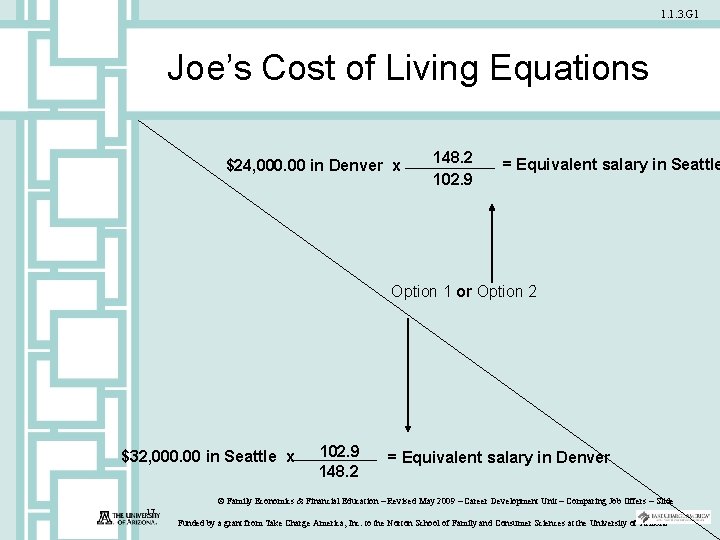
1. 1. 3. G 1 Joe’s Cost of Living Equations $24, 000. 00 in Denver x 148. 2 102. 9 = Equivalent salary in Seattle Option 1 or Option 2 $32, 000. 00 in Seattle x 102. 9 148. 2 = Equivalent salary in Denver © Family Economics & Financial Education – Revised May 2009 – Career Development Unit – Comparing Job Offers – Slide 17 Funded by a grant from Take Charge America, Inc. to the Norton School of Family and Consumer Sciences at the University of Arizona
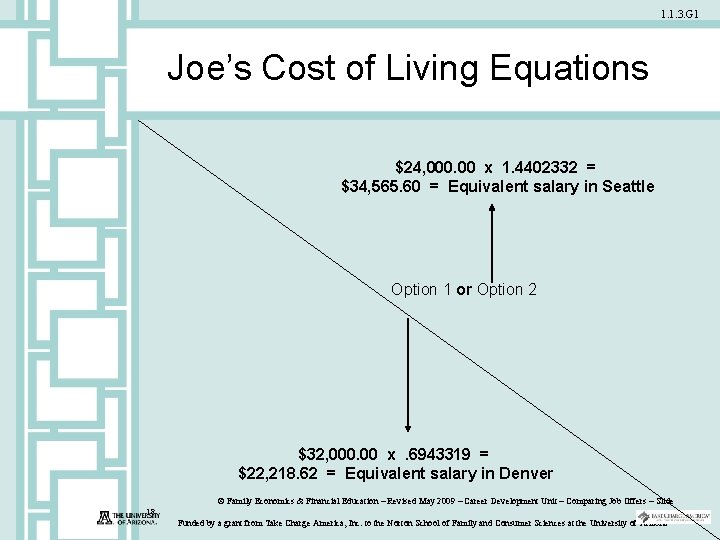
1. 1. 3. G 1 Joe’s Cost of Living Equations $24, 000. 00 x 1. 4402332 = $34, 565. 60 = Equivalent salary in Seattle Option 1 or Option 2 $32, 000. 00 x. 6943319 = $22, 218. 62 = Equivalent salary in Denver © Family Economics & Financial Education – Revised May 2009 – Career Development Unit – Comparing Job Offers – Slide 18 Funded by a grant from Take Charge America, Inc. to the Norton School of Family and Consumer Sciences at the University of Arizona
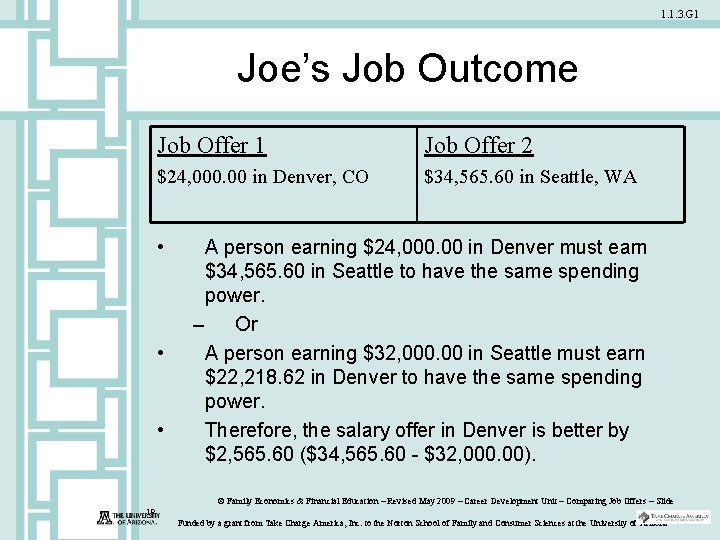
1. 1. 3. G 1 Joe’s Job Outcome Job Offer 1 Job Offer 2 $24, 000. 00 in Denver, CO $34, 565. 60 in Seattle, WA • • • A person earning $24, 000. 00 in Denver must earn $34, 565. 60 in Seattle to have the same spending power. – Or A person earning $32, 000. 00 in Seattle must earn $22, 218. 62 in Denver to have the same spending power. Therefore, the salary offer in Denver is better by $2, 565. 60 ($34, 565. 60 - $32, 000. 00). © Family Economics & Financial Education – Revised May 2009 – Career Development Unit – Comparing Job Offers – Slide 19 Funded by a grant from Take Charge America, Inc. to the Norton School of Family and Consumer Sciences at the University of Arizona

1. 1. 3. G 1 Benefits Fringe benefits and employer provided services can make a difference: – – For example, if a $35, 000. 00 job had 100% of medical insurance coverage valuing $400. 00 per month, a person would not have to budget for $4, 800. 00 in medical insurance per year. This would increase the value of his or her salary to $39, 800. Benefits and services should be included within the salary before calculating the cost of living. © Family Economics & Financial Education – Revised May 2009 – Career Development Unit – Comparing Job Offers – Slide 20 Funded by a grant from Take Charge America, Inc. to the Norton School of Family and Consumer Sciences at the University of Arizona
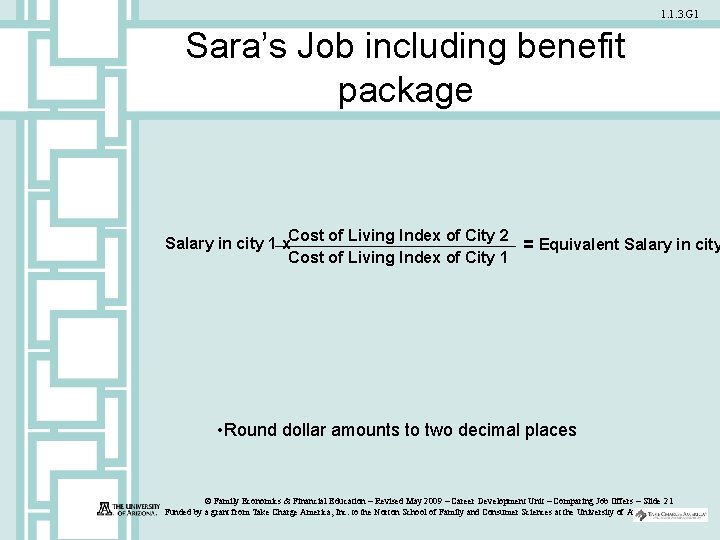
1. 1. 3. G 1 Sara’s Job including benefit package Cost of Living Index of City 2 Salary in city 1 x = Equivalent Salary in city Cost of Living Index of City 1 • Round dollar amounts to two decimal places © Family Economics & Financial Education – Revised May 2009 – Career Development Unit – Comparing Job Offers – Slide 21 Funded by a grant from Take Charge America, Inc. to the Norton School of Family and Consumer Sciences at the University of Arizona
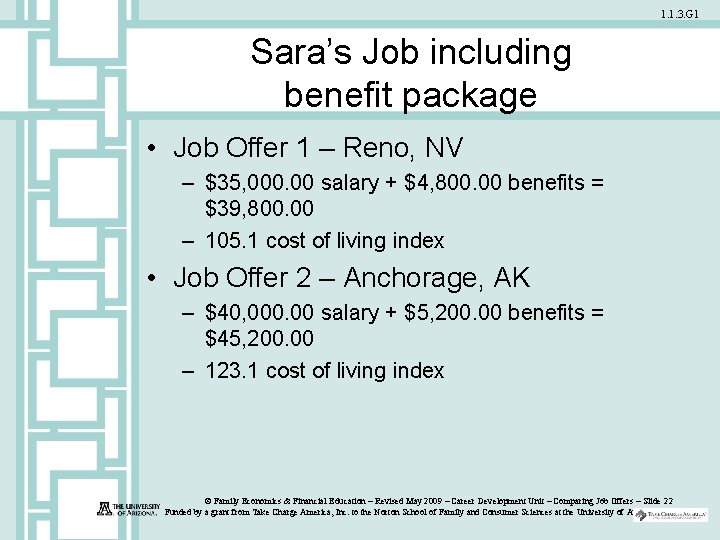
1. 1. 3. G 1 Sara’s Job including benefit package • Job Offer 1 – Reno, NV – $35, 000. 00 salary + $4, 800. 00 benefits = $39, 800. 00 – 105. 1 cost of living index • Job Offer 2 – Anchorage, AK – $40, 000. 00 salary + $5, 200. 00 benefits = $45, 200. 00 – 123. 1 cost of living index © Family Economics & Financial Education – Revised May 2009 – Career Development Unit – Comparing Job Offers – Slide 22 Funded by a grant from Take Charge America, Inc. to the Norton School of Family and Consumer Sciences at the University of Arizona
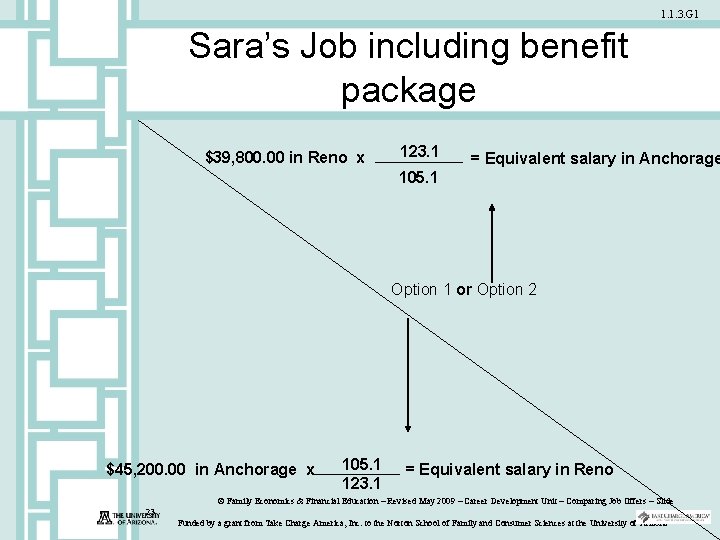
1. 1. 3. G 1 Sara’s Job including benefit package $39, 800. 00 in Reno x 123. 1 = Equivalent salary in Anchorage 105. 1 Option 1 or Option 2 $45, 200. 00 in Anchorage x 105. 1 123. 1 = Equivalent salary in Reno © Family Economics & Financial Education – Revised May 2009 – Career Development Unit – Comparing Job Offers – Slide 23 Funded by a grant from Take Charge America, Inc. to the Norton School of Family and Consumer Sciences at the University of Arizona
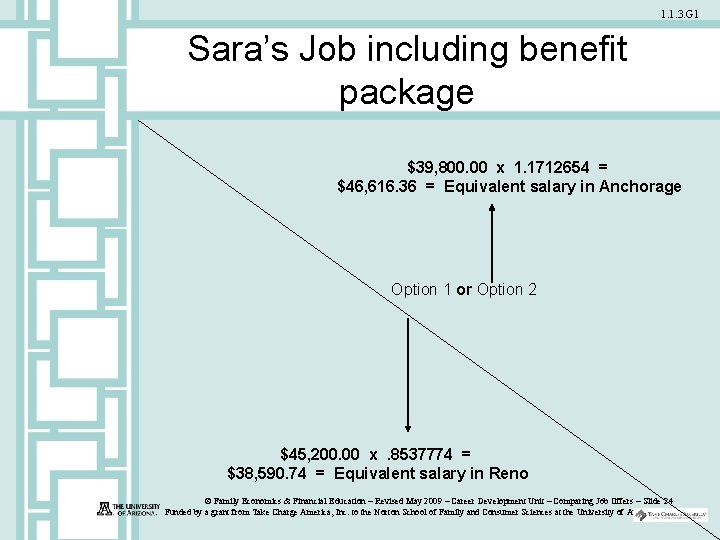
1. 1. 3. G 1 Sara’s Job including benefit package $39, 800. 00 x 1. 1712654 = $46, 616. 36 = Equivalent salary in Anchorage Option 1 or Option 2 $45, 200. 00 x. 8537774 = $38, 590. 74 = Equivalent salary in Reno © Family Economics & Financial Education – Revised May 2009 – Career Development Unit – Comparing Job Offers – Slide 24 Funded by a grant from Take Charge America, Inc. to the Norton School of Family and Consumer Sciences at the University of Arizona
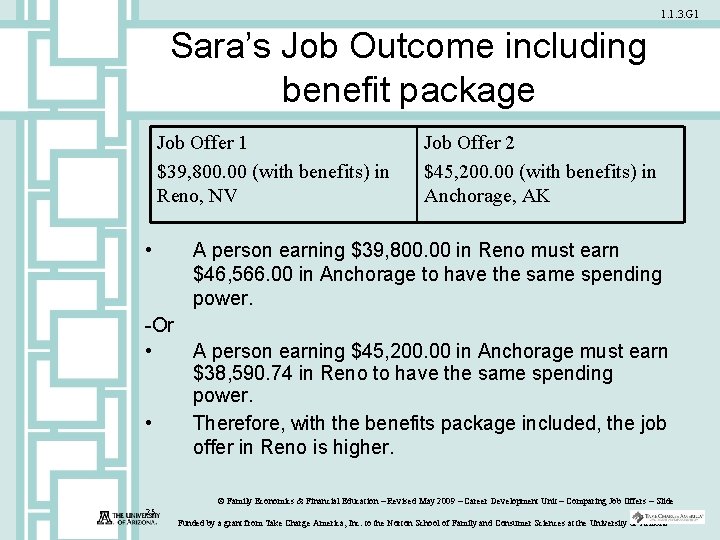
1. 1. 3. G 1 Sara’s Job Outcome including benefit package Job Offer 1 $39, 800. 00 (with benefits) in Reno, NV • Job Offer 2 $45, 200. 00 (with benefits) in Anchorage, AK A person earning $39, 800. 00 in Reno must earn $46, 566. 00 in Anchorage to have the same spending power. -Or • A person earning $45, 200. 00 in Anchorage must earn $38, 590. 74 in Reno to have the same spending power. • Therefore, with the benefits package included, the job offer in Reno is higher. © Family Economics & Financial Education – Revised May 2009 – Career Development Unit – Comparing Job Offers – Slide 25 Funded by a grant from Take Charge America, Inc. to the Norton School of Family and Consumer Sciences at the University of Arizona
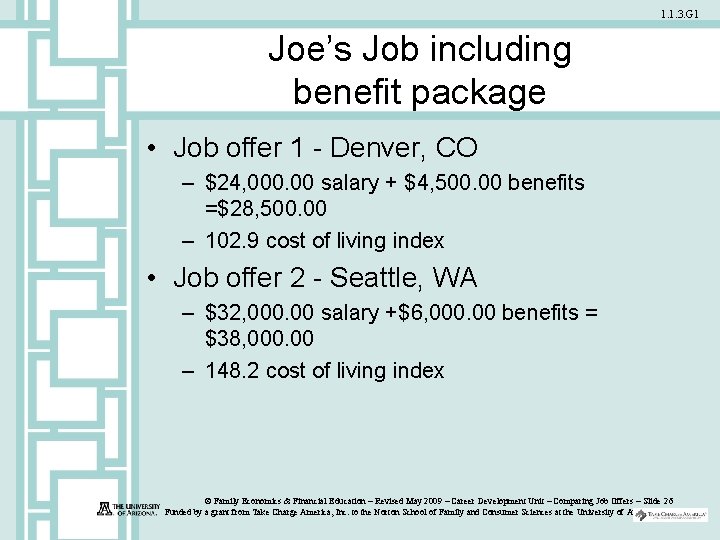
1. 1. 3. G 1 Joe’s Job including benefit package • Job offer 1 - Denver, CO – $24, 000. 00 salary + $4, 500. 00 benefits =$28, 500. 00 – 102. 9 cost of living index • Job offer 2 - Seattle, WA – $32, 000. 00 salary +$6, 000. 00 benefits = $38, 000. 00 – 148. 2 cost of living index © Family Economics & Financial Education – Revised May 2009 – Career Development Unit – Comparing Job Offers – Slide 26 Funded by a grant from Take Charge America, Inc. to the Norton School of Family and Consumer Sciences at the University of Arizona
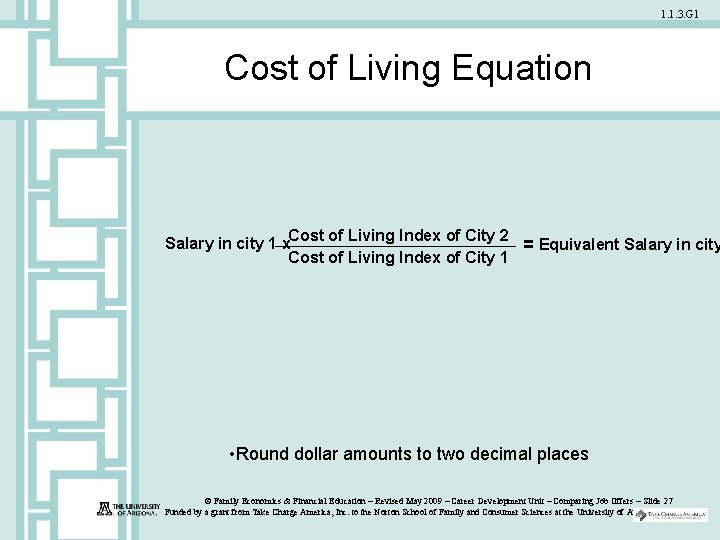
1. 1. 3. G 1 Cost of Living Equation Cost of Living Index of City 2 Salary in city 1 x = Equivalent Salary in city Cost of Living Index of City 1 • Round dollar amounts to two decimal places © Family Economics & Financial Education – Revised May 2009 – Career Development Unit – Comparing Job Offers – Slide 27 Funded by a grant from Take Charge America, Inc. to the Norton School of Family and Consumer Sciences at the University of Arizona
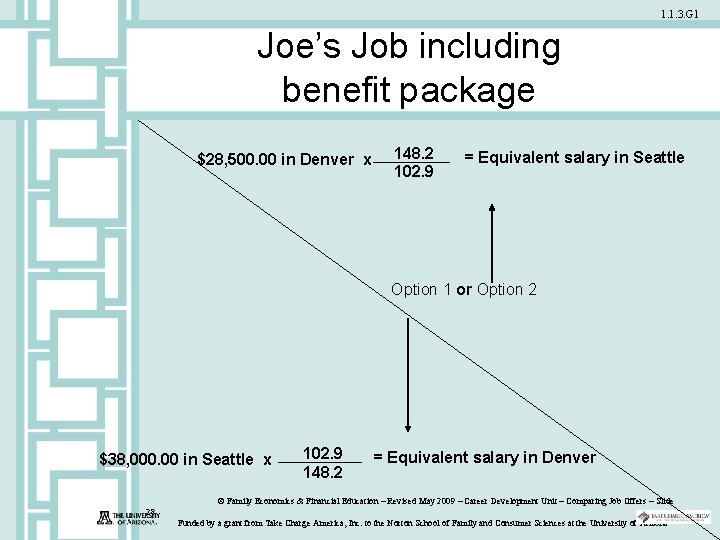
1. 1. 3. G 1 Joe’s Job including benefit package $28, 500. 00 in Denver x 148. 2 102. 9 = Equivalent salary in Seattle Option 1 or Option 2 $38, 000. 00 in Seattle x 102. 9 148. 2 = Equivalent salary in Denver © Family Economics & Financial Education – Revised May 2009 – Career Development Unit – Comparing Job Offers – Slide 28 Funded by a grant from Take Charge America, Inc. to the Norton School of Family and Consumer Sciences at the University of Arizona
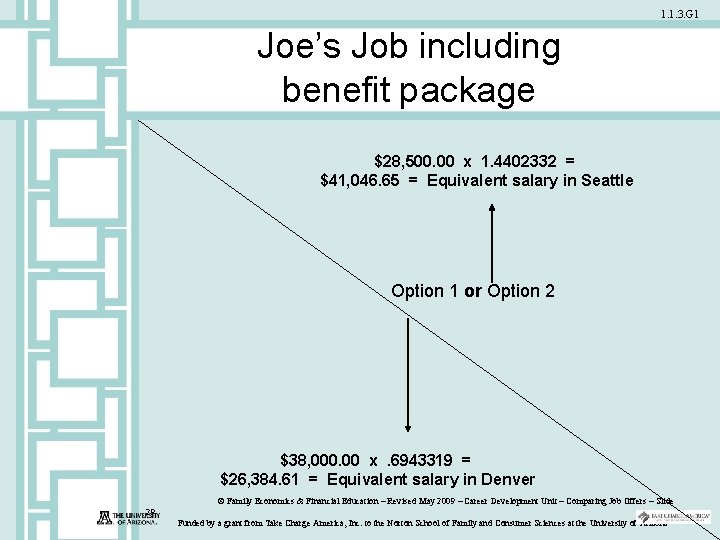
1. 1. 3. G 1 Joe’s Job including benefit package $28, 500. 00 x 1. 4402332 = $41, 046. 65 = Equivalent salary in Seattle Option 1 or Option 2 $38, 000. 00 x. 6943319 = $26, 384. 61 = Equivalent salary in Denver © Family Economics & Financial Education – Revised May 2009 – Career Development Unit – Comparing Job Offers – Slide 29 Funded by a grant from Take Charge America, Inc. to the Norton School of Family and Consumer Sciences at the University of Arizona

1. 1. 3. G 1 Joe’s Job Outcome including benefit package Job Offer 1 $28, 500. 00(with benefits) in Denver, CO • Or • • Job Offer 2 $38, 000. 00(with benefits) in Seattle, WA A person earning $28, 500. 00 in Denver must earn $41, 046. 65 in Seattle to have the same spending power. A person earning $38, 000. 00 in Seattle must earn $26, 384. 61 in Denver to have the same spending power. Therefore, with the benefits package included, the job offer in Denver is higher. © Family Economics & Financial Education – Revised May 2009 – Career Development Unit – Comparing Job Offers – Slide 30 Funded by a grant from Take Charge America, Inc. to the Norton School of Family and Consumer Sciences at the University of Arizona
1. 1. 3. G 1 Additional Web sites • Web sites available to help calculate salaries and cost of living in various locations – www. homefair. com – www. bankrate. com/brm/movecalc. asp – www. accra. org • $12. 95 fee © Family Economics & Financial Education – Revised May 2009 – Career Development Unit – Comparing Job Offers – Slide 31 Funded by a grant from Take Charge America, Inc. to the Norton School of Family and Consumer Sciences at the University of Arizona

Questions?
- Slides: 32