
Comparing Intercell Distance and Cell Wall Midpoint Criteria
- Slides: 29
Comparing Intercell Distance and Cell Wall Midpoint Criteria for Discrete Global Grid Systems Matt Gregory, A Jon Kimerling, Denis White and Kevin Sahr Department of Geosciences Oregon State University
Objectives v Develop criteria to get a general understanding of neighborhood metrics for discrete global grid systems (DGGSs) v Characterize the behavior of different design choices within a specific DGGS (e. g. cell shape, base modeling solid) v Apply these criteria to a variety of known DGGSs
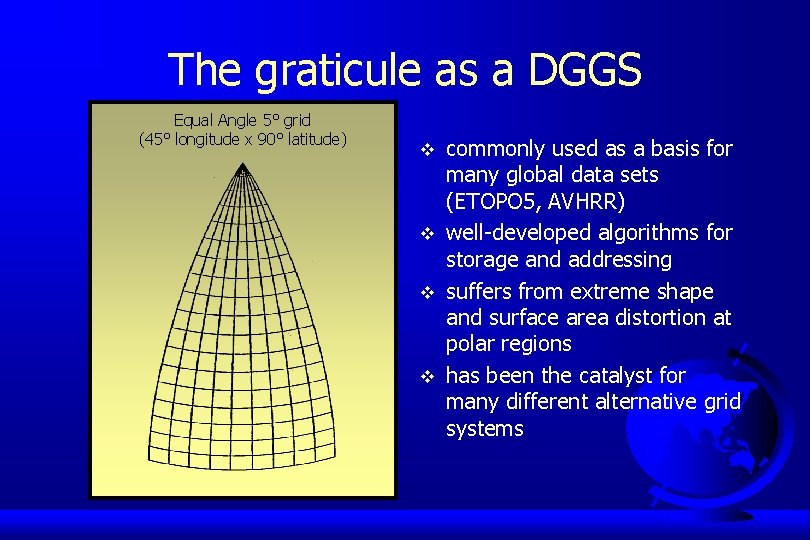
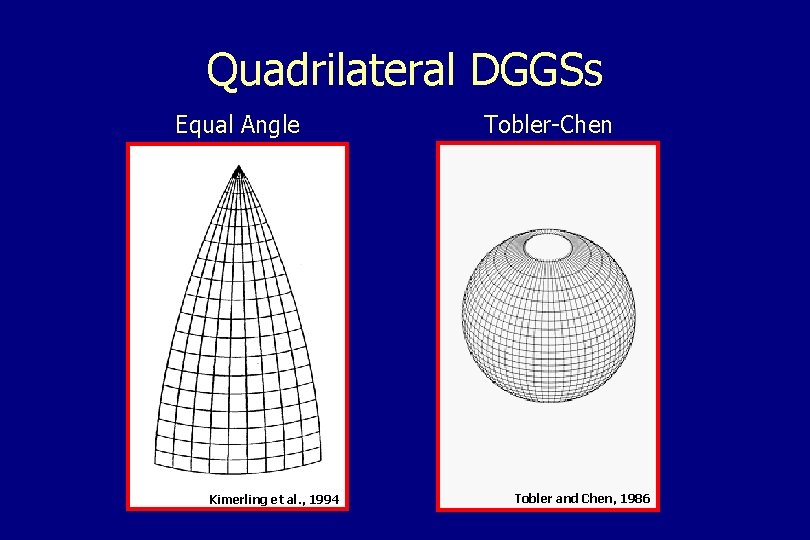
The graticule as a DGGS Equal Angle 5° grid (45° longitude x 90° latitude) commonly used as a basis for many global data sets (ETOPO 5, AVHRR) v well-developed algorithms for storage and addressing v suffers from extreme shape and surface area distortion at polar regions v has been the catalyst for many different alternative grid systems v
DGGS Evaluating Criteria v Topological checks of a grid system v Areal cells constitute a complete tiling of the globe v A single areal cell contains only one point v Geometric properties of a grid system v Areal cells have equal areas v Areal cells are compact v Metrics can be developed to assess how well a grid conforms to each geometric criterion
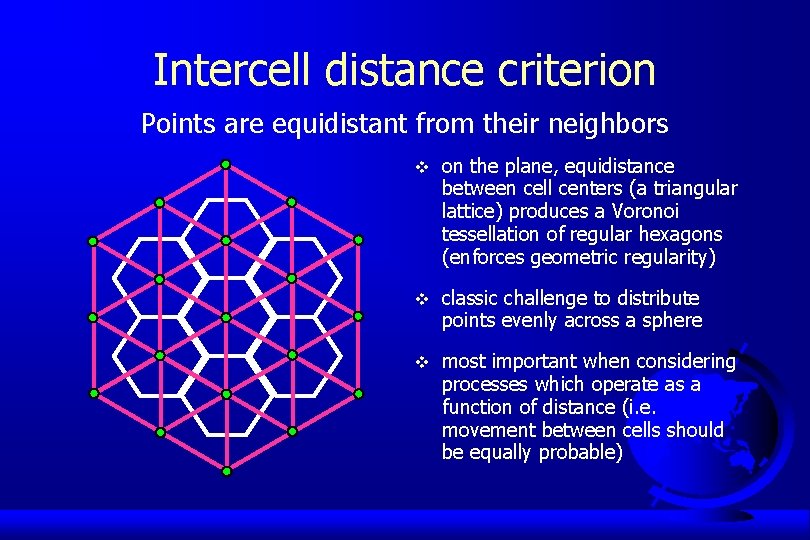
Intercell distance criterion Points are equidistant from their neighbors v on the plane, equidistance between cell centers (a triangular lattice) produces a Voronoi tessellation of regular hexagons (enforces geometric regularity) v classic challenge to distribute points evenly across a sphere v most important when considering processes which operate as a function of distance (i. e. movement between cells should be equally probable)
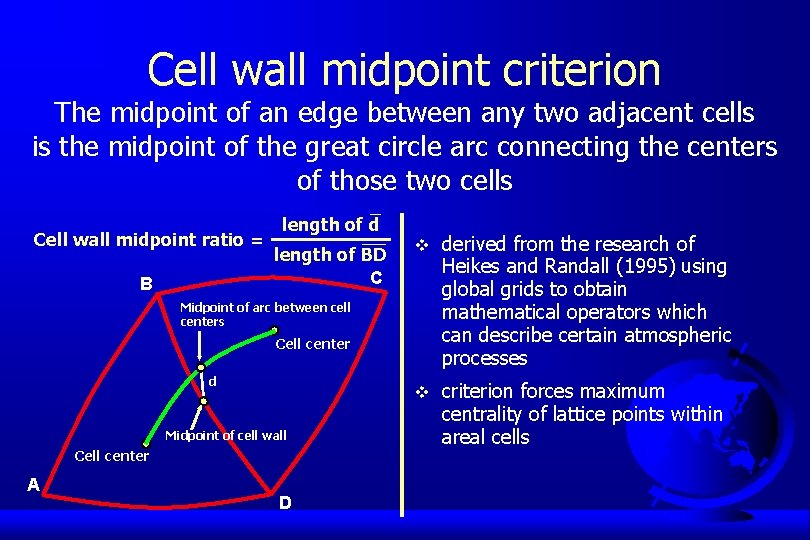
Cell wall midpoint criterion The midpoint of an edge between any two adjacent cells is the midpoint of the great circle arc connecting the centers of those two cells Cell wall midpoint ratio = B length of d length of BD C v derived from the research of Heikes and Randall (1995) using global grids to obtain mathematical operators which can describe certain atmospheric processes v criterion forces maximum centrality of lattice points within areal cells Midpoint of arc between cell centers Cell center d Midpoint of cell wall Cell center A D
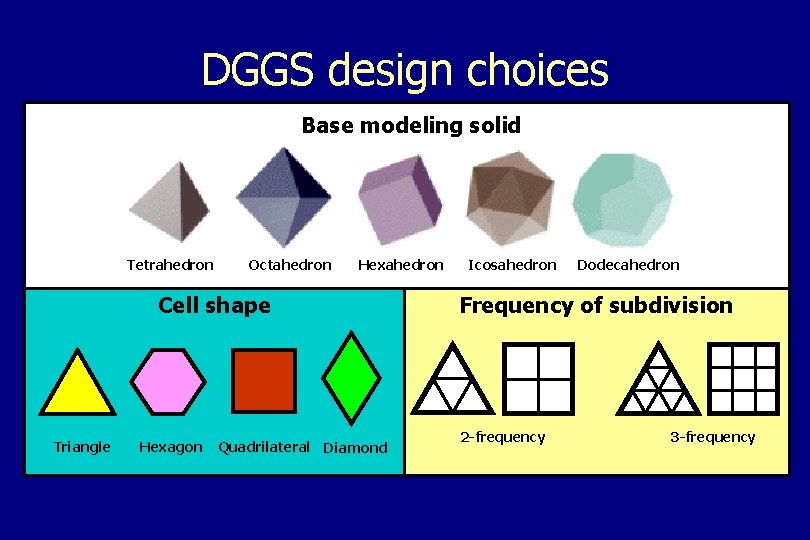
DGGS design choices Base modeling solid Tetrahedron Octahedron Hexahedron Cell shape Triangle Hexagon Quadrilateral Diamond Icosahedron Dodecahedron Frequency of subdivision 2 -frequency 3 -frequency
Quadrilateral DGGSs Equal Angle Kimerling et al. , 1994 Tobler-Chen Tobler and Chen, 1986
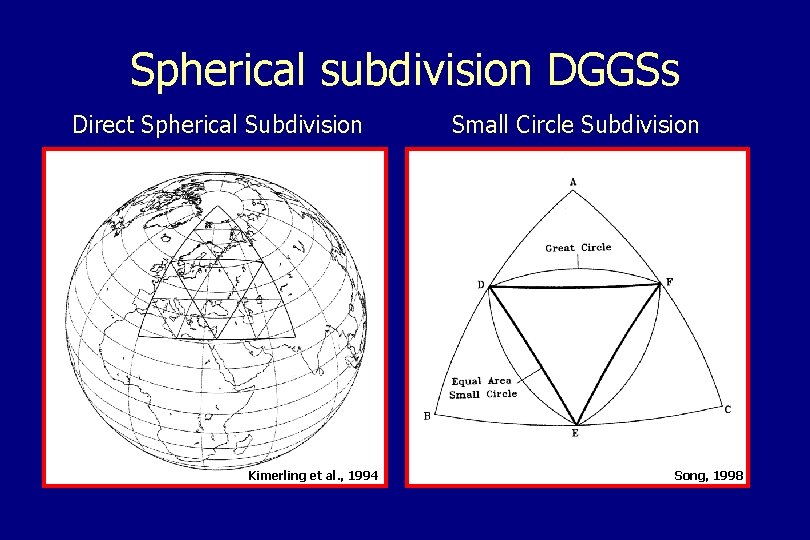
Spherical subdivision DGGSs Direct Spherical Subdivision Kimerling et al. , 1994 Small Circle Subdivision Song, 1998
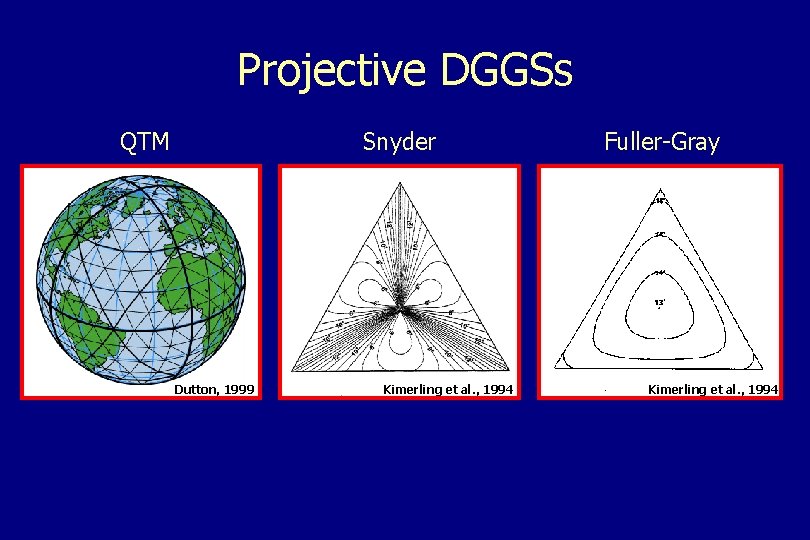
Projective DGGSs QTM Snyder Dutton, 1999 Kimerling et al. , 1994 Fuller-Gray Kimerling et al. , 1994
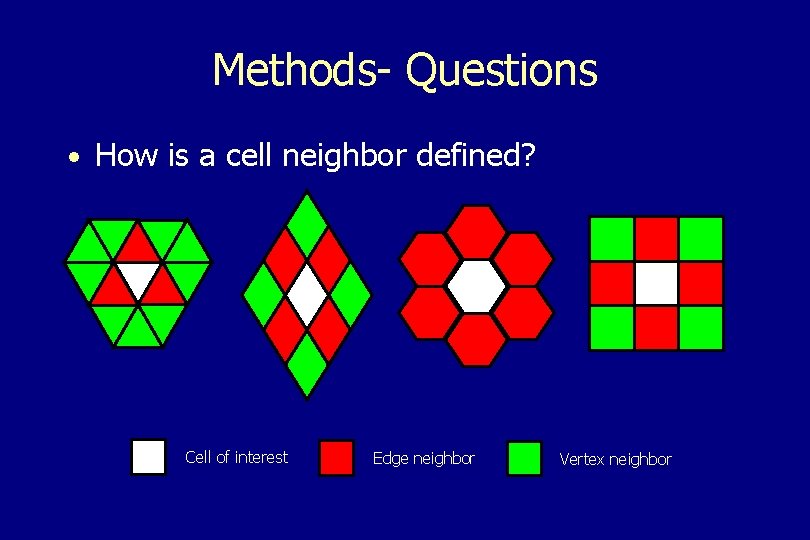
Methods- Questions · How is a cell neighbor defined? Cell of interest Edge neighbor Vertex neighbor
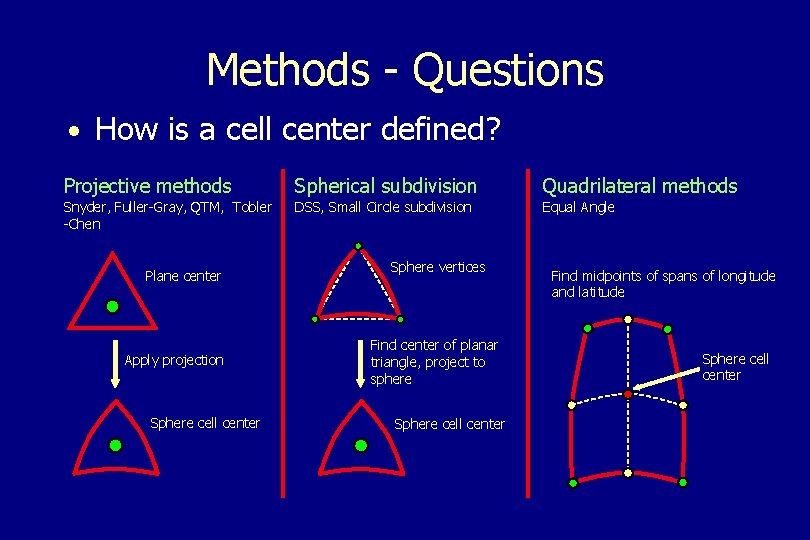
Methods - Questions · How is a cell center defined? Projective methods Spherical subdivision Quadrilateral methods Snyder, Fuller-Gray, QTM, Tobler -Chen DSS, Small Circle subdivision Equal Angle Plane center Apply projection Sphere cell center Sphere vertices Find center of planar triangle, project to sphere Sphere cell center Find midpoints of spans of longitude and latitude Sphere cell center
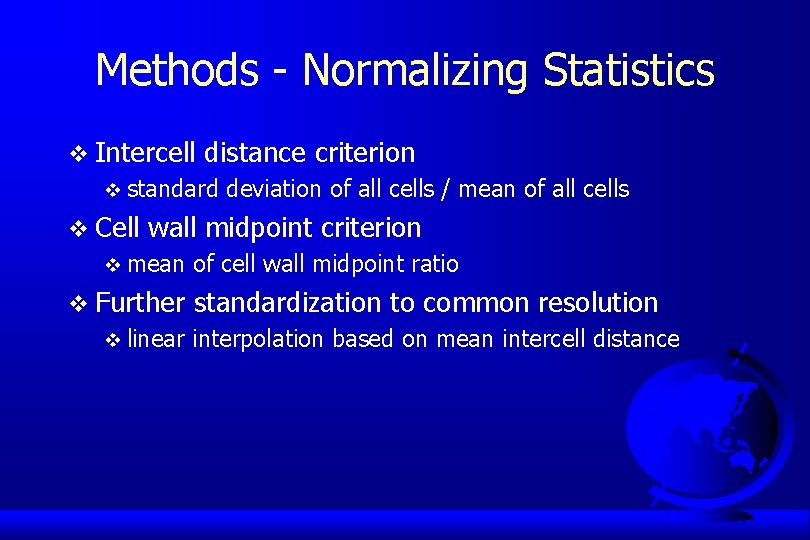
Methods - Normalizing Statistics v Intercell distance criterion v standard v Cell deviation of all cells / mean of all cells wall midpoint criterion v mean v Further v linear of cell wall midpoint ratio standardization to common resolution interpolation based on mean intercell distance
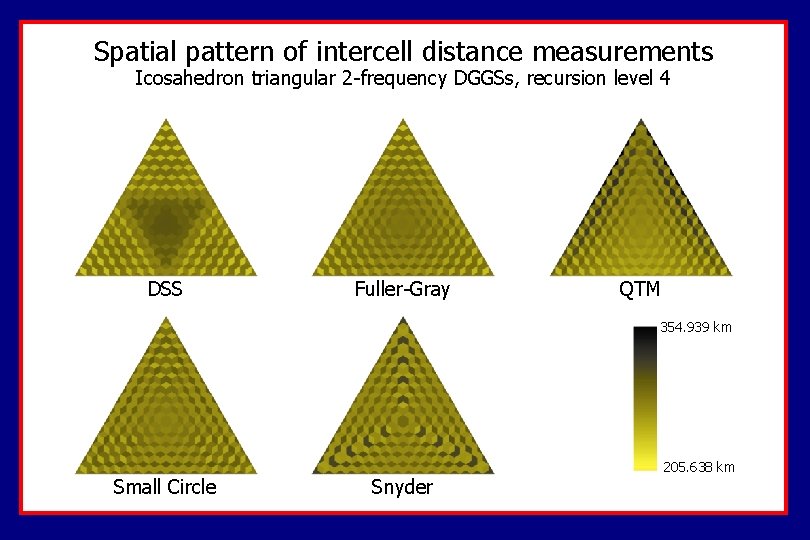
Spatial pattern of intercell distance measurements Icosahedron triangular 2 -frequency DGGSs, recursion level 4 DSS Fuller-Gray QTM 354. 939 km Small Circle Snyder 205. 638 km
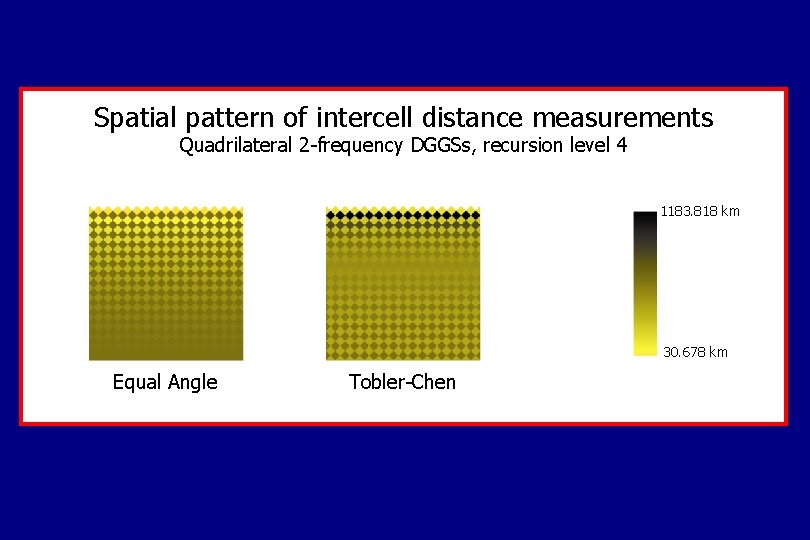
Spatial pattern of intercell distance measurements Quadrilateral 2 -frequency DGGSs, recursion level 4 1183. 818 km 30. 678 km Equal Angle Tobler-Chen
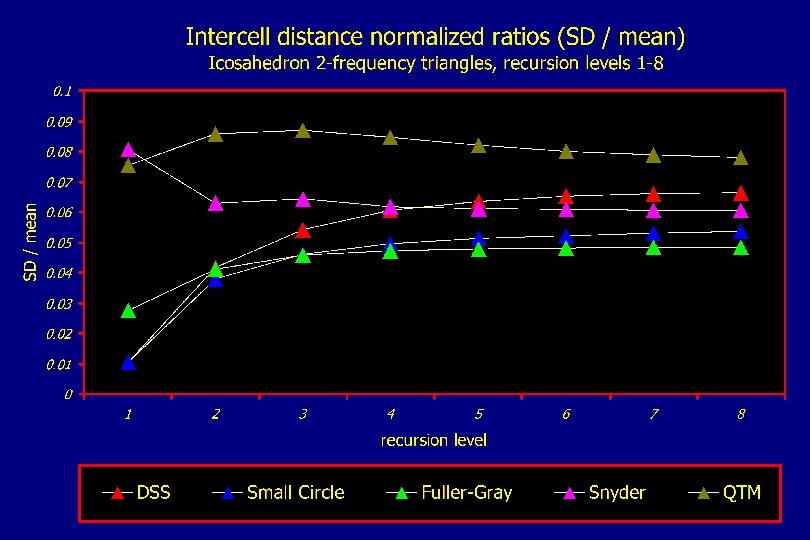
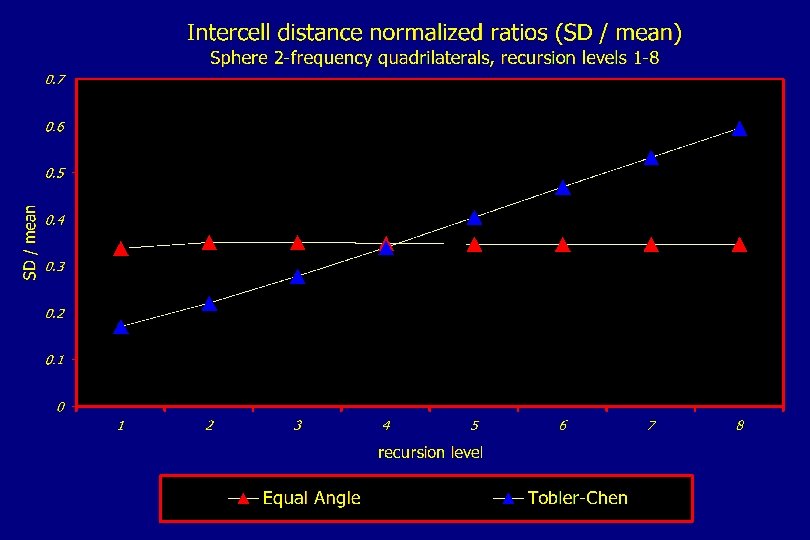
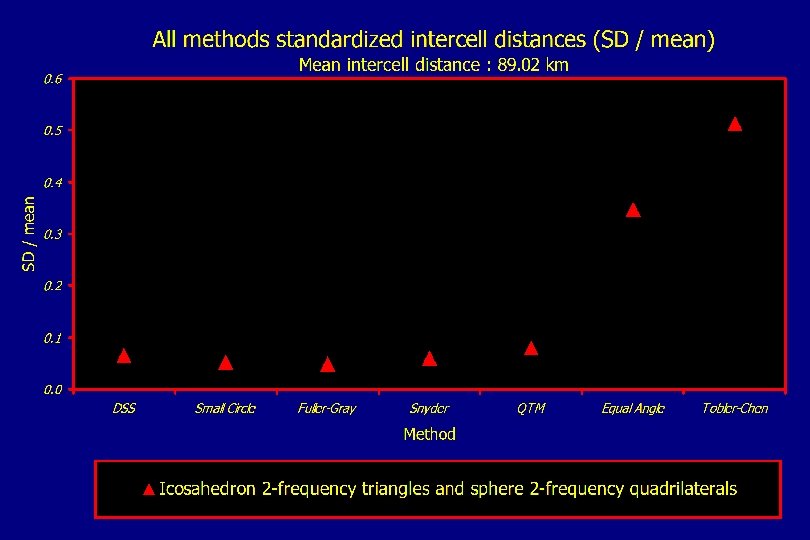
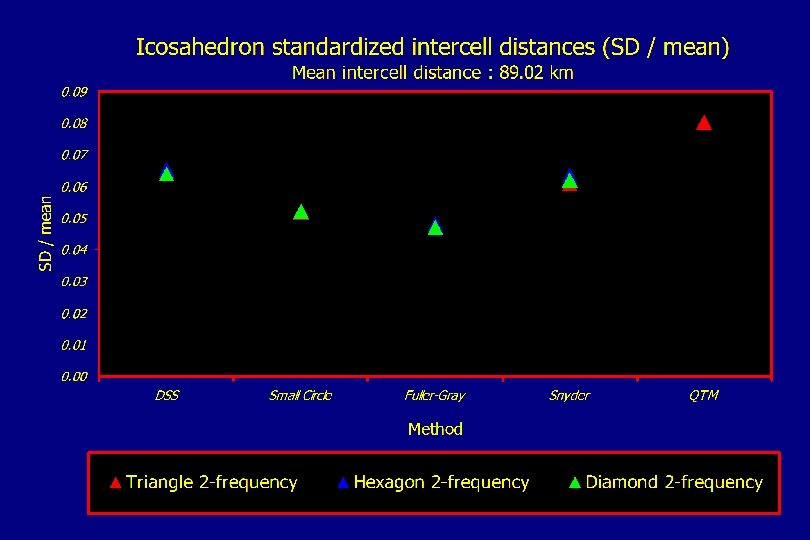
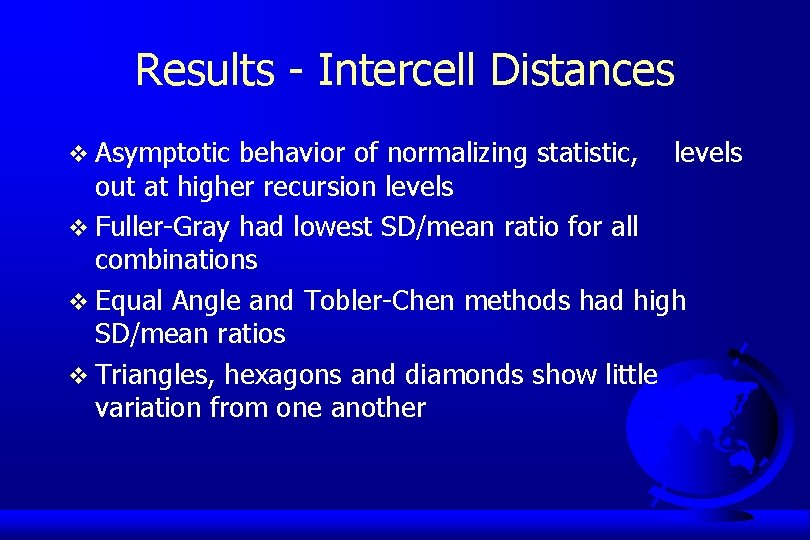
Results - Intercell Distances v Asymptotic behavior of normalizing statistic, levels out at higher recursion levels v Fuller-Gray had lowest SD/mean ratio for all combinations v Equal Angle and Tobler-Chen methods had high SD/mean ratios v Triangles, hexagons and diamonds show little variation from one another
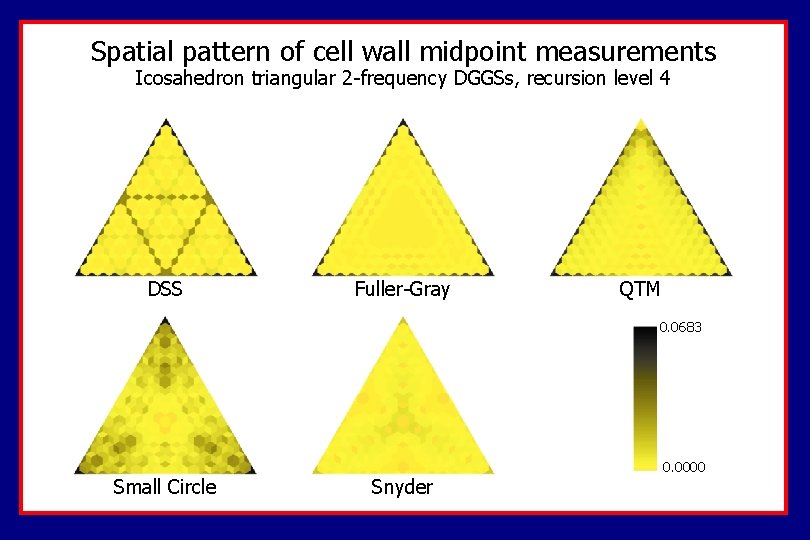
Spatial pattern of cell wall midpoint measurements Icosahedron triangular 2 -frequency DGGSs, recursion level 4 DSS Fuller-Gray QTM 0. 0683 Small Circle Snyder 0. 0000
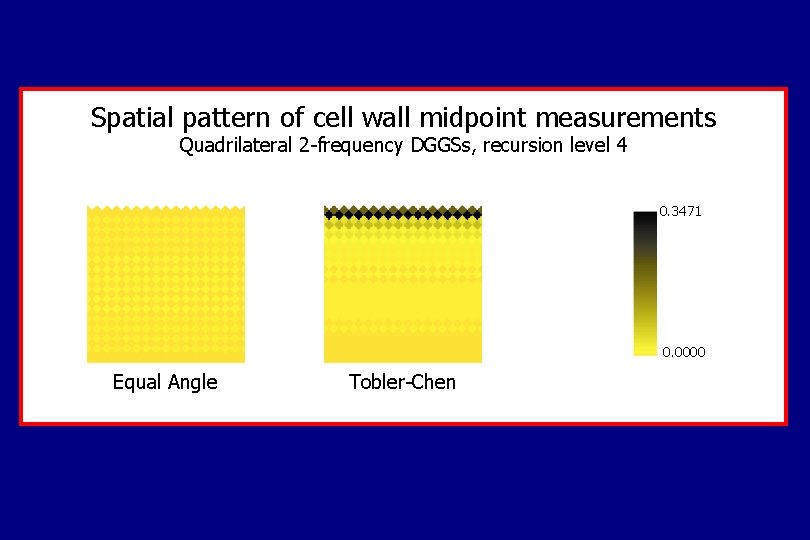
Spatial pattern of cell wall midpoint measurements Quadrilateral 2 -frequency DGGSs, recursion level 4 0. 3471 0. 0000 Equal Angle Tobler-Chen
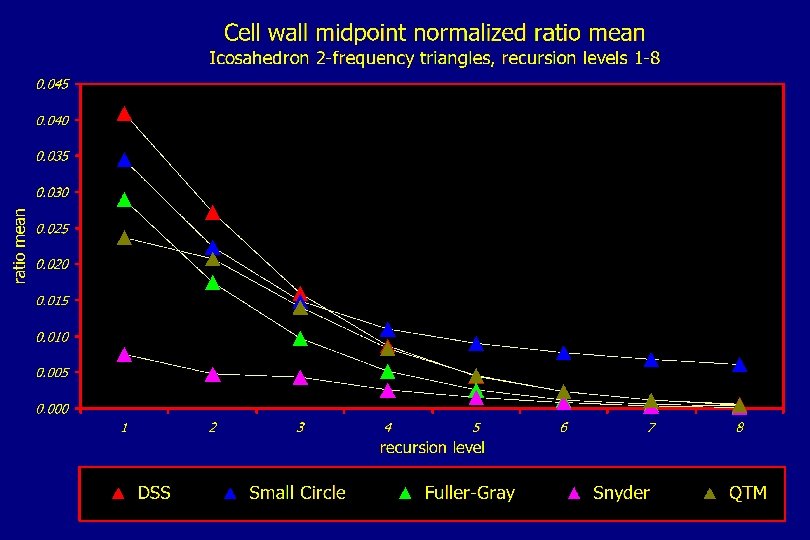
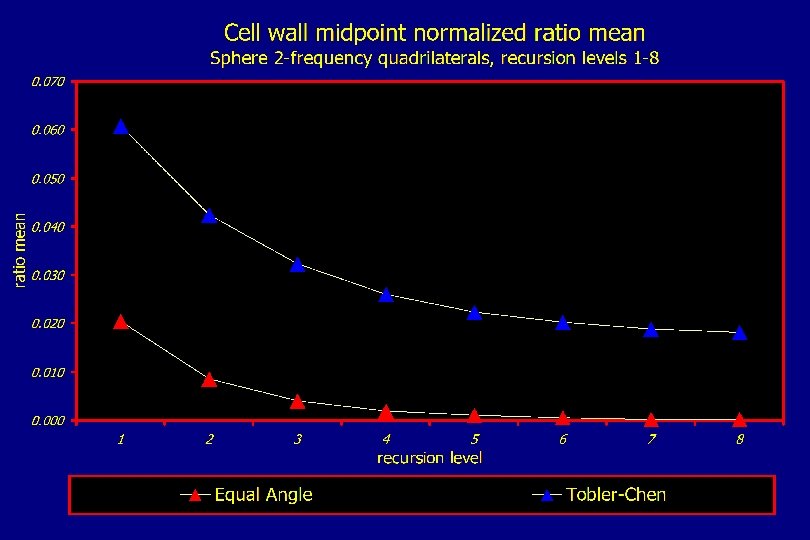
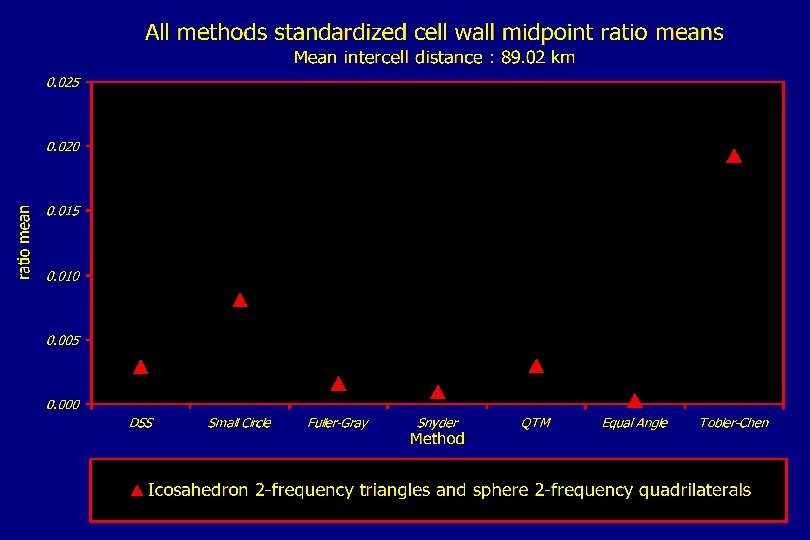
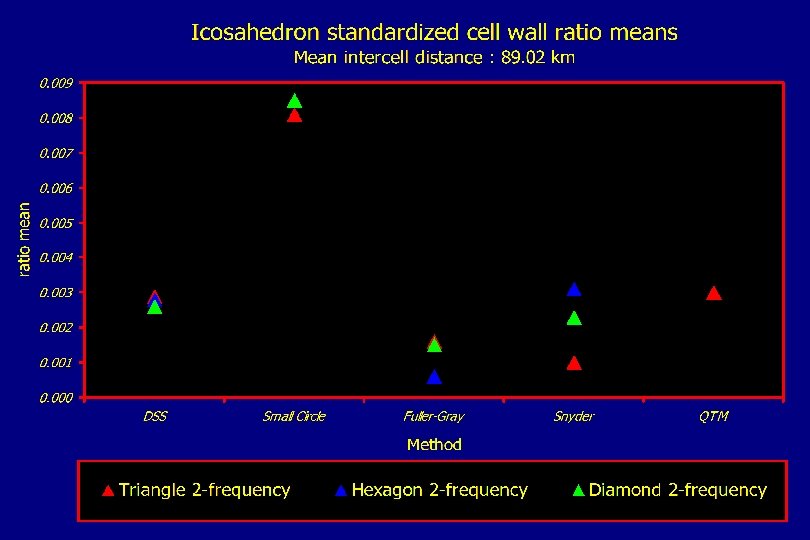
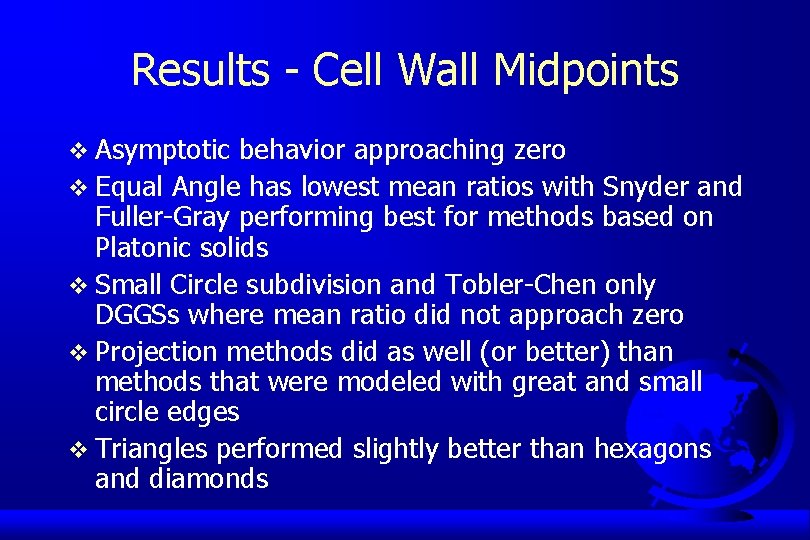
Results - Cell Wall Midpoints v Asymptotic behavior approaching zero v Equal Angle has lowest mean ratios with Snyder and Fuller-Gray performing best for methods based on Platonic solids v Small Circle subdivision and Tobler-Chen only DGGSs where mean ratio did not approach zero v Projection methods did as well (or better) than methods that were modeled with great and small circle edges v Triangles performed slightly better than hexagons and diamonds
General Results v Asymptotic relationship between resolution and normalized measurement allows generalization v Relatively similar intercell distance measurements for triangles, hexagons and diamonds implies aggregation has little impact on performance for Platonic solid methods v Generally, projective DGGSs performed unexpectedly well for cell wall midpoint criterion
Implications and Future Directions v Grids can be chosen to optimize one specific criterion (application specific) v Grids can be chosen based on general performance of all DGGS criteria v Study meant to be integrated with comparisons of other metrics to be used in selecting suitable grid systems v Study the impact of different methods of defining cell centers v Examine the plausibility of using these DGGSs in global modeling applications