
Comparing Images Using Hausdorff Distance RUNDOWN Some Image




- Slides: 31
Comparing Images Using Hausdorff Distance
RUNDOWN • (Some) Image Registration Methods • What is Hausdorff Distance? • Hausdorff Matching • Distance Transformation • Algorithm • Example Results
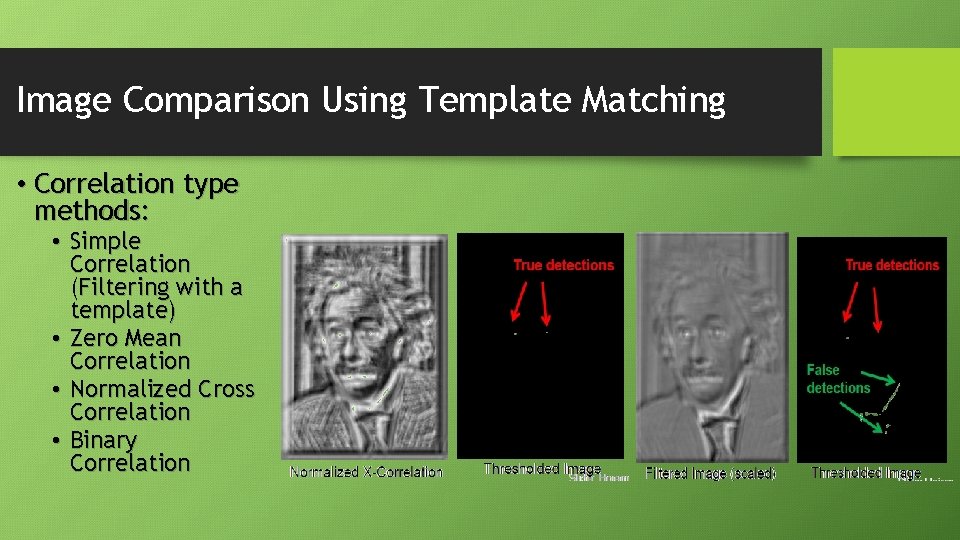
Image Comparison Using Template Matching • Correlation type methods: • Simple Correlation (Filtering with a template) • Zero Mean Correlation • Normalized Cross Correlation • Binary Correlation
Image Comparison Using Template Matching (Cont’d) • Edge Based Matching • Hausdorff Distance Based Matching
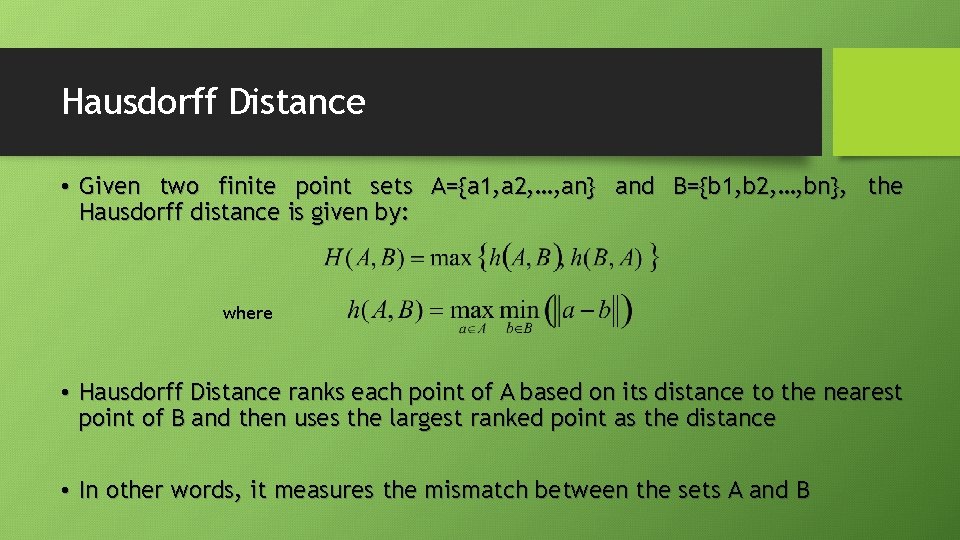
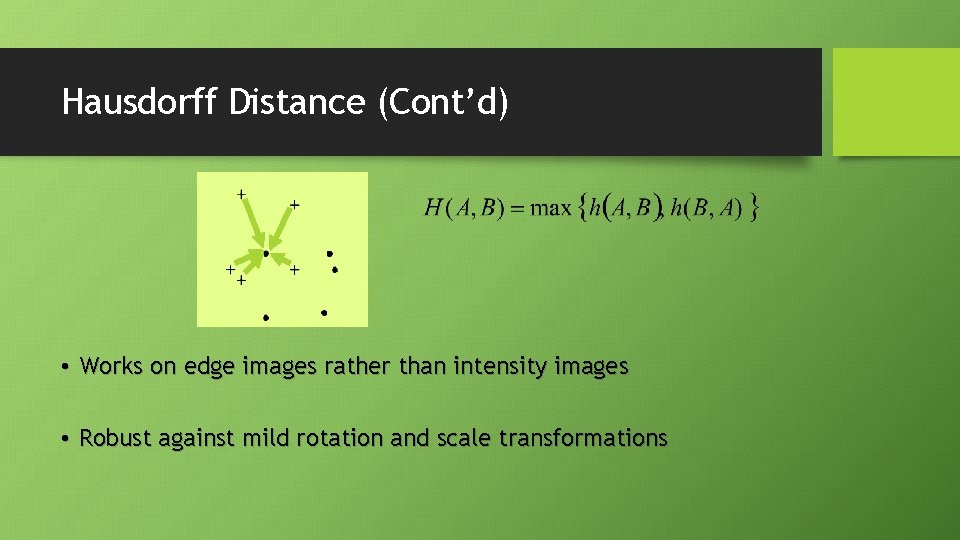
Hausdorff Distance • Given two finite point sets A={a 1, a 2, …, an} and B={b 1, b 2, …, bn}, the Hausdorff distance is given by: where • Hausdorff Distance ranks each point of A based on its distance to the nearest point of B and then uses the largest ranked point as the distance • In other words, it measures the mismatch between the sets A and B
Hausdorff Distance (Cont’d) • Works on edge images rather than intensity images • Robust against mild rotation and scale transformations
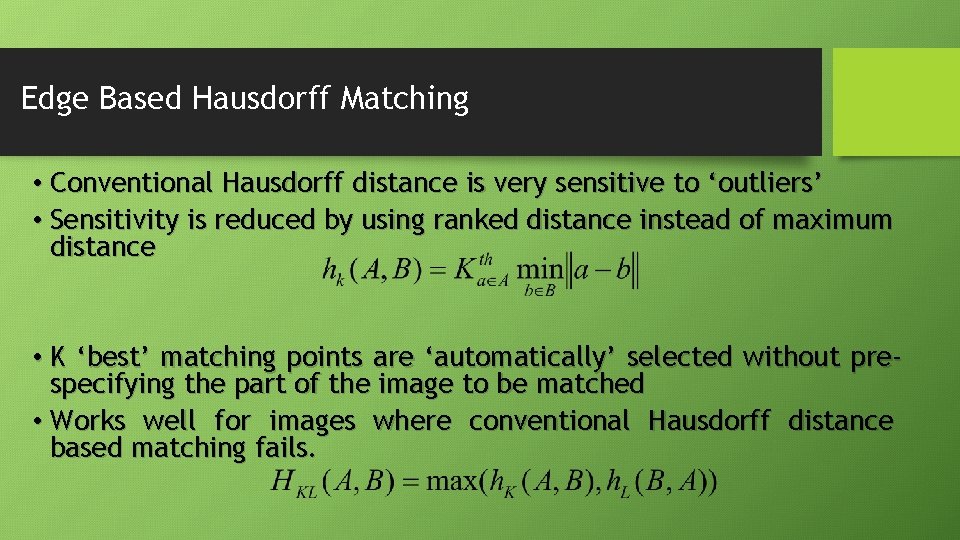
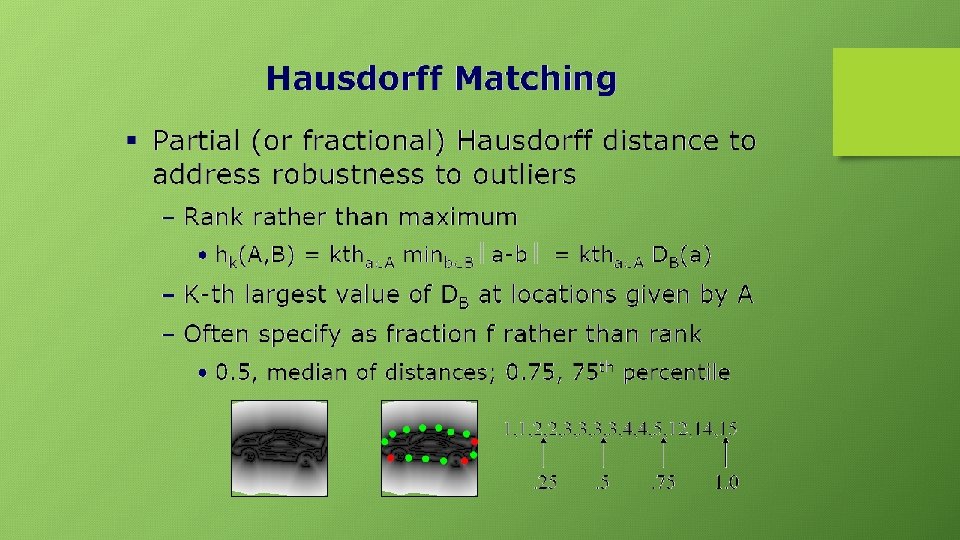
Edge Based Hausdorff Matching • Conventional Hausdorff distance is very sensitive to ‘outliers’ • Sensitivity is reduced by using ranked distance instead of maximum distance • K ‘best’ matching points are ‘automatically’ selected without prespecifying the part of the image to be matched • Works well for images where conventional Hausdorff distance based matching fails.
Edge based Hausdorff matching (Contd. ) • Partial Hausdorff distance is computed through a Distance Transformation (DT) using iterated local operations • Distances are approximated by propagating distances between the neighboring pixels over the entire image
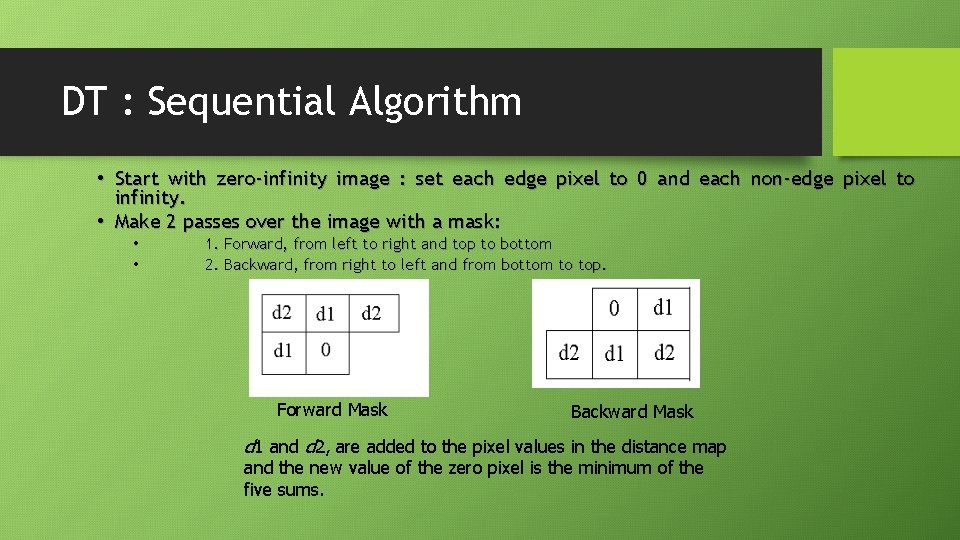
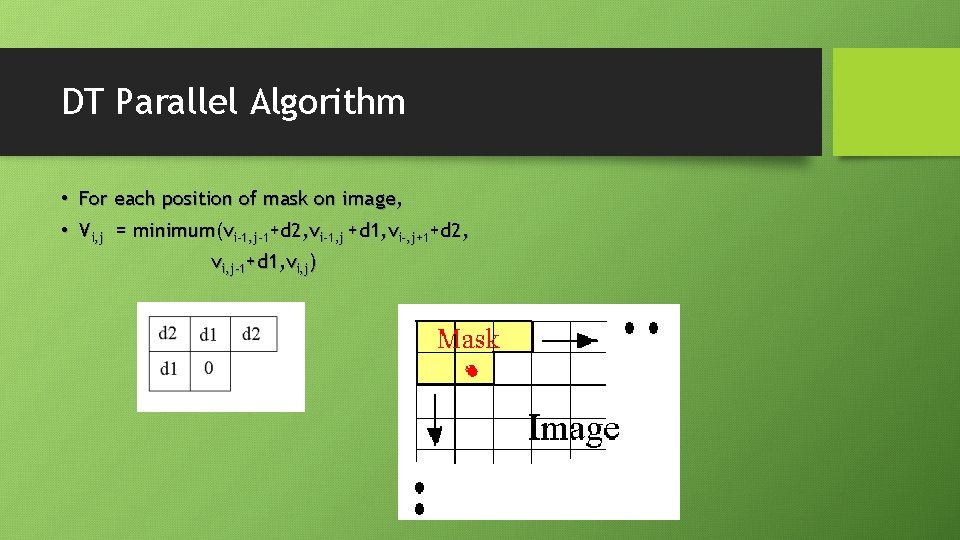
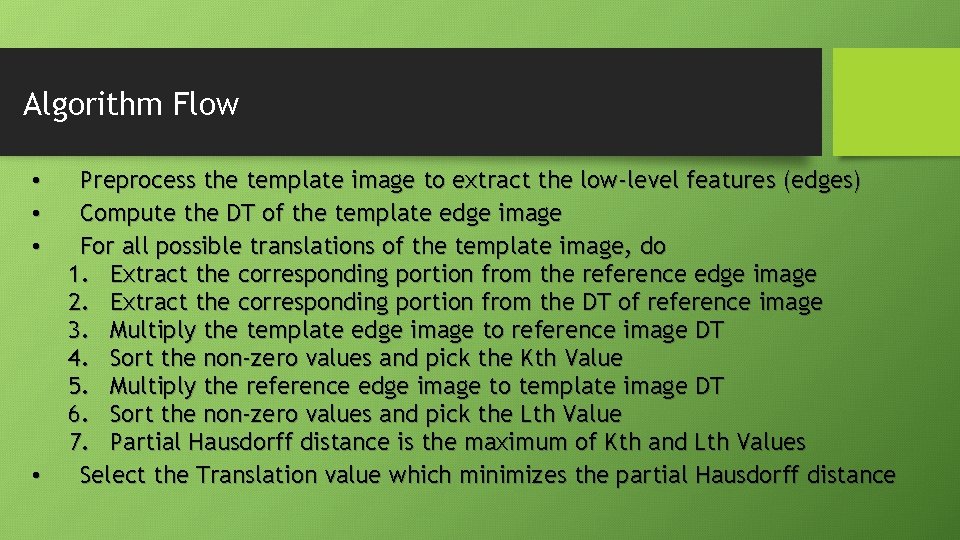
DT : Sequential Algorithm • Start with zero-infinity image : set each edge pixel to 0 and each non-edge pixel to infinity. • Make 2 passes over the image with a mask: • • 1. Forward, from left to right and top to bottom 2. Backward, from right to left and from bottom to top. Forward Mask Backward Mask d 1 and d 2, are added to the pixel values in the distance map and the new value of the zero pixel is the minimum of the five sums.
DT Parallel Algorithm • For each position of mask on image, • Vi, j = minimum(vi-1, j-1+d 2, vi-1, j +d 1, vi-, j+1+d 2, vi, j-1+d 1, vi, j)
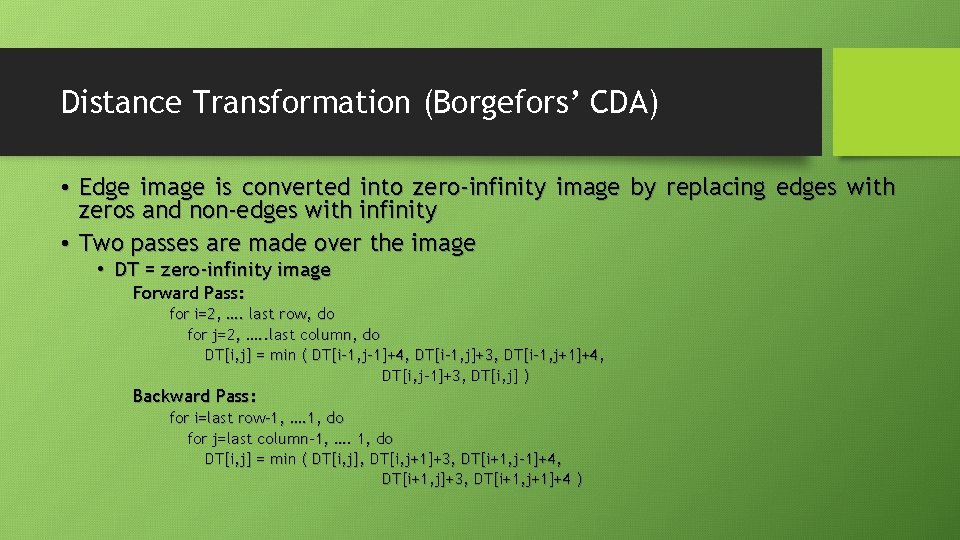
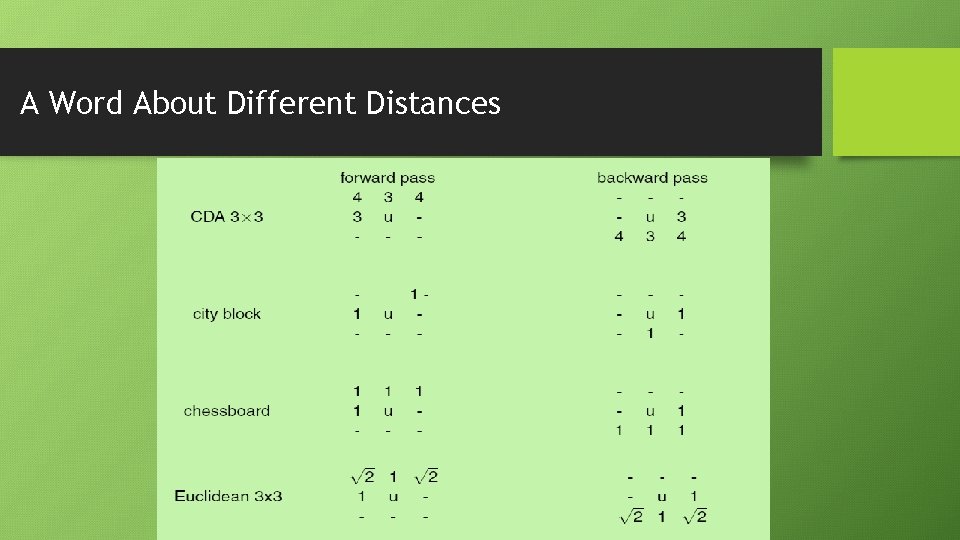
Distance Transformation (Borgefors’ CDA) • Edge image is converted into zero-infinity image by replacing edges with zeros and non-edges with infinity • Two passes are made over the image • DT = zero-infinity image Forward Pass: for i=2, …. last row, do for j=2, …. . last column, do DT[i, j] = min ( DT[i-1, j-1]+4, DT[i-1, j]+3, DT[i-1, j+1]+4, DT[i, j-1]+3, DT[i, j] ) Backward Pass: for i=last row-1, …. 1, do for j=last column-1, …. 1, do DT[i, j] = min ( DT[i, j], DT[i, j+1]+3, DT[i+1, j-1]+4, DT[i+1, j]+3, DT[i+1, j+1]+4 )
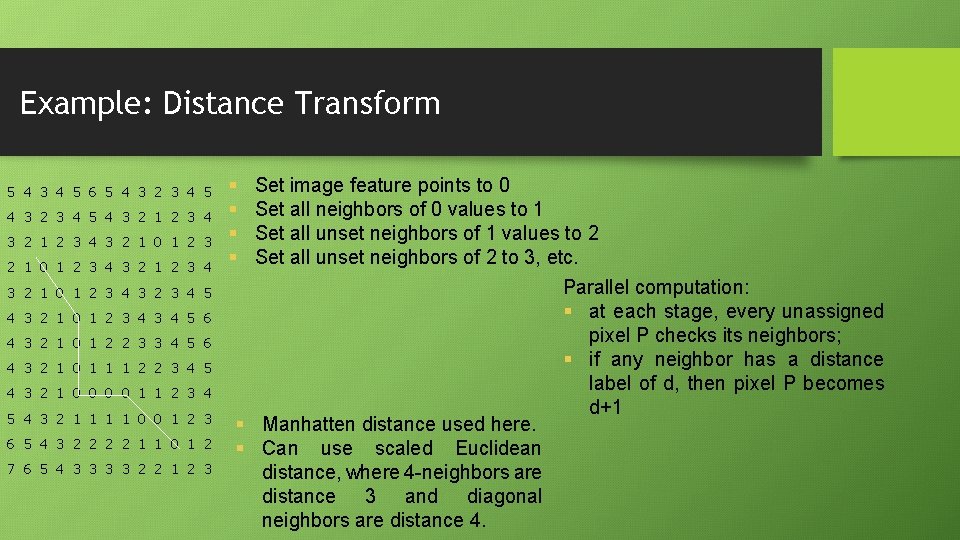
Example: Distance Transform 5 4 3 4 5 6 5 4 3 2 3 4 5 4 3 2 1 2 3 4 3 2 1 0 1 2 3 4 3 2 3 4 5 4 3 2 1 0 1 2 3 4 5 6 4 3 2 1 0 1 2 2 3 3 4 5 6 4 3 2 1 0 1 1 1 2 2 3 4 5 4 3 2 1 0 0 1 1 2 3 4 5 4 3 2 1 1 0 0 1 2 3 6 5 4 3 2 2 1 1 0 1 2 7 6 5 4 3 3 2 2 1 2 3 § § Set image feature points to 0 Set all neighbors of 0 values to 1 Set all unset neighbors of 1 values to 2 Set all unset neighbors of 2 to 3, etc. Parallel computation: § at each stage, every unassigned pixel P checks its neighbors; § if any neighbor has a distance label of d, then pixel P becomes d+1 § Manhatten distance used here. § Can use scaled Euclidean distance, where 4 -neighbors are distance 3 and diagonal neighbors are distance 4.
A Word About Different Distances
Algorithm Flow • • Preprocess the template image to extract the low-level features (edges) Compute the DT of the template edge image For all possible translations of the template image, do 1. Extract the corresponding portion from the reference edge image 2. Extract the corresponding portion from the DT of reference image 3. Multiply the template edge image to reference image DT 4. Sort the non-zero values and pick the Kth Value 5. Multiply the reference edge image to template image DT 6. Sort the non-zero values and pick the Lth Value 7. Partial Hausdorff distance is the maximum of Kth and Lth Values Select the Translation value which minimizes the partial Hausdorff distance
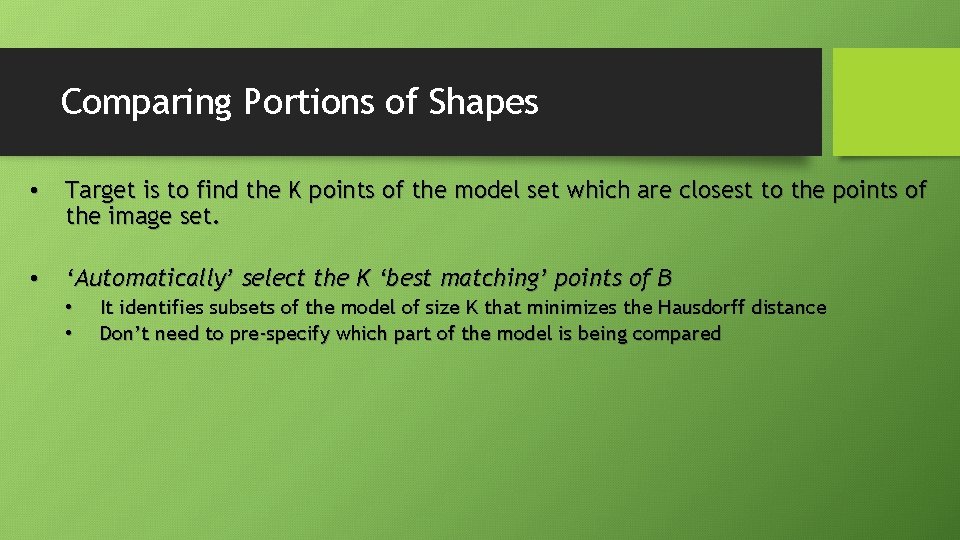
Comparing Portions of Shapes • Target is to find the K points of the model set which are closest to the points of the image set. • ‘Automatically’ select the K ‘best matching’ points of B • • It identifies subsets of the model of size K that minimizes the Hausdorff distance Don’t need to pre-specify which part of the model is being compared
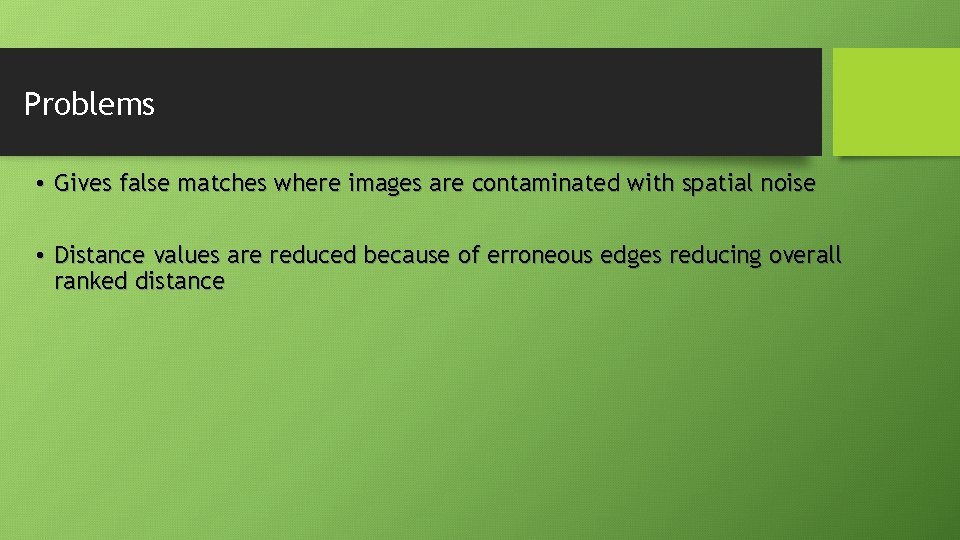
Problems • Gives false matches where images are contaminated with spatial noise • Distance values are reduced because of erroneous edges reducing overall ranked distance
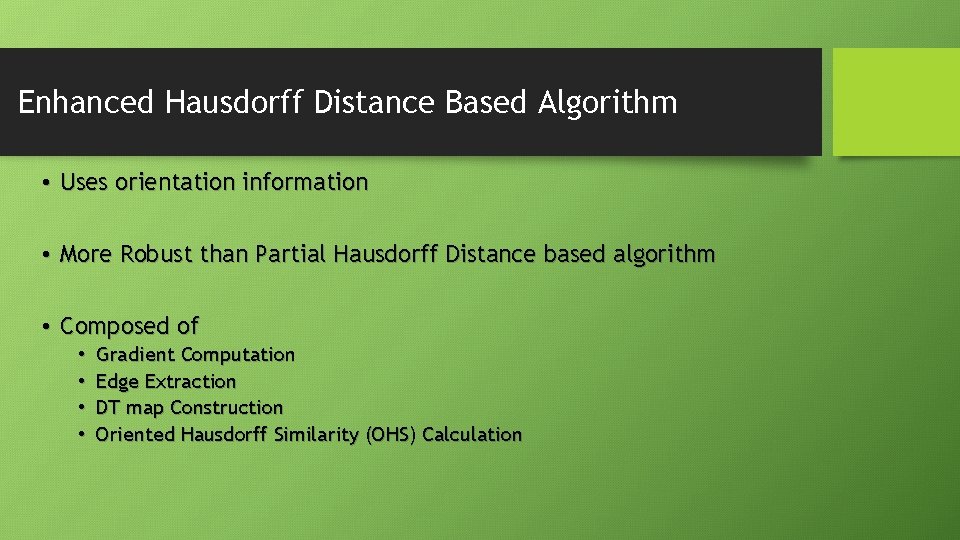
Enhanced Hausdorff Distance Based Algorithm • Uses orientation information • More Robust than Partial Hausdorff Distance based algorithm • Composed of • • Gradient Computation Edge Extraction DT map Construction Oriented Hausdorff Similarity (OHS) Calculation
Example 1 • Sample Template Image • Reference image
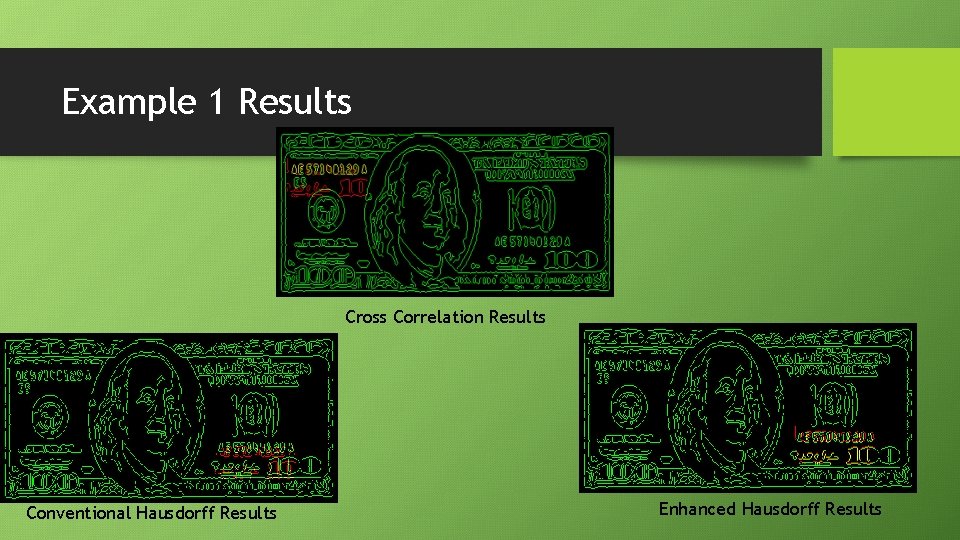
Example 1 Results Cross Correlation Results Conventional Hausdorff Results Enhanced Hausdorff Results
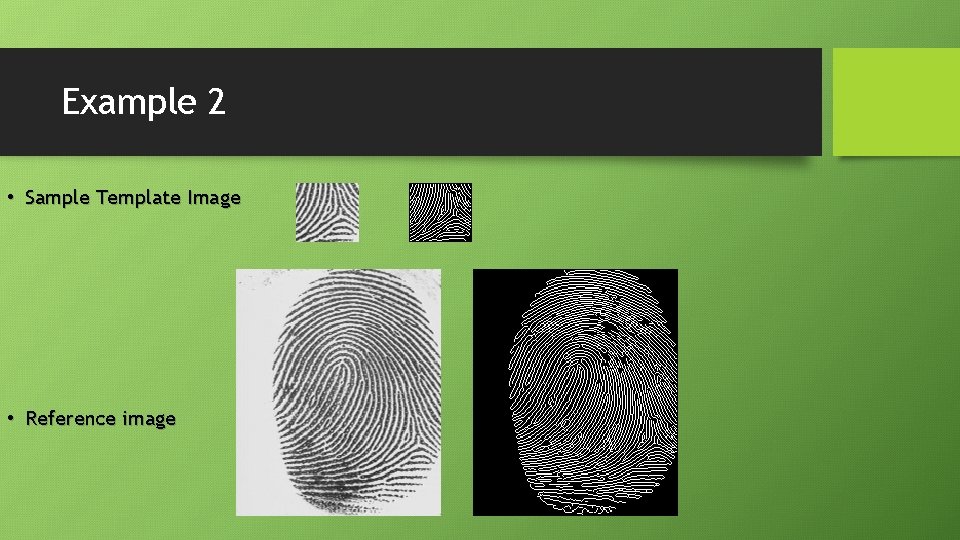
Example 2 • Sample Template Image • Reference image
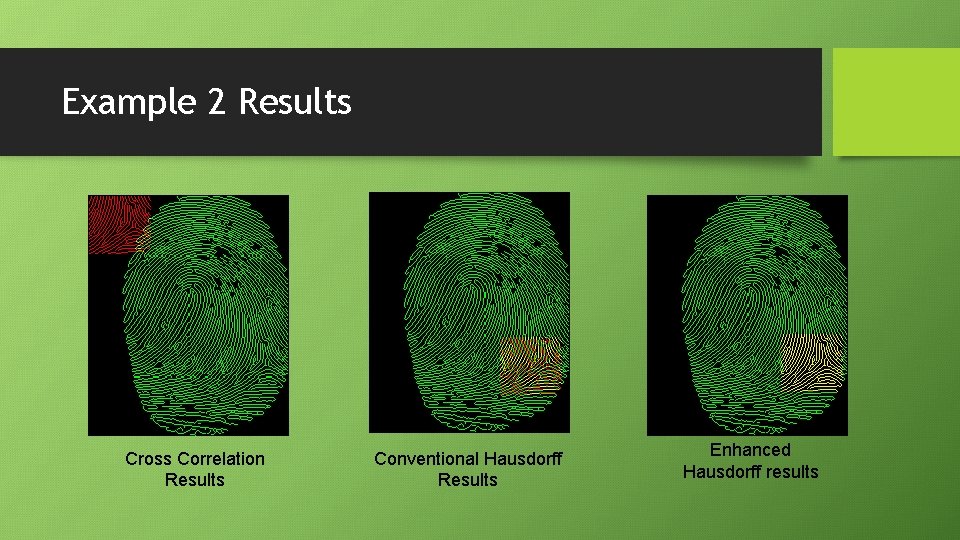
Example 2 Results Cross Correlation Results Conventional Hausdorff Results Enhanced Hausdorff results
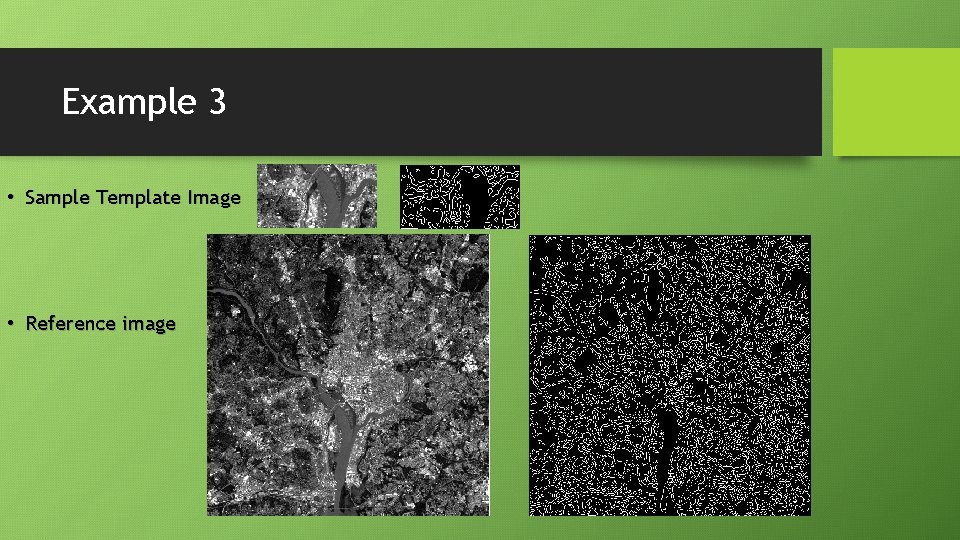
Example 3 • Sample Template Image • Reference image
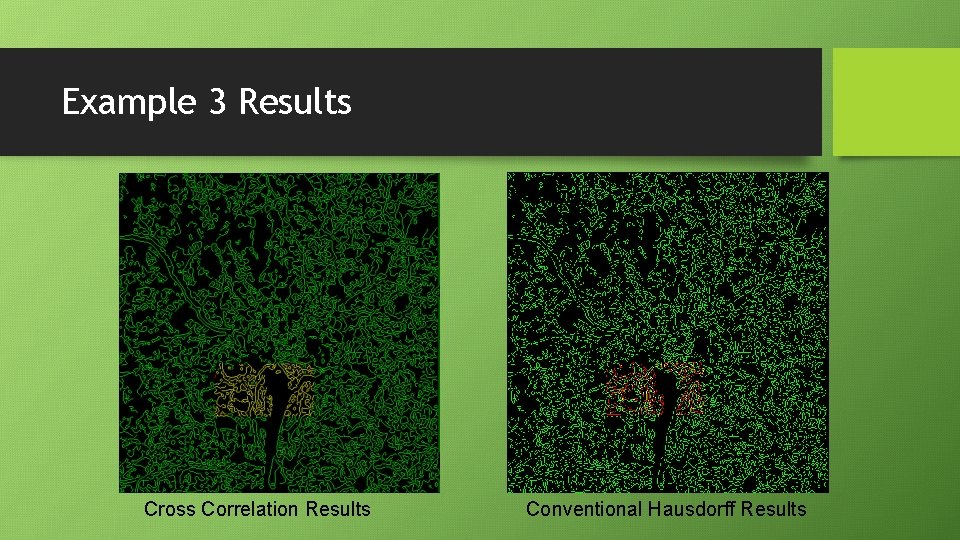
Example 3 Results Cross Correlation Results Conventional Hausdorff Results
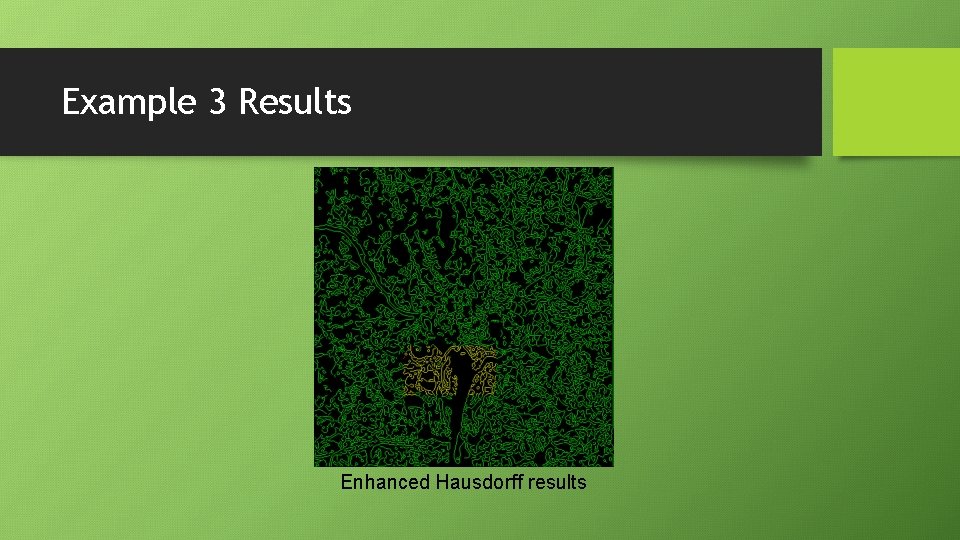
Example 3 Results Enhanced Hausdorff results
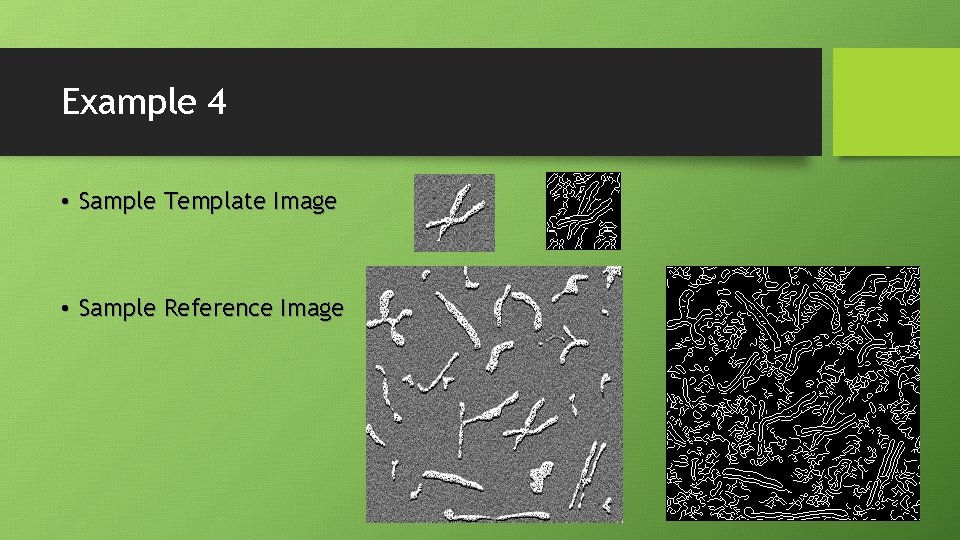
Example 4 • Sample Template Image • Sample Reference Image
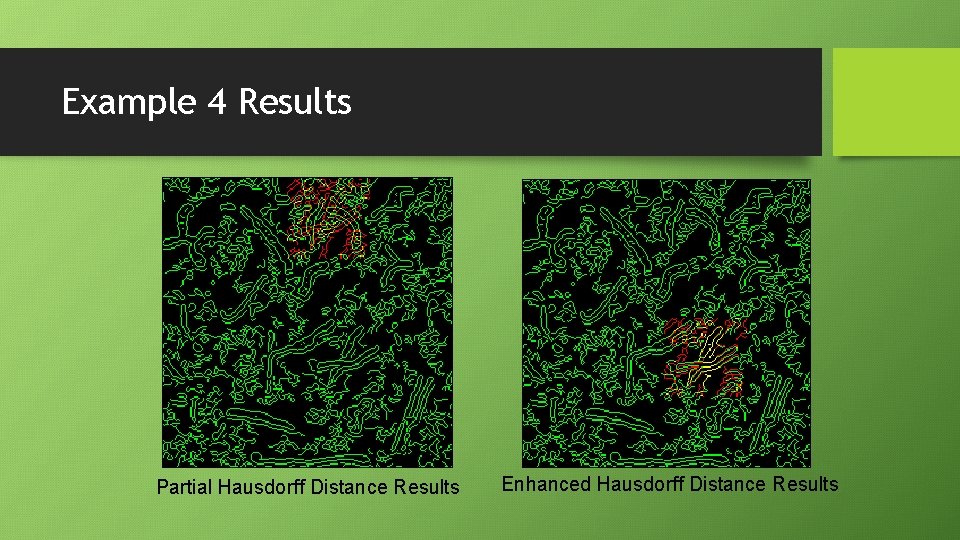
Example 4 Results Partial Hausdorff Distance Results Enhanced Hausdorff Distance Results
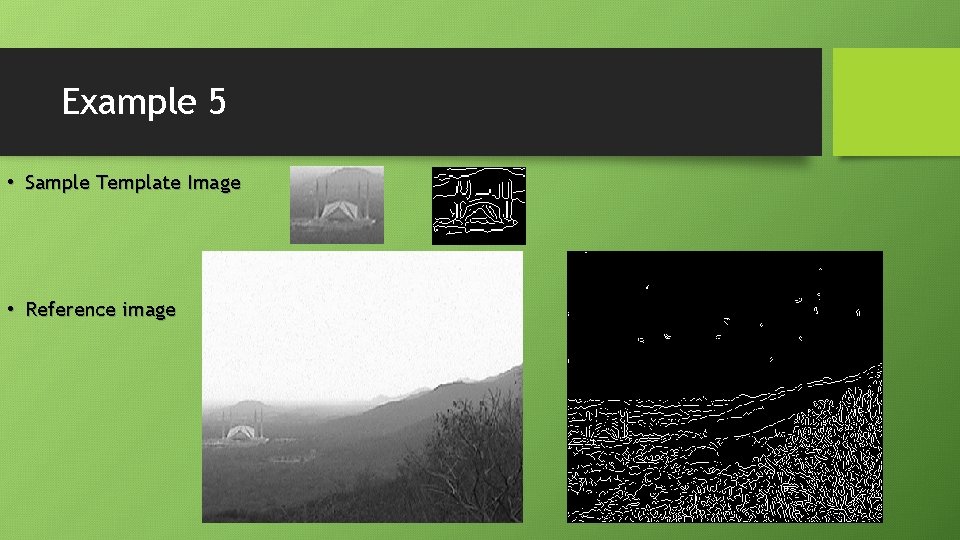
Example 5 • Sample Template Image • Reference image
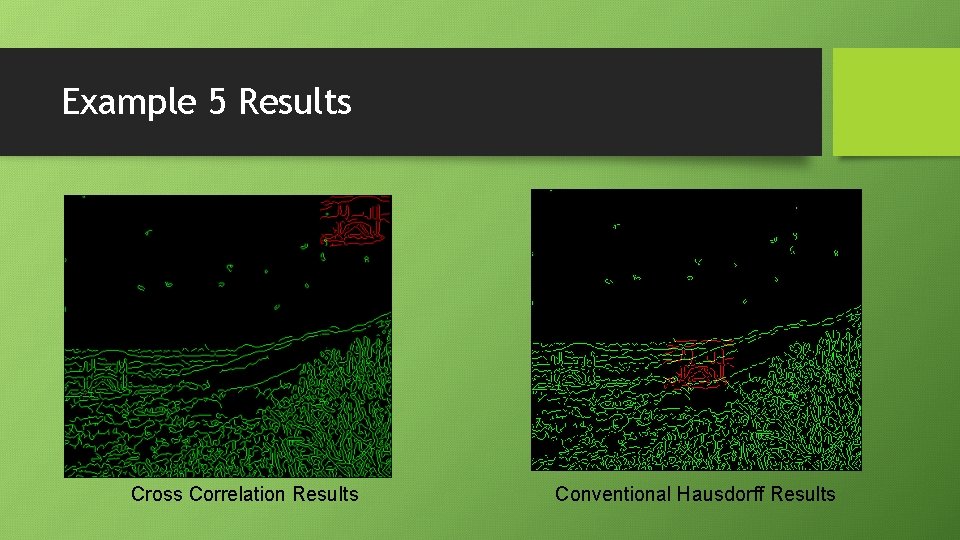
Example 5 Results Cross Correlation Results Conventional Hausdorff Results
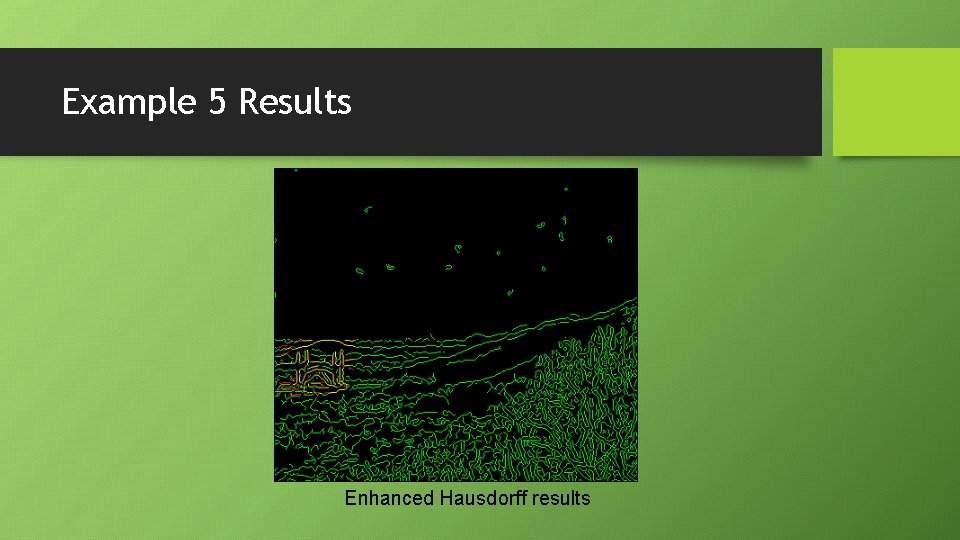
Example 5 Results Enhanced Hausdorff results
References • www. biomisa. org/usman/courses. html • DISTANCE TRANSFORM ALGORITHMS AND THEIR IMPLEMENTATION AND EVALUATION, George J. Grevera