
Comparing covalent compounds Intermolecular bonds To determine relative
Comparing covalent compounds
Intermolecular bonds • To determine relative melting points for ionic compounds, we looked at the strength of intramolecular bonds (bonds between atoms).
Intermolecular bonds • To determine relative melting points for ionic compounds, we looked at the strength of intramolecular bonds (bonds between atoms). • To determine relative melting points for covalent compounds, we looked at the strength of intermolecular bonds (bonds between adjacent molecules).
Intermolecular bonds • To determine relative melting points for ionic compounds, we looked at the strength of intramolecular bonds (bonds between atoms). • To determine relative melting points for covalent compounds, we looked at the strength of intermolecular bonds (bonds between adjacent molecules). • Single, double, and triple bonds tell us nothing about relative melting point.
Melting point for covalent compounds • First, we must determine the polarity of the molecule. Polar molecules have higher melting points than nonpolar molecules.
Melting point for covalent compounds • First, we must determine the polarity of the molecule. Polar molecules have higher melting points than nonpolar molecules. • If both compounds are polar, the one with the greater electronegativity difference will have a higher melting point.
Melting point for covalent compounds • First, we must determine the polarity of the molecule. Polar molecules have higher melting points than nonpolar molecules. • If both compounds are polar, the one with the greater electronegativity difference will have a higher melting point. • If both compounds are nonpolar, the one with a greater number of overall electrons will have the higher melting point.
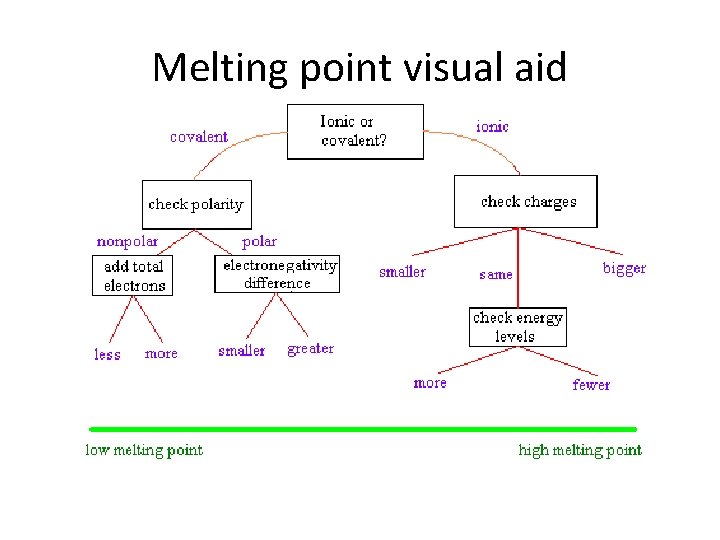
Melting point visual aid
Which substance has a higher melting point, CO or CO 2?
Which substance has a higher melting point, CO or CO 2? • We need to determine the polarity of each substance. The difference in electronegativity will be the same for each compound, 0. 89.
Which substance has a higher melting point, CO or CO 2? • We need to determine the polarity of each substance. The difference in electronegativity will be the same for each compound, 0. 89. • Lewis structure for CO will not be symmetrical and is polar.
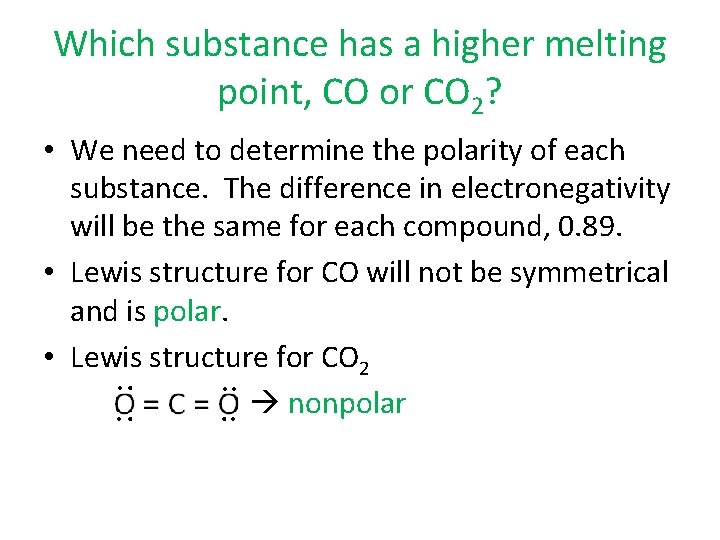
Which substance has a higher melting point, CO or CO 2? • We need to determine the polarity of each substance. The difference in electronegativity will be the same for each compound, 0. 89. • Lewis structure for CO will not be symmetrical and is polar. • Lewis structure for CO 2 O = C = O nonpolar
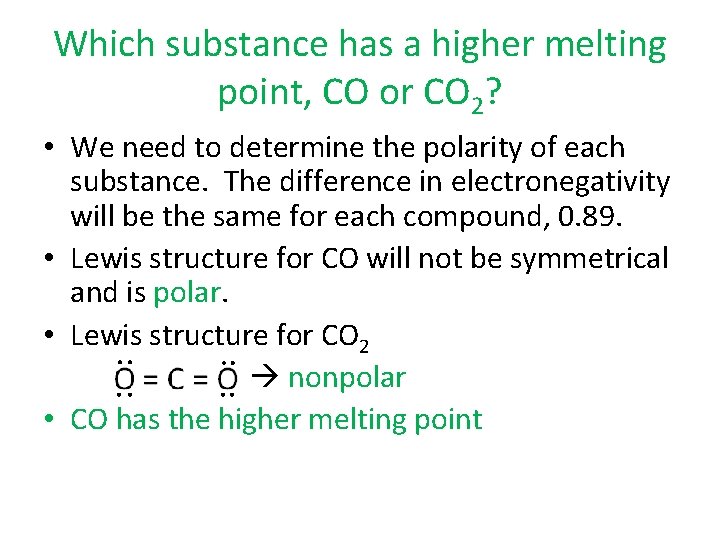
Which substance has a higher melting point, CO or CO 2? • We need to determine the polarity of each substance. The difference in electronegativity will be the same for each compound, 0. 89. • Lewis structure for CO will not be symmetrical and is polar. • Lewis structure for CO 2 O = C = O nonpolar • CO has the higher melting point
Which substance is more likely to be a gas at room temperature, NH 3 or PBr 3?
Which substance is more likely to be a gas at room temperature, NH 3 or PBr 3? • NH 3 is polar according to the Lewis structure.
Which substance is more likely to be a gas at room temperature, NH 3 or PBr 3? • NH 3 is polar according to the Lewis structure. • PBr 3 is also polar according to its Lewis structure.
Which substance is more likely to be a gas at room temperature, NH 3 or PBr 3? • NH 3 is polar according to the Lewis structure. • PBr 3 is also polar according to its Lewis structure. • The substance with the smaller difference in electronegativity will have weaker intermolecular bonds and is more likely to be a gas at room temperature.
Which substance is more likely to be a gas at room temperature, NH 3 or PBr 3? • NH 3 is polar according to the Lewis structure. • PBr 3 is also polar according to its Lewis structure. • The substance with the smaller difference in electronegativity will have weaker intermolecular bonds and is more likely to be a gas at room temperature. • PBr 3
Which substance has a higher boiling point, N 2 or O 2?
Which substance has a higher boiling point, N 2 or O 2? • Both substances have an electronegativity difference of zero and are nonpolar.
Which substance has a higher boiling point, N 2 or O 2? • Both substances have an electronegativity difference of zero and are nonpolar. • The substance with more electrons will have the higher boiling point.
Which substance has a higher boiling point, N 2 or O 2? • Both substances have an electronegativity difference of zero and are nonpolar. • The substance with more electrons will have the higher boiling point. • N 2 has 14 electrons, O 2 has 16 electrons, oxygen has the higher boiling point.
Naming binary covalent compounds • A binary covalent compound consists of exactly two nonmetals.
Naming binary covalent compounds • A binary covalent compound consists of exactly two nonmetals. • The name of the first nonmetal is the name of the element with a latin prefix to represent the subscript (unless it’s 1).
Naming binary covalent compounds • A binary covalent compound consists of exactly two nonmetals. • The name of the first nonmetal is the name of the element with a latin prefix to represent the subscript (unless it’s 1). • The name of the second nonmetal must end in -ide with a latin prefix to represent the subscript (even if it’s 1).
Latin prefixes 1. mono-
Latin prefixes 1. mono 2. di-
Latin prefixes 1. mono 2. di 3. tri-
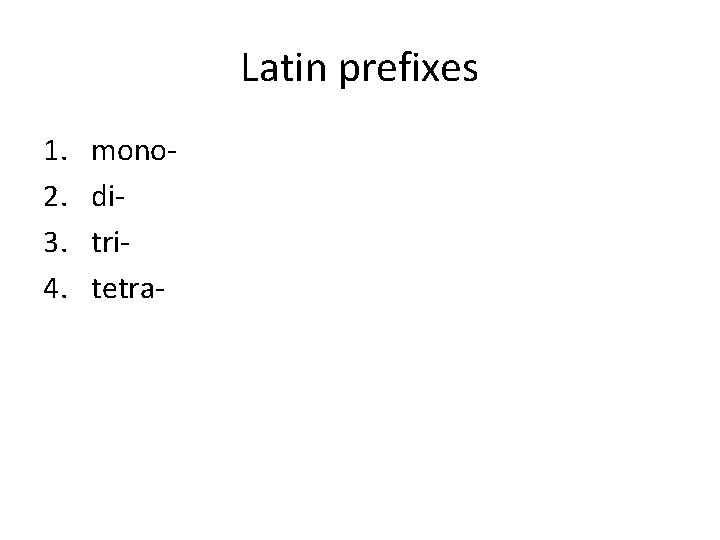
Latin prefixes 1. 2. 3. 4. monoditritetra-
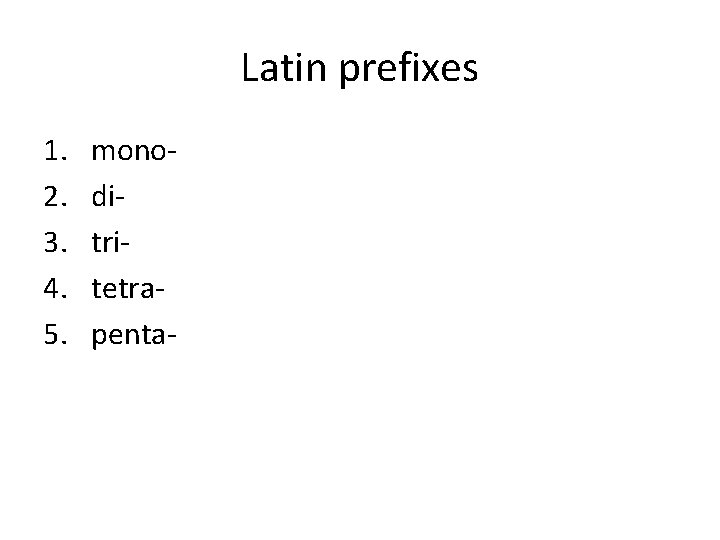
Latin prefixes 1. 2. 3. 4. 5. monoditritetrapenta-
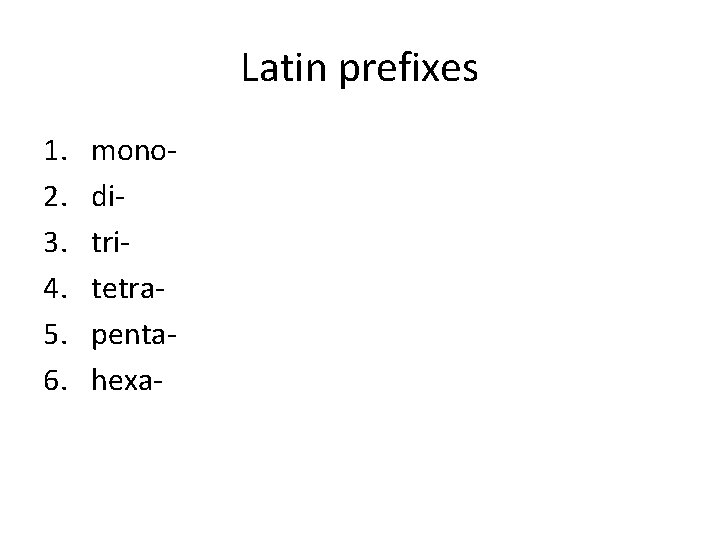
Latin prefixes 1. 2. 3. 4. 5. 6. monoditritetrapentahexa-
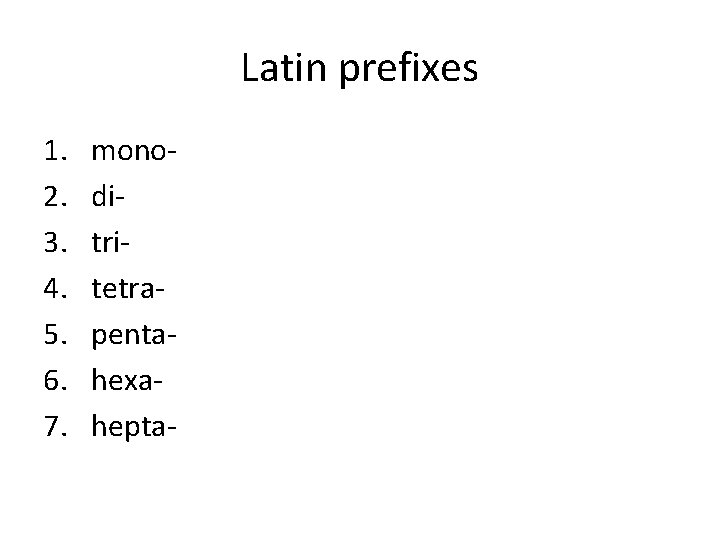
Latin prefixes 1. 2. 3. 4. 5. 6. 7. monoditritetrapentahexahepta-
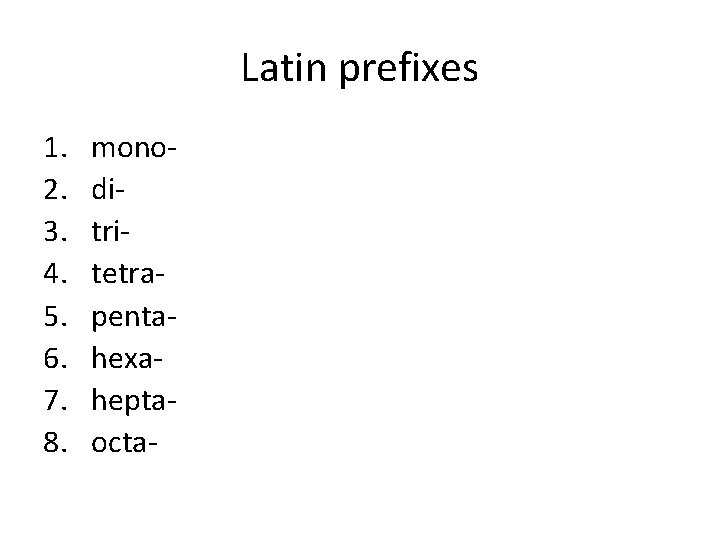
Latin prefixes 1. 2. 3. 4. 5. 6. 7. 8. monoditritetrapentahexaheptaocta-
Examples • CCl 4 =
Examples • CCl 4 = carbon tetrachloride • P 2 O 5 =
Examples • CCl 4 = carbon tetrachloride • P 2 O 5 = diphosphorus pentoxide • CO =
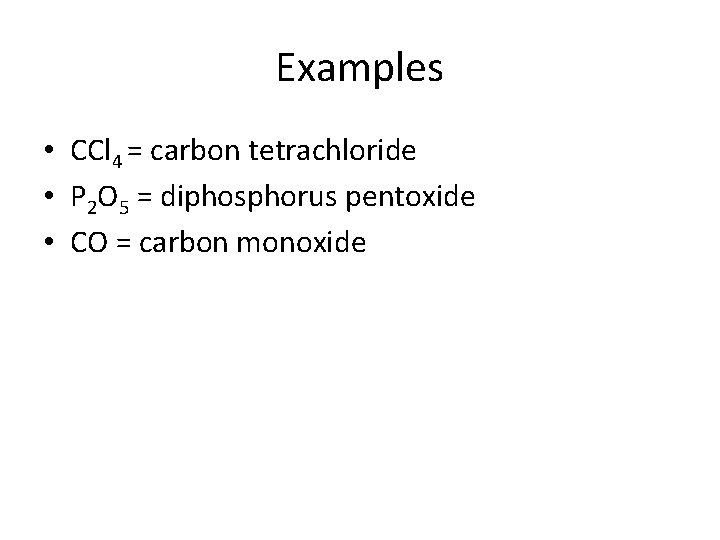
Examples • CCl 4 = carbon tetrachloride • P 2 O 5 = diphosphorus pentoxide • CO = carbon monoxide
- Slides: 37