
Comparing Cameras Using EMVA 1288 Dr Friedrich Dierks




- Slides: 37
Comparing Cameras Using EMVA 1288 Dr. Friedrich Dierks Head of Software Development Components © Basler AG, 2006, Version 1. 2
www. standard 1288. org Why Attend this Presentation? After attending this presentation you can… 4 compare the sensitivity of cameras 4 with respect to temporal and spatial noise 4 using EMVA 1288 data sheets. You understand the role of 4 Gain (doesn’t matter) 4 Pixel size (doesn’t matter) 4 Bright light (the key) Beware : All formulas in this presentation will drop out of the sky For details see the standard and the white papers. © Basler AG, 2006 2 Dierks: EMVA 1288
www. standard 1288. org Outline 4 Some Basics 4 Temporal Noise 4 Spatial Noise © Basler AG, 2006 3 Dierks: EMVA 1288
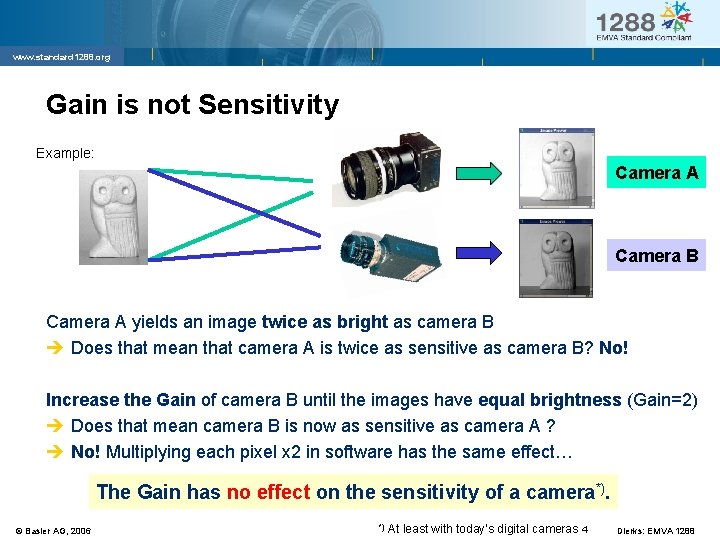
www. standard 1288. org Gain is not Sensitivity Example: Camera A Camera B Camera A yields an image twice as bright as camera B Does that mean that camera A is twice as sensitive as camera B? No! Increase the Gain of camera B until the images have equal brightness (Gain=2) Does that mean camera B is now as sensitive as camera A ? No! Multiplying each pixel x 2 in software has the same effect… The Gain has no effect on the sensitivity of a camera*). © Basler AG, 2006 *) At least with today’s digital cameras 4 Dierks: EMVA 1288
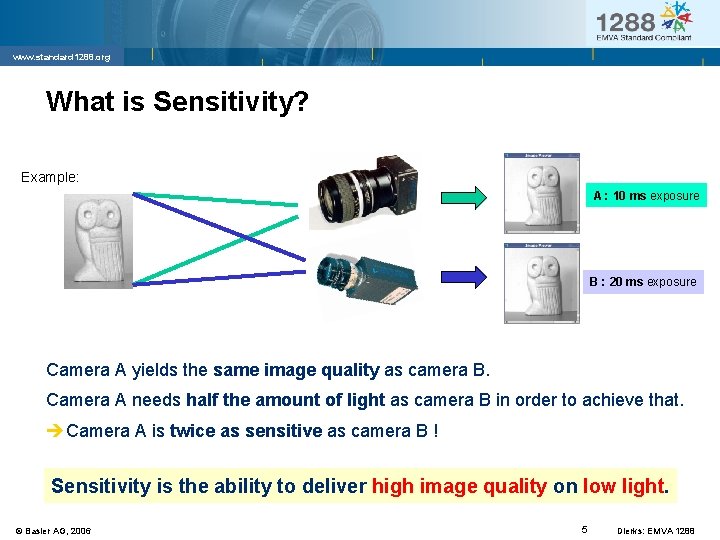
www. standard 1288. org What is Sensitivity? Example: A : 10 ms exposure B : 20 ms exposure Camera A yields the same image quality as camera B. Camera A needs half the amount of light as camera B in order to achieve that. Camera A is twice as sensitive as camera B ! Sensitivity is the ability to deliver high image quality on low light. © Basler AG, 2006 5 Dierks: EMVA 1288
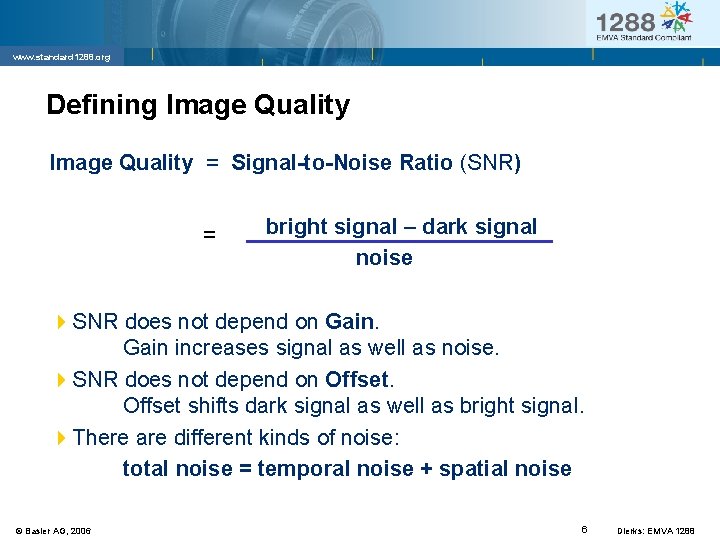
www. standard 1288. org Defining Image Quality = Signal-to-Noise Ratio (SNR) = bright signal – dark signal noise 4 SNR does not depend on Gain increases signal as well as noise. 4 SNR does not depend on Offset shifts dark signal as well as bright signal. 4 There are different kinds of noise: total noise = temporal noise + spatial noise © Basler AG, 2006 6 Dierks: EMVA 1288
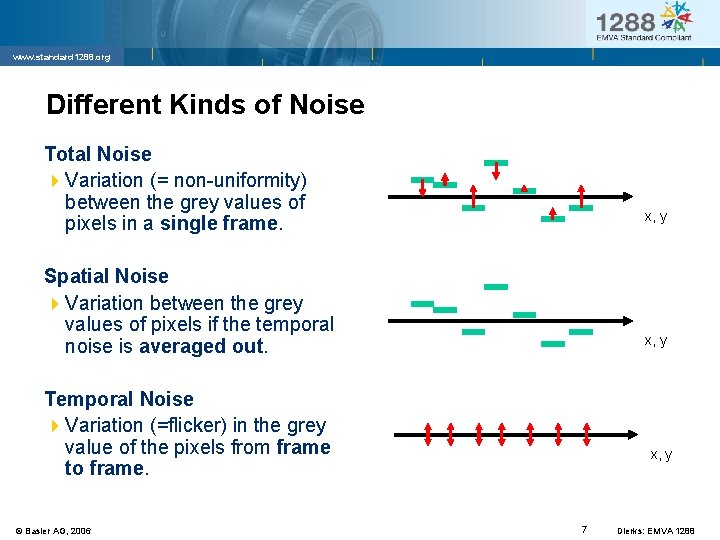
www. standard 1288. org Different Kinds of Noise Total Noise 4 Variation (= non-uniformity) between the grey values of pixels in a single frame. x, y Spatial Noise 4 Variation between the grey values of pixels if the temporal noise is averaged out. x, y Temporal Noise 4 Variation (=flicker) in the grey value of the pixels from frame to frame. © Basler AG, 2006 x, y 7 Dierks: EMVA 1288
www. standard 1288. org Outline 4 Some Basics 4 Temporal Noise 4 Spatial Noise © Basler AG, 2006 8 Dierks: EMVA 1288
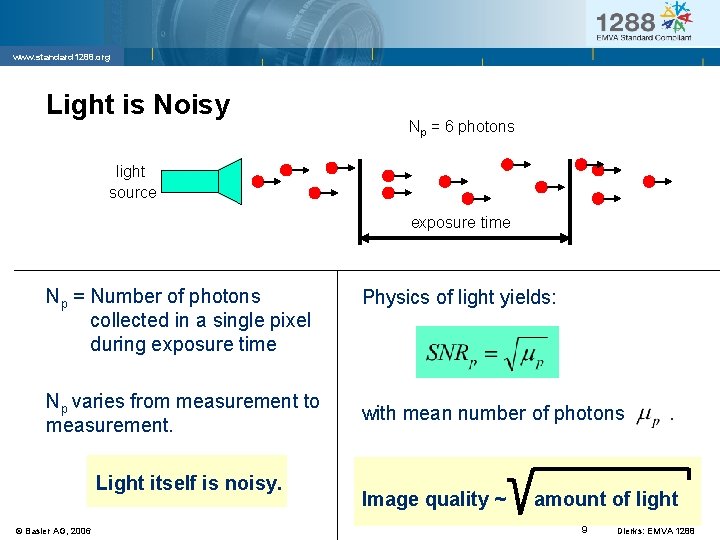
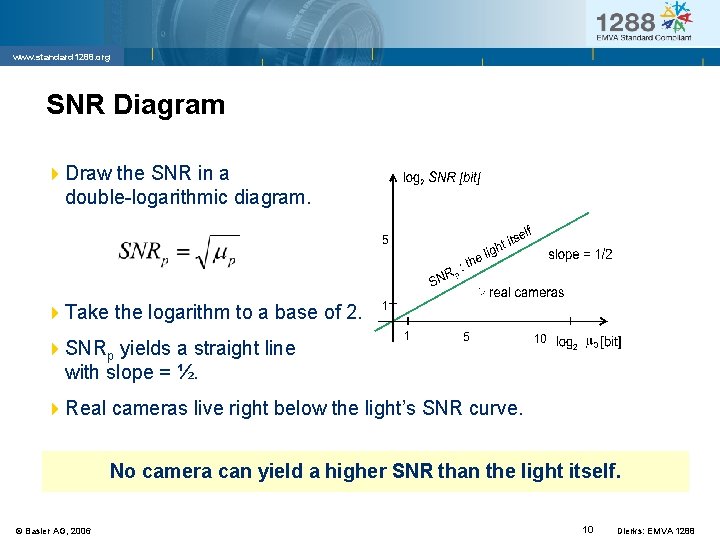
www. standard 1288. org Light is Noisy Np = 6 photons light source exposure time Np = Number of photons collected in a single pixel during exposure time Np varies from measurement to measurement. Light itself is noisy. © Basler AG, 2006 Physics of light yields: with mean number of photons Image quality ~ . amount of light 9 Dierks: EMVA 1288
www. standard 1288. org SNR Diagram 4 Draw the SNR in a double-logarithmic diagram. 4 Take the logarithm to a base of 2. 4 SNRp yields a straight line with slope = ½. 4 Real cameras live right below the light’s SNR curve. No camera can yield a higher SNR than the light itself. © Basler AG, 2006 10 Dierks: EMVA 1288
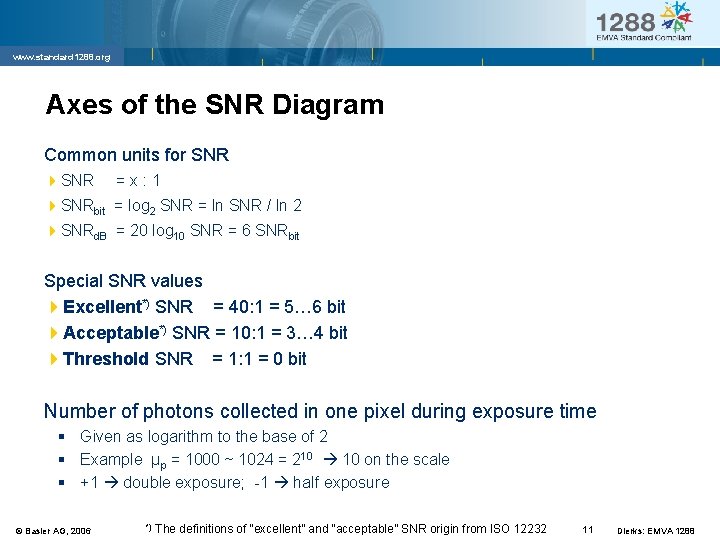
www. standard 1288. org Axes of the SNR Diagram Common units for SNR 4 SNR =x: 1 4 SNRbit = log 2 SNR = ln SNR / ln 2 4 SNRd. B = 20 log 10 SNR = 6 SNRbit Special SNR values 4 Excellent*) SNR = 40: 1 = 5… 6 bit 4 Acceptable*) SNR = 10: 1 = 3… 4 bit 4 Threshold SNR = 1: 1 = 0 bit Number of photons collected in one pixel during exposure time § Given as logarithm to the base of 2 § Example µp = 1000 ~ 1024 = 210 10 on the scale § +1 double exposure; -1 half exposure © Basler AG, 2006 *) The definitions of “excellent” and “acceptable” SNR origin from ISO 12232 11 Dierks: EMVA 1288
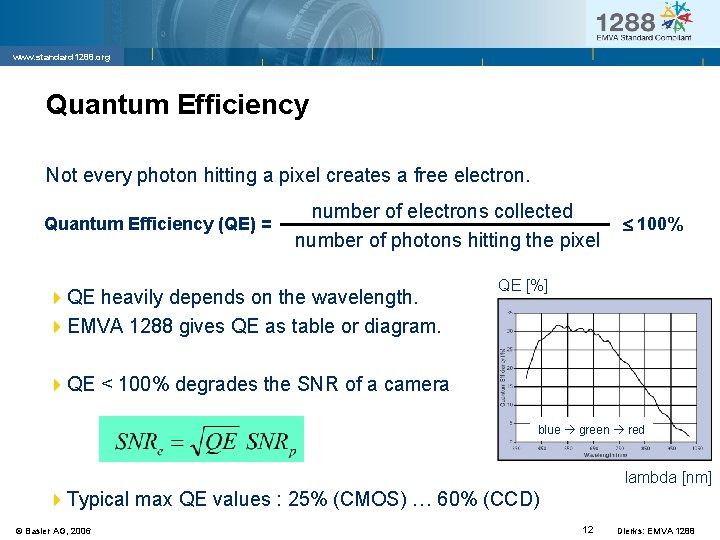
www. standard 1288. org Quantum Efficiency Not every photon hitting a pixel creates a free electron. Quantum Efficiency (QE) = number of electrons collected number of photons hitting the pixel 4 QE heavily depends on the wavelength. 4 EMVA 1288 gives QE as table or diagram. 100% QE [%] 4 QE < 100% degrades the SNR of a camera blue green red lambda [nm] 4 Typical max QE values : 25% (CMOS) … 60% (CCD) © Basler AG, 2006 12 Dierks: EMVA 1288
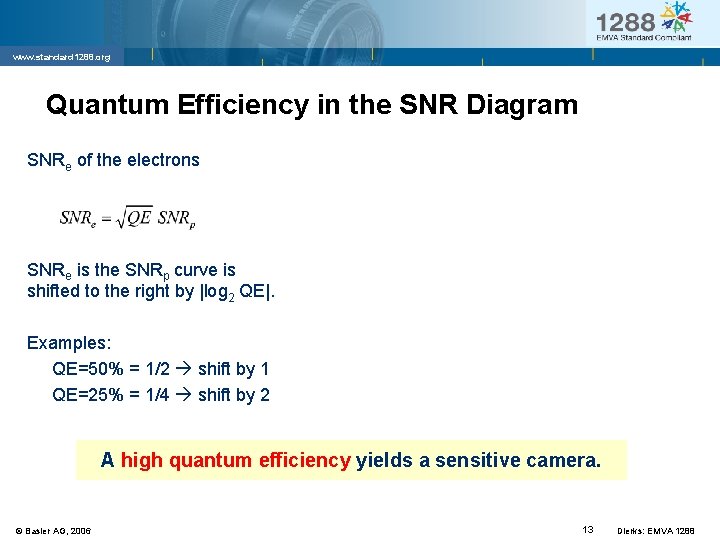
www. standard 1288. org Quantum Efficiency in the SNR Diagram SNRe of the electrons SNRe is the SNRp curve is shifted to the right by |log 2 QE|. Examples: QE=50% = 1/2 shift by 1 QE=25% = 1/4 shift by 2 A high quantum efficiency yields a sensitive camera. © Basler AG, 2006 13 Dierks: EMVA 1288
www. standard 1288. org Saturation analog signal 4 A camera saturates… § if the pixel saturates § if the analog-to-digital converter saturates 4 The useful signal range lies between saturation and the noise floor 4 At minimum Gain the ADC saturates shortly before the pixel*) 11 *) no Gain min Gain 12 8 max Gain useful signal range 8 1 1 noise floor The saturation capacity depends on the Gain. © Basler AG, 2006 8 bit subset pixel saturates 4 The number of electrons at saturation is the Saturation Capacity 4 Do not confuse saturation capacity with full well capacity (pixel only). 12 bit Otherwise you get high fixed pattern noise at saturation. 1 1 All scales are log 2 14 Dierks: EMVA 1288
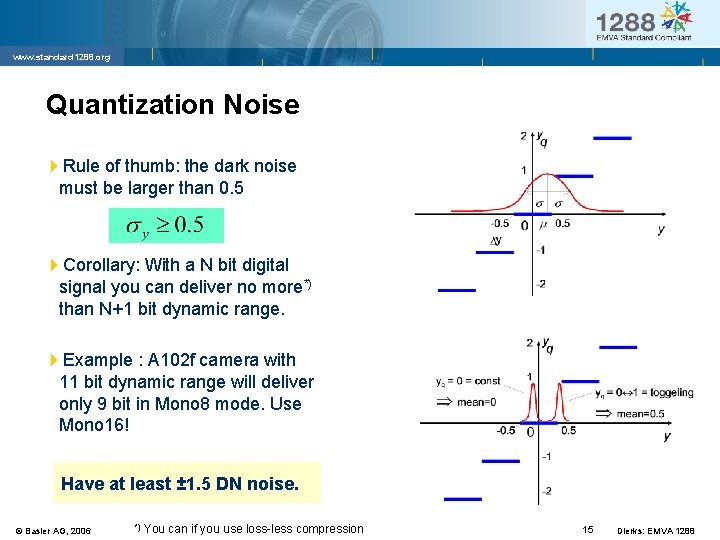
www. standard 1288. org Quantization Noise 4 Rule of thumb: the dark noise must be larger than 0. 5 4 Corollary: With a N bit digital signal you can deliver no more*) than N+1 bit dynamic range. 4 Example : A 102 f camera with 11 bit dynamic range will deliver only 9 bit in Mono 8 mode. Use Mono 16! Have at least ± 1. 5 DN noise. © Basler AG, 2006 *) You can if you use loss-less compression 15 Dierks: EMVA 1288
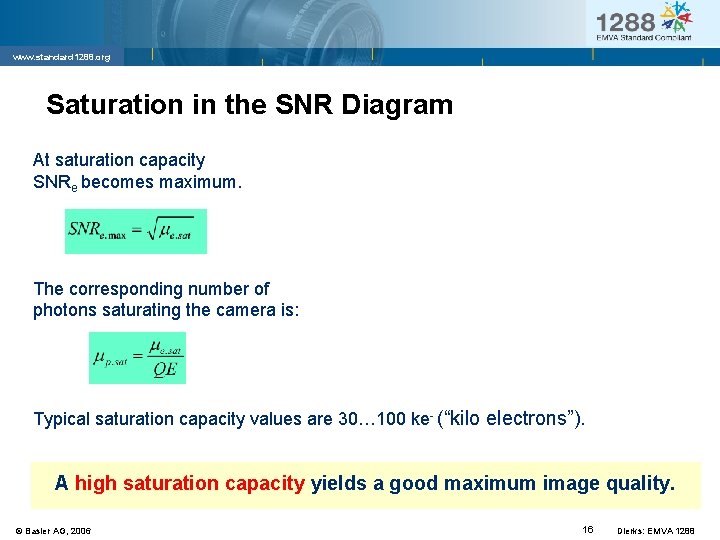
www. standard 1288. org Saturation in the SNR Diagram At saturation capacity SNRe becomes maximum. The corresponding number of photons saturating the camera is: Typical saturation capacity values are 30… 100 ke- (“kilo electrons”). A high saturation capacity yields a good maximum image quality. © Basler AG, 2006 16 Dierks: EMVA 1288
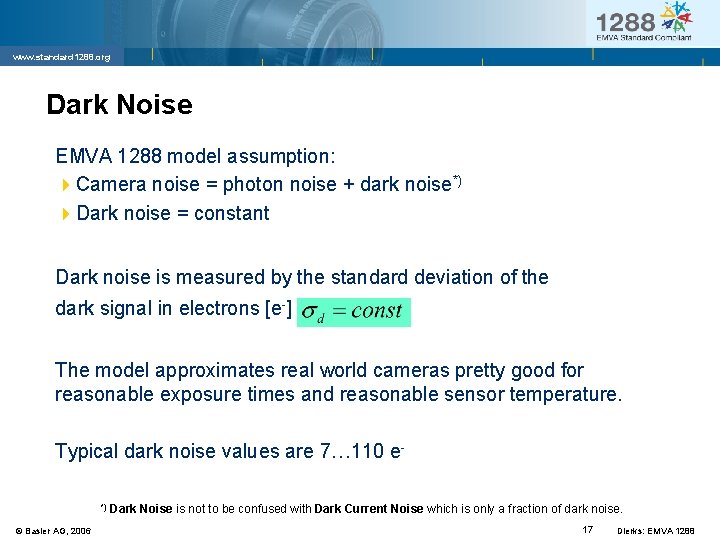
www. standard 1288. org Dark Noise EMVA 1288 model assumption: 4 Camera noise = photon noise + dark noise*) 4 Dark noise = constant Dark noise is measured by the standard deviation of the dark signal in electrons [e-] The model approximates real world cameras pretty good for reasonable exposure times and reasonable sensor temperature. Typical dark noise values are 7… 110 e*) © Basler AG, 2006 Dark Noise is not to be confused with Dark Current Noise which is only a fraction of dark noise. 17 Dierks: EMVA 1288
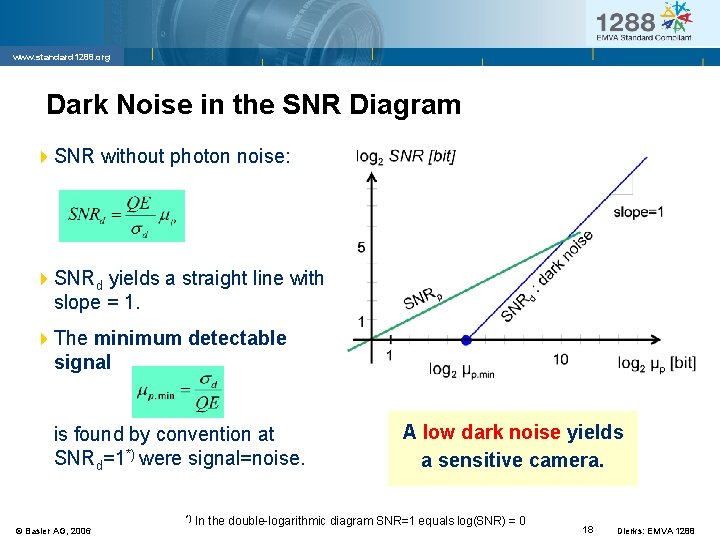
www. standard 1288. org Dark Noise in the SNR Diagram 4 SNR without photon noise: 4 SNRd yields a straight line with slope = 1. 4 The minimum detectable signal is found by convention at SNRd=1*) were signal=noise. *) © Basler AG, 2006 A low dark noise yields a sensitive camera. In the double-logarithmic diagram SNR=1 equals log(SNR) = 0 18 Dierks: EMVA 1288
www. standard 1288. org The Complete SNR Diagram Overlaying photon noise and dark noise yields: with The curve starts at An EMVA 1288 data sheet provides all parameters to draw the curve, e. g. in Excel: and ends at © Basler AG, 2006 § Quantum efficiency QE [%] as a function of wavelength § Dark noise sd [e-] § Saturation capacity µe. sat [e-] 19 Dierks: EMVA 1288
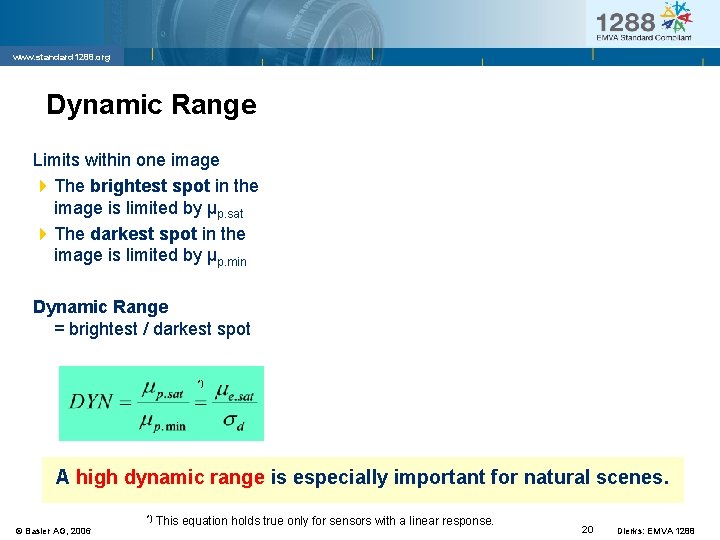
www. standard 1288. org Dynamic Range Limits within one image 4 The brightest spot in the image is limited by µp. sat 4 The darkest spot in the image is limited by µp. min Dynamic Range = brightest / darkest spot *) A high dynamic range is especially important for natural scenes. *) © Basler AG, 2006 This equation holds true only for sensors with a linear response. 20 Dierks: EMVA 1288
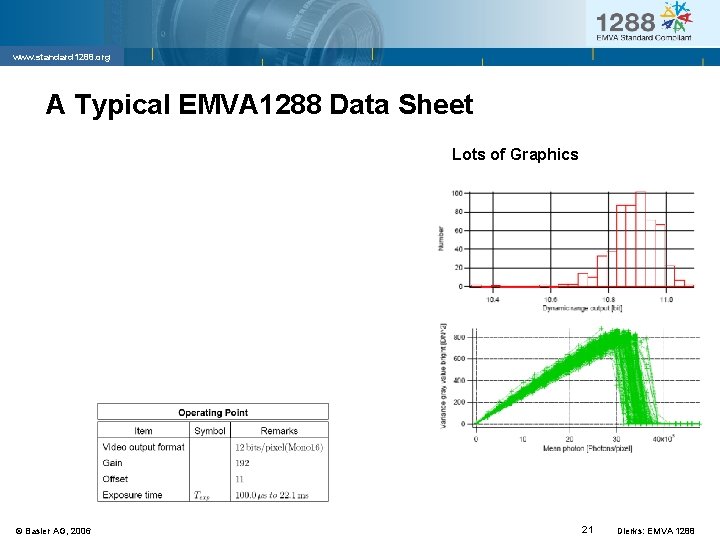
www. standard 1288. org A Typical EMVA 1288 Data Sheet Lots of Graphics © Basler AG, 2006 21 Dierks: EMVA 1288
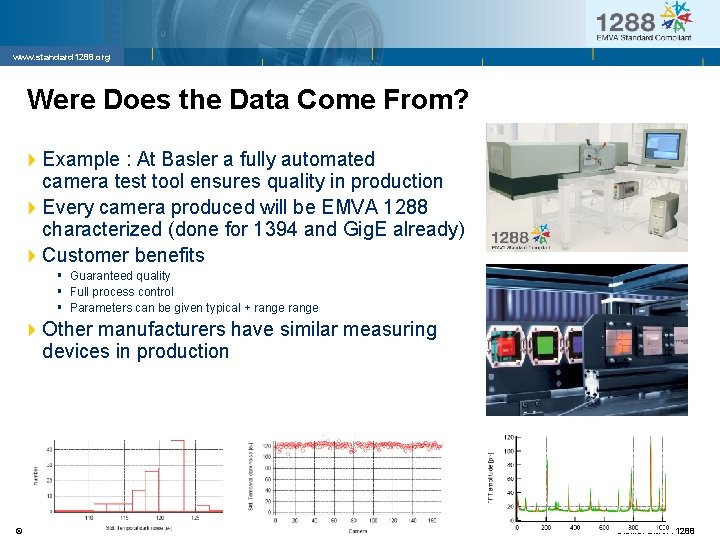
www. standard 1288. org Were Does the Data Come From? 4 Example : At Basler a fully automated camera test tool ensures quality in production 4 Every camera produced will be EMVA 1288 characterized (done for 1394 and Gig. E already) 4 Customer benefits § Guaranteed quality § Full process control § Parameters can be given typical + range 4 Other manufacturers have similar measuring devices in production © Basler AG, 2006 22 Dierks: EMVA 1288
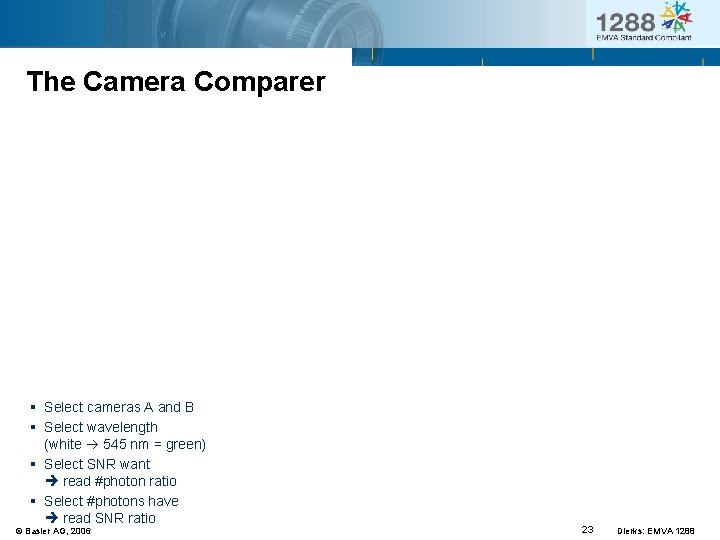
www. standard 1288. org The Camera Comparer § Select cameras A and B § Select wavelength (white 545 nm = green) § Select SNR want read #photon ratio § Select #photons have read SNR ratio © Basler AG, 2006 23 Dierks: EMVA 1288
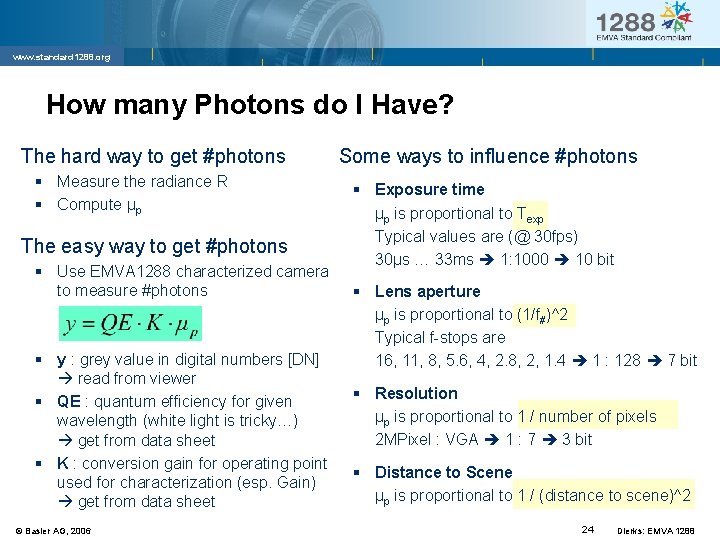
www. standard 1288. org How many Photons do I Have? The hard way to get #photons § Measure the radiance R § Compute µp The easy way to get #photons § Use EMVA 1288 characterized camera to measure #photons § y : grey value in digital numbers [DN] read from viewer § QE : quantum efficiency for given wavelength (white light is tricky…) get from data sheet § K : conversion gain for operating point used for characterization (esp. Gain) get from data sheet © Basler AG, 2006 Some ways to influence #photons § Exposure time µp is proportional to Texp Typical values are (@ 30 fps) 30µs … 33 ms 1: 1000 10 bit § Lens aperture µp is proportional to (1/f#)^2 Typical f-stops are 16, 11, 8, 5. 6, 4, 2. 8, 2, 1. 4 1 : 128 7 bit § Resolution µp is proportional to 1 / number of pixels 2 MPixel : VGA 1 : 7 3 bit § Distance to Scene µp is proportional to 1 / (distance to scene)^2 24 Dierks: EMVA 1288
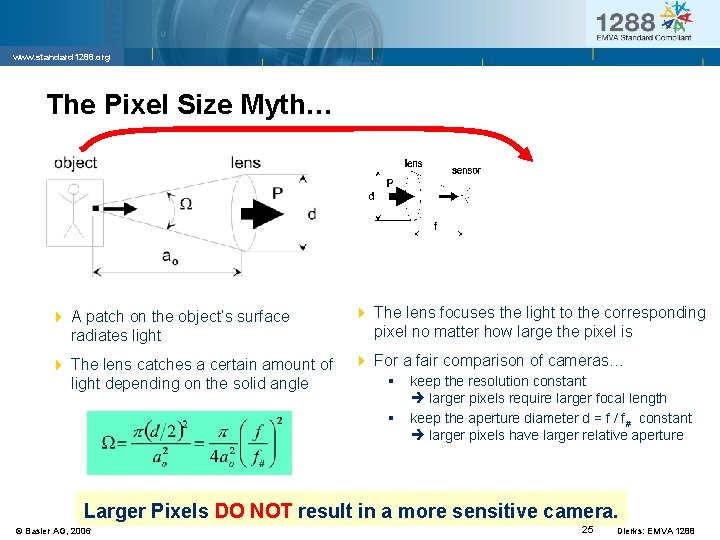
www. standard 1288. org The Pixel Size Myth… 4 A patch on the object’s surface radiates light 4 The lens focuses the light to the corresponding pixel no matter how large the pixel is 4 The lens catches a certain amount of light depending on the solid angle 4 For a fair comparison of cameras… § § keep the resolution constant larger pixels require larger focal length keep the aperture diameter d = f / f# constant larger pixels have larger relative aperture Larger Pixels DO NOT result in a more sensitive camera. © Basler AG, 2006 25 Dierks: EMVA 1288
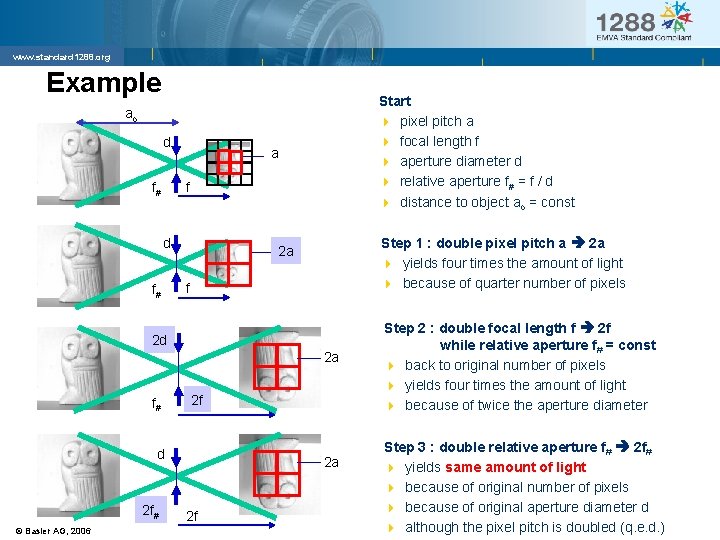
www. standard 1288. org Example Start 4 pixel pitch a 4 focal length f 4 aperture diameter d 4 relative aperture f# = f / d 4 distance to object ao = const ao d f# a f d f# Step 1 : double pixel pitch a 2 a 4 yields four times the amount of light 4 because of quarter number of pixels 2 a f 2 d 2 a f# 2 f d 2 f# © Basler AG, 2006 2 a 2 f Step 2 : double focal length f 2 f while relative aperture f# = const 4 back to original number of pixels 4 yields four times the amount of light 4 because of twice the aperture diameter Step 3 : double relative aperture f# 2 f# 4 yields same amount of light 4 because of original number of pixels 4 because of original aperture diameter d 4 although the pixel pitch is doubled (q. e. d. ) 26 Dierks: EMVA 1288
www. standard 1288. org Don’t Get Confused - Pixel Size Matters a Lot*) For example smaller pixels… 4 yield less aberrations because of near-axis optics 4 yield smaller and cheaper optics 4 allow larger number of pixels 4 have less problems with micro lenses For example larger pixels… 4 yield sharper images because less resolving power of the lens is required 4 keep you out of the refraction limit of the lens 4 have a better geometrical fill factor (area scan) 4 have a larger full well capacity *) © Basler AG, 2006 Although not with respect to sensitivity 27 Dierks: EMVA 1288
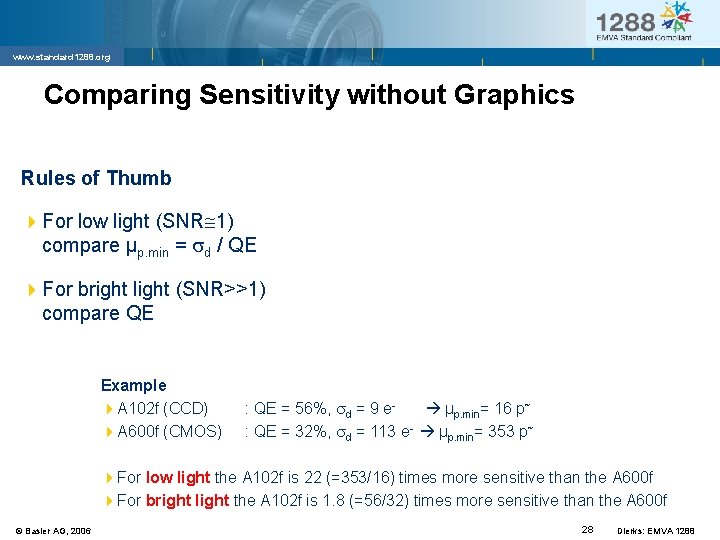
www. standard 1288. org Comparing Sensitivity without Graphics Rules of Thumb 4 For low light (SNR 1) compare µp. min = sd / QE 4 For bright light (SNR>>1) compare QE Example 4 A 102 f (CCD) 4 A 600 f (CMOS) : QE = 56%, sd = 9 e µp. min= 16 p~ : QE = 32%, sd = 113 e- µp. min= 353 p~ 4 For low light the A 102 f is 22 (=353/16) times more sensitive than the A 600 f 4 For bright light the A 102 f is 1. 8 (=56/32) times more sensitive than the A 600 f © Basler AG, 2006 28 Dierks: EMVA 1288
www. standard 1288. org Outline 4 Some Basics 4 Temporal Noise 4 Spatial Noise © Basler AG, 2006 29 Dierks: EMVA 1288
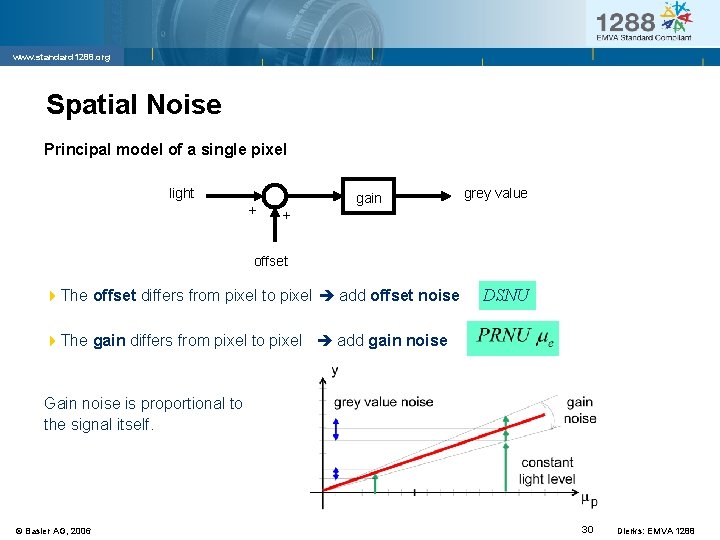
www. standard 1288. org Spatial Noise Principal model of a single pixel light + gain grey value + offset 4 The offset differs from pixel to pixel add offset noise DSNU 4 The gain differs from pixel to pixel add gain noise Gain noise is proportional to the signal itself. © Basler AG, 2006 30 Dierks: EMVA 1288
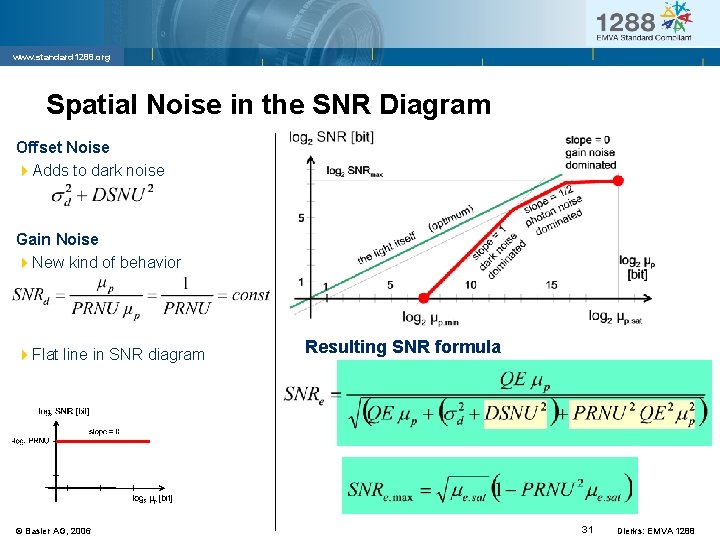
www. standard 1288. org Spatial Noise in the SNR Diagram Offset Noise 4 Adds to dark noise Gain Noise 4 New kind of behavior 4 Flat line in SNR diagram © Basler AG, 2006 Resulting SNR formula 31 Dierks: EMVA 1288
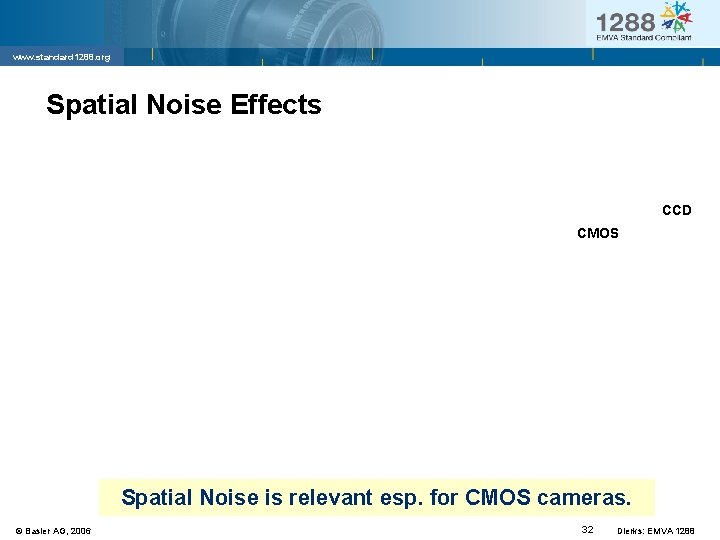
www. standard 1288. org Spatial Noise Effects CCD CMOS Spatial Noise is relevant esp. for CMOS cameras. © Basler AG, 2006 32 Dierks: EMVA 1288
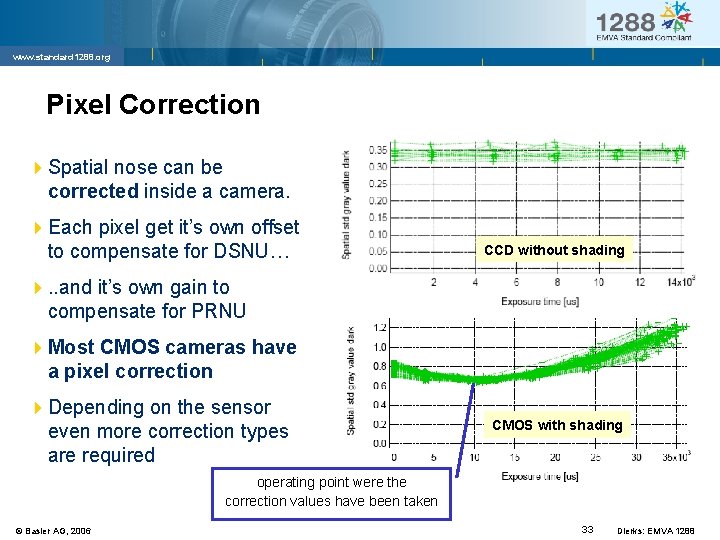
www. standard 1288. org Pixel Correction 4 Spatial nose can be corrected inside a camera. 4 Each pixel get it’s own offset to compensate for DSNU… CCD without shading 4. . and it’s own gain to compensate for PRNU 4 Most CMOS cameras have a pixel correction 4 Depending on the sensor even more correction types are required CMOS with shading operating point were the correction values have been taken © Basler AG, 2006 33 Dierks: EMVA 1288
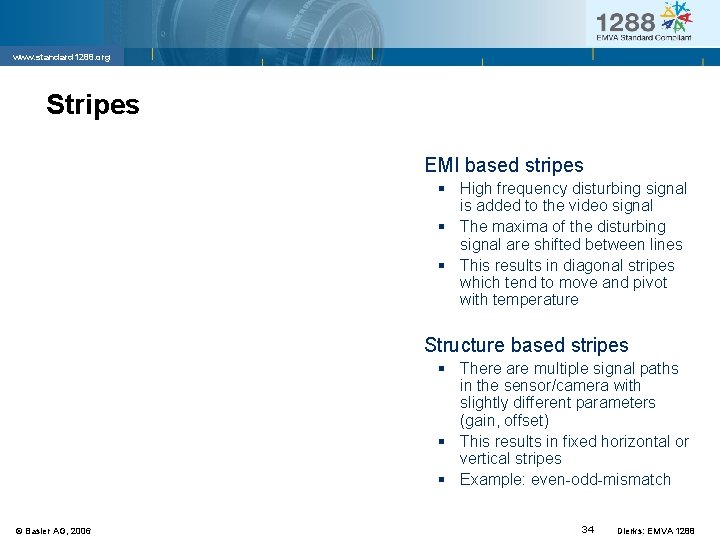
www. standard 1288. org Stripes EMI based stripes § High frequency disturbing signal is added to the video signal § The maxima of the disturbing signal are shifted between lines § This results in diagonal stripes which tend to move and pivot with temperature Structure based stripes § There are multiple signal paths in the sensor/camera with slightly different parameters (gain, offset) § This results in fixed horizontal or vertical stripes § Example: even-odd-mismatch © Basler AG, 2006 34 Dierks: EMVA 1288
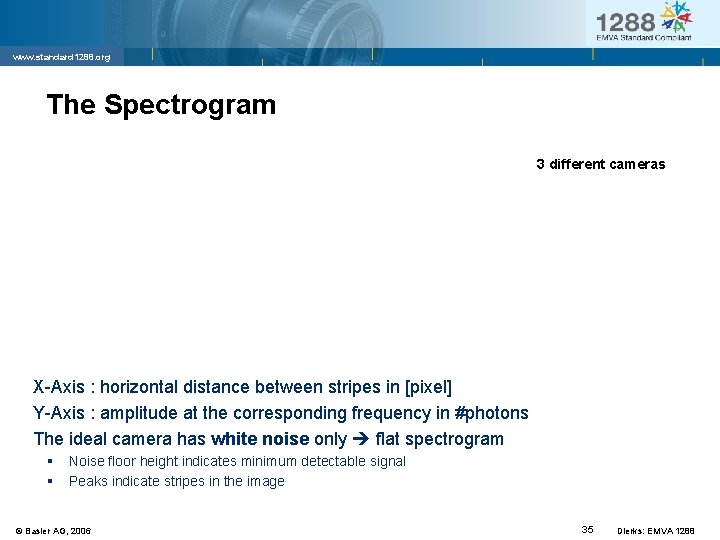
www. standard 1288. org The Spectrogram 3 different cameras X-Axis : horizontal distance between stripes in [pixel] Y-Axis : amplitude at the corresponding frequency in #photons The ideal camera has white noise only flat spectrogram § § Noise floor height indicates minimum detectable signal Peaks indicate stripes in the image © Basler AG, 2006 35 Dierks: EMVA 1288
www. standard 1288. org Conclusion With EMVA 1288 data sheet you can… 4 compare the sensitivity of cameras 4 with respect to temporal and spatial noise Remember: 4 Gain doesn’t matter 4 Pixel size doesn’t matter 4 Nothing beats having enough light Get Started: 4 Get the camera comparer and play around with the parameters. 4 Get a camera with EMVA 1288 data sheet and determine the #photons in your application. © Basler AG, 2006 36 Dierks: EMVA 1288
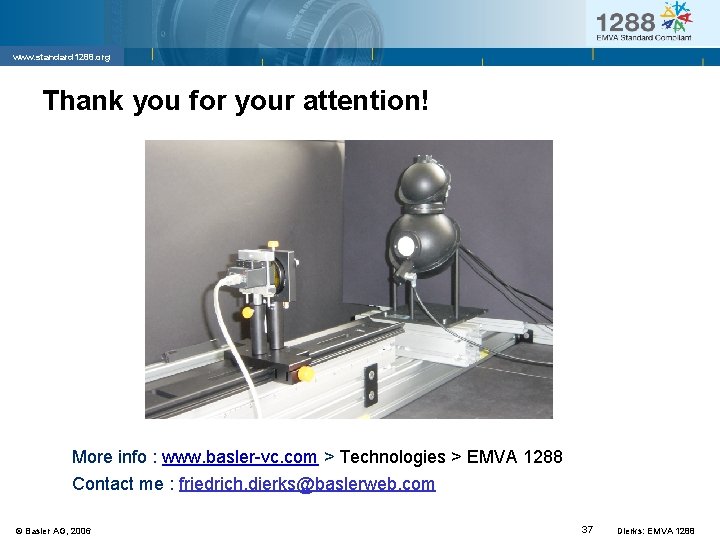
www. standard 1288. org Thank you for your attention! More info : www. basler-vc. com > Technologies > EMVA 1288 Contact me : friedrich. dierks@baslerweb. com © Basler AG, 2006 37 Dierks: EMVA 1288