
COMPARING AND SCALING Investigation 1 1 ways of

- Slides: 7
COMPARING AND SCALING Investigation 1. 1 ways of comparing ratios and proportions
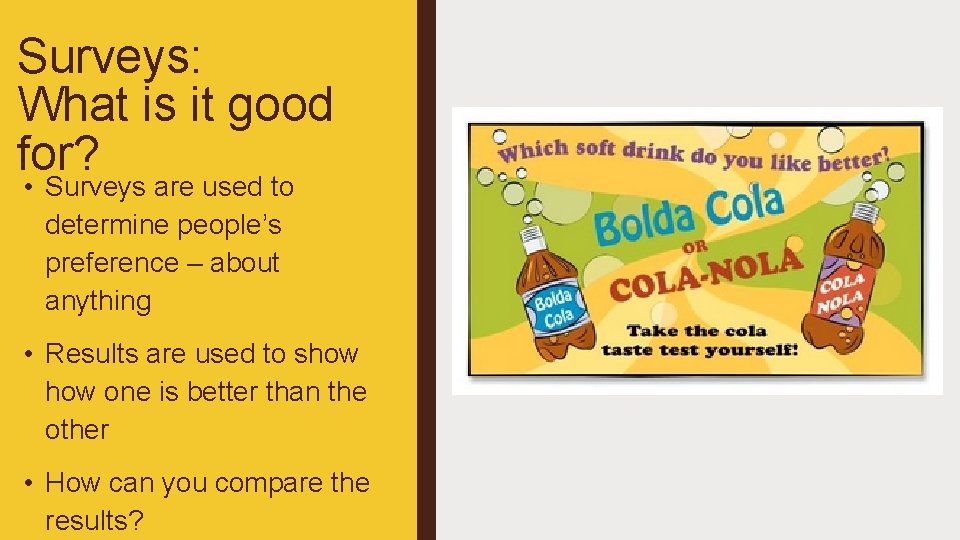
Surveys: What is it good for? • Surveys are used to determine people’s preference – about anything • Results are used to show one is better than the other • How can you compare the results?
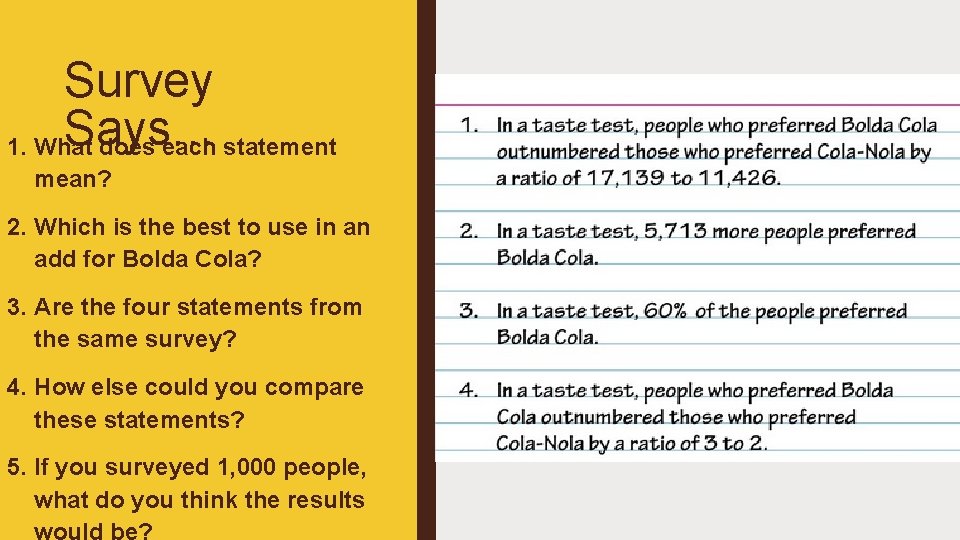
Survey Says… 1. What does each statement mean? 2. Which is the best to use in an add for Bolda Cola? 3. Are the four statements from the same survey? 4. How else could you compare these statements? 5. If you surveyed 1, 000 people, what do you think the results
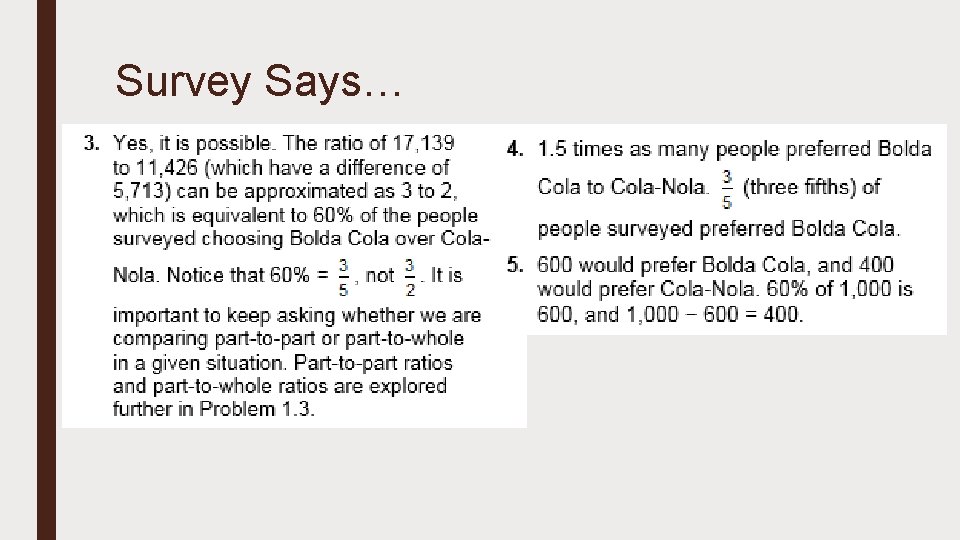
Survey Says…. 1. Statement A means that out of the total number surveyed (17, 139 + 11, 426 = 28, 565), 17, 139 of them preferred Bolda Cola and 11, 426 preferred Cola. Nola. In other words, for every 17, 139 people who preferred Bolda Cola, there were 11, 426 who preferred Cola-Nola. Statement B reports the difference in numbers between the two groups of people. We can’t tell how many people were surveyed, but we do know that 5, 713 more people preferred Bolda Cola. Statement C means that 60 percent (60%) of the sample chose Bolda Cola as their preference. 60% means that if there were 100 people, 60 would prefer Bolda Cola. Statement D means that for every 3 people who preferred Bolda Cola, there were 2 people who preferred Cola-Nola. 2. The ratio 3 to 2 or the 60% might be the most effective advertisements because the numbers are smaller and easier to relate to. You can easily use the ratio of 3 to 2 to predict what you would expect preferences to be in your class or in some other group of people. Or, the greater numbers may make a more powerful impression; the difference between 3 and 2 is only 1, while the difference between 17, 139 and 11, 426 is 5, 713.
Survey Says…
YOUR TURN!!
And this SURVEY SAYS…. ■ YES ■ YES ■ NO