
Compare Outcomes n Using all the above specific
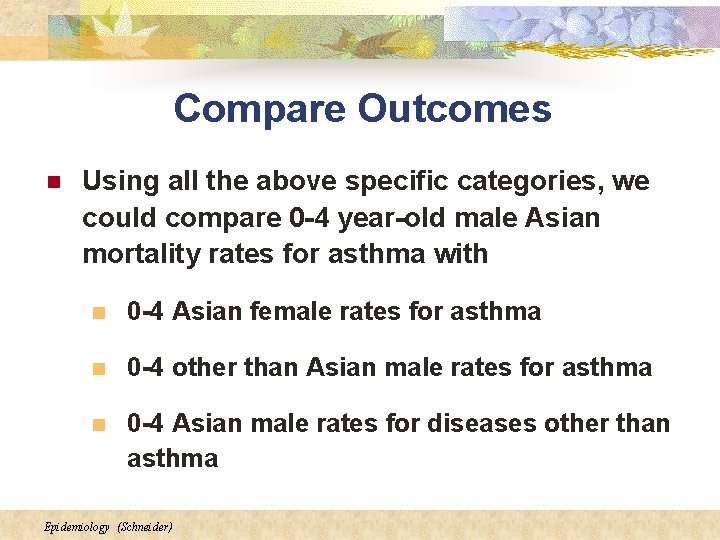
Compare Outcomes n Using all the above specific categories, we could compare 0 -4 year-old male Asian mortality rates for asthma with n 0 -4 Asian female rates for asthma n 0 -4 other than Asian male rates for asthma n 0 -4 Asian male rates for diseases other than asthma Epidemiology (Schneider)
Calculation Practice Calculate cause-specific and agespecific lung cancer death rates What information will you need?
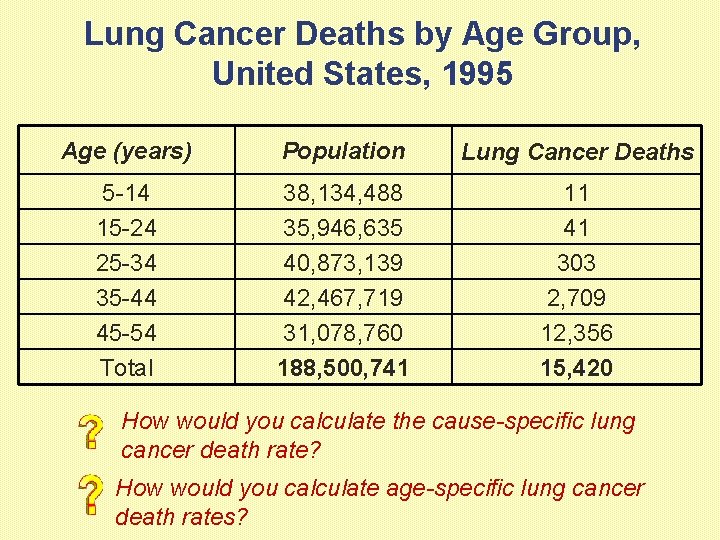
Lung Cancer Deaths by Age Group, United States, 1995 Age (years) Population Lung Cancer Deaths 5 -14 15 -24 25 -34 35 -44 45 -54 Total 38, 134, 488 35, 946, 635 40, 873, 139 42, 467, 719 31, 078, 760 188, 500, 741 11 41 303 2, 709 12, 356 15, 420 How would you calculate the cause-specific lung cancer death rate? How would you calculate age-specific lung cancer death rates?
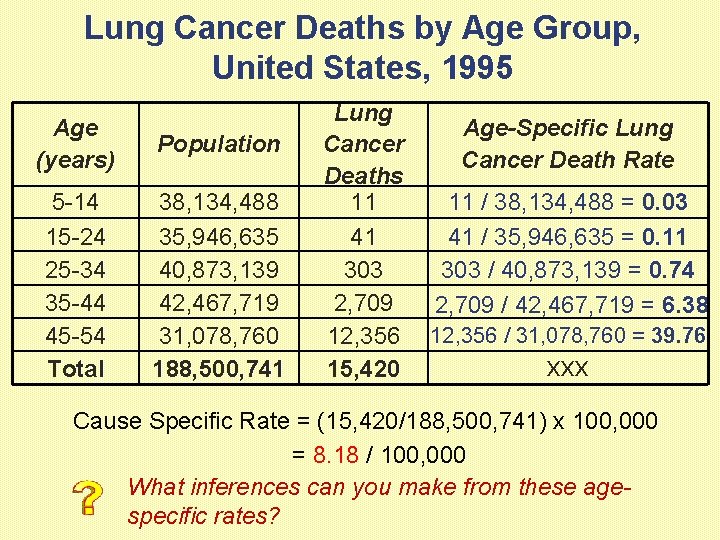
Lung Cancer Deaths by Age Group, United States, 1995 Age (years) Population 5 -14 15 -24 25 -34 35 -44 45 -54 Total 38, 134, 488 35, 946, 635 40, 873, 139 42, 467, 719 31, 078, 760 188, 500, 741 Lung Cancer Deaths 11 41 303 2, 709 12, 356 15, 420 Age-Specific Lung Cancer Death Rate 11 / 38, 134, 488 = 0. 03 41 / 35, 946, 635 = 0. 11 303 / 40, 873, 139 = 0. 74 2, 709 / 42, 467, 719 = 6. 38 12, 356 / 31, 078, 760 = 39. 76 xxx Cause Specific Rate = (15, 420/188, 500, 741) x 100, 000 = 8. 18 / 100, 000 What inferences can you make from these agespecific rates?
Mortality Outcomes (cont. ) n Adjusted rate: n Used to compare rates for entire populations, taking into account differences in variables we consider as influencing outcomes (age, gender, race) Epidemiology (Schneider)
Two methods to adjust rates: n Direct Method: AAR (age-adjusted rate) n Indirect Method: SMR (standardized mortality ratio) Epidemiology (Schneider)
Standardization for Age (Age Adjustment) n Direct method n n Requires n Age-specific rates for the sample n Age-structure of a standard population Yields a summary figure: AGE-ADJUSTED RATE Epidemiology (Schneider)
Standardization: Age Adjustment (cont. ) n Indirect method n n Requires n Age structure of the sample population at risk n Total cases in the sample population (not ages of cases) n Age-specific rates for a standard population Yields a summary figure: STANDARDIZED MORTALITY RATIO (SMR) Epidemiology (Schneider)
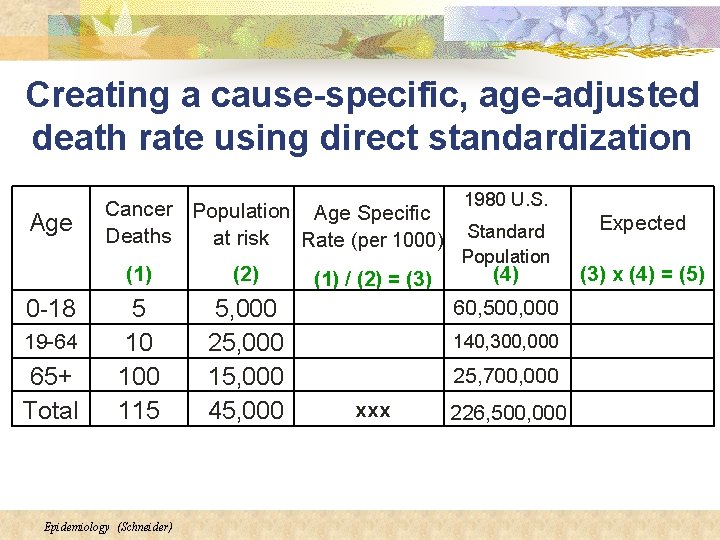
Creating a cause-specific, age-adjusted death rate using direct standardization Age 0 -18 19 -64 65+ Total 1980 U. S. Cancer Population Age Specific Deaths at risk Rate (per 1000) Standard (1) (2) 5 10 100 115 5, 000 25, 000 15, 000 45, 000 Epidemiology (Schneider) (1) / (2) = (3) Population (4) 60, 500, 000 140, 300, 000 25, 700, 000 xxx 226, 500, 000 Expected (3) x (4) = (5)
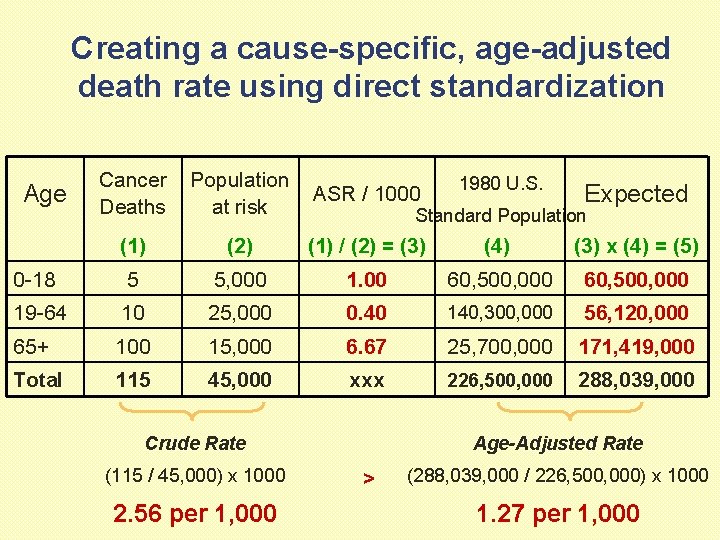
Creating a cause-specific, age-adjusted death rate using direct standardization Cancer Deaths Population at risk ASR / 1000 1980 U. S. (1) (2) (1) / (2) = (3) (4) (3) x (4) = (5) 0 -18 5 5, 000 1. 00 60, 500, 000 19 -64 10 25, 000 0. 40 140, 300, 000 56, 120, 000 65+ 100 15, 000 6. 67 25, 700, 000 171, 419, 000 Total 115 45, 000 xxx 226, 500, 000 288, 039, 000 Age Standard Population Crude Rate (115 / 45, 000) x 1000 2. 56 per 1, 000 Expected Age-Adjusted Rate > (288, 039, 000 / 226, 500, 000) x 1000 1. 27 per 1, 000
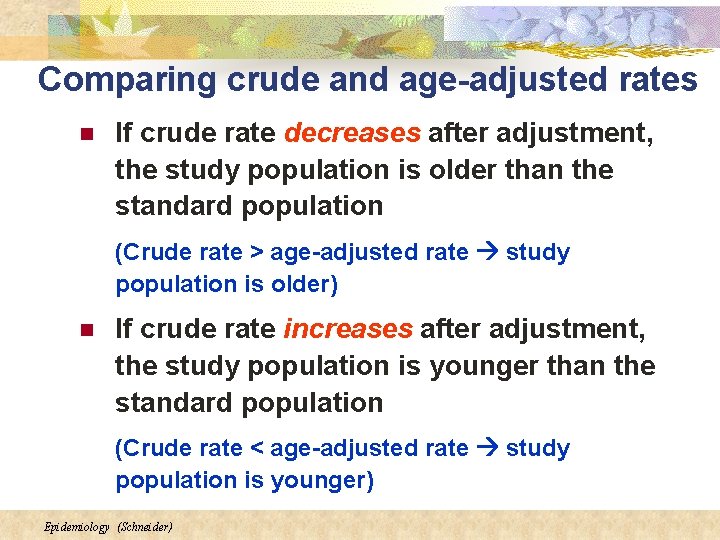
Comparing crude and age-adjusted rates n If crude rate decreases after adjustment, the study population is older than the standard population (Crude rate > age-adjusted rate study population is older) n If crude rate increases after adjustment, the study population is younger than the standard population (Crude rate < age-adjusted rate study population is younger) Epidemiology (Schneider)
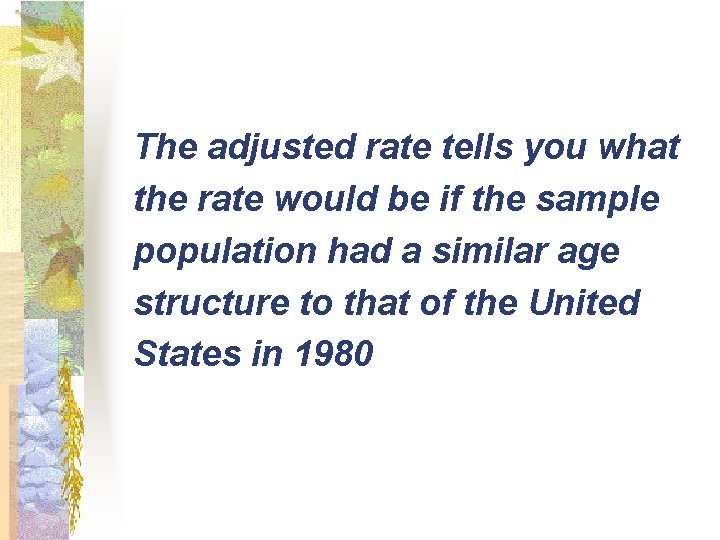
The adjusted rate tells you what the rate would be if the sample population had a similar age structure to that of the United States in 1980
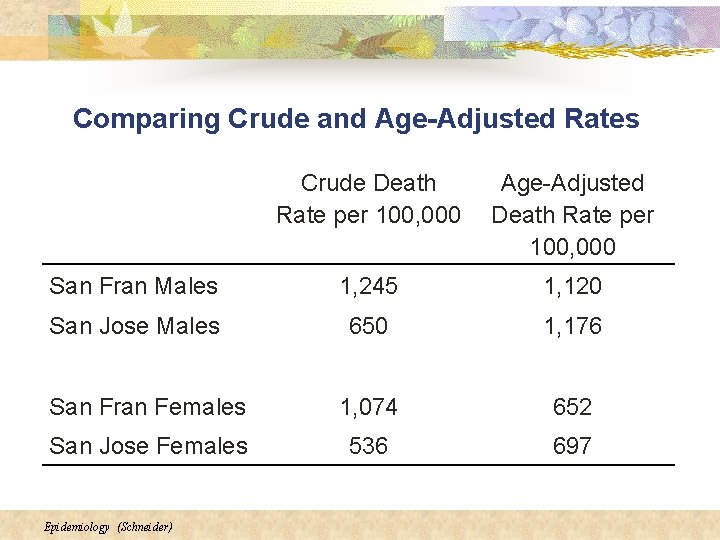
Comparing Crude and Age-Adjusted Rates Crude Death Rate per 100, 000 Age-Adjusted Death Rate per 100, 000 San Fran Males 1, 245 1, 120 San Jose Males 650 1, 176 San Fran Females 1, 074 652 San Jose Females 536 697 Epidemiology (Schneider)
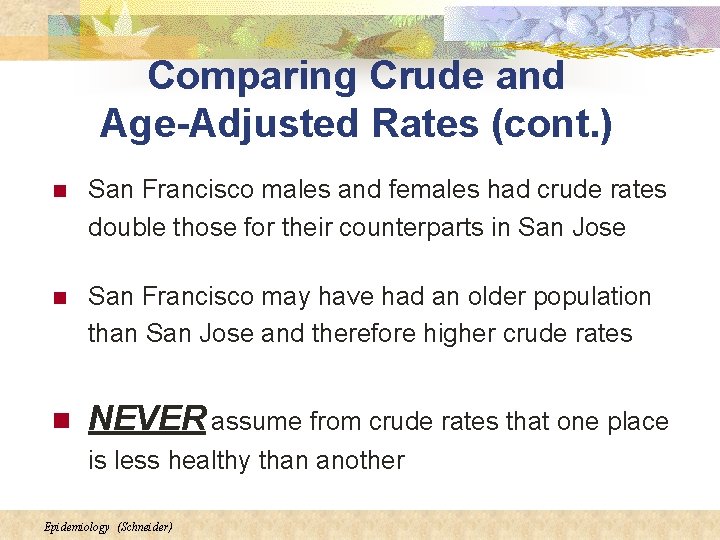
Comparing Crude and Age-Adjusted Rates (cont. ) n San Francisco males and females had crude rates double those for their counterparts in San Jose n San Francisco may have had an older population than San Jose and therefore higher crude rates n NEVER assume from crude rates that one place is less healthy than another Epidemiology (Schneider)
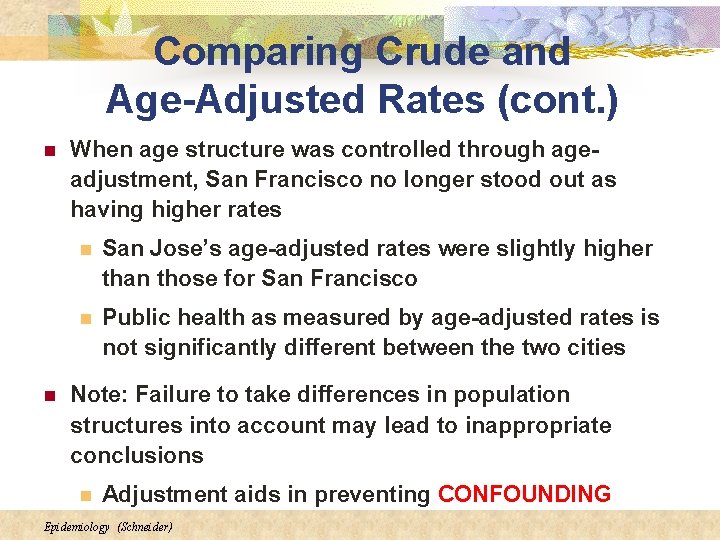
Comparing Crude and Age-Adjusted Rates (cont. ) n n When age structure was controlled through ageadjustment, San Francisco no longer stood out as having higher rates n San Jose’s age-adjusted rates were slightly higher than those for San Francisco n Public health as measured by age-adjusted rates is not significantly different between the two cities Note: Failure to take differences in population structures into account may lead to inappropriate conclusions n Adjustment aids in preventing CONFOUNDING Epidemiology (Schneider)
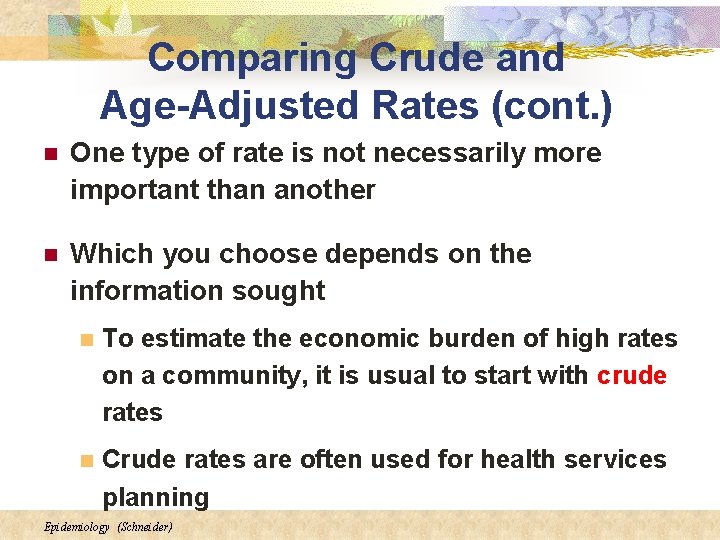
Comparing Crude and Age-Adjusted Rates (cont. ) n One type of rate is not necessarily more important than another n Which you choose depends on the information sought n To estimate the economic burden of high rates on a community, it is usual to start with crude rates n Crude rates are often used for health services planning Epidemiology (Schneider)
Comparing Crude and Age-Adjusted Rates (cont. ) n n To compare rates among subpopulations or for various causes, specific rates are preferred n infant mortality n maternal mortality rates To compare the health of entire populations, adjusted rates are preferred as they allow for comparison of populations with different demographic structures Epidemiology (Schneider)
New 2000 Standard for Age-Adjustment n Historically, a 1940 base-year has been used for age-adjustment n n Also, other standards have been used which created confusion among data users Starting September 1, 1998, HHS agencies and programs were required to use the year 2000 standard Epidemiology (Schneider)
New 2000 Standard for Age-Adjustment (cont. ) n What are the implications? n When describing disparities in mortality between racial and ethnic groups, the size of the disparity between Blacks and Whites and between Hispanics and Non-Hispanics will be affected Epidemiology (Schneider)
New 2000 Standard for Age-Adjustment (cont. ) n Example: The mortality ratio for Black and White total populations in 1995 is reduced from 1. 6 (1940 standard) to 1. 4 (2000 standard) n The Blacks population tends to be younger than the White population Epidemiology (Schneider)
New 2000 Standard for Age-Adjustment (cont. ) n NCHS recommends that researchers present age-specific rates, not just AARs n If an AAR is used to describe racial and ethnic disparities, explain the impact of the change in the standard and provide agespecific rates n When comparing AARs over time, make sure the same standard is used throughout Epidemiology (Schneider)
Alternate Method of Direct Adjustment n Some calculators cannot handle large numbers n To overcome this limitation, you can convert your standard population into a standard vector Epidemiology (Schneider)
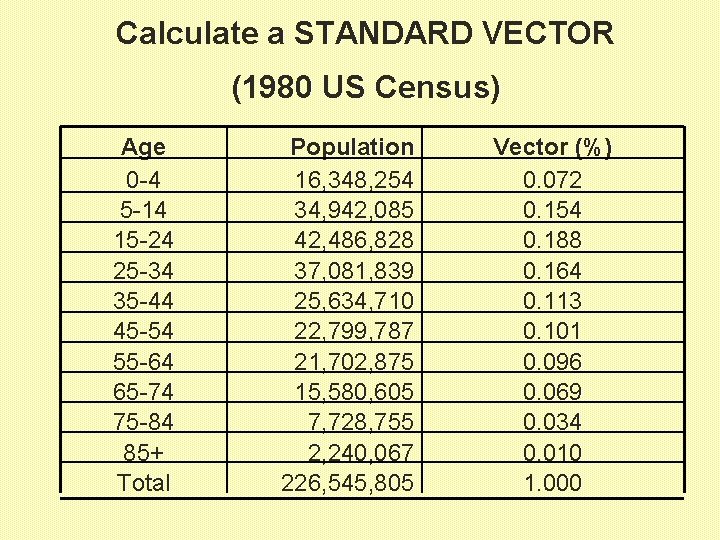
Calculate a STANDARD VECTOR (1980 US Census) Age 0 -4 5 -14 15 -24 25 -34 35 -44 45 -54 55 -64 65 -74 75 -84 85+ Total Population 16, 348, 254 34, 942, 085 42, 486, 828 37, 081, 839 25, 634, 710 22, 799, 787 21, 702, 875 15, 580, 605 7, 728, 755 2, 240, 067 226, 545, 805 Vector (%) 0. 072 0. 154 0. 188 0. 164 0. 113 0. 101 0. 096 0. 069 0. 034 0. 010 1. 000
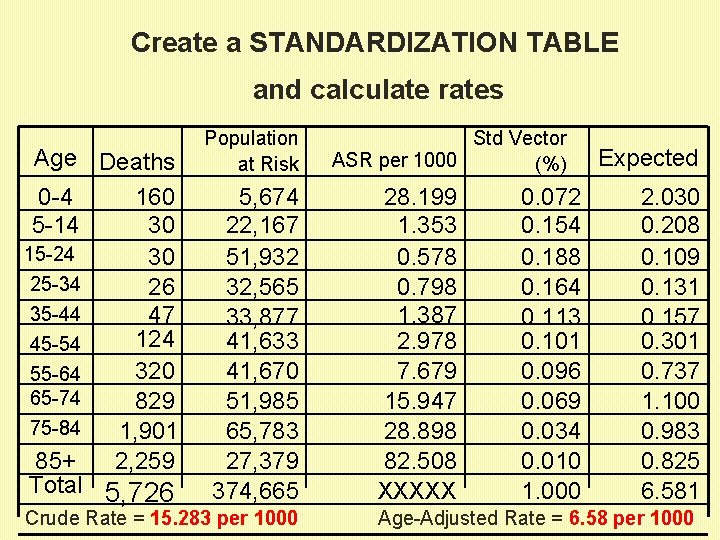
Create a STANDARDIZATION TABLE and calculate rates Age Deaths 0 -4 160 5 -14 30 15 -24 30 25 -34 26 35 -44 47 124 45 -54 320 55 -64 65 -74 829 75 -84 1, 901 85+ 2, 259 Total 5, 726 Population at Risk 5, 674 22, 167 51, 932 32, 565 33, 877 41, 633 41, 670 51, 985 65, 783 27, 379 374, 665 Crude Rate = 15. 283 per 1000 Std Vector ASR per 1000 (%) 28. 199 1. 353 0. 578 0. 798 1. 387 2. 978 7. 679 15. 947 28. 898 82. 508 XXXXX 0. 072 0. 154 0. 188 0. 164 0. 113 0. 101 0. 096 0. 069 0. 034 0. 010 1. 000 Expected 2. 030 0. 208 0. 109 0. 131 0. 157 0. 301 0. 737 1. 100 0. 983 0. 825 6. 581 Age-Adjusted Rate = 6. 58 per 1000
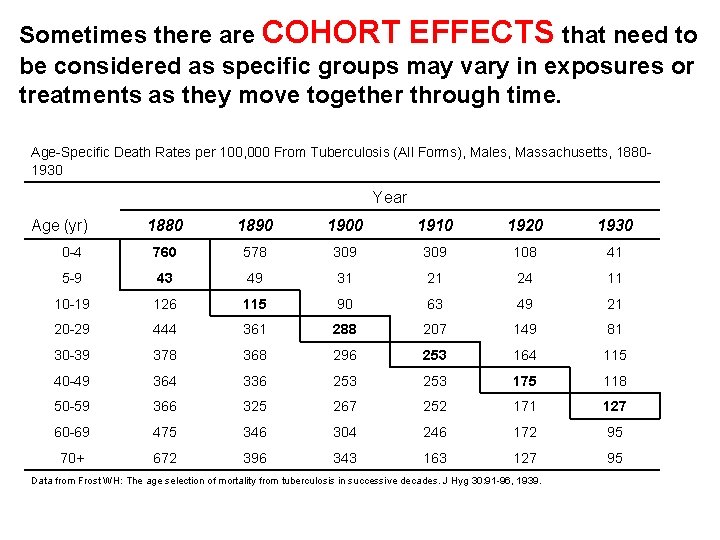
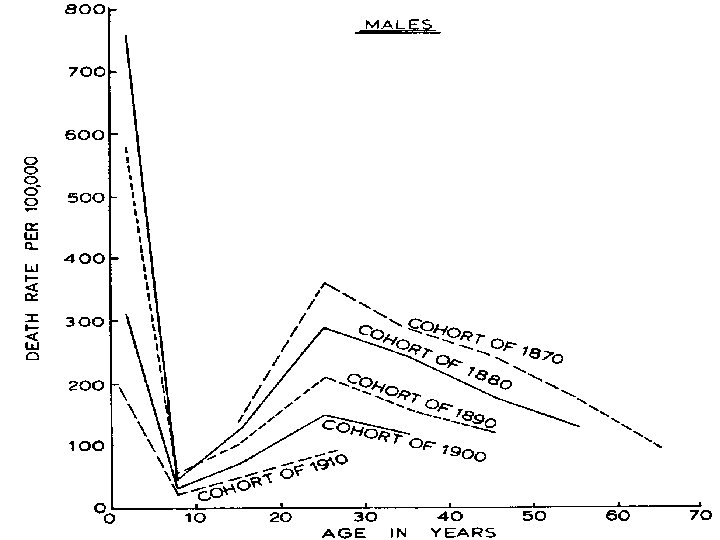
Sometimes there are COHORT EFFECTS that need to be considered as specific groups may vary in exposures or treatments as they move together through time. Age-Specific Death Rates per 100, 000 From Tuberculosis (All Forms), Males, Massachusetts, 18801930 Year Age (yr) 1880 1890 1900 1910 1920 1930 0 -4 760 578 309 108 41 5 -9 43 49 31 21 24 11 10 -19 126 115 90 63 49 21 20 -29 444 361 288 207 149 81 30 -39 378 368 296 253 164 115 40 -49 364 336 253 175 118 50 -59 366 325 267 252 171 127 60 -69 475 346 304 246 172 95 70+ 672 396 343 163 127 95 Data from Frost WH: The age selection of mortality from tuberculosis in successive decades. J Hyg 30: 91 -96, 1939.
- Slides: 26