
COMPARATIVE STUDY ON SOCCER PLAYERS OF DIFFERENT TRAINING
- Slides: 2
COMPARATIVE STUDY ON SOCCER PLAYERS OF DIFFERENT TRAINING LEVEL Bogatsiotis D. , Gioftsidou A. , Malliou P. , Beneka A. School of Physical Education and Sport Science, Democritus University of Thrace, Komotini, Greece Introduction Soccer is a sport that demands movements like sprinting, jumping, kicks, fast changing of direction, which mostly depends of the lower extremities of the body. These activities require power and strength to complete them (1, 2). An isokinetic muscular contraction is one that the muscle shortens or lengthens in a constant angular velocity. This method allows to measure the force of the muscle in dynamic conditions and provides its peak power during the entire exercise. The most used parameters are peak torque and the angular position that it was measured, the torque development in different angular velocities, the ration between the torque of the agonists and antagonists and the torque development in recurrent contractions (1, 2, 3). The aim of this study was to measure possible variations in muscular development (peak torque) bilateral and unilateral in the knee flexors and extensors in elite adult male soccer players of different training lever and field position. Methods Forty-five players participated in this study, 22 elite players (Champions League Clubs) and 23 high level players (Superleague Clubs). The football players were evaluated on an isokinetic-computerized dynamometer (Kin – Com). The participants underwent a five minute warm up on a static bike followed by five minutes dynamic stretching. The subjects performed a set of 3 repetitions of knee extensions and flexion with maximal effort in 60 degrees pre second. The peak torque as well as the position of the joint where the best performance was recorded.
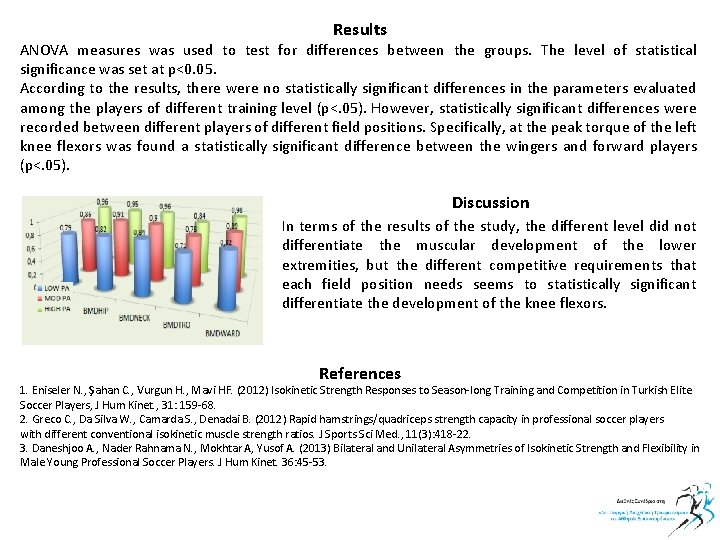
Results ANOVA measures was used to test for differences between the groups. The level of statistical significance was set at p<0. 05. According to the results, there were no statistically significant differences in the parameters evaluated among the players of different training level (p<. 05). However, statistically significant differences were recorded between different players of different field positions. Specifically, at the peak torque of the left knee flexors was found a statistically significant difference between the wingers and forward players (p<. 05). Discussion In terms of the results of the study, the different level did not differentiate the muscular development of the lower extremities, but the different competitive requirements that each field position needs seems to statistically significant differentiate the development of the knee flexors. References 1. Eniseler N. , Şahan C. , Vurgun H. , Mavi HF. (2012) Isokinetic Strength Responses to Season-long Training and Competition in Turkish Elite Soccer Players, J Hum Kinet. , 31: 159 -68. 2. Greco C. , Da Silva W. , Camarda S. , Denadai B. (2012) Rapid hamstrings/quadriceps strength capacity in professional soccer players with different conventional isokinetic muscle strength ratios. J Sports Sci Med. , 11(3): 418 -22. 3. Daneshjoo A. , Nader Rahnama N. , Mokhtar A, Yusof A. (2013) Bilateral and Unilateral Asymmetries of Isokinetic Strength and Flexibility in Male Young Professional Soccer Players. J Hum Kinet. 36: 45 -53.