
Comparative modeling with MODELLER http salilab orgmodeller Ben
Comparative modeling with MODELLER http: //salilab. org/modeller/ Ben Webb, Andrej Sali Lab UC San Francisco Maya Topf, Birkbeck College, London

Comparative modeling overview Why build comparative models? Many more sequences available than structures (millions vs. tens of thousands) Many applications (e. g. determination of function) rely on structural information Structure is often more conserved than sequence (in 2005, 900 K of 1. 7 M structures modeled), since evolution tends to preserve function
Comparative modeling overview How does it work? Extract information from known structures (one or more templates), and use to build the structure for the ‘target’ sequence Should also consider information from other sources: physical force fields, statistics (e. g. PDB mining) Classes of methods for comparative modeling Assembly of rigid bodies (core, loops, sidechains) Segment matching Satisfaction of spatial restraints
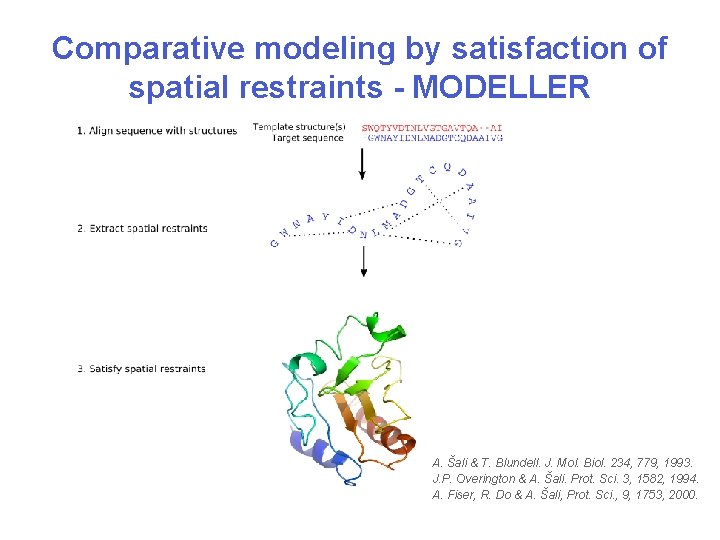
Comparative modeling by satisfaction of spatial restraints - MODELLER A. Šali & T. Blundell. J. Mol. Biol. 234, 779, 1993. J. P. Overington & A. Šali. Prot. Sci. 3, 1582, 1994. A. Fiser, R. Do & A. Šali, Prot. Sci. , 9, 1753, 2000.
1. Align sequence with structures First, must determine the template structures Simplistically, try to align the target sequence against every known structure’s sequence In practice, this is too slow, so heuristics are used (e. g. BLAST) Profile or HMM searches are generally more sensitive in difficult cases (e. g. Modeller’s profile. build method, or PSI-BLAST) Could also use threading or other web servers Alignment to templates generally uses global dynamic programming Sequence-sequence: relies purely on a matrix of observed residue-residue mutation probabilities (‘align’) Sequence-structure: gap insertion is penalized within secondary structure (helices etc. ) (‘align 2 d’) Other features and/or user-defined (‘salign’) or use an external program
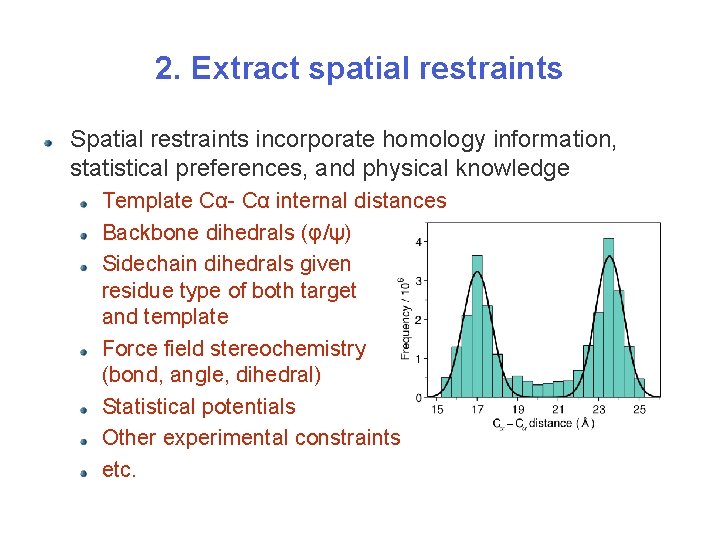
2. Extract spatial restraints Spatial restraints incorporate homology information, statistical preferences, and physical knowledge Template Cα- Cα internal distances Backbone dihedrals (φ/ψ) Sidechain dihedrals given residue type of both target and template Force field stereochemistry (bond, angle, dihedral) Statistical potentials Other experimental constraints etc.
3. Satisfy spatial restraints All information is combined into a single objective function Restraints and statistics are converted to an “energy” by taking the negative log Force field (CHARMM 22) simply added in Function is optimized by conjugate gradients and simulated annealing molecular dynamics, starting from the target sequence threaded onto template structure(s) Multiple models are generally recommended; ‘best’ model or cluster or models chosen by simply taking the lowest objective function score, or using a model assessment method such as Modeller’s own DOPE or GA 341, fit to EM density, or external programs such as PROSA or DFIRE
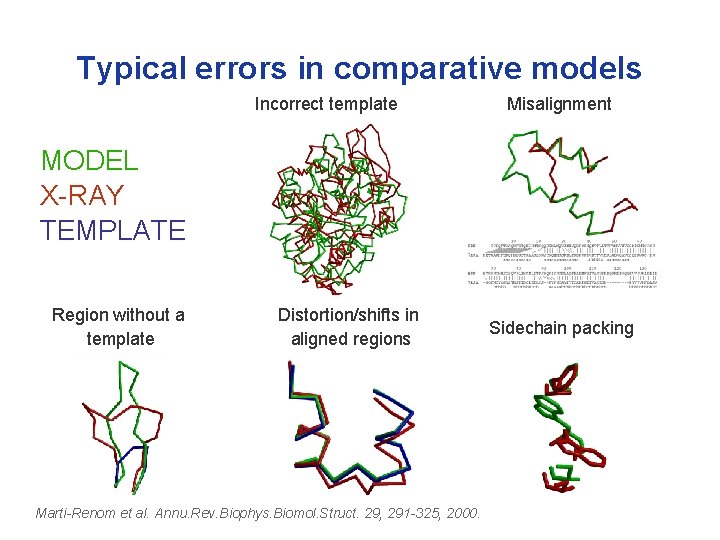
Typical errors in comparative models Incorrect template Misalignment MODEL X-RAY TEMPLATE Region without a template Distortion/shifts in aligned regions Marti-Renom et al. Annu. Rev. Biophys. Biomol. Struct. 29, 291 -325, 2000. Sidechain packing
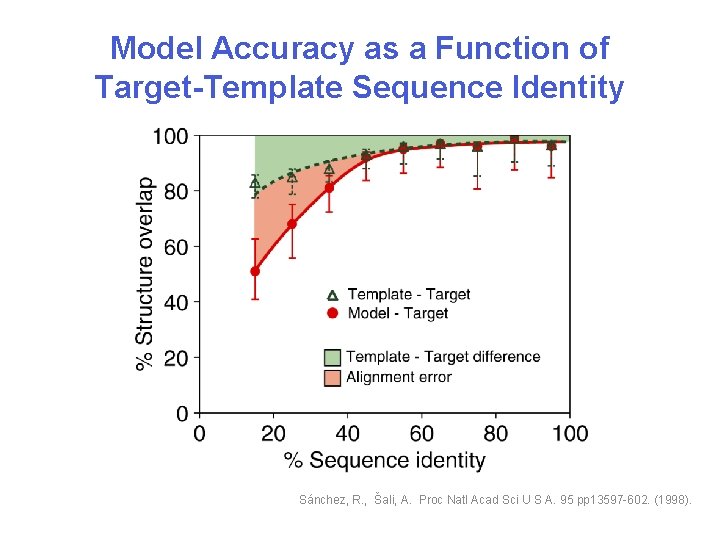
Model Accuracy as a Function of Target-Template Sequence Identity Sánchez, R. , Šali, A. Proc Natl Acad Sci U S A. 95 pp 13597 -602. (1998).
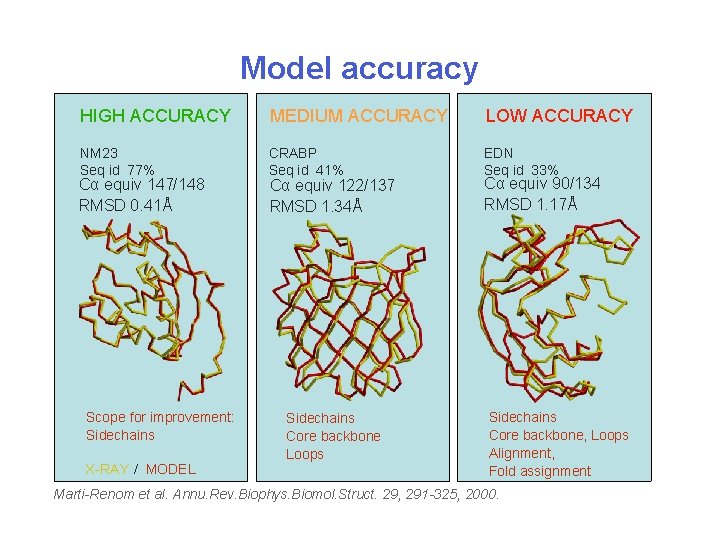
Model accuracy HIGH ACCURACY MEDIUM ACCURACY LOW ACCURACY NM 23 Seq id 77% CRABP Seq id 41% EDN Seq id 33% Cα equiv 147/148 RMSD 0. 41Å Scope for improvement: Sidechains X-RAY / MODEL Cα equiv 122/137 RMSD 1. 34Å Sidechains Core backbone Loops Cα equiv 90/134 RMSD 1. 17Å Sidechains Core backbone, Loops Alignment, Fold assignment Marti-Renom et al. Annu. Rev. Biophys. Biomol. Struct. 29, 291 -325, 2000.
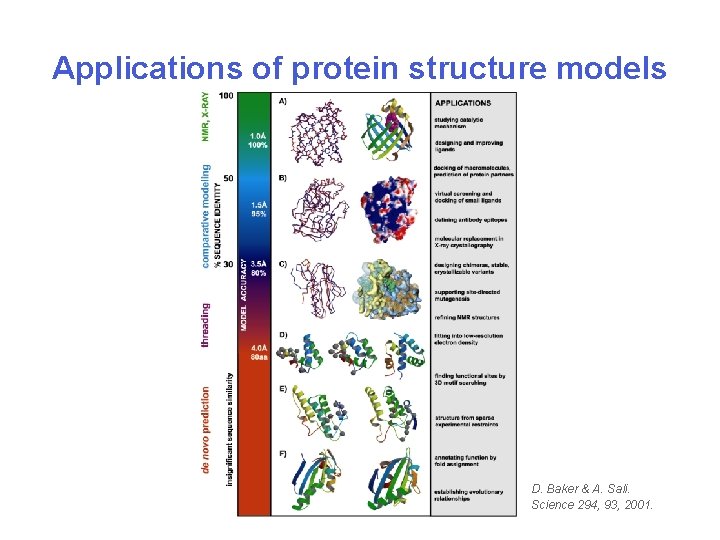
Applications of protein structure models D. Baker & A. Sali. Science 294, 93, 2001.
Loop modeling Often, there are parts of the sequence which have no detectable templates (usually loops) “Mini folding problem” – these loops must be sampled to get improved conformations Database searches only complete for 4 -6 residue loops Modeller uses conformational search with a custom energy function optimized for loop modeling (statistical potential derived from PDB) Fiser/Melo protocol (‘loopmodel’) Newer DOPE + GB/SA protocol (‘dope_loopmodel’)
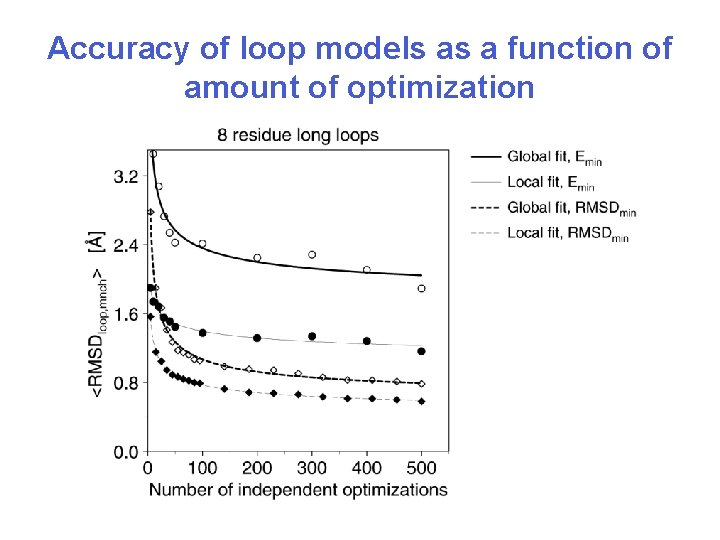
Accuracy of loop models as a function of amount of optimization
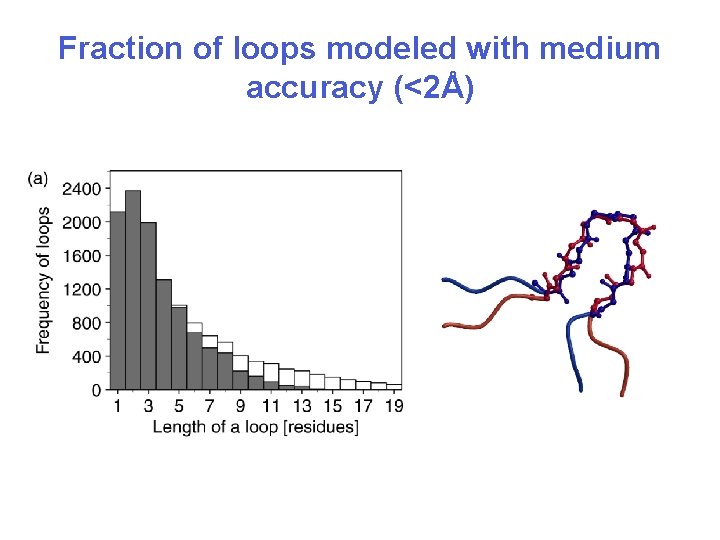
Fraction of loops modeled with medium accuracy (<2Å)
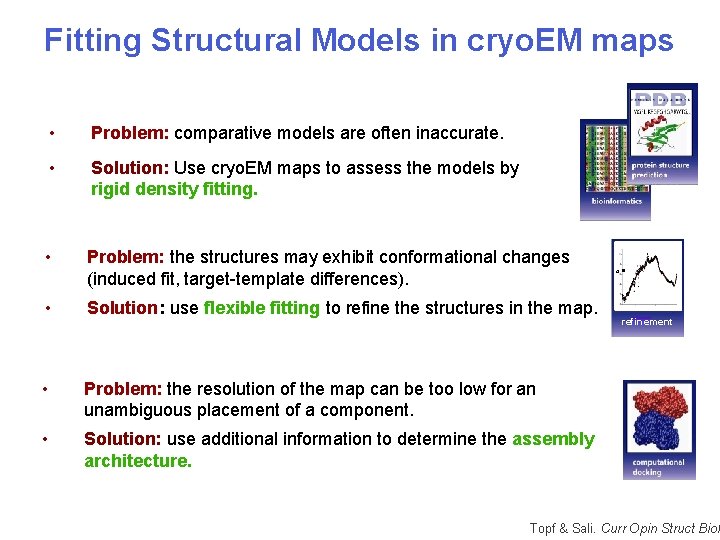
• Problem: comparative models are often inaccurate. • Solution: Use cryo. EM maps to assess the models by rigid density fitting. • Problem: the structures may exhibit conformational changes (induced fit, target-template differences). • Solution: use flexible fitting to refine the structures in the map. • Problem: the resolution of the map can be too low for an unambiguous placement of a component. • Solution: use additional information to determine the assembly architecture. Δ G Fitting Structural Models in cryo. EM maps refinement Topf & Sali. Curr Opin Struct Biol
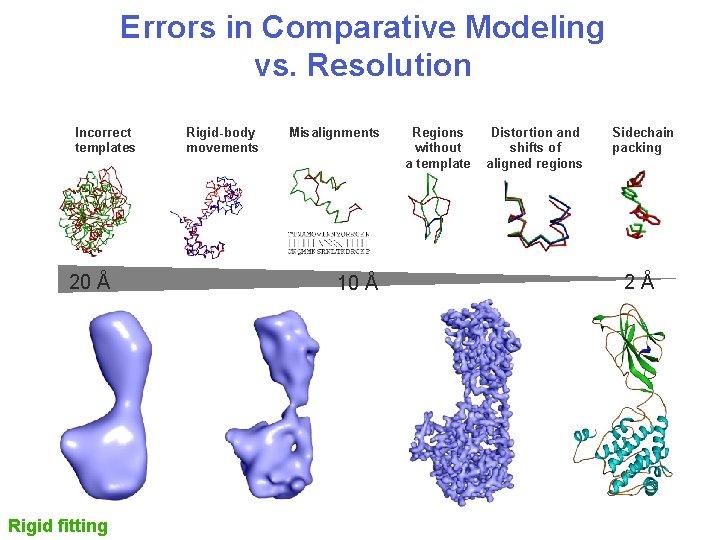
Errors in Comparative Modeling vs. Resolution Incorrect templates 20 Å Rigid fitting Rigid-body movements Misalignments 10 Å Regions without a template Distortion and shifts of aligned regions Sidechain packing 2 Å
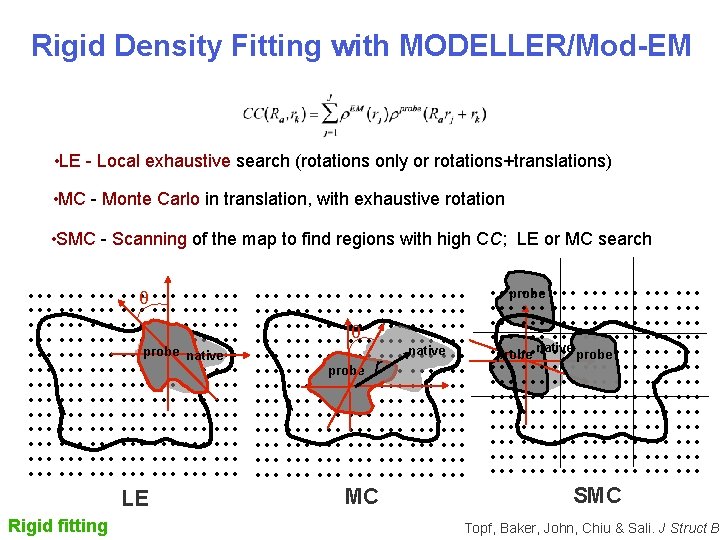
Rigid Density Fitting with MODELLER/Mod-EM • LE - Local exhaustive search (rotations only or rotations+translations) • MC - Monte Carlo in translation, with exhaustive rotation • SMC - Scanning of the map to find regions with high CC; LE or MC search ………………… θ ………………… probe native ………………… r ………………… ………………… ………………… θ ………………… native ………………… probe r ………………… ………………… LE MC Rigid fitting ………………… probe ………………… native ………………… probe ………………… ………………… SMC Topf, Baker, John, Chiu & Sali. J Struct Bi
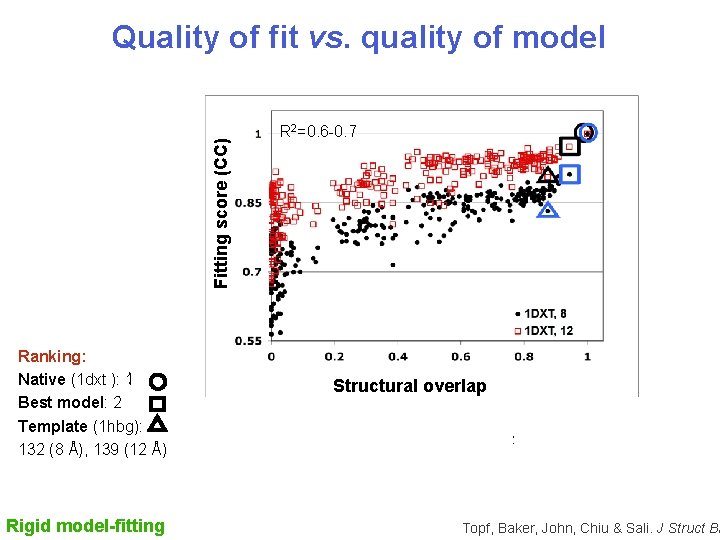
Fitting score (CC) Quality of fit vs. quality of model Ranking: Native (1 dxt ): 1 Best model: 2 Template (1 hbg): 132 (8 Å), 139 (12 Å) Rigid model-fitting R 2=0. 6 -0. 7 Structural overlap Topf, Baker, John, Chiu & Sali. J Struct Bi
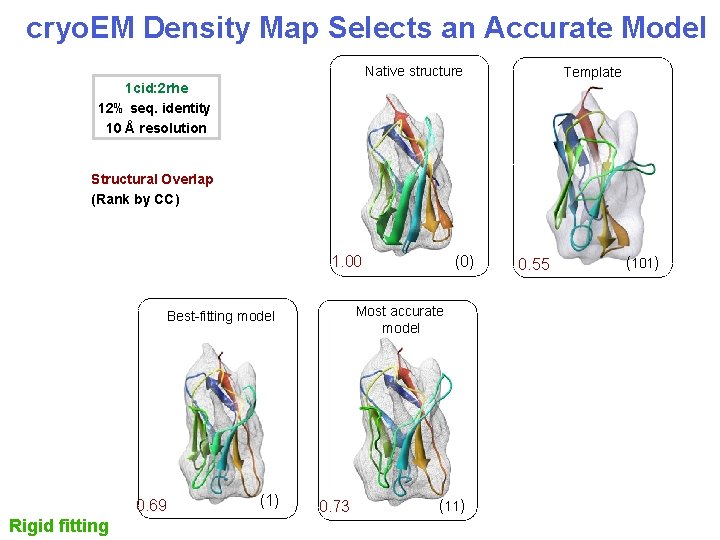
cryo. EM Density Map Selects an Accurate Model Native structure Template 1 cid: 2 rhe 12% seq. identity 10 Å resolution Structural Overlap (Rank by CC) 1. 00 Most accurate model Best-fitting model 0. 69 Rigid fitting (1) (0) 0. 73 (11) 0. 55 (101)
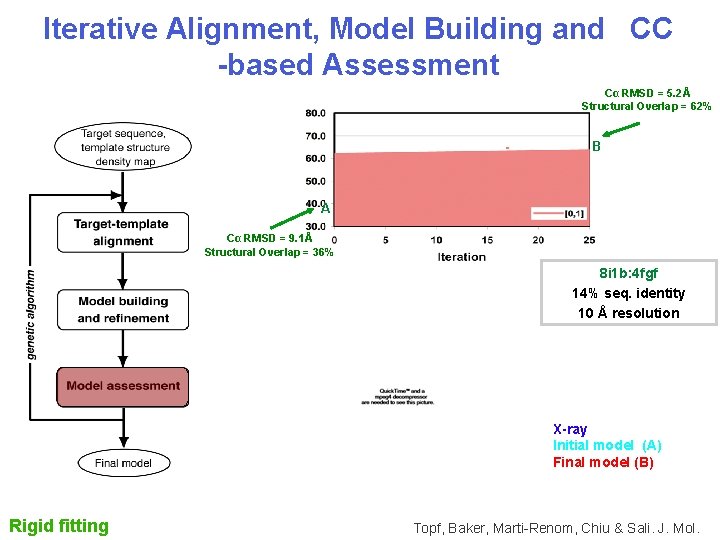
Iterative Alignment, Model Building and CC -based Assessment Cα RMSD = 5. 2Å Structural Overlap = 62% B A Cα RMSD = 9. 1Å Structural Overlap = 36% 8 i 1 b: 4 fgf 14% seq. identity 10 Å resolution X-ray Initial model (A) Final model (B) Rigid fitting Topf, Baker, Marti-Renom, Chiu & Sali. J. Mol.
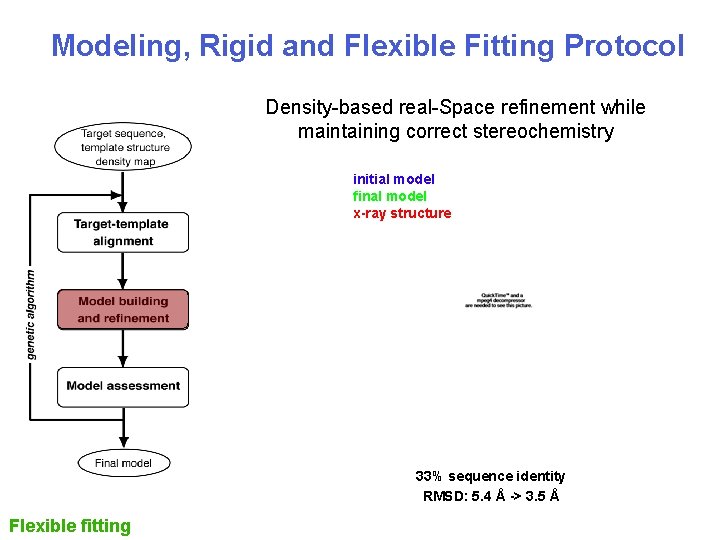
Modeling, Rigid and Flexible Fitting Protocol Density-based real-Space refinement while maintaining correct stereochemistry initial model final model x-ray structure 33% sequence identity RMSD: 5. 4 Å -> 3. 5 Å Flexible fitting
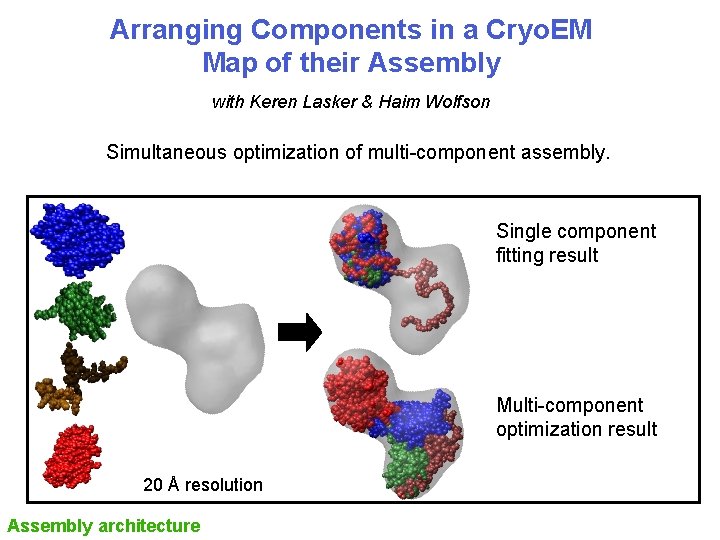
Arranging Components in a Cryo. EM Map of their Assembly with Keren Lasker & Haim Wolfson Simultaneous optimization of multi-component assembly. Single component fitting result Multi-component optimization result 20 Å resolution Assembly architecture
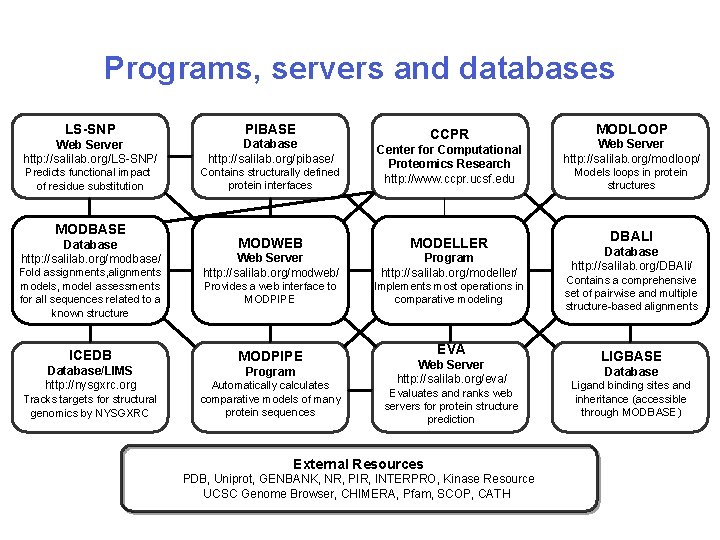
Programs, servers and databases LS-SNP PIBASE Web Server http: //salilab. org/LS-SNP/ Database http: //salilab. org/pibase/ Predicts functional impact of residue substitution Contains structurally defined protein interfaces MODBASE Database http: //salilab. org/modbase/ Fold assignments, alignments models, model assessments for all sequences related to a known structure ICEDB Database/LIMS http: //nysgxrc. org Tracks targets for structural genomics by NYSGXRC CCPR Center for Computational Proteomics Research http: //www. ccpr. ucsf. edu MODWEB MODELLER Web Server http: //salilab. org/modweb/ Program http: //salilab. org/modeller/ Provides a web interface to MODPIPE Implements most operations in comparative modeling MODPIPE Program Automatically calculates comparative models of many protein sequences EVA Web Server http: //salilab. org/eva/ Evaluates and ranks web servers for protein structure prediction External Resources PDB, Uniprot, GENBANK, NR, PIR, INTERPRO, Kinase Resource UCSC Genome Browser, CHIMERA, Pfam, SCOP, CATH MODLOOP Web Server http: //salilab. org/modloop/ Models loops in protein structures DBALI Database http: //salilab. org/DBAli/ Contains a comprehensive set of pairwise and multiple structure-based alignments LIGBASE Database Ligand binding sites and inheritance (accessible through MODBASE)
Useful resources http: //salilab. org/bioinformatics_resources. shtml
For further examples… http: //salilab. org/modeller/tutorial/
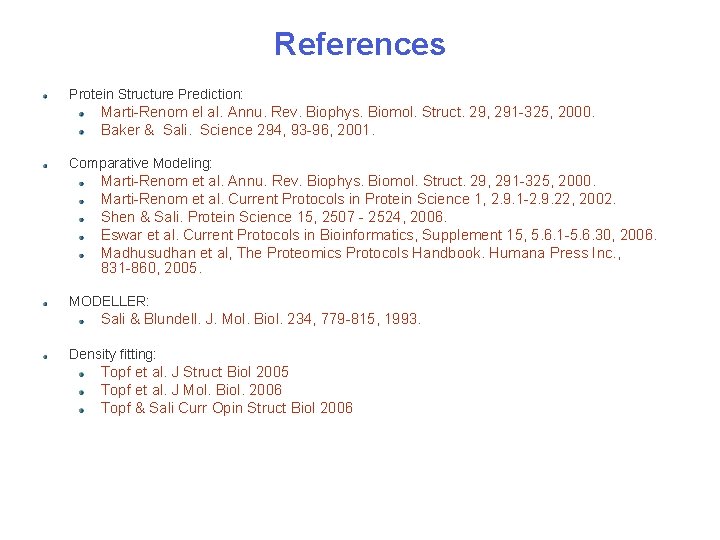
References Protein Structure Prediction: Marti-Renom el al. Annu. Rev. Biophys. Biomol. Struct. 29, 291 -325, 2000. Baker & Sali. Science 294, 93 -96, 2001. Comparative Modeling: Marti-Renom et al. Annu. Rev. Biophys. Biomol. Struct. 29, 291 -325, 2000. Marti-Renom et al. Current Protocols in Protein Science 1, 2. 9. 1 -2. 9. 22, 2002. Shen & Sali. Protein Science 15, 2507 - 2524, 2006. Eswar et al. Current Protocols in Bioinformatics, Supplement 15, 5. 6. 1 -5. 6. 30, 2006. Madhusudhan et al, The Proteomics Protocols Handbook. Humana Press Inc. , 831 -860, 2005. MODELLER: Sali & Blundell. J. Mol. Biol. 234, 779 -815, 1993. Density fitting: Topf et al. J Struct Biol 2005 Topf et al. J Mol. Biol. 2006 Topf & Sali Curr Opin Struct Biol 2006
Acknowledgements UCSF Andrej Sali Lab Narayanan Eswar Ursula Pieper M. S. Madhusudhan Marc Marti-Renom Roberto Sanchez (MSSM) Min-yi Shen Andras Fiser (AECOM) David Eramian Mark Peterson Francisco Melo (Catholic U. ) Ash Stuart (Rampallo Coll. ) Eric Feyfant (GI) Valentin Ilyin (NE) Frank Alber Bino John (Pitsburg U. ) Fred Davis Andrea Rossi Tom Goddard (Chimera group) Tel Aviv University Baylor College Haim Wolfson Wah Chiu Keren Lasker Matt Baker Yao Cong Irina Serysheva Mike Schmid
- Slides: 27