
Comparative Healthcare Systems Explore the US Healthcare System
- Slides: 53
Comparative Healthcare Systems Explore the US Healthcare System and compare it with other Healthcare Systems to identify what can we learn Michael Teasdale OLLI
Objectives of this course Compare the performance of USA health system with others to build an understanding of the relative quality of the US healthcare system Explore if the USA is getting optimal value from its Healthcare System by analyzing cost, service, access and outcomes Explore why does the US system cost so much and identify the drivers of high HC cost in the USA Explore other Healthcare systems structure and mechanisms Draw lessons and apply them to current proposals for change 2
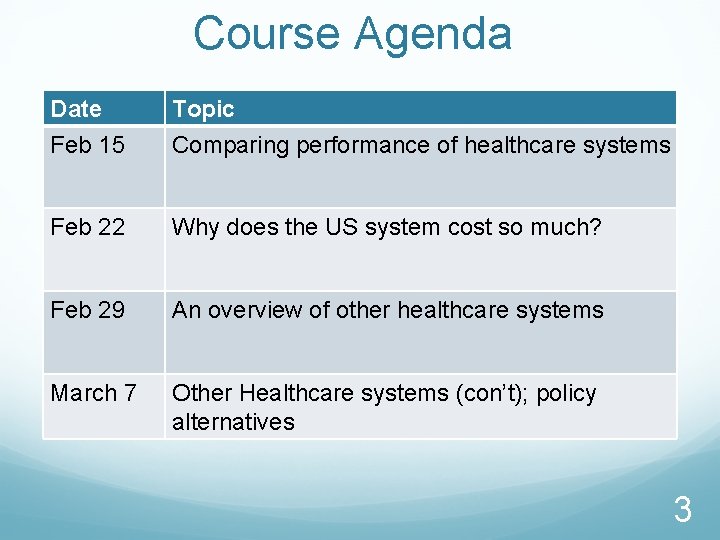
Course Agenda Date Feb 15 Topic Comparing performance of healthcare systems Feb 22 Why does the US system cost so much? Feb 29 An overview of other healthcare systems March 7 Other Healthcare systems (con’t); policy alternatives 3
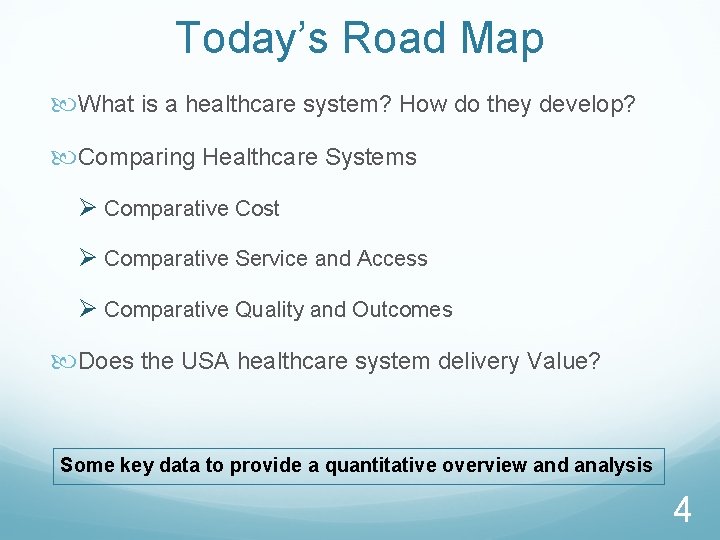
Today’s Road Map What is a healthcare system? How do they develop? Comparing Healthcare Systems Ø Comparative Cost Ø Comparative Service and Access Ø Comparative Quality and Outcomes Does the USA healthcare system delivery Value? Some key data to provide a quantitative overview and analysis 4
Data Sources Organization for Economic Cooperation and Development (OECD) Ø Healthcare Status Report, 2015 Ø Healthcare Quality Indicators Project, 2014 World Heath Organization (WHO), various papers and data The Commonwealth Fund Survey, 2006, 2010, 2015 Mc. Kinsey Report on Healthcare Spending in USA, 2008 Various articles - Atul Gawande (New Yorker), Time magazine (Steven Brill), Lancet 5
Limits to Data and HC comparability Limitations of Measuring Health Care System data due to data definition and robustness: cultural differences, definitions of data, adjustments for acuity or severity or lack thereof, etc. Confounding factors: educational levels, environmental hazards, housing, nutritional status and diet, homicide rates, lifestyles Adversely affected by new disease (e. g. HIV/AIDS) or civil unrest Despite issues with data, major trends appear with some confidence 6
Definitions of a Healthcare System The combination of healthcare institutions, supporting human resources, financing mechanisms, organizational structures that link institutions, information systems, and resources and management structures that collectively culminate in the delivery of healthcare services to patients – Lassey, Lassey and Jinks Healthcare systems permeate society and represent a large part of the economy: We ain’t just talking hospitals, nurses and doctors 7
National Environment and Healthcare All healthcare systems function in a physical, economic, historical and cultural environment Ø General physical environment and climate Ø Socio-economic factors: income levels and distribution, education and knowledge of hygiene Ø History and historical values - a sense of “solidarity” or individualism Ø Political and cultural ideals expressing norms and values Ø Cultural, Family and Individual factors: personality, genetic make-up, life style, diet, use of tobacco, alcohol use, exercise, mental health, etc. Healthcare Systems are born from their environment and history 8
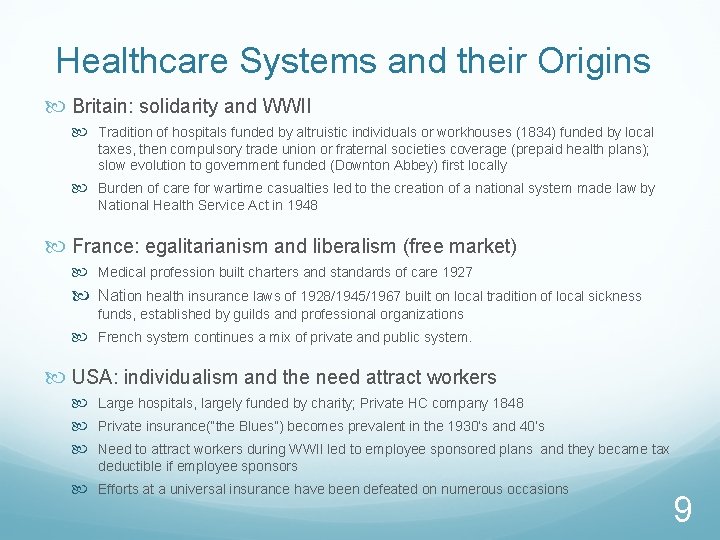
Healthcare Systems and their Origins Britain: solidarity and WWII Tradition of hospitals funded by altruistic individuals or workhouses (1834) funded by local taxes, then compulsory trade union or fraternal societies coverage (prepaid health plans); slow evolution to government funded (Downton Abbey) first locally Burden of care for wartime casualties led to the creation of a national system made law by National Health Service Act in 1948 France: egalitarianism and liberalism (free market) Medical profession built charters and standards of care 1927 Nation health insurance laws of 1928/1945/1967 built on local tradition of local sickness funds, established by guilds and professional organizations French system continues a mix of private and public system. USA: individualism and the need attract workers Large hospitals, largely funded by charity; Private HC company 1848 Private insurance(“the Blues”) becomes prevalent in the 1930’s and 40’s Need to attract workers during WWII led to employee sponsored plans and they became tax deductible if employee sponsors Efforts at a universal insurance have been defeated on numerous occasions 9
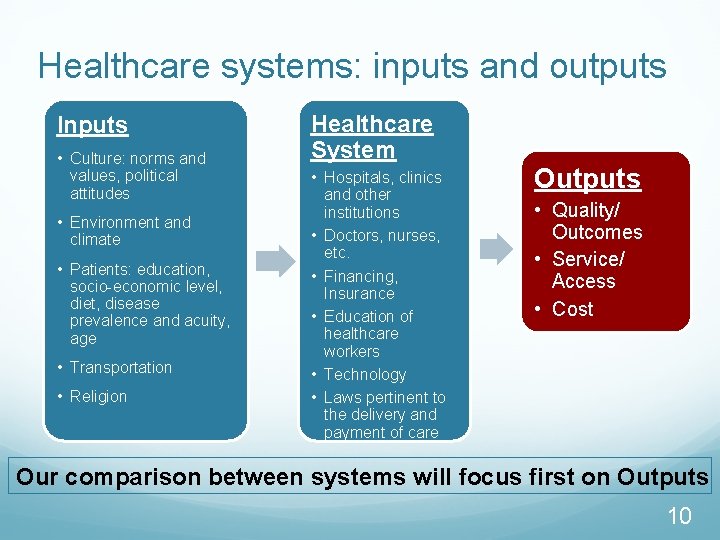
Healthcare systems: inputs and outputs Inputs • Culture: norms and values, political attitudes • Environment and climate • Patients: education, socio-economic level, diet, disease prevalence and acuity, age • Transportation • Religion Healthcare System • Hospitals, clinics and other institutions • Doctors, nurses, etc. • Financing, Insurance • Education of healthcare workers • Technology • Laws pertinent to the delivery and payment of care Outputs • Quality/ Outcomes • Service/ Access • Cost Our comparison between systems will focus first on Outputs 10
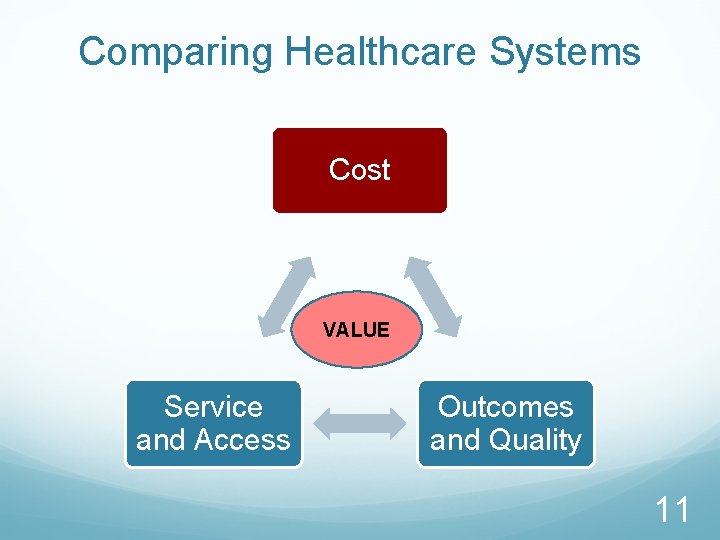
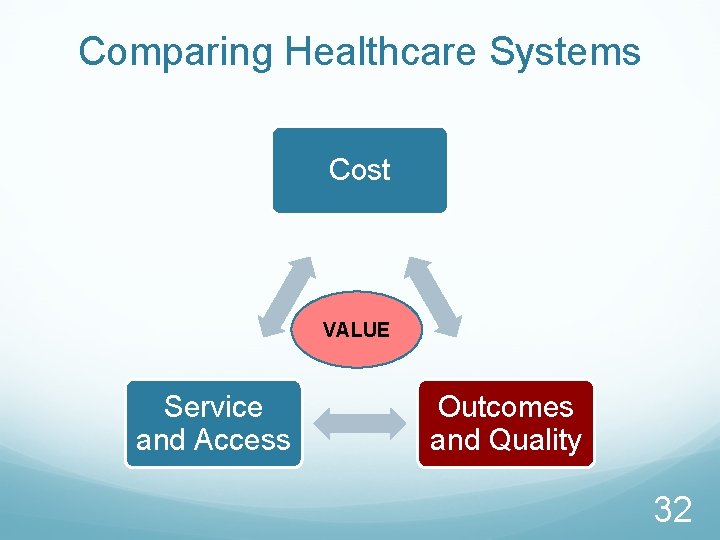
Comparing Healthcare Systems Cost VALUE Service and Access Outcomes and Quality 11
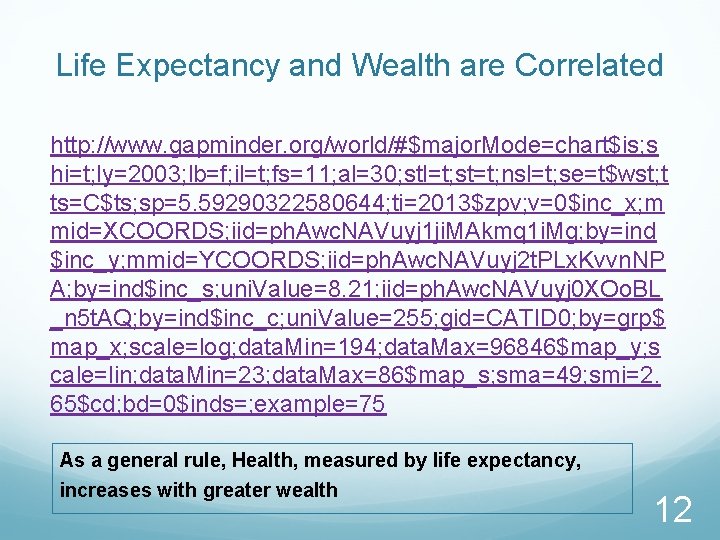
Life Expectancy and Wealth are Correlated http: //www. gapminder. org/world/#$major. Mode=chart$is; s hi=t; ly=2003; lb=f; il=t; fs=11; al=30; stl=t; st=t; nsl=t; se=t$wst; t ts=C$ts; sp=5. 59290322580644; ti=2013$zpv; v=0$inc_x; m mid=XCOORDS; iid=ph. Awc. NAVuyj 1 ji. MAkmq 1 i. Mg; by=ind $inc_y; mmid=YCOORDS; iid=ph. Awc. NAVuyj 2 t. PLx. Kvvn. NP A; by=ind$inc_s; uni. Value=8. 21; iid=ph. Awc. NAVuyj 0 XOo. BL _n 5 t. AQ; by=ind$inc_c; uni. Value=255; gid=CATID 0; by=grp$ map_x; scale=log; data. Min=194; data. Max=96846$map_y; s cale=lin; data. Min=23; data. Max=86$map_s; sma=49; smi=2. 65$cd; bd=0$inds=; example=75 As a general rule, Health, measured by life expectancy, increases with greater wealth 12
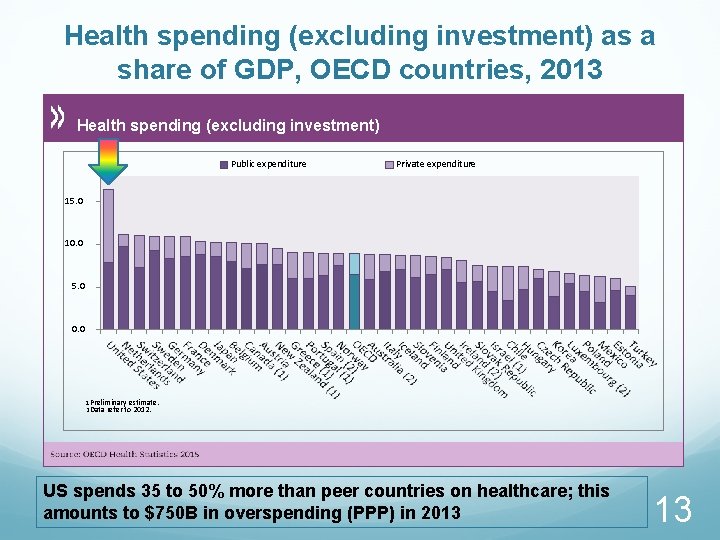
Health spending (excluding investment) as a share of GDP, OECD countries, 2013 Health spending (excluding investment) Public expenditure Private expenditure 15. 0 10. 0 5. 0 0. 0 1 Preliminary estimate. 2 Data refer to 2012. US spends 35 to 50% more than peer countries on healthcare; this amounts to $750 B in overspending (PPP) in 2013 13
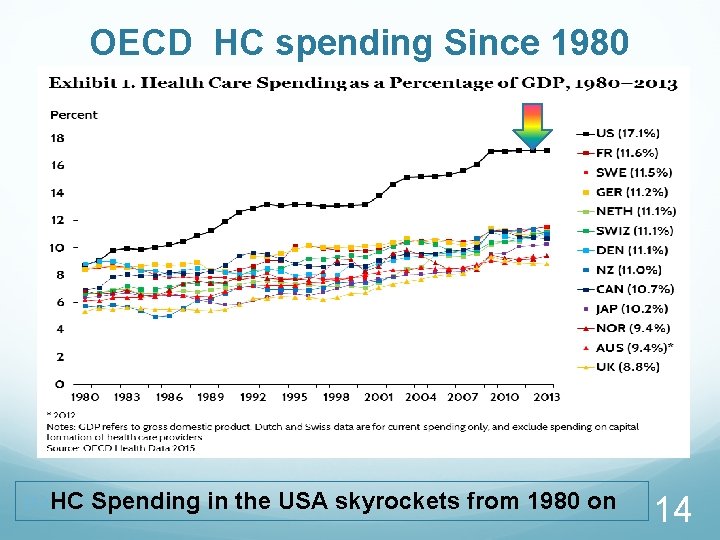
OECD HC spending Since 1980 HC Spending in the USA skyrockets from 1980 on 14
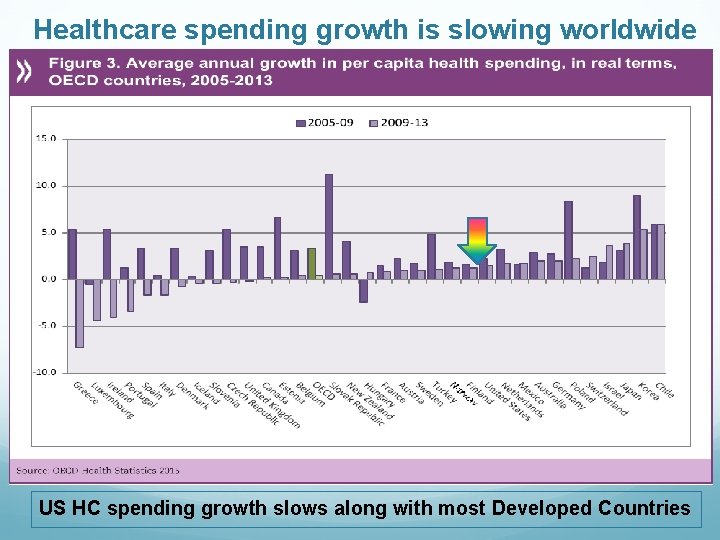
Healthcare spending growth is slowing worldwide US HC spending growth slows along with most Developed Countries
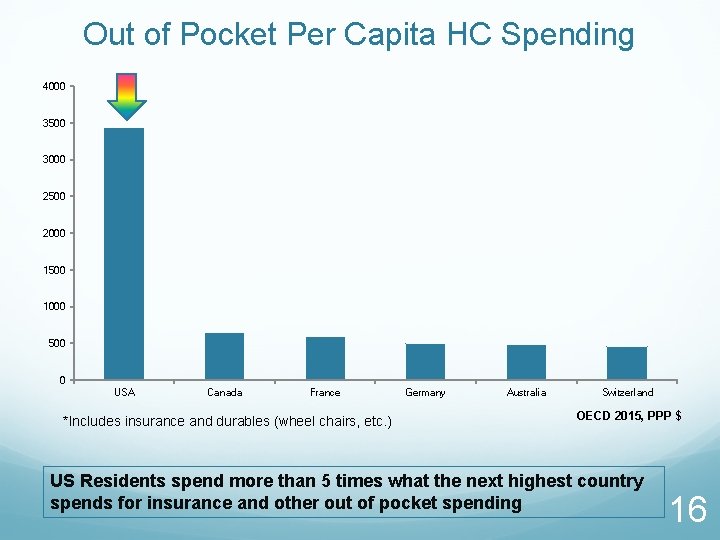
Out of Pocket Per Capita HC Spending 4000 3500 3000 2500 2000 1500 1000 500 0 USA Canada France *Includes insurance and durables (wheel chairs, etc. ) Germany Australia Switzerland OECD 2015, PPP $ US Residents spend more than 5 times what the next highest country spends for insurance and other out of pocket spending 16
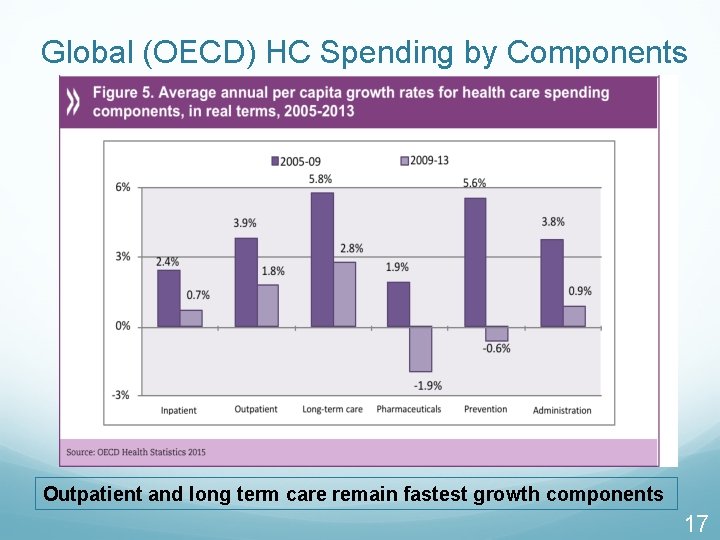
Global (OECD) HC Spending by Components Outpatient and long term care remain fastest growth components 17
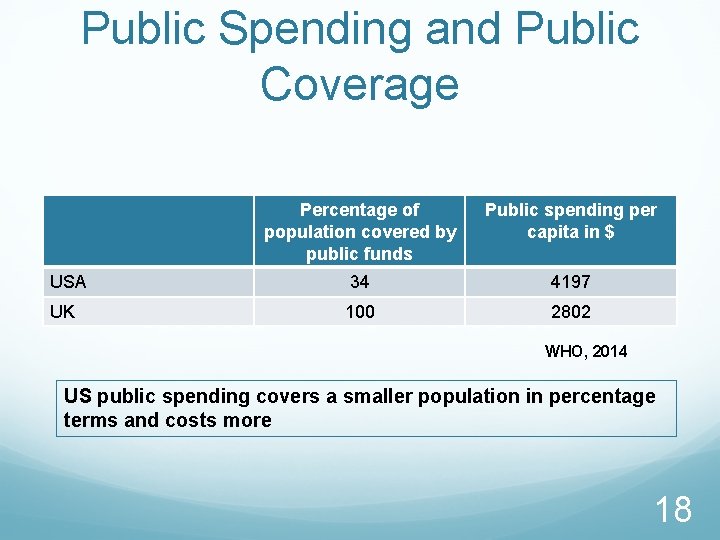
Public Spending and Public Coverage Percentage of population covered by public funds Public spending per capita in $ USA 34 4197 UK 100 2802 WHO, 2014 US public spending covers a smaller population in percentage terms and costs more 18
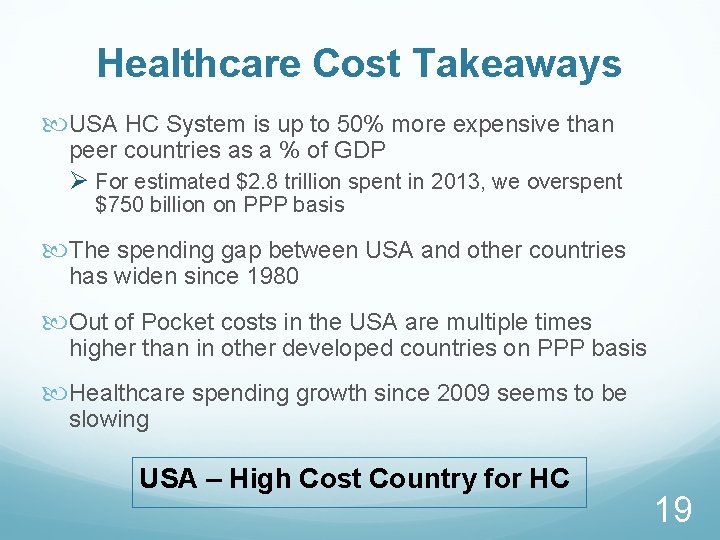
Healthcare Cost Takeaways USA HC System is up to 50% more expensive than peer countries as a % of GDP Ø For estimated $2. 8 trillion spent in 2013, we overspent $750 billion on PPP basis The spending gap between USA and other countries has widen since 1980 Out of Pocket costs in the USA are multiple times higher than in other developed countries on PPP basis Healthcare spending growth since 2009 seems to be slowing USA – High Cost Country for HC 19
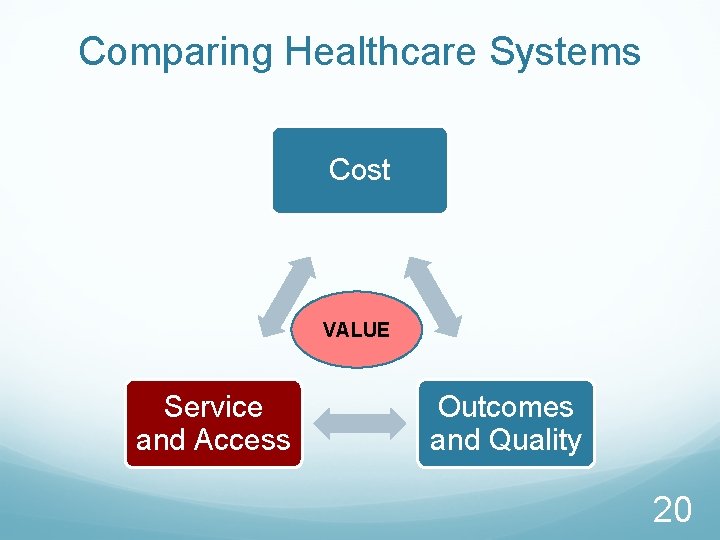
Comparing Healthcare Systems Cost VALUE Service and Access Outcomes and Quality 20
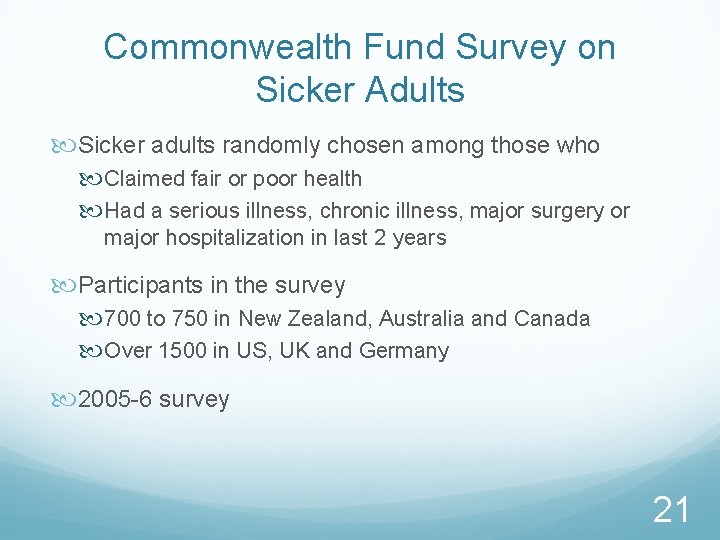
Commonwealth Fund Survey on Sicker Adults Sicker adults randomly chosen among those who Claimed fair or poor health Had a serious illness, chronic illness, major surgery or major hospitalization in last 2 years Participants in the survey 700 to 750 in New Zealand, Australia and Canada Over 1500 in US, UK and Germany 2005 -6 survey 21
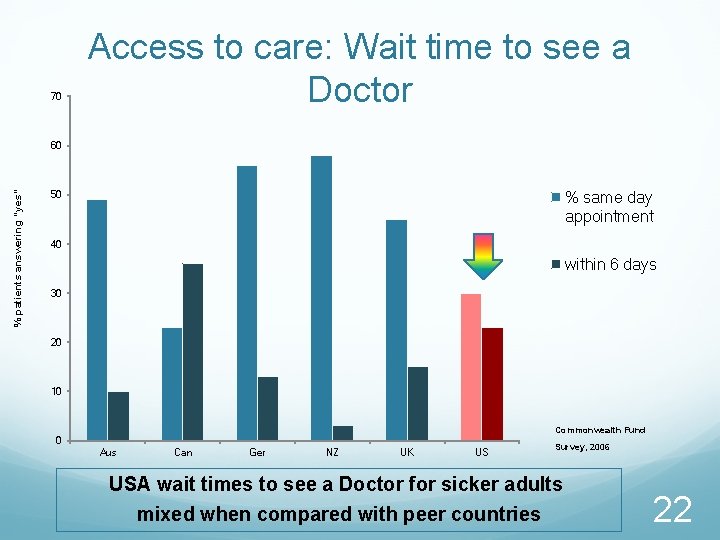
70 Access to care: Wait time to see a Doctor % patients answering “yes” 60 % same day appointment 50 40 within 6 days 30 20 10 Commonwealth Fund 0 Aus Can Ger NZ UK US Survey, 2006 USA wait times to see a Doctor for sicker adults mixed when compared with peer countries 22
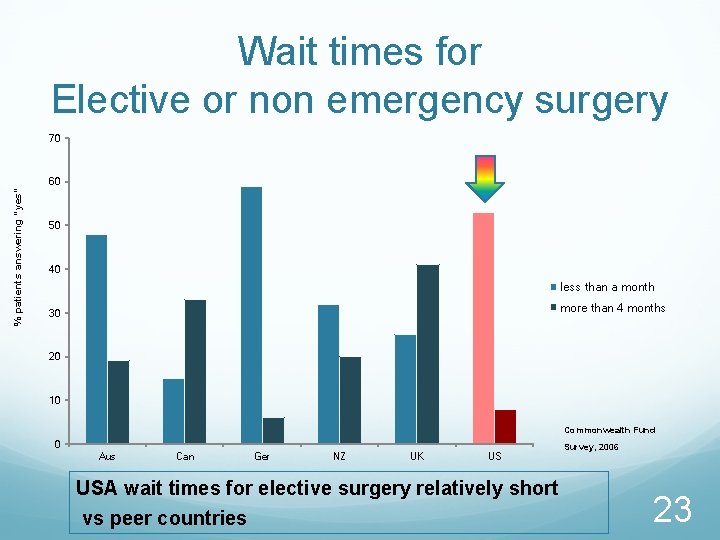
Wait times for Elective or non emergency surgery % patients answering “yes” 70 60 50 40 less than a month more than 4 months 30 20 10 Commonwealth Fund 0 Aus Can Ger NZ UK US USA wait times for elective surgery relatively short vs peer countries Survey, 2006 23
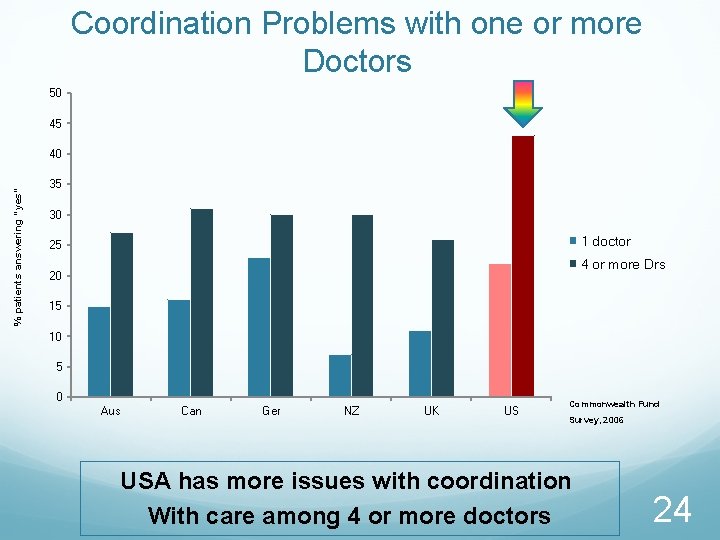
Coordination Problems with one or more Doctors 50 45 % patients answering “yes” 40 35 30 1 doctor 25 4 or more Drs 20 15 10 5 0 Aus Can Ger NZ UK US Commonwealth Fund Survey, 2006 USA has more issues with coordination With care among 4 or more doctors 24
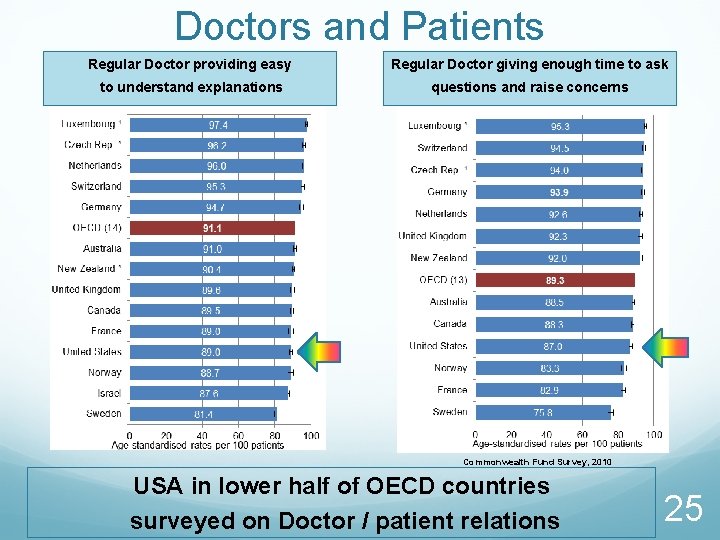
Doctors and Patients Regular Doctor providing easy Regular Doctor giving enough time to ask to understand explanations questions and raise concerns Commonwealth Fund Survey, 2010 USA in lower half of OECD countries surveyed on Doctor / patient relations 25
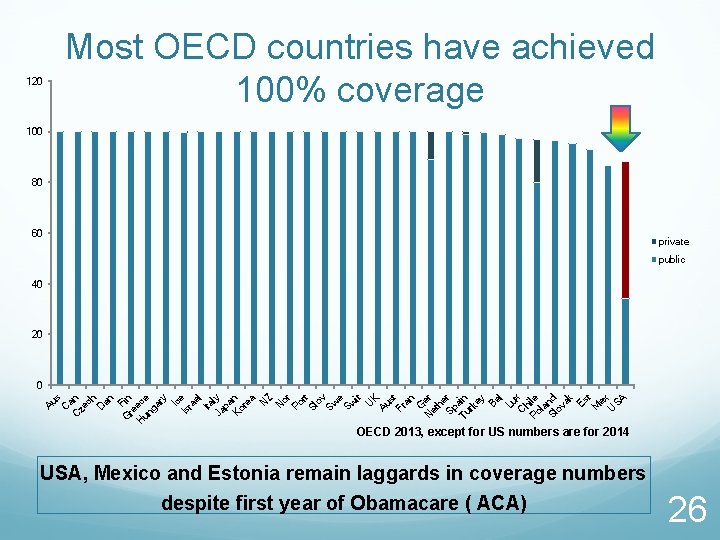
Most OECD countries have achieved 100% coverage 120 100 80 60 private public 40 20 G Fin re H ec un e ga ry Ic Is e ra el Ita Ja ly pa Ko n re a N Z N or Po rt Sl ov Sw e Sw it U K Au st Fr an G N er et he Sp r a Tu in rk ey Be l Lu x C hi Po le la Sl nd ov ak Es t M ex U SA C Au s an C ze ch D en 0 OECD 2013, except for US numbers are for 2014 USA, Mexico and Estonia remain laggards in coverage numbers despite first year of Obamacare ( ACA) 26
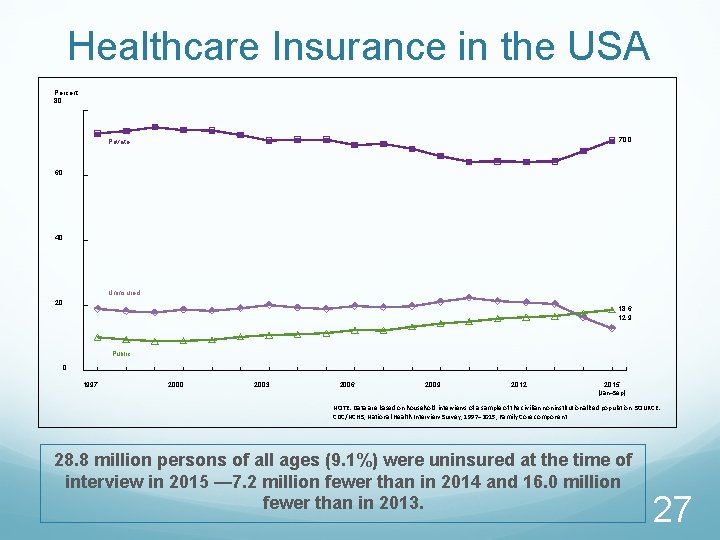
Healthcare Insurance in the USA Percent 80 70. 0 Private 60 40 Uninsured 20 18. 6 12. 9 Public 0 1997 2000 2003 2006 2009 2012 2015 (Jan–Sep) NOTE: Data are based on household interviews of a sample of the civilian noninstitutionalized population. SOURCE: CDC/NCHS, National Health Interview Survey, 1997– 2015, Family Core component. 28. 8 million persons of all ages (9. 1%) were uninsured at the time of interview in 2015 — 7. 2 million fewer than in 2014 and 16. 0 million fewer than in 2013. 27
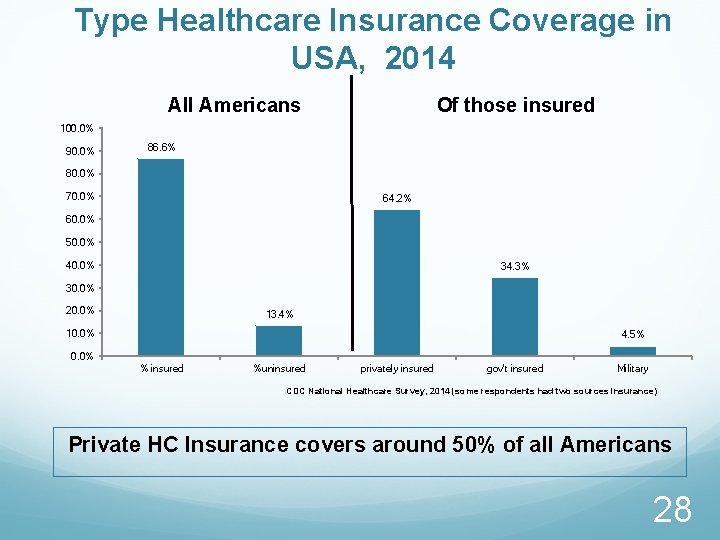
Type Healthcare Insurance Coverage in USA, 2014 All Americans Of those insured 100. 0% 90. 0% 86. 6% 80. 0% 70. 0% 64. 2% 60. 0% 50. 0% 40. 0% 34. 3% 30. 0% 20. 0% 13. 4% 10. 0% 4. 5% 0. 0% % insured %uninsured privately insured gov't insured Military CDC National Healthcare Survey, 2014 (some respondents had two sources insurance) Private HC Insurance covers around 50% of all Americans 28
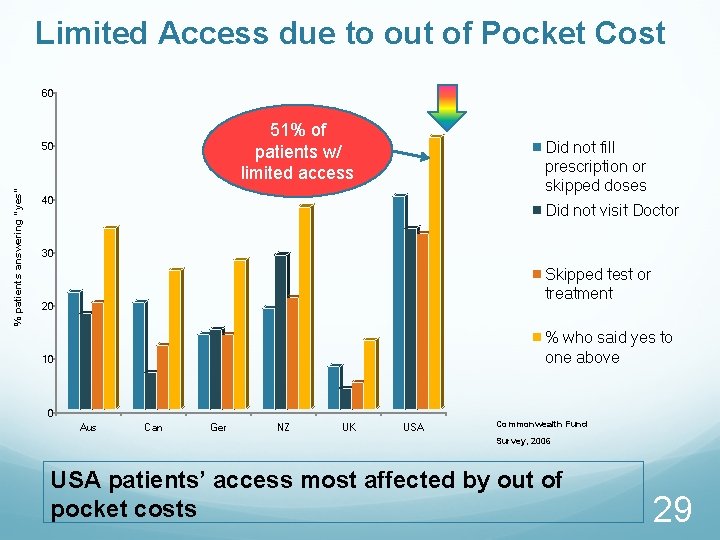
Limited Access due to out of Pocket Cost 60 51% of patients w/ limited access % patients answering “yes” 50 Did not fill prescription or skipped doses 40 Did not visit Doctor 30 Skipped test or treatment 20 % who said yes to one above 10 0 Aus Can Ger NZ UK USA Commonwealth Fund Survey, 2006 USA patients’ access most affected by out of pocket costs 29
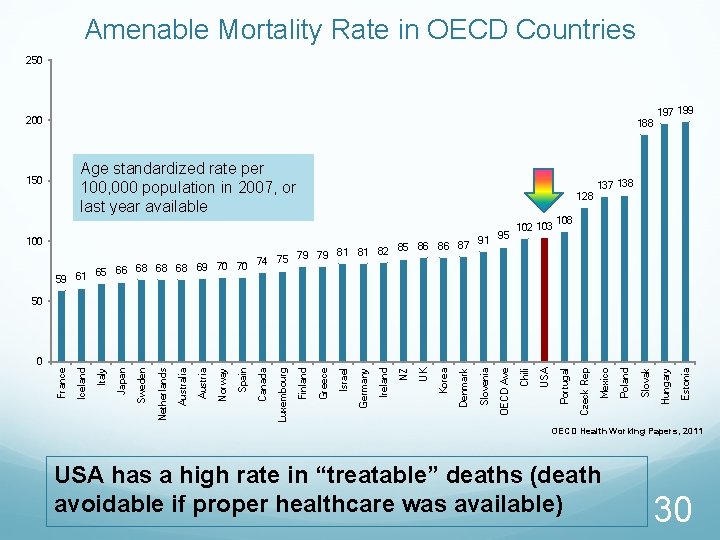
Amenable Mortality Rate in OECD Countries 250 200 188 Age standardized rate per 100, 000 population in 2007, or last year available 150 100 128 95 87 91 86 86 85 81 81 82 75 79 79 74 70 70 65 66 68 68 68 69 59 61 102 103 197 199 137 138 108 Estonia Hungary Slovak Poland Mexico Czeck Rep Portugal USA Chili OECD Ave Slovenia Denmark Korea UK NZ Ireland Germany Israel Greece Finland Luxembourg Canada Spain Norway Austria Australia Netherlands Sweden Japan Italy France 0 Iceland 50 OECD Health Working Papers, 2011 USA has a high rate in “treatable” deaths (death avoidable if proper healthcare was available) 30
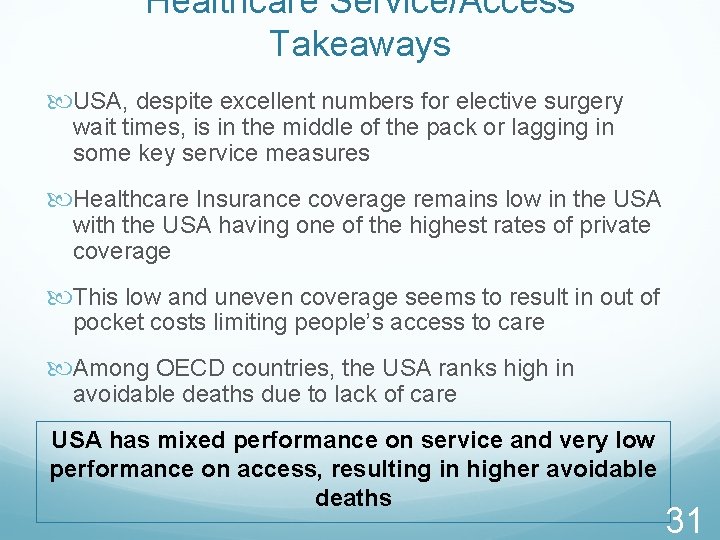
Healthcare Service/Access Takeaways USA, despite excellent numbers for elective surgery wait times, is in the middle of the pack or lagging in some key service measures Healthcare Insurance coverage remains low in the USA with the USA having one of the highest rates of private coverage This low and uneven coverage seems to result in out of pocket costs limiting people’s access to care Among OECD countries, the USA ranks high in avoidable deaths due to lack of care USA has mixed performance on service and very low performance on access, resulting in higher avoidable deaths 31
Comparing Healthcare Systems Cost VALUE Service and Access Outcomes and Quality 32
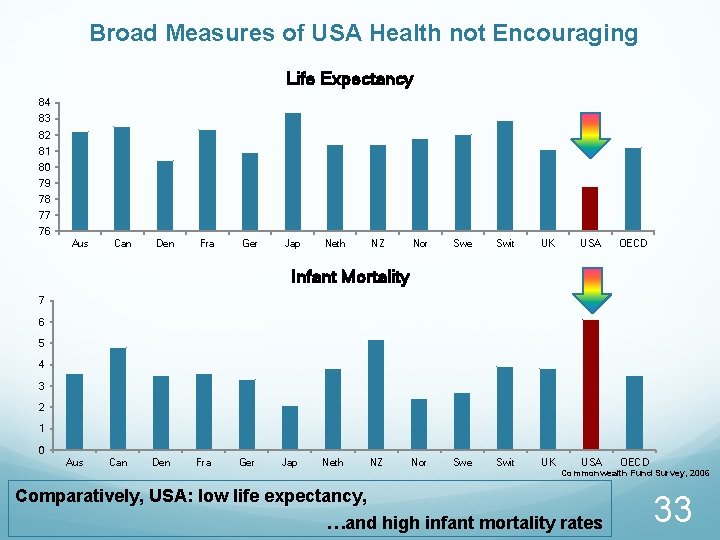
Broad Measures of USA Health not Encouraging Life Expectancy 84 83 82 81 80 79 78 77 76 Aus Can Den Fra Ger Jap Neth NZ Nor Swe Swit UK USA OECD Infant Mortality 7 6 5 4 3 2 1 0 Aus Can Den Fra Ger Jap Neth NZ Commonwealth Fund Survey, 2006 Comparatively, USA: low life expectancy, …and high infant mortality rates 33
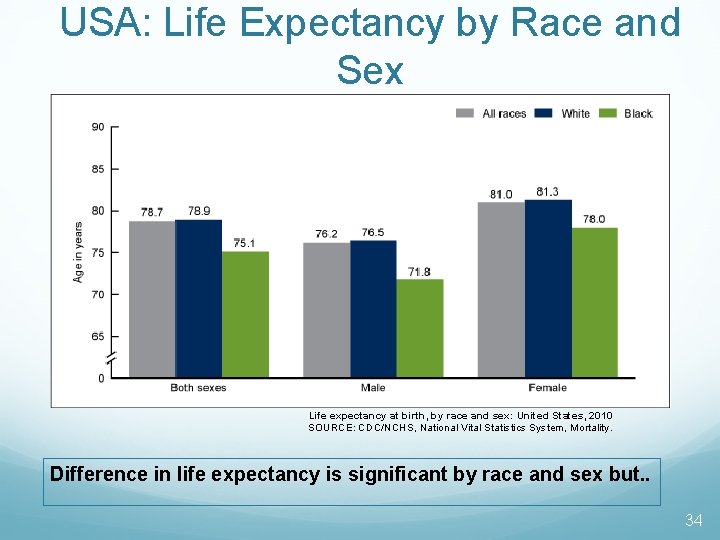
USA: Life Expectancy by Race and Sex Life expectancy at birth, by race and sex: United States, 2010 SOURCE: CDC/NCHS, National Vital Statistics System, Mortality. Difference in life expectancy is significant by race and sex but. . 34
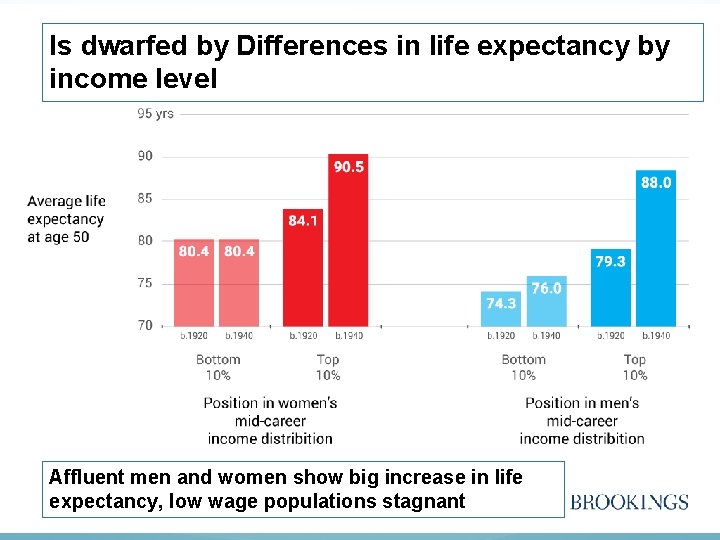
Is dwarfed by Differences in life expectancy by income level Affluent men and women show big increase in life expectancy, low wage populations stagnant
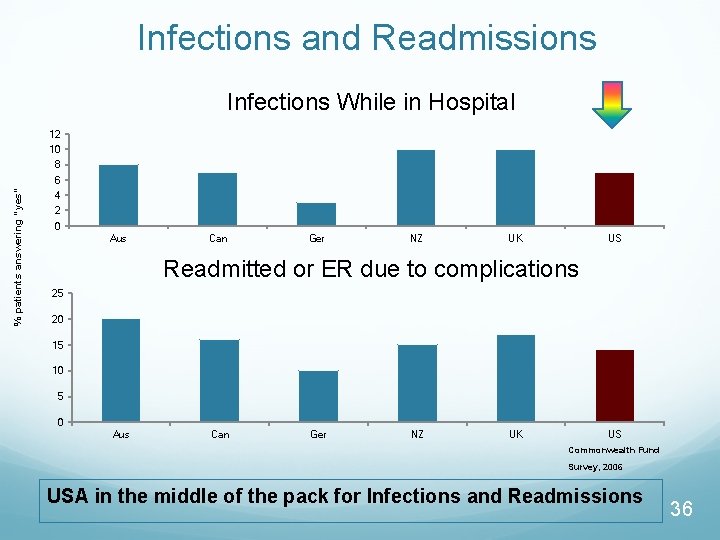
Infections and Readmissions Infections While in Hospital 12 10 8 % patients answering “yes” 6 4 2 0 Aus Can Ger NZ UK US Readmitted or ER due to complications 25 20 15 10 5 0 Aus Can Ger NZ UK US Commonwealth Fund Survey, 2006 USA in the middle of the pack for Infections and Readmissions 36
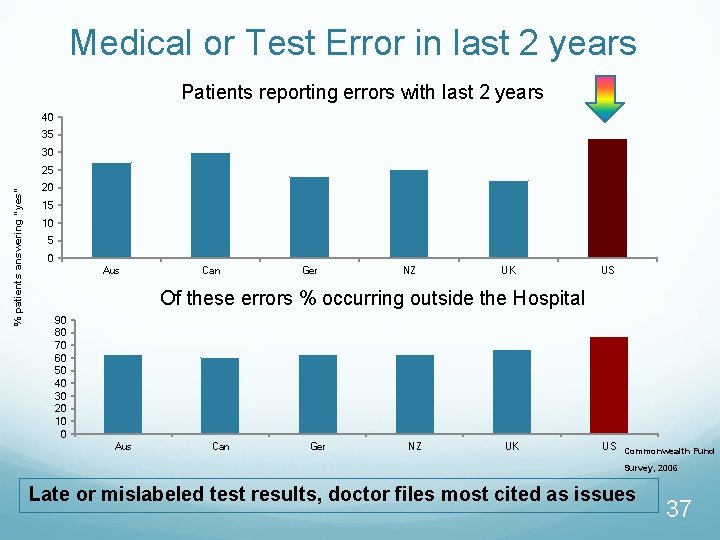
Medical or Test Error in last 2 years Patients reporting errors with last 2 years 40 35 30 % patients answering “yes” 25 20 15 10 5 0 Aus Can Ger NZ UK US Of these errors % occurring outside the Hospital 90 80 70 60 50 40 30 20 10 0 Aus Can Ger NZ UK US Commonwealth Fund Survey, 2006 Late or mislabeled test results, doctor files most cited as issues 37
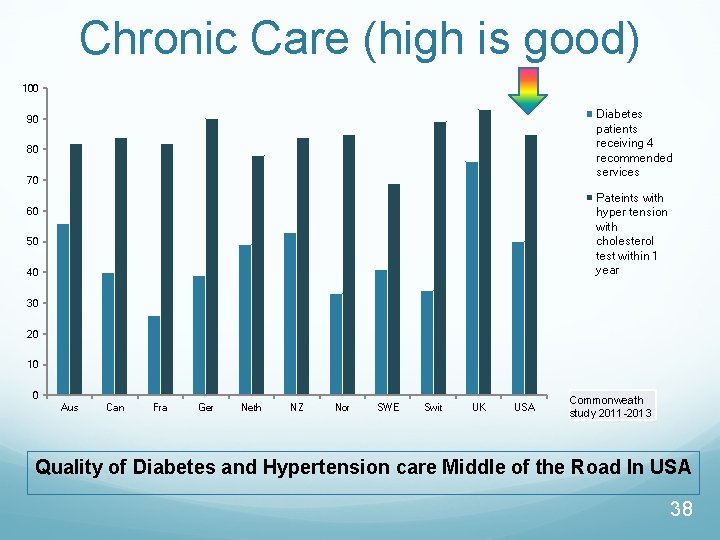
Chronic Care (high is good) 100 Diabetes patients receiving 4 recommended services 90 80 70 Pateints with hyper tension with cholesterol test within 1 year 60 50 40 30 20 10 0 Aus Can Fra Ger Neth NZ Nor SWE Swit UK USA Commonweath study 2011 -2013 Quality of Diabetes and Hypertension care Middle of the Road In USA 38
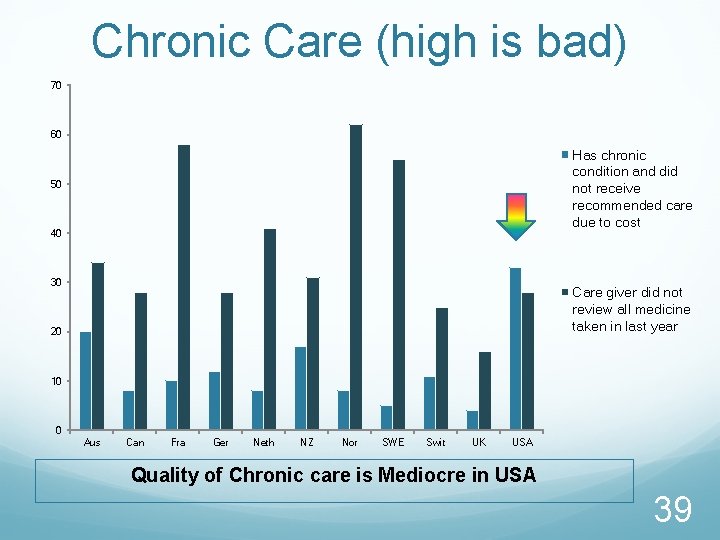
Chronic Care (high is bad) 70 60 Has chronic condition and did not receive recommended care due to cost 50 40 30 Care giver did not review all medicine taken in last year 20 10 0 Aus Can Fra Ger Neth NZ Nor SWE Swit UK USA Quality of Chronic care is Mediocre in USA 39
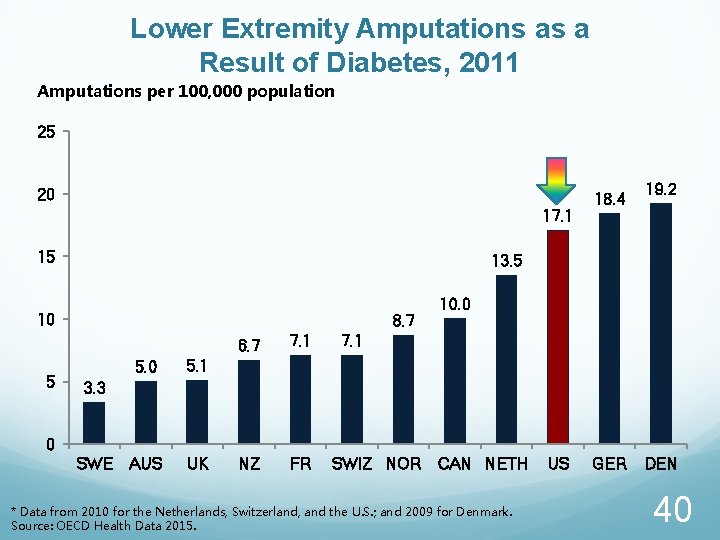
Lower Extremity Amputations as a Result of Diabetes, 2011 Amputations per 100, 000 population 25 20 17. 1 15 19. 2 13. 5 10 5 18. 4 8. 7 5. 0 5. 1 AUS UK 6. 7 7. 1 NZ FR 10. 0 7. 1 3. 3 0 SWE SWIZ NOR CAN NETH * Data from 2010 for the Netherlands, Switzerland, and the U. S. ; and 2009 for Denmark. Source: OECD Health Data 2015. US GER DEN 40
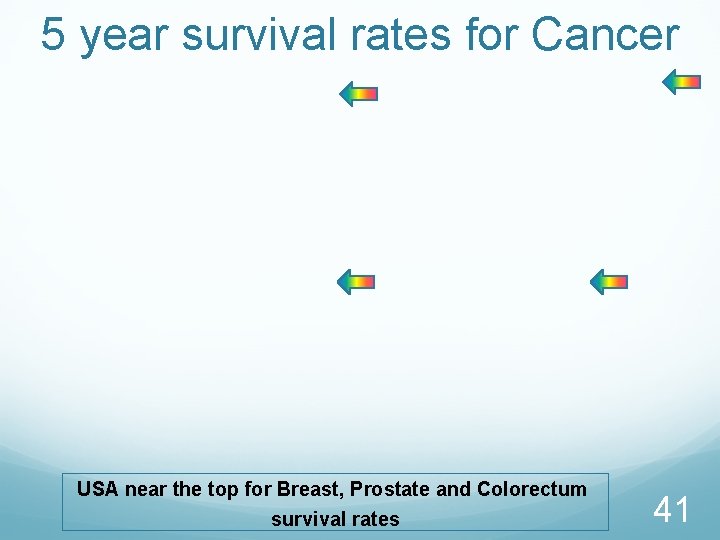
5 year survival rates for Cancer USA near the top for Breast, Prostate and Colorectum survival rates 41
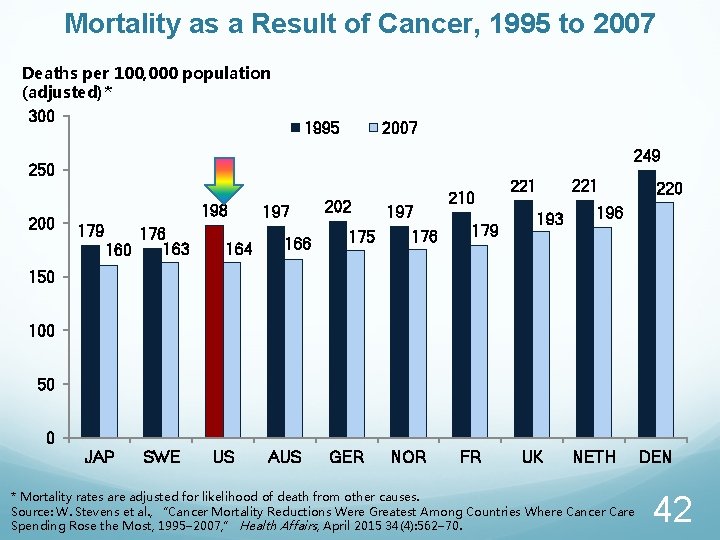
Mortality as a Result of Cancer, 1995 to 2007 Deaths per 100, 000 population (adjusted)* 300 1995 2007 249 250 200 198 179 176 163 160 164 197 166 202 175 197 176 210 179 221 193 221 220 196 150 100 50 0 JAP SWE US AUS GER NOR FR UK NETH * Mortality rates are adjusted for likelihood of death from other causes. Source: W. Stevens et al. , “Cancer Mortality Reductions Were Greatest Among Countries Where Cancer Care Spending Rose the Most, 1995– 2007, ” Health Affairs, April 2015 34(4): 562– 70. DEN 42
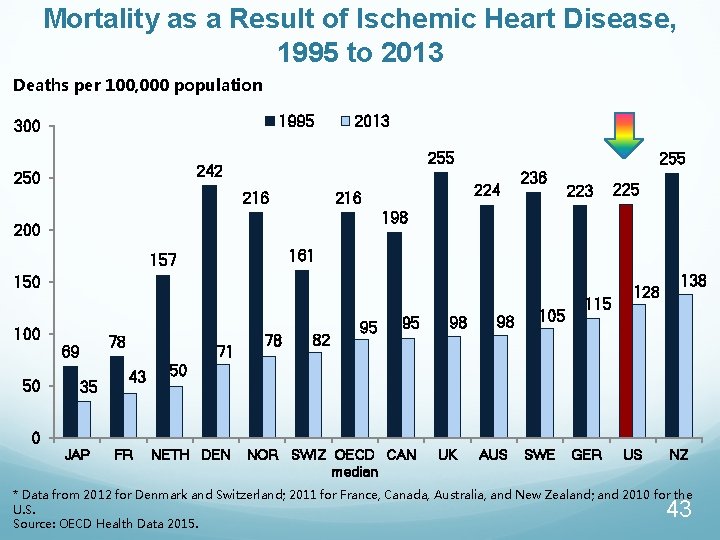
Mortality as a Result of Ischemic Heart Disease, 1995 to 2013 Deaths per 100, 000 population 1995 300 2013 255 242 250 216 255 224 216 236 223 198 200 161 157 150 100 50 0 225 78 69 35 JAP 71 43 FR 78 82 95 95 98 98 105 115 128 138 50 NETH DEN NOR SWIZ OECD CAN median UK AUS SWE GER US NZ * Data from 2012 for Denmark and Switzerland; 2011 for France, Canada, Australia, and New Zealand; and 2010 for the U. S. Source: OECD Health Data 2015. 43
Healthcare Quality/Outcomes Takeaways From the broad measures of HC systems US performance is mediocre to underperforming (Life expectancy and Infant mortality) More precise measures of outcomes and quality are mixed (and difficult to assess) with some islands of excellence in outcomes (Cancer, breast cancer, etc. ) USA has very mixed performance in comparison with other developed countries 44
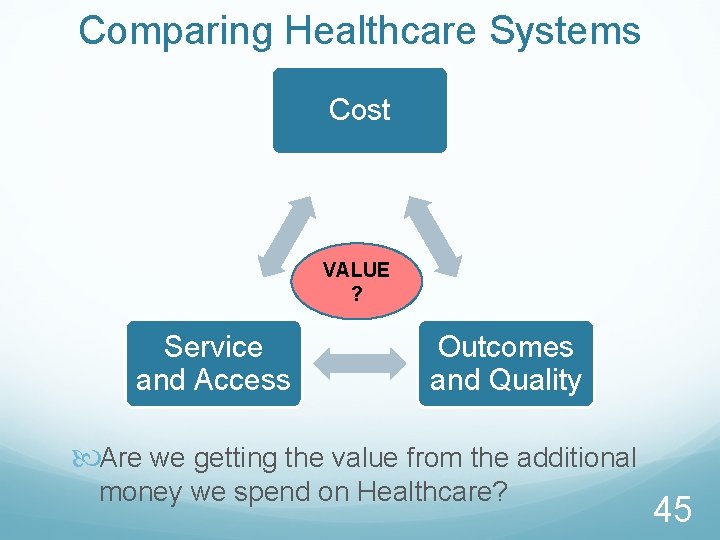
Comparing Healthcare Systems Cost VALUE ? Service and Access Outcomes and Quality Are we getting the value from the additional money we spend on Healthcare? 45
Strengths of US HC System Innovation and rapid adoption of new technology, new drugs and new processes Premium Healthcare institutions: top hospitals (John Hopkins, Mayo clinic, academic medical centers, etc. ), medical tourism – people seek out care in USA Cancer survival rates higher: 5 year rate in US at 66% vs 47% for rest of OECD Shorter waiting times for visits and elective surgery 46
Mixed performance of US HC System Rapid adoption of new technology, new drugs and new processes can lead to safety issues and questions of efficacy Despite large amount of insurance plans, patients have limited choice of plans: 50% of Americans have a choice of 3 plans or less; Other countries ( Denmark, Portugal) offer as much choice (before Obamacare) 47
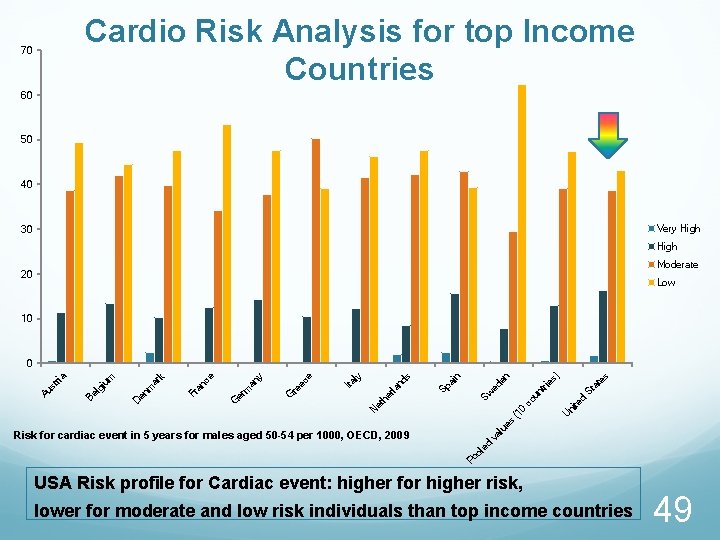
Weaknesses of US HC System US lags in key population level measures: infant mortality and amenable mortality rates Service and quality measures show the USA system in the middle of the pack among peer countries with some lagging measures Access to care – 12% without insurance and a larger percentage with partial insurance leads to negative health outcomes One additional Question: Is the US population sicker than other populations? 48
Cardio Risk Analysis for top Income Countries 70 60 50 40 Very High 30 High Moderate 20 Low 10 es ) St d ni te lu e s U (1 0 co un tri at es ed en n Sw la er et h N Sp ai nd s ly Ita e ec re er G m an y e Fr an c G D en m ar k um lg i Be Au st ria 0 Po ol ed va Risk for cardiac event in 5 years for males aged 50 -54 per 1000, OECD, 2009 USA Risk profile for Cardiac event: higher for higher risk, lower for moderate and low risk individuals than top income countries 49
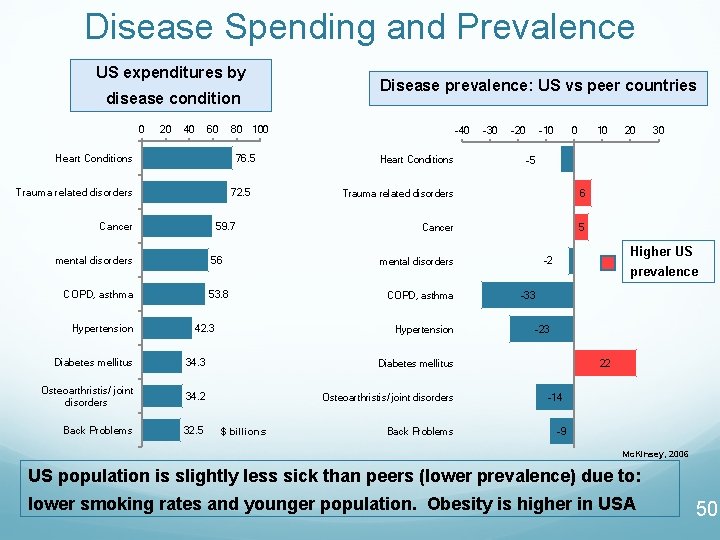
Disease Spending and Prevalence US expenditures by Disease prevalence: US vs peer countries disease condition 0 20 40 60 80 Heart Conditions 76. 5 Trauma related disorders 72. 5 Cancer 59. 7 mental disorders 56 COPD, asthma Hypertension 100 53. 8 42. 3 -40 Heart Conditions -20 -10 0 10 6 Cancer 5 Diabetes mellitus 34. 3 Diabetes mellitus Osteoarthristis/ joint disorders 34. 2 Osteoarthristis/ joint disorders Back Problems 32. 5 Back Problems 30 Higher US -2 mental disorders COPD, asthma 20 -5 Trauma related disorders Hypertension $ billions -30 prevalence -33 -23 22 -14 -9 Mc. Kinsey, 2006 US population is slightly less sick than peers (lower prevalence) due to: lower smoking rates and younger population. Obesity is higher in USA 50
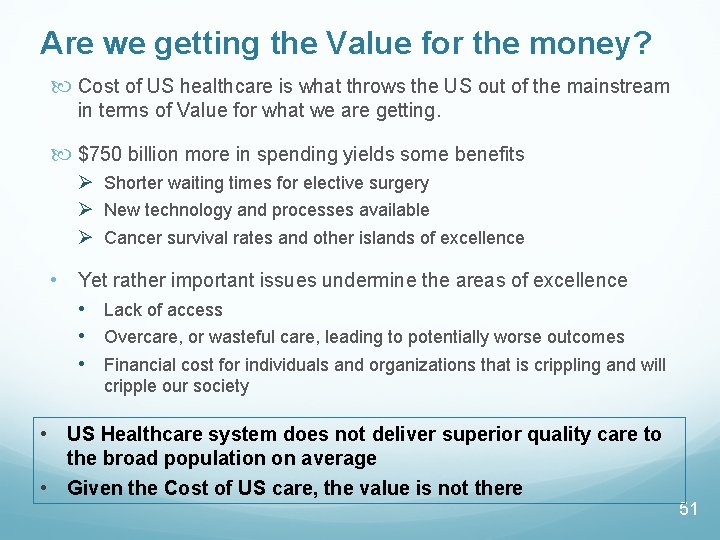
Are we getting the Value for the money? Cost of US healthcare is what throws the US out of the mainstream in terms of Value for what we are getting. $750 billion more in spending yields some benefits Ø Shorter waiting times for elective surgery Ø New technology and processes available Ø Cancer survival rates and other islands of excellence • Yet rather important issues undermine the areas of excellence • Lack of access • Overcare, or wasteful care, leading to potentially worse outcomes • Financial cost for individuals and organizations that is crippling and will cripple our society • US Healthcare system does not deliver superior quality care to the broad population on average • Given the Cost of US care, the value is not there 51
American Healthcare Myths The American Healthcare system is the best in the world Everybody eventually gets the care they need Almost always the quality of care people get is very good Cost of care in America is not really a problem If you like your care, nothing about it will change “American healthcare is a paradox of excess and deprivation. ” -Marmor and Oberland 52
US Healthcare Myths “American healthcare is a paradox of excess and deprivation. ” -Marmor and Oberland https: //www. youtube. com/watch? v=2 y. Jq. Adf. O 2 wk Start at 10: 09 53