
Comparative genomics of 24 mammals Manolis Kellis MIT


- Slides: 42
Comparative genomics of 24 mammals Manolis Kellis MIT Broad Institute of MIT and Harvard MIT Computer Science & Artificial Intelligence Laboratory
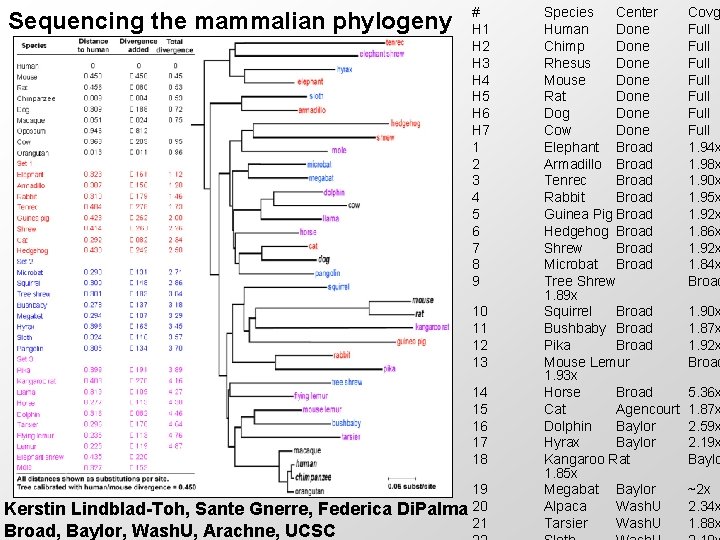
Sequencing the mammalian phylogeny # H 1 H 2 H 3 H 4 H 5 H 6 H 7 1 2 3 4 5 6 7 8 9 10 11 12 13 14 15 16 17 18 Kerstin Lindblad-Toh, Sante Gnerre, Federica Broad, Baylor, Wash. U, Arachne, UCSC 19 Di. Palma 20 21 Species Center Human Done Chimp Done Rhesus Done Mouse Done Rat Done Dog Done Cow Done Elephant Broad Armadillo Broad Tenrec Broad Rabbit Broad Guinea Pig Broad Hedgehog Broad Shrew Broad Microbat Broad Tree Shrew 1. 89 x Squirrel Broad Bushbaby Broad Pika Broad Mouse Lemur 1. 93 x Horse Broad Cat Agencourt Dolphin Baylor Hyrax Baylor Kangaroo Rat 1. 85 x Megabat Baylor Alpaca Wash. U Tarsier Wash. U Covg Full Full 1. 94 x 1. 98 x 1. 90 x 1. 95 x 1. 92 x 1. 86 x 1. 92 x 1. 84 x Broad 1. 90 x 1. 87 x 1. 92 x Broad 5. 36 x 1. 87 x 2. 59 x 2. 19 x Baylo ~2 x 2. 34 x 1. 88 x
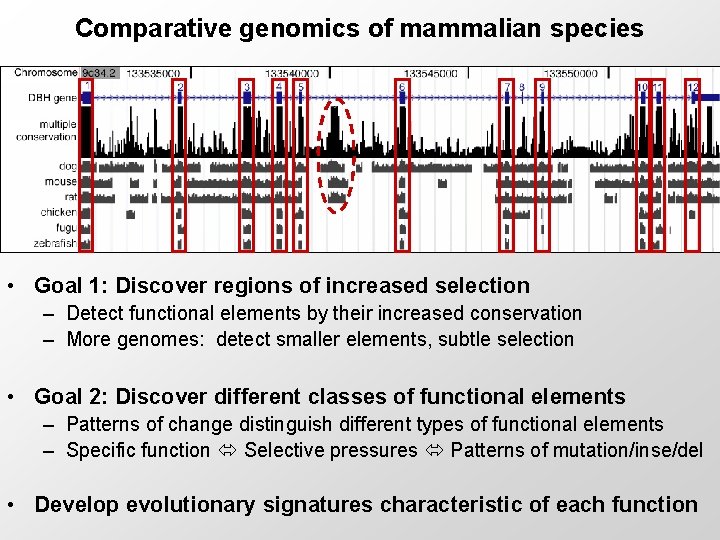
Comparative genomics of mammalian species • Goal 1: Discover regions of increased selection – Detect functional elements by their increased conservation – More genomes: detect smaller elements, subtle selection • Goal 2: Discover different classes of functional elements – Patterns of change distinguish different types of functional elements – Specific function Selective pressures Patterns of mutation/inse/del • Develop evolutionary signatures characteristic of each function
Protein-coding genes Mike Lin
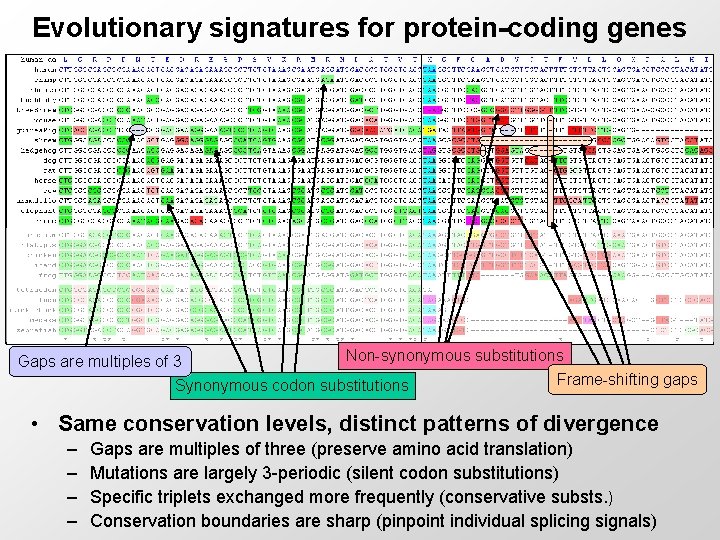
Evolutionary signatures for protein-coding genes Non-synonymous substitutions Gaps are multiples of 3 Frame-shifting gaps Synonymous codon substitutions • Same conservation levels, distinct patterns of divergence – – Gaps are multiples of three (preserve amino acid translation) Mutations are largely 3 -periodic (silent codon substitutions) Specific triplets exchanged more frequently (conservative substs. ) Conservation boundaries are sharp (pinpoint individual splicing signals)
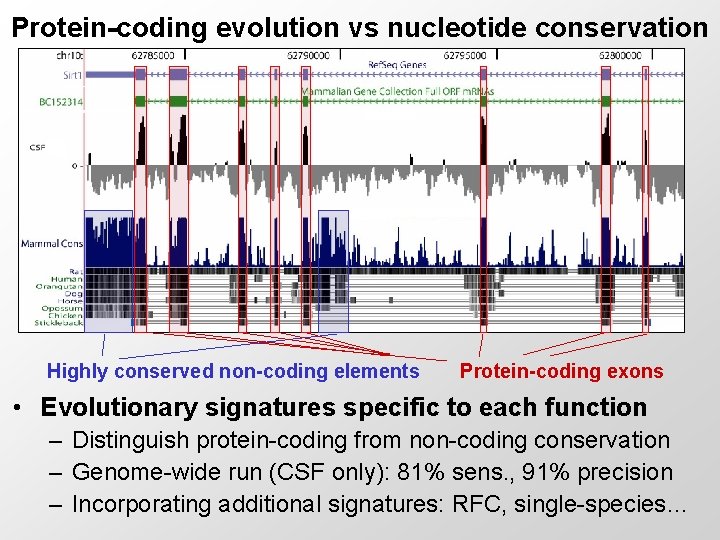
Protein-coding evolution vs nucleotide conservation Highly conserved non-coding elements Protein-coding exons • Evolutionary signatures specific to each function – Distinguish protein-coding from non-coding conservation – Genome-wide run (CSF only): 81% sens. , 91% precision – Incorporating additional signatures: RFC, single-species…
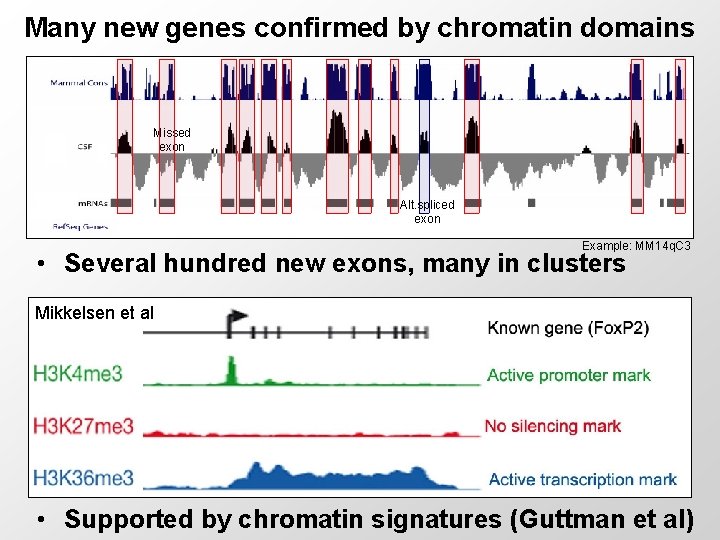
Many new genes confirmed by chromatin domains Missed exon Alt. spliced exon Example: MM 14 q. C 3 • Several hundred new exons, many in clusters Mikkelsen et al • Supported by chromatin signatures (Guttman et al)
Genome-wide curation / experimental follow-up G PI: Tim Hubbard, Sanger Center. HAVANA curators, experimental validation. • Novel candidate genes and exons – Experimental c. DNA sequencing and validation – Curation of gene structures integrating evidence • Revising existing annotations – Identify dubious genes with non-protein-like evolution – Refine boundaries and exon sets of existing genes – Curation: evaluate evidence supporting that annotation • Unusual gene structures – Evolutionary evidence in absence of primary signals – Reveal new and unusual biological mechanisms
Unusual protein-coding events Mike Lin
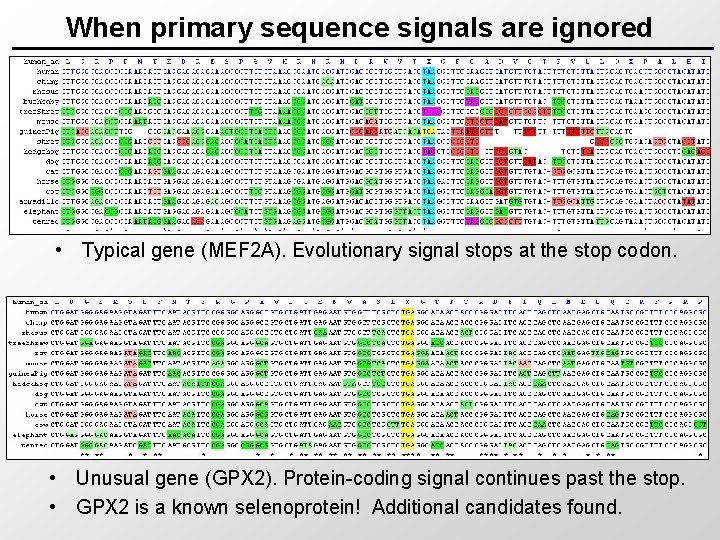
When primary sequence signals are ignored • Typical gene (MEF 2 A). Evolutionary signal stops at the stop codon. • Unusual gene (GPX 2). Protein-coding signal continues past the stop. • GPX 2 is a known selenoprotein! Additional candidates found.
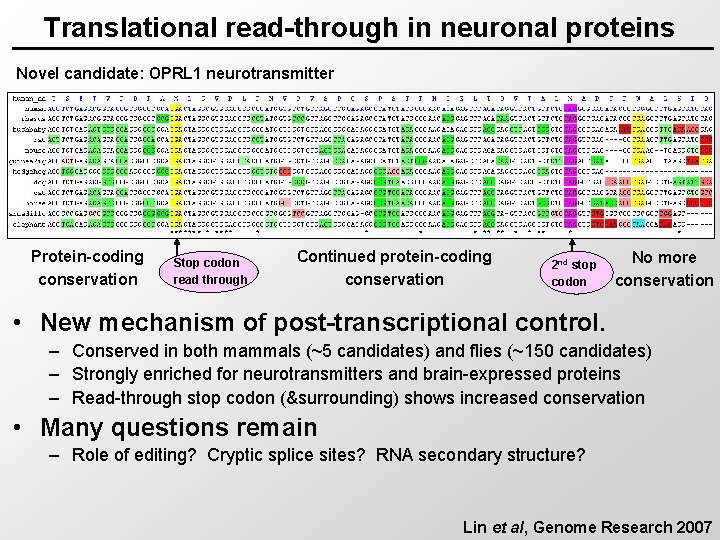
Translational read-through in neuronal proteins Novel candidate: OPRL 1 neurotransmitter Protein-coding conservation Stop codon read through Continued protein-coding conservation 2 nd stop codon No more conservation • New mechanism of post-transcriptional control. – Conserved in both mammals (~5 candidates) and flies (~150 candidates) – Strongly enriched for neurotransmitters and brain-expressed proteins – Read-through stop codon (&surrounding) shows increased conservation • Many questions remain – Role of editing? Cryptic splice sites? RNA secondary structure? Lin et al, Genome Research 2007
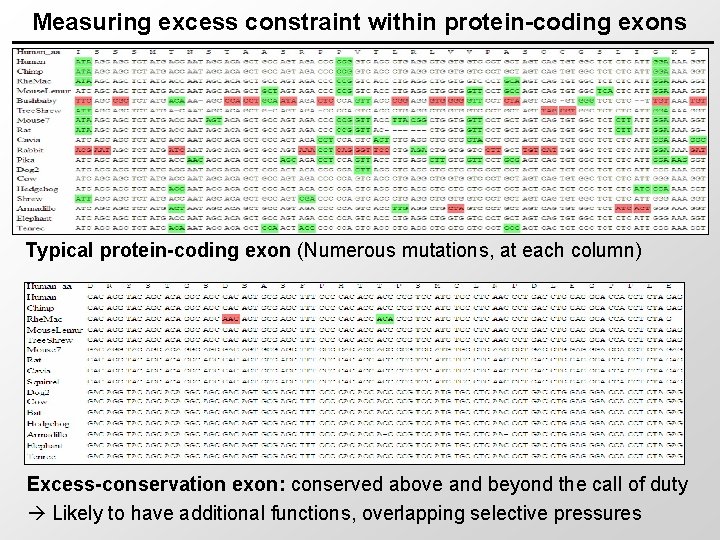
Measuring excess constraint within protein-coding exons Typical protein-coding exon (Numerous mutations, at each column) Excess-conservation exon: conserved above and beyond the call of duty Likely to have additional functions, overlapping selective pressures
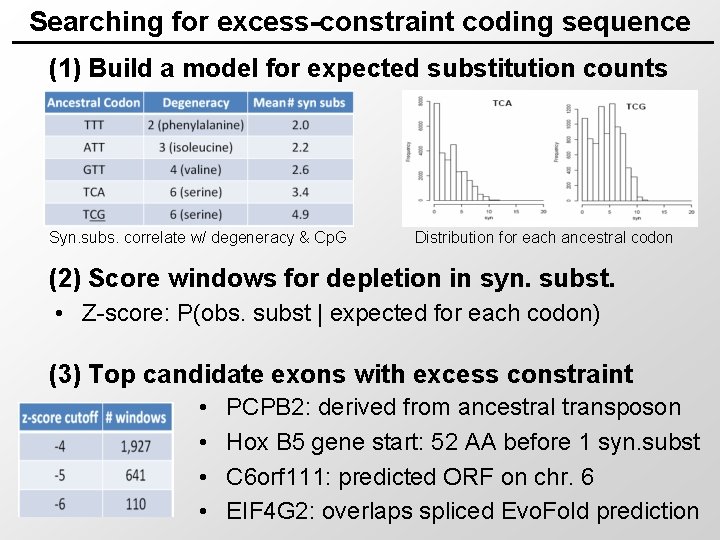
Searching for excess-constraint coding sequence (1) Build a model for expected substitution counts Syn. subs. correlate w/ degeneracy & Cp. G Distribution for each ancestral codon (2) Score windows for depletion in syn. subst. • Z-score: P(obs. subst | expected for each codon) (3) Top candidate exons with excess constraint • • PCPB 2: derived from ancestral transposon Hox B 5 gene start: 52 AA before 1 syn. subst C 6 orf 111: predicted ORF on chr. 6 EIF 4 G 2: overlaps spliced Evo. Fold prediction
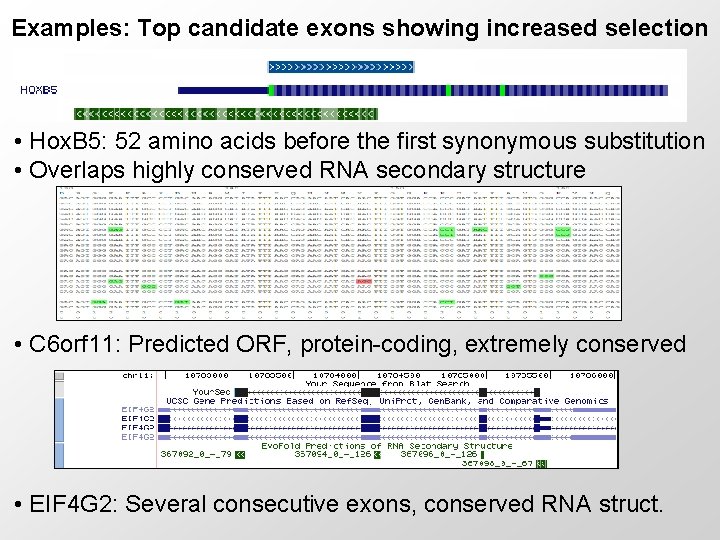
Examples: Top candidate exons showing increased selection • Hox. B 5: 52 amino acids before the first synonymous substitution • Overlaps highly conserved RNA secondary structure • C 6 orf 11: Predicted ORF, protein-coding, extremely conserved • EIF 4 G 2: Several consecutive exons, conserved RNA struct.
micro. RNA genes Alex Stark Pouya Kheradpour
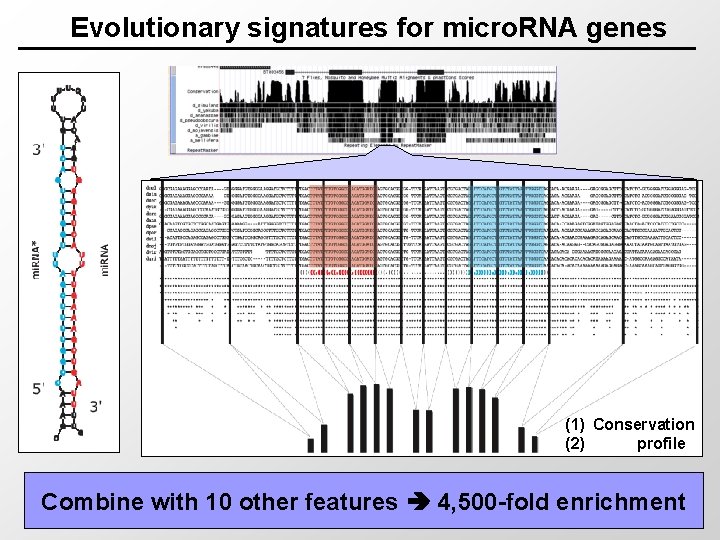
Evolutionary signatures for micro. RNA genes (1) Conservation (2) profile Combine with 10 other features 4, 500 -fold enrichment
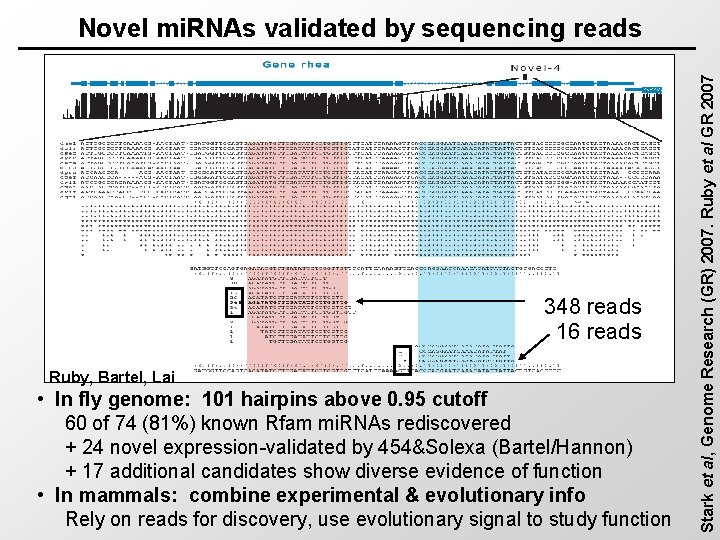
348 reads 16 reads Ruby, Bartel, Lai • In fly genome: 101 hairpins above 0. 95 cutoff 60 of 74 (81%) known Rfam mi. RNAs rediscovered + 24 novel expression-validated by 454&Solexa (Bartel/Hannon) + 17 additional candidates show diverse evidence of function • In mammals: combine experimental & evolutionary info Rely on reads for discovery, use evolutionary signal to study function Stark et al, Genome Research (GR) 2007. Ruby et al GR 2007 Novel mi. RNAs validated by sequencing reads
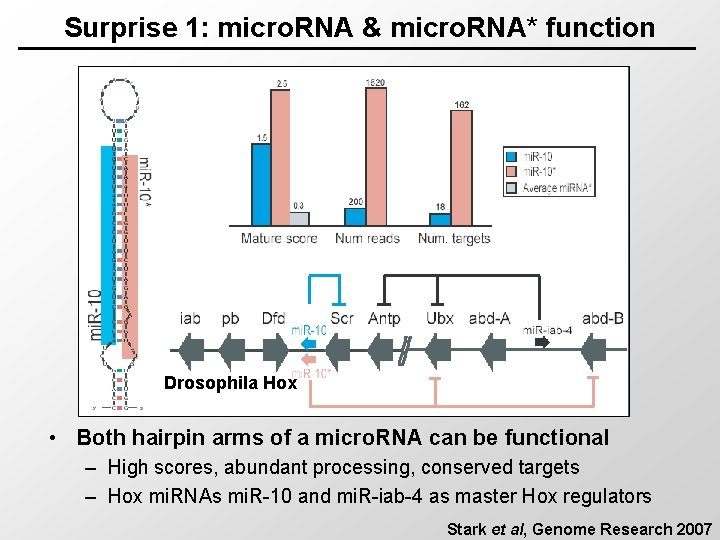
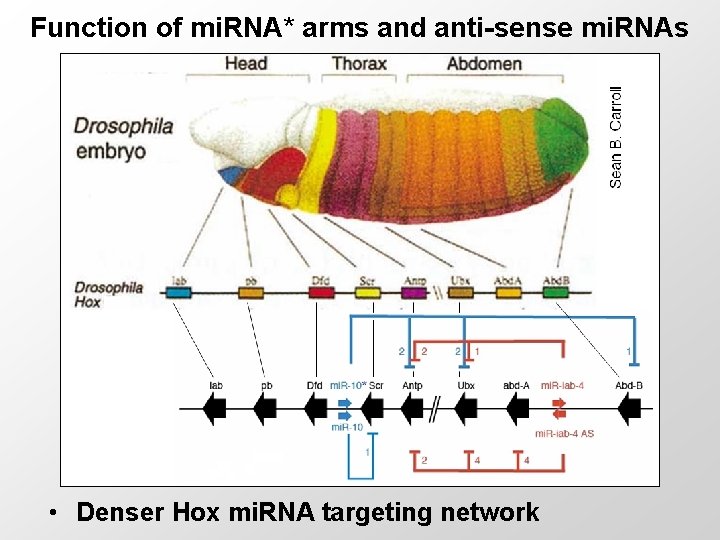
Surprise 1: micro. RNA & micro. RNA* function Drosophila Hox • Both hairpin arms of a micro. RNA can be functional – High scores, abundant processing, conserved targets – Hox mi. RNAs mi. R-10 and mi. R-iab-4 as master Hox regulators Stark et al, Genome Research 2007
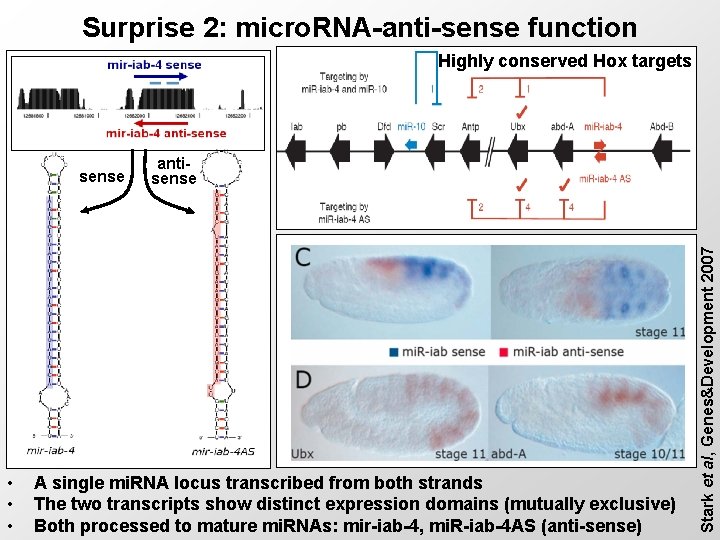
Surprise 2: micro. RNA-anti-sense function Highly conserved Hox targets • • • antisense A single mi. RNA locus transcribed from both strands The two transcripts show distinct expression domains (mutually exclusive) Both processed to mature mi. RNAs: mir-iab-4, mi. R-iab-4 AS (anti-sense) Stark et al, Genes&Development 2007 sense
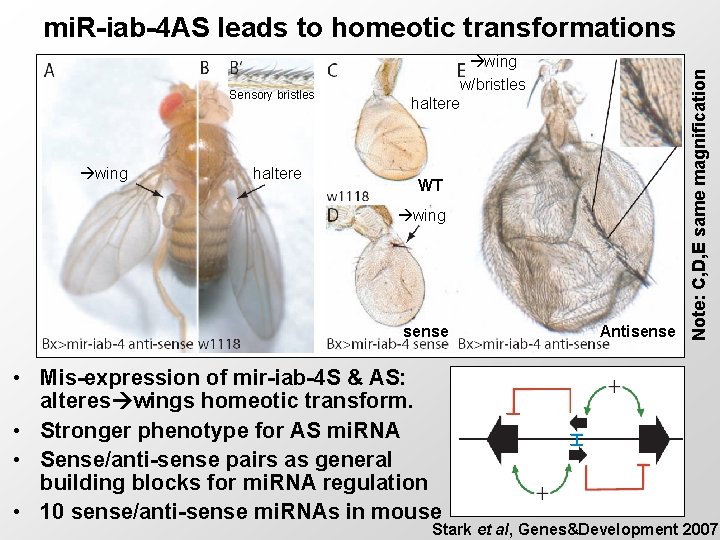
Sensory bristles wing haltere wing w/bristles haltere WT wing sense • Mis-expression of mir-iab-4 S & AS: alteres wings homeotic transform. • Stronger phenotype for AS mi. RNA • Sense/anti-sense pairs as general building blocks for mi. RNA regulation • 10 sense/anti-sense mi. RNAs in mouse Antisense Note: C, D, E same magnification mi. R-iab-4 AS leads to homeotic transformations Stark et al, Genes&Development 2007
Function of mi. RNA* arms and anti-sense mi. RNAs • Denser Hox mi. RNA targeting network
Measuring selection Michele Clamp Manuel Garber Xiaohui Xie
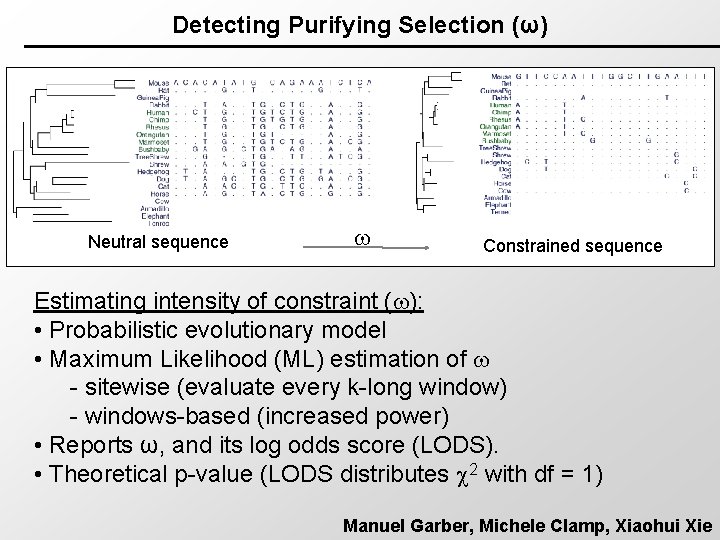
Detecting Purifying Selection (ω) Neutral sequence Constrained sequence Estimating intensity of constraint ( ): • Probabilistic evolutionary model • Maximum Likelihood (ML) estimation of - sitewise (evaluate every k-long window) - windows-based (increased power) • Reports ω, and its log odds score (LODS). • Theoretical p-value (LODS distributes 2 with df = 1) Manuel Garber, Michele Clamp, Xiaohui Xie
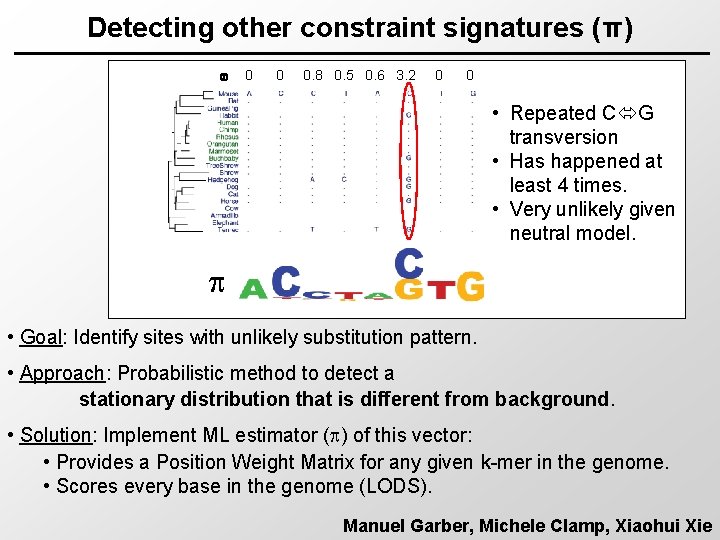
Detecting other constraint signatures (π) 0 0 0. 8 0. 5 0. 6 3. 2 0 0 • Repeated C G transversion • Has happened at least 4 times. • Very unlikely given neutral model. • Goal: Identify sites with unlikely substitution pattern. • Approach: Probabilistic method to detect a stationary distribution that is different from background. • Solution: Implement ML estimator ( ) of this vector: • Provides a Position Weight Matrix for any given k-mer in the genome. • Scores every base in the genome (LODS). Manuel Garber, Michele Clamp, Xiaohui Xie
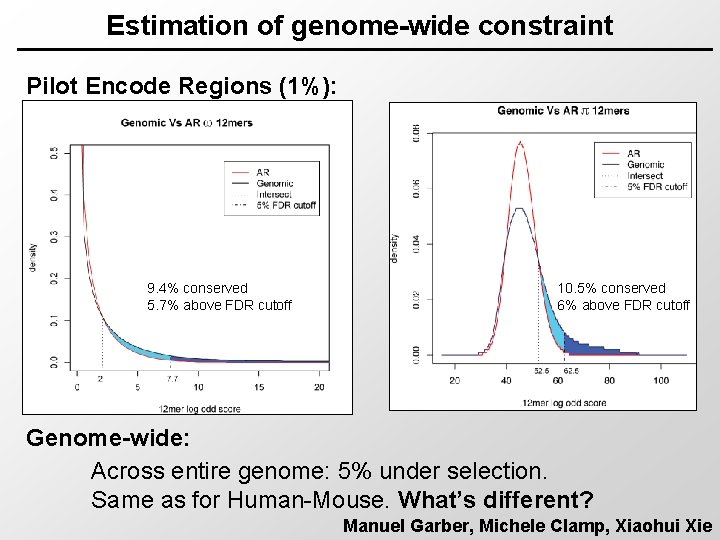
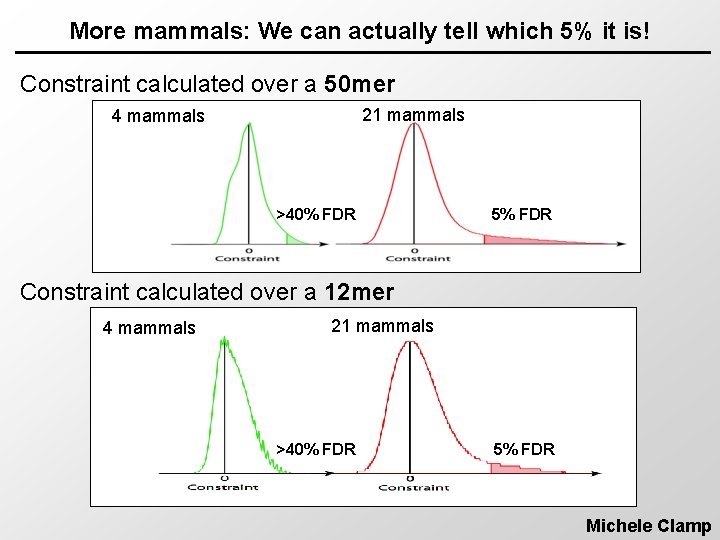
Estimation of genome-wide constraint Pilot Encode Regions (1%): 9. 4% conserved 5. 7% above FDR cutoff 10. 5% conserved 6% above FDR cutoff Genome-wide: Across entire genome: 5% under selection. Same as for Human-Mouse. What’s different? Manuel Garber, Michele Clamp, Xiaohui Xie
More mammals: We can actually tell which 5% it is! Constraint calculated over a 50 mer 21 mammals 4 mammals >40% FDR 5% FDR Constraint calculated over a 12 mer 4 mammals 21 mammals >40% FDR 5% FDR Michele Clamp
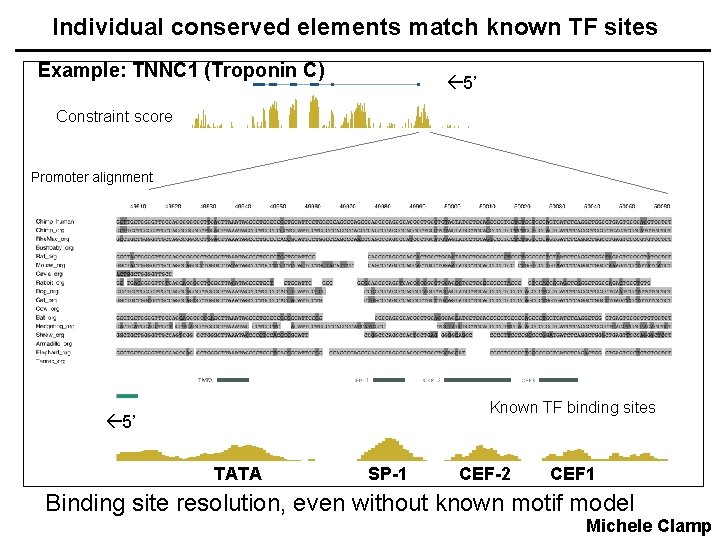
Individual conserved elements match known TF sites Example: TNNC 1 (Troponin C) 5’ Constraint score Promoter alignment Known TF binding sites 5’ TATA SP-1 CEF-2 CEF 1 Binding site resolution, even without known motif model Michele Clamp
Binding sites for known regulators Pouya Kheradpour Alex Stark
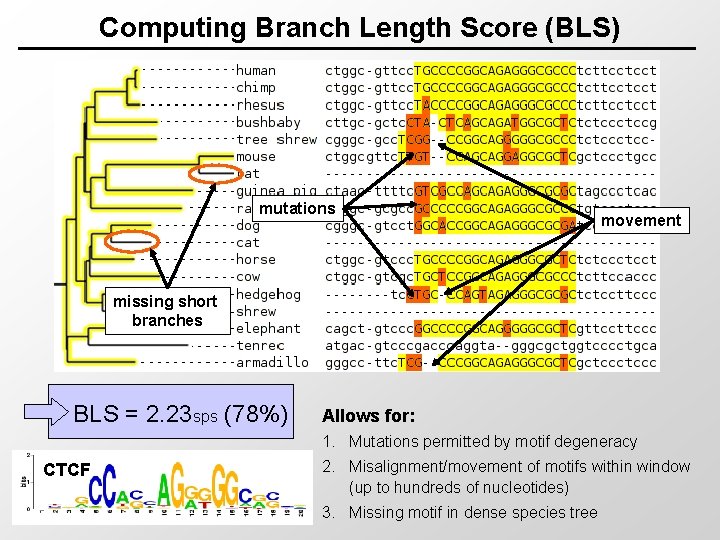
Computing Branch Length Score (BLS) mutations movement missing short branches BLS = 2. 23 sps (78%) Allows for: 1. Mutations permitted by motif degeneracy CTCF 2. Misalignment/movement of motifs within window (up to hundreds of nucleotides) 3. Missing motif in dense species tree
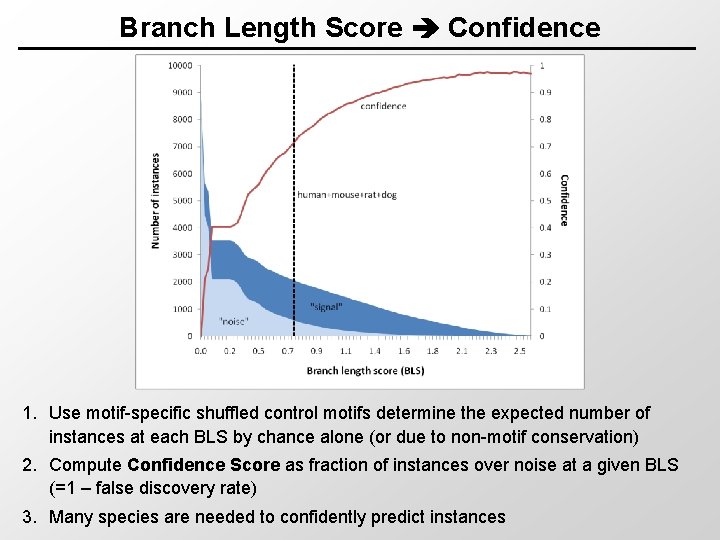
Branch Length Score Confidence 1. Use motif-specific shuffled control motifs determine the expected number of instances at each BLS by chance alone (or due to non-motif conservation) 2. Compute Confidence Score as fraction of instances over noise at a given BLS (=1 – false discovery rate) 3. Many species are needed to confidently predict instances
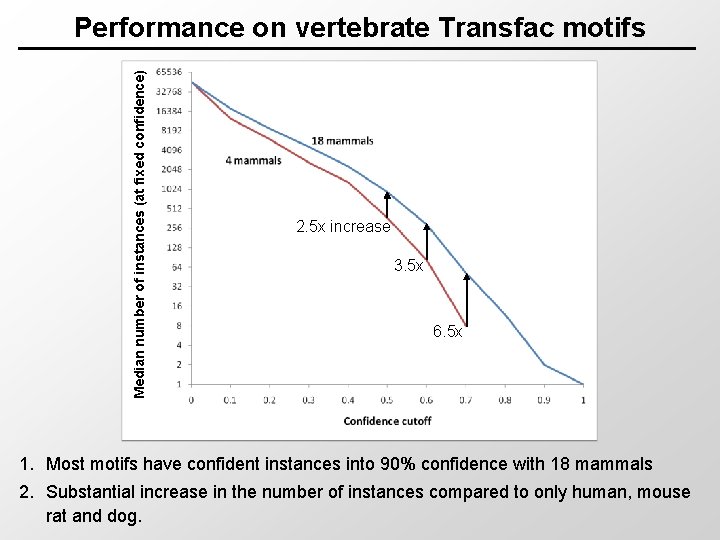
Median number of instances (at fixed confidence) Performance on vertebrate Transfac motifs 2. 5 x increase 3. 5 x 6. 5 x 1. Most motifs have confident instances into 90% confidence with 18 mammals 2. Substantial increase in the number of instances compared to only human, mouse rat and dog.
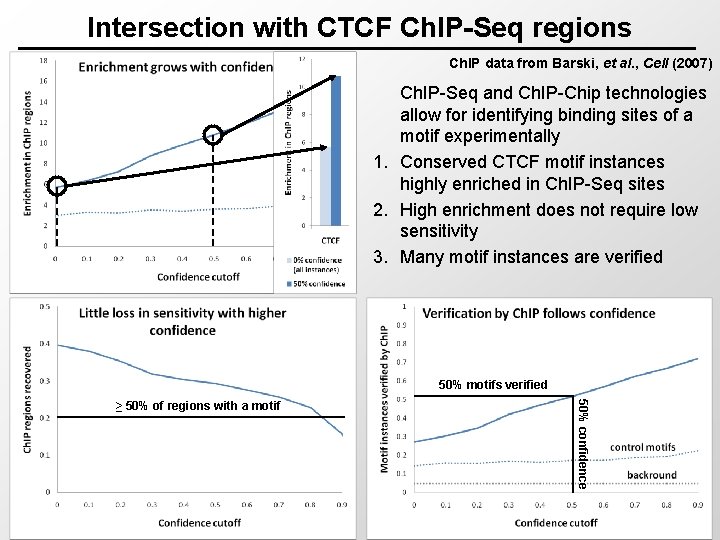
Intersection with CTCF Ch. IP-Seq regions Ch. IP data from Barski, et al. , Cell (2007) Ch. IP-Seq and Ch. IP-Chip technologies allow for identifying binding sites of a motif experimentally 1. Conserved CTCF motif instances highly enriched in Ch. IP-Seq sites 2. High enrichment does not require low sensitivity 3. Many motif instances are verified 50% motifs verified 50% confidence ≥ 50% of regions with a motif
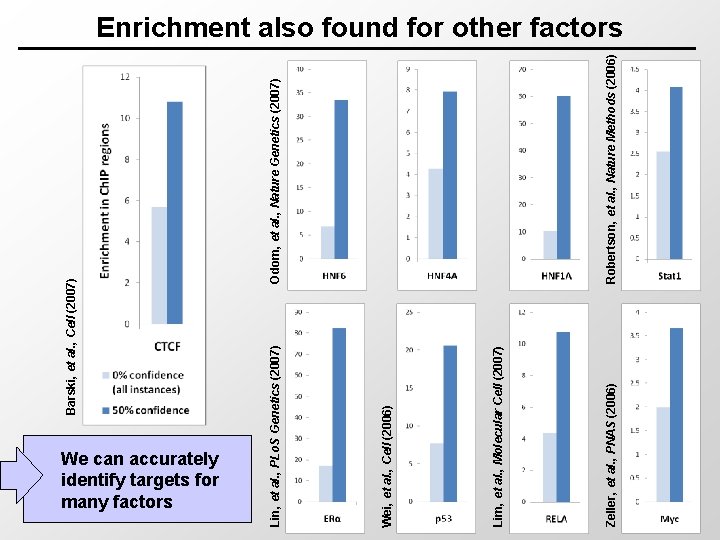
We can accurately identify targets for many factors Zeller, et al. , PNAS (2006) Lim, et al. , Molecular Cell (2007) Wei, et al. , Cell (2006) Lin, et al. , PLo. S Genetics (2007) Robertson, et al. , Nature Methods (2006) Odom, et al. , Nature Genetics (2007) Barski, et al. , Cell (2007) Enrichment also found for other factors
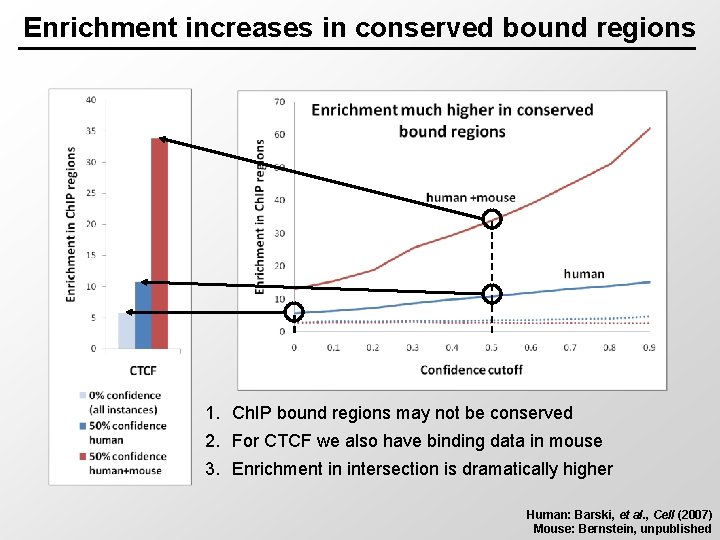
Enrichment increases in conserved bound regions 1. Ch. IP bound regions may not be conserved 2. For CTCF we also have binding data in mouse 3. Enrichment in intersection is dramatically higher Human: Barski, et al. , Cell (2007) Mouse: Bernstein, unpublished
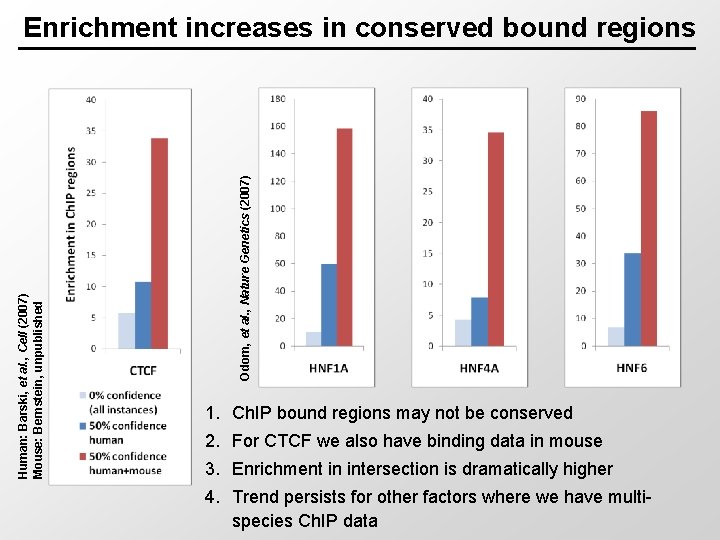
Odom, et al. , Nature Genetics (2007) Human: Barski, et al. , Cell (2007) Mouse: Bernstein, unpublished Enrichment increases in conserved bound regions 1. Ch. IP bound regions may not be conserved 2. For CTCF we also have binding data in mouse 3. Enrichment in intersection is dramatically higher 4. Trend persists for other factors where we have multispecies Ch. IP data
Motif discovery Pouya Kheradpour Alex Stark
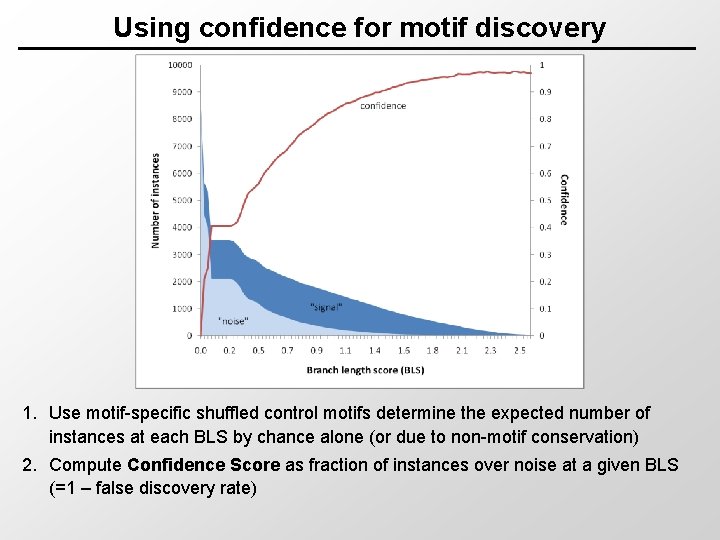
Using confidence for motif discovery 1. Use motif-specific shuffled control motifs determine the expected number of instances at each BLS by chance alone (or due to non-motif conservation) 2. Compute Confidence Score as fraction of instances over noise at a given BLS (=1 – false discovery rate)
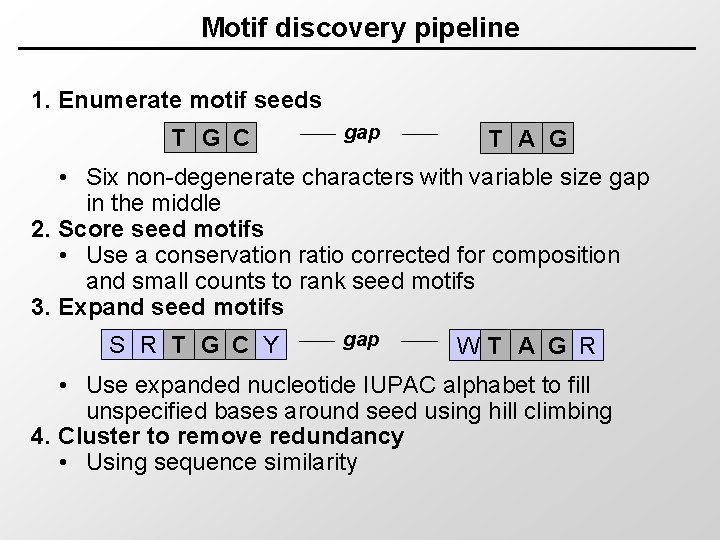
Motif discovery pipeline 1. Enumerate motif seeds T G C gap T A G • Six non-degenerate characters with variable size gap in the middle 2. Score seed motifs • Use a conservation ratio corrected for composition and small counts to rank seed motifs 3. Expand seed motifs S R T G C Y gap WT A G R • Use expanded nucleotide IUPAC alphabet to fill unspecified bases around seed using hill climbing 4. Cluster to remove redundancy • Using sequence similarity
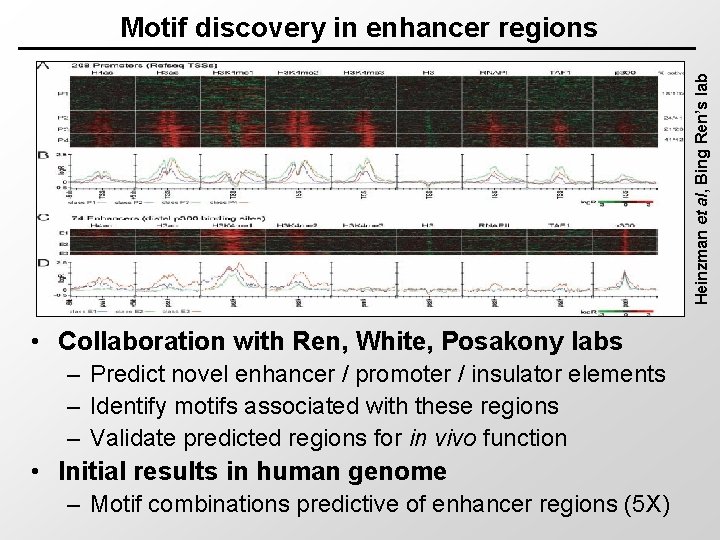
Heinzman et al, Bing Ren’s lab Motif discovery in enhancer regions • Collaboration with Ren, White, Posakony labs – Predict novel enhancer / promoter / insulator elements – Identify motifs associated with these regions – Validate predicted regions for in vivo function • Initial results in human genome – Motif combinations predictive of enhancer regions (5 X)
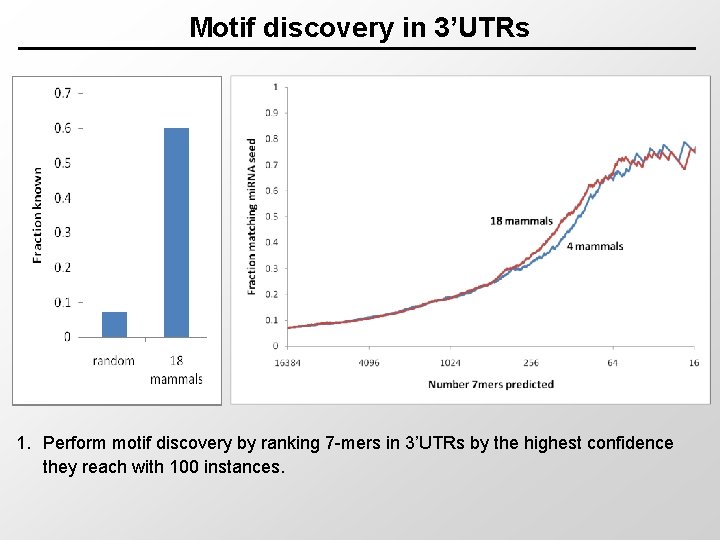
Motif discovery in 3’UTRs 1. Perform motif discovery by ranking 7 -mers in 3’UTRs by the highest confidence they reach with 100 instances.
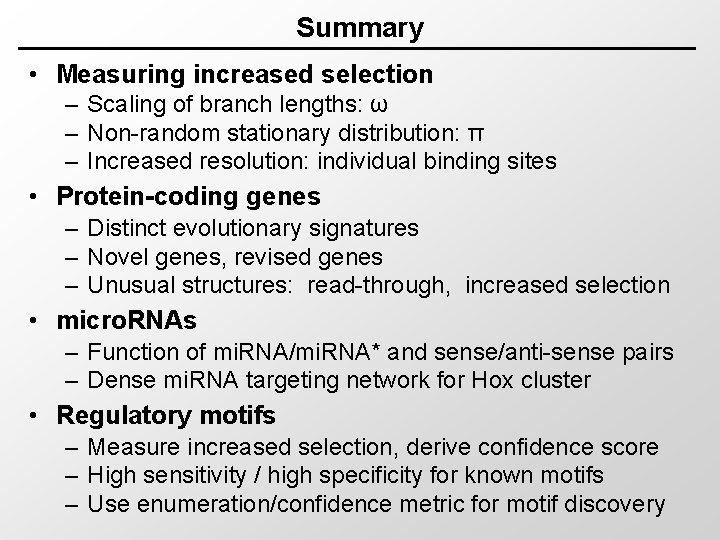
Summary • Measuring increased selection – Scaling of branch lengths: ω – Non-random stationary distribution: π – Increased resolution: individual binding sites • Protein-coding genes – Distinct evolutionary signatures – Novel genes, revised genes – Unusual structures: read-through, increased selection • micro. RNAs – Function of mi. RNA/mi. RNA* and sense/anti-sense pairs – Dense mi. RNA targeting network for Hox cluster • Regulatory motifs – Measure increased selection, derive confidence score – High sensitivity / high specificity for known motifs – Use enumeration/confidence metric for motif discovery
Acknowledgements MIT Computer Science and AI Lab Mike Lin Pouya Kheradpour Alex Stark Matt Rasmussen Broad Institute of MIT and Harvard Kerstin Michele Manuel Xiaohui Xie Lindblad-Toh Clamp Garber Sante Gnerre, David Jaffe Issao Fujiwara Federica Di Palma Arachne Assembly Team Broad Sequencing Platform Sequencing Baylor, Wash. U, Agencourt. Funding: NHGRI Eric Lander. Julius Brennecke, Graham Ruby, Greg Hannon, David Bartel mi. RNAs iab-4 AS Natascha Bushati, Steve Cohen, Julius, Greg Hannon