
Comparative Analysis of Terminal WindShear Detection Systems John

- Slides: 17
Comparative Analysis of Terminal Wind-Shear Detection Systems John Y. N. Cho, Robert G. Hallowell, and Mark E. Weber 24 January 2008 MIT Lincoln Laboratory Wind. Shear-1 JYNC 1/24/2008
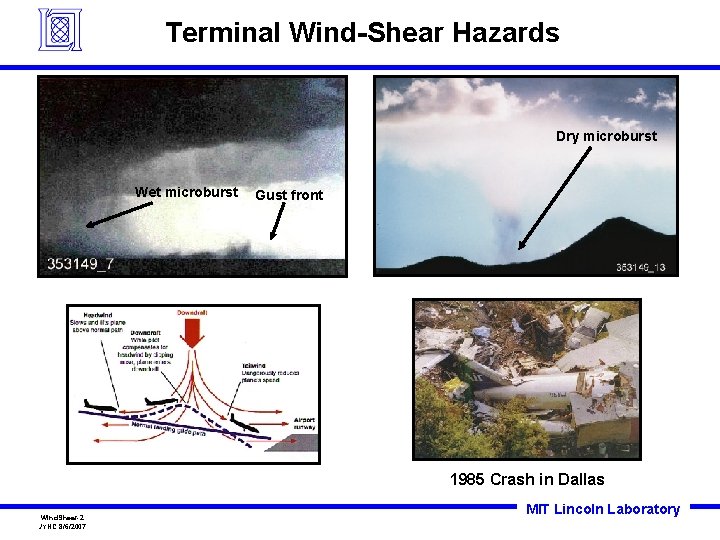
Terminal Wind-Shear Hazards Dry microburst Wet microburst Gust front 1985 Crash in Dallas Wind. Shear-2 JYNC 8/6/2007 MIT Lincoln Laboratory
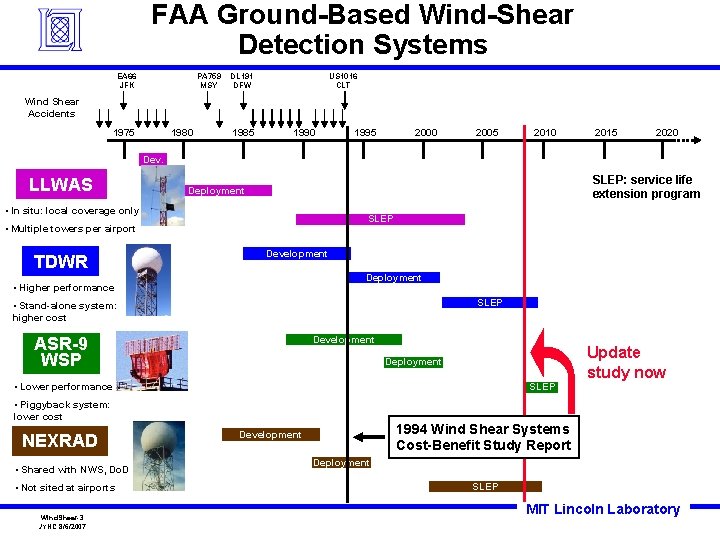
FAA Ground-Based Wind-Shear Detection Systems EA 66 JFK PA 759 MSY DL 191 DFW US 1016 CLT Wind Shear Accidents 1975 1980 1985 1990 1995 2000 2005 2010 2015 2020 Dev. LLWAS SLEP: service life extension program Deployment • In situ: local coverage only SLEP • Multiple towers per airport TDWR Development Deployment • Higher performance SLEP • Stand-alone system: higher cost ASR-9 WSP Development Update study now Deployment • Lower performance SLEP • Piggyback system: lower cost NEXRAD • Shared with NWS, Do. D • Not sited at airports Wind. Shear-3 JYNC 8/6/2007 1994 Wind Shear Systems Cost-Benefit Study Report Development Deployment SLEP MIT Lincoln Laboratory
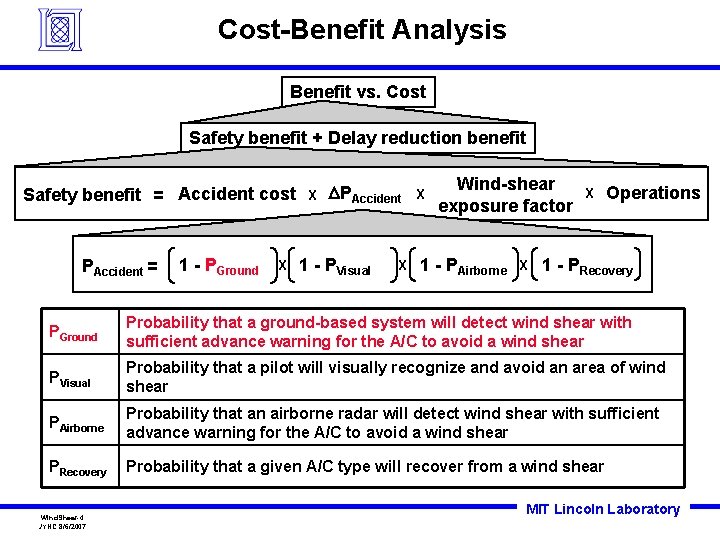
Cost-Benefit Analysis Benefit vs. Cost Safety benefit + Delay reduction benefit Safety benefit = Accident cost PAccident = 1 - PGround X X DPAccident 1 - PVisual X X Wind-shear exposure factor 1 - PAirborne X X Operations 1 - PRecovery PGround Probability that a ground-based system will detect wind shear with sufficient advance warning for the A/C to avoid a wind shear PVisual Probability that a pilot will visually recognize and avoid an area of wind shear PAirborne Probability that an airborne radar will detect wind shear with sufficient advance warning for the A/C to avoid a wind shear PRecovery Probability that a given A/C type will recover from a wind shear Wind. Shear-4 JYNC 8/6/2007 MIT Lincoln Laboratory
Outline • Scope – Sensors – Sites – Wind-shear type and coverage • Methodology – Radar – Lidar – Combinations • • Wind. Shear-5 JYNC 8/6/2007 Selected results Summary MIT Lincoln Laboratory
Sensor Sites 46 TDWR Airports 154 NEXRADs* TDWRs 135 ASR-9 s 35 WSPs *Only some are close enough to airports to be useful 40 LLWAS-RSs ASR-9 s 46 TDWR airports + 35 WSP airports + 40 LLWAS-RS airports = 121 total airports studied Wind. Shear-6 JYNC 8/6/2007 MIT Lincoln Laboratory
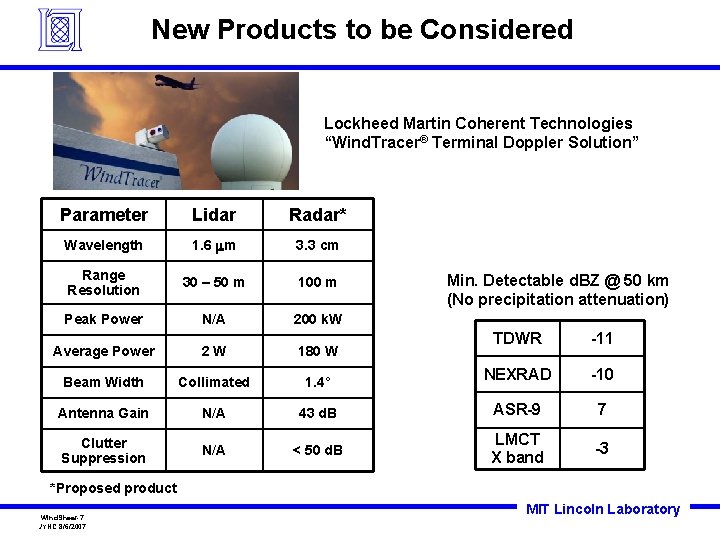
New Products to be Considered Lockheed Martin Coherent Technologies “Wind. Tracer® Terminal Doppler Solution” Parameter Lidar Radar* Wavelength 1. 6 mm 3. 3 cm Range Resolution 30 – 50 m 100 m Peak Power N/A 200 k. W Average Power 2 W 180 W Beam Width Collimated 1. 4° Antenna Gain N/A Clutter Suppression N/A Min. Detectable d. BZ @ 50 km (No precipitation attenuation) TDWR -11 NEXRAD -10 43 d. B ASR-9 7 < 50 d. B LMCT X band -3 *Proposed product Wind. Shear-7 JYNC 8/6/2007 MIT Lincoln Laboratory
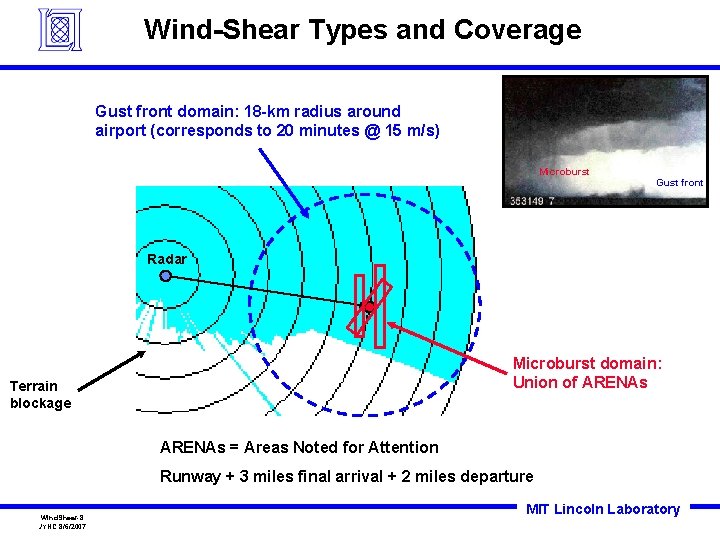
Wind-Shear Types and Coverage Gust front domain: 18 -km radius around airport (corresponds to 20 minutes @ 15 m/s) Microburst Gust front Radar Microburst domain: Union of ARENAs Terrain blockage ARENAs = Areas Noted for Attention Runway + 3 miles final arrival + 2 miles departure Wind. Shear-8 JYNC 8/6/2007 MIT Lincoln Laboratory
Outline • Scope – Sensors – Sites – Wind-shear type and coverage • Methodology – Radar – Lidar – Combinations • • Wind. Shear-9 JYNC 8/6/2007 Selected results Summary MIT Lincoln Laboratory
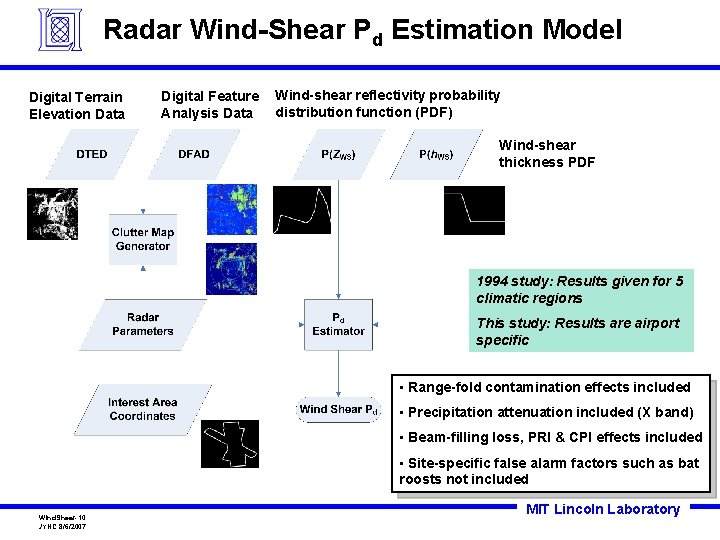
Radar Wind-Shear Pd Estimation Model Digital Terrain Elevation Data Digital Feature Analysis Data Wind-shear reflectivity probability distribution function (PDF) Wind-shear thickness PDF 1994 study: Results given for 5 climatic regions This study: Results are airport specific • Range-fold contamination effects included • Precipitation attenuation included (X band) • Beam-filling loss, PRI & CPI effects included • Site-specific false alarm factors such as bat roosts not included Wind. Shear-10 JYNC 8/6/2007 MIT Lincoln Laboratory
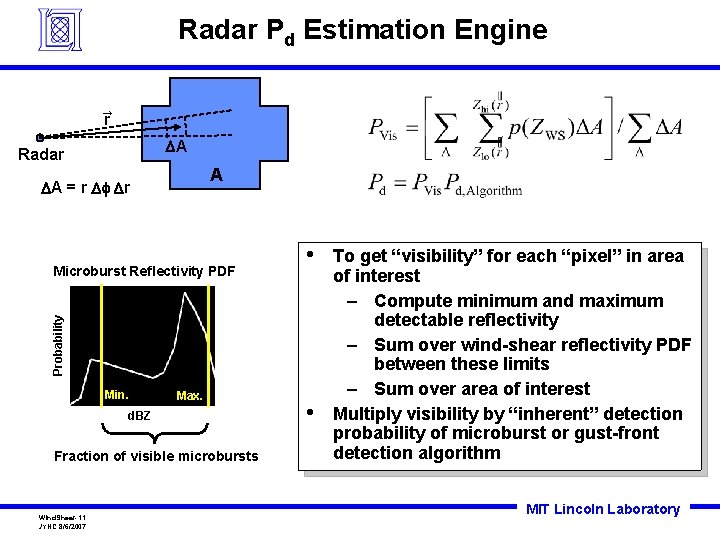
Radar Pd Estimation Engine → r DA Radar A DA = r Df Dr • Probability Microburst Reflectivity PDF Min. Max. d. BZ Fraction of visible microbursts Wind. Shear-11 JYNC 8/6/2007 • To get “visibility” for each “pixel” in area of interest – Compute minimum and maximum detectable reflectivity – Sum over wind-shear reflectivity PDF between these limits – Sum over area of interest Multiply visibility by “inherent” detection probability of microburst or gust-front detection algorithm MIT Lincoln Laboratory
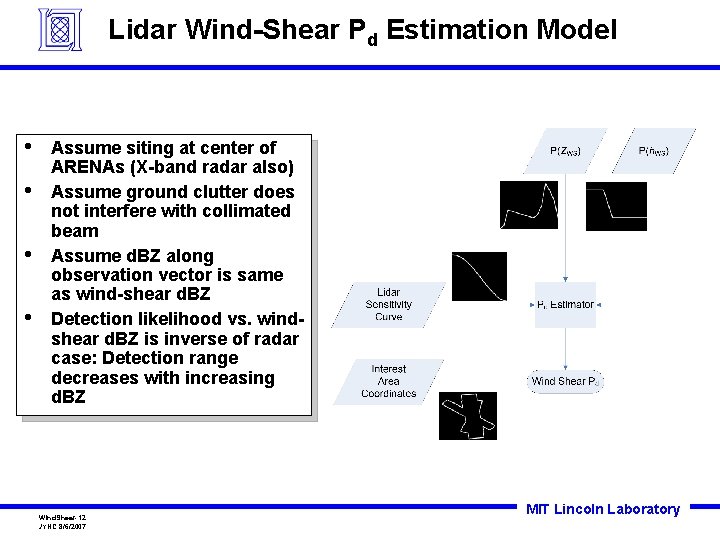
Lidar Wind-Shear Pd Estimation Model • • Assume siting at center of ARENAs (X-band radar also) Assume ground clutter does not interfere with collimated beam Assume d. BZ along observation vector is same as wind-shear d. BZ Detection likelihood vs. windshear d. BZ is inverse of radar case: Detection range decreases with increasing d. BZ Wind. Shear-12 JYNC 8/6/2007 MIT Lincoln Laboratory
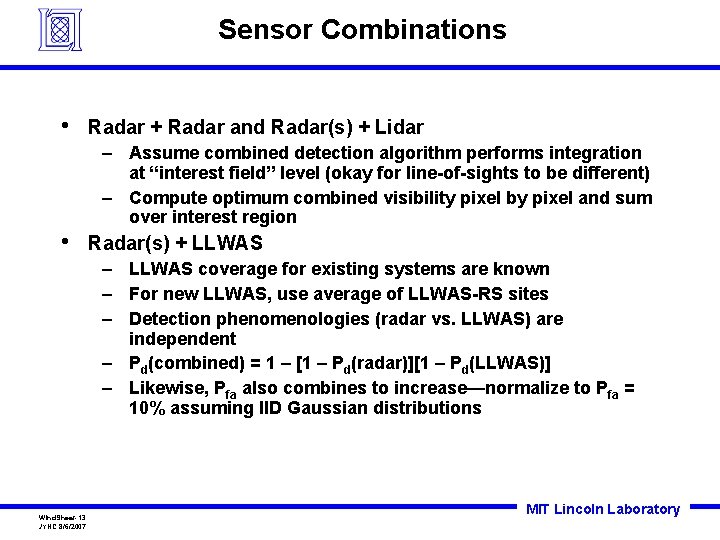
Sensor Combinations • Radar + Radar and Radar(s) + Lidar – Assume combined detection algorithm performs integration at “interest field” level (okay for line-of-sights to be different) – Compute optimum combined visibility pixel by pixel and sum over interest region • Radar(s) + LLWAS – LLWAS coverage for existing systems are known – For new LLWAS, use average of LLWAS-RS sites – Detection phenomenologies (radar vs. LLWAS) are independent – Pd(combined) = 1 – [1 – Pd(radar)][1 – Pd(LLWAS)] – Likewise, Pfa also combines to increase—normalize to Pfa = 10% assuming IID Gaussian distributions Wind. Shear-13 JYNC 8/6/2007 MIT Lincoln Laboratory
Outline • Scope – Sensors – Sites – Wind-shear type and coverage • Methodology – Radar – Lidar – Combinations • • Wind. Shear-14 JYNC 8/6/2007 Selected results Summary MIT Lincoln Laboratory
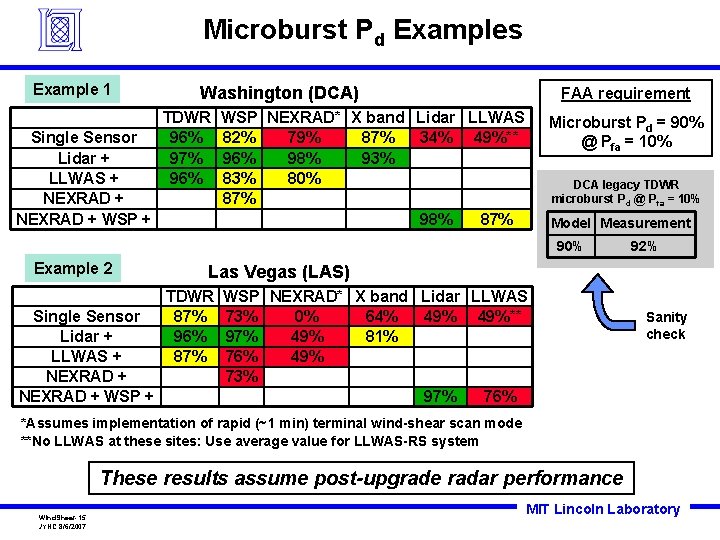
Microburst Pd Examples Example 1 Single Sensor Lidar + LLWAS + NEXRAD + WSP + Washington (DCA) TDWR 96% 97% 96% FAA requirement WSP NEXRAD* X band Lidar LLWAS 82% 79% 87% 34% 49%** 96% 98% 93% 80% 87% 98% 87% Microburst Pd = 90% @ Pfa = 10% DCA legacy TDWR microburst Pd @ Pfa = 10% Model Measurement 90% Example 2 Single Sensor Lidar + LLWAS + NEXRAD + WSP + 92% Las Vegas (LAS) TDWR 87% 96% 87% WSP NEXRAD* X band Lidar LLWAS 73% 0% 64% 49%** 97% 49% 81% 76% 49% 73% 97% 76% Sanity check *Assumes implementation of rapid (~1 min) terminal wind-shear scan mode **No LLWAS at these sites: Use average value for LLWAS-RS system These results assume post-upgrade radar performance Wind. Shear-15 JYNC 8/6/2007 MIT Lincoln Laboratory
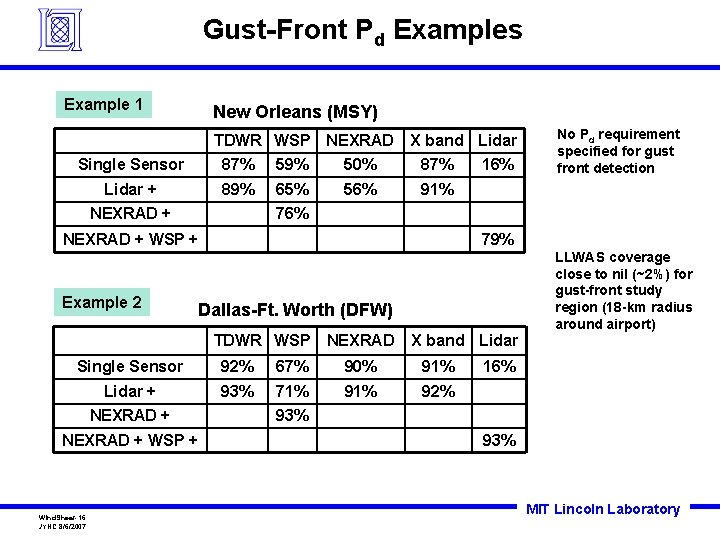
Gust-Front Pd Examples Example 1 New Orleans (MSY) TDWR WSP NEXRAD X band Lidar Single Sensor 87% 59% 50% 87% Lidar + 89% 65% 56% 91% NEXRAD + 76% NEXRAD + WSP + Example 2 79% Dallas-Ft. Worth (DFW) TDWR WSP NEXRAD X band Lidar Single Sensor 92% 67% 90% 91% Lidar + 93% 71% 92% NEXRAD + WSP + Wind. Shear-16 JYNC 8/6/2007 16% No Pd requirement specified for gust front detection LLWAS coverage close to nil (~2%) for gust-front study region (18 -km radius around airport) 16% 93% MIT Lincoln Laboratory
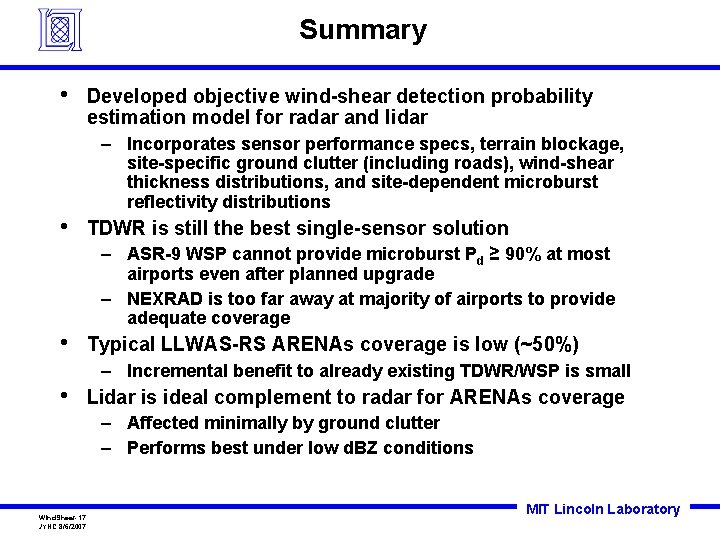
Summary • Developed objective wind-shear detection probability estimation model for radar and lidar – Incorporates sensor performance specs, terrain blockage, site-specific ground clutter (including roads), wind-shear thickness distributions, and site-dependent microburst reflectivity distributions • TDWR is still the best single-sensor solution – ASR-9 WSP cannot provide microburst Pd ≥ 90% at most airports even after planned upgrade – NEXRAD is too far away at majority of airports to provide adequate coverage • Typical LLWAS-RS ARENAs coverage is low (~50%) – Incremental benefit to already existing TDWR/WSP is small • Lidar is ideal complement to radar for ARENAs coverage – Affected minimally by ground clutter – Performs best under low d. BZ conditions Wind. Shear-17 JYNC 8/6/2007 MIT Lincoln Laboratory