
Comparative Analysis of Process Variation Impact on FlipFlops




![Soft Error Modeling The particle strike current pulse can be modeled as[1, 2]: This](https://slidetodoc.com/presentation_image_h2/84952e7d333528cfefaf67fee49802cd/image-20.jpg "Soft Error Modeling The particle strike current pulse can be modeled as[1, 2]: This")



- Slides: 31
Comparative Analysis of Process Variation Impact on Flip-Flops Soft Error Rate Hassan Mostafa & M. Anis & M. Elmasry University of Waterloo, Ontario, Canada
Outline Introduction and Background Motivation and Objectives Simulation Procedure Results and Discussions Conclusions Introduction and Background ASQED 2009 Slide 2
Outline Introduction and Background Variability Classification and Design methodologies Sources Variability and Yield Soft Errors Motivation and Objectives Simulation Procedure Results and Discussions Conclusions Introduction and Background ASQED 2009 Slide 3
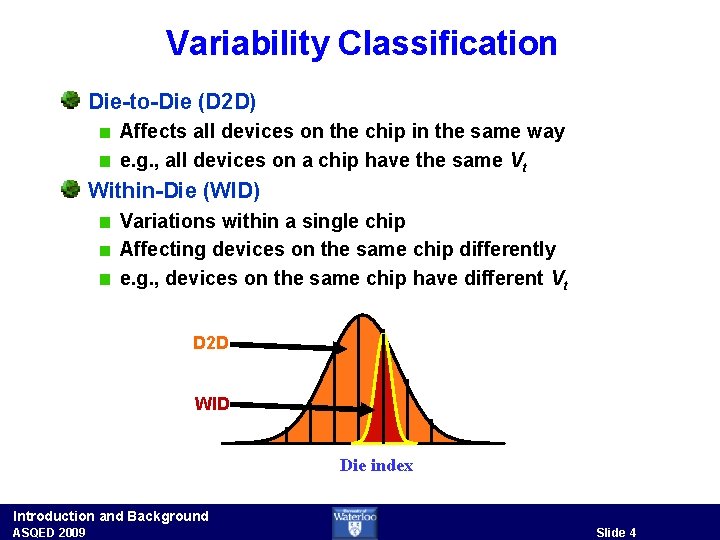
Variability Classification Die-to-Die (D 2 D) Affects all devices on the chip in the same way e. g. , all devices on a chip have the same Vt Within-Die (WID) Variations within a single chip Affecting devices on the same chip differently e. g. , devices on the same chip have different Vt D 2 D WID Die index Introduction and Background ASQED 2009 Slide 4
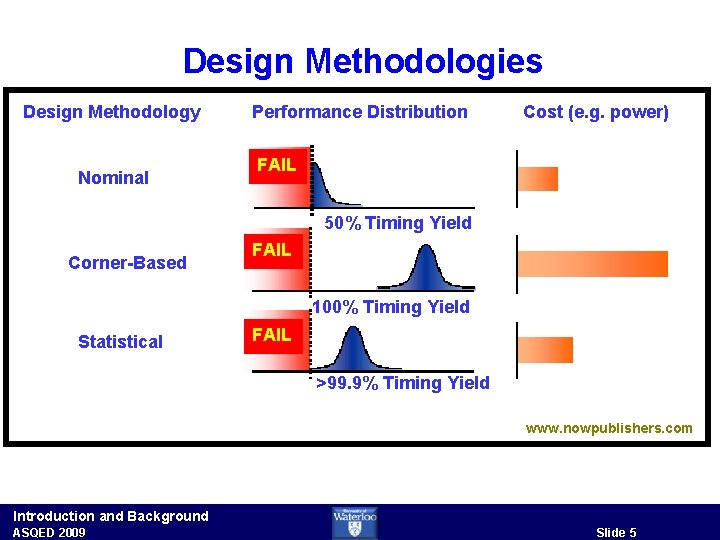
Design Methodologies Design Methodology Nominal Performance Distribution Cost (e. g. power) FAIL 50% Timing Yield Corner-Based FAIL 100% Timing Yield Statistical FAIL >99. 9% Timing Yield www. nowpublishers. com Introduction and Background ASQED 2009 Slide 5
Process Variations Sources Random Dopant Fluctuations (RDF) As CMOS devices are scaled, number of dopant atoms decreases The number of dopant atoms has variations around its nominal value resulting in Vt variations σVt α (WL)-0. 5 As transistor area decreases with scaling, σVt increases [1 ] 06 . T. C n et e h C al. , Channel Length Variation Difficulty to control the critical dimensions at sub-wavelength lithography Large variations in the channel length (L) Vt α exp(-L) due to short channel effects A small variations in L results in large variations in Vt S. Borkar et al. , DAC 04 Variations increase with technology scaling Introduction and Background ASQED 2009 Slide 6 CC ISS
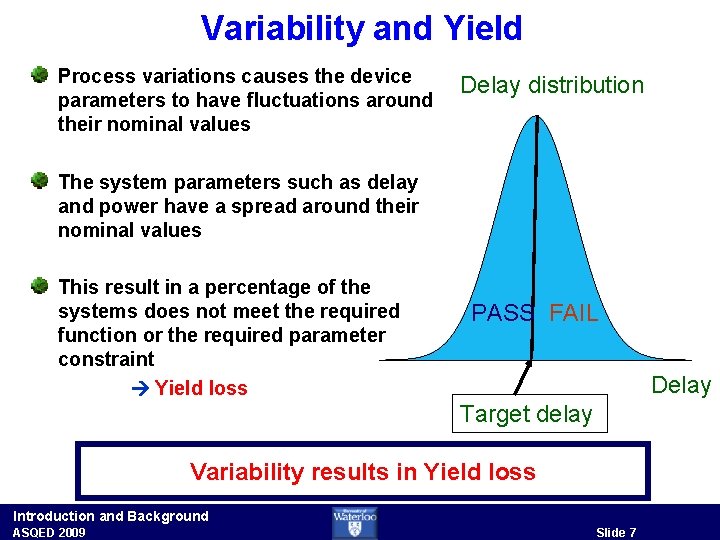
Variability and Yield Process variations causes the device parameters to have fluctuations around their nominal values Delay distribution The system parameters such as delay and power have a spread around their nominal values This result in a percentage of the systems does not meet the required function or the required parameter constraint Yield loss PASS FAIL Delay Target delay Variability results in Yield loss Introduction and Background ASQED 2009 Slide 7
Outline Introduction and Background Variability Soft Errors Sources and Mechanism SER and Technology scaling Impact of Variability on Soft Errors Motivation and Objectives Simulation Procedure Results and Discussions Conclusions Introduction and Background ASQED 2009 Slide 8
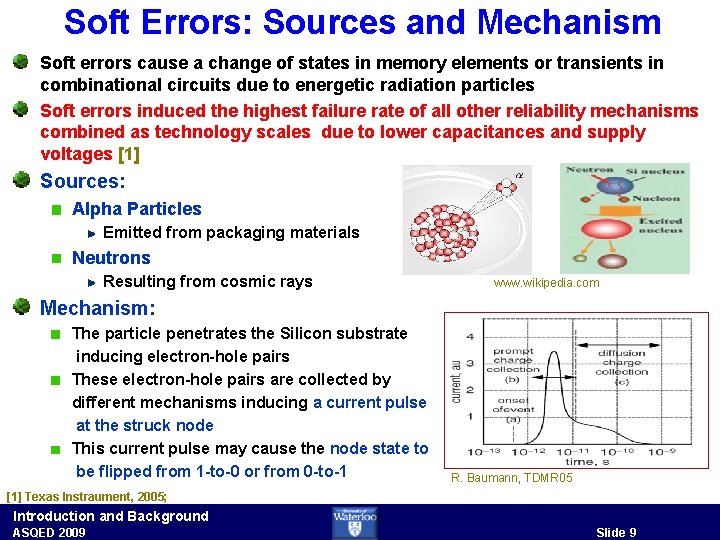
Soft Errors: Sources and Mechanism Soft errors cause a change of states in memory elements or transients in combinational circuits due to energetic radiation particles Soft errors induced the highest failure rate of all other reliability mechanisms combined as technology scales due to lower capacitances and supply voltages [1] Sources: Alpha Particles Emitted from packaging materials Neutrons Resulting from cosmic rays www. wikipedia. com Mechanism: The particle penetrates the Silicon substrate inducing electron-hole pairs These electron-hole pairs are collected by different mechanisms inducing a current pulse at the struck node This current pulse may cause the node state to be flipped from 1 -to-0 or from 0 -to-1 R. Baumann, TDMR 05 [1] Texas Instraument, 2005; Introduction and Background ASQED 2009 Slide 9
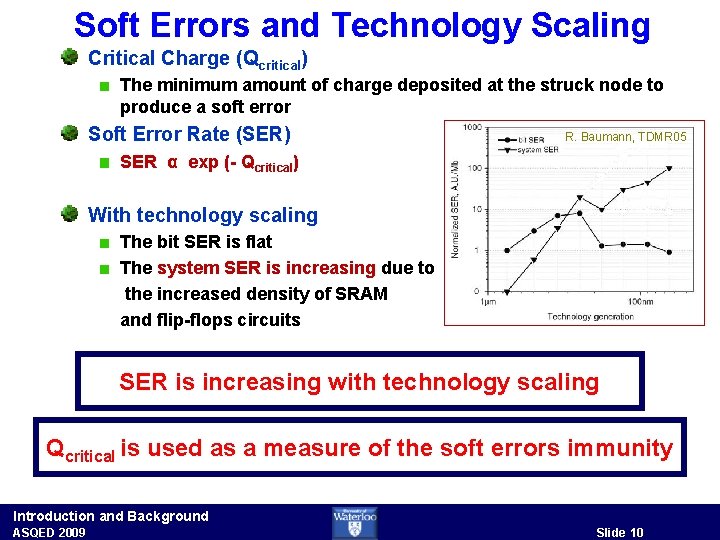
Soft Errors and Technology Scaling Critical Charge (Qcritical) The minimum amount of charge deposited at the struck node to produce a soft error Soft Error Rate (SER) R. Baumann, TDMR 05 SER α exp (- Qcritical) With technology scaling The bit SER is flat The system SER is increasing due to the increased density of SRAM and flip-flops circuits SER is increasing with technology scaling Qcritical is used as a measure of the soft errors immunity Introduction and Background ASQED 2009 Slide 10
Impact of Variability on Soft Errors Qcritical exhibits a spread around its nominal value due to variability and so does the SER The SER spread results in some of the chips will not meet the SER constraint and will be discarded in applications with strict SER constraints resulting in SER yield loss The impact of the D 2 D variations on the SER using worst case analysis is performed in [1] This leads to pessimistic an misleading results The work in [1] is remedied to some extent in [2] using Monte Carlo analysis Only D 2 D variations are included. The impact of the total variability (WID and D 2 D) on soft errors has not been attempted [1] Q. Ding et al. , ASICON’ 05 ; [2] Q. Ding et al. , SOC 06 Introduction and Background ASQED 2009 Slide 11
Outline Introduction and Background Motivation and Objectives Simulation Procedure Results and Discussions Conclusions Motivation and Objectives ASQED 2009 Slide 12
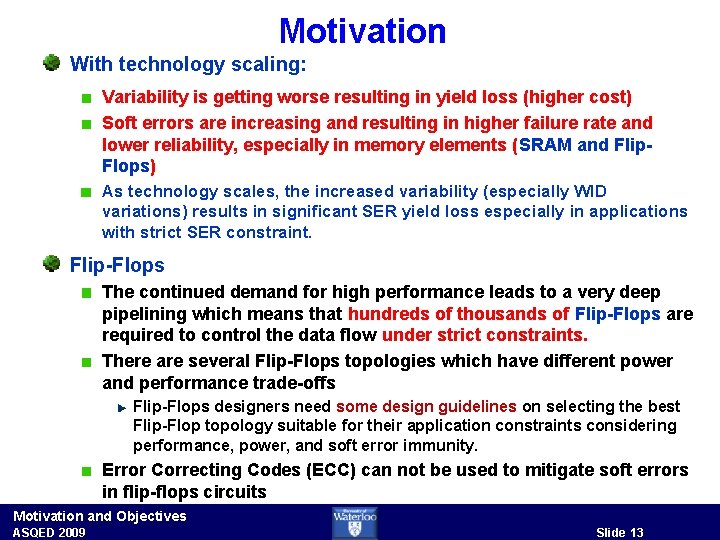
Motivation With technology scaling: Variability is getting worse resulting in yield loss (higher cost) Soft errors are increasing and resulting in higher failure rate and lower reliability, especially in memory elements (SRAM and Flip. Flops) As technology scales, the increased variability (especially WID variations) results in significant SER yield loss especially in applications with strict SER constraint. Flip-Flops The continued demand for high performance leads to a very deep pipelining which means that hundreds of thousands of Flip-Flops are required to control the data flow under strict constraints. There are several Flip-Flops topologies which have different power and performance trade-offs Flip-Flops designers need some design guidelines on selecting the best Flip-Flop topology suitable for their application constraints considering performance, power, and soft error immunity. Error Correcting Codes (ECC) can not be used to mitigate soft errors in flip-flops circuits Motivation and Objectives ASQED 2009 Slide 13
Objectives This work introduces a comparative analysis among different flip-flops topologies considering the following aspects: The delay, power, and energy nominal values The delay, power, and energy distributions due to variability (D 2 D and WID) The nominal critical charge value The critical charge distribution due to variability (D 2 D and WID) The soft error yield Motivation and Objectives ASQED 2009 Slide 14
Outline Introduction and Background Motivation and Objective Simulation Procedure Flip-Flops Selection and Design Soft Error Modeling Soft Error Yield Results and Discussions Conclusions Simulation Procedure ASQED 2009 Slide 15
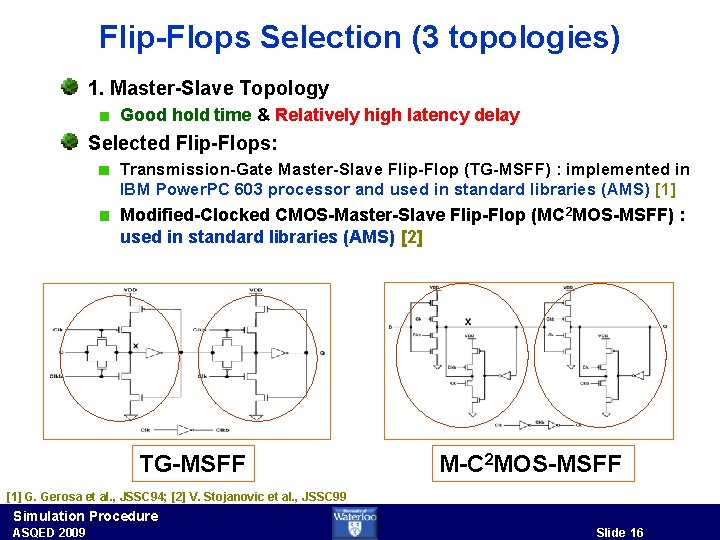
Flip-Flops Selection (3 topologies) 1. Master-Slave Topology Good hold time & Relatively high latency delay Selected Flip-Flops: Transmission-Gate Master-Slave Flip-Flop (TG-MSFF) : implemented in IBM Power. PC 603 processor and used in standard libraries (AMS) [1] Modified-Clocked CMOS-Master-Slave Flip-Flop (MC 2 MOS-MSFF) : used in standard libraries (AMS) [2] TG-MSFF M-C 2 MOS-MSFF [1] G. Gerosa et al. , JSSC 94; [2] V. Stojanovic et al. , JSSC 99 Simulation Procedure ASQED 2009 Slide 16
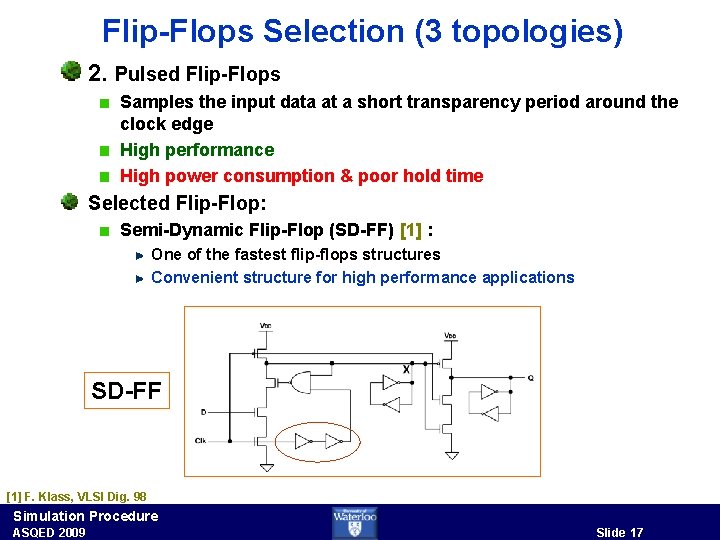
Flip-Flops Selection (3 topologies) 2. Pulsed Flip-Flops Samples the input data at a short transparency period around the clock edge High performance High power consumption & poor hold time Selected Flip-Flop: Semi-Dynamic Flip-Flop (SD-FF) [1] : One of the fastest flip-flops structures Convenient structure for high performance applications SD-FF [1] F. Klass, VLSI Dig. 98 Simulation Procedure ASQED 2009 Slide 17
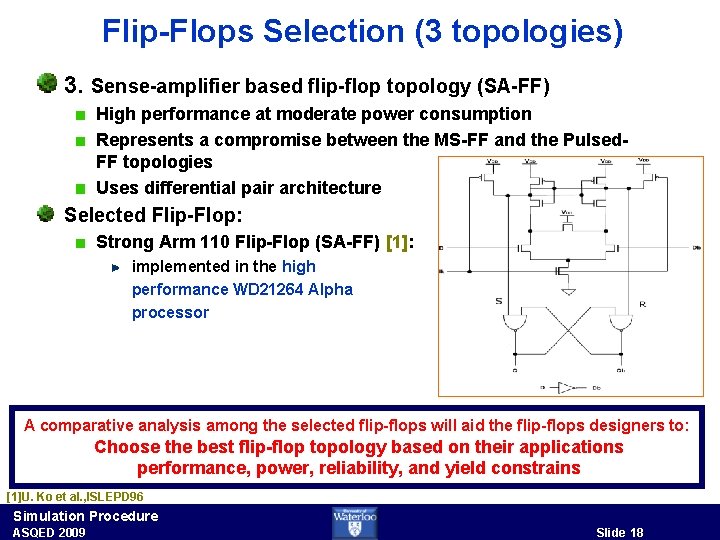
Flip-Flops Selection (3 topologies) 3. Sense-amplifier based flip-flop topology (SA-FF) High performance at moderate power consumption Represents a compromise between the MS-FF and the Pulsed. FF topologies Uses differential pair architecture Selected Flip-Flop: Strong Arm 110 Flip-Flop (SA-FF) [1]: implemented in the high performance WD 21264 Alpha processor A comparative analysis among the selected flip-flops will aid the flip-flops designers to: Choose the best flip-flop topology based on their applications performance, power, reliability, and yield constrains [1]U. Ko et al. , ISLEPD 96 Simulation Procedure ASQED 2009 Slide 18
Flip-Flops Design Optimum Power Delay Product (PDP) Design All flip-flops sizes are optimized to achieve minimum PDP The optimization process is performed by using the CFSQP (C -version Feasible Sequential Quadratic Programming) optimization package Functional Yield Improvement Using Setup Time Margin Monte Carlo Analysis including D 2 D and WID variations is conducted using industrial STMicroelectronics 65 -nm Technology node. Due to variability, the setup time of some of the flip-flops samples is violated and these samples malfunction reducing the functional yield A setup time margin is added to improve the functionl yield > 99. 9% Simulation Procedure ASQED 2009 Slide 19
Soft Error Modeling The particle strike current pulse can be modeled as[1, 2]: This current pulse is inserted at all the flip-flops nodes and the critical charge Qcritical is calculated for all the nodes using [1, 2]: | Min The node that exhibits the smallest Qcritical is selected as the most susceptible node to soft errors [1] Jahin et al. , ISQED 08, [2]H. Mostafa et al. , ISVLSI 09 Simulation Procedure ASQED 2009 Slide 20
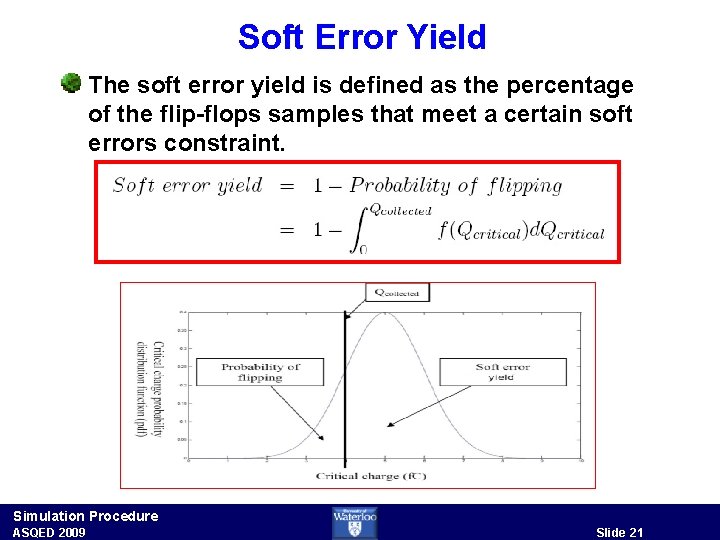
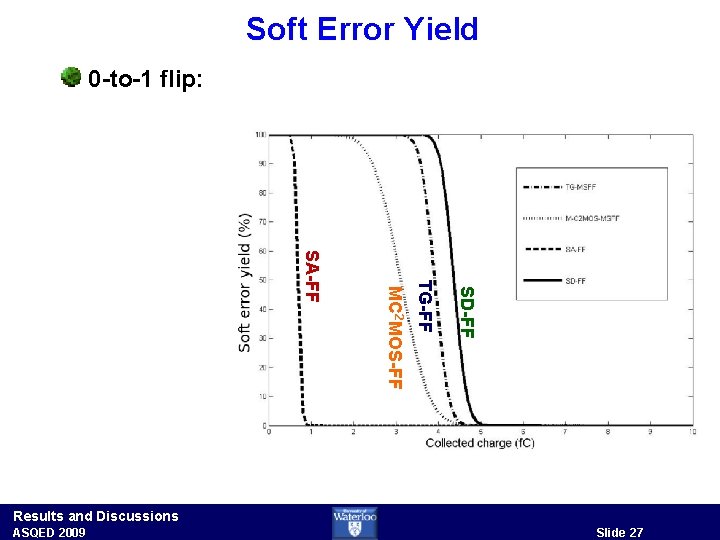
Soft Error Yield The soft error yield is defined as the percentage of the flip-flops samples that meet a certain soft errors constraint. Simulation Procedure ASQED 2009 Slide 21
Outline Introduction and Background Motivation and Objective Simulation Procedure Results and Discussions Delay, Power, and Energy Mean and Variance Critical Charge Mean and Variance Soft Error Yield Design Insights Conclusions Results and Discussions ASQED 2009 Slide 22
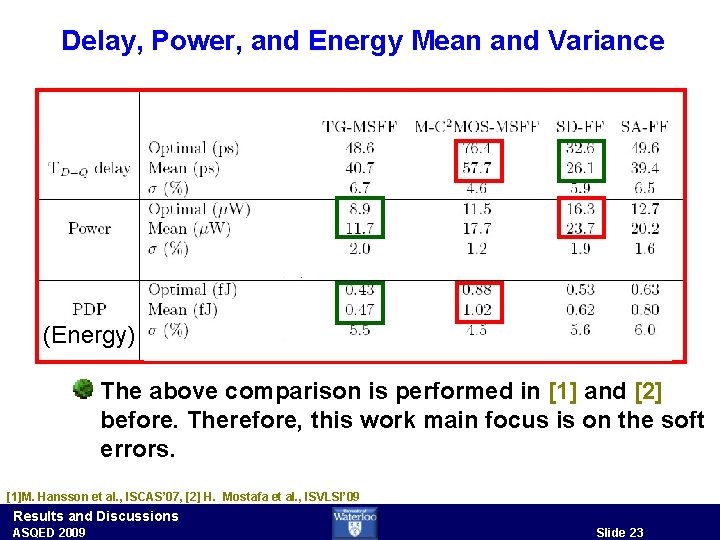
Delay, Power, and Energy Mean and Variance (Energy) The above comparison is performed in [1] and [2] before. Therefore, this work main focus is on the soft errors. [1]M. Hansson et al. , ISCAS’ 07, [2] H. Mostafa et al. , ISVLSI’ 09 Results and Discussions ASQED 2009 Slide 23
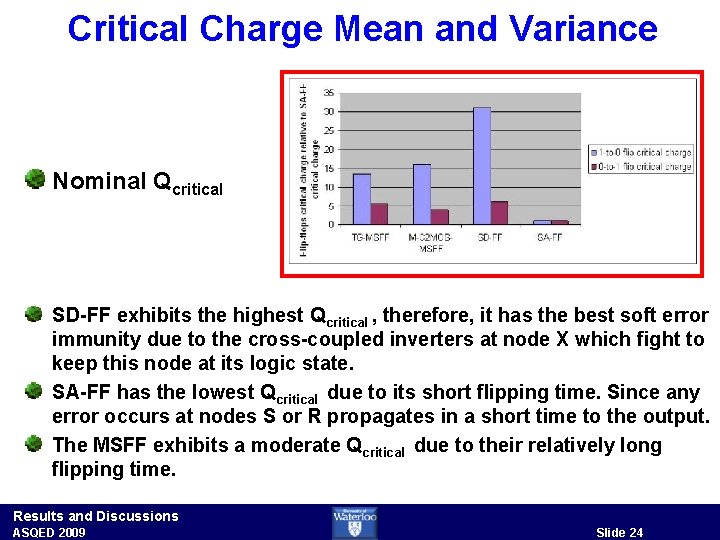
Critical Charge Mean and Variance Nominal Qcritical SD-FF exhibits the highest Qcritical , therefore, it has the best soft error immunity due to the cross-coupled inverters at node X which fight to keep this node at its logic state. SA-FF has the lowest Qcritical due to its short flipping time. Since any error occurs at nodes S or R propagates in a short time to the output. The MSFF exhibits a moderate Qcritical due to their relatively long flipping time. Results and Discussions ASQED 2009 Slide 24
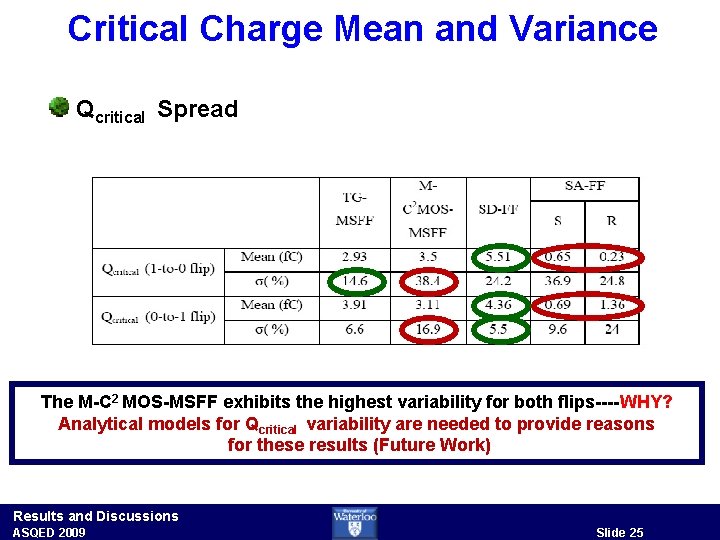
Critical Charge Mean and Variance Qcritical Spread The M-C 2 MOS-MSFF exhibits the highest variability for both flips----WHY? Analytical models for Qcritical variability are needed to provide reasons for these results (Future Work) Results and Discussions ASQED 2009 Slide 25
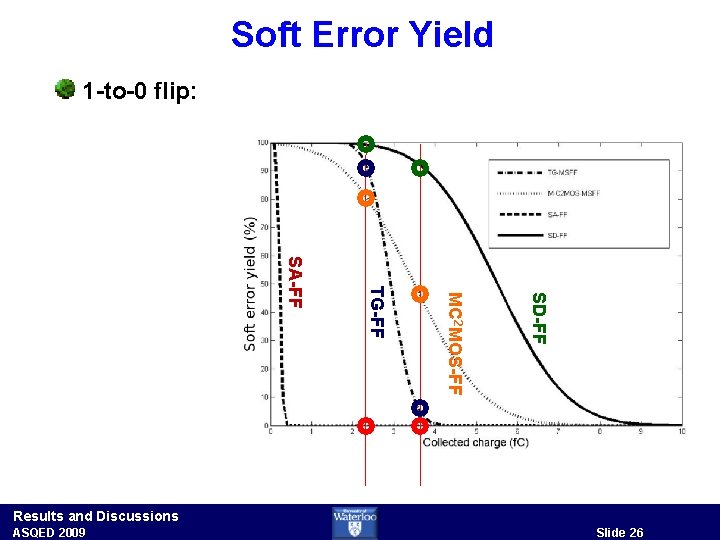
Soft Error Yield 1 -to-0 flip: SD-FF MC 2 MOS-FF TG-FF SA-FF Results and Discussions ASQED 2009 Slide 26
Soft Error Yield 0 -to-1 flip: SD-FF TG-FF MC 2 MOS-FF SA-FF Results and Discussions ASQED 2009 Slide 27
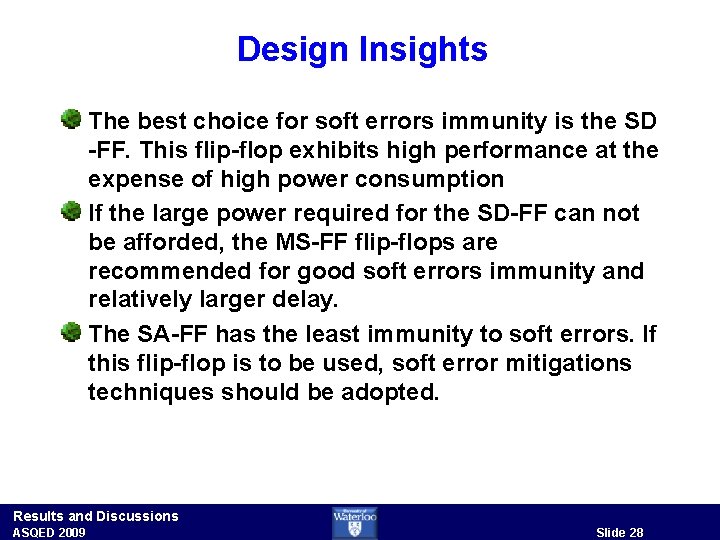
Design Insights The best choice for soft errors immunity is the SD -FF. This flip-flop exhibits high performance at the expense of high power consumption If the large power required for the SD-FF can not be afforded, the MS-FF flip-flops are recommended for good soft errors immunity and relatively larger delay. The SA-FF has the least immunity to soft errors. If this flip-flop is to be used, soft error mitigations techniques should be adopted. Results and Discussions ASQED 2009 Slide 28
Outline Introduction and Background Motivation and Objective Simulation Procedure Results and Discussions Conclusions ASQED 2009 Slide 29
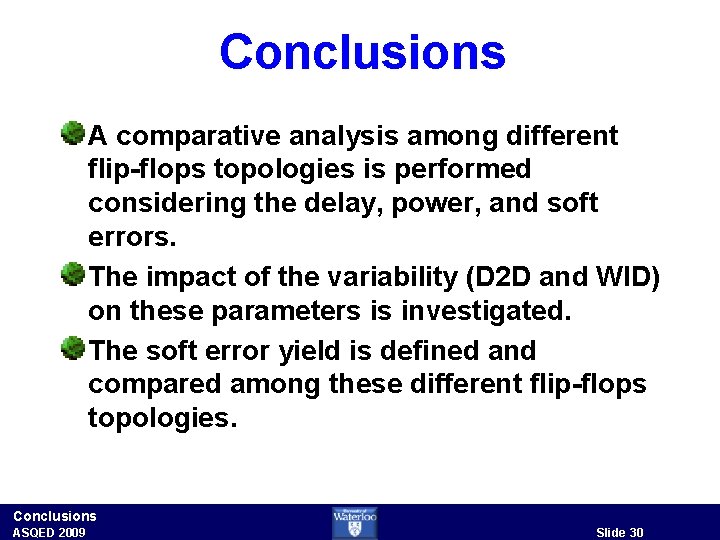
Conclusions A comparative analysis among different flip-flops topologies is performed considering the delay, power, and soft errors. The impact of the variability (D 2 D and WID) on these parameters is investigated. The soft error yield is defined and compared among these different flip-flops topologies. Conclusions ASQED 2009 Slide 30
THANK YOU ASQED 2009 Slide 31