
Comparative Analysis of Competitive Procurement Mechanisms April 2019
- Slides: 17
Comparative Analysis of Competitive Procurement Mechanisms April 2019
Agenda • Overview on difference administratively-set FITs, bilateral deals, auctions and their applicability • The auction design process and design elements • Simulation to understand the problem of the winner’s curse and how it can be addressed • Site-selected vs bidder-selected auctions • How to set ceiling prices • Technical requirements, financial guarantees and penalties to ensure project realization • Conclusion
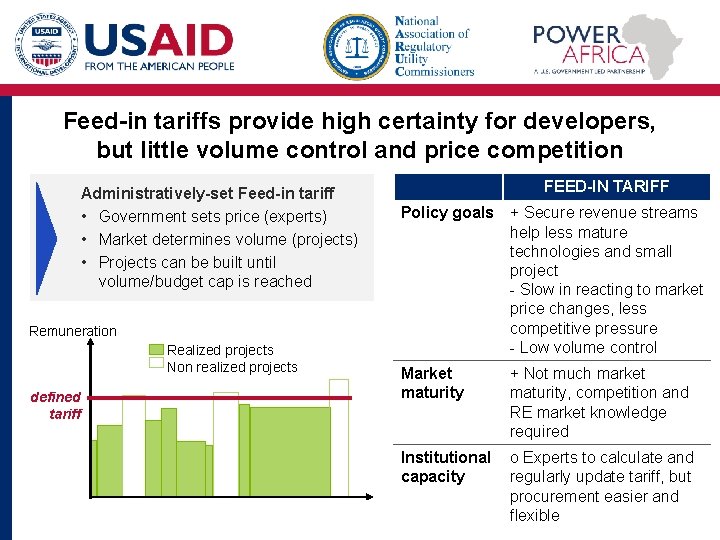
Feed-in tariffs provide high certainty for developers, but little volume control and price competition Administratively-set Feed-in tariff • Government sets price (experts) • Market determines volume (projects) • Projects can be built until volume/budget cap is reached FEED-IN TARIFF Policy goals + Secure revenue streams help less mature technologies and small project - Slow in reacting to market price changes, less competitive pressure - Low volume control Market maturity + Not much market maturity, competition and RE market knowledge required Institutional capacity o Experts to calculate and regularly update tariff, but procurement easier and flexible Remuneration Realized projects Non realized projects defined tariff
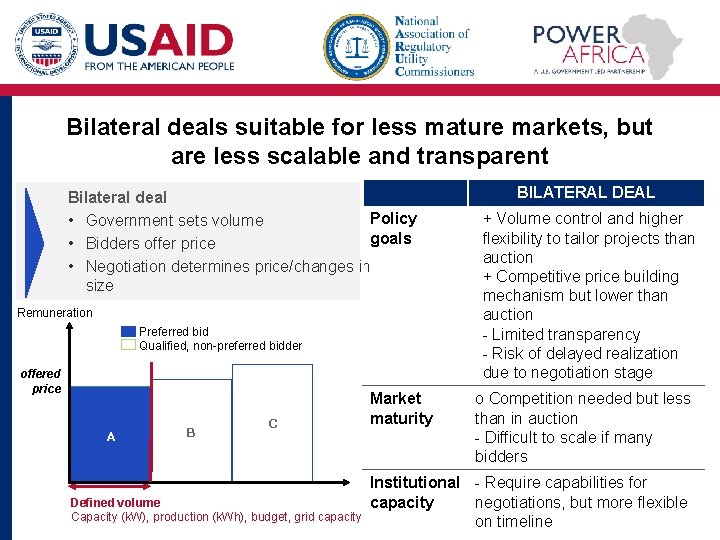
Bilateral deals suitable for less mature markets, but are less scalable and transparent Bilateral deal Policy • Government sets volume goals • Bidders offer price • Negotiation determines price/changes in size Remuneration Preferred bid Qualified, non-preferred bidder offered price A B C Defined volume Capacity (k. W), production (k. Wh), budget, grid capacity Market maturity BILATERAL DEAL + Volume control and higher flexibility to tailor projects than auction + Competitive price building mechanism but lower than auction - Limited transparency - Risk of delayed realization due to negotiation stage o Competition needed but less than in auction - Difficult to scale if many bidders Institutional - Require capabilities for capacity negotiations, but more flexible on timeline
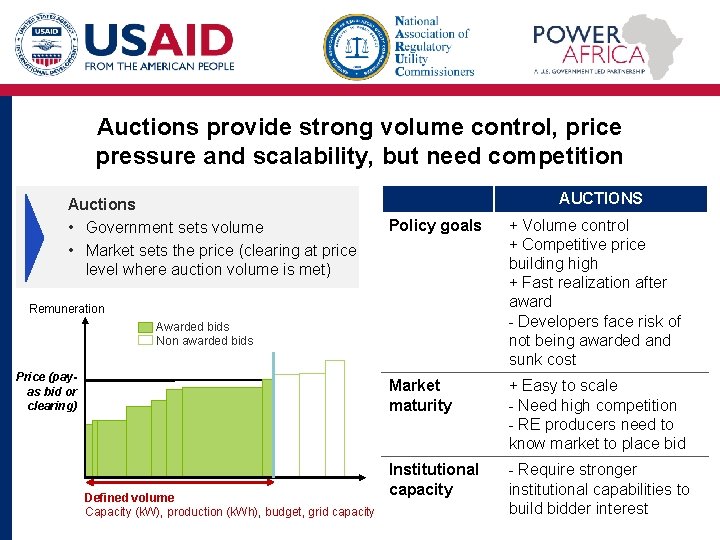
Auctions provide strong volume control, price pressure and scalability, but need competition Auctions • Government sets volume • Market sets the price (clearing at price level where auction volume is met) AUCTIONS Policy goals + Volume control + Competitive price building high + Fast realization after award - Developers face risk of not being awarded and sunk cost Market maturity + Easy to scale - Need high competition - RE producers need to know market to place bid Institutional capacity - Require stronger institutional capabilities to build bidder interest Remuneration Awarded bids Non awarded bids Price (payas bid or clearing) Defined volume Capacity (k. W), production (k. Wh), budget, grid capacity
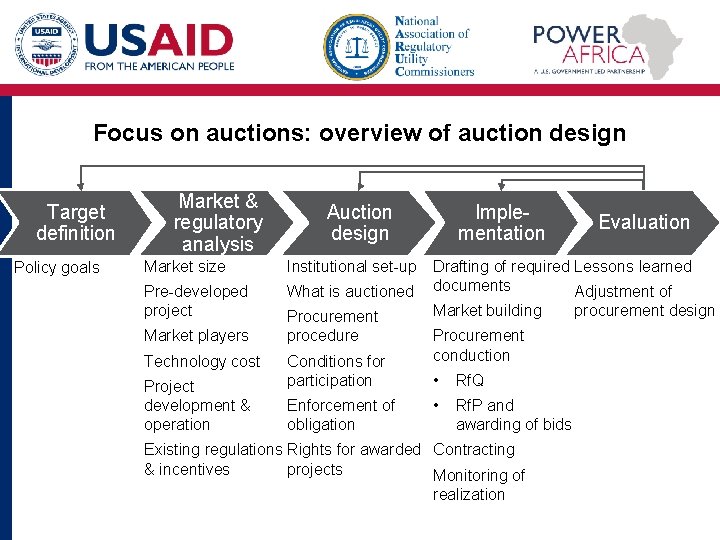
Focus on auctions: overview of auction design Target • . . . definition Policy goals Market & regulatory analysis Auction design Market size Institutional set-up Pre-developed project What is auctioned Market players Technology cost Project development & operation Procurement procedure Conditions for participation Enforcement of obligation Implementation Evaluation Drafting of required Lessons learned documents Adjustment of Market building Procurement conduction • Rf. Q • Rf. P and awarding of bids Existing regulations Rights for awarded Contracting & incentives projects Monitoring of realization procurement design
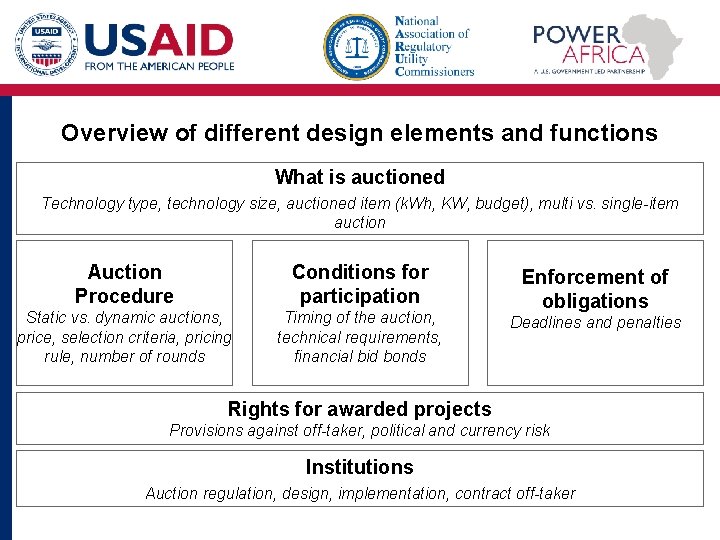
Overview of different design elements and functions What is auctioned Technology type, technology size, auctioned item (k. Wh, KW, budget), multi vs. single-item auction Auction Procedure Conditions for participation Static vs. dynamic auctions, price, selection criteria, pricing rule, number of rounds Timing of the auction, technical requirements, financial bid bonds Enforcement of obligations Deadlines and penalties Rights for awarded projects Provisions against off-taker, political and currency risk Institutions Auction regulation, design, implementation, contract off-taker
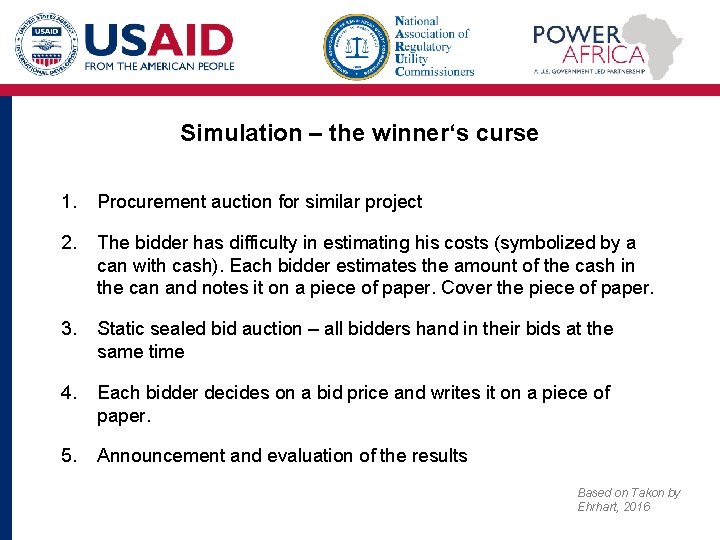
Simulation – the winner‘s curse 1. Procurement auction for similar project 2. The bidder has difficulty in estimating his costs (symbolized by a can with cash). Each bidder estimates the amount of the cash in the can and notes it on a piece of paper. Cover the piece of paper. 3. Static sealed bid auction – all bidders hand in their bids at the same time 4. Each bidder decides on a bid price and writes it on a piece of paper. 5. Announcement and evaluation of the results Based on Takon by Ehrhart, 2016
Introduction to the problem of the winner‘s curse • • Definition – Auction bid price is less than the actual value of the good, which will result in a loss for the auction winner Example – Excessive yield or underestimated costs Impact on bidders – Often bidders tend to estimate the costs relatively well – If bidders are guided by their cost estimates in their bid strategy, the bidder who underestimates costs wins the auction Adequate bidding behavior – Upward adjustment of the cost estimation in case of having a winning bid Based on Takon by – Adjustment of the bid where possible Ehrhart, 2016
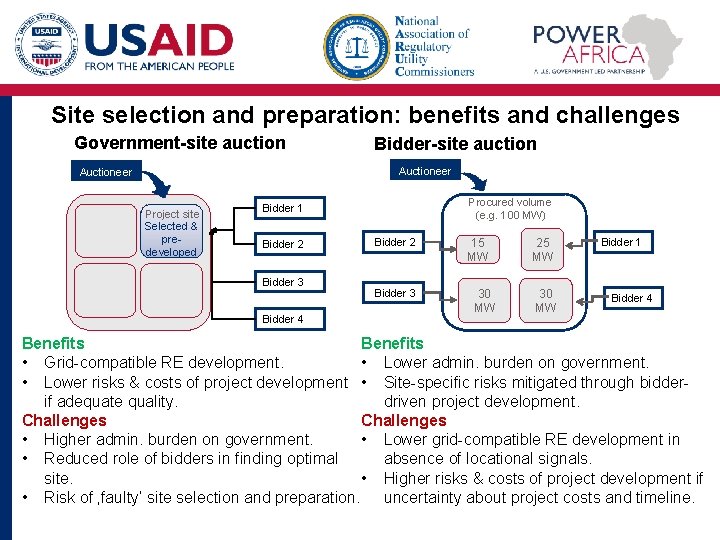
Site selection and preparation: benefits and challenges Government-site auction Bidder-site auction Auctioneer Project site Selected & predeveloped Procured volume (e. g. 100 MW) Bidder 1 Bidder 2 Bidder 3 Bidder 4 Bidder 2 Bidder 3 15 MW 30 MW 25 MW 30 MW Bidder 1 Bidder 4 Benefits • Grid-compatible RE development. • Lower admin. burden on government. • Lower risks & costs of project development • Site-specific risks mitigated through bidderif adequate quality. driven project development. Challenges • Higher admin. burden on government. • Lower grid-compatible RE development in • Reduced role of bidders in finding optimal absence of locational signals. site. • Higher risks & costs of project development if • Risk of ‚faulty‘ site selection and preparation. uncertainty about project costs and timeline.
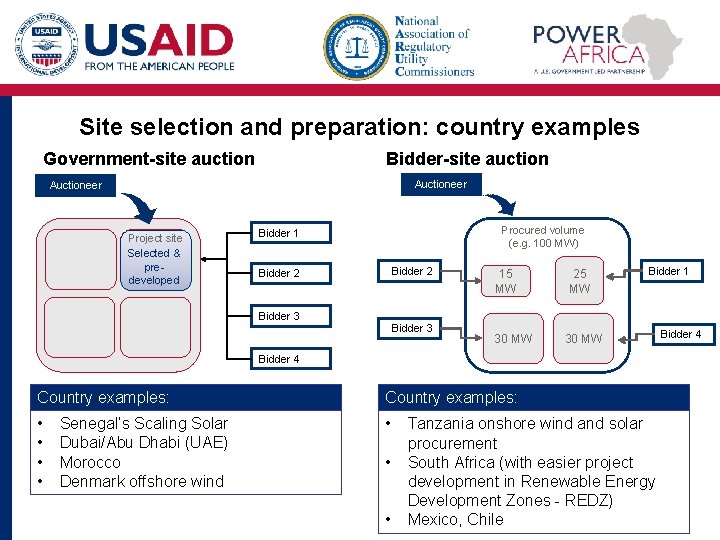
Site selection and preparation: country examples Government-site auction Bidder-site auction Auctioneer Project site Selected & predeveloped Procured volume (e. g. 100 MW) Bidder 1 Bidder 2 15 MW 25 MW Bidder 1 Bidder 3 30 MW Bidder 4 Country examples: • • • Senegal’s Scaling Solar Dubai/Abu Dhabi (UAE) Morocco Denmark offshore wind • • Tanzania onshore wind and solar procurement South Africa (with easier project development in Renewable Energy Development Zones - REDZ) Mexico, Chile Bidder 4
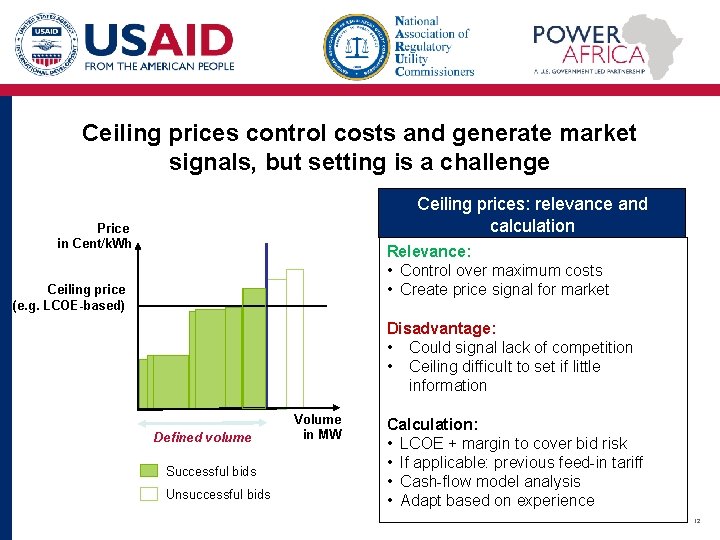
Ceiling prices control costs and generate market signals, but setting is a challenge Ceiling prices: relevance and calculation Price in Cent/k. Wh Relevance: • Control over maximum costs • Create price signal for market Ceiling price (e. g. LCOE-based) Disadvantage: • Could signal lack of competition • Ceiling difficult to set if little information Defined volume Successful bids Unsuccessful bids Volume in MW Calculation: • LCOE + margin to cover bid risk • If applicable: previous feed-in tariff • Cash-flow model analysis • Adapt based on experience 12
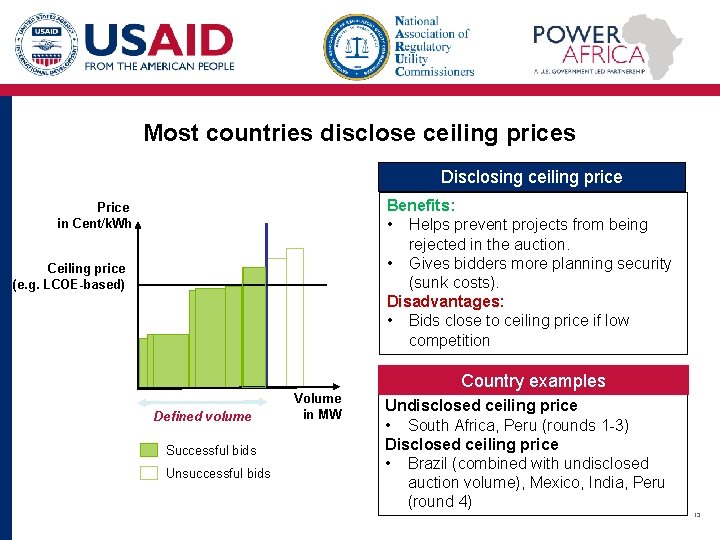
Most countries disclose ceiling prices Disclosing ceiling price Benefits: • Helps prevent projects from being rejected in the auction. • Gives bidders more planning security (sunk costs). Disadvantages: • Bids close to ceiling price if low competition Price in Cent/k. Wh Ceiling price (e. g. LCOE-based) Country examples Defined volume Successful bids Unsuccessful bids Volume in MW Undisclosed ceiling price • South Africa, Peru (rounds 1 -3) Disclosed ceiling price • Brazil (combined with undisclosed auction volume), Mexico, India, Peru (round 4) 13
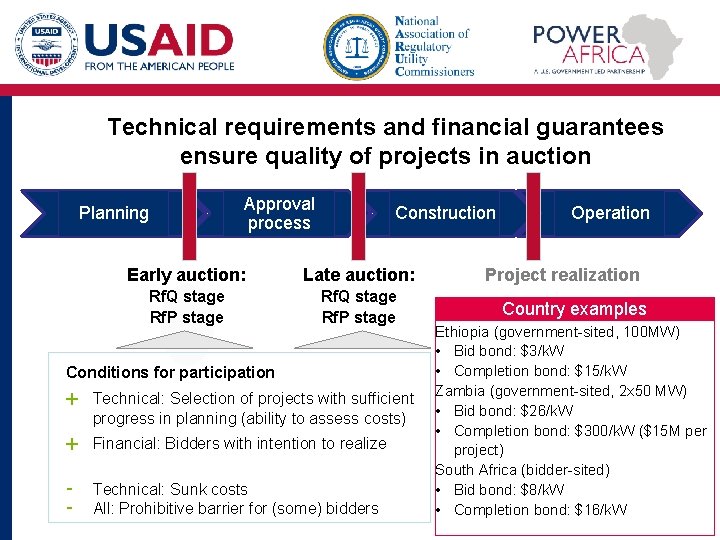
Technical requirements and financial guarantees ensure quality of projects in auction Planning Approval process Construction Early auction: Late auction: Rf. Q stage Rf. P stage Conditions for participation + Technical: Selection of projects with sufficient progress in planning (ability to assess costs) + Financial: Bidders with intention to realize - Technical: Sunk costs All: Prohibitive barrier for (some) bidders Operation Project realization Country examples Ethiopia (government-sited, 100 MW) • Bid bond: $3/k. W • Completion bond: $15/k. W Zambia (government-sited, 2 x 50 MW) • Bid bond: $26/k. W • Completion bond: $300/k. W ($15 M per project) South Africa (bidder-sited) • Bid bond: $8/k. W • Completion bond: $16/k. W
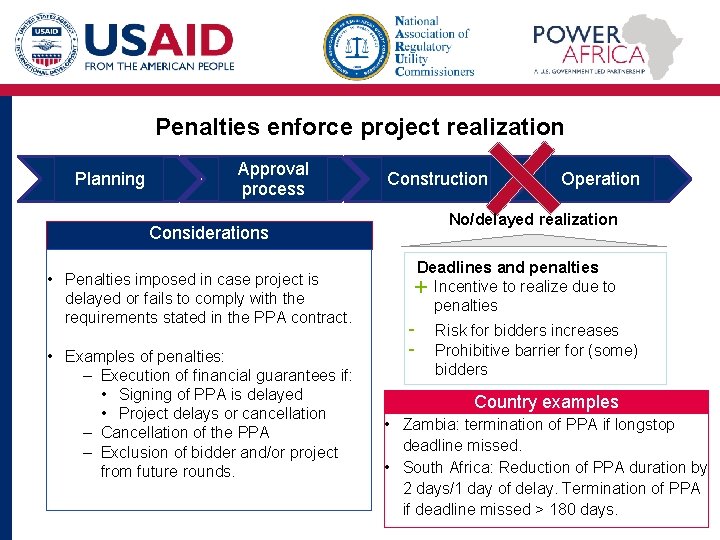
Penalties enforce project realization Planning Approval process Construction No/delayed realization Considerations • Penalties imposed in case project is delayed or fails to comply with the requirements stated in the PPA contract. • Examples of penalties: – Execution of financial guarantees if: • Signing of PPA is delayed • Project delays or cancellation – Cancellation of the PPA – Exclusion of bidder and/or project from future rounds. Operation Deadlines and penalties + Incentive to realize due to penalties - Risk for bidders increases Prohibitive barrier for (some) bidders Country examples • Zambia: termination of PPA if longstop deadline missed. • South Africa: Reduction of PPA duration by 2 days/1 day of delay. Termination of PPA if deadline missed > 180 days.
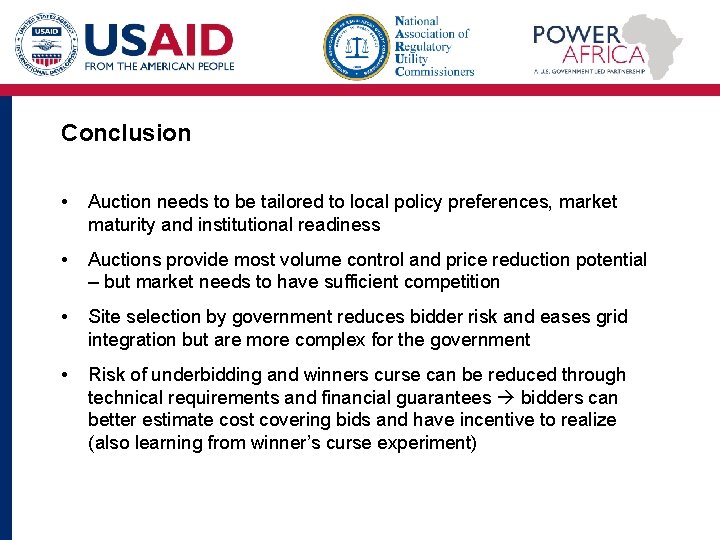
Conclusion • Auction needs to be tailored to local policy preferences, market maturity and institutional readiness • Auctions provide most volume control and price reduction potential – but market needs to have sufficient competition • Site selection by government reduces bidder risk and eases grid integration but are more complex for the government • Risk of underbidding and winners curse can be reduced through technical requirements and financial guarantees bidders can better estimate cost covering bids and have incentive to realize (also learning from winner’s curse experiment)
Questions?