
Comparative Advantage and Competitiveness Analysis for Japans Synthetic












- Slides: 29
Comparative Advantage and Competitiveness Analysis for Japan’s Synthetic Fibre Export K. F. AU and M. C. WONG Institute of Textiles and Clothing The Hong Kong Polytechnic University 1
Presentation Outline I. III. IV. V. VII. Introduction Overview of Japan’s synthetic fibre industry Revealed Comparative Advantage (RCA) Revealed Competitiveness (RC) concepts Empirical Analysis of RCA in Japan’s synthetic fibres export Japan’s Comparative Advantage and Competitiveness of synthetic fibre exports Conclusion 2
1. Introduction In 2004 : q q q An increase of 6. 7 % in world textile fibre consumption At 67. 4 Mn tons Per capita fibre consumption: 10. 5 kg/capita 3
1. Introduction q 2004: World synthetic fibres consumption: 38 Mn tons (56. 3%) Synthetic fibre consumption Natural fibre consumption 38 Mn tons 24 Mn tons 4
1. Introduction Artificial petrochemical products created by chemical synthesis process Synthetic textile fibres 5
1. Introduction Most important and popularly-used synthetic fibres Relative Importance of Textile Fibres Ø Polyester (25%) Ø Nylon (12%) Ø Polypropylene (12%) Ø Acrylic (6%) 6
1. Introduction FIGURE 1: WORLD CONSUMPTION OF MAJOR TEXTILE FIBRES (MN TONS) Source: Complied from Fiber Organon, various issues. Note: Natural Fibres include cotton, wool and silk 7
1. Introduction Assured growth in world synthetic fibre consumption q q q Increasing world population Surging economic growth in 1990 s and new millennium Increasing scope of substitution for natural fibres 8
1. Introduction q Synthetic fibre production: Ø Capital-intensive manufacturing activity q Dominated by developed countries since the early 1970 s Øe. g. Germany, Italy, France, UK, US and Japan etc. Ø losing shares to low-cost Asian regions Ø From 1980 to 2003, world share dropped from 94% to 34% 9
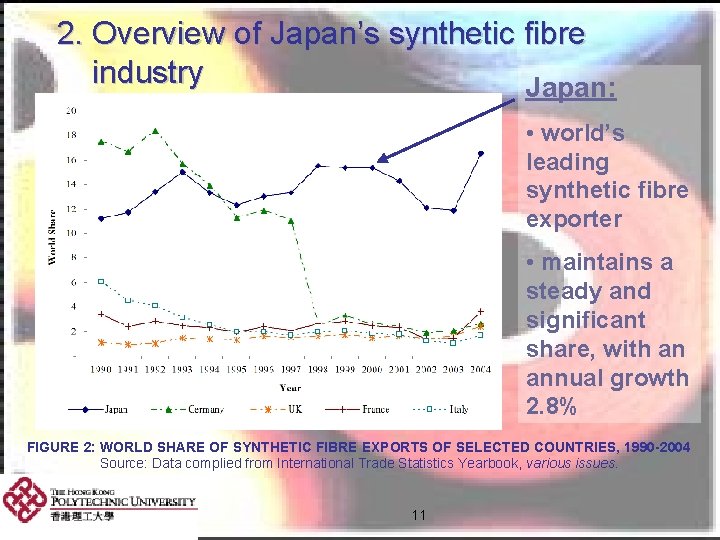
1. Introduction JAPAN : Exception q No similar declining trend q As world’s top-3 exporter q World share of synthetic fibre exports maintained around 14 % from 1990 to 2004 10
2. Overview of Japan’s synthetic fibre industry Japan: • world’s leading synthetic fibre exporter • maintains a steady and significant share, with an annual growth 2. 8% FIGURE 2: WORLD SHARE OF SYNTHETIC FIBRE EXPORTS OF SELECTED COUNTRIES, 1990 -2004 Source: Data complied from International Trade Statistics Yearbook, various issues. 11
2. Overview of Japan’s synthetic fibre industry q q Shift from quantity to quality Shift from commodity products to specialty and niche items Focus on technical fibre innovations Develop market opportunities for new applications 12
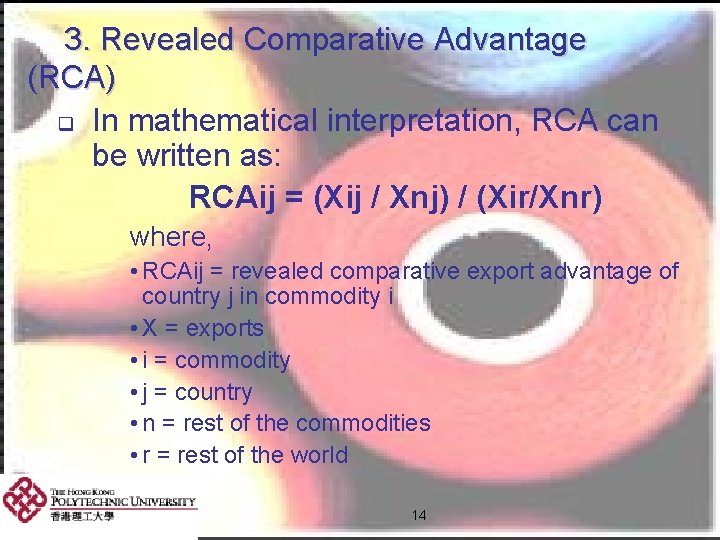
3. Revealed Comparative Advantage (RCA) q Balassa defined the concept of RCA as the ratio between: (1) share of commodity exports from a certain country in commodity exports from all countries, and (2) share of total manufactured goods exports from the country in total manufacturing merchandise exports from world 13
3. Revealed Comparative Advantage (RCA) q In mathematical interpretation, RCA can be written as: RCAij = (Xij / Xnj) / (Xir/Xnr) where, • RCAij = revealed comparative export advantage of country j in commodity i • X = exports • i = commodity • j = country • n = rest of the commodities • r = rest of the world 14
4. Revealed Competitiveness (RC) q q More appropriate measuring index as supply and demand balances are embodied Show clear distinctions between specific commodity and all other commodities, as well as between specific country and rest of the world 15
4. Revealed Competitiveness (RC) q In mathematical interpretation, RC can be expressed as: RCij = Ln(RXAij ) - Ln(RMAij) where, • RCij = Revealed competitiveness index of country j in commodity i • RXAij = Relative export advantage of country j in commodity i • RMAij =Relative import advantage of country j in commodity i • Ln = Natural logarithm 16
5. Empirical analysis of RCA in Japan’s synthetic fibres export q Based on: (1) Balassa’s RCA index (2) Vollrath’s RC index q Similar economic background comparators include: Ø Belgium, France, Germany, Ireland, Italy, Spain, UK and US 17
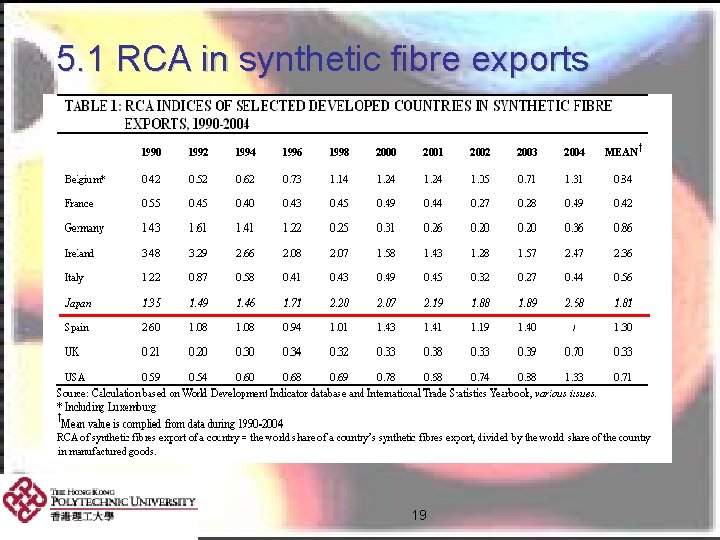
5. 1 RCA in synthetic fibre exports q RCA > 1 have revealed comparative advantage q RCA < 1 having revealed comparative disadvantage 18
5. 1 RCA in synthetic fibre exports 19
5. 1 RCA in synthetic fibre exports q Japan, Ireland Spain: ØTheir RCA > 1 ØHave revealed comparative advantage in synthetic fibre exports q Japan: only country shows “increasing” RCA ØRCA index increased significantly, from 1. 35 in 1990 to 2. 68 in 2004 q Ireland Spain: ØTheir RCA indices demonstrated a downward trend ØLosing their revealed comparative advantage in synthetic fibre exports 20
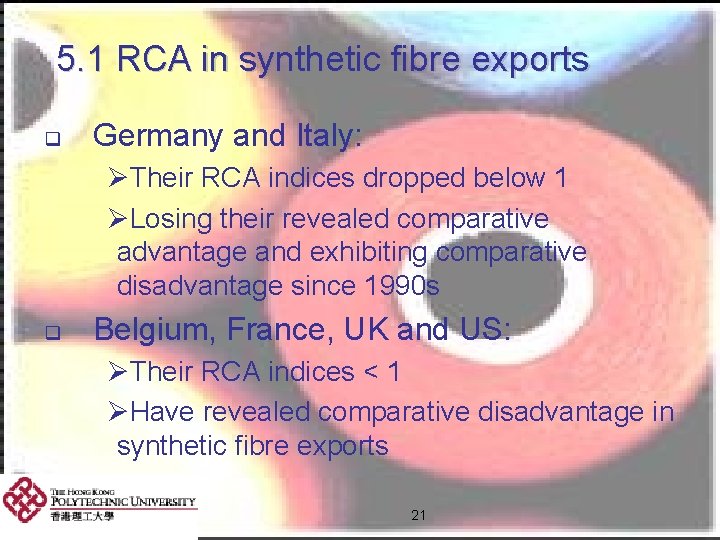
5. 1 RCA in synthetic fibre exports q Germany and Italy: ØTheir RCA indices dropped below 1 ØLosing their revealed comparative advantage and exhibiting comparative disadvantage since 1990 s q Belgium, France, UK and US: ØTheir RCA indices < 1 ØHave revealed comparative disadvantage in synthetic fibre exports 21
5. 2 RC in synthetic fibre exports q q Positive RC country is competitive in commodity trade Negative RC country is not competitive internationally in the specific trading commodity 22
5. 2 RC in synthetic fibre exports Japan: Most competitive synthetic fibre exporter 23
6. Analysis of Japan’s Comparative Advantage and Competitiveness of synthetic fibre exports q Key factors for the success of Japan’s synthetic fibre industry: Ø Ø Ø High technological level Innovative development Highly- educated scientists Abundant capital resources Large investment in R & D 24
6. Analysis of Japan’s comparative advantage and competitiveness of synthetic fibre exports Japan has a comparatively higher R&D/GDP ratio Higher potential to innovate new products or technology Enhanced the RCA in her synthetic fibres export 25
7. Conclusion (a) From Balassa’s RCA study: q Increasing RCA trend in Japan synthetic fibre exports q Related with R&D/GDP ratio q Able to produce hi-tech and niche synthetic fibres 26
7. Conclusion (b) From Vollrath’s RC study: q Japan has the highest RC index among the other studied countries q Demonstrated export competitiveness in synthetic fibre sector 27
7. Conclusion Future Prospect of Japan Synthetic Fibre Sector q Face competitive challenges from other low cost producing countries q Continue her edge in synthetic fibre sector by exerting more R&D efforts q Focus on developing high-value added niche products 28
- End Thank You 29