
COMPANY LOGO COMPANY NAME OSHAs Bloodborne Pathogens Standard
(COMPANY LOGO) (COMPANY NAME) OSHA’s Bloodborne Pathogens Standard Training for OSHA standard 29 CFR 1910. 1030 1

The Importance of Bloodborne Pathogens Compliance • OSHA’s bloodborne pathogens standard is the second most cited safety and health regulation in the textile services industry. • In 2006 – 2007 OSHA issued 82 citations of its bloodborne pathogens standard to textile service companies. • The 82 citations resulted in total initial fines of nearly $100, 000 industry wide. 2
Bloodborne Pathogens • What is a bloodborne pathogen? - Microorganisms or substances that can produce disease in humans - Bloodborne pathogens are found in: ØBlood ØOther bodily fluids ØAny bodily fluids visibly contaminated with blood ØBody specimens ØOther potentially infectious materials (OPIM) 3
Bloodborne Pathogens • Who is at risk? -Bloodborne pathogens are not just a hazard for those who have direct patient contact in a healthcare setting. - Those in outside settings who have contact with objects from healthcare settings may also be exposed. 4
Bloodborne Pathogens • How are you at risk? - Soiled linens can be a source of countless pathogenic microorganisms. - Danger of actual disease spread seems to be minor. - However, it does not mean that there is NO risk. 5
Bloodborne Pathogens • How are bloodborne pathogens transmitted? - Through Direct Contact: body-to-body; physical transfer between and infected individual and another individual. - Through Indirect Contact: contact of a contaminated object (such as linen or a sharp) with an individual. 6
Bloodborne Pathogens • Indirect Contact: - Percutaneous exposure: cuts or punctures of the skin from contaminated sharps such as: - needles - broken glass - scalpels - Mucosal Exposure: contact of the mucous membranes or broken skin with infectious blood or body fluids. 7
Bloodborne Pathogens • Mucosal Exposure: - Conjunctiva of the eye - Nasal mucosa - Oral mucosa 8
Bloodborne Pathogens • Diseases Caused by Bloodborne Pathogens: - Hepatitis B virus (HBV) - Hepatitis C virus (HBC) - Human Immunodeficiency Virus (HIV) 9
Hepatitis B • Hepatitis B: 1. Attacks the liver 2. Signs may not appear for several months 3. May lead to serious illness - Liver cirrhosis - Liver cancer 4. Highly Infectious 5. Small amounts can produce infection 6. Powerful and durable virus 10
Hepatitis B • Hepatitis B: 7. Survives in dried blood for up to 7 days 8. Risk is directly related to the nature and frequency of exposure 9. Risk of infection after percutaneous exposure is at least 30%. 10. Risk after mucosal exposure is not well known 11. A safe, effective vaccine is available 11
Hepatitis B Vaccination • Hepatitis B Vaccine and Vaccination Series: - (Company Name) will make the HBV vaccine available to all employees with possible exposure to blood or other infectious materials at no cost to the employee during normal working hours, without loss of pay and at no cost to the employee. 12
Hepatitis B Vaccination • Hepatitis B Vaccine and Vaccination Series: 1. Series consists of three (3) shots: - 1 st shot will be administered within 10 days of initial assignment. - 2 nd shot will be administered within 1 month of 1 st shot - 3 rd shot will be administered within 6 months of shot 2. 3. Immune memory remains indefinitely following immunization 13
Hepatitis C • Hepatitis C: 1. Similar to Hepatitis B 2. Develops more slowly 3. Most do not experience symptoms for the first 20 years 4. Leads to more chronic liver problems and deaths than Hepatitis B 5. No vaccine 14
HIV • Human Immunodeficiency Virus (HIV): 1. Causes Acquired Immune Deficiency Syndrome (AIDS)—a fatal disease 2. Your body is weakened and cannot fight other deadly diseases 3. The virus may be carried without signs for many years 4. No cure or vaccine 5. Treatments are improving 15
HIV • Human Immunodeficiency Virus (HIV): 6. Virus is weak 7. Does not survive long outside of the human body 8. Direct contact with flesh blood or other bodily fluids 16
Bloodborne Pathogens • OSHA’s Bloodborne Pathogens Standard (29 CFR 1910. 1030) - Available on OSHA’s Website or by contacting the (Designated Department). - Bloodborne Pathogens Standard Online at: http: //www. osha. gov/pls/oshaweb/owadisp. show _document? p_table=STANDARDS&p_id=10051 17
Exposure Control Plan (ECP) • - Employees with occupational exposure to bloodborne pathogens will receive a copy and explanation of (Company Name)’s ECP during this training session. • - The ECP will also be reviewed in the employees’ annual refresher training. • - All employees will have an opportunity to obtain a copy of the ECP free of charge and at any time during their work shifts by contacting the (Designated Department). 18
Exposure Control Plan (ECP) • (Company Name)’s Exposure Control Plan – Exposure determination – Scheduled and method of implementation of: • Methods of compliance for; General Practices, Engineering and Work Practices, Personal Protective Equipment, and Housekeeping • Hepatitis B Vaccination and Post-Exposure Evaluation and Follow-up • Communication of Hazards to Employees and • Recordkeeping of this standard 19
Exposure Control Plan (ECP) – (Company Name)’s procedure for the evaluation of circumstances surrounding exposure incidents – (Company Name)’s methods and manner of communication of plan and procedures to employees – Annual review and update • Reflect any changes in technology that eliminate or reduce exposure to bloodborne pathogens 20
Methods of Compliance • Universal Precautions 1. (Company Name) strictly adheres to the practice of “Universal Precautions” to prevent contact with potentially infectious materials. – “Universal Precautions” means treating all soiled linens are treated as if they are known to be contaminated 21
Methods of Compliance • Engineering and Work Practice Controls Employers must select and implement appropriate engineering and work practice controls to reduce or eliminate employee exposure. 22
Methods of Compliance • Engineering Controls – Annual review and safety inspections 1) Operations where engineering controls are currently employed 2) Operations where engineering controls can be updated and 3) Operations currently not employing engineering controls, but where engineering controls could be beneficial. 23
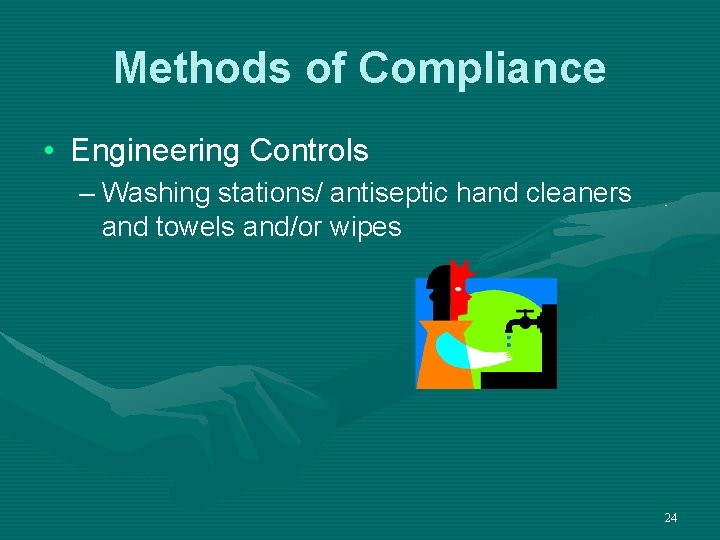
Methods of Compliance • Engineering Controls – Washing stations/ antiseptic hand cleaners and towels and/or wipes 24
Methods of Compliance • Engineering Controls - Containers for contaminated sharps having the characteristics of: • puncture-resistant • color-coded or labeled with a biohazard warning label • leak-proof on sides and bottom • available in the soiled linen sorting area. 25
Methods of Compliance • Engineering Controls - Containers for transporting soiled linen (carts, bags, etc. ) must have the characteristics of: • puncture-resistant • color-coded or labeled with a biohazard warning label • leak-proof on sides and bottom • available in the soiled linen sorting area. 26
Methods of Compliance • Engineering Controls – Physical Barrier Wall: • The soil area is separated from the clean area by a wall and/or a plastic curtain wall(s) to insure an airborne barriers 27
Methods of Compliance • Engineering Controls – Ventilation of the soil area is provided by exhaust fans. • fans provide an outside air exchange of approximately three to four times per minute – Ventilation of the clean area is provided by exhaust fans. • fans provide an outside air exchange of approximately three to four times per minute. 28
Methods of Compliance • Engineering Controls - Positive Air Flow: Air is directed from the clean side of the plant to the soil side of the plant so that no potentially contaminated air reaches the clean side. 29
Methods of Compliance • Work Practice Controls – Handle contaminated linen as little as possible with a minimum of agitation to prevent the spread of airborne bacteria. – Soiled healthcare textiles are sorted by grasping the edges of the textiles and pulling them apart thus spreading out the soiled textiles and easily revealing any sharps that may have inadvertently been left in the soiled textiles by the customer. 30
Methods of Compliance • Work Practice Controls - Employees must not rub their eyes or any other mucous membranes on their bodies until after personal protective equipment has been removed and hands have been thoroughly washed. - When found in soiled laundry, needles and other sharps are handled and disposed of in the designated sharps container provided by the employer. 31
Methods of Compliance • Work Practice Controls: - When found in soiled laundry, needles are not to be bent, recapped, removed, broken or sheared by employees. - When found in soiled laundry, needles and other sharps are to be immediately disposed of in a sharps container by employees. 32
Methods of Compliance • Work Practice Controls – Affected employees are required to wear (PPE) while working in the soil department – Wash hands and any other exposed skin with soap and water after removing PPE – Eating, drinking, smoking, applying cosmetics or lip balm and handling of contact lenses is prohibited in in the soil area. 33
Methods of Compliance • Work Practice Controls - Food and drink is NOT kept in Soil area. - Contaminated linens will be laundered as per (Company Name)’s procedures - Employees who have cuts, abrasions, rashes or any condition that compromises the protection provided by intact skin shall not handle soiled textiles unless the affected area of the skin has been properly and safety protected by appropriate dressings and/or coverings. 34
Methods of Compliance • Work Practice Controls - Employees handling soiled healthcare textiles are encouraged to bathe and change clothes after completion of their work day and before coming into immediate contact with other persons. 35
Personal Protective Equipment (PPE) • All employees at risk of exposure to bloodborne pathogens will follow these procedures regarding the use of personal protective equipment which is provided to the employee by the employer at not cost: 1. If PPE penetrated by blood or other potentially infectious materials, it shall be removed immediately or as soon as feasible. 36
Personal Protective Equipment (PPE) 2. All PPE shall be removed after each shift and prior to leaving the work area. 3. When PPE is removed it shall be placed in an appropriately designated area or container for storage, washing, decontamination or disposal by the company. 37
Personal Protective Equipment (PPE) 4. After removing PPE employees shall thoroughly wash their hands with soap and hot water. 5. All PPE will be cleaned, repaired or replaced as needed to maintain its effectiveness at no cost to the employee. 38
Personal Protective Equipment (PPE) 6) Fluid-proof gowns shall be worn by soil sort employees when it can be reasonably anticipated that they may come into direct contact with blood, other potentially infectious materials, mucous membranes, and non-intact skin while performing their normal duties. 39
Personal Protective Equipment (PPE) • Fluid-Proof Gowns: - The gowns must be worn with the opening to the employee’s back so that the front of the body has full protection. - The sleeves of the gown must be long enough to extend to the hands. - The sleeves of the gown must either be tucked inside fluid-proof gloves or have an elastic cuff which holds the end of the sleeve closed and in place around the fluid-proof gloves. 40
Personal Protective Equipment (PPE) 7) Fluid-proof gloves shall be worn by employees when it can be reasonably anticipated that they may come into direct contact with blood, other potentially infectious materials, mucous membranes, and non-intact skin while performing their normal duties. 41
Personal Protective Equipment (PPE) • Fluid-Proof Gloves: - Fluid-proof gloves shall be replaced immediately when torn, punctured, or when their ability to function as a barrier is compromised. - The gloves must form a complete barrier with the gown being worn 42
Exposure Incident Procedure • In the event of an employee exposure to bloodborne pathogens or other potentially infectious materials, the following procedure must be followed: 1. Seek first aid immediately 2. Notify the supervisor on duty in the area of the plant in which the exposure occurred 3. Notify (Designated Employee) of the exposure 43
Exposure Incident Procedure 4. Transport the employee with the exposure to the nearest healthcare clinic or hospital 5. (Designated Department) will then ensure the exposure is accurately logged onto the “Sharps Injury Log” and the “Exposure Incident Report Form” is accurately completed. 6. (Designated Department) will place the sharp responsible for the exposure in a designated sharps container provided by the employer. 44
Exposure Incident Follow-Up • Following an exposure incident, a confidential medical evaluation and followup shall be made available to the exposed employee at no cost • The medical evaluation and follow-up will include at least the following: 45
Exposure Incident Follow-Up 1. Documentation of the route of exposure, and the circumstances under which the exposure incident occurred 2. Identification and documentation of the source facility 3. A reasonable effort to identify and document the source of the contamination to a specific individual at the source facility will be made 46
Exposure Incident Follow-Up 4. If identified, the source individual’s blood shall be tested as soon as feasible and after consent is obtained in order to determine HBV and HIV infectivity. If consent is not obtained, the employer shall establish that legally required consent cannot be obtained. When the source individual's consent is not required by law, the source individual's blood, if available, shall be tested and the results documented. -Results of the source individual's testing shall be made available to the exposed employee, and the employee shall be informed of applicable laws and regulations concerning disclosure of the identity and infectious status of the source individual. 47
Exposure Incident Follow-Up 5. When the source individual is already known to be infected with HBV or HIV, testing for the source individual's known HBV or HIV status need not be repeated. 6. The exposed employee's blood shall be collected as soon as feasible and tested after consent is obtained 48
Exposure Incident Follow-Up 7. If the employee consents to baseline blood collection, but does not give consent at that time for HIV serologic testing, the sample shall be preserved for at least 90 days. If, within 90 days of the exposure incident, the employee elects to have the baseline sample tested, such testing shall be done immediately. 8. Counseling and evaluation of reported illnesses 49
Exposure Incident Follow-Up (Company Name) will obtain and provide the employee who experienced the exposure incident with a copy of the evaluating healthcare professional's written opinion within 15 days of the completion of the evaluation. The employer will provide the employee with a HIPAA notice that the employee’s personal and confidential health information will not be shared unless required by law. 50
Sharps Injury Log - Must be kept confidential - Must be maintained independently from OSHA Form 300 “Log of Work-Related Injuries and Illnesses” - At a minimum, must include the following for each incident: - Type and brand of device involved - Department or area of incident - Description of incident 51
Sharps Injury Log • From the incident report form, a log is maintained. – This information is kept confidential by HR – It is NOT maintained in a personnel file – It is kept separate from all other OSHA reporting forms 52
Incident Report Form The “Incident Report Form” can be found in (Company Name)’s Bloodborne Pathogens Policies and Procedures Manual. 53
Communicating Hazards - Warning labels will be affixed to all designated sharps containers in (Company Name)’s operations. - Designated sharps containers will have the biohazard symbol attached to them and the symbol will be fluorescent orange or orange-red or predominantly so, with lettering and symbols in a contrasting color 54
Communicating Hazards - A designated sharps container being red in color does not require the biohazard label to be attached to the sharps containers. 55

Questions & Answers 56
- Slides: 56