
Company Introduction Leigh Anne Alford Emily Behncke Janet
Company Introduction Leigh Anne Alford Emily Behncke Janet Mozaffari Sofie Leon
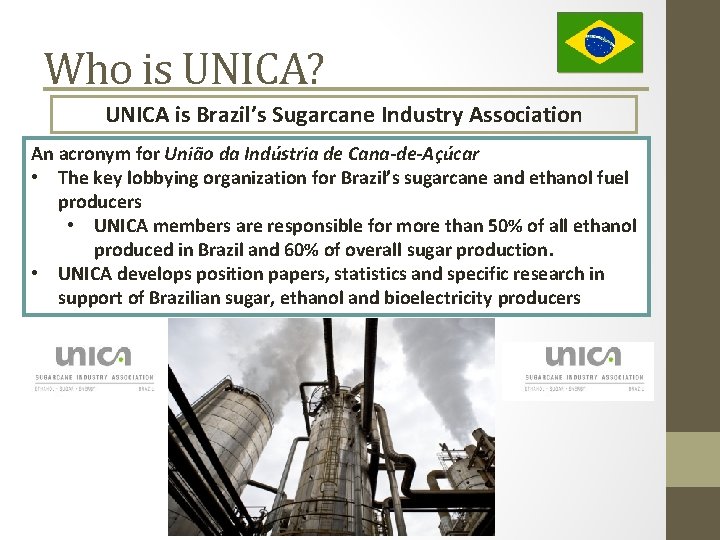
Who is UNICA? UNICA is Brazil’s Sugarcane Industry Association An acronym for União da Indústria de Cana-de-Açúcar • The key lobbying organization for Brazil’s sugarcane and ethanol fuel producers • UNICA members are responsible for more than 50% of all ethanol produced in Brazil and 60% of overall sugar production. • UNICA develops position papers, statistics and specific research in support of Brazilian sugar, ethanol and bioelectricity producers
UNICA’s History & Global Presence • Government deregulated sugar and ethanol • 1997: UNICA was created [Focus on Sao Paulo] • UNICA is now Brazil’s largest organization representing producers of sugar, ethanol and bioelectricity • The Board of Directors: Member companies, full-time executives, specialists and technical consultants with expertise in environmental issues, technology, energy, international trade, corporate social responsibility, legislation, economics and communications. • 2007: International Strategy: Lobbying & Education • Washington D. C & Brussels • 2012: March 27 th Marcos Jank Resigns from Presidency
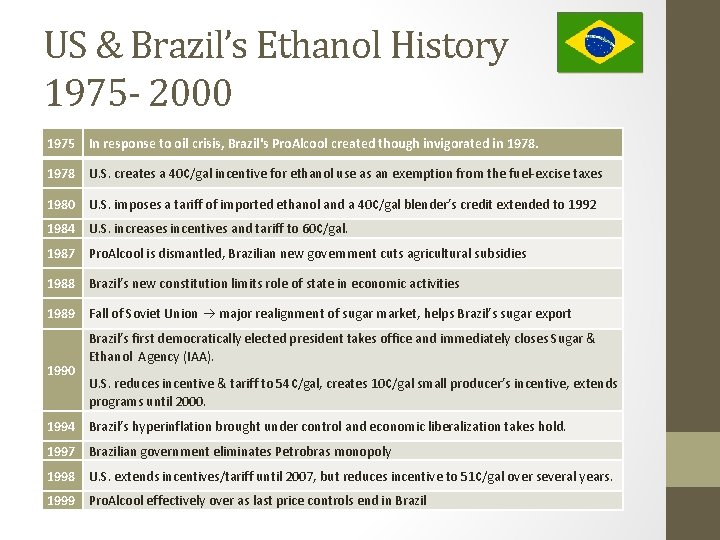
US & Brazil’s Ethanol History 1975 - 2000 1975 In response to oil crisis, Brazil's Pro. Alcool created though invigorated in 1978 U. S. creates a 40¢/gal incentive for ethanol use as an exemption from the fuel-excise taxes 1980 U. S. imposes a tariff of imported ethanol and a 40¢/gal blender’s credit extended to 1992 1984 U. S. increases incentives and tariff to 60¢/gal. 1987 Pro. Alcool is dismantled, Brazilian new government cuts agricultural subsidies 1988 Brazil’s new constitution limits role of state in economic activities 1989 Fall of Soviet Union major realignment of sugar market, helps Brazil’s sugar export 1990 Brazil’s first democratically elected president takes office and immediately closes Sugar & Ethanol Agency (IAA). U. S. reduces incentive & tariff to 54¢/gal, creates 10¢/gal small producer’s incentive, extends programs until 2000. 1994 Brazil’s hyperinflation brought under control and economic liberalization takes hold. 1997 Brazilian government eliminates Petrobras monopoly 1998 U. S. extends incentives/tariff until 2007, but reduces incentive to 51¢/gal over several years. 1999 Pro. Alcool effectively over as last price controls end in Brazil
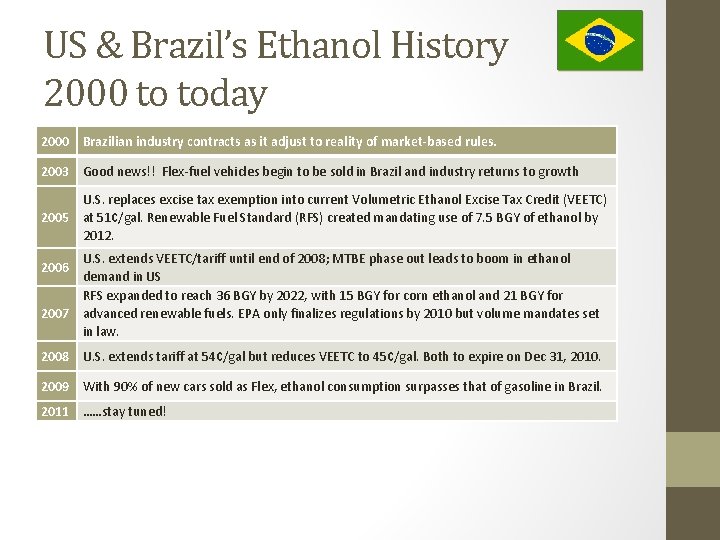
US & Brazil’s Ethanol History 2000 to today 2000 Brazilian industry contracts as it adjust to reality of market-based rules. 2003 Good news!! Flex-fuel vehicles begin to be sold in Brazil and industry returns to growth U. S. replaces excise tax exemption into current Volumetric Ethanol Excise Tax Credit (VEETC) 2005 at 51¢/gal. Renewable Fuel Standard (RFS) created mandating use of 7. 5 BGY of ethanol by 2012. U. S. extends VEETC/tariff until end of 2008; MTBE phase out leads to boom in ethanol demand in US RFS expanded to reach 36 BGY by 2022, with 15 BGY for corn ethanol and 21 BGY for 2007 advanced renewable fuels. EPA only finalizes regulations by 2010 but volume mandates set in law. 2006 2008 U. S. extends tariff at 54¢/gal but reduces VEETC to 45¢/gal. Both to expire on Dec 31, 2010. 2009 With 90% of new cars sold as Flex, ethanol consumption surpasses that of gasoline in Brazil. 2011 ……stay tuned!
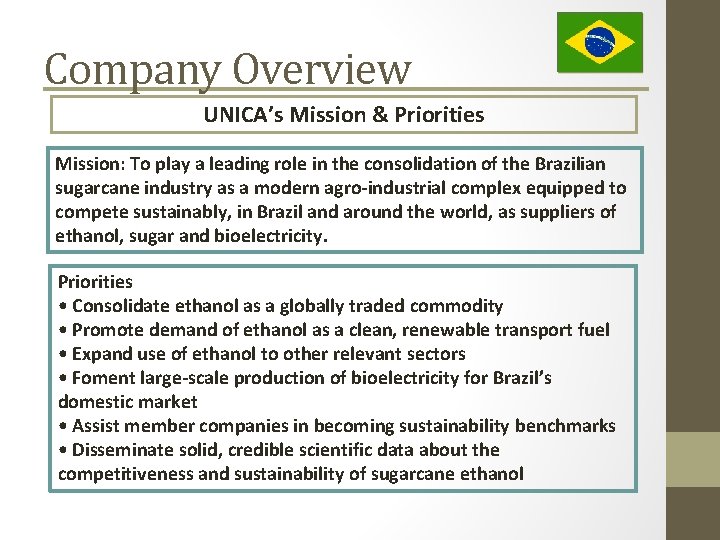
Company Overview UNICA’s Mission & Priorities Mission: To play a leading role in the consolidation of the Brazilian sugarcane industry as a modern agro-industrial complex equipped to compete sustainably, in Brazil and around the world, as suppliers of ethanol, sugar and bioelectricity. Priorities • Consolidate ethanol as a globally traded commodity • Promote demand of ethanol as a clean, renewable transport fuel • Expand use of ethanol to other relevant sectors • Foment large-scale production of bioelectricity for Brazil’s domestic market • Assist member companies in becoming sustainability benchmarks • Disseminate solid, credible scientific data about the competitiveness and sustainability of sugarcane ethanol
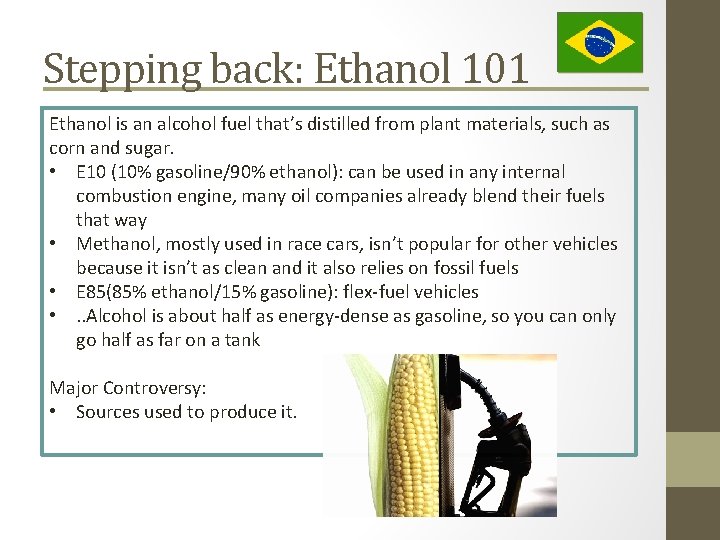
Stepping back: Ethanol 101 Ethanol is an alcohol fuel that’s distilled from plant materials, such as corn and sugar. • E 10 (10% gasoline/90% ethanol): can be used in any internal combustion engine, many oil companies already blend their fuels that way • Methanol, mostly used in race cars, isn’t popular for other vehicles because it isn’t as clean and it also relies on fossil fuels • E 85(85% ethanol/15% gasoline): flex-fuel vehicles • . . Alcohol is about half as energy-dense as gasoline, so you can only go half as far on a tank Major Controversy: • Sources used to produce it.
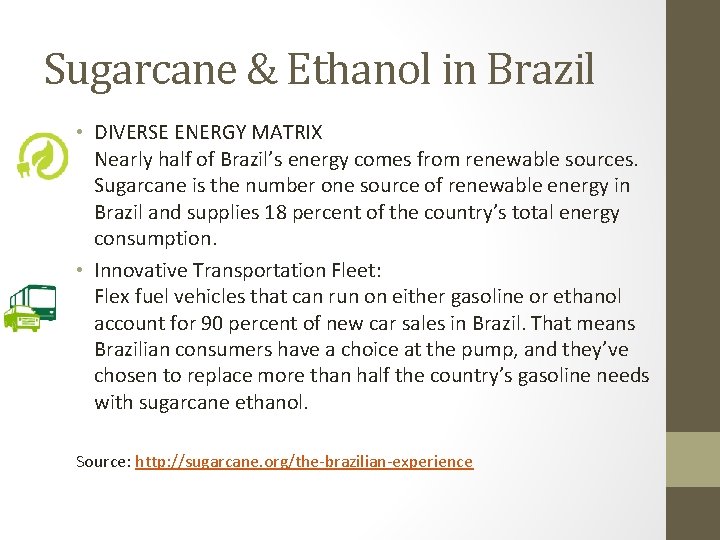
Sugarcane & Ethanol in Brazil • DIVERSE ENERGY MATRIX Nearly half of Brazil’s energy comes from renewable sources. Sugarcane is the number one source of renewable energy in Brazil and supplies 18 percent of the country’s total energy consumption. • Innovative Transportation Fleet: Flex fuel vehicles that can run on either gasoline or ethanol account for 90 percent of new car sales in Brazil. That means Brazilian consumers have a choice at the pump, and they’ve chosen to replace more than half the country’s gasoline needs with sugarcane ethanol. Source: http: //sugarcane. org/the-brazilian-experience
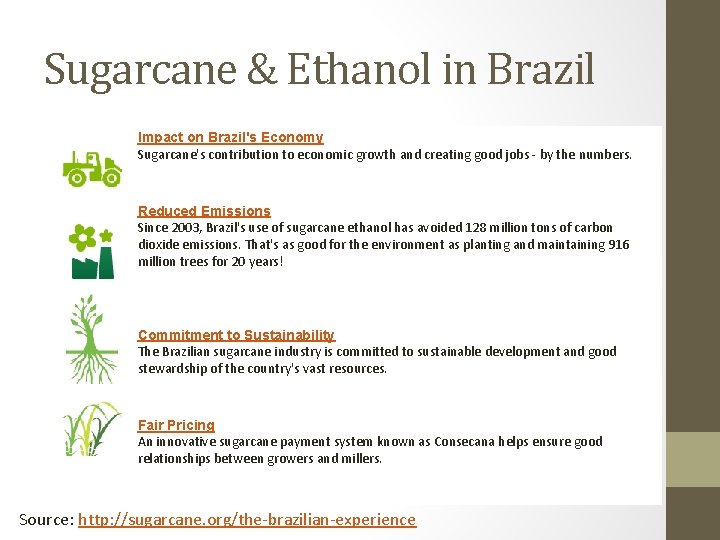
Sugarcane & Ethanol in Brazil Impact on Brazil's Economy Sugarcane's contribution to economic growth and creating good jobs - by the numbers. Reduced Emissions Since 2003, Brazil's use of sugarcane ethanol has avoided 128 million tons of carbon dioxide emissions. That's as good for the environment as planting and maintaining 916 million trees for 20 years! Commitment to Sustainability The Brazilian sugarcane industry is committed to sustainable development and good stewardship of the country's vast resources. Fair Pricing An innovative sugarcane payment system known as Consecana helps ensure good relationships between growers and millers. Source: http: //sugarcane. org/the-brazilian-experience
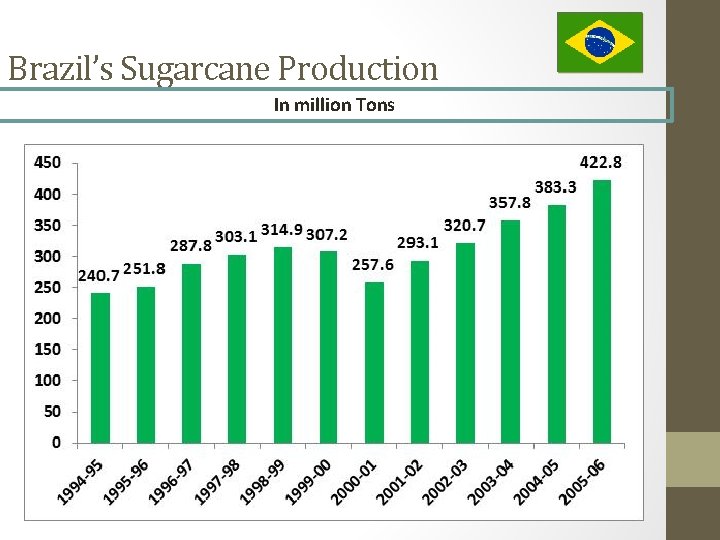
Brazil’s Sugarcane Production In million Tons
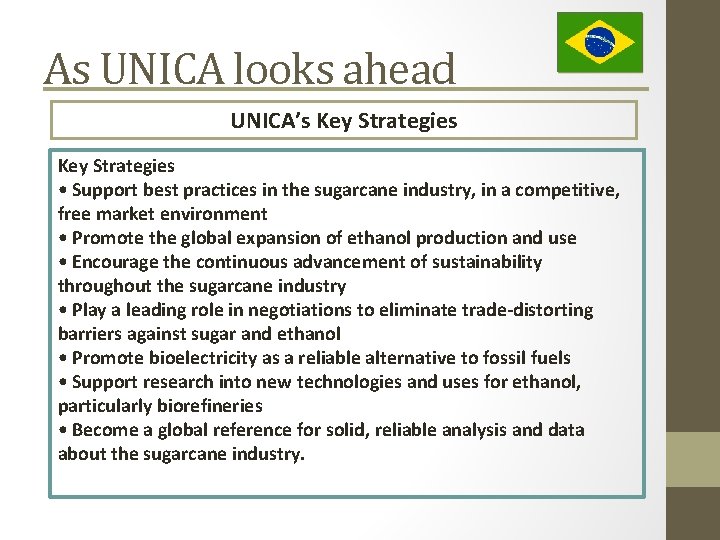
As UNICA looks ahead UNICA’s Key Strategies • Support best practices in the sugarcane industry, in a competitive, free market environment • Promote the global expansion of ethanol production and use • Encourage the continuous advancement of sustainability throughout the sugarcane industry • Play a leading role in negotiations to eliminate trade-distorting barriers against sugar and ethanol • Promote bioelectricity as a reliable alternative to fossil fuels • Support research into new technologies and uses for ethanol, particularly biorefineries • Become a global reference for solid, reliable analysis and data about the sugarcane industry.
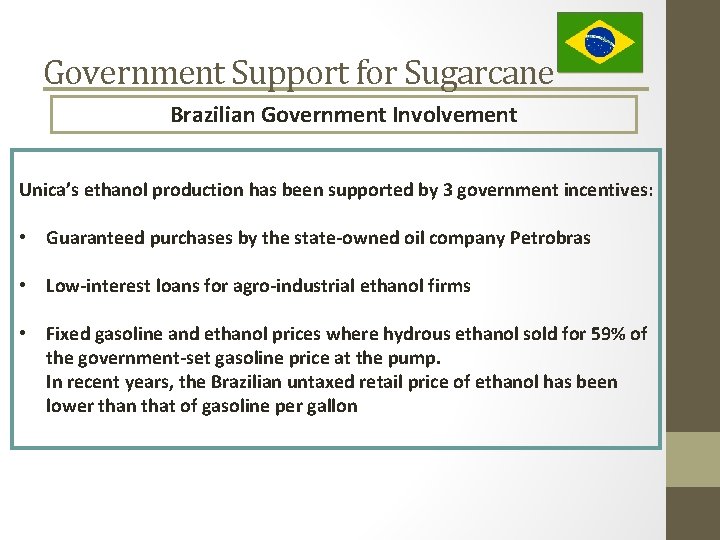
Government Support for Sugarcane Brazilian Government Involvement Unica’s ethanol production has been supported by 3 government incentives: • Guaranteed purchases by the state-owned oil company Petrobras • Low-interest loans for agro-industrial ethanol firms • Fixed gasoline and ethanol prices where hydrous ethanol sold for 59% of the government-set gasoline price at the pump. In recent years, the Brazilian untaxed retail price of ethanol has been lower than that of gasoline per gallon
Tarriff Removed but Challenges lie ahead US Trade Barriers • Two years of bad weather and high sugar prices have left Brazil struggling to meet its own demands recently and many believe that even if Brazil’s low-carbon sugarcane ethanol can earn a premium price in the corndominated U. S. market, there just simply isn’t enough supply right now for an invasion of foreign ethanol. • Previously a huge challenge… • The US corn lobby in the US, Japan and the EU imposed significant tariffs on Brazilian ethanol which led to higher prices and lower profitability • In particular, up until late 2011, a 54 -cent import tariff on Brazilian ethanol
UNICA in the News Brazil’s Sugarcane Industry Faces Brownout on Cost Reuters, March 2, 2012 UNICA says Brazilian Government Sugarcane crushing in South. Financing Support for Ethanol is Not a Subsidy -Central Brazil Reaches Biofuels Digest, March 2, 2012 492. 70 million tons with Demand for Ethanol Stable Discovery Channel Documentary in Early January includes Brazilian Sugarcane Ethanol Feb 1, 2012 Among “Energies of the Future” February 12, 2012 EU Should Follow US Example and Remove Import Brazil Sugar-Cane Growers to Tariffs on Sugarcane Ethanol Invest $3. 4 Billion to Renew Crops November 2, 2011 Bloomberg, March 9, 2012 Marcos Jank Resigns from Presidency at Brazilian Sugarcane Industry Association March 27, 2012
Questions for UNICA How has the leadership transition affected UNICA? With the removal of How are global energy sources the tariff, how does changing and how will this affect that change the strategic vision of Brazil’s sugarcane industry? your organization? How dependent are ethanol producers on Petrobras and other forms of government support? What research does What other sectors is UNICA provide to aid the UNICA trying to push industry? ethanol use into?
- Slides: 15