
Companies Share Capital and the Statement of Financial



- Slides: 55
Companies: Share Capital and the Statement of Financial Position Chapter 14 HORNGREN ♦ HARRISON ♦ BAMBER ♦ BEST ♦ FRASER ♦ WILLETT
Objectives 1. Identify the characteristics of a company. 2. Record the issue of shares 3. Prepare the shareholders’ equity section of a company’s statement of financial position 4. Account for cash dividends 5. Use different share values in decision-making 6. Evaluate a company’s return on assets and return on shareholders’ equity 7. Account for the income tax of a company Horngren ♦ Harrison ♦ Bamber ♦ Best ♦ Fraser ♦ Willett, Accounting 4 e Copyright © 2004 Pearson Education Australia 14 - 2
Objective 1 Identify the characteristics of a company. Horngren ♦ Harrison ♦ Bamber ♦ Best ♦ Fraser ♦ Willett, Accounting 4 e Copyright © 2004 Pearson Education Australia 14 - 3
Characteristics – – – – separate legal entity continuous life and transferability of ownership no mutual agency limited liability of shareholders separation of ownership and management company taxation government regulation Horngren ♦ Harrison ♦ Bamber ♦ Best ♦ Fraser ♦ Willett, Accounting 4 e Copyright © 2004 Pearson Education Australia 14 - 4
Organising a company The process of creating a company begins when the organisers (promoters) obtain a certificate of registration from ASIC. l The Corporations Act includes a number of basic rules for managing the company. l The company can accept these rules or replace them with their own company constitution. l Horngren ♦ Harrison ♦ Bamber ♦ Best ♦ Fraser ♦ Willett, Accounting 4 e Copyright © 2004 Pearson Education Australia 14 - 5
Organising a company Shareholders elect the board of directors. l The board sets policy, appoints the officers, and elects a chairperson. l The board also designates the managing director, who is often known as the chief executive officer (CEO). l Horngren ♦ Harrison ♦ Bamber ♦ Best ♦ Fraser ♦ Willett, Accounting 4 e Copyright © 2004 Pearson Education Australia 14 - 6
Authority Structure in a Company Shareholders Board of Directors Chairperson of the Board Chief Executive Officer Various Executives and Company Secretary Controller? Treasurer? Horngren ♦ Harrison ♦ Bamber ♦ Best ♦ Fraser ♦ Willett, Accounting 4 e Copyright © 2004 Pearson Education Australia 14 - 7
Share Capital Company ownership is evidenced by a ‘share certificate’ or ‘shareholder holding statement’ which may be for any number of shares. l See Exhibit 14 -3 and 14 -4 in your textbook l A share that is held by a shareholder is said to be an ‘issued share’. l Horngren ♦ Harrison ♦ Bamber ♦ Best ♦ Fraser ♦ Willett, Accounting 4 e Copyright © 2004 Pearson Education Australia 14 - 8
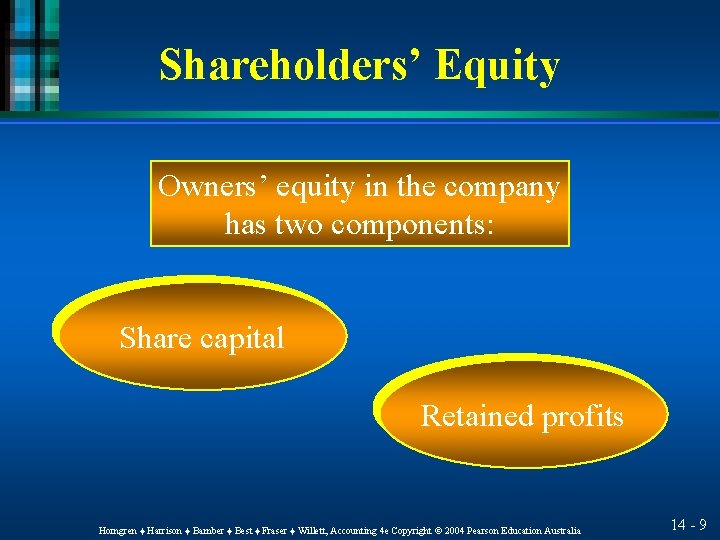
Shareholders’ Equity Owners’ equity in the company has two components: Share capital Retained profits Horngren ♦ Harrison ♦ Bamber ♦ Best ♦ Fraser ♦ Willett, Accounting 4 e Copyright © 2004 Pearson Education Australia 14 - 9
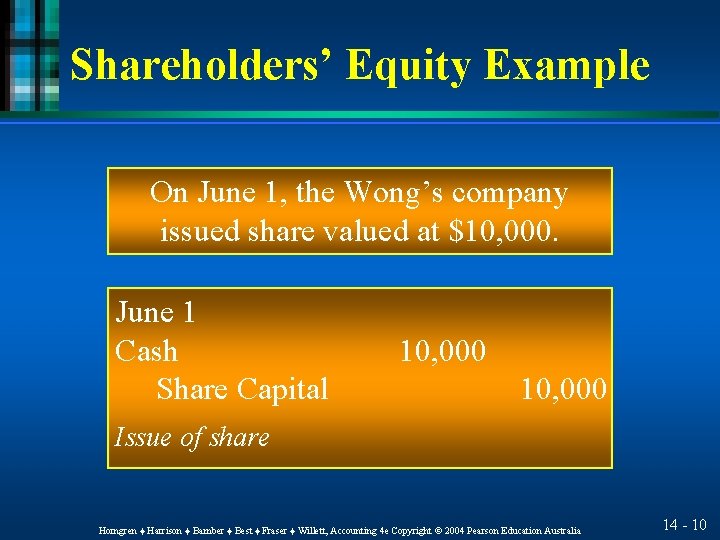
Shareholders’ Equity Example On June 1, the Wong’s company issued share valued at $10, 000. June 1 Cash Share Capital 10, 000 Issue of share Horngren ♦ Harrison ♦ Bamber ♦ Best ♦ Fraser ♦ Willett, Accounting 4 e Copyright © 2004 Pearson Education Australia 14 - 10
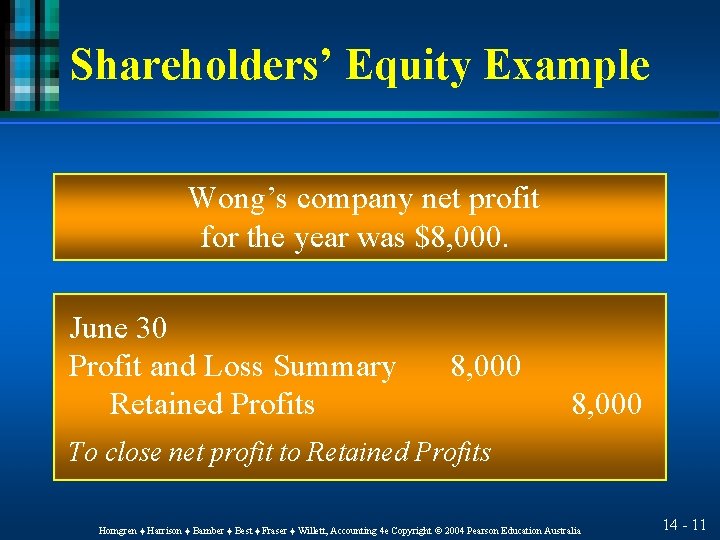
Shareholders’ Equity Example Wong’s company net profit for the year was $8, 000. June 30 Profit and Loss Summary Retained Profits 8, 000 To close net profit to Retained Profits Horngren ♦ Harrison ♦ Bamber ♦ Best ♦ Fraser ♦ Willett, Accounting 4 e Copyright © 2004 Pearson Education Australia 14 - 11
Shareholders’ Rights l 1 2 3 4 The ownership of share entitles shareholders to four basic rights, unless specific rights are withheld by agreement. Vote Dividends Liquidation Preemption Horngren ♦ Harrison ♦ Bamber ♦ Best ♦ Fraser ♦ Willett, Accounting 4 e Copyright © 2004 Pearson Education Australia 14 - 12
Classes of share Ordinary share is the most basic form of capital share. l Preference share gives its owners certain advantages over ordinary shareholders. l In Australia shares are now issued without a par value (it makes the accounting easier). l Horngren ♦ Harrison ♦ Bamber ♦ Best ♦ Fraser ♦ Willett, Accounting 4 e Copyright © 2004 Pearson Education Australia 14 - 13
Objective 2 Record the issue of shares. Horngren ♦ Harrison ♦ Bamber ♦ Best ♦ Fraser ♦ Willett, Accounting 4 e Copyright © 2004 Pearson Education Australia 14 - 14
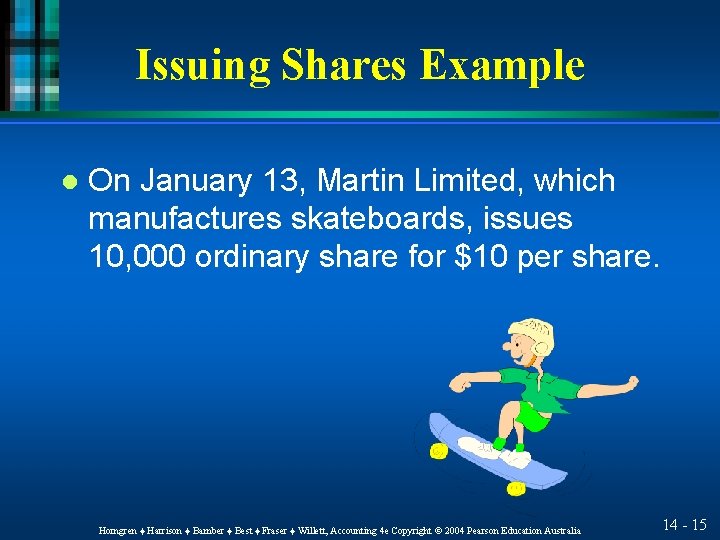
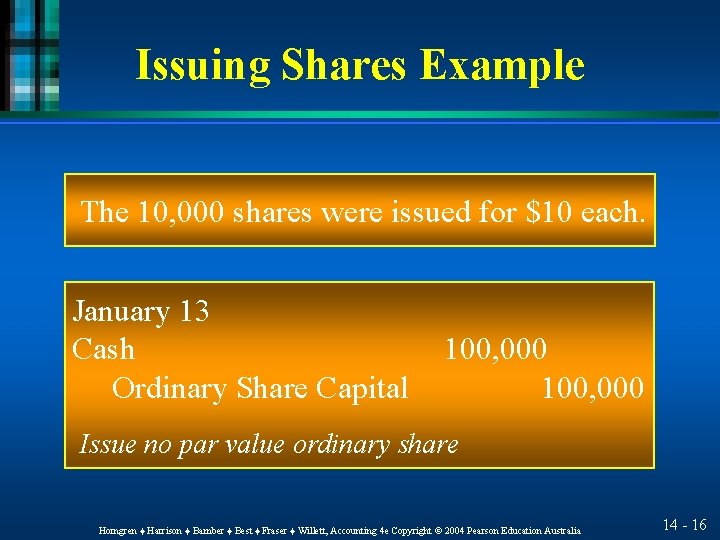
Issuing Shares Example l On January 13, Martin Limited, which manufactures skateboards, issues 10, 000 ordinary share for $10 per share. Horngren ♦ Harrison ♦ Bamber ♦ Best ♦ Fraser ♦ Willett, Accounting 4 e Copyright © 2004 Pearson Education Australia 14 - 15
Issuing Shares Example The 10, 000 shares were issued for $10 each. January 13 Cash Ordinary Share Capital 100, 000 Issue no par value ordinary share Horngren ♦ Harrison ♦ Bamber ♦ Best ♦ Fraser ♦ Willett, Accounting 4 e Copyright © 2004 Pearson Education Australia 14 - 16
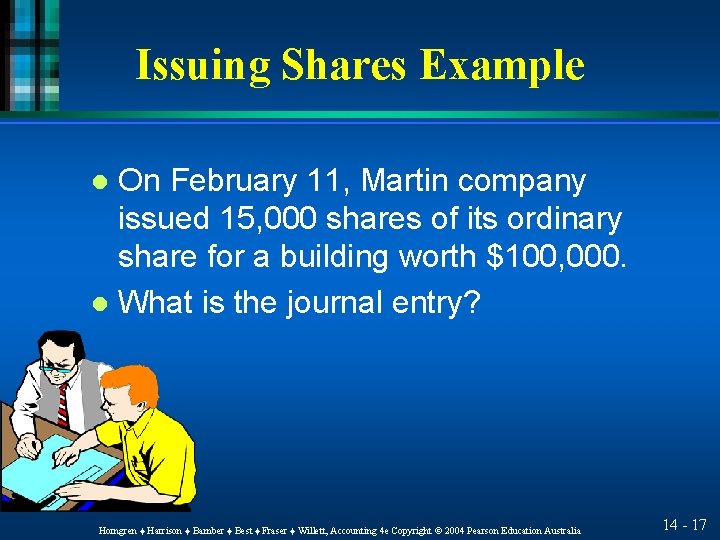
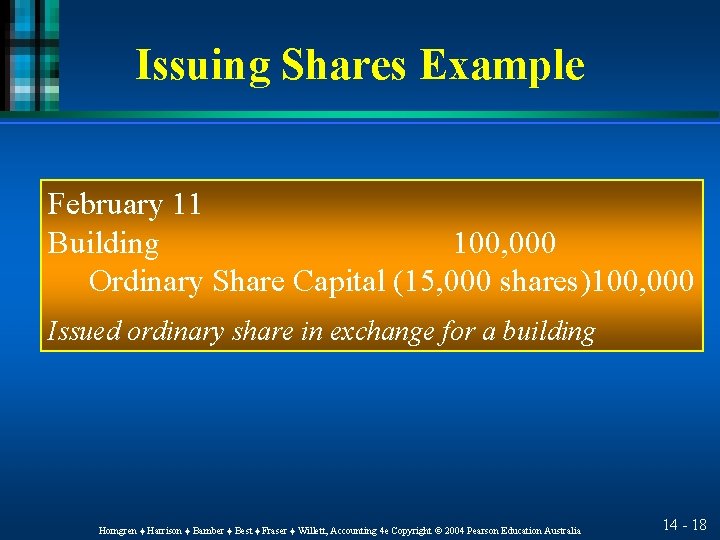
Issuing Shares Example On February 11, Martin company issued 15, 000 shares of its ordinary share for a building worth $100, 000. l What is the journal entry? l Horngren ♦ Harrison ♦ Bamber ♦ Best ♦ Fraser ♦ Willett, Accounting 4 e Copyright © 2004 Pearson Education Australia 14 - 17
Issuing Shares Example February 11 Building 100, 000 Ordinary Share Capital (15, 000 shares)100, 000 Issued ordinary share in exchange for a building Horngren ♦ Harrison ♦ Bamber ♦ Best ♦ Fraser ♦ Willett, Accounting 4 e Copyright © 2004 Pearson Education Australia 14 - 18
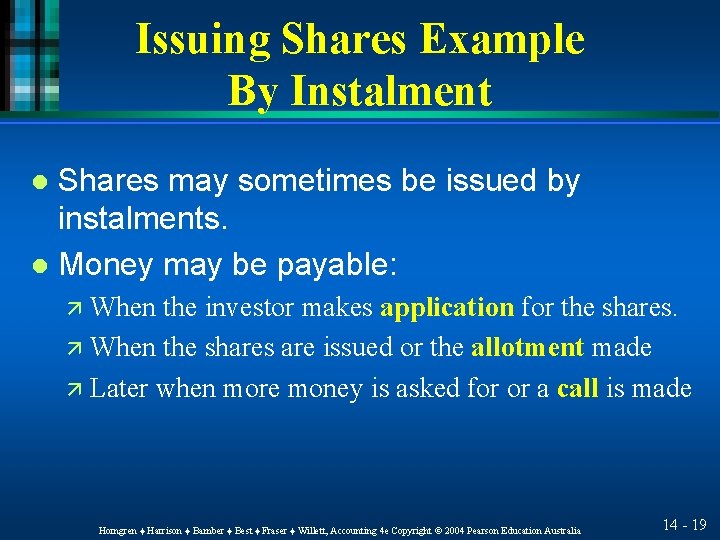
Issuing Shares Example By Instalment Shares may sometimes be issued by instalments. l Money may be payable: l ä When the investor makes application for the shares. ä When the shares are issued or the allotment made ä Later when more money is asked for or a call is made Horngren ♦ Harrison ♦ Bamber ♦ Best ♦ Fraser ♦ Willett, Accounting 4 e Copyright © 2004 Pearson Education Australia 14 - 19
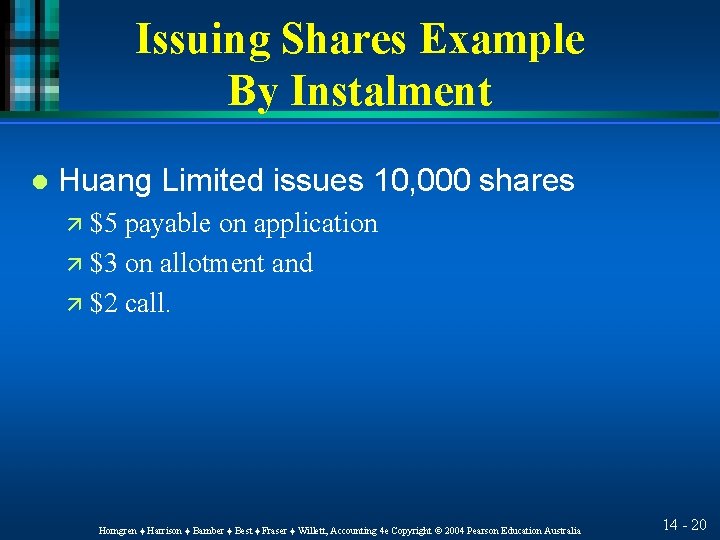
Issuing Shares Example By Instalment l Huang Limited issues 10, 000 shares ä $5 payable on application ä $3 on allotment and ä $2 call. Horngren ♦ Harrison ♦ Bamber ♦ Best ♦ Fraser ♦ Willett, Accounting 4 e Copyright © 2004 Pearson Education Australia 14 - 20
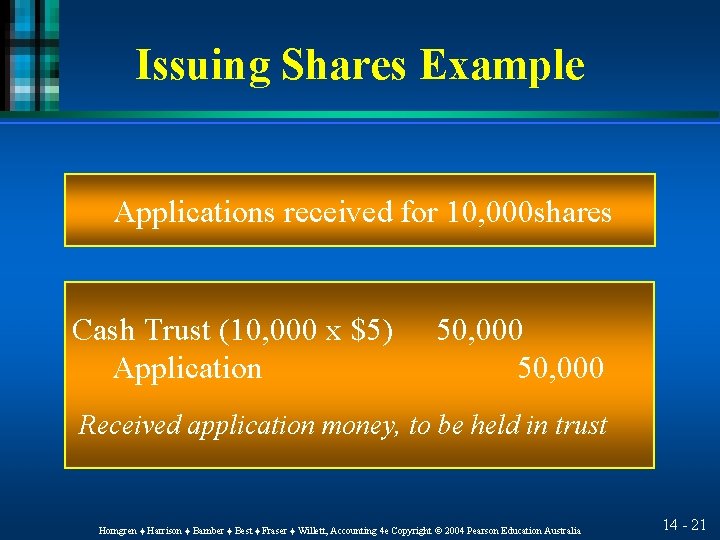
Issuing Shares Example Applications received for 10, 000 shares Cash Trust (10, 000 x $5) Application 50, 000 Received application money, to be held in trust Horngren ♦ Harrison ♦ Bamber ♦ Best ♦ Fraser ♦ Willett, Accounting 4 e Copyright © 2004 Pearson Education Australia 14 - 21
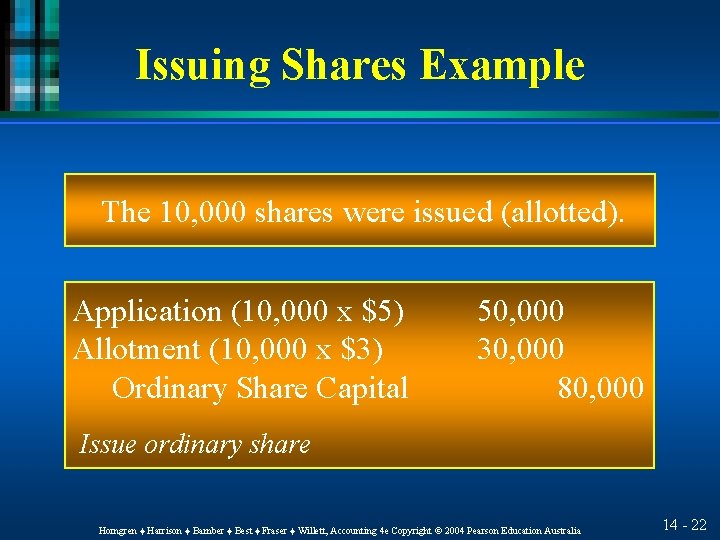
Issuing Shares Example The 10, 000 shares were issued (allotted). Application (10, 000 x $5) Allotment (10, 000 x $3) Ordinary Share Capital 50, 000 30, 000 80, 000 Issue ordinary share Horngren ♦ Harrison ♦ Bamber ♦ Best ♦ Fraser ♦ Willett, Accounting 4 e Copyright © 2004 Pearson Education Australia 14 - 22
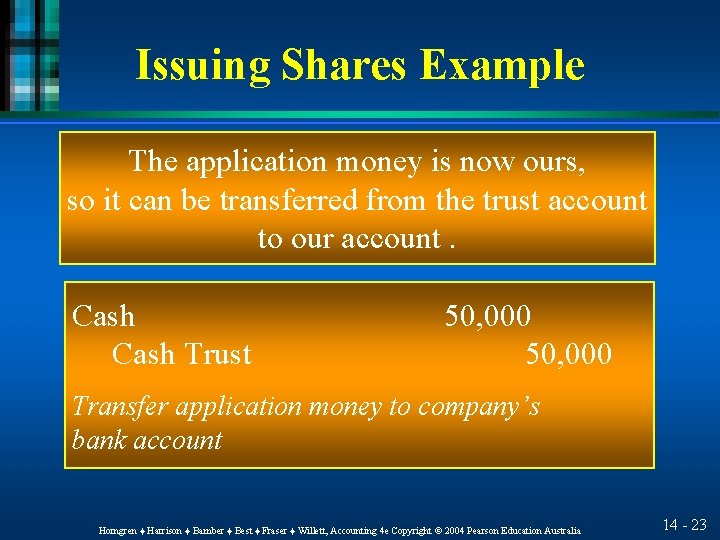
Issuing Shares Example The application money is now ours, so it can be transferred from the trust account to our account. Cash Trust 50, 000 Transfer application money to company’s bank account Horngren ♦ Harrison ♦ Bamber ♦ Best ♦ Fraser ♦ Willett, Accounting 4 e Copyright © 2004 Pearson Education Australia 14 - 23
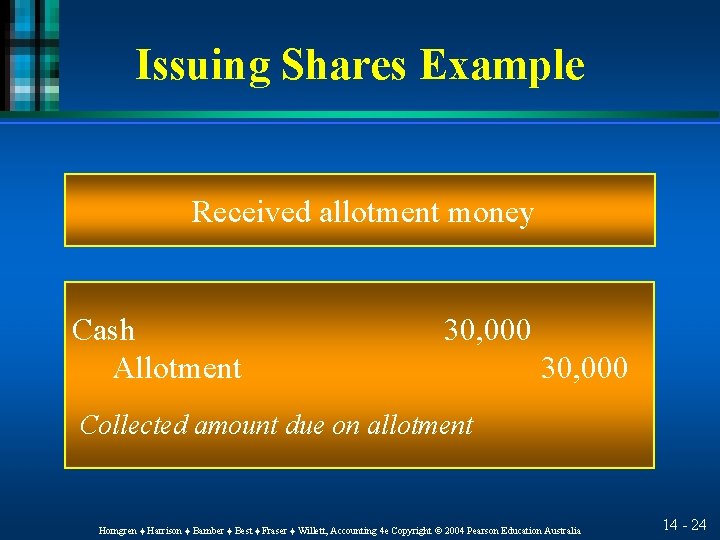
Issuing Shares Example Received allotment money Cash Allotment 30, 000 Collected amount due on allotment Horngren ♦ Harrison ♦ Bamber ♦ Best ♦ Fraser ♦ Willett, Accounting 4 e Copyright © 2004 Pearson Education Australia 14 - 24
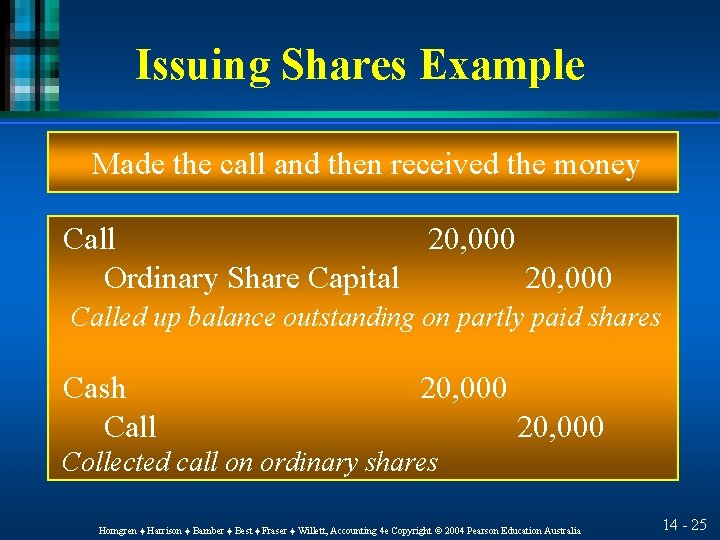
Issuing Shares Example Made the call and then received the money Call 20, 000 Ordinary Share Capital 20, 000 Called up balance outstanding on partly paid shares Cash Call 20, 000 Collected call on ordinary shares Horngren ♦ Harrison ♦ Bamber ♦ Best ♦ Fraser ♦ Willett, Accounting 4 e Copyright © 2004 Pearson Education Australia 14 - 25
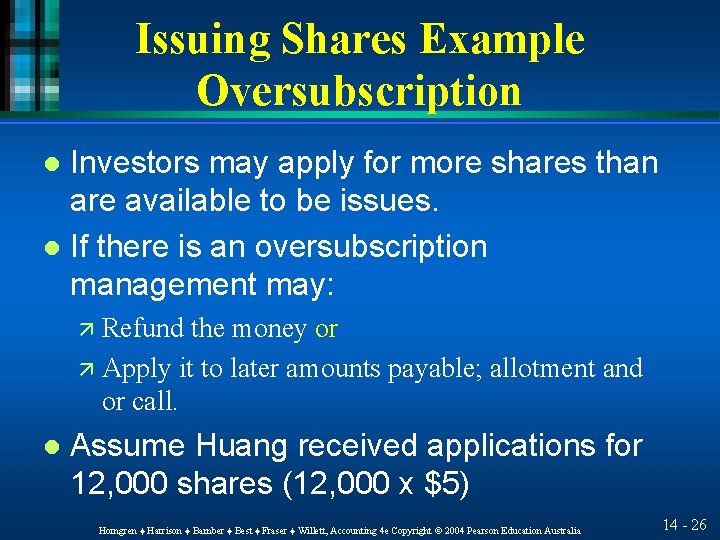
Issuing Shares Example Oversubscription Investors may apply for more shares than are available to be issues. l If there is an oversubscription management may: l ä Refund the money or ä Apply it to later amounts payable; allotment and or call. l Assume Huang received applications for 12, 000 shares (12, 000 x $5) Horngren ♦ Harrison ♦ Bamber ♦ Best ♦ Fraser ♦ Willett, Accounting 4 e Copyright © 2004 Pearson Education Australia 14 - 26
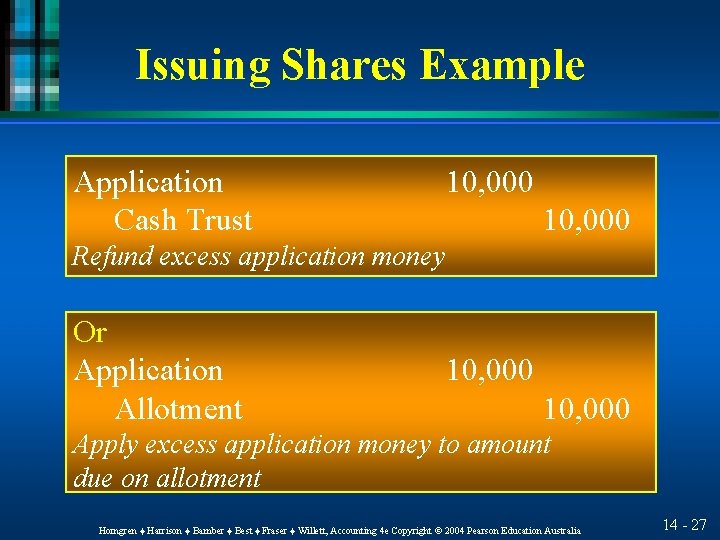
Issuing Shares Example Application Cash Trust 10, 000 Refund excess application money Or Application Allotment 10, 000 Apply excess application money to amount due on allotment Horngren ♦ Harrison ♦ Bamber ♦ Best ♦ Fraser ♦ Willett, Accounting 4 e Copyright © 2004 Pearson Education Australia 14 - 27
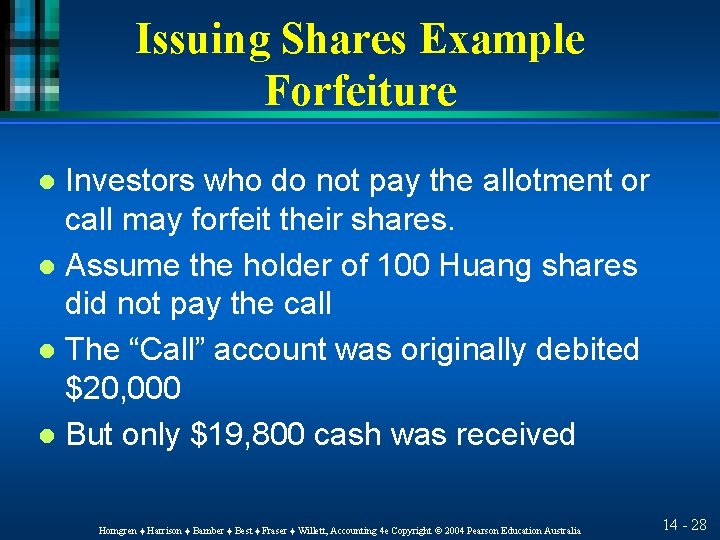
Issuing Shares Example Forfeiture Investors who do not pay the allotment or call may forfeit their shares. l Assume the holder of 100 Huang shares did not pay the call l The “Call” account was originally debited $20, 000 l But only $19, 800 cash was received l Horngren ♦ Harrison ♦ Bamber ♦ Best ♦ Fraser ♦ Willett, Accounting 4 e Copyright © 2004 Pearson Education Australia 14 - 28
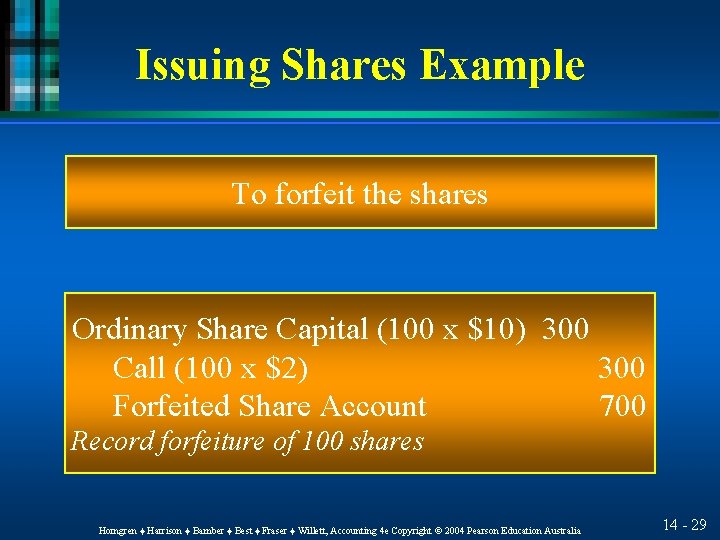
Issuing Shares Example To forfeit the shares Ordinary Share Capital (100 x $10) 300 Call (100 x $2) 300 Forfeited Share Account 700 Record forfeiture of 100 shares Horngren ♦ Harrison ♦ Bamber ♦ Best ♦ Fraser ♦ Willett, Accounting 4 e Copyright © 2004 Pearson Education Australia 14 - 29
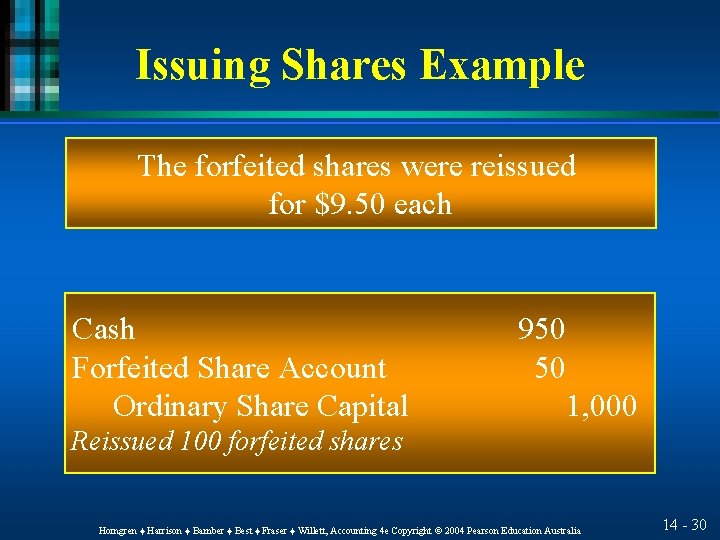
Issuing Shares Example The forfeited shares were reissued for $9. 50 each Cash Forfeited Share Account Ordinary Share Capital 950 50 1, 000 Reissued 100 forfeited shares Horngren ♦ Harrison ♦ Bamber ♦ Best ♦ Fraser ♦ Willett, Accounting 4 e Copyright © 2004 Pearson Education Australia 14 - 30
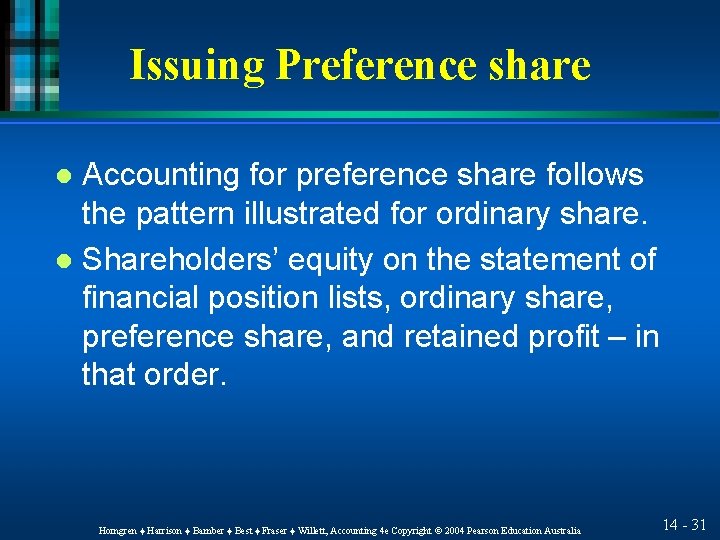
Issuing Preference share Accounting for preference share follows the pattern illustrated for ordinary share. l Shareholders’ equity on the statement of financial position lists, ordinary share, preference share, and retained profit – in that order. l Horngren ♦ Harrison ♦ Bamber ♦ Best ♦ Fraser ♦ Willett, Accounting 4 e Copyright © 2004 Pearson Education Australia 14 - 31
Objective 3 Prepare the shareholders’ equity section of a company’s statement of financial position. Horngren ♦ Harrison ♦ Bamber ♦ Best ♦ Fraser ♦ Willett, Accounting 4 e Copyright © 2004 Pearson Education Australia 14 - 32
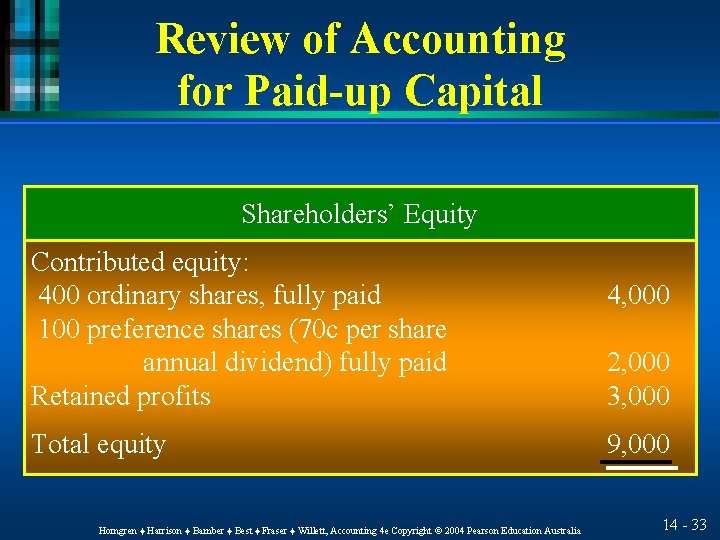
Review of Accounting for Paid-up Capital Shareholders’ Equity Contributed equity: 400 ordinary shares, fully paid 100 preference shares (70 c per share annual dividend) fully paid Retained profits Total equity Horngren ♦ Harrison ♦ Bamber ♦ Best ♦ Fraser ♦ Willett, Accounting 4 e Copyright © 2004 Pearson Education Australia 4, 000 2, 000 3, 000 9, 000 14 - 33
Review of Accounting for Paid-up Capital Contributed equity and retained profits represent the shareholders’ equity (ownership) in the assets of the company. l Contributed equity comes from the company’s shareholders who invested in the company. l Retained profits come from the company’s customers – but has become the shareholders’. l Horngren ♦ Harrison ♦ Bamber ♦ Best ♦ Fraser ♦ Willett, Accounting 4 e Copyright © 2004 Pearson Education Australia 14 - 34
Objective 4 Account for cash dividends. Horngren ♦ Harrison ♦ Bamber ♦ Best ♦ Fraser ♦ Willett, Accounting 4 e Copyright © 2004 Pearson Education Australia 14 - 35
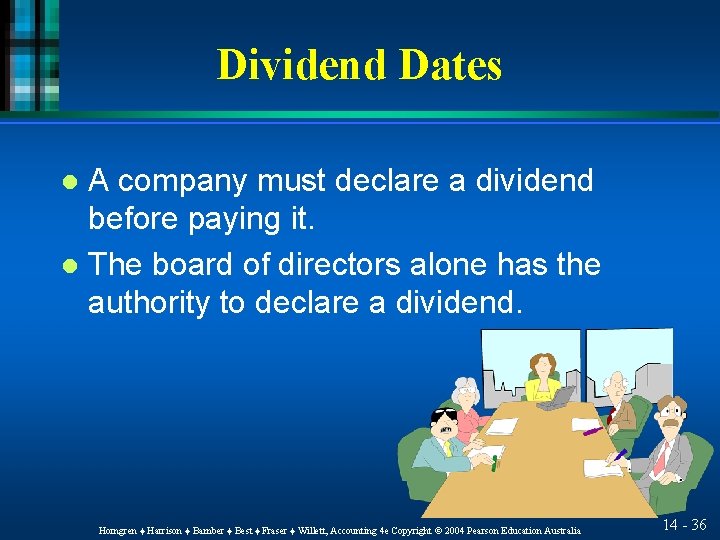
Dividend Dates A company must declare a dividend before paying it. l The board of directors alone has the authority to declare a dividend. l Horngren ♦ Harrison ♦ Bamber ♦ Best ♦ Fraser ♦ Willett, Accounting 4 e Copyright © 2004 Pearson Education Australia 14 - 36
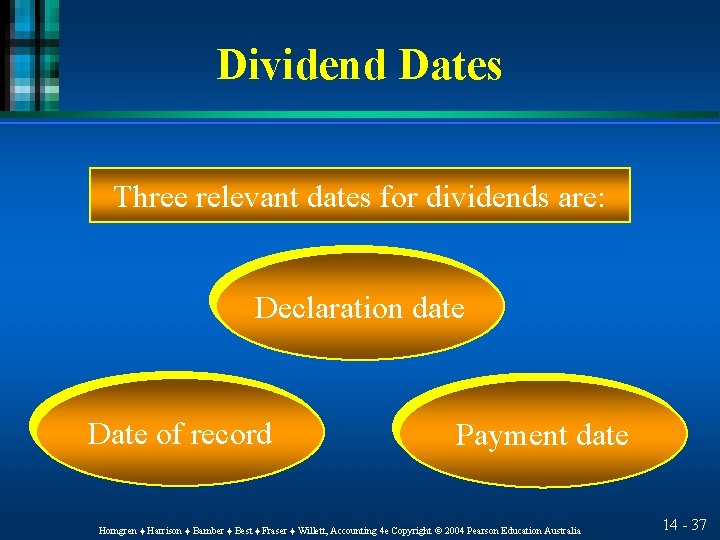
Dividend Dates Three relevant dates for dividends are: Declaration date Date of record Payment date Horngren ♦ Harrison ♦ Bamber ♦ Best ♦ Fraser ♦ Willett, Accounting 4 e Copyright © 2004 Pearson Education Australia 14 - 37
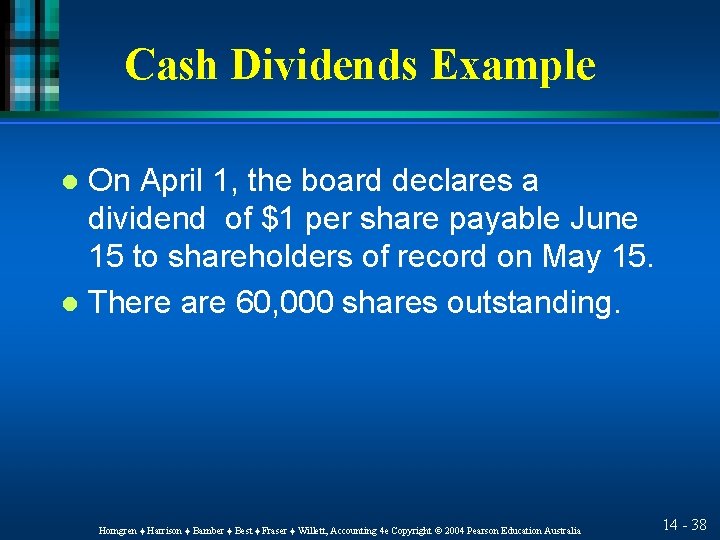
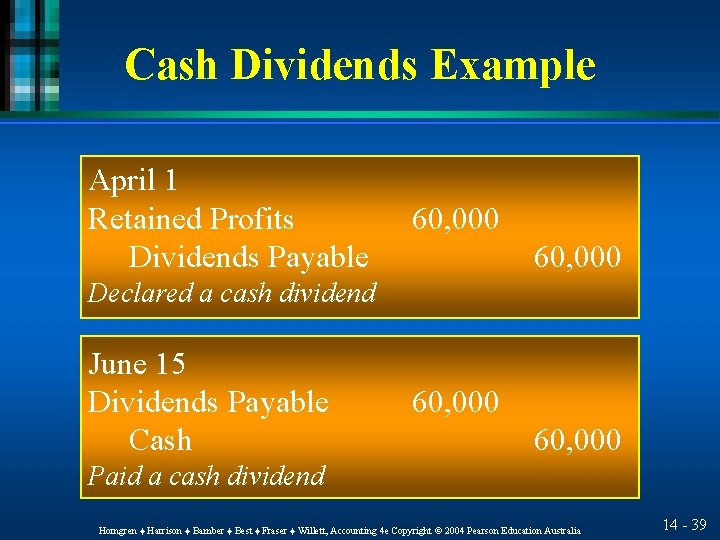
Cash Dividends Example On April 1, the board declares a dividend of $1 per share payable June 15 to shareholders of record on May 15. l There are 60, 000 shares outstanding. l Horngren ♦ Harrison ♦ Bamber ♦ Best ♦ Fraser ♦ Willett, Accounting 4 e Copyright © 2004 Pearson Education Australia 14 - 38
Cash Dividends Example April 1 Retained Profits Dividends Payable 60, 000 Declared a cash dividend June 15 Dividends Payable Cash 60, 000 Paid a cash dividend Horngren ♦ Harrison ♦ Bamber ♦ Best ♦ Fraser ♦ Willett, Accounting 4 e Copyright © 2004 Pearson Education Australia 14 - 39
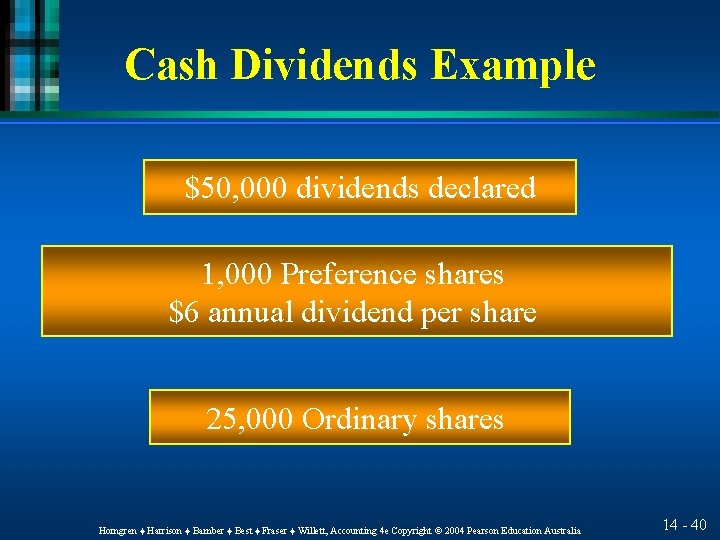
Cash Dividends Example $50, 000 dividends declared 1, 000 Preference shares $6 annual dividend per share 25, 000 Ordinary shares Horngren ♦ Harrison ♦ Bamber ♦ Best ♦ Fraser ♦ Willett, Accounting 4 e Copyright © 2004 Pearson Education Australia 14 - 40
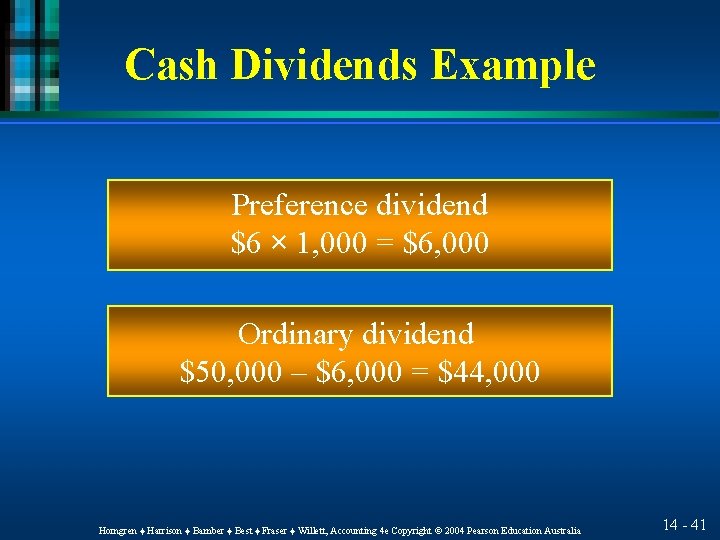
Cash Dividends Example Preference dividend $6 × 1, 000 = $6, 000 Ordinary dividend $50, 000 – $6, 000 = $44, 000 Horngren ♦ Harrison ♦ Bamber ♦ Best ♦ Fraser ♦ Willett, Accounting 4 e Copyright © 2004 Pearson Education Australia 14 - 41
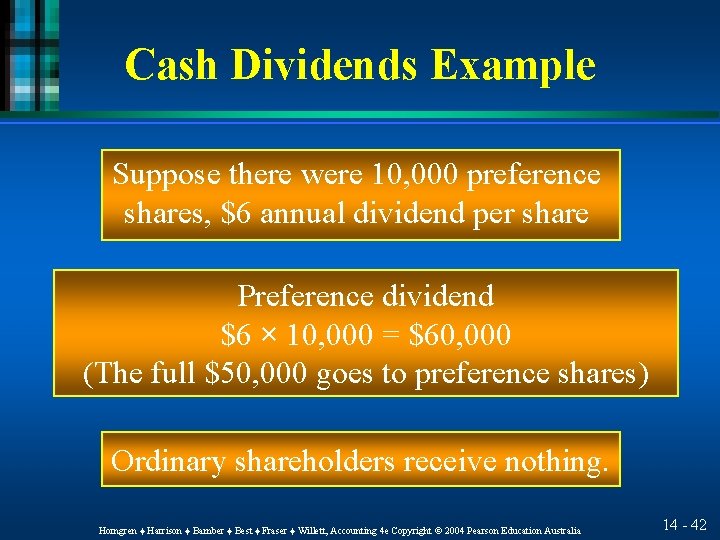
Cash Dividends Example Suppose there were 10, 000 preference shares, $6 annual dividend per share Preference dividend $6 × 10, 000 = $60, 000 (The full $50, 000 goes to preference shares) Ordinary shareholders receive nothing. Horngren ♦ Harrison ♦ Bamber ♦ Best ♦ Fraser ♦ Willett, Accounting 4 e Copyright © 2004 Pearson Education Australia 14 - 42
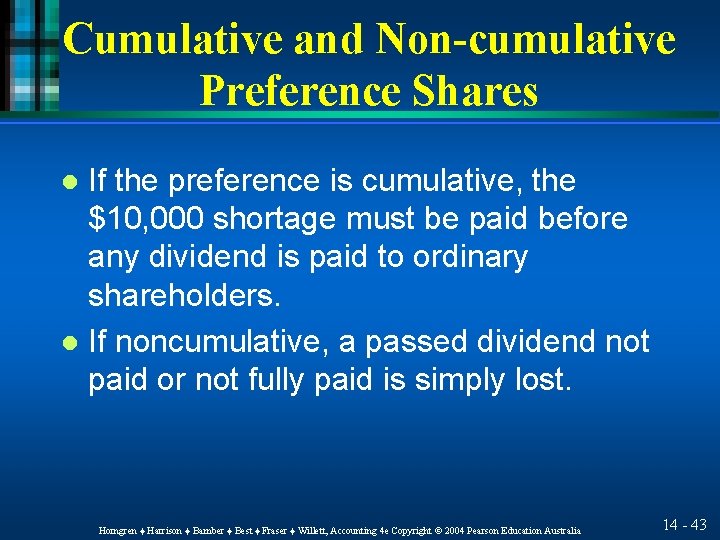
Cumulative and Non-cumulative Preference Shares If the preference is cumulative, the $10, 000 shortage must be paid before any dividend is paid to ordinary shareholders. l If noncumulative, a passed dividend not paid or not fully paid is simply lost. l Horngren ♦ Harrison ♦ Bamber ♦ Best ♦ Fraser ♦ Willett, Accounting 4 e Copyright © 2004 Pearson Education Australia 14 - 43
Objective 5 Use different share values in decision-making. Horngren ♦ Harrison ♦ Bamber ♦ Best ♦ Fraser ♦ Willett, Accounting 4 e Copyright © 2004 Pearson Education Australia 14 - 44
Share Values l – – – The business community refers to different share values in addition to the original issue price. market value liquidation value book value Horngren ♦ Harrison ♦ Bamber ♦ Best ♦ Fraser ♦ Willett, Accounting 4 e Copyright © 2004 Pearson Education Australia 14 - 45
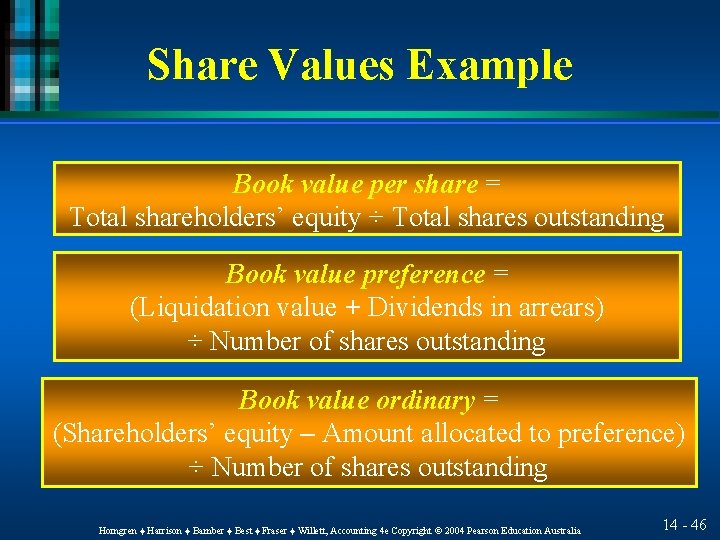
Share Values Example Book value per share = Total shareholders’ equity ÷ Total shares outstanding Book value preference = (Liquidation value + Dividends in arrears) ÷ Number of shares outstanding Book value ordinary = (Shareholders’ equity – Amount allocated to preference) ÷ Number of shares outstanding Horngren ♦ Harrison ♦ Bamber ♦ Best ♦ Fraser ♦ Willett, Accounting 4 e Copyright © 2004 Pearson Education Australia 14 - 46
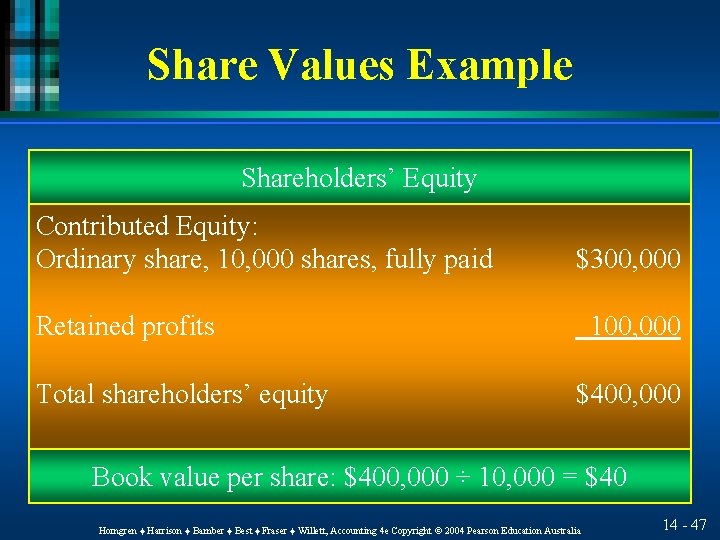
Share Values Example Shareholders’ Equity Contributed Equity: Ordinary share, 10, 000 shares, fully paid $300, 000 Retained profits Total shareholders’ equity 100, 000 $400, 000 Book value per share: $400, 000 ÷ 10, 000 = $40 Horngren ♦ Harrison ♦ Bamber ♦ Best ♦ Fraser ♦ Willett, Accounting 4 e Copyright © 2004 Pearson Education Australia 14 - 47
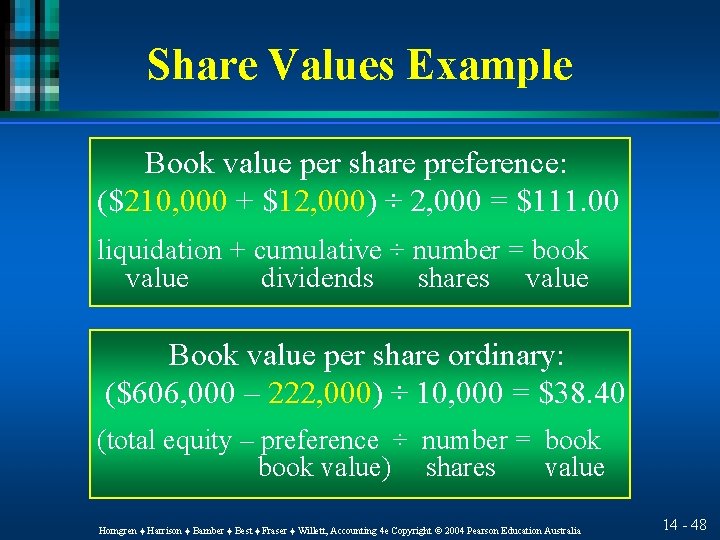
Share Values Example Book value per share preference: ($210, 000 + $12, 000) ÷ 2, 000 = $111. 00 liquidation + cumulative ÷ number = book value dividends shares value Book value per share ordinary: ($606, 000 – 222, 000) ÷ 10, 000 = $38. 40 (total equity – preference ÷ number = book value) shares value Horngren ♦ Harrison ♦ Bamber ♦ Best ♦ Fraser ♦ Willett, Accounting 4 e Copyright © 2004 Pearson Education Australia 14 - 48
Objective 6 Evaluate a company’s return on assets and return on shareholders’ equity. Horngren ♦ Harrison ♦ Bamber ♦ Best ♦ Fraser ♦ Willett, Accounting 4 e Copyright © 2004 Pearson Education Australia 14 - 49
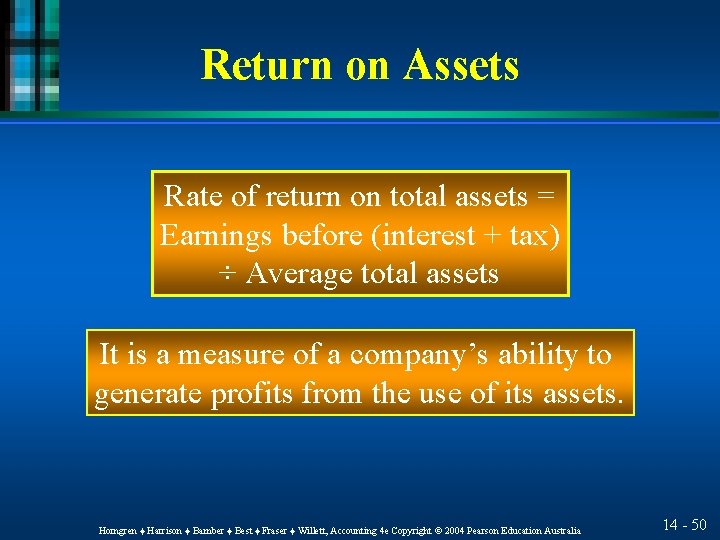
Return on Assets Rate of return on total assets = Earnings before (interest + tax) ÷ Average total assets It is a measure of a company’s ability to generate profits from the use of its assets. Horngren ♦ Harrison ♦ Bamber ♦ Best ♦ Fraser ♦ Willett, Accounting 4 e Copyright © 2004 Pearson Education Australia 14 - 50
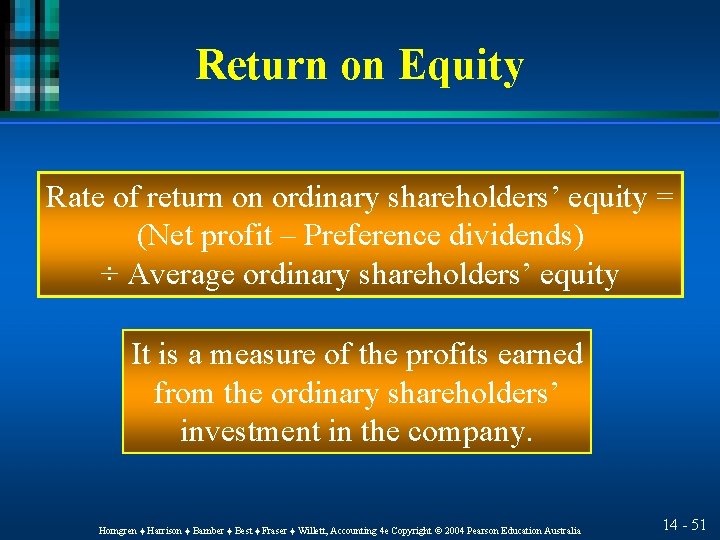
Return on Equity Rate of return on ordinary shareholders’ equity = (Net profit – Preference dividends) ÷ Average ordinary shareholders’ equity It is a measure of the profits earned from the ordinary shareholders’ investment in the company. Horngren ♦ Harrison ♦ Bamber ♦ Best ♦ Fraser ♦ Willett, Accounting 4 e Copyright © 2004 Pearson Education Australia 14 - 51
Objective 7 Account for the income tax of a company. Horngren ♦ Harrison ♦ Bamber ♦ Best ♦ Fraser ♦ Willett, Accounting 4 e Copyright © 2004 Pearson Education Australia 14 - 52
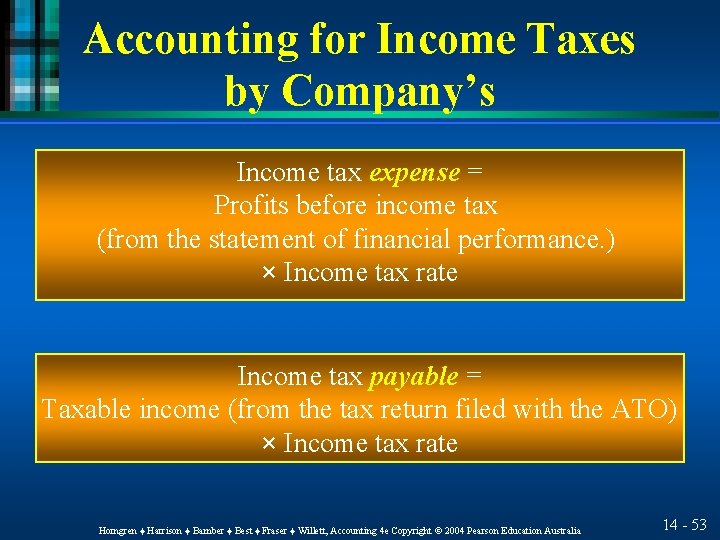
Accounting for Income Taxes by Company’s Income tax expense = Profits before income tax (from the statement of financial performance. ) × Income tax rate Income tax payable = Taxable income (from the tax return filed with the ATO) × Income tax rate Horngren ♦ Harrison ♦ Bamber ♦ Best ♦ Fraser ♦ Willett, Accounting 4 e Copyright © 2004 Pearson Education Australia 14 - 53
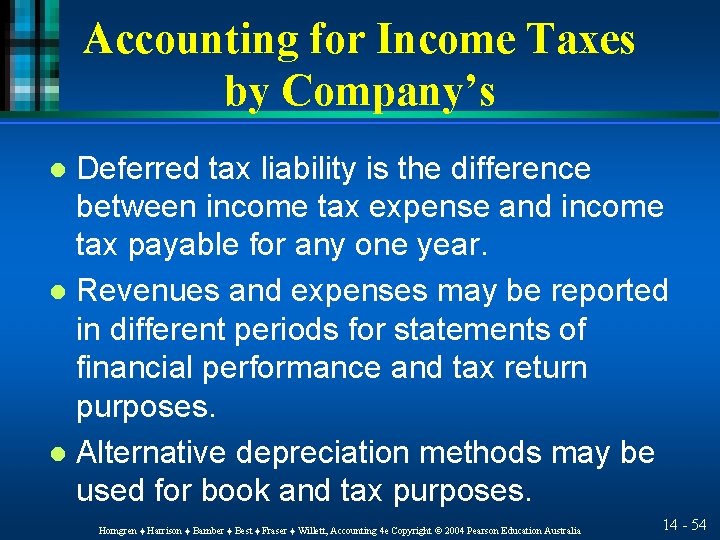
Accounting for Income Taxes by Company’s Deferred tax liability is the difference between income tax expense and income tax payable for any one year. l Revenues and expenses may be reported in different periods for statements of financial performance and tax return purposes. l Alternative depreciation methods may be used for book and tax purposes. l Horngren ♦ Harrison ♦ Bamber ♦ Best ♦ Fraser ♦ Willett, Accounting 4 e Copyright © 2004 Pearson Education Australia 14 - 54
End of Chapter 14 Horngren ♦ Harrison ♦ Bamber ♦ Best ♦ Fraser ♦ Willett, Accounting 4 e Copyright © 2004 Pearson Education Australia 14 - 55