
Compaction Insitu soils used as Bases for the
Compaction • In-situ soils used as: – Bases for the construction of highway pavements – embankments or leveling material for construction projects • Compacted to improve their density: M/V – improves the soil’s strength – lowers it’s permeability – reduces future settlement ENCI 579 1
Compaction • Evaluation of density as a result of compactive efforts with rollers and other equipment – common quality control measurement on soils at construction sites – density of a compacted soil is measured and compared to a density goal previously determined in laboratory tests ENCI 579 2
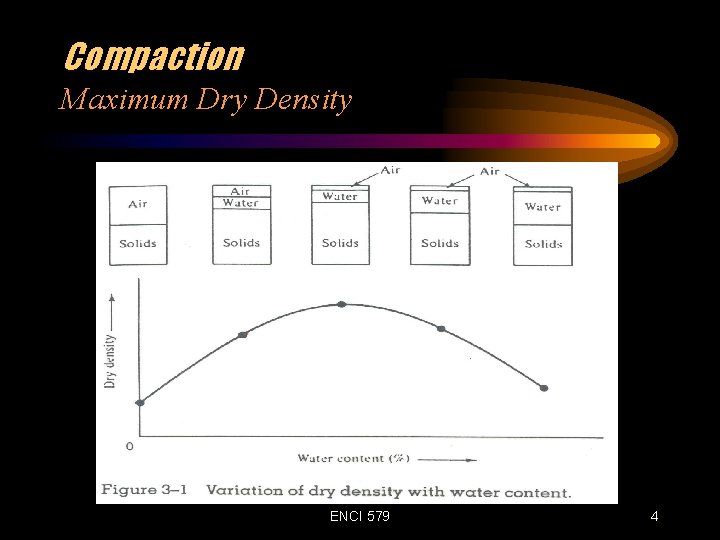
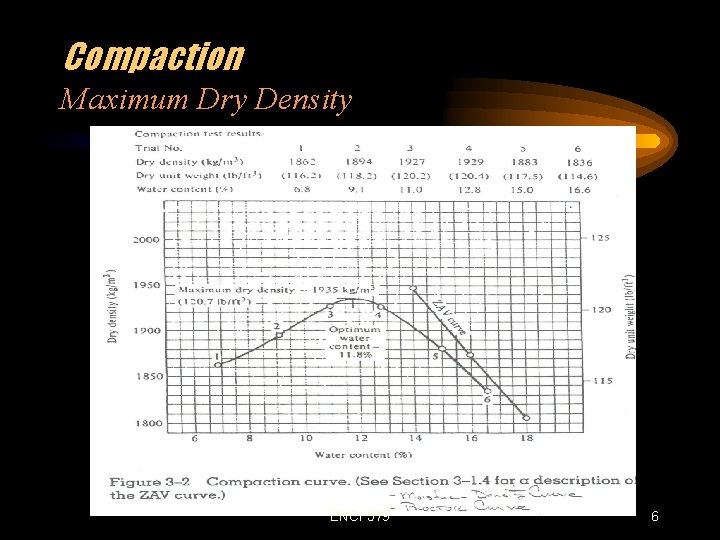
Compaction Maximum Dry Density • Maximum dry density must be established for each soil type – clay soil after compactive effort 2000 Kg/m 3 – granular soil with no compactive effort may be well above this • Dry density of a soil fn (water content) ENCI 579 3
Compaction Maximum Dry Density ENCI 579 4
Compaction Maximum Dry Density Compaction Control Determine the maximum dry density for a particular soil under a certain compactive effort and the water content at which this density is reached. MD/V ENCI 579 5
Compaction Maximum Dry Density ENCI 579 6
Compaction Maximum Dry Density • Compaction Test – Moisture density test – Proctor test • soil is compacted into 10 cm diameter mold for material passes 4. 75 mm sieve (15 cm mold for coarser material) • soil is placed in 3 layers • each layer compacted 25 blows with a 2. 5 Kg hammer dropping 30 cm ( 56 blows) 7 ENCI 579
Compaction Maximum Dry Density • 25 blow/56 blow compactive efforts are the same and represent the compactive efforts of 1930 construction rollers • Compaction Test – sample of soil is mixed with water • mass of compacted sample is measured • water content determined – sample of soil is mixed with more water – repeated until density decreases ENCI 579 8
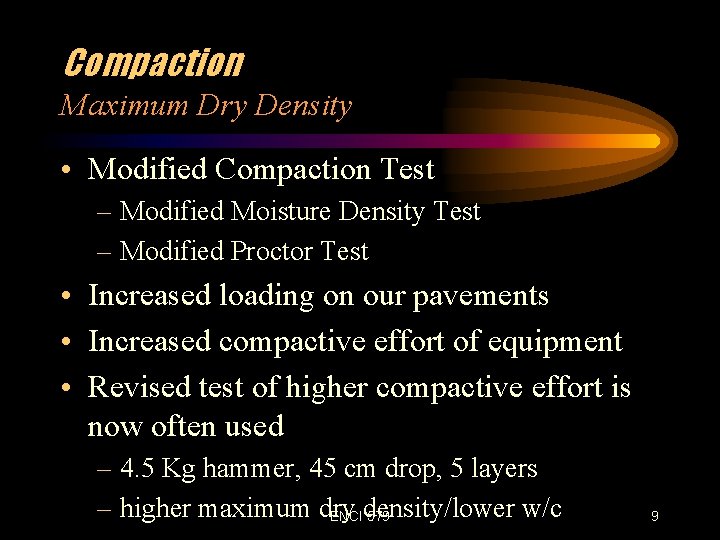
Compaction Maximum Dry Density • Modified Compaction Test – Modified Moisture Density Test – Modified Proctor Test • Increased loading on our pavements • Increased compactive effort of equipment • Revised test of higher compactive effort is now often used – 4. 5 Kg hammer, 45 cm drop, 5 layers – higher maximum dry w/c ENCIdensity/lower 579 9
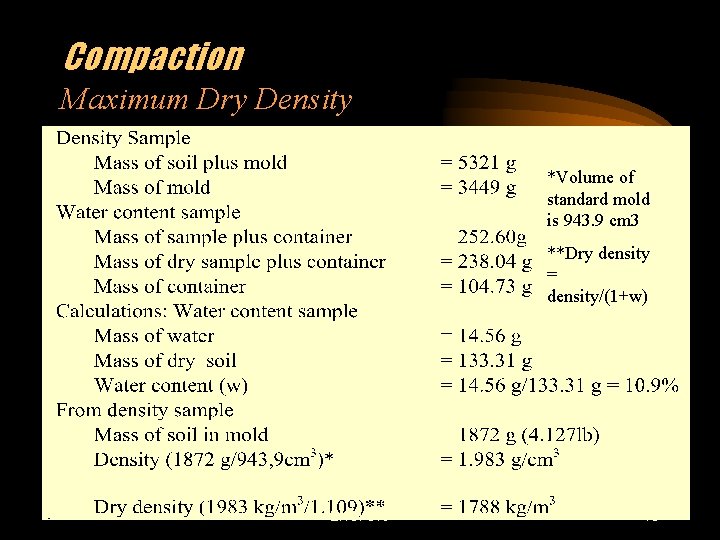
Compaction Maximum Dry Density *Volume of standard mold is 943. 9 cm 3 **Dry density = density/(1+w) ENCI 579 10
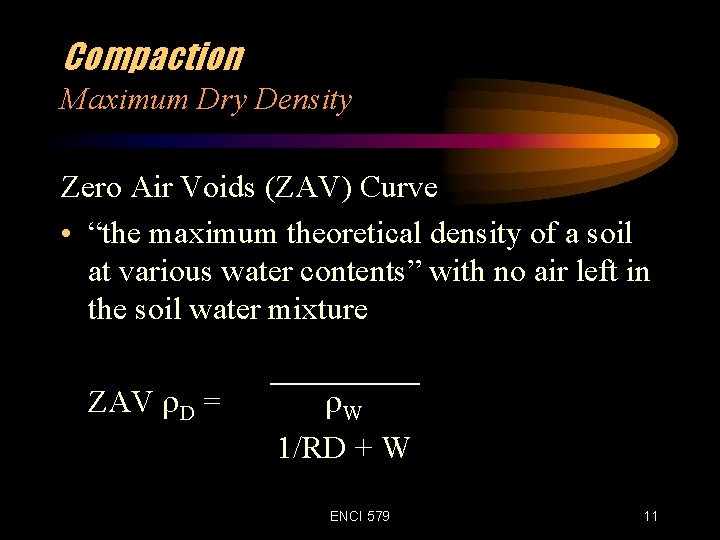
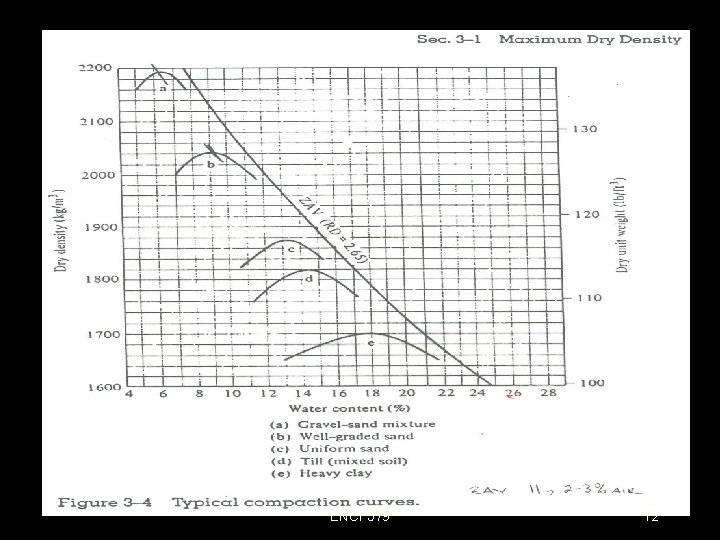
Compaction Maximum Dry Density Zero Air Voids (ZAV) Curve • “the maximum theoretical density of a soil at various water contents” with no air left in the soil water mixture ZAV r. D = r. W 1/RD + W ENCI 579 11
ENCI 579 12
Compaction Maximum Dry Density • Maximum Dry Density of a soil is used in quality control • Specification requires a certain % of maximum dry density at optimum water content found by the compaction test for that particular soil – Ensures density – Reduces the compactive effort ENCI 579 13
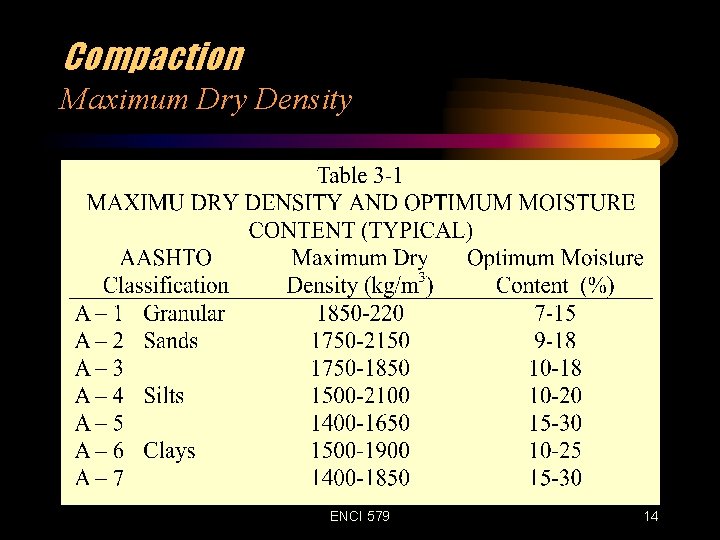
Compaction Maximum Dry Density ENCI 579 14
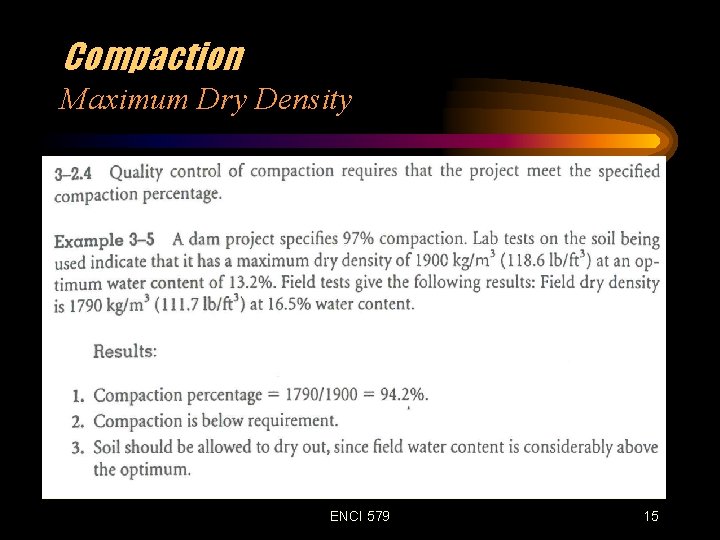
Compaction Maximum Dry Density ENCI 579 15
Compaction Maximum Dry Density Note: • If the soil was below optimum water content it may be necessary to add water by spraying • The most important factor required for successful compaction is having the correct water content ENCI 579 16
Compaction Field Density Tests • Sampling Methods – sample of compacted material taken – dry mass of the soil taken is determined – volume originally occupied by the sample is measured – field dry density = dry mass/volume of sample • Two sampling methods – balloon densometer – sand cone apparatus ENCI 579 17
Compaction Field Density Tests • Balloon densometer – Dry mass of the soil is determined – Volume of the sample hole is found by forcing a liquid filled balloon into the test hole – A rubber membrane allows the fluid to fill all the cavities of the hole – The volume of fluid required is measured – density calculated – water content determined ENCI 579 18
Compaction Field Density Tests • Sand Cone Apparatus – Dry mass of the soil is determined – Volume of the test hole is obtained from the mass of loose sand required to fill the hole – Sand is a uniform medium sand with a constant loose density – Volume=mass of sand / loose density of sand – density is calculated – water content determined ENCI 579 19
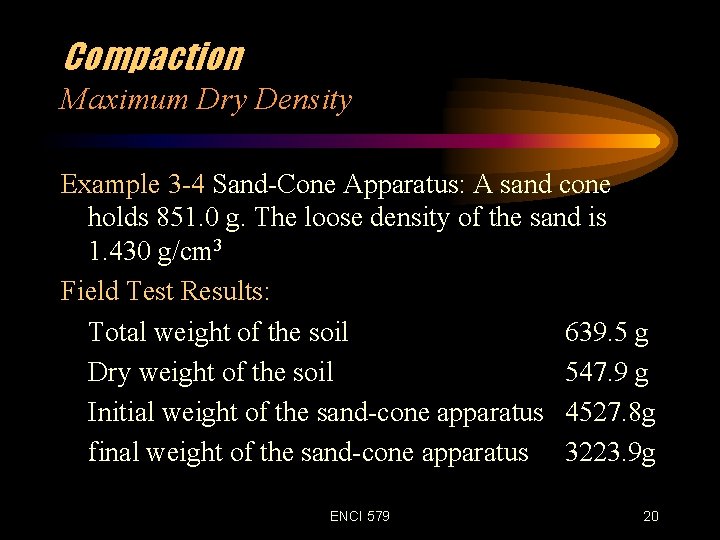
Compaction Maximum Dry Density Example 3 -4 Sand-Cone Apparatus: A sand cone holds 851. 0 g. The loose density of the sand is 1. 430 g/cm 3 Field Test Results: Total weight of the soil 639. 5 g Dry weight of the soil 547. 9 g Initial weight of the sand-cone apparatus 4527. 8 g final weight of the sand-cone apparatus 3223. 9 g ENCI 579 20
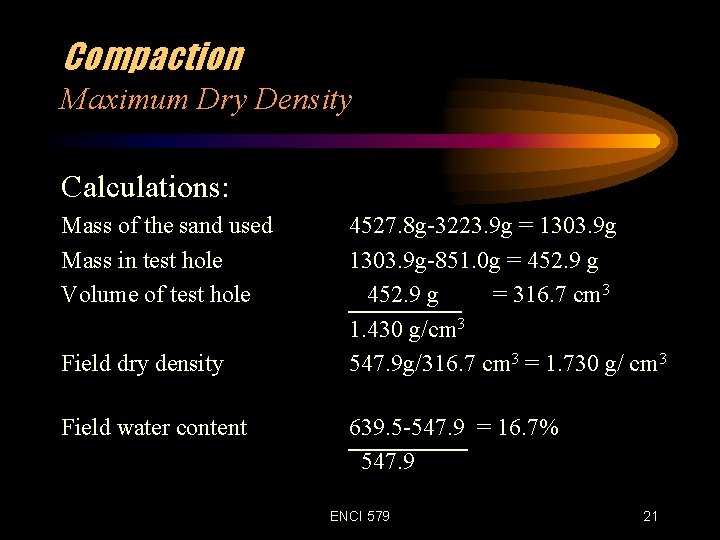
Compaction Maximum Dry Density Calculations: Mass of the sand used Mass in test hole Volume of test hole Field dry density Field water content 4527. 8 g-3223. 9 g = 1303. 9 g-851. 0 g = 452. 9 g = 316. 7 cm 3 1. 430 g/cm 3 547. 9 g/316. 7 cm 3 = 1. 730 g/ cm 3 639. 5 -547. 9 = 16. 7% 547. 9 ENCI 579 21
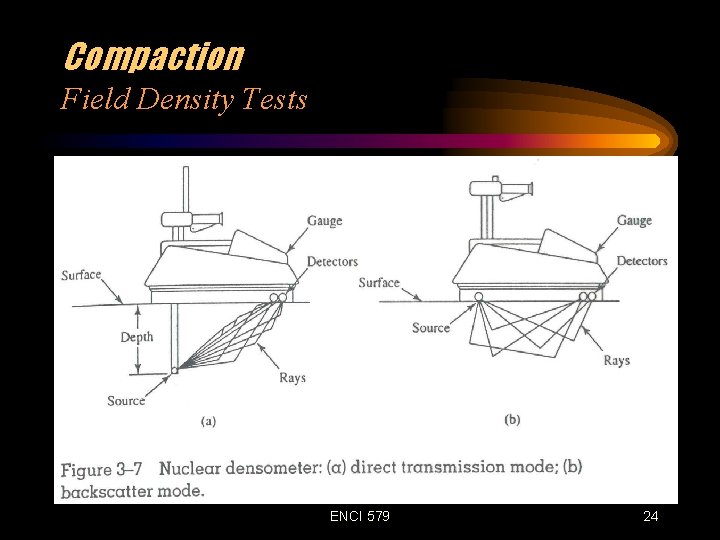
Compaction Field Density Tests • Nuclear Moisture-Density Gauge – Results are available within minutes • Increases equipment efficiency • Know that your construction methods are correct – Gamma rays are emitted into the soil • absorbed by the soil according to it’s density • rays that pass through the soil are measured by a detector • density is then calculated ENCI 579 22
Compaction Field Density Tests • Nuclear Moisture-Density Gauge – Neutron radiation emitted into the soil • neutrons loose energy when they collide with hydrogen atoms in the soil water • detector measures the amount of moderated neutrons • water content can be calculated – Direct transmission mode – Backscatter mode ENCI 579 23
Compaction Field Density Tests ENCI 579 24
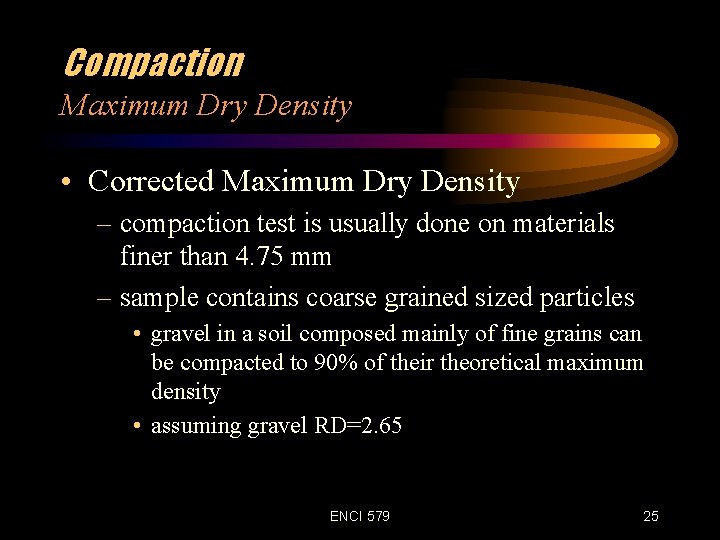
Compaction Maximum Dry Density • Corrected Maximum Dry Density – compaction test is usually done on materials finer than 4. 75 mm – sample contains coarse grained sized particles • gravel in a soil composed mainly of fine grains can be compacted to 90% of their theoretical maximum density • assuming gravel RD=2. 65 ENCI 579 25
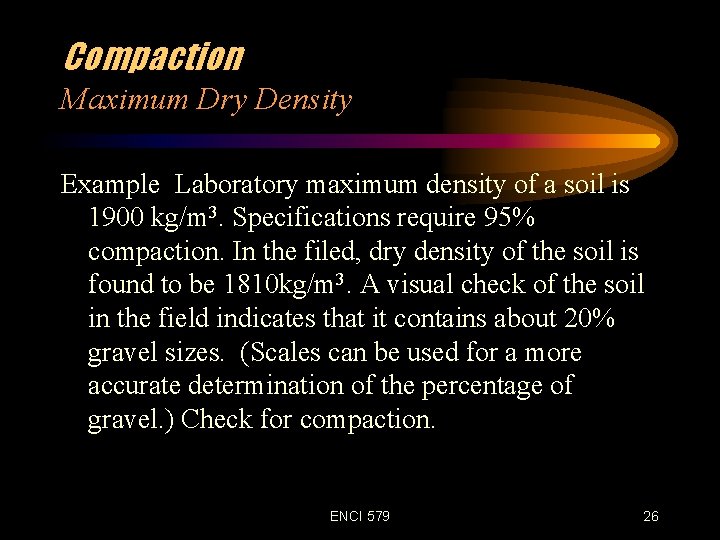
Compaction Maximum Dry Density Example Laboratory maximum density of a soil is 1900 kg/m 3. Specifications require 95% compaction. In the filed, dry density of the soil is found to be 1810 kg/m 3. A visual check of the soil in the field indicates that it contains about 20% gravel sizes. (Scales can be used for a more accurate determination of the percentage of gravel. ) Check for compaction. ENCI 579 26
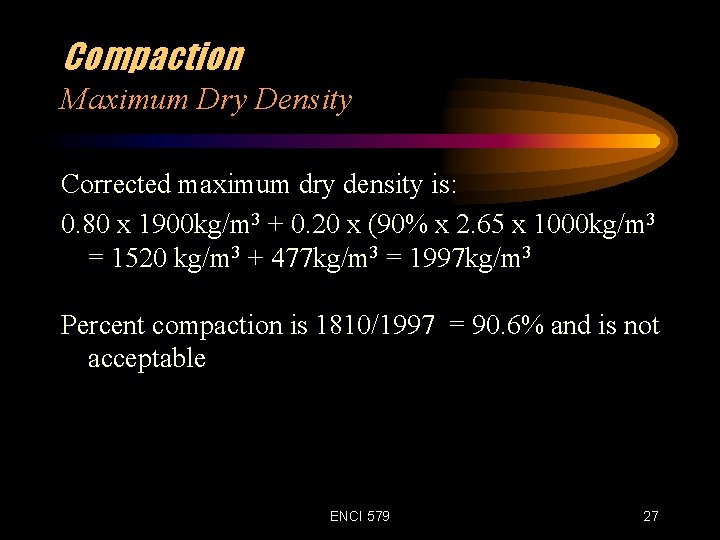
Compaction Maximum Dry Density Corrected maximum dry density is: 0. 80 x 1900 kg/m 3 + 0. 20 x (90% x 2. 65 x 1000 kg/m 3 = 1520 kg/m 3 + 477 kg/m 3 = 1997 kg/m 3 Percent compaction is 1810/1997 = 90. 6% and is not acceptable ENCI 579 27
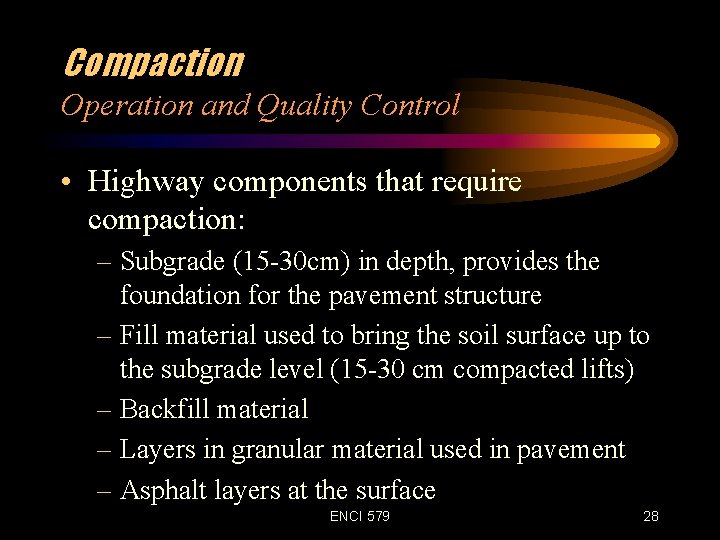
Compaction Operation and Quality Control • Highway components that require compaction: – Subgrade (15 -30 cm) in depth, provides the foundation for the pavement structure – Fill material used to bring the soil surface up to the subgrade level (15 -30 cm compacted lifts) – Backfill material – Layers in granular material used in pavement – Asphalt layers at the surface ENCI 579 28
Compaction Equipment • Compaction Equipment – Consists of various types of rollers and tamping equipment – self propelled – compacting wheels equipped to vibrate • 1500 -2500 cycles/minute for most soils and granular materials – smooth steel drums – drums with pads or “feet” ENCI 579 – rubber tires 29
Compaction Equipment • Vibratory Smooth Drum Rollers – one steel drum and rubber tired drive wheels – two steel drums one of which is the driver – effective for gravel, sand, silt soils – granular base courses and asphalt mixtures – mass of the drum is between 2 -15 tonnes – utilized in layers from 0. 5 -1. 0 meters in depth – usually require 3 -5 passes to produce specified density ENCI 579 30
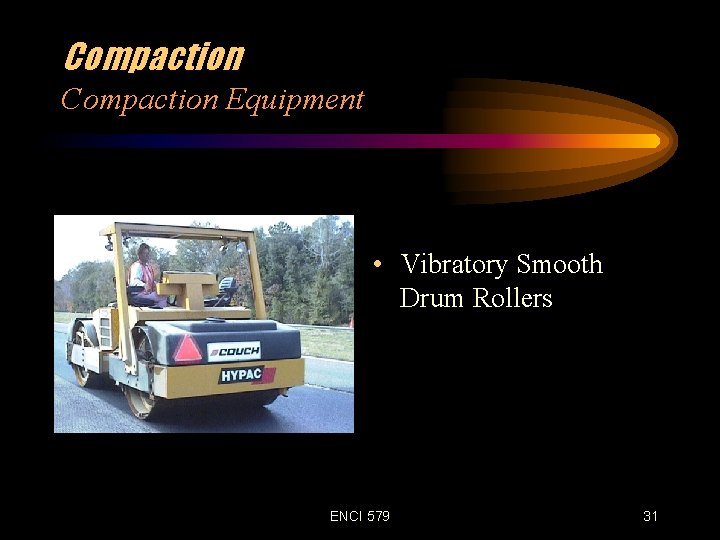
Compaction Equipment • Vibratory Smooth Drum Rollers ENCI 579 31
Compaction Equipment • Padded Wheel or “Sheep’s Foot” Rollers – pads on the rotating drum and may vibrate – effective in clay and silty clay soils – punching action breaks the clay’s bonds which resist rearrangement of the grain structure – pressure exerted by the pad 1000 -5000 kpa depending on the size of the roller – utilized in layers of 15 -30 cm in depth – usually require 3 -5 passes to achieve density ENCI 579 32
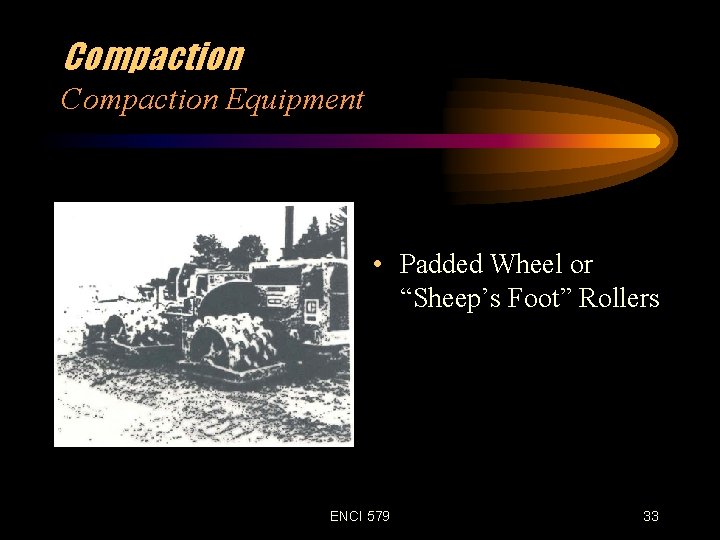
Compaction Equipment • Padded Wheel or “Sheep’s Foot” Rollers ENCI 579 33
Compaction Equipment • Pneumatic Tire Rollers – 2 -12 rubber tires on each axle – individual tires wobble or weave or move lower than adjacent tires to improve the kneading action – effective in clay and granular soils and asphalt mixtures can be kneaded and compacted – effective depths for soils or base courses is up to 15 cm (larger units of 40 -50 tonnes 30 cm) ENCI 579 34
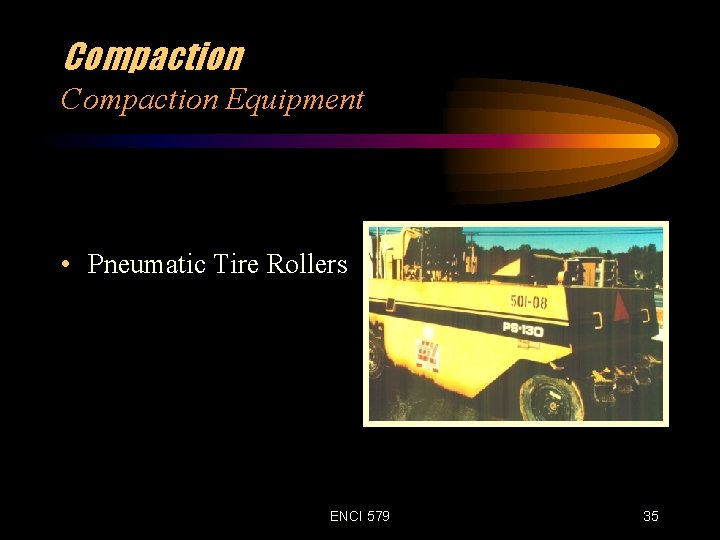
Compaction Equipment • Pneumatic Tire Rollers ENCI 579 35
Compaction Equipment • Smooth Drum Non-vibratory Rollers – used for finishing or sealing passes on soils and granular layers – final leveling passes on asphalt layers • Vibrating Plates or Tampers – used for trench backfills – around structures where larger equipment can’t operate – larger tamping equipment is usually attached to excavators or other. ENCI equipment 579 36
Compaction Quality Control • Determine which materials are to be sampled and tested • Frequency of the testing and type of tests to be performed on the material • Transportation authorities usually have specifications outlining these criteria – Moisture Density 1/ soil type (or 5000 m subgrade) – Field Compaction 4/500 m of each layer • Method Specification vs EPS Specifications ENCI 579 37
- Slides: 37